web analytics

Menu

Skip to content
Shades of Knife
  • Home
  • True Colors of a Vile Wife
  • Need Inspiration?
  • Blog Updates
  • SOK Gallery
  • Vile News Reporter
  • About Me
  • Contact Me

Shades of Knife

True Colors of a Vile Wife

Tag: CrPC 482 – Quash

Checklist Before Filing Quashing Petition – Complete Practical Guide

Posted on June 25 by Suprajaa Rajan

A criminal case does not always have to proceed until trial. In appropriate situations, an accused person may approach the High Court seeking quashing of criminal proceedings to prevent abuse of the legal process and to secure the ends of justice.

However, filing a quashing petition is not a routine appeal against an FIR or chargesheet. High Courts exercise their inherent powers carefully and interfere only when the case falls within recognized legal principles.

Many petitions fail because they are filed:

  • Without proper documents
  • Without identifying legal grounds
  • Without examining maintainability
  • Without considering the stage of proceedings
  • Without understanding the limits of High Court jurisdiction

Therefore, before filing a quashing petition, a detailed legal and factual checklist is essential.

This article explains the complete checklist before filing a quashing petition, including documents, legal grounds, procedural requirements, strategy, and common mistakes.
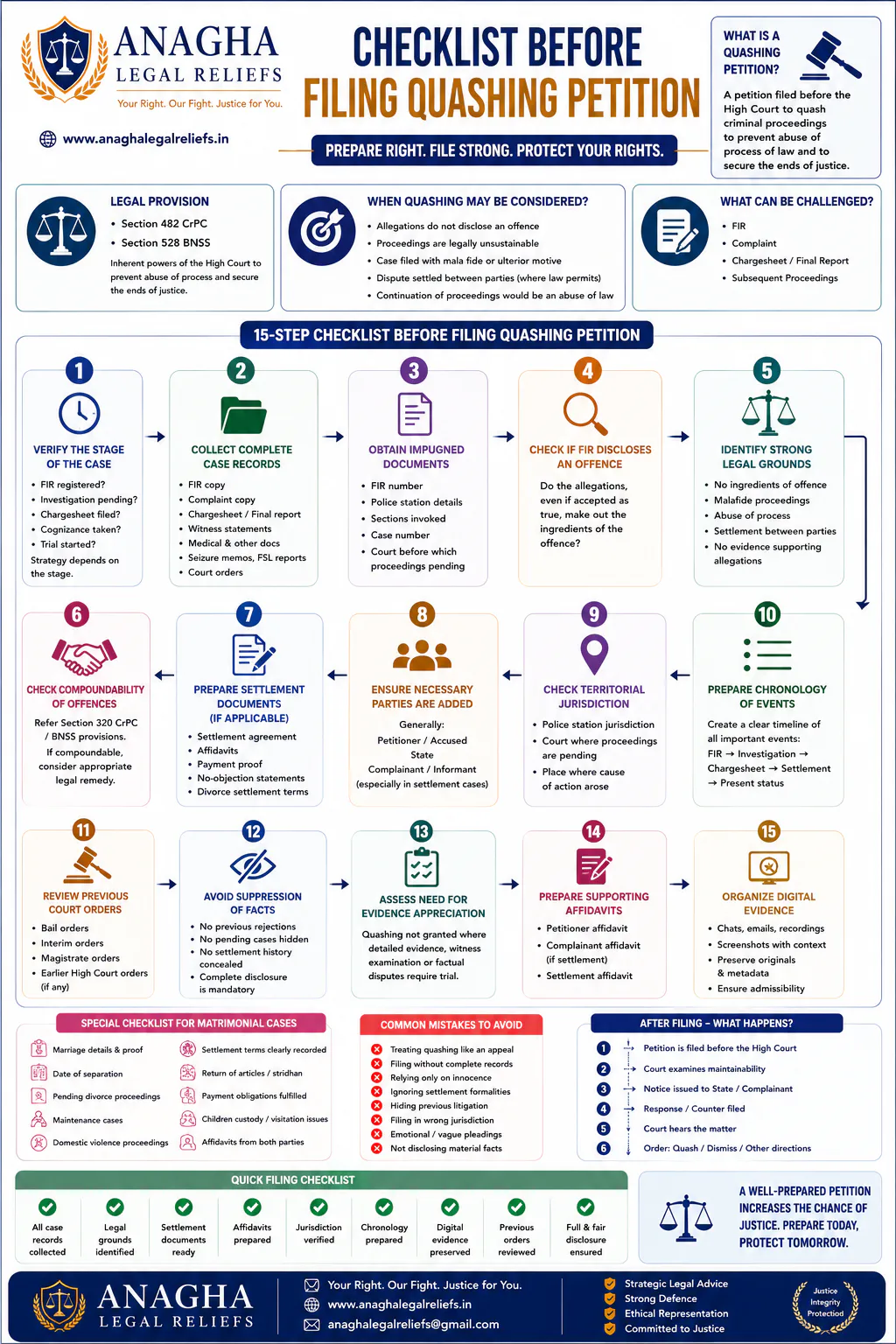
What Is a Quashing Petition?

A quashing petition is an application filed before the High Court requesting it to terminate criminal proceedings.

The High Court may exercise its inherent powers when:

  • The allegations do not disclose an offence
  • Proceedings are legally unsustainable
  • Continuation of the case would amount to abuse of process
  • Parties have settled a dispute where law permits
  • Criminal proceedings are being misused for personal disputes

Legal Provision for Quashing

Under CrPC

Section 482 CrPC

This provision recognises the inherent powers of the High Court.

Under BNSS

Section 528 BNSS

The BNSS continues the High Court’s inherent power to:

  • Prevent abuse of process
  • Secure the ends of justice

When Is Quashing Generally Considered?

Quashing may be considered in situations such as:

1. False or Baseless Allegations

Where the FIR or complaint does not disclose any criminal offence.

2. Civil Dispute Given Criminal Colour

Example:

A purely contractual or family dispute is converted into a criminal complaint.

3. Matrimonial Disputes

Common examples:

  • 498A IPC matters
  • Family disputes
  • Settlement after complaint

4. Settlement Between Parties

Where continuation of prosecution serves no purpose.

5. Legal Bar Against Proceedings

Where law prevents continuation of prosecution.

Checklist Before Filing Quashing Petition

1. Verify the Correct Stage of the Case

First determine:

  • Is only FIR registered?
  • Is investigation pending?
  • Is chargesheet filed?
  • Has cognizance been taken?
  • Has trial started?

The strategy changes depending on the stage.

For example:

An FIR challenge may focus on allegations.

A chargesheet challenge may require examination of investigation material.

2. Collect Complete Case Records

Before approaching the High Court, obtain:

  • FIR copy
  • Complaint copy
  • Chargesheet/final report (if filed)
  • Statements recorded during investigation
  • Medical documents (if applicable)
  • Seizure memos
  • Forensic reports
  • Court orders

Incomplete records often weaken petitions.

3. Obtain the Impugned Documents

The petition should clearly identify what is being challenged.

Collect:

  • FIR number
  • Police station details
  • Sections invoked
  • Case number
  • Magistrate court details

Accuracy is critical.

4. Check Whether the FIR Discloses an Offence

One of the strongest grounds.

Ask:

Even if the allegations are accepted as true, do they constitute an offence?

If the answer is no, quashing may be considered.

5. Identify the Legal Grounds Clearly

A strong petition must state specific grounds.

Common grounds include:

Ground 1: No Ingredients of Offence

The complaint lacks essential elements of the alleged offence.

Example:

Section invoked but necessary facts missing.

Ground 2: Malafide Proceedings

The complaint appears motivated by:

  • Personal revenge
  • Pressure tactics
  • Harassment

Ground 3: Abuse of Criminal Process

Criminal law cannot be used as a tool for:

  • Civil recovery
  • Personal disputes
  • Settlement pressure

Ground 4: Settlement Between Parties

Where parties have resolved disputes.

Common in:

  • Matrimonial cases
  • Business disputes
  • Personal disputes

Ground 5: No Evidence Supporting Allegations

Investigation does not support the complaint.

6. Check Whether the Offences Are Compoundable

Before filing quashing:

Examine whether settlement can legally end proceedings.

Relevant provision:

CrPC

Section 320 CrPC

BNSS

Corresponding compounding provisions.

If an offence is compoundable, another remedy may exist.

7. Prepare Settlement Documents (If Applicable)

If parties have settled, collect:

  • Settlement agreement
  • Affidavits
  • Divorce settlement terms (if applicable)
  • Payment proof
  • No-objection statements

A vague settlement is usually insufficient.

8. Verify Presence of All Necessary Parties

Generally, proceedings involve:

  • Petitioner/accused
  • State
  • Complainant/informant

The complainant’s presence becomes important especially where settlement is relied upon.

9. Check Territorial Jurisdiction

File before the appropriate High Court.

Consider:

  • Police station jurisdiction
  • Court where proceedings are pending
  • Cause of action

Wrong jurisdiction can delay proceedings.

10. Prepare a Complete Chronology

Create a timeline:

Example:

Date | Event

  • FIR registered
  • Arrest/bail
  • Investigation
  • Settlement
  • Chargesheet filing

Courts appreciate clear factual presentation.

11. Review Previous Court Orders

Collect:

  • Bail orders
  • Interim protection orders
  • Magistrate orders
  • Earlier High Court orders

Previous proceedings must be disclosed.

12. Check for Suppression of Facts

Never hide:

  • Earlier rejection orders
  • Pending proceedings
  • Settlement history
  • Related cases

Suppression can damage credibility.

13. Examine Whether Evidence Needs Trial

High Courts generally avoid detailed evidence appreciation.

Quashing may not be appropriate where:

  • Witness examination is required
  • Facts are disputed
  • Evidence needs evaluation

14. Prepare Supporting Affidavits

Depending on circumstances:

  • Petitioner affidavit
  • Complainant affidavit
  • Settlement affidavit

may be required.

15. Organise Digital Evidence

Modern criminal cases often involve:

  • WhatsApp chats
  • Emails
  • Audio recordings
  • CCTV
  • Digital documents

Preserve originals and metadata wherever possible.

Special Checklist for Matrimonial Quashing Cases

Matrimonial matters require additional preparation.

Check:

  • Marriage details
  • Separation date
  • Pending divorce proceedings
  • Maintenance cases
  • Domestic violence proceedings
  • Settlement terms
  • Return of articles/stridhan
  • Payment obligations

Common Mistakes While Filing Quashing Petition

Mistake 1: Treating Quashing Like an Appeal

High Court does not conduct a full trial.

Mistake 2: Filing Without Complete Records

Incomplete facts weaken the petition.

Mistake 3: Relying Only on Innocence

“I am innocent” alone is not a quashing ground.

Mistake 4: Ignoring Settlement Formalities

Settlement must be properly documented.

Mistake 5: Hiding Previous Litigation

Transparency matters.

What Happens After Filing?

Generally:

Step 1

Petition is filed.

Step 2

Court examines maintainability.

Step 3

Notice may be issued.

Step 4

State and complainant respond.

Step 5

Court decides whether interference is justified.

Important Judicial Principle

The High Court uses inherent powers sparingly.

The objective is not to decide guilt or innocence but to prevent:

  • Abuse of process
  • Unnecessary harassment
  • Legally unsustainable prosecution

Practical Filing Checklist

Before filing, confirm:

  • FIR copy obtained
  • Chargesheet status checked
  • Correct sections identified
  • Grounds of quashing prepared
  • Case chronology drafted
  • Supporting documents attached
  • Settlement documents ready (if applicable)
  • Previous orders disclosed
  • Jurisdiction verified
  • Affidavits prepared
  • Digital evidence preserved

Conclusion

A quashing petition is a powerful legal remedy, but success depends heavily on preparation.

The strongest petitions are built on:

  • Clear legal grounds
  • Complete documentation
  • Accurate facts
  • Proper procedural compliance
  • Strategic presentation

Before approaching the High Court, a litigant must carefully evaluate whether the case genuinely falls within the scope of inherent powers.

A well-prepared quashing petition can prevent unnecessary criminal proceedings and protect individuals from misuse of the criminal justice system.


Index of Legal Strategies and Defence is here. 


Posted in Legal Procedure | Tagged Absurd Or After Thought Or Baseless Or False Or General Or Inherently Improbable Or Improved Or UnSpecific Or Omnibus Or Vague Allegations BNSS Sec 528 – Saving of inherent powers of High Court CrPC 482 - Quash Legal Strategies and Defence Quashing of FIR | Leave a comment

Sivaraman Nair and Ors Vs State of Kerala and Anr on 24 Apr 2026 – Judgement Summary

Posted on April 29 by Suprajaa Rajan

In Sivaraman Nair & Ors. v. State of Kerala & Anr., the Supreme Court examined whether criminal proceedings for offences under Sections 498A, 494 read with 34 IPC (now corresponding provisions under Bharatiya Nyaya Sanhita (BNS)) could be sustained against the husband’s relatives in the absence of specific allegations.

The case arose from an FIR alleging dowry harassment, cruelty, and bigamy. While detailed accusations were made against the husband, the allegations against the in-laws were largely general, vague, and based on their familial relationship.

The accused-appellants approached the High Court under Section 482 CrPC (now Section 528 BNSS) seeking quashing of proceedings, but the High Court refused. On appeal, the Supreme Court re-evaluated whether the continuation of proceedings amounted to abuse of process of law.

The Court ultimately held that mere presence, passive knowledge, or general allegations are insufficient to prosecute relatives in matrimonial disputes. Consequently, it quashed proceedings against the in-laws while allowing the case against the husband to continue.

“21. That the inherent powers of the Court under section 482 CrPC are to be exercised ‘to prevent the abuse of the process of any court or otherwise to secure the ends of justice.”

“24. The FIR does not attribute to them any specific act of demand, threat, or physical assault on any identifiable occasion.”

“25. Accused-appellant no. 3, the sister-in-law, is alleged to have received money for the purchase of a flat from the proceeds of the sale of gold, but no specific act of cruelty or coercion on her part has been alleged.”

“26….the complainant is required to prima facie prove the overt act or omission of the accused persons in the second marriage ceremony. The prosecution has failed to provide any cogent evidence to establish such overt act or intention on part of the accused-appellants.”

“27. However, such inferential knowledge, without more, is insufficient to satisfy the threshold established in S. Nitheen (supra), which requires evidence of an overt act or omission. While it has been alleged that the accused-appellants were aware of the second marriage, mere knowledge that an act is being or has been committed by another person does not, by itself, establish the requisite common intention.”

Decision

The Supreme Court allowed the appeal and held that:

  • Proceedings against the in-laws lacked specific, credible allegations necessary to constitute offences under Sections 498A and 494 IPC (read with Section 34 IPC) [BNS equivalents].
  • The continuation of such proceedings would amount to abuse of process of law under Section 482 CrPC (Section 528 BNSS).
  • Mere familial relationship, presence, or passive knowledge does not establish criminal liability.
  • No material existed to show active participation in the alleged second marriage, a requirement for Section 494 IPC.

Accordingly, the Court quashed the criminal proceedings qua the accused-appellants (in-laws) while leaving the case against the husband unaffected.


Sivaraman Nair and Ors Vs State of Kerala and Anr on 24 Apr 2026

Citation : 2026 INSC 412

Other Sources :


Index of Quash judgements is here.


Related Legal Concepts

Explore related remedies and procedural safeguards in criminal law:

  • Abuse of Process of Law
  • First Information Report (FIR)
  • Quashing of FIR
  • Inherent Powers of High Court


Key Contributor :
Mrs. Suprajaa Rajan B.Com., LL.B., LL.M.
+91-9606345150


Posted in Supreme Court of India Judgment or Order or Notification | Tagged 2-Judge (Division) Bench Decision Abuse Or Misuse of Process of Court CrPC 482 - Quash Matrimonial disputes law Matrimonial Litigation India Sivaraman Nair and Ors Vs State of Kerala and Anr | Leave a comment

Asha G Vs State of Karnataka on 6 Jan 2026 – Judgement Summary

Posted on April 1 by Suprajaa Rajan

498A IPC: Karnataka High Court Quashes Case Against Neighbour Under CrPC 482 (BNSS 528)

In Asha G Vs State of Karnataka, the High Court of Karnataka addressed a crucial legal issue regarding the misuse of Section 498A IPC in matrimonial disputes.

The petitioner, who was merely a neighbour of the complainant, sought quashing of criminal proceedings under Section 482 of the Code of Criminal Procedure (CrPC) (now BNSS Section 528). The allegations against her were limited to instigating the husband, without any direct involvement in matrimonial cruelty or dowry harassment.

After examining the complaint and charge sheet, the Court observed that:

  • The petitioner was not a relative of the husband.
  • Allegations were vague and omnibus, lacking specific acts.
  • Inclusion of the petitioner amounted to misuse of criminal law.

Consequently, the Court held that continuing proceedings against the neighbour would be an abuse of process of law, and therefore quashed the case against her.

“The name of this petitioner is nowhere found except contending that she has instigated the husband… otherwise the petitioner would not fit into the definition of family as is obtaining under Section 498A of the IPC.”

“Neighbours of the husband’s family are not relatives of the husband and cannot be implicated for offences under Section 498A of the IPC.”

“Permitting further proceedings against this petitioner would become an abuse of the process of the law and result in miscarriage of justice.”


Asha G Vs State of Karnataka on 6 Jan 2026

Index of Quash Judgments is here. 


Related Legal Concepts

  • Quashing of FIR
  • Relative under Section 498A IPC
  • Abuse of Process of Law
  • False Implication in Matrimonial Disputes
  • Requirement of Specific Allegations in FIR/Charge Sheet


Key Contributor :

Mrs. Suprajaa Rajan B.Com., LL.B., LL.M.

+91-9606345150

Posted in High Court of Karnataka Judgment or Order or Notification | Tagged 1-Judge Bench Decision Abuse Or Misuse of Process of Court Asha G Vs State of Karnataka CrPC 482 - Quash CrPC 482 – IPC 498A Quashed Matrimonial Criminal Law Matrimonial dispute Misuse of Section 498A of IPC Quashing of FIR | Leave a comment

Tushar Sampat Mane and Ors Vs State of Maharashtra on 8 Aug 2025 – Judgment Summary

Posted on March 26 by Suprajaa Rajan

The Bombay High Court in Tushar Sampat Mane and Ors Vs State of Maharashtra on 8 Aug 2025 held that courts must quash criminal proceedings when allegations fail to meet the legal threshold of cruelty under Section 498A IPC. The Court found that the allegations were exaggerated, omnibus, and not grave in nature.

It further observed that prior knowledge of the husband’s medical condition weakens claims of suppression. Additionally, routine marital discord or trivial disputes cannot amount to cruelty.

Therefore, the Court concluded that continuation of criminal proceedings would amount to abuse of process of law.


“5. Therefore, either the case may come under Explanation (a) or Explanation (b) or in some cases it may be both. But such cruelty then should be of a grave nature.”

“5. Now, except the statement of informant there is nothing in the charge sheet. The Investigating Officer has not even taken care to make inquiry with the neighbours of applicants regarding the treatment given by applicants to informant.”

“5. Making annoying statements that informant was not wearing proper clothes, was not able to cook food properly, cannot be said to be acts of grave cruelty or harassment.”

“7. When the relationship gets strained, it appears that exaggerations are made.”

“7. When everything was disclosed prior to the marriage and allegations are omnibus or of not so grave for befitting in the concept of cruelty contemplated under Section 498-A of the Indian Penal Code, it would be an abuse of process of law if the applicants are asked to face the trial.”

Decision

The Court allowed the criminal application. It quashed Regular Criminal Case under Sections 498A, 323, 504, 506 read with Section 34 IPC (corresponding provisions under BNS).

The Court held that allegations lacked gravity and specificity. It further held that continuation of proceedings would amount to abuse of process of law.


Tushar Sampath Mane and Ors Vs State of Maharashtra on 8 Aug 2025

Citation :2025:BHC-AUG:21166-DB

Other Sources :


Index of Quash Judgment u/s 482 Cr.P.C is here.


Related Legal Concepts

Explore related stages and concepts in criminal procedure:

  • Meaning of cruelty under Criminal law
  • Omnibus Allegations in matrimonial cases
  • Dowry Demand and Harassment
  • Matrimonial Disputes vs Criminal Liability


Key Contributor : 

Mrs. Suprajaa Rajan B.Com., LL.B., LL.M.

+91-9606345150

Posted in High Court of Bombay Judgment or Order or Notification | Tagged 2-Judge (Division) Bench Decision Abuse Or Misuse of Process of Court CrPC 482 - Quash Summary Post Tushar Sampat Mane and Ors Vs State of Maharashtra | Leave a comment

Asish Bera and Ors Vs The State of West Bengal and Anr on 30 Jan 2026

Posted on March 9 by Suprajaa Rajan

The Calcutta High Court held that criminal proceedings cannot continue when the complaint lacks specific material and shows serious inconsistencies. The Court found that the complainant had filed two complaints regarding the same alleged incident without proper explanation.

The Court also noted contradictions in the statements recorded during investigation. It observed that courts must prevent misuse of criminal law in matrimonial disputes. Exercising its inherent powers under Section 482 CrPC (Section 528 BNSS), the Court held that continuation of the proceedings would amount to abuse of the process of law and therefore quashed the case.

The following paragraphs explain the reasoning that led to the decision.

“On careful perusal of the materials on record, it can be found that the Opposite Party no. 2 lodged the complaint before Sagar Police Station… The subsequent complaint was filed before the Court of Learned ACJM at Ranaghat under Section 156(3) Cr.P.C… also in respect of the incident dated March 18, 2022.”

“No satisfactory explanation can be found as to why the de-facto complainant had to lodge two different complaint before different places in respect of self-same incident within a gap of 2 months.”

“It is also a settled law that in case it is found that the nature of complaint primarily found to be of vexatious and frivolous, the courts owes a duty to look into the other evidences collected and did not have to be confined within the content of the written complaint.”

“Therefore on the cumulative assessment of the entire facts and circumstances this Court do not find any material or sufficient material to allow the proceedings to continue further since it would otherwise be absolute abuse of the process of law.” 

Decision

The Calcutta High Court allowed the criminal revision petition.

The Court quashed the criminal proceedings pending before the Magistrate. The Court held that continuation of the case would amount to abuse of the process of law.


Asish Bera and Ors Vs The State of West Bengal and Anr on 30 Jan 2026

Citation :2026:CHC-AS:134

Other Sources :


Index of Quash judgments is here.


Key Contributor :

Mrs. Suprajaa Rajan B.Com., LL.B., LL.M.

+91-9606345150


Posted in High Court of Calcutta Judgment or Order or Notification | Tagged 1-Judge Bench Decision Asish Bera & Ors. v. The State of West Bengal & Anr CrPC 482 - Quash CrPC 482 – IPC 498A Quashed Matrimonial dispute Matrimonial disputes law Quashing of FIR | Leave a comment

Mathi Vijaya Lakshmi and Ors Vs State of Telangana and Anr on 03 May 2024

Posted on May 19, 2024 by ShadesOfKnife

A single judge of Telangana HC, held that allegations against accused are vague and unspecific and hence the proceedings against them are quashed.

From Para 6,

6. In view of the rival submissions made by both the counsel, this Court has perused the material available on record. As per the averments of the complaint, petitioners/accused Nos.2 to 5 along with accused No.1 harassed respondent No.2 for want of additional dowry. It is pertinent to note that except the above allegation there are no specific allegations against the petitioners/accused Nos.2 to 5 and there is no allegation to demonstrate that they interfered with the matrimonial disputes between accused No.1 and respondent No.2. Further, the statement of respondent No.2 recorded by the Police under Section 161 of Cr.P.C., shows that when she complained to accused Nos.2 to 5 about the harassment of accused No.1, they supported accused No.1. Except the above said allegation, there are no specific allegations against the petitioner to constitute offence under Section 498-A of IPC and Sections 3, 4 of DP Act.

From Paras 7 and 8,

7. At this stage, it is relevant to note the observations made by the Apex Court in State of Haryana and others vs. Bhajanlal1, whereunder the following categories were illustrated, wherein the extraordinary power under Article 226 of the Constitution of India or the inherent powers under Section 482 Cr.P.C. can be exercised by the High Court to prevent the abuse of process of any Court or otherwise to secure the ends of justice.
8. Further, in Preeti Gupta vs. State of Jharkhand2, the Apex Court observed that the family members who are residing away from accused No.1 cannot be roped into the case. In view thereof, as the petitioners are not residing along with the family of accused No.1, the allegations against them are vague. Therefore, it can be said that category No.1 as extracted above in the case of Bhajanlal (Supra) is relevant to the present case. Therefore, this Court is of the considered view that even if the trial is conducted, no purpose would be served and there are no other specific allegations against the petitioners.

Mathi Vijaya Lakshmi and Ors Vs State of Telangana and Anr on 03 May 2024

Index of Quash judgments is here.

Posted in High Court of Telangana Judgment or Order or Notification | Tagged 1-Judge Bench Decision Absurd Or After Thought Or Baseless Or False Or General Or Inherently Improbable Or Improved Or UnSpecific Or Omnibus Or Vague Allegations CrPC 482 - Quash CrPC 482 – IPC 498A Quashed IPC 498A and 3 and 4 DP Act Combo Alleged Mathi Vijaya Lakshmi and Ors Vs State of Telangana and Anr | Leave a comment

Dr.S.Ariharan and Anr Vs Inspector of Police and Anr on 26 Nov 2019

Posted on April 6, 2022 by ShadesOfKnife

Justice G.R. Swaminathan held that Section 438 of Cr.PC is not the sole repository of the power to grant anticipatory bail. The High Courts are endowed with inherent powers (u/s 482 CrPC) to make such orders as to secure the ends of justice.

From Para 5,

5.The Union of India not wanting to take chances also filed Review Petition (Crl) No.228 of 2018. The same was disposed of vide judgment dated 01.10.2019 by a three Judges Bench. On a careful reading of the judgement dated 01.10.2019, one can note that the essence and soul of Dr.Subhash Kashinath Mahajan judgment has not only survived but remains intact.

From Para 11,

11.The outcome of the challenge can be one way or the other. Section 18 A of the Act can be upheld. Or it can be struck down. Even if its validity is upheld, the High Courts would still be entitled to grant anticipatory bail. The statute only excludes the applicability of Section 438 of Cr.PC. In the State of Uttar Pradesh, Section 438 of the Code has been deleted by the State amendment and the said deletion has been upheld in (1994) 3 SCC 569 (Kartar Singh vs. State of Punjab). But, that has not curtailed the extraordinary power of the High Court to entertain a plea of anticipatory bail and this power was held to be available in Hema Mishra vs. State of U.P. and Ors, (2014) 4 SCC 453).

From Para 12,

12. Section 438 of Cr.PC is not the sole repository of the power to grant anticipatory bail. The High Courts are endowed with inherent powers to make such orders as to secure the ends of justice. I hope I am not indulging in quibbling or hair-splitting when I say that neither Section 18 nor Section 18 A engraft a bar against grant of anticipatory bail. They are to the effect that the provision of Section 438 of the Code shall not apply to a case under the Atrocities Act. Even if Section 438 of Cr.PC is not available, Section 482 of Cr.PC can very much be invoked. Hence, I hold that this Court is very much possessed of the power to grant anticipatory bail even in cases arising under the Schedules Castes and the Scheduled Tribes (Prevention of Atrocities) Act, 1989. The petitions can be filed under Article 226 of the Constitution of India or under Section 482 of Cr.PC.

Dr.S.Ariharan and Anr Vs Inspector of Police and Anr on 26 Nov 2019

Citations :

Other Sources :

https://indiankanoon.org/doc/186580740/

https://www.lawyerservices.in/Dr-S-Ariharan-and-Another-Versus-The-Inspector-of-Police-Thirumangalam-Madurai-District-Crime-No-of-2019-and-Another-2019-11-26


Posted in High Court of Madras Judgment or Order or Notification | Tagged 1-Judge Bench Decision CrPC 482 - Quash CrPC 482 - Saving of inherent powers of High Court CrPC Sec 438 - Anticipatory Bail CrPC Sec 438 - Anticipatory Bail Denied CrPC Sec 438 - Anticipatory Bail in SC/ST Atrocities Act CrPC Sec 438 - Anticipatory Bail Not Maintainable Dr.S.Ariharan and Anr Vs Inspector of Police and Anr Legal Procedure Explained - Interpretation of Statutes Reportable Judgement or Order | Leave a comment

Neeharika Infrastructure Pvt Ltd Vs State of Maharashtra and Ors on 13 Apr 2021

Posted on November 10, 2021 by ShadesOfKnife

This is a landmark judgment from the 3-judge full-bench of Supreme Court of India.

From Para 23,

23. In view of the above and for the reasons stated above, our final conclusions on the principal/core issue, whether the High Court would be justified in passing an interim order of stay of investigation and/or “no coercive steps to be adopted”, during the pendency of the quashing petition under Section 482 Cr.P.C and/or under Article 226 of the Constitution of India and in what circumstances and whether the High Court would be justified in passing the order of not to arrest the accused or “no coercive steps to be adopted” during the investigation or till the final report/chargesheet is filed under Section 173 Cr.P.C., while dismissing/disposing of/not entertaining/not quashing the criminal proceedings/complaint/FIR in exercise of powers under Section 482 Cr.P.C. and/or under Article 226 of the Constitution of India, our final conclusions are as under:

i) Police has the statutory right and duty under the relevant provisions of the Code of Criminal Procedure contained in Chapter XIV of the Code to investigate into a cognizable offence;
ii) Courts would not thwart any investigation into the cognizable offences;
iii) It is only in cases where no cognizable offence or offence of any kind is disclosed in the first information report that the Court will not permit an investigation to go on;
iv) The power of quashing should be exercised sparingly with circumspection, as it has been observed, in the ‘rarest of rare cases (not to be confused with the formation in the context of death penalty).
v) While examining an FIR/complaint, quashing of which is sought, the court cannot embark upon an enquiry as to the reliability or genuineness or otherwise of the allegations made in the FIR/complaint;
vi) Criminal proceedings ought not to be scuttled at the initial stage;
vii) Quashing of a complaint/FIR should be an exception rather than an ordinary rule;
viii) Ordinarily, the courts are barred from usurping the jurisdiction of the police, since the two organs of the State operate in two specific spheres of activities and one ought not to tread over the other sphere;
ix) The functions of the judiciary and the police are complementary, not overlapping;
x) Save in exceptional cases where non-interference would result in miscarriage of justice, the Court and the judicial process should not interfere at the stage of investigation of offences;
xi) Extraordinary and inherent powers of the Court do not confer an arbitrary jurisdiction on the Court to act according to its whims or caprice;
xii) The first information report is not an encyclopaedia which must disclose all facts and details relating to the offence reported. Therefore, when the investigation by the police is in progress, the court should not go into the merits of the allegations in the FIR. Police must be permitted to complete the investigation. It would be premature to pronounce the conclusion based on hazy facts that the complaint/FIR does not deserve to be investigated or that it amounts to abuse of process of law. After investigation, if the investigating officer finds that there is no substance in the application made by the complainant, the investigating officer may file an appropriate report/summary before the learned Magistrate which may be considered by the learned Magistrate in accordance with the known procedure;
xiii) The power under Section 482 Cr.P.C. is very wide, but conferment of wide power requires the court to be more cautious. It casts an onerous and more diligent duty on the court;
xiv) However, at the same time, the court, if it thinks fit, regard being had to the parameters of quashing and the self-restraint imposed by law, more particularly the parameters laid down by this Court in the cases of R.P. Kapur (supra) and Bhajan Lal (supra), has the jurisdiction to quash the FIR/complaint;
xv) When a prayer for quashing the FIR is made by the alleged accused and the court when it exercises the power under Section 482 Cr.P.C., only has to consider whether the allegations in the FIR disclose commission of a cognizable offence or not. The court is not required to consider on merits whether or not the merits of the allegations make out a cognizable offence and the court has to permit the investigating agency/police to investigate the allegations in the FIR;
xvi) The aforesaid parameters would be applicable and/or the aforesaid aspects are required to be considered by the High Court while passing an interim order in a quashing petition in exercise of powers under Section 482 Cr.P.C. and/or under Article 226 of the Constitution of India. However, an interim order of stay of investigation during the pendency of the quashing petition can be passed with circumspection. Such an interim order should not require to be passed routinely, casually and/or mechanically. Normally, when the investigation is in progress and the facts are hazy and the entire evidence/material is not before the High Court, the High Court should restrain itself from passing the interim order of not to arrest or “no coercive steps to be adopted” and the accused should be relegated to apply for anticipatory bail under Section 438 Cr.P.C. before the competent court. The High Court shall not and as such is not justified in passing the order of not to arrest and/or “no coercive steps” either during the investigation or till the investigation is completed and/or till the final report/chargesheet is filed under Section 173 Cr.P.C., while dismissing/disposing of the quashing petition under Section 482 Cr.P.C. and/or under Article 226 of the Constitution of India.
xvii) Even in a case where the High Court is prima facie of the opinion that an exceptional case is made out for grant of interim stay of further investigation, after considering the broad parameters while exercising the powers under Section 482 Cr.P.C. and/or under Article 226 of the Constitution of India referred to hereinabove, the High Court has to give brief reasons why such an interim order is warranted and/or is required to be passed so that it can demonstrate the application of mind by the Court and the higher forum can consider what was weighed with the High Court while passing such an interim order.
xviii) Whenever an interim order is passed by the High Court of “no coercive steps to be adopted” within the aforesaid parameters, the High Court must clarify what does it mean by “no coercive steps to be adopted” as the term “no coercive steps to be adopted” can be said to be too vague and/or broad which can be misunderstood and/or misapplied.

Neeharika Infrastructure Pvt Ltd Vs State of Maharashtra and Ors on 13 Apr 2021

Citations : [2021 SCC ONLINE SC 315]

Other Sources :

https://indiankanoon.org/doc/199473647/

https://www.casemine.com/judgement/in/607d22efba0bb01cbed0c0a7

https://www.indianemployees.com/judgments/details/m-s-neeharika-infrastructure-pvt-ltd-versus-state-of-maharashtra-and-others


Index of Quash judgments is here.

Posted in Supreme Court of India Judgment or Order or Notification | Tagged 3-Judge (Full) Bench Decision Article 226 - Power of High Courts to issue certain writs Catena of Landmark Judgments Referred/Cited to CrPC 482 - Quash Issued or Recommended Guidelines or Directions or Protocols to be followed Landmark Case Neeharika Infrastructure Pvt Ltd Vs State of Maharashtra and Ors | Leave a comment

Dhariwal Tobaco Products Ltd and Ors Vs State of Maharastra and Anr on 17 Dec 2008

Posted on July 19, 2021 by ShadesOfKnife

A wonderful decision by Supreme Court of India around High Court’s inherent power under section 482 CrPC against the Revisional Powers u/s 401 CrPC.

From Para 8,

8. Indisputably issuance of summons is not an interlocutory order within the meaning of Section 397 of the Code. This Court in a large number of decisions beginning from R .P. Kapur v. State of Punjab, AIR 1960 SC 866 to Som Mittal v. Govt. of Karnataka , [ (2008) 3 SCC 574 ] has laid down the criterion for entertaining an application under Section 482. Only because a revision petition is maintainable, the same by itself, in our considered opinion, would not constitute a bar for entertaining an application under Section 482 of the Code.
Even where a revision application is barred, as for example the remedy by way of Section 115 of the Code of Civil Procedure, 1908 this Court has held that the remedies under Articles 226/227 of the Constitution of India would be available. (See Surya Dev Rai v. Ram Chander Rai and others, [ (2003) 6 SCC 675 ] ).
Even in cases where a second revision before the High Court after dismissal of the first one by the Court of Sessions is barred under Section 397 (2) of the Code, the inherent power of the Court has been held to be available.

Dhariwal Tobaco Products Ltd and Ors Vs State of Maharastra and Anr on 17 Dec 2008

Citations : [2009 SCC 2 370], [2009 CRLJ SC 974], [2008 SCALE 16 240], [2009 SCC CRI 1 806], [2009 BOMCR CRI SC 1 802], [2008 AIOL 1468], [2008 SCR 17 844], [2009 AIR SC 1032], [2009 AIC SC 75 265], [2009 ECRN SC 2 284]

Other Sources :

https://indiankanoon.org/doc/1891955/

https://www.casemine.com/judgement/in/5609ae9ee4b0149711414586

Posted in Supreme Court of India Judgment or Order or Notification | Tagged 2-Judge (Division) Bench Decision Catena of Landmark Judgments Referred/Cited to CrPC 397 - Calling for records to exercise powers of revision CrPC 397/401 - Revision CrPC 401 - High Court's Powers of revision CrPC 482 - High Court does not function either as a Court of Appeal or Revision CrPC 482 - Quash CrPC 483 - Duty of High Court to exercise continuous superintendence over Courts of Judicial Magistrates Dhariwal Tobaco Products Ltd and Ors Vs State of Maharastra and Anr Landmark Case Legal Procedure Explained - Interpretation of Statutes Reportable Judgement or Order | Leave a comment

Superintendent and Remembrancer of Legal Affairs West Bengal Vs Mohan Singh and Ors on 08 Oct 1974

Posted on July 10, 2021 by ShadesOfKnife

A division bench consisting the legendary Justice P.N. Bhagvati, held that a subsequent petition under 482 CrPC is maintainable if the facts and circumstances are different from earlier application. Here Section 561-A is current Section 482 CrPC.

Section 561-A preserves the inherent power of the High Court to make such orders as it deems fit to prevent abuse of the process of the Court or to secure the ends of justice and the High Court must, therefore, exercise its inherent powers having regard to the situation prevailing at the particular point of time when its inherent jurisdiction is sought to be invoked. The High Court was in the circumstances entitled to entertain the subsequent application of Respondents 1 and 2 and consider whether on the facts and circumstances then obtaining the continuance of the proceeding against the respondents constituted an abuse of the process of the Court or its quashing was necessary to secure the ends of justice.

Indiankanoon version:

Superintendent and Remembrancer of Legal Affairs West Bengal Vs Mohan Singh and Ors

Casemine version:

Superintendent and Remembrancer of Legal Affairs West Bengal Vs Mohan Singh and Ors (Casemine)

Citations : [1975 AIR SC 1002], [1975 PLR 77 147], [1975 SCC 3 706], [1974 CRLR 0 691], [1975 AIR SC 100], [1975 SCJ 11 478], [1976 MLJ CRL 1 1], [1975 SCC CRI 156], [1975 CRLJ SC 812]

Other Sources :

https://indiankanoon.org/doc/1993916/

https://www.casemine.com/judgement/in/5609aba3e4b014971140cf5f


Index of Quash judgments is here.

Posted in Supreme Court of India Judgment or Order or Notification | Tagged 2-Judge (Division) Bench Decision Catena of Landmark Judgments Referred/Cited to CrPC 482 - Quash CrPC 482 - Saving of inherent powers of High Court Landmark Case Legal Procedure Explained - Interpretation of Statutes Reportable Judgement or Order Superintendent and Remembrancer of Legal Affairs West Bengal Vs Mohan Singh and Ors | Leave a comment

Post navigation

  • Older posts

Search within entire Content of “Shades of Knife”

My Legal X Timeline

Advocate Sandeep Pamarati 🇮🇳💪👨🏻‍🎓 Follow

AP High Court Advocate with M Tech (CS) || 12 years in 'Software Industry' as Solution Architect || Blogs at https://t.co/29CB9BzK4w || #TDPTwitter

SandeepPamarati
Retweet on Twitter Advocate Sandeep Pamarati 🇮🇳💪👨🏻‍🎓 Retweeted
rose_k01 Rosy @rose_k01 ·
10 Jul

Women in the Yao village of China are famous for having the Longest hair in the World averaging 6 feet long. Women in their 80s still don't have a Single grey hair!! Their secret is Fermented Rice water. Watch How they make & use it 🍚🌾💧

Reply on Twitter 2075635918879523325 Retweet on Twitter 2075635918879523325 897 Like on Twitter 2075635918879523325 3906 X 2075635918879523325
Retweet on Twitter Advocate Sandeep Pamarati 🇮🇳💪👨🏻‍🎓 Retweeted
ani ANI @ani ·
12 Jul

Promo | ANI Podcast with R.V.S. Mani, Former Under Secretary, Ministry of Home Affairs, Premieres Today at 5 PM IST

"Narendra Modi and Amit Shah Were the Targets in the Ishrat Jahan Case."

"None of the Files Had the Term 'Hindu Terror' Until 2010."

"Digvijaya Singh Asked Me to

Reply on Twitter 2076177037165994029 Retweet on Twitter 2076177037165994029 625 Like on Twitter 2076177037165994029 1604 X 2076177037165994029
Retweet on Twitter Advocate Sandeep Pamarati 🇮🇳💪👨🏻‍🎓 Retweeted
kolla_ch1 చైతన్య కొల్లా @kolla_ch1 ·
11 Jul

రాష్ట్రం మీద పడి.. అడ్డ గాడిదల్లా... అడ్డ దిడ్డంగా పడి దోచుకున్న అడ్డమైన ఎదవలకు ఊడిగం చేస్తూ

డెలివరీ బాయ్ లను అవమానపర్చే

ఆ నెల తక్కువ సన్నాసి మొహాన కొట్టండయ్యా దీన్ని 🤷‍♂️

Reply on Twitter 2076018293836808437 Retweet on Twitter 2076018293836808437 111 Like on Twitter 2076018293836808437 644 X 2076018293836808437
Retweet on Twitter Advocate Sandeep Pamarati 🇮🇳💪👨🏻‍🎓 Retweeted
shunyta_007 𝐒ɦυ𐓣𝗒𝗍α @shunyta_007 ·
12 Jul

Observation Skills 🔥

Reply on Twitter 2076189650885226496 Retweet on Twitter 2076189650885226496 537 Like on Twitter 2076189650885226496 3147 X 2076189650885226496
Load More

Recent Posts

  • Prahlad Singh Bhati Vs N.C.T. Delhi and Anr on 23 Mar 2001 July 12, 2026
  • Application for Day-to-Day Trial – Format, Procedure & Sample Draft July 8, 2026
  • Pooja Ramesh Singh Vs JnK Bank and Anr on 02 Jul 2026 July 8, 2026
  • A.S.S.K.Durga Prasad Vs NCDRC and Ors on 24 Jun 2026 July 7, 2026
  • Application for Permanent Exemption from Appearance – Format, Procedure & Sample Draft July 7, 2026

Most Read Posts

  • Reply to Section 41A CrPC Notice – Format with Legal Explanation (5,051 views)
  • Anu Aggarwal Vs Sushant Aggarwal on 20 Jan 2026 (3,607 views)
  • Umme Farva Vs State of U.P. and Anr on 14 Jan 2026 (3,533 views)
  • Charge Sheet and Final Report Explained (3,008 views)
  • Regular Bail Application Format (Section 437/439 CrPC) (2,378 views)
  • Neha Lal Vs Abhishek Kumar on 20 Jan 2026 (2,155 views)
  • Arrest Procedure in 498A cases after Arnesh Kumar (2,058 views)
  • Discharge Application Format in 498A Case – Draft, Procedure & Sample Template (1,927 views)
  • Can You Travel Abroad After an FIR Is Registered? – Legal Position Explained (1,872 views)
  • Life Cycle of a Perjury Case (1,798 views)

Tags

Reportable Judgement or Order (436)2-Judge (Division) Bench Decision (422)Legal Procedure Explained - Interpretation of Statutes (386)Landmark Case (383)1-Judge Bench Decision (366)Catena of Landmark Judgments Referred/Cited to (297)Work-In-Progress Article (215)3-Judge (Full) Bench Decision (101)Sandeep Pamarati (91)Article 21 - Protection of life and personal liberty (80)Issued or Recommended Guidelines or Directions or Protocols to be followed (71)Perjury Under 340 CrPC (66)Absurd Or After Thought Or Baseless Or False Or General Or Inherently Improbable Or Improved Or UnSpecific Or Omnibus Or Vague Allegations (62)Reprimands or Setbacks to YCP Govt of Andhra Pradesh (49)Summary Post (47)CrPC 482 - Quash (44)HM Act Sec 13 - Divorce Granted to Husband (42)Divorce Granted on Cruelty ground (42)Legal Terrorism (41)Abuse Or Misuse of Process of Court (40)

Categories

Supreme Court of India Judgment or Order or Notification (758)Bare Acts or State Amendments or Statutes or GOs or Notifications issued by Central or State Governments (329)High Court of Andhra Pradesh Judgment or Order or Notification (187)High Court of Delhi Judgment or Order or Notification (164)High Court of Bombay Judgment or Order or Notification (112)High Court of Karnataka Judgment or Order or Notification (95)Legal Procedure (83)High Court of Madras Judgment or Order or Notification (71)High Court of Allahabad Judgment or Order or Notification (62)LLB Study Material (59)General Study Material (56)High Court of Punjab & Haryana Judgment or Order or Notification (53)Assorted Court Judgments or Orders or Notifications (51)High Court of Kerala Judgment or Order or Notification (47)Judicial Activism (for Public Benefit) (47)Prakasam DV Cases (46)District or Sessions or Magistrate Court Judgment or Order or Notification (44)High Court of Madhya Pradesh Judgment or Order or Notification (38)High Court of Gujarat Judgment or Order or Notification (28)High Court of Telangana Judgment or Order or Notification (28)

Recent Comments

  • eCourts India on Compromise-Based Quashing in Matrimonial Cases – Complete Legal Strategy
  • The Divorce Law Firm on Life Cycle Stages of a Divorce case
  • The Divorce Law Firm on Life Cycle Stages of a Divorce case
  • ShadesOfKnife on Sandeep Pamarati Vs Ungrateful Knife (IPC 498A Case)
  • KONURU VINAYKUMAR on Sandeep Pamarati Vs Ungrateful Knife (IPC 498A Case)

Archives of SoK

  • July 2026 (13)
  • June 2026 (19)
  • May 2026 (24)
  • April 2026 (33)
  • March 2026 (42)
  • February 2026 (30)
  • January 2026 (21)
  • December 2025 (2)
  • November 2025 (3)
  • October 2025 (17)
  • September 2025 (12)
  • August 2025 (5)
  • July 2025 (10)
  • June 2025 (15)
  • May 2025 (3)
  • April 2025 (10)
  • March 2025 (7)
  • February 2025 (8)
  • January 2025 (1)
  • December 2024 (3)
  • November 2024 (4)
  • October 2024 (16)
  • September 2024 (15)
  • August 2024 (14)
  • July 2024 (11)
  • June 2024 (18)
  • May 2024 (13)
  • April 2024 (9)
  • March 2024 (23)
  • February 2024 (15)
  • January 2024 (11)
  • December 2023 (11)
  • November 2023 (9)
  • October 2023 (13)
  • September 2023 (12)
  • August 2023 (15)
  • July 2023 (17)
  • June 2023 (11)
  • May 2023 (6)
  • April 2023 (5)
  • March 2023 (10)
  • February 2023 (9)
  • January 2023 (12)
  • December 2022 (12)
  • November 2022 (8)
  • October 2022 (13)
  • September 2022 (17)
  • August 2022 (10)
  • July 2022 (21)
  • June 2022 (27)
  • May 2022 (23)
  • April 2022 (32)
  • March 2022 (17)
  • February 2022 (6)
  • January 2022 (2)
  • December 2021 (7)
  • November 2021 (7)
  • October 2021 (6)
  • September 2021 (10)
  • August 2021 (31)
  • July 2021 (45)
  • June 2021 (17)
  • May 2021 (17)
  • April 2021 (18)
  • March 2021 (58)
  • February 2021 (14)
  • January 2021 (50)
  • December 2020 (35)
  • November 2020 (68)
  • October 2020 (67)
  • September 2020 (28)
  • August 2020 (41)
  • July 2020 (20)
  • June 2020 (36)
  • May 2020 (40)
  • April 2020 (38)
  • March 2020 (26)
  • February 2020 (43)
  • January 2020 (35)
  • December 2019 (34)
  • November 2019 (4)
  • October 2019 (18)
  • September 2019 (57)
  • August 2019 (33)
  • July 2019 (12)
  • June 2019 (18)
  • May 2019 (5)
  • April 2019 (19)
  • March 2019 (58)
  • February 2019 (11)
  • January 2019 (90)
  • December 2018 (97)
  • November 2018 (43)
  • October 2018 (31)
  • September 2018 (73)
  • August 2018 (47)
  • July 2018 (143)
  • June 2018 (92)
  • May 2018 (97)
  • April 2018 (59)
  • March 2018 (8)

Blogroll

  • Daaman Promoting Harmony 0
  • Fight against Legal Terrorism Fight against Legal Terrorism along with MyNation Foundation 0
  • Good Morning Good Morning News 0
  • Insaaf India Insaaf Awareness Movement 0
  • MyNation Hope Foundation Wiki 0
  • MyNation.net Equality, Justice and Harmony 0
  • Sarvepalli Legal 0
  • Save Indian Family Save Indian Family Movement 0
  • SIF Chandigarh SIF Chandigarh 0
  • The Male Factor The Male Factor 0
  • Unitedmen Foundation a dedicated community forged with the mission to unite men facing legal challenges in marital disputes. 0
  • Vaastav Foundation The Social Reality 0
  • Vinayak my2centsworth – This blog is for honest law abiding men, married or planning to get married 0
  • Voice4india Indian Laws, Non-profits, Environment 0
  • Writing Law Writing Law by Ankur 0

RSS Cloudflare Status

  • AMS (Amsterdam) on 2026-07-24 July 24, 2026
    THIS IS A SCHEDULED EVENT Jul 24, 00:30 - 06:00 UTC Jul 14, 10:30 UTC Update - We will be performing scheduled maintenance in AMS (Amsterdam) datacenter on 2026-07-24 between 00:30 and 06:00 UTC.Traffic might be re-routed from this location, hence there is a possibility of a slight increase in latency during this maintenance window […]
    Cloudflare

RSS List of Spam Server IPs from Project Honeypot

  • 85.158.110.120 | S July 14, 2026
    Event: Bad Event | Total: 5 | First: 2026-07-14 | Last: 2026-07-14
Owned and Operated by Advocate Sandeep Pamarati and Advocate Suprajaa Rajan
Proudly powered by WordPress
Theme: Flint by Star Verte LLC

Bad Behavior has blocked 1076 access attempts in the last 7 days.

pixel