web analytics

Menu

Skip to content
Shades of Knife
  • Home
  • True Colors of a Vile Wife
  • Need Inspiration?
  • Blog Updates
  • SOK Gallery
  • Vile News Reporter
  • About Me
  • Contact Me

Shades of Knife

True Colors of a Vile Wife

Tag: CrPC 239 – Discharge

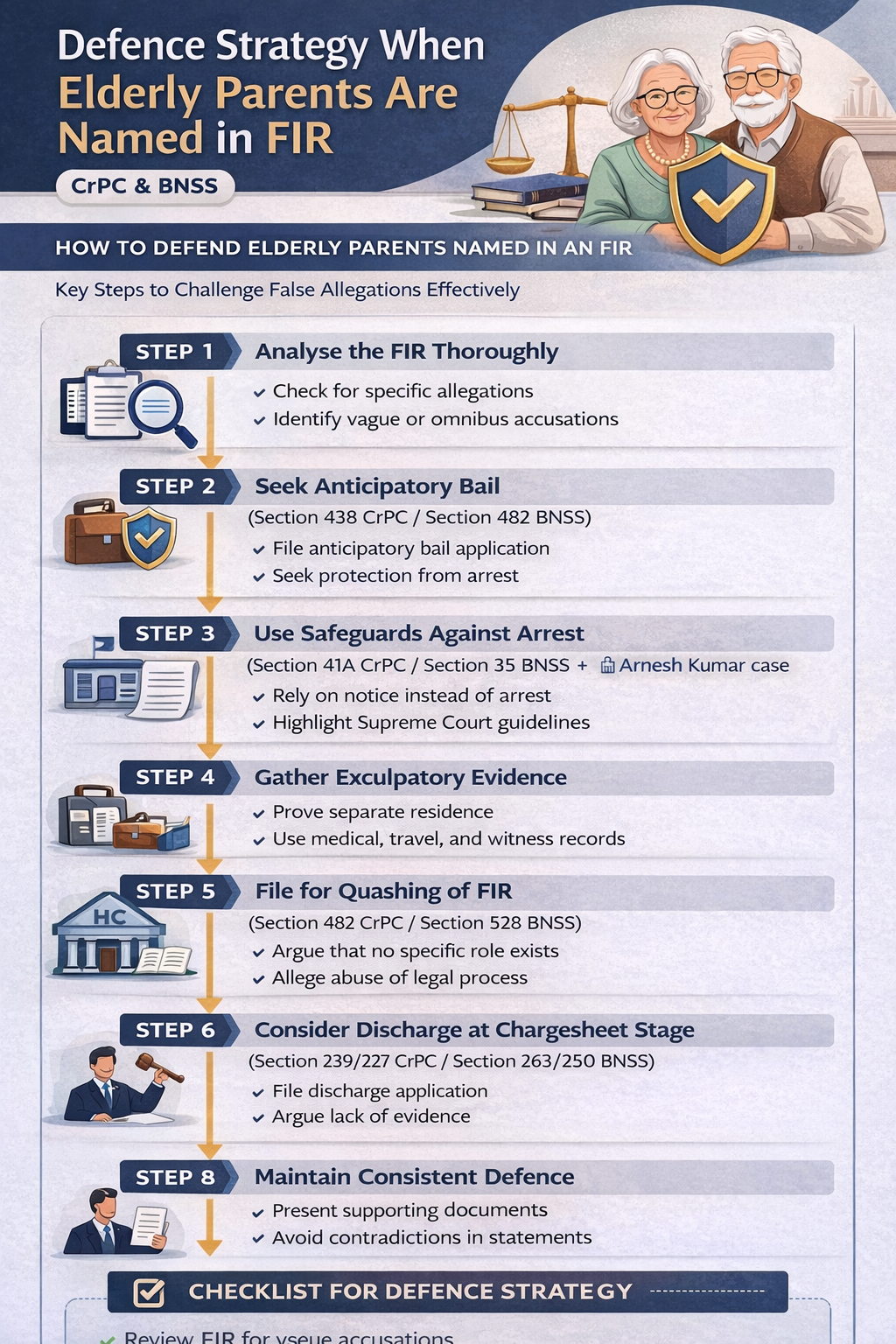
Defence Strategy When Elderly Parents Are Named in FIR

Posted on April 3 by Suprajaa Rajan

In matrimonial and family disputes, complainants often name multiple family members, including elderly parents, in a First Information Report (FIR). However, courts have consistently cautioned against the mechanical implication of relatives without specific allegations.

Therefore, when an FIR includes elderly parents, you must adopt a focused legal defence strategy. You should highlight the absence of direct involvement, lack of evidence, and misuse of criminal law provisions.

This article explains the legal remedies and defence strategies available when elderly parents are falsely implicated, along with relevant provisions under the Code of Criminal Procedure, 1973 (CrPC) and the Bharatiya Nagarik Suraksha Sanhita, 2023 (BNSS).

Understanding the Legal Position

The police register an FIR under Section 154 CrPC (Section 173 BNSS) when they receive information about a cognizable offence. After registration, the investigation begins, and all named persons may face legal scrutiny.

However, courts do not rely solely on allegations. Instead, they examine:

  • Specific acts attributed to each accused
  • Supporting evidence
  • The individual role of each person

In many cases, complaints contain general and vague allegations against elderly parents, which you can challenge at an early stage.

Step 1: Analyse the FIR Carefully

First, you must carefully examine the FIR. A strong defence always begins with identifying weaknesses in the complaint.

You should check:

  • Whether the FIR contains specific allegations
  • Whether it mentions dates, events, or overt acts
  • Whether allegations appear vague or omnibus

If the complaint lacks specificity, you can argue that it fails to disclose a prima facie case against elderly parents.

Step 2: Seek Protection from Arrest

Next, you should promptly seek protection from arrest by filing an anticipatory bail application.

You can file this application under:

  • Section 438 CrPC (Section 482 BNSS)

Courts generally adopt a lenient approach toward elderly parents, especially when:

  • They reside separately
  • They have no direct involvement
  • The allegations appear exaggerated

Additionally, courts consider age, health, and dependency factors while granting relief.

Step 3: Rely on Safeguards Against Arbitrary Arrest

You should also rely on statutory safeguards that prevent unnecessary arrests.

The police must issue a notice of appearance under:

  • Section 41A CrPC (Section 35 BNSS)

instead of making immediate arrests when the accused cooperates with the investigation.

Further, the Supreme Court in
Arnesh Kumar v. State of Bihar
directed authorities to avoid automatic arrests in matrimonial offences.

Therefore, elderly parents can use these safeguards to prevent unjustified detention and harassment.

Step 4: Gather Evidence Showing Lack of Involvement

After securing protection, you should collect evidence that demonstrates the absence of involvement.

You should gather:

  • Proof of separate residence
  • Medical records indicating age-related limitations
  • Travel records
  • Independent witness statements

This evidence helps establish that the allegations are false, exaggerated, or legally unsustainable.

Step 5: File for Quashing of FIR

If the FIR clearly lacks specific allegations, you should approach the High Court to quash the proceedings.

You can invoke:

  • Section 482 CrPC (Section 528 BNSS)

The High Court may quash proceedings when:

  • Allegations are vague or omnibus
  • No specific role is attributed
  • Continuation of proceedings amounts to abuse of process

Courts frequently grant relief to elderly parents in such circumstances.

Step 6: Seek Discharge at Chargesheet Stage

If the police file a chargesheet, you should consider filing a discharge application.

Relevant provisions include:

  • Section 239 CrPC (Section 263 BNSS) – Warrant cases
  • Section 227 CrPC (Section 250 BNSS) – Sessions cases

You can argue that:

  • No evidence exists against elderly parents
  • The chargesheet fails to establish involvement
  • The case relies on assumptions rather than proof

If the court agrees, it may discharge the accused at this stage.

Step 7: Challenge Mechanical Implication of Relatives

Courts consistently discourage the practice of implicating all family members without distinction.

Therefore, you should emphasize:

  • Absence of specific allegations
  • Lack of direct interaction with the complainant
  • No supporting evidence

This approach aligns with judicial principles that prevent misuse of criminal law in matrimonial disputes.

Step 8: Maintain a Consistent Defence Strategy

Finally, you must maintain a consistent and structured defence throughout the proceedings.

You should:

  • Avoid contradictory statements
  • Cooperate with the investigation
  • Present documentary evidence at each stage

A consistent defence strengthens credibility and improves the chances of relief.

Judicial Approach

Courts recognise that false implication of elderly parents can lead to serious injustice and misuse of the legal process.

Therefore, courts often:

  • Grant anticipatory bail
  • Quash proceedings where appropriate
  • Discharge accused in absence of evidence

This balanced approach ensures that only genuine cases proceed to trial.

Conclusion

When elderly parents are named in an FIR, the law provides multiple safeguards to protect them from unjust prosecution.

You should:

  • Analyse the FIR thoroughly
  • Seek anticipatory bail under Section 438 CrPC (Section 482 BNSS)
  • Invoke High Court powers under Section 482 CrPC (Section 528 BNSS)
  • File for discharge under Section 239/227 CrPC (Section 263/250 BNSS)

By adopting a structured legal strategy, you can effectively challenge false allegations and protect innocent family members.


Index of Legal Strategies and Defence is here.


Related Legal Concepts

Explore related stages and concepts in criminal procedure:

  • First Information Report 
  • Anticipatory Bail
  • Quashing of FIR
  • Discharge of an accused
  • Inherent powers of High Court


Key Contributor :
Mrs. Suprajaa Rajan B.Com., LL.B., LL.M.
+91-9606345150


Posted in Legal Procedure | Tagged 498A defence strategy BNSS Code of Criminal Procedure CrPC 239 - Discharge CrPC 438 - Anticipatory Bail Legal Strategies and Defence | Leave a comment

Discharge Application Format in 498A Case – Draft, Procedure & Sample Template

Posted on March 19 by Suprajaa Rajan

A practical guide to seeking discharge in matrimonial criminal cases under Indian law.

In matrimonial criminal litigation, accused persons often face allegations under Section 498A IPC (cruelty) and Section 406 IPC (criminal breach of trust). However, in many cases, the allegations are general, omnibus, or unsupported by evidence. Therefore, the law provides a remedy to seek discharge before trial begins.

A discharge application allows the accused to request the court to drop proceedings at an early stage, provided no prima facie case exists. Consequently, drafting a clear and precise discharge application becomes critical.

This article explains the legal framework, drafting strategy, and provides a ready-to-use format with copy-to-clipboard functionality.

I. Legal Provisions Governing Discharge

Under the Code of Criminal Procedure, 1973

  • Section 239 CrPC – Discharge in warrant cases (by Magistrate)

  • Section 227 CrPC – Discharge in sessions cases

Corresponding Provisions under BNSS, 2023

  • Section 262 BNSS – Discharge in warrant cases (equivalent to Section 239 CrPC)

  • Section 250 BNSS – Discharge in sessions cases (equivalent to Section 227 CrPC)

Thus, in most 498A cases (triable by Magistrate), the discharge application is filed under Section 239 CrPC (Section 262 BNSS)

II. What is a Discharge Application?

A discharge application is filed after filing of chargesheet but before framing of charges. At this stage, the court examines whether:

  • There is sufficient material to proceed, or

  • The case is groundless and should be dismissed

Therefore, discharge acts as a filter mechanism to prevent unnecessary trial.

III. When Can Discharge Be Sought in 498A Cases?

A discharge application may be filed when:

  • Allegations are vague or general in nature

  • No specific role is attributed to the accused

  • Evidence in the chargesheet does not support allegations

  • The accused is unnecessarily implicated (e.g., distant relatives)

  • The dispute is purely matrimonial without criminal intent

Consequently, courts have repeatedly held that mechanical prosecution must be avoided in matrimonial disputes.

IV. Key Grounds for Discharge

Before drafting, you should incorporate strong legal grounds. For instance:

1. Absence of Specific Allegations

Courts often discharge accused where allegations are general and omnibus.

2. No Prima Facie Case

If the chargesheet does not disclose essential ingredients of the offence, discharge must follow.

3. False Implication of Relatives

In many cases, distant relatives are unnecessarily roped in without evidence.

4. Civil Nature of Dispute

Where the dispute relates to matrimonial discord without criminal elements, discharge may be granted.

5. Lack of Evidence

If documentary or witness evidence does not support allegations, continuation of proceedings becomes unjustified.

V. Important Drafting Principles

While drafting a discharge application, you should:

  • Keep facts concise and structured

  • Avoid detailed trial-level arguments

  • Focus on chargesheet deficiencies

  • Highlight absence of ingredients of offence

  • Maintain a neutral and professional tone

A well-drafted application focuses on legal insufficiency, not emotional narrative.

VI. Sample Draft Format – Discharge Application in 498A Case

Below is a standard format used before the Magistrate.

Sample Draft – Discharge Application in 498A Case (Section 239 CrPC | Section 262 BNSS)

BEFORE THE HONOURABLE COURT OF [MAGISTRATE] AT [CITY]

Criminal Case No. [____]

In the matter of:

State of [State]
…Complainant

Versus

[Name of Accused]
…Accused/Applicant


APPLICATION FOR DISCHARGE UNDER SECTION 239 CrPC
(READ WITH SECTION 262 BNSS)

Most Respectfully Submitted:

1. That the present application is being filed by the Applicant seeking discharge in the above-mentioned case.

2. That the chargesheet has been filed under Sections 498A, 406 IPC and other allied provisions.

3. That the allegations made in the FIR and chargesheet are vague, general and do not disclose any specific role attributed to the Applicant.

4. That the Applicant has been falsely implicated due to matrimonial disputes and no prima facie case is made out against the Applicant.

5. That the material on record does not disclose the essential ingredients of the alleged offences.

6. That continuation of proceedings against the Applicant would amount to abuse of process of law.

7. That the Applicant is entitled to be discharged at this stage as no sufficient grounds exist to proceed further.

PRAYER

In view of the facts and circumstances stated above, it is most respectfully prayed that this Hon’ble Court may be pleased to discharge the Applicant from the present case.


Place: [City]
Date: [Date]


Counsel for the Applicant
[Signature]

✔ Draft Copied Successfully!

VII. Common Mistakes to Avoid

While filing discharge applications, avoid:

  • Arguing the entire case like final arguments

  • Filing without analysing the chargesheet

  • Using aggressive or emotional language

  • Ignoring legal ingredients of offences

Instead, focus on legal insufficiency and lack of prima facie material.

Conclusion

A discharge application is a powerful remedy to prevent unnecessary criminal trials in matrimonial disputes. Therefore, a carefully drafted application can save time, cost, and reputational harm.

By focusing on lack of evidence, vague allegations, and absence of legal ingredients, the accused can effectively seek discharge under Section 239 CrPC (Section 262 BNSS).


Index of Legal Templates and Drafting is here.


Disclaimer

These templates are provided for educational and informational purposes. Every case depends on specific facts and procedural posture. Professional legal advice should be obtained before filing any application.


Key Contributor :

Mrs. Suprajaa Rajan B.Com., LL.B., LL.M.

+91-9606345150

Posted in Legal Procedure | Tagged CrPC 227 - Discharge CrPC 239 - Discharge discharge application draft Legal templates and drafting Matrimonial Criminal Law | Leave a comment

Discharge of Accused Explained

Posted on March 18 by Suprajaa Rajan

Discharge of an accused is a crucial stage in criminal proceedings where the court examines the material on record and decides whether the case should proceed to trial. At this stage, the court evaluates whether sufficient grounds exist to continue proceedings against the accused.

Under Indian criminal law, provisions relating to discharge are contained in:

  • Section 227 CrPC (Section 250 BNSS) – Discharge in Sessions cases

  • Section 239 CrPC (Section 262 BNSS) – Discharge in warrant cases based on police report

  • Section 245 CrPC (Section 268 BNSS) – Discharge in warrant cases otherwise than on police report

These provisions ensure that courts do not subject individuals to unnecessary trials when the evidence does not disclose a prima facie case.

Meaning and Scope of Discharge

Discharge refers to the release of an accused person from criminal proceedings before the commencement of trial.

At this stage, the court does not conduct a detailed examination of evidence. Instead, it assesses whether:

  • The allegations, even if accepted as true, make out an offence, and

  • The material on record justifies proceeding further

If the court finds that the case lacks sufficient grounds, it discharges the accused.

Thus, discharge acts as a filtering mechanism to prevent misuse of criminal law.

Statutory Framework

The law provides different provisions for discharge depending on the nature of the case.

Sessions Cases

In serious offences triable by a Court of Session, the court exercises power under:

  • Section 227 CrPC (Section 250 BNSS)

Warrant Cases (Police Report)

Where the case arises from a police investigation:

  • Section 239 CrPC (Section 262 BNSS)

Warrant Cases (Complaint Cases)

Where the case is instituted otherwise than on a police report:

  • Section 245 CrPC (Section 268 BNSS)

Each provision ensures that the court applies judicial mind before allowing the case to proceed.

Stage at Which Discharge is Considered

The court considers discharge after the filing of the charge sheet and before framing of charges.

At this stage, the court examines:

  • Police report and documents

  • Statements of witnesses

  • Submissions made by the accused

Importantly, the court does not conduct a mini-trial. Instead, it only determines whether sufficient grounds exist to proceed.

Grounds for Discharge

Courts may discharge an accused under the following circumstances:

  • Absence of prima facie evidence

  • Allegations do not constitute any offence

  • Evidence appears inherently unreliable

  • Legal bar to prosecution exists

  • Proceedings are manifestly frivolous or vexatious

Therefore, discharge ensures that only legally sustainable cases proceed to trial.

Difference Between Discharge and Acquittal

Although both result in the release of the accused, they operate at different stages.

Discharge:

  • Occurs before trial

  • Based on preliminary evaluation

  • No detailed evidence examination

Acquittal:

  • Occurs after trial

  • Based on full appreciation of evidence

  • Results in final adjudication

Thus, discharge prevents unnecessary trials, while acquittal follows a complete judicial process.

Judicial Approach to Discharge

Courts have consistently held that while deciding discharge applications, judges must:

  • Apply judicial mind to the material on record

  • Avoid detailed analysis of evidence

  • Consider whether the case discloses a prima facie offence

If two views are possible, and one supports the prosecution, courts generally allow the case to proceed to trial.

However, if the material clearly fails to establish an offence, courts must discharge the accused to prevent abuse of process.

Importance of Discharge in Criminal Law

Discharge plays a vital role in ensuring fairness in criminal proceedings.

It protects individuals from:

  • Harassment through baseless prosecutions

  • Unnecessary criminal trials

  • Prolonged litigation without sufficient grounds

At the same time, it ensures that genuine cases proceed to trial based on credible material and legal justification.

Conclusion

Discharge of an accused serves as an important safeguard within the criminal justice system. It ensures that courts do not proceed with cases that lack sufficient legal basis.

By filtering out weak or unfounded cases at an early stage, discharge maintains the balance between individual liberty and the need to prosecute offences effectively.

Related Legal Concepts

To understand how discharge fits within criminal procedure, explore these related concepts:

  • First Information Report (FIR)
  • Police Investigation
  • Charge Sheet and Final Report
  • Framing of Charges
  • Criminal Trial Procedure


Index of Law Concepts explained here.


Key Contributor :

Mrs. Suprajaa Rajan B.Com., LL.B., LL.M.

+91-9606345150

Posted in LLB Study Material | Tagged Code of Criminal Procedure Criminal law CrPC 227 - Discharge CrPC 239 - Discharge CrPC 245 - When accused shall be discharged Law Concepts explained | Leave a comment

Bhushan Kumar and Anr Vs State (NCT of Delhi) and Anr on 4 April 2012

Posted on December 29, 2020 by ShadesOfKnife

A 2-judge Division Bench held that Quash petition is maintainable even though this instant matter is dismissed on merits.

From Para 5,

5) The questions which arise for consideration in these appeals are:
(a) Whether taking cognizance of an offence by the Magistrate is same as summoning an accused to appear?
(b) Whether the Magistrate, while considering the question of summoning an accused, is required to assign reasons for the same?

From Para 7,

7) In S.K. Sinha, Chief Enforcement Officer vs. Videocon International Ltd. & Ors., (2008) 2 SCC 492, the expression “cognizance” was explained by this Court as it merely means“become aware of” and when used with reference to a court or a Judge, it connotes “to take notice of judicially”. It indicates the point when a court or a Magistrate takes judicial notice of an offence with a view to initiating proceedings in respect of such offence said to have been committed by someone. It is entirely a different thing from initiation of proceedings; rather it is the condition precedent to the initiation of proceedings by the Magistrate or the Judge. Cognizance is taken of cases and not of persons.

From Para 8 (Very Imp)

8) Under Section 190 of the Code, it is the application of judicial mind to the averments in the complaint that constitutes cognizance. At this stage, the Magistrate has to be satisfied whether there is sufficient ground for proceeding and not whether there is sufficient ground for conviction. Whether the evidence is adequate for supporting the conviction can be determined only at the trial and not at the stage of enquiry. If there is sufficient ground for proceeding then the Magistrate is empowered for issuance of process under Section 204 of the Code.

From Para 9,

9) A summon is a process issued by a Court calling upon a person to appear before a Magistrate. It is used for the purpose of notifying an individual of his legal obligation to appear before the Magistrate as a response to violation of law. In other words, the summons will announce to the person to whom it is directed that a legal proceeding has been started against that person and the date and time on which the person must appear in Court. A person who is summoned is legally bound to appear before the Court on the given date and time. Willful disobedience is liable to be punished under Section 174 IPC. It is a ground for contempt of court.

From Paras 10 and 11, (Very IMP)

10) Section 204 of the Code does not mandate the Magistrate to explicitly state the reasons for issuance of summons. It clearly states that if in the opinion of a Magistrate taking cognizance of an offence, there is sufficient ground for proceeding, then the summons may be issued. This section mandates the Magistrate to form an opinion as to whether there exists a sufficient ground for summons to be issued but it is nowhere mentioned in the section that the explicit narration of the same is mandatory, meaning thereby that it is not a pre-requisite for deciding the validity of the summons issued.
11) Time and again it has been stated by this Court that the summoning order under Section 204 of the Code requires no explicit reasons to be stated because it is imperative that the Magistrate must have taken notice of the accusations and applied his mind to the allegations made in the police report and the materials filed therewith.

Bhushan Kumar and Anr Vs State (NCT of Delhi) and Anr on 4 April 2012

Citations : [2012 RCR CRIMINAL SC 2 794], [2012 SUPREME 2 699], [2012 BOMCR CRI SC 4 138], [2012 SLT 3 221], [2012 AIR SC 1747], [2012 SCALE 3 191], [2012 AIOL 161], [2012 CRIMES SC 2 101], [2012 CRLJ SC 2286], [2012 AIR SC 2476], [2012 SCALE 4 191], [2012 SCC 5 424], [2012 SCC CRI 2 872], [2012 JT 4 127], [2012 SCC ONLINE SC 325], [2012 AIC 113 116], [2012 UC 2 1121], [2012 JCR SC 2 269], [2012 ACR SC 2 1514], [2012 LW CRL 2 33], [2012 PLJR 2 422], [2012 JLJR 2 307], [2012 RLW SC 3 2467], [2012 SCC 5 422], [2012 DRJ 130 225], [2012 ALT CRI SC 3 223], [2012 AIR SCW 2476], [2012 DLT SC 189 252]

Other Sources :

https://indiankanoon.org/doc/71570434/

https://www.casemine.com/judgement/in/5609af1de4b0149711415a6b

Posted in Supreme Court of India Judgment or Order or Notification | Tagged 2-Judge (Division) Bench Decision Bhushan Kumar and Anr Vs State (NCT of Delhi) and Anr Catena of Landmark Judgments Referred/Cited to CrPC 190 - Cognizance of Offences by Magistrates CrPC 204 - Issue of Process CrPC 239 - Discharge CrPC 482 - Quash Landmark Case Legal Procedure Explained - Interpretation of Statutes Reportable Judgement or Order Sensational Or Peculiar Cases | Leave a comment

CBI Vs Ram Swaroop Chandel and Ors on 30 Sep 2020

Posted on October 19, 2020 by ShadesOfKnife

Delhi High Court held this interesting point on discharge an accused.

71. In view of above facts discussed, the settled law is that if the prosecution witnesses presumed to be true, without any cross examination, still conviction cannot be awarded to the accused, then deserves for discharge, as the case in hand is.

CBI Vs Ram Swaroop Chandel and Ors on 30 Sep 2020

Citations :

Other Sources :


Index of Discharge Judgments u/s 239 are here.

Posted in High Court of Delhi Judgment or Order or Notification | Tagged 1-Judge Bench Decision CBI Vs Ram Swaroop Chandel and Ors CrPC 239 - Discharge | Leave a comment

Kanti Bhadra Shah and Anr Vs State of West Bengal on 5 January 2000

Posted on May 24, 2020 by ShadesOfKnife

Supreme held as follows which shows the importance of filing a Discharge petition u/s 239 CrPC (or 227/245 CrPC, as the case may be) since without such petition, Magistrate is free to skip applying his/her judicial mind on the said sections and proceed with charge framing, unrestricted and he/she is not bound to record reasons for charge framing.

We wish to point out that if the trial court decides to frame a charge there is no legal requirement that he should pass an order specifying the reasons as to why he opts to do so. Framing of charge itself is prima facie order that the trial judge has formed the opinion, upon consideration of the police report and other documents and after hearing both sides, that there is ground for presuming that the accused has committed the offence concerned.

And then,

If there is no legal requirement that the trial court should write an order showing the reasons for framing a charge, why should the already burdened trial Courts be further burdened with such an extra work. The time has reached to adopt all possible measures to expedite the the court procedures and to chalk out measures to avert all roadblocks causing avoidable delays. If a Magistrate is to write detailed orders at different stages merely because the counsel would address arguments at all stages, the snail paced progress of proceedings in trial courts would further be slowed down. We are coming across interlocutory orders of Magistrates and Sessions Judges running into several pages. We can appreciate if such a detailed order has been passed for culminating the proceedings before them. But it is quite unnecessary to write detailed orders at other stages, such as issuing process, remanding the accused to custody, framing of charges, passing over to next stage in the trial. It is a salutary guideline that when orders rejecting or granting bail are passed, the Court should avoid expressing one way or other on contentious issues, except in cases such as those falling within Section 37 of the Narcotic Drugs and Psychotropic Substances Act, 1985.

Kanti Bhadra Shah and Anr Vs State of West Bengal on 5 January 2000

Citations: [2000 SLT 1 133], [2000 RCR CRI 1 407], [2000 CRLJ 0 746], [2000 SCC 1 722], [2000 SUPREME 1 6], [2000 AIR SC 522], [2000 AIR SC 0 52], [2000 JT 1 13], [2000 CALCRILR 0 151], [2000 CRIMES 1 96], [2000 CCR 1 72], [2000 KERLT 1 795], [2000 RCR CRIMINAL 1 407], [2000 SCALE 1 19], [2000 SCC CR 303], [2000 SCJ 3 77], [2000 SRJ 2 112], [2000 ALD CRI 1 421], [2000 CRLR 173], [2000 MLJ CRI 1 243], [2000 MAHLR 2 534], [2000 SCC CRI 303], [2000 CRI LJ 746]

Other Source links: https://indiankanoon.org/doc/1735113/ or https://www.casemine.com/judgement/in/5609ad74e4b01497114117a5


Index of Discharge Judgments u/s 239 are here.


Posted in Supreme Court of India Judgment or Order or Notification | Tagged 2-Judge (Division) Bench Decision CrPC 239 - Discharge Kanti Bhadra Shah and Anr Vs State of West Bengal Landmark Case | Leave a comment

B.S.Neelakanta and Anr Vs State of A.P. and Anr on 04 December 2013

Posted on March 7, 2020 by ShadesOfKnife

AP High Court has rightly held the various counts of errors committed by the Trial Court magistrate in dismissing a Discharge Petition filed u/s 239.

B.S.Neelakanta and Anr Vs State of A.P. and Anr on 04 December 2013

Citations: [2014(1) Law Summary (A.P.) 266], [2014(1) ALD (Crl) 611 (AP)], [2014(2) ALT (Crl) 237 (AP)]

Other Source links:


Index of Discharge Judgments u/s 239 are here.

Posted in High Court of Andhra Pradesh Judgment or Order or Notification | Tagged B.S.Neelakanta and Anr Vs State of A.P. and Anr CrPC 239 - Discharge CrPC 239 - Discharge Rejection is Set Aside CrPC 239 - Exercise of Judicial Mind CrPC 239 - When accused shall be discharged Sandeep Pamarati | Leave a comment

Asim Shariff Vs National Investigation Agency on 01 July 2019

Posted on February 16, 2020 by ShadesOfKnife

Supreme Court has held that,

19. Taking note of the exposition of law on the subject laid down by this Court, it is settled that the Judge while considering the question of framing  charge under Section 227 CrPC in sessions cases (which is akin to Section 239 CrPC pertaining to warrant cases) has the undoubted power to sift and weigh the evidence for the limited purpose of finding out whether or not a prima facie case against the accused has been made out; where the  material placed before the Court discloses grave suspicion against the accused which has not been properly explained, the Court will be fully justified  in framing the charge; by and large if two views are possible and one of them giving rise to suspicion only, as distinguished from grave suspicion  against the accused, the trial Judge will be justified in discharging him. It is thus clear that while examining the discharge application filed under Section 227 CrPC, it is expected from the trial Judge to exercise its judicial mind to determine as to whether a case for trial has been made out or not. It is true that in such proceedings, the Court is not supposed to hold a mini trial by marshalling the evidence on record.

Asim Shariff Vs National Investigation Agency on 01 July 2019

Citations: [

Other Source links: https://indiankanoon.org/doc/33080905/ Earlier High Court order: https://www.casemine.com/judgement/in/5c4c63cb9eff4364f62e246c


Index of Discharge Judgments u/s 227 Cr.P.C. is here.


Reproduced in accordance with Section 52(q) of the Copyright Act 1957 (India) from main.sci.gov.in/judgments, judis.nic.in, lobis.nic.in, indiacode.nic.in and other Indian High Court and District Court Websites such as ecourts.gov.in

Posted in Supreme Court of India Judgment or Order or Notification | Tagged Asim Shariff Vs National Investigation Agency CrPC 227 - Discharge CrPC 227 - Exercise of Judicial Mind CrPC 239 - Discharge CrPC 239 - Exercise of Judicial Mind Legal Procedure Explained - Interpretation of Statutes Reportable Judgement or Order Work-In-Progress Article | Leave a comment

G.Sagar Suri and Anr Vs State of UP and Ors on 28 January, 2000

Posted on December 15, 2019 by ShadesOfKnife

In this judgment, Supreme Court has held that, there is no bar to pursue Quash at High Court under sec 482 CrPC, even when a Discharge was pending in the Trial Court under sec 239 CrPC or 245 CrPC.

It was submitted by Mr. Lalit, learned counsel for the second respondent, that the appellants have already filed an application in the Court of Additional Judicial Magistrate for their discharge and that this Court should not interfere in the criminal proceedings which are at the threshold. We do not think that on filing of any application for discharge, High Court Cannot exercise its jurisdiction under Section 482 of the Code. In this connection, reference may be made to two decisions of this Court in Pepsi Foods Ltd. & Anr. v. Special Judicial Magistrate & Ors., [1998] 5 SCC 749 and Ashok Chaturvedi & Ors. v. Shitul H. Chanchani & Anr., [1998] 7 SCC 698, wherein it has been specifically held that though the Magistrate trying a case has jurisdiction to discharge the accused at any stage of the trial if he considers the charge to be groundless but that does not mean that the accused cannot approach the High Court under Section 482 of the Code or Article 227 of the Constitution to have the proceeding quashed against them when no offence has been made out against them and still why must they undergo the agony of a criminal trial.

G.Sagar Suri and Anr Vs State of UP and Ors on 28 January, 2000

Citations: 2000 C Cr. LR(SC) 136 : JT 2000(1) SC 360, (2000)2 SCC 636, J.T. 2000 Vol. 1 page 126

Indiankanoon.org link: https://indiankanoon.org/doc/1699144/


Reproduced in accordance with Section 52(q) of the Copyright Act 1957 (India) from judis.nic.in, lobis.nic.in, indiacode.nic.in and other Indian High Court and District Court Websites such as ecourts.gov.in

Posted in Supreme Court of India Judgment or Order or Notification | Tagged Civil Case Given Color of Criminal Case CrPC 239 - Discharge CrPC 482 - Quash Discharge does not Prohibit Quash G.Sagar Suri and Anr Vs State of UP and Ors Landmark Case Legal Procedure Explained - Interpretation of Statutes

Sandeep Pamarati Vs Ungrateful Knife (IPC 498A Case)

Posted on April 7, 2018 by ShadesOfKnife

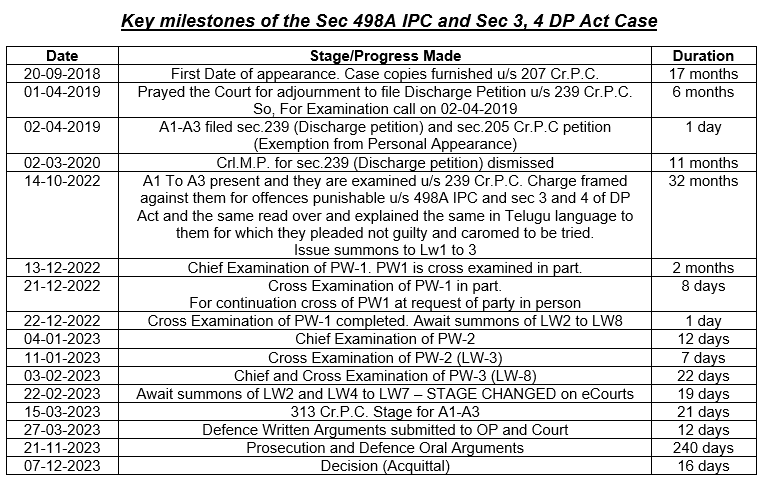
Hi Folks, Sharing with you all, how I dealt with the false 498A IPC case put on me and my innocent parents, along with timelines. I have also shared samples/templates made out of my petitions (obviously, totally redacted) along with below timelines, in PDF format.

Take little pains to have them drafted for your cases. Do NOT ask me word versions. Even if you ask, I will NOT give 😉

NOTE: If you become my client, all these samples and templates will be customized for your case requirements.


All credit primarily goes to one Mens’ Rights Organization, named and styled as MyNation Foundation. Hundreds of exceptionally knowledgeable members have spend thousands of hours selflessly just to guide, motivate, support another of their brother from another mother (that is myself) who has been facing a false matrimonial case in India.

Thank you Rudy, for giving us MyNation.net.

NOTE: My DV case is available here. Index of all cases filed against my and my parents is here and my defence/counter attacks.


Detailed Timeline of the case under IPC 498A


On 07-April-2017,

Compliant filed with Women Police Station, Ongole;
Same day FIR is also registered under IPC 498A and u/s 3 and 4 of D.P.Act

On 08-April-2017,

FIR sent to 3rd Additional Judicial Magistrate of First Class, Ongole

On 01-May-2017,

Regular Bail granted by 1st Additional Sessions Judge, Ongole to Parents

On 01-June-2017,

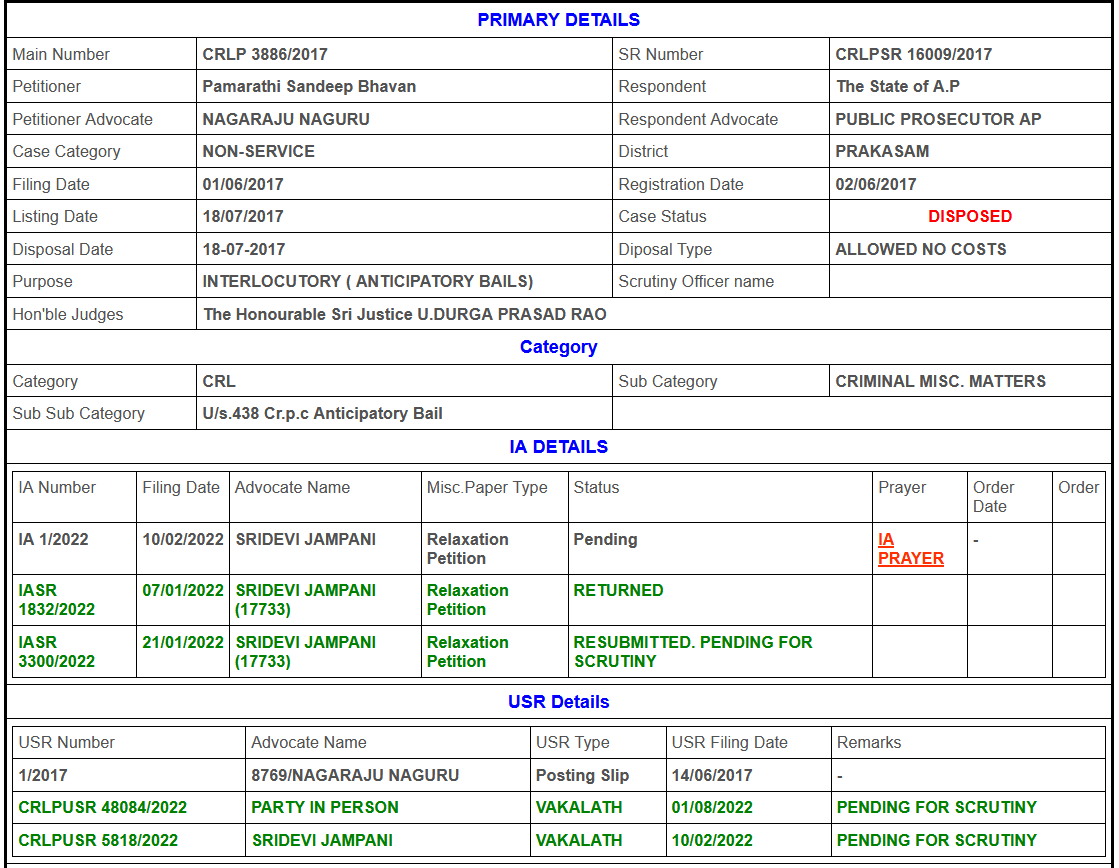
Application filed for Anticipatory Bail with High Court of AP u/s 438 of Cr.P.C

On 18-July-2017,

High Court of AP granted Anticipatory Bail

On 31-October-2017,

Charge sheet filed with 3rd Additional Judicial Magistrate of First Class, Ongole

On 20-September-2018,

First appearance in the Court along with parents. Collected accused copies of all prosecution documents, 1 set per accused person. We were three, we got 3 copies of below documents.

  1. Complaint
  2. FIR
  3. Printed Charge sheet
  4. 161 CrPC statements of all witnesses
  5. Rough sketch of scene of offence
  6. and few more documents/evidences

On 02-April-2019,

Filed Party-in-person petition in 498A IPC case. All three accused (myself, my daddy and my maa) are PIP !!!

Sample Petition below

Application to go PIP in IPC 498A Case (Without Auth)

Sample Affidavit below

Affidavit - Petition to go PIP in IPC 498A Case (Without Auth)

Sample Docket below

Docket Sheet for 498A Case PIP Petition

On 02-April-2019,

Parents filed 205 CrPC petition praying for exemption from personal appearance during this false case proceedings.

Sample Petition below

Exemption from Personal Appearance under CrPC 205 in IPC 498A Case

Sample Affidavit below

Affidavit - Exemption from Personal Appearance under CrPC 205 in IPC 498A Case

Sample Docket below

Docket Sheet for 205 CrPC Petition in 498A Case


Authorization under Rule 37 filed in the case proceedings.

Sample Authorization below

Authorization from one PIP in IPC 498A Case (under Rule 37 CRP and CO of AP HC) SAMPLE

No sample form or format is available anywhere on the Internet or High Court of AP website. Hence prepared the template myself. You may copy it. 😉


IMPORTANT ASPECT: If you and your parents wanna go PIP, file separate PIP petitions for each accused and separate Rule 37 authorization. Do NOT file 205 CrPC in such case. During the proceedings, one accused can file absent petition or any other petition for other accused. So PIP+Rule 37 is the combination to utilize. Not 205 CrPC, as 205 CrPC mandates, in the absense of accused, their advocate should represent them. In PIP, there is no advocate at all.

Obviously, I filed another memo, seeking permission to withdraw my 205 CrPC petition filed on behalf of my parents. Now, I am free to file any number of absent petitions for them in Court. I also attach any medical certificate or prescriptions in support of the absent petitions. Magistrate cannot deny them.


On 02-April-2019,

Filed Discharge petition in 498A IPC case for all three accused myself, my daddy and my maa

Sample Petition below

Discharge Petition under Sec 239 CrPC in Sec 498A case

Sample Affidavit below

Affidavit - Discharge Petition under Sec 239 CrPC in Sec 498A case

Sample Docket below

Docket Sheet for 239 CrPC Petition in 498A Case

On 22-April-2019, 25-April-2019 and 09-May-2019,

APP sought more time to file Counter to the Discharge petition

On 30-May-2019,

APP finally filed a 1-pager Counter to the Discharge petition

zCounter of APP against Discharge Petition

Take time to laugh at it. Contact me to know why APP has filed such worthless Counter and the back story.


On 14-June-2019,

Court allows the absent petitions sent via Registered Post with Acknowledgement due. Interesting !!!

Sample covering letter to be sent to the Superintendent of the Filing Section of the Court where the Case is pending, along with duly filled and stamped absent petitions.

Covering Letter - SAMPLE

Absent Petition for absence from a Court hearing date is filed under section 317 Cr.P.C. Sample available here.


From July 2019 to December 2019, Magistrate goes on training!!! 6 Months of training…


On 12-February-2020,

Hearing in the Discharge Petition

Hearing in the Discharge Petition happened. This is otherwise called as Hearing Before Charge framing (HBC)

I introduced the genesis of the case and then the discharge petition and swiftly moved onto the 8 grounds, one by one. Magistrate kept interrupting me by way of clarifications. Took around 15 mins to finish. APP was asked if she got anything to say to the 8 grounds (Note: Magistrate noted down 4 grounds only in her notes). As expected, APP denied the grounds as invalid and not applicable at this stage of case. APP amused me with 1-page Counter earlier (scroll up and read above) and now said very funny and weird reasonings to invalidate my grounds.

After this ruckus, Magistrate asked me for Judgments that I cited in the Discharge Petition. I said, all the judgments are reported judgments and are picked from Law reporters. Still Magistrate and APP also insisted that I produce judgments. I said, I will bring them in the next date. Finally, Magistrate said, she is moving the proceeding, For Orders.

I am glad, at last, I will have a Judicial order soon, that I can go against for Revision in Sessions Court u/s 397 Cr.P.C read with 399 Cr.P.C. with an additional prayer to stay the Trail Court proceedings and for this I have 90 Days of time.


On 24-February-2020,

Order in the Discharge Petition was not passed.


On 02-March-2020,

Order in the Discharge Petition was passed. I was absent.

On 12-March-2020,

I got a CA filed via a advocate friend (yes, i made friends with advocates)

Dismissal Order in Discharge petition

Now working on Criminal Revision Petition to file against above dismissal order at Sessions Court, at the earliest, along with PIP petitions at Sessions Court.

On 08-October-2020,

I got the Criminal Revision filed via the advocate friend; Awaiting numbering and subsequent initial hearing

Revision petition against Discharge Dismissal in IPC 498A Case (SAMPLE)

On 10-February-2021,

The Criminal Revision is numbered and notices sent to Respondent. Call on 12 March 2021

On 12-March-2021,

Nothing actually happen on the Bluejeans session. Since Notice to R2 had returned as party not available’, Court allowed serving of Notice to correct/alternative address. If this too fails, next step is to go for Newspaper publication.

On 12-April-2021,

Awaiting hearing…

On 07-August-2022,

Just updating developments…

  1. Stopped pursuing the Criminal Revision at Sessions Court, till date. But will proceed with newspaper publication.
  2. Initiated a IA (IA 1/2022 on 10/02/2022), in the long-disposed matter of Crl.P. No. 3886/2017 which was filed seeking Anticipatory Bail from AP HC), seeking release of my passport from the custody of Ongole Trial Court, where my newly renewed passport has been locked up from 2017 July… i.e., just over 5 years! Half the time for which the passport was renewed went in Court itself.
    • The SO of criminal section (B Satyanarayana) says, this 2017 file is not here at Amaravathi but may be at Hyderabad for which his office sent a requisition note to Telangana High Court in February itself but surprisingly the staff at TS HC says they never received any such note!! Interesting!
    • Also went to the New Filing section counter asking why my NOC was not reflecting on the Case Status portal. It is revealed that it was never taken up for processing because the person was on leave. My NOC-Vakalatnama was just lying there in a bundle of to-do items, for 4 full weeks!


On 10-October-2022,

Came to know that Requisition Note was sent to TS HC from AP HC but there is no response on my case bundle. More details here.


On 14-October-2022,

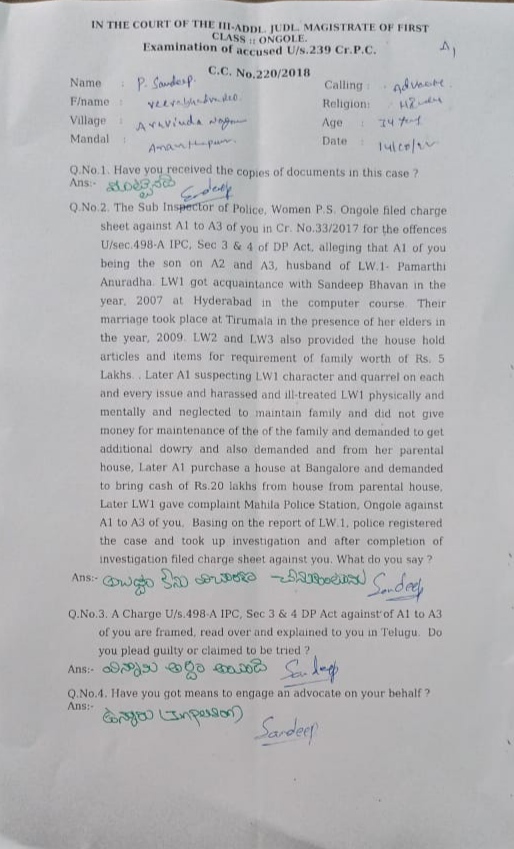
Appeared before the Magistrate for Charge-framing circus and Millions Thanks to God, THAT happened.


On 16-November-2022, 07-December-2022 and 12-December-2022,

Business: The Complainant must turn into Prosecution Witness-1 and file her Chief Examination/Evidence Affidavit and serve a copy to me. As I expected this did not happen.


On 13-December-2022,

First Listed Witness LW-1 turned First Prosecution Witness PW-1 and sat for Chief Examination by Assistant Public Prosecutor. Finished the drama on same day.

I cross examined the PW-1, in part and sought adjournment for continuation of Cross on NDOH.


On 19-December-2022 and 20-December-2022,

Nothing happened.


On 21-December-2022 and 22-December-2022,

I cross examined the PW-1, in part on 21-Dec-2021 and sought adjournment for continuation of Cross on NDOH. Finished the Cross examination of PW-1 on 22-Dec-2022.


On 04-January-2023,

APP finished Chief Examination of PW-2 (mother of complainant and LW-3 from Charge sheet).


On 11-January-2023,

Prepared detailed set of Questions (as with PW-1 above in Excel) to ask the PW-2. Asked them in a pre-organized manner so as to hit the key allegations of dowry and counter allegation of bigamy. Got as many favourable as I needed to dismantle the allegations of PW-2. She eventually became a hearsay witness.


On 03-February-2023,

Prepared detailed set of Questions to ask the PW-3 (the Investigating Officer/LW-8). Asked the witness questions beginning from the fundamentals like names of parties and went ahead in a pre-organized manner so as to hit the lapses in the procedural steps in a dowry case. Could ask around 40-45 questions from my prepared set of 100+ questions. 3 documents are marked as exhibits (FIR, Charge sheet and sketch of scene of offence at Hyderabad) but none incriminating me or other accused to the case.

Since there is nothing incriminating accused was brought on record of the Court, the Court may dispense with proceedings under 313 CrPC. Let’s see.


On 16-February-2023,

After facing a loss in the DV case yesterday, today I found out, on the eCourts app of course, that the Criminal Revision filed in 2021 was dismissed. Here is the 1-page Order. Double Whammy for me… on back to back dates.

Sandeep Bhavan Pamarati and Ors Vs State of AP and Anr on 14 Dec 2022

On 27-March-2023,

Decided to file Written Arguments u/s 314 Cr.P.C. into Court, instead of waiting for APP to argue the case.

2023-03-18 Memo of Written Arguments u-s 314 CrPC in 498A IPC Case v0.2

On 08-December-2023,

Decided to trim the timeline entries on this page and jump straight to Judgment date.


On 07 Dec 2023,

I and my parents are acquitted from the false 498A IPC case, on merits. Not settled, not quashed. Acquitted on merits. This is a big deal, for me.


On judgment date, I have with me Dr. Parasar Sarvepalli and Rama Krishna garu to support me. The moment came at about 2PM, when we were called into the Court. As usual, we were called last after all litigants and advocates left Court hall. It was a tense 2 mins, when I faintly heard that A1-A3 are found NOT guilty and therefore they are acquitted… We came out of the Court hall and the emotions started to flood the dam/eyes. For out 15 mins, it was a mixed feeling of joy, exhaustion, despair, hope and angst… We regains our balance, finished formalities (signing of bonds u/s 437A CrPC) and left the Court premises, Happy.

My Advocate friends Pokala Venkateswarlu and Bandaru Dhanalakshmi garu helped me with filing the Surety bonds and necessary affidavit and preparing the documents in prescribed fashion. Thanks to them, for their timely help.

State of AP Vs Pamarati Sandeep Bhavan and 2 Ors on 07 Dec 2023

LEGAL PROCEDURE TO FILE PETITIONS IN TRIAL COURTS and COMMON PITFALLS TO AVOID:

  • One petition per accused to be filed those that are going to defend their cases as Party-in-person. If you file one petition for 3 accused’s party-in-person, some idiots at Court will ask for rule which states that 3 accused can file one petition seeking party-in-person. Be aware of this.
  • All petitions (along with it’s affidavit and covering docket sheet) given to Court should be in green-colored Conquest paper, in legal size only.
    • Update: This requirement is no longer valid, as AP HC decided to do-away with conquest/legal paper at all District Courts in the State of AP. Details here.
  • Petitions can be submitted in the Court to the Magistrate (via the Court attendant) or filed at the Bench Clerk’s office to Supervisor/Clerk there. Go with first option always.
    • IMPORTANT: Obtain signature of the APP/PP on the petition that is going to be submitted to Court and then submit. Else, petition may be taken in, but then you will have to file a memo with signature from APP/PP. To avoid this double work, find out on what days (Mon-Sat) does the APP/PP of that Court come to Court. Then give a copy to APP/PP for their perusal and get received copy signature on the Original petition that will be submitted to Court.
  • For every petition submitted to Court, one copy should be given to PP/APP in Criminal Cases (like 498A IPC etc) and to Prosecution advocate in Civil Cases (like DVC, 125 CrPC etc). This can be in regular white paper, in legal size only.
  • Copy of petition to be served on OP advocate/A.PP before providing a copy to Court, preferably. Otherwise, OP Advocate can create ruckus and this can lead to another date.
  • Each petition we submit to Court should have Rs.2/- (in Andhra Pradesh) Court Fee stamp on it. Check your Court procedure, where should it be attached. Even check amount of stamps necessary. To be on safer side, many attach more valued stamp than necessary.
  • No stamps necessary to stick on replies given by us such as Counter, Written Statements etc
  • Ensure the proper sections are cited on the petition’s cause title. There will be objections raised by APP/PP on this technicality itself.
  • Ensure verification section is there on your affidavits. And signed.
  • If there are a bunch of documents along with the petition, tie them together with a strong thread/tag.
  • Use Memos to convey information to Court. I used a memo to convey that I be exempted from Daily hearing for a certain week time due to personal emergencies. Magistrate did consider my memo/request and delayed the NDOH to another date.

The strategy to win in this case is as mentioned here.


Posted in Sandeep Pamarati | Tagged CrPC 239 - Discharge CrPC 239 - Discharge Rejected CrPC 248 - Acquittal or conviction IPC 498A - Husband or relative of husband of a woman subjecting her to cruelty Sandeep Pamarati | 6 Comments

Search within entire Content of “Shades of Knife”

My Legal X Timeline

Advocate Sandeep Pamarati 🇮🇳💪👨🏻‍🎓 Follow

AP High Court Advocate with M Tech (CS) || 12 years in 'Software Industry' as Solution Architect || Blogs at https://t.co/29CB9BzK4w || #TDPTwitter

SandeepPamarati
Retweet on Twitter Advocate Sandeep Pamarati 🇮🇳💪👨🏻‍🎓 Retweeted
anandmahindra anand mahindra @anandmahindra ·
18 Jun

I ran across this video a few days ago and couldn’t stop watching it.

It’s about something ordinary & boring, a plastic gas lighter. But it changes how one thinks about manufacturing.

That lighter in so many of our homes, holds pressurised gas. It has over 30 microscopic parts,

Reply on Twitter 2067509022723633219 Retweet on Twitter 2067509022723633219 987 Like on Twitter 2067509022723633219 4738 X 2067509022723633219
Retweet on Twitter Advocate Sandeep Pamarati 🇮🇳💪👨🏻‍🎓 Retweeted
thebetterindia The Better India @thebetterindia ·
17 Jun

Every evening, while most people head home, Gautam Yadav begins his mission of kindness.

For the last 7 years, this daily wage worker from Berunda has been collecting leftover rotis from households and feeding nearly 300 stray animals every day. Despite facing financial

Reply on Twitter 2067283631517614204 Retweet on Twitter 2067283631517614204 121 Like on Twitter 2067283631517614204 398 X 2067283631517614204
Retweet on Twitter Advocate Sandeep Pamarati 🇮🇳💪👨🏻‍🎓 Retweeted
alongimna Temjen Imna Along @alongimna ·
18 Jun

Ye hai Northeast meri jaan 🩵

Thank you, Lieutenant General Vikas Lakhera Ji, for reminding the nation that there is much to learn from the honesty, discipline, culture, and community spirit of the Northeastern states.

Reply on Twitter 2067431201967861969 Retweet on Twitter 2067431201967861969 460 Like on Twitter 2067431201967861969 2231 X 2067431201967861969
Retweet on Twitter Advocate Sandeep Pamarati 🇮🇳💪👨🏻‍🎓 Retweeted
kadirodu_offl 🔱🐎 సుజత్ 🕉️☪️✝️ @kadirodu_offl ·
18 Jun

బాగ సంపాదించి అమ్మ నాన్న ని గొప్పగా చూసుకోవాలని కలలు కనే ప్రతి కొడుక్కి చివర్లో ఒక విషయం తెలుస్తుంది ..

అదే 👇 ఇది !!

ఈ విషయం తెలిసాక వాడి మనసు ఎంత ఆవేదన పడుతుందో అనుభవించిన వాడికే అర్థం అవుతుంది !!

Reply on Twitter 2067493903490851119 Retweet on Twitter 2067493903490851119 382 Like on Twitter 2067493903490851119 2450 X 2067493903490851119
Load More

Recent Posts

  • Pavul Yesu Dhasan Vs Registrar SHRC of TN and Ors on 30 Apr 2025 June 18, 2026
  • Manoj Kumar Vs Nita Bharti on 17 Mar 2026 June 17, 2026
  • Cruelty as a Criminal Offence Explained June 12, 2026
  • Bail Compliance Undertaking Format – Draft, Legal Requirements & Sample Template June 12, 2026
  • Warning Signs of Escalating Matrimonial Litigation – Early Red Flags Every Spouse Should Recognize June 12, 2026

Most Read Posts

  • Reply to Section 41A CrPC Notice – Format with Legal Explanation (4,925 views)
  • Anu Aggarwal Vs Sushant Aggarwal on 20 Jan 2026 (3,453 views)
  • Umme Farva Vs State of U.P. and Anr on 14 Jan 2026 (3,333 views)
  • Charge Sheet and Final Report Explained (2,777 views)
  • Regular Bail Application Format (Section 437/439 CrPC) (2,159 views)
  • Neha Lal Vs Abhishek Kumar on 20 Jan 2026 (1,978 views)
  • Arrest Procedure in 498A cases after Arnesh Kumar (1,911 views)
  • Discharge Application Format in 498A Case – Draft, Procedure & Sample Template (1,745 views)
  • Can You Travel Abroad After an FIR Is Registered? – Legal Position Explained (1,659 views)
  • Atul Kumar Bajpai Vs State of UP and Anr on 17 Sep 2025 (1,520 views)

Tags

Reportable Judgement or Order (433)2-Judge (Division) Bench Decision (413)Legal Procedure Explained - Interpretation of Statutes (382)Landmark Case (381)1-Judge Bench Decision (362)Catena of Landmark Judgments Referred/Cited to (293)Work-In-Progress Article (215)3-Judge (Full) Bench Decision (101)Sandeep Pamarati (92)Article 21 - Protection of life and personal liberty (80)Issued or Recommended Guidelines or Directions or Protocols to be followed (71)Perjury Under 340 CrPC (66)Absurd Or After Thought Or Baseless Or False Or General Or Inherently Improbable Or Improved Or UnSpecific Or Omnibus Or Vague Allegations (61)Reprimands or Setbacks to YCP Govt of Andhra Pradesh (49)Summary Post (47)CrPC 482 - Quash (43)HM Act 13 - Divorce Granted to Husband (42)Legal Terrorism (41)Divorce granted on Cruelty ground (41)Not Authentic copy hence to be replaced (40)

Categories

Supreme Court of India Judgment or Order or Notification (753)Bare Acts or State Amendments or Statutes or GOs or Notifications issued by Central or State Governments (328)High Court of Andhra Pradesh Judgment or Order or Notification (186)High Court of Delhi Judgment or Order or Notification (164)High Court of Bombay Judgment or Order or Notification (112)High Court of Karnataka Judgment or Order or Notification (93)Legal Procedure (77)High Court of Madras Judgment or Order or Notification (70)High Court of Allahabad Judgment or Order or Notification (61)LLB Study Material (59)General Study Material (56)High Court of Punjab & Haryana Judgment or Order or Notification (52)Assorted Court Judgments or Orders or Notifications (50)High Court of Kerala Judgment or Order or Notification (46)Prakasam DV Cases (46)Judicial Activism (for Public Benefit) (45)District or Sessions or Magistrate Court Judgment or Order or Notification (44)High Court of Madhya Pradesh Judgment or Order or Notification (38)High Court of Gujarat Judgment or Order or Notification (28)High Court of Calcutta Judgment or Order or Notification (27)

Recent Comments

  • The Divorce Law Firm on Life Cycle Stages of a Divorce case
  • The Divorce Law Firm on Life Cycle Stages of a Divorce case
  • ShadesOfKnife on Sandeep Pamarati Vs Ungrateful Knife (IPC 498A Case)
  • KONURU VINAYKUMAR on Sandeep Pamarati Vs Ungrateful Knife (IPC 498A Case)
  • ShadesOfKnife on Lifecycle Stages of a Section 498A IPC Case

Archives of SoK

  • June 2026 (9)
  • May 2026 (24)
  • April 2026 (33)
  • March 2026 (42)
  • February 2026 (30)
  • January 2026 (21)
  • December 2025 (2)
  • November 2025 (3)
  • October 2025 (17)
  • September 2025 (12)
  • August 2025 (5)
  • July 2025 (10)
  • June 2025 (15)
  • May 2025 (3)
  • April 2025 (10)
  • March 2025 (7)
  • February 2025 (8)
  • January 2025 (1)
  • December 2024 (3)
  • November 2024 (4)
  • October 2024 (16)
  • September 2024 (15)
  • August 2024 (14)
  • July 2024 (11)
  • June 2024 (18)
  • May 2024 (13)
  • April 2024 (9)
  • March 2024 (23)
  • February 2024 (15)
  • January 2024 (11)
  • December 2023 (11)
  • November 2023 (9)
  • October 2023 (13)
  • September 2023 (12)
  • August 2023 (15)
  • July 2023 (17)
  • June 2023 (11)
  • May 2023 (6)
  • April 2023 (5)
  • March 2023 (10)
  • February 2023 (9)
  • January 2023 (12)
  • December 2022 (12)
  • November 2022 (8)
  • October 2022 (13)
  • September 2022 (17)
  • August 2022 (10)
  • July 2022 (21)
  • June 2022 (27)
  • May 2022 (23)
  • April 2022 (32)
  • March 2022 (17)
  • February 2022 (6)
  • January 2022 (2)
  • December 2021 (7)
  • November 2021 (7)
  • October 2021 (6)
  • September 2021 (10)
  • August 2021 (31)
  • July 2021 (45)
  • June 2021 (17)
  • May 2021 (17)
  • April 2021 (18)
  • March 2021 (58)
  • February 2021 (14)
  • January 2021 (50)
  • December 2020 (35)
  • November 2020 (68)
  • October 2020 (67)
  • September 2020 (28)
  • August 2020 (41)
  • July 2020 (20)
  • June 2020 (36)
  • May 2020 (40)
  • April 2020 (38)
  • March 2020 (26)
  • February 2020 (43)
  • January 2020 (35)
  • December 2019 (34)
  • November 2019 (4)
  • October 2019 (18)
  • September 2019 (57)
  • August 2019 (33)
  • July 2019 (12)
  • June 2019 (18)
  • May 2019 (5)
  • April 2019 (19)
  • March 2019 (58)
  • February 2019 (11)
  • January 2019 (90)
  • December 2018 (97)
  • November 2018 (43)
  • October 2018 (31)
  • September 2018 (73)
  • August 2018 (47)
  • July 2018 (143)
  • June 2018 (92)
  • May 2018 (97)
  • April 2018 (59)
  • March 2018 (8)

Blogroll

  • Daaman Promoting Harmony 0
  • Fight against Legal Terrorism Fight against Legal Terrorism along with MyNation Foundation 0
  • Good Morning Good Morning News 0
  • Insaaf India Insaaf Awareness Movement 0
  • MyNation Hope Foundation Wiki 0
  • MyNation.net Equality, Justice and Harmony 0
  • Sarvepalli Legal 0
  • Save Indian Family Save Indian Family Movement 0
  • SIF Chandigarh SIF Chandigarh 0
  • The Male Factor The Male Factor 0
  • Unitedmen Foundation a dedicated community forged with the mission to unite men facing legal challenges in marital disputes. 0
  • Vaastav Foundation The Social Reality 0
  • Vinayak my2centsworth – This blog is for honest law abiding men, married or planning to get married 0
  • Voice4india Indian Laws, Non-profits, Environment 0
  • Writing Law Writing Law by Ankur 0

RSS Cloudflare Status

  • ARN (Stockholm) on 2026-06-25 June 25, 2026
    THIS IS A SCHEDULED EVENT Jun 25, 00:00 - 05:00 UTC Jun 19, 14:18 UTC Scheduled - We will be performing scheduled maintenance in ARN (Stockholm) datacenter on 2026-06-25 between 00:00 and 05:00 UTC.Traffic might be re-routed from this location, hence there is a possibility of a slight increase in latency during this maintenance window […]
  • ARN (Stockholm) on 2026-06-24 June 24, 2026
    THIS IS A SCHEDULED EVENT Jun 24, 00:00 - 05:00 UTC Jun 19, 13:08 UTC Scheduled - We will be performing scheduled maintenance in ARN (Stockholm) datacenter on 2026-06-24 between 00:00 and 05:00 UTC.Traffic might be re-routed from this location, hence there is a possibility of a slight increase in latency during this maintenance window […]
  • MSP (Minneapolis) on 2026-06-23 June 23, 2026
    THIS IS A SCHEDULED EVENT Jun 23, 03:00 - 08:00 UTC Jun 18, 18:30 UTC Scheduled - We will be performing scheduled maintenance in MSP (Minneapolis) datacenter on 2026-06-23 between 03:00 and 08:00 UTC.Traffic might be re-routed from this location, hence there is a possibility of a slight increase in latency during this maintenance window […]

RSS List of Spam Server IPs from Project Honeypot

  • 198.62.6.49 | SD June 19, 2026
    Event: Bad Event | Total: 34 | First: 2026-06-19 | Last: 2026-06-19
  • 23.175.248.21 | S June 19, 2026
    Event: Bad Event | Total: 196 | First: 2026-04-24 | Last: 2026-06-19
  • 34.70.149.56 | SD June 19, 2026
    Event: Bad Event | Total: 9 | First: 2026-06-19 | Last: 2026-06-19
Owned and Operated by Advocate Sandeep Pamarati
Proudly powered by WordPress
Theme: Flint by Star Verte LLC

Bad Behavior has blocked 817 access attempts in the last 7 days.

pixel