web analytics

Menu

Skip to content
Shades of Knife
  • Home
  • True Colors of a Vile Wife
  • Need Inspiration?
  • Blog Updates
  • SOK Gallery
  • Vile News Reporter
  • About Me
  • Contact Me

Shades of Knife

True Colors of a Vile Wife

Tag: CrPC 438 – Anticipatory Bail

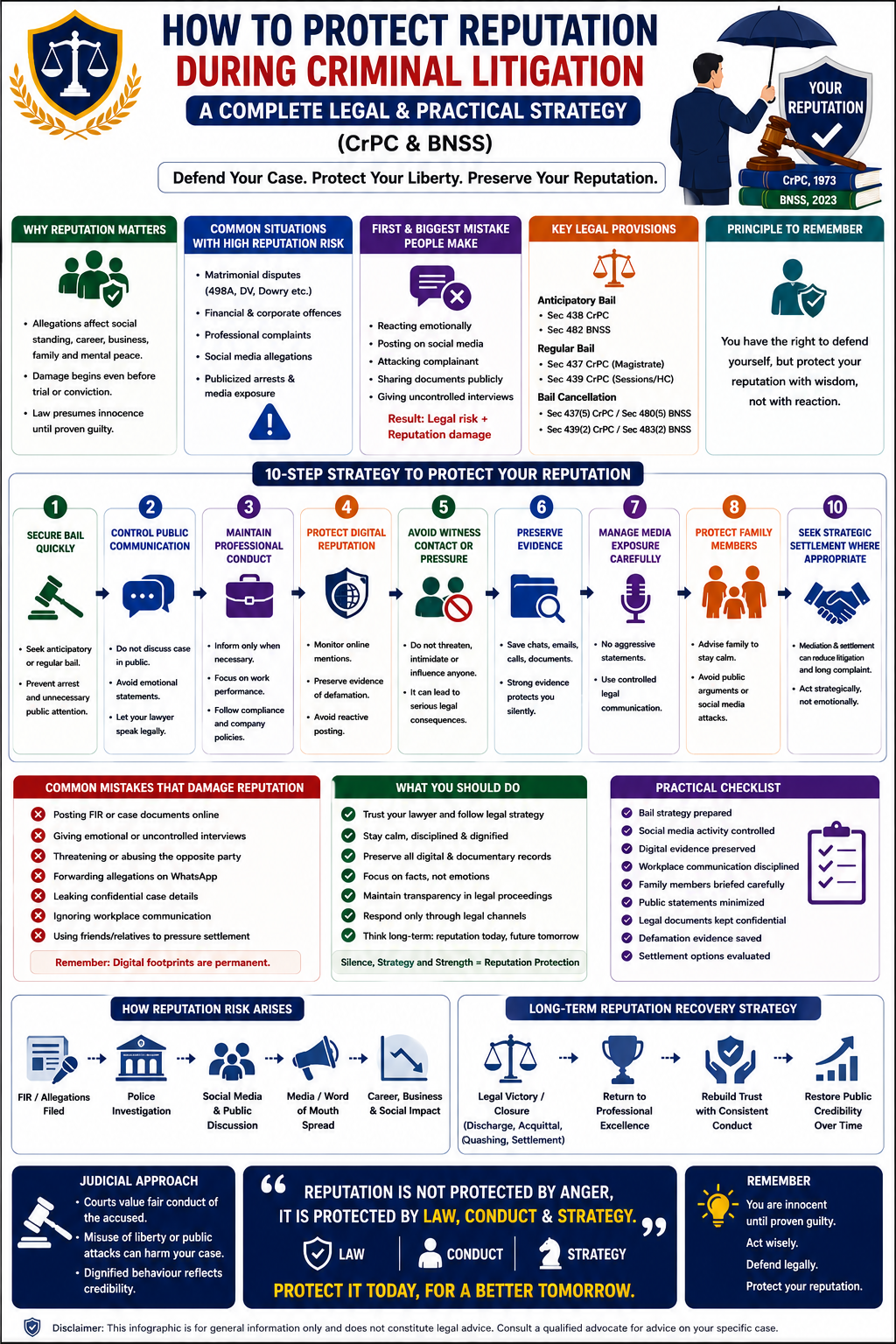
How to Protect Reputation During Criminal Litigation – A Complete Legal & Practical Strategy

Posted on May 21 by Suprajaa Rajan

Criminal litigation affects more than just legal rights—it can deeply impact a person’s reputation, career, family relationships, social standing, mental peace, and professional future. In many cases, especially involving:

  • Matrimonial disputes
  • Financial allegations
  • Corporate complaints
  • Sexual offence accusations
  • Social media controversies
  • Publicised arrests

the reputational damage begins long before trial concludes.

Unfortunately, many accused persons focus only on the courtroom battle while ignoring the parallel battle for reputation management. However, in modern litigation, public perception, digital footprints, media exposure, and social conduct can significantly influence both personal and professional consequences.

Therefore, understanding how to protect reputation during criminal litigation becomes just as important as preparing legal defence.

This article explains the legal safeguards, strategic precautions, media risks, digital reputation protection, workplace considerations, social media strategy, and practical defence measures, with references to the Code of Criminal Procedure, 1973 (CrPC) and the Bharatiya Nagarik Suraksha Sanhita, 2023 (BNSS).

Why Reputation Protection Matters During Criminal Litigation

Criminal allegations often trigger immediate consequences such as:

  • Social stigma
  • Workplace scrutiny
  • Suspension from employment
  • Loss of business relationships
  • Family pressure
  • Media exposure
  • Online defamation
  • Emotional isolation

Even before conviction, many people face “social punishment.”

However, Indian criminal law follows a foundational principle:

An accused is presumed innocent until proven guilty.

Therefore, protecting reputation lawfully and strategically becomes essential.

Common Situations Where Reputation Risks Arise

Reputation concerns frequently arise in:

Matrimonial Cases

Examples:

  • Section 498A allegations
  • Domestic violence complaints
  • Dowry accusations

Financial & Corporate Cases

Examples:

  • Fraud allegations
  • Cheating complaints
  • Breach of trust allegations

Professional Complaints

Examples:

  • Workplace harassment complaints
  • Regulatory proceedings

Public or Political Disputes

Examples:

  • Viral social media allegations
  • Media trials
  • Public accusations

Immediate Mistake Most Accused Persons Make

Many accused react emotionally by:

  • Posting online explanations
  • Uploading case documents
  • Attacking complainants publicly
  • Sending threatening messages
  • Giving uncontrolled interviews

These reactions often worsen both:

  • Legal exposure
  • Reputational damage

Therefore, controlled conduct becomes the first rule of reputation defence.

Step 1: Understand the Difference Between Legal Defence and Public Defence

Winning in court and protecting reputation are related—but different—objectives.

Legal Defence Focuses On:

  • Evidence
  • Procedure
  • Bail
  • Trial strategy

Reputation Protection Focuses On:

  • Public conduct
  • Professional stability
  • Digital footprint
  • Communication discipline
  • Social perception

A smart defence strategy addresses both simultaneously.

Step 2: Secure Bail Quickly

Arrest often causes the greatest reputational damage.

Therefore, obtaining timely bail becomes critical.

Relevant provisions include:

Anticipatory Bail

  • Section 438 CrPC (Section 482 BNSS)

Regular Bail

  • Section 437 CrPC (Section 480 BNSS)
  • Section 439 CrPC (Section 483 BNSS)

Prompt legal protection may help:

  • Prevent custodial humiliation
  • Reduce public escalation
  • Maintain employment stability
  • Avoid unnecessary media attention

Step 3: Control Public Communication

One of the most important rules:

Do not litigate emotionally in public.

Avoid:

  • Social media rants
  • Public accusations
  • Aggressive WhatsApp forwards
  • Emotional videos
  • Publishing confidential documents

Why?

Because these actions may:

  • Become evidence
  • Trigger fresh allegations
  • Harm settlement opportunities
  • Damage judicial perception

Step 4: Maintain Professional Conduct

If you are employed or running a business:

Inform Only When Necessary

Disclose matters carefully and professionally.

Avoid Emotional Narratives at Workplace

Keep communication factual.

Preserve Performance Records

Strong professional records support credibility.

Follow Internal Compliance Processes

Especially in regulated sectors.

Professional stability often protects reputation better than public defence.

Step 5: Protect Digital Reputation

Modern criminal litigation increasingly unfolds online.

Therefore, digital reputation management is essential.

Monitor Social Media Exposure

Check for:

  • Viral allegations
  • Fake posts
  • Defamatory content
  • Impersonation accounts

Preserve Evidence of Online Defamation

Save:

  • Screenshots
  • URLs
  • Timestamps
  • Comments
  • Shared posts

This may later support legal remedies.

Avoid Reactive Posting

Never respond impulsively.

Silence often protects credibility better than emotional explanation.

Step 6: Avoid Witness Contact or Pressure

After litigation begins, avoid:

  • Direct confrontation
  • Emotional calls
  • Threatening language
  • Settlement coercion

Such conduct may lead to allegations involving:

  • Witness intimidation
  • Obstruction
  • Bail cancellation

Relevant provisions include:

  • Section 437(5) CrPC (Section 480(5) BNSS)
  • Section 439(2) CrPC (Section 483(2) BNSS)

Controlled communication protects both liberty and reputation.

Step 7: Preserve Documentary and Digital Evidence

Strong evidence quietly protects reputation over time.

Preserve:

  • WhatsApp chats
  • Emails
  • Financial records
  • Employment documents
  • Call logs
  • Travel history
  • Medical records
  • Social media records

Well-preserved evidence often defeats false narratives.

Step 8: Manage Media Exposure Carefully

In high-profile cases, media involvement may become unavoidable.

If media attention arises:

Avoid Aggressive Public Statements

Statements made emotionally may later backfire.

Use Controlled Legal Communication

Only authorised legal responses should be issued.

Avoid Leaking Documents

Unauthorised disclosure may create complications.

Maintain Dignity

Courts often observe public conduct indirectly.

Step 9: Protect Family Members From Escalation

In matrimonial or family disputes, relatives often become emotionally involved.

Common mistakes include:

  • Public arguments
  • Social media attacks
  • Community pressure tactics
  • Verbal confrontations

These actions may:

  • Escalate litigation
  • Create additional evidence
  • Harm settlement possibilities

A disciplined family response matters.

Step 10: Use Legal Remedies Against False Public Allegations

If defamatory allegations spread publicly, legal remedies may be available.

Possible actions may include:

  • Defamation proceedings
  • Injunction applications
  • Takedown requests
  • Cyber complaints

However, strategy matters.

Not every public statement requires immediate aggressive litigation.

Sometimes controlled restraint works better.

Reputation Risks in Matrimonial Cases

Matrimonial criminal litigation creates unique reputational risks because allegations often involve:

  • Cruelty
  • Dowry harassment
  • Domestic violence
  • Emotional abuse

Social assumptions arise quickly—even before evidence is examined.

Therefore, accused persons should focus on:

Maintaining Dignified Conduct

Avoid retaliation.

Preserving Financial Transparency

Hidden financial conduct damages credibility.

Avoiding Public Character Assassination

Courts dislike vindictive conduct.

Pursuing Structured Settlement Where Appropriate

Strategic settlement often limits long-term reputational harm.

Reputation Risks for Professionals

Professionals such as:

  • Doctors
  • Lawyers
  • Government employees
  • Corporate executives
  • Teachers
  • Public figures

may face additional consequences.

Possible impacts include:

  • Suspension
  • Departmental inquiry
  • Licensing scrutiny
  • Client loss
  • Contract termination

Therefore, coordination between:

  • Criminal defence
  • Employment strategy
  • Regulatory compliance

becomes essential.

Common Mistakes That Damage Reputation Further

Avoid:

Publicly Sharing FIR Copies

May escalate online circulation.

Giving Uncontrolled Interviews

Statements may later contradict defence.

Posting Emotional Content Online

Digital footprints remain permanent.

Threatening the Opposite Party

May trigger fresh allegations.

Using Friends or Relatives to Pressure Settlement

Indirect intimidation can backfire.

Ignoring Professional Compliance

Silence at workplace may create suspicion.

Practical Reputation Protection Checklist

If facing criminal litigation, ensure:

  • Bail strategy prepared
  • Social media activity controlled
  • Digital evidence preserved
  • Workplace communication disciplined
  • Family members briefed carefully
  • Public statements minimized
  • Legal documents kept confidential
  • Defamation evidence archived
  • Settlement options evaluated strategically

Judicial Approach

Courts increasingly recognise:

  • Media trials
  • Social stigma
  • Online harassment
  • Misuse of digital narratives

At the same time, courts also examine:

  • Conduct of accused
  • Communication behaviour
  • Witness interaction
  • Digital activity

Therefore, reputation protection must always remain lawful and ethical.

Long-Term Reputation Recovery Strategy

Even after litigation stabilises, rebuilding reputation takes time.

Focus on:

Professional Consistency

Continue lawful work and responsibilities.

Controlled Public Presence

Avoid unnecessary public commentary.

Legal Closure

Seek:

  • Discharge
  • Acquittal
  • Quashing
  • Settlement where appropriate

Digital Clean-Up

Monitor online search visibility over time.

Conclusion

Criminal litigation can, thus, create serious reputational pressure—but panic, emotional reactions, and uncontrolled public conduct often make the situation worse.

By:

  • Securing timely legal protection
  • Preserving evidence
  • Maintaining disciplined communication
  • Avoiding social media escalation
  • Protecting professional credibility
  • Responding strategically rather than emotionally

an accused person can significantly reduce long-term reputational harm.

In modern criminal litigation, reputation is protected not by public anger—but by disciplined legal strategy and controlled conduct.


Index of Legal Strategies and Defence is here. 


Key Contributor : 

Mrs. Suprajaa Rajan B.Com., LL.B., LL.M.

+91-9606345150

Posted in Legal Procedure | Tagged CrPC 437 - Valid Duration For Regular Bail CrPC 438 - Anticipatory Bail CrPC 439 - Special powers of High Court or Court of Session regarding bail Legal Strategies and Defence Matrimonial Criminal Law Matrimonial Litigation India | Leave a comment

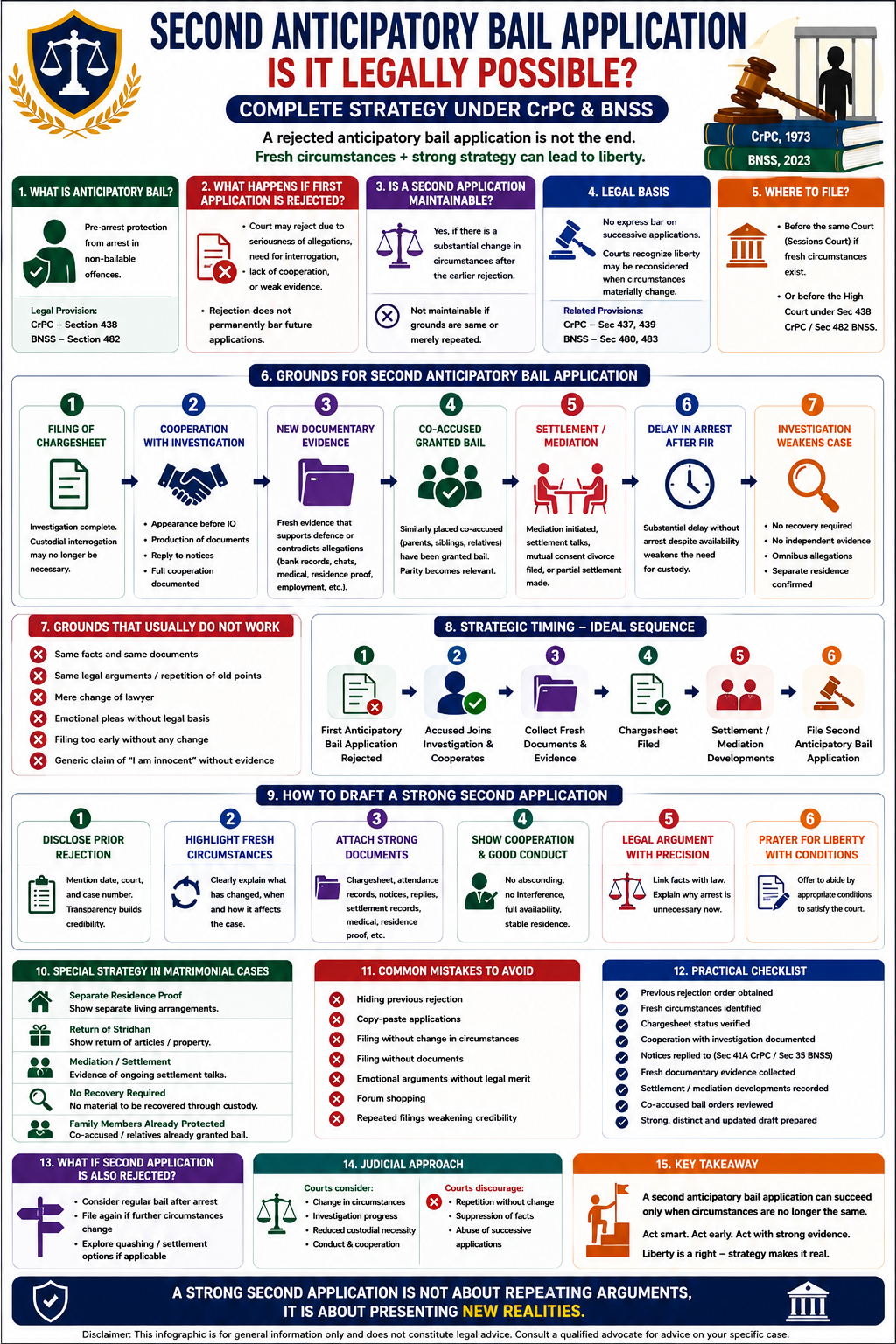
Second Anticipatory Bail Application – Is It Legally Possible? Complete Strategy

Posted on May 19 by Suprajaa Rajan

Anticipatory bail often becomes the first line of defence in criminal litigation, especially in sensitive matters involving:

  • Matrimonial disputes
  • Section 498A prosecutions
  • Financial offences
  • Family disputes
  • Property-related criminal complaints
  • Allegations involving multiple accused

However, an important question frequently arises after the first anticipatory bail application is rejected:

Can an accused file a second anticipatory bail application?

The short answer is:

Yes—but not automatically, and not on identical grounds.

Indian courts do permit a second anticipatory bail application, but only under legally sustainable circumstances such as change in circumstances, emergence of new facts, procedural developments, fresh evidence, or material changes in investigation.

Therefore, understanding when a second anticipatory bail application is maintainable—and how to strategically prepare it—can make the difference between liberty and custody.

This article explains the legal framework, maintainability principles, strategic grounds, judicial approach, drafting strategy, and defence tactics, with references to both the Code of Criminal Procedure, 1973 (CrPC) and the Bharatiya Nagarik Suraksha Sanhita, 2023 (BNSS).

What Is Anticipatory Bail?

Anticipatory bail protects a person from arrest in a non-bailable offence.

It allows the accused to seek pre-arrest protection when they reasonably apprehend arrest.

Relevant provisions include:

Under CrPC

  • Section 438 CrPC

Under BNSS

  • Section 482 BNSS

Courts granting anticipatory bail may impose conditions such as:

  • Cooperation with investigation
  • Appearance before investigating officer
  • Non-interference with witnesses
  • Travel restrictions
  • Preservation of evidence

What Happens If the First Anticipatory Bail Application Is Rejected?

The first anticipatory bail application may be rejected by:

  • Sessions Court
  • High Court

Common reasons include:

  • Serious allegations
  • Incomplete investigation
  • Need for custodial interrogation
  • Lack of cooperation
  • Weak documentation
  • Premature filing

However, rejection of the first application does not permanently bar future applications.

That said, a second application cannot become an appeal in disguise.

The accused must demonstrate something legally new.

Is a Second Anticipatory Bail Application Maintainable?

Yes.

A second anticipatory bail application is maintainable if there is a substantial change in circumstances after the earlier rejection.

Courts generally ask:

“What has changed since the previous rejection?”

If nothing material has changed, the second application may fail at the threshold.

Therefore, maintainability depends on fresh grounds—not repetition of old arguments.

Legal Basis for Successive Bail Applications

Although Section 438 CrPC (Section 482 BNSS) does not expressly mention successive applications, Indian courts recognise the principle that liberty may be reconsidered when circumstances materially change.

This principle also aligns with broader bail jurisprudence under:

  • Section 437 CrPC (Section 480 BNSS)
  • Section 439 CrPC (Section 483 BNSS)

Therefore, successive bail applications are not prohibited—but they require justification.

What Qualifies as “Change in Circumstances”?

This is the most critical question.

A second anticipatory bail application usually succeeds only when new developments arise.

Ground 1: Filing of Chargesheet

One of the strongest grounds.

Relevant provisions:

  • Section 173 CrPC (Section 193 BNSS) – Police report

Once the investigation is complete and the chargesheet is filed:

  • Custodial interrogation may become unnecessary
  • Evidence may already be collected
  • The prosecution’s need for arrest may weaken

Therefore, filing of chargesheet often becomes a valid fresh ground.

Ground 2: Cooperation With Investigation

If the earlier rejection was based on non-cooperation, subsequent cooperation may change the situation.

Examples:

  • Appearance before investigating officer
  • Production of documents
  • Joining investigation
  • Responding to notices

Relevant notice provision:

  • Section 41A CrPC (Section 35 BNSS)

Documented cooperation significantly improves credibility.

Ground 3: New Documentary Evidence

Fresh evidence may change the court’s view.

Examples:

  • Bank records
  • Travel documents
  • Digital chats
  • Medical records
  • Residence proof
  • Employment records

Such evidence may:

  • Contradict allegations
  • Show false implication
  • Prove separate residence
  • Disprove presence at the alleged incident

Ground 4: Co-Accused Granted Bail

If similarly placed co-accused obtain protection, parity becomes relevant.

Examples:

  • Parents granted bail
  • Siblings granted bail
  • Co-accused discharged from similar allegations

Parity is not automatic, but it strengthens the case.

Ground 5: Settlement Negotiations or Mediation

In matrimonial disputes, settlement developments may materially change the case.

Examples:

  • Mediation initiated
  • Settlement terms recorded
  • Mutual consent divorce filed
  • Partial settlement payments made

Courts may consider these developments.

Ground 6: Delay in Arrest Despite FIR

If substantial time passes after FIR registration and the accused remains available, the prosecution’s urgency may weaken.

Questions courts may consider:

  • Why was arrest not made earlier?
  • Was the accused available throughout?
  • Was there any attempt to abscond?

Delay can support a fresh application.

Ground 7: False or General Allegations Revealed During Investigation

Sometimes investigation itself weakens the prosecution.

Examples:

  • No recovery required
  • No independent witness support
  • Omnibus allegations against relatives
  • Separate residence confirmed

This may justify a fresh attempt.

Grounds That Usually Do NOT Work

Courts usually reject second applications based on:

  • Same facts
  • Same documents
  • Same legal arguments
  • Mere change of lawyer
  • Emotional pleas
  • Generic “I am innocent” claims

Repetition is not strategy.

Can You File Before the Same Court?

Possibly—but strategy matters.

Before Sessions Court

A second application before the Sessions Court may be maintainable if:

  • Fresh circumstances arise after rejection

Before High Court

If Sessions Court rejects relief, the accused may approach the High Court.

Relevant provision:

  • Section 438 CrPC (Section 482 BNSS)

The High Court independently examines maintainability.

Strategic Timing for the Second Application

Timing can determine success.

A strong sequence may look like:

Step 1 – First application rejected.

Step 2 – Accused joins investigation.

Step 3 – Documents collected.

Step 4 – Chargesheet filed.

Step 5 – Settlement or mediation begins.

Step 6 – Second anticipatory bail filed.

This creates a stronger narrative.

How to Draft a Strong Second Anticipatory Bail Application

The second application must clearly disclose:

Prior Rejection

Never suppress previous rejection.

Mention:

  • Date
  • Court
  • Case number

Transparency builds credibility.

Fresh Circumstances

Clearly identify:

  • What changed
  • When it changed
  • How it affects custodial necessity

This section often decides the case.

Documentary Support

Attach:

  • Chargesheet
  • Attendance proofs
  • Notice replies
  • Settlement records
  • Medical documents
  • Residence proof

Documents matter more than allegations.

Bail Conduct and Availability

Show:

  • Stable residence
  • No absconding
  • No witness interference
  • Full cooperation

Conduct influences discretion.

Special Strategy in Matrimonial Cases

In matrimonial prosecutions such as:

  • Section 498A IPC cases
  • Dowry allegations
  • Domestic violence-linked complaints

The following fresh grounds often become effective:

Separate Residence Proof

Parents or siblings living separately.

Return of Stridhan

Property already returned.

Mediation Proceedings

Settlement underway.

No Recovery Required

Custodial interrogation no longer necessary.

Family Members Already Protected

Parity argument strengthens.

Common Mistakes in Second Bail Applications

Avoid:

Hiding Previous Rejection

Courts treat suppression seriously.

Copy-Paste Drafting

Every fresh application must show fresh grounds.

Filing Too Early

Without change in circumstances.

Filing Without Documents

Assertions alone rarely work.

Emotional Arguments Without Legal Basis

Liberty requires legal structure.

What If the Second Application Is Also Rejected?

Further remedies may still exist depending on circumstances:

  • Fresh application after later developments
  • Regular bail after appearance
  • Interim protection in exceptional situations
  • Quashing or other strategic remedies

However, repeated applications without new grounds may harm credibility.

Practical Checklist Before Filing

Before filing a second anticipatory bail application, ensure:

  • Previous rejection order obtained
  • Fresh circumstances identified
  • Chargesheet status verified
  • Investigation cooperation documented
  • Notices responded to
  • Documentary evidence collected
  • Settlement developments recorded
  • Co-accused orders reviewed
  • Draft clearly distinguishes old and new grounds

Judicial Approach

Courts generally protect personal liberty—but they also guard against abuse of successive applications.

Courts look for:

  • Genuine change in circumstances
  • Procedural fairness
  • Reduced custodial necessity
  • Documentary credibility
  • Consistent conduct

Courts discourage:

  • Forum shopping
  • Repetitive litigation
  • Suppression of prior orders

Therefore, credibility becomes as important as legal merit.

Conclusion

A rejected anticipatory bail application is not necessarily the end of the road.

Indian criminal law allows a second anticipatory bail application—but only when:

  • Facts materially change
  • Investigation progresses
  • New evidence emerges
  • Cooperation improves
  • Settlement developments occur
  • Custodial necessity weakens

By:

  • Acting strategically
  • Preserving documents
  • Demonstrating cooperation
  • Drafting with precision
  • Filing at the right time

an accused can significantly improve the chances of securing pre-arrest protection.

In criminal litigation, a second bail application succeeds not because it is repeated—but because the circumstances are no longer the same.


Related Legal Concepts

  • Anticipatory Bail Strategy in Matrimonial Cases
  • How to Reply to Section 41A Notice
  • Bail Conditions – How to Avoid Cancellation
  • Compromise-Based Quashing in Matrimonial Cases
  • What Happens After Chargesheet


Index of Legal Strategies and Defence is here. 


Key Contributor : 

Mrs. Suprajaa Rajan B.Com., LL.B., LL.M.

+91-9606345150

Posted in Legal Procedure | Tagged Anticipatory bail CrPC 438 - Anticipatory Bail Legal Strategies and Defence legal strategy Pre-Arrest bail | Leave a comment

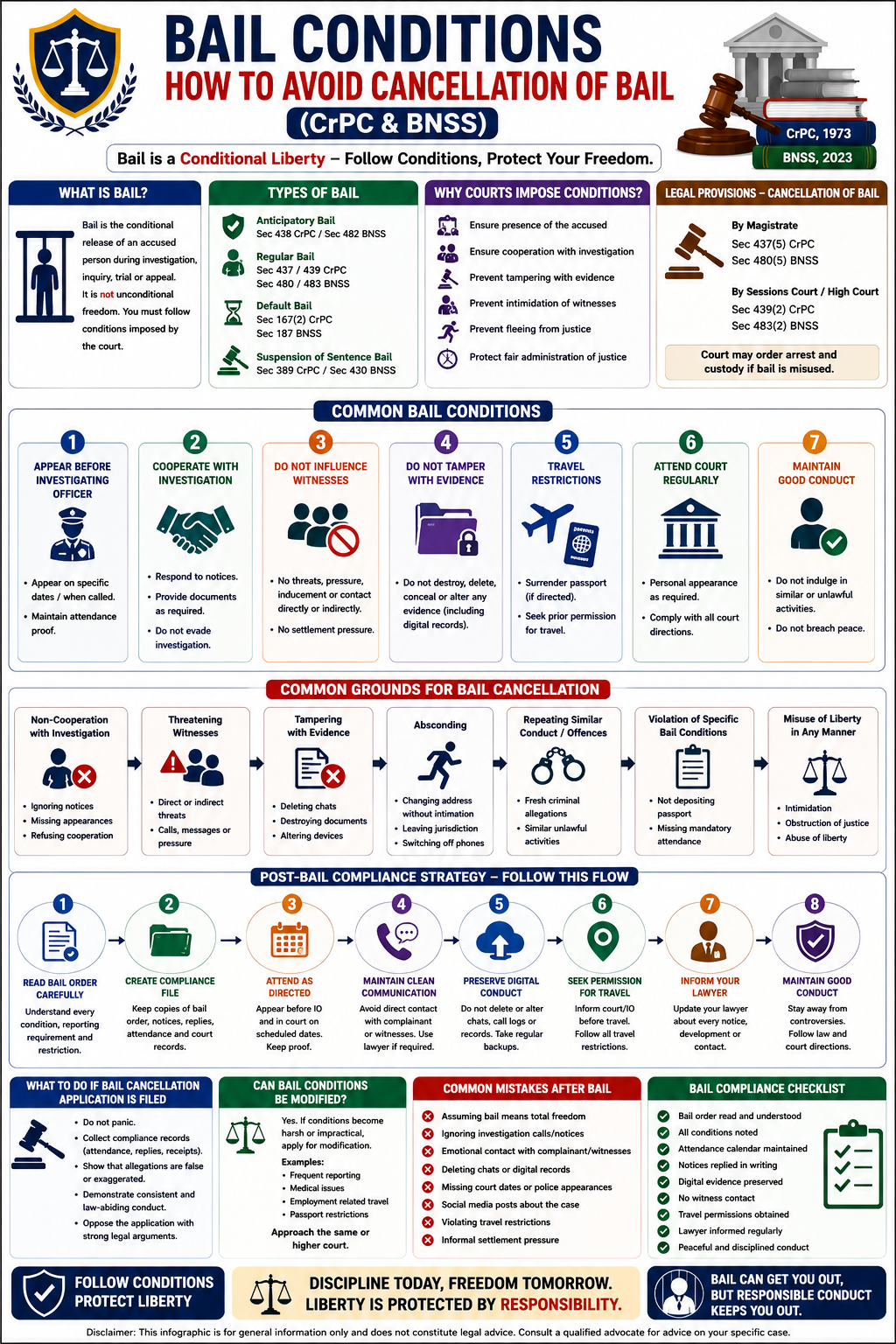
Bail Conditions – How to Avoid Cancellation of Bail

Posted on May 8 by Suprajaa Rajan

Obtaining bail is often the first major legal relief in criminal litigation. Whether the accused secures anticipatory bail, regular bail, interim bail, or default bail, the grant of bail does not end legal responsibility. In fact, the real challenge begins after bail is granted.

Many accused persons mistakenly believe:

“Once I get bail, the risk is over.”

Legally, that assumption can be dangerous.

Courts may cancel bail if the accused violates conditions, misuses liberty, interferes with investigation, intimidates witnesses, or attempts to obstruct justice.

Therefore, understanding bail conditions and how to avoid cancellation of bail becomes critical for every accused person, family member, and defence lawyer.

This article explains the legal framework, common bail conditions, cancellation grounds, compliance strategy, defence tactics, and practical safeguards, with references to both the Code of Criminal Procedure, 1973 (CrPC) and the Bharatiya Nagarik Suraksha Sanhita, 2023 (BNSS).

What Does Bail Actually Mean?

Bail is the conditional release of an accused person during:

  • Investigation
  • Inquiry
  • Trial
  • Appeal

The court allows liberty while ensuring:

  • Presence during proceedings
  • Cooperation with investigation
  • Protection of evidence
  • Fair administration of justice

However, bail is conditional liberty—not unconditional freedom.

Types of Bail Where Conditions May Apply

Conditions may be imposed in:

Anticipatory Bail

  • Section 438 CrPC (BNSS Section 482)

Regular Bail

  • Section 437 CrPC (BNSS Section 480) – Magistrate
  • Section 439 CrPC (BNSS Section 483) – Sessions Court/High Court

Default Bail

  • Section 167(2) CrPC (BNSS Section 187)

Suspension of Sentence Bail

  • Section 389 CrPC (BNSS Section 430)

Each form of bail may carry specific conditions.

Why Courts Impose Bail Conditions

Courts impose conditions to ensure that the accused:

  • Appears when required
  • Cooperates with investigation
  • Does not tamper with evidence
  • Does not threaten witnesses
  • Does not repeat alleged offences
  • Does not flee jurisdiction

Courts balance:

Personal liberty vs administration of justice

Common Bail Conditions

Although conditions vary by case, courts frequently direct:

Condition 1: Appear Before Investigating Officer

Particularly in anticipatory bail matters.

Examples:

  • Weekly appearance
  • Appearance on specific dates
  • Appearance when called

Failure may be treated as non-cooperation.

Practical Tip

Always maintain:

  • Attendance proof
  • Signed appearance records
  • Written communication with investigating officer

Condition 2: Cooperate With Investigation

Courts often direct:

“The accused shall cooperate with investigation.”

This may include:

  • Responding to notices
  • Producing documents
  • Giving specimen signatures
  • Providing electronic devices where lawfully required

Relevant notice provision:

  • Section 41A CrPC (BNSS Section 35)

Ignoring notices may trigger cancellation attempts.

Condition 3: Do Not Influence Witnesses

Courts routinely prohibit:

  • Direct contact
  • Threats
  • Pressure
  • Financial inducement
  • Settlement coercion

Even indirect contact through relatives may create problems.

Condition 4: Do Not Tamper With Evidence

Examples include:

  • Deleting chats
  • Destroying documents
  • Altering devices
  • Influencing documentary records

Digital evidence preservation is increasingly important.

Condition 5: Travel Restrictions

Courts may require:

  • Passport surrender
  • Prior permission for foreign travel
  • Travel disclosure

Especially in:

  • Economic offences
  • NRI matrimonial disputes
  • Fraud allegations

Condition 6: Attend Court Regularly

Courts expect:

  • Personal appearance where required
  • Compliance with exemptions

Relevant provision:

  • Section 205 CrPC (BNSS Section 227) – Exemption from personal appearance

Repeated absence can create complications.

Condition 7: Maintain Good Conduct

Courts may direct:

  • No similar offence
  • No unlawful activity
  • No breach of peace

Fresh criminal allegations may trigger cancellation proceedings.

Can Bail Be Cancelled?

Yes.

Bail can be cancelled if liberty is misused.

Relevant provisions:

Magistrate Bail Cancellation

  • Section 437(5) CrPC (BNSS Section 480(5))

Sessions Court/High Court Bail Cancellation

  • Section 439(2) CrPC (BNSS Section 483(2))

These courts may direct:

Arrest and custody of the accused.

Therefore, compliance after bail becomes essential.

Common Grounds for Bail Cancellation

Ground 1: Non-Cooperation With Investigation

Examples:

  • Ignoring notices
  • Missing appearances
  • Refusing lawful cooperation

Defence Strategy

Always:

  • Reply in writing
  • Preserve acknowledgments
  • Inform counsel immediately

Ground 2: Threatening Witnesses

Examples:

  • Calls
  • WhatsApp messages
  • Social media posts
  • Third-party pressure

Even emotional messages may be misinterpreted.

Defence Strategy

After bail:

  • Avoid direct communication
  • Use lawyers for settlement discussions
  • Preserve communication records

Ground 3: Tampering With Evidence

Examples:

  • Deleting messages
  • Altering files
  • Removing financial records

Courts take digital tampering seriously.

Defence Strategy

Preserve:

  • Devices
  • Chats
  • Emails
  • Cloud backups

Ground 4: Absconding

Examples:

  • Changing address without intimation
  • Leaving jurisdiction secretly
  • Switching off phones continuously

Defence Strategy

Always update:

  • Address
  • Phone number
  • Email

Maintain availability.

Ground 5: Repeating Similar Conduct

Examples:

  • Fresh harassment allegations
  • New criminal complaints
  • Violent confrontations

Defence Strategy

Maintain strict personal discipline.

Ground 6: Violation of Specific Bail Conditions

Examples:

  • Failure to deposit passport
  • Missing mandatory attendance
  • Violating travel restrictions

Defence Strategy

Maintain a compliance calendar.

Special Risk in Matrimonial Cases

In matrimonial litigation, bail cancellation applications commonly allege:

  • Threats to complainant
  • Settlement pressure
  • Contact through relatives
  • Social media harassment
  • Financial coercion
  • Return of stridhan disputes

These allegations may be exaggerated.

Therefore, accused persons must act cautiously.

Practical Post-Bail Compliance Strategy

Step 1: Read the Bail Order Carefully

Do not rely on verbal explanations.

Read:

  • Every condition
  • Every reporting requirement
  • Every travel restriction

Keep digital and printed copies.

Step 2: Create a Bail Compliance File

Maintain:

  • Bail order
  • Attendance proofs
  • Investigation notices
  • Replies
  • Court attendance records

Documentation defeats false allegations.

Step 3: Maintain Controlled Communication

If communication is unavoidable:

Use:

  • Email
  • Lawyer correspondence
  • Recorded written communication

Avoid:

  • Emotional phone calls
  • Voice notes
  • Informal intermediaries

Step 4: Preserve Digital Conduct

Do not:

  • Delete chats
  • Remove call logs
  • Change devices carelessly

Instead:

  • Create backups
  • Preserve originals
  • Maintain metadata

Step 5: Seek Permission Before Travel

If the bail order restricts travel:

Apply before:

  • Domestic relocation
  • Foreign travel
  • Extended absence

Never assume permission.

Step 6: Inform Counsel About Every Development

Inform your lawyer immediately if:

  • Police call you
  • Witness contacts you
  • New allegations arise
  • Settlement discussions begin

Early response prevents escalation.

What to Do If Someone Files for Bail Cancellation

Do not panic.

Take immediate action:

Collect Compliance Records

Produce:

  • Attendance records
  • Call logs
  • Emails
  • Travel permissions
  • Investigation replies

Challenge False Allegations

Demonstrate:

  • No contact
  • No tampering
  • No evasion

Show Consistent Conduct

Highlight:

  • Regular appearances
  • Cooperation
  • Stable residence
  • No fresh offences

Courts value conduct.

Can Bail Conditions Be Modified?

Yes.

If conditions become impractical, seek modification.

Examples:

  • Frequent police attendance
  • Passport restrictions
  • Medical limitations
  • Employment-related travel

Apply before the same court or appropriate superior court.

Common Mistakes After Bail

Avoid:

Assuming Bail Means Total Freedom

Bail remains conditional.

Ignoring Investigation Calls

Non-cooperation creates risk.

Emotional Contact With Complainant

Messages may become evidence.

Informal Settlement Pressure

Can be portrayed as intimidation.

Missing Court Dates

Repeated absence creates adverse perception.

Social Media Commentary

Public posts may backfire.

Practical Bail Compliance Checklist

After securing bail, ensure:

  • Bail order copied and reviewed
  • Conditions explained clearly
  • Attendance calendar created
  • Passport compliance completed
  • Digital evidence preserved
  • No direct witness contact
  • Travel restrictions understood
  • Lawyer updated regularly

Judicial Approach

The Courts generally protect liberty—but only when liberty is responsibly exercised.

Courts look for:

  • Cooperation
  • Transparency
  • Consistency
  • Respect for process

Courts act strictly against:

  • Intimidation
  • Delay tactics
  • Evidence destruction
  • Abuse of judicial protection

Your conduct after bail often influences the entire trial.

Conclusion

Securing bail is a major relief—but keeping bail intact requires discipline.

Many accused lose strategic advantage not because of weak legal arguments, but because of careless post-bail conduct.

By:

  • Understanding every bail condition
  • Maintaining written compliance
  • Avoiding emotional reactions
  • Preserving digital evidence
  • Respecting court directions

you can significantly reduce the risk of cancellation.

In criminal litigation, bail protects liberty—but disciplined conduct protects bail.


Index of Legal Strategies and Defence is here. 


Key Contributor : 

Mrs. Suprajaa Rajan B.Com., LL.B., LL.M.

+91-9606345150

Posted in Legal Procedure | Tagged BNSS CrPC 167 - Default Bail CrPC 167(2) - Default or Statutory Bail CrPC 389 - Suspension of sentence pending the appeal; release of appellant on bail CrPC 438 - Anticipatory Bail CrPC 439 - Special powers of High Court or Court of Session regarding bail Legal Strategies and Defence Regular Bail Orders u/s 437 | Leave a comment

Strategic Divorce Filing After Criminal Complaint – A Legal Perspective

Posted on April 27 by Suprajaa Rajan

Introduction

In matrimonial disputes, it is increasingly common for one spouse to initiate criminal proceedings (such as cruelty, dowry harassment, or domestic violence) before or alongside divorce proceedings. This raises a critical question—should and when should the other spouse file for divorce after a criminal complaint?

Filing for divorce after a criminal complaint is not merely a reactive step. Instead, it can be a strategic legal decision that influences both civil and criminal proceedings.

This article explains the timing, legal grounds, and strategic advantages of filing for divorce after a criminal complaint, along with procedural aspects under the Code of Civil Procedure, 1908, the Hindu Marriage Act, 1955, and relevant criminal provisions under CrPC and BNSS.

Understanding the Legal Landscape

When a criminal complaint is filed (commonly under Section 498A IPC or domestic violence laws), two parallel legal tracks may emerge:

  1. Criminal Proceedings
  2. Civil Matrimonial Proceedings (Divorce)

These proceedings are independent, but they often influence each other in practice.

Why Consider Divorce After a Criminal Complaint?

Filing for divorce after a criminal complaint can serve multiple legal and strategic purposes.

1. Allegations May Constitute Mental Cruelty

False or exaggerated criminal allegations can amount to mental cruelty, which is a valid ground for divorce under:

  • Section 13 Hindu Marriage Act

Courts have repeatedly held that false criminal cases against a spouse or their family can justify dissolution of marriage.

2. Break Down of Matrimonial Relationship

A criminal complaint often reflects:

  • Complete breakdown of trust
  • Irretrievable breakdown of marriage (though not a statutory ground, courts consider it)

Therefore, filing for divorce acknowledges the practical reality of a failed marriage.

3. Strategic Pressure for Settlement

Divorce proceedings can:

  • Encourage settlement discussions
  • Lead to mediation or mutual consent divorce
  • Balance negotiating positions between parties

Thus, it becomes a strategic legal counterstep.

When Should You File for Divorce?

Timing plays a crucial role in maximising legal advantage.

1. After Filing of FIR

Once an FIR is registered under:

  • Section 154 CrPC (Section 173 BNSS)

you may consider initiating divorce proceedings.

At this stage:

  • Allegations are formally on record
  • You can rely on the contents of the complaint

2. After Interim Protection or Bail

It is often advisable to file for divorce after securing:

  • Anticipatory bail → Section 438 CrPC (Section 482 BNSS)

This ensures:

  • Protection from arrest
  • Stability to pursue civil proceedings

3. After Chargesheet or Weak Evidence

If the investigation results in:

  • Weak chargesheet → Section 173 CrPC (Section 193 BNSS)
  • Lack of evidence

you gain a stronger footing to claim false implication and cruelty.

4. After Acquittal (Strongest Ground)

If the court acquits the accused:

  • It significantly strengthens the divorce case
  • It establishes falsity of allegations

This becomes the most powerful ground for divorce based on cruelty.

Legal Grounds for Divorce in Such Cases

1. Mental Cruelty

False criminal allegations, harassment through legal proceedings, and damage to reputation constitute mental cruelty.

2. Desertion (if applicable)

If the complainant has:

  • Left the matrimonial home
  • Refused cohabitation

you may also invoke desertion as an additional ground.

3. Irretrievable Breakdown (Judicial Consideration)

Although not codified, courts often consider irretrievable breakdown of marriage in such disputes.

Step-by-Step Strategic Approach

Step 1: Secure Criminal Law Protection

First, ensure:

  • Anticipatory bail
  • Protection from coercive action

Step 2: Analyse Allegations

Carefully evaluate:

  • Nature of allegations
  • Evidence on record
  • Role attributed to each accused

Step 3: Decide Timing of Divorce Petition

Choose timing based on:

  • Stage of criminal case
  • Strength of evidence
  • Settlement possibilities

Step 4: Draft Divorce Petition Strategically

Your petition should clearly highlight:

  • False allegations
  • Harassment through legal proceedings
  • Impact on mental health and reputation

Step 5: Explore Settlement Options

Simultaneously consider:

  • Mediation
  • Mutual consent divorce
  • Comprehensive settlement agreements

Impact on Criminal Proceedings

While divorce and criminal cases are separate:

  • Statements in divorce petitions can be used in criminal trial
  • Settlement in matrimonial disputes may lead to quashing of FIR

Relevant provision:

  • Section 482 CrPC (Section 528 BNSS)

Thus, both proceedings often become strategically interconnected.

Judicial Approach

Courts adopt a balanced view:

  • They protect genuine victims
  • They discourage misuse of criminal law

Courts have repeatedly held that:

  • Filing false criminal complaints amounts to cruelty
  • Matrimonial litigation should not become a tool of harassment

Risks and Considerations

Before filing for divorce, you must consider:

  • Ongoing criminal liability
  • Possibility of counter-allegations
  • Impact on settlement negotiations

A poorly timed divorce petition may weaken your position.

Conclusion

Filing for divorce after a criminal complaint is not merely a reaction—it is a strategic legal decision.

By:

  • Choosing the right timing
  • Securing criminal law protection
  • Highlighting false allegations as cruelty

you can effectively strengthen your case in matrimonial proceedings.

A well-planned approach ensures that both criminal defence and matrimonial strategy work in alignment, leading to better legal outcomes.


Related Legal Concepts

  • First Information Report (FIR)
  • Anticipatory Bail
  • Quashing of FIR
  • Mental Cruelty in Divorce
  • Chargesheet

Index of Legal Strategies and Defence is here. 


Key Contributor : 

Mrs. Suprajaa Rajan B.Com., LL.B., LL.M.

+91-9606345150


Posted in Legal Procedure | Tagged 498A cases CrPC 438 - Anticipatory Bail Divorce Strategy Legal Strategies and Defence Matrimonial dispute Matrimonial law | Leave a comment

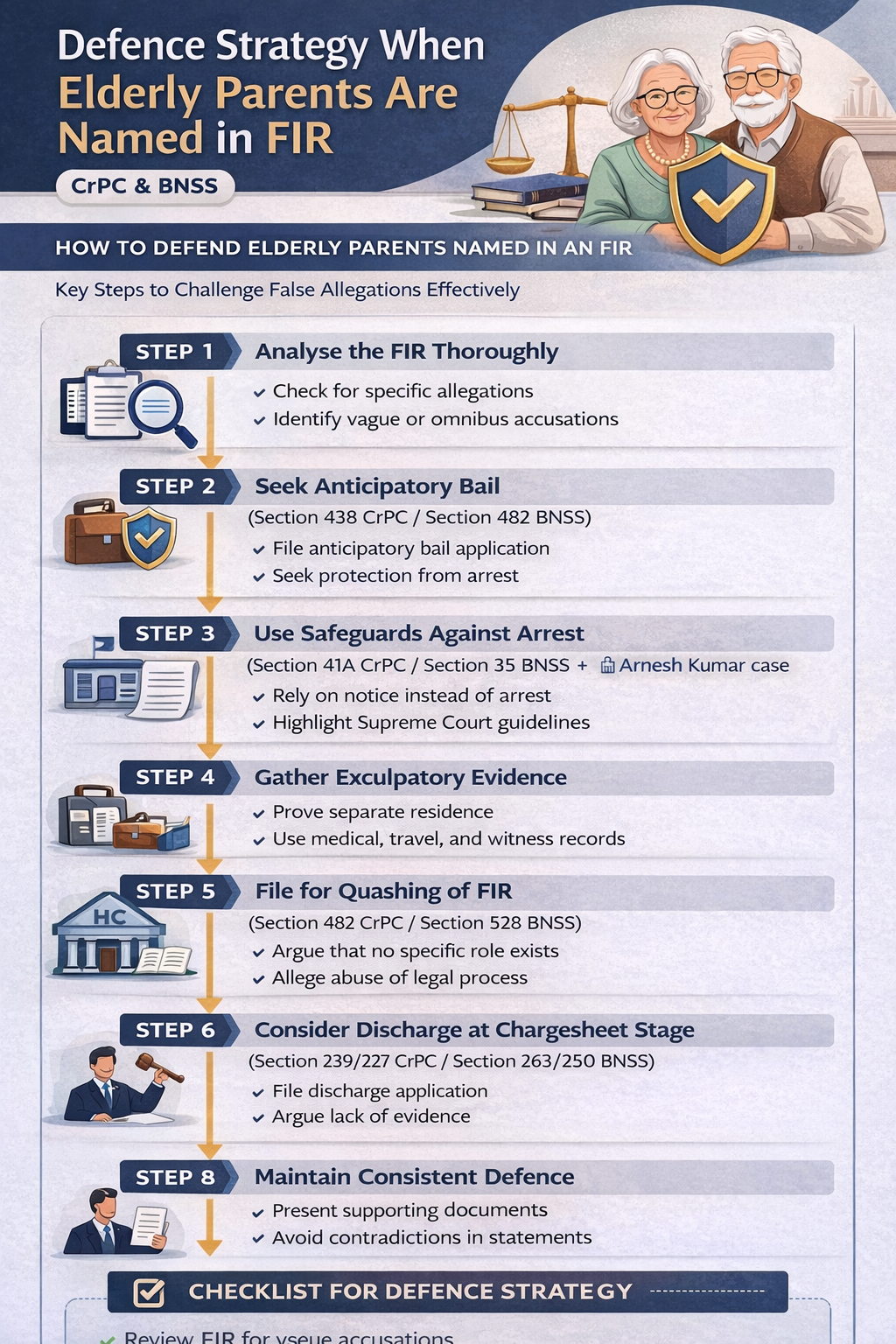
Defence Strategy When Elderly Parents Are Named in FIR

Posted on April 3 by Suprajaa Rajan

In matrimonial and family disputes, complainants often name multiple family members, including elderly parents, in a First Information Report (FIR). However, courts have consistently cautioned against the mechanical implication of relatives without specific allegations.

Therefore, when an FIR includes elderly parents, you must adopt a focused legal defence strategy. You should highlight the absence of direct involvement, lack of evidence, and misuse of criminal law provisions.

This article explains the legal remedies and defence strategies available when elderly parents are falsely implicated, along with relevant provisions under the Code of Criminal Procedure, 1973 (CrPC) and the Bharatiya Nagarik Suraksha Sanhita, 2023 (BNSS).

Understanding the Legal Position

The police register an FIR under Section 154 CrPC (Section 173 BNSS) when they receive information about a cognizable offence. After registration, the investigation begins, and all named persons may face legal scrutiny.

However, courts do not rely solely on allegations. Instead, they examine:

  • Specific acts attributed to each accused
  • Supporting evidence
  • The individual role of each person

In many cases, complaints contain general and vague allegations against elderly parents, which you can challenge at an early stage.

Step 1: Analyse the FIR Carefully

First, you must carefully examine the FIR. A strong defence always begins with identifying weaknesses in the complaint.

You should check:

  • Whether the FIR contains specific allegations
  • Whether it mentions dates, events, or overt acts
  • Whether allegations appear vague or omnibus

If the complaint lacks specificity, you can argue that it fails to disclose a prima facie case against elderly parents.

Step 2: Seek Protection from Arrest

Next, you should promptly seek protection from arrest by filing an anticipatory bail application.

You can file this application under:

  • Section 438 CrPC (Section 482 BNSS)

Courts generally adopt a lenient approach toward elderly parents, especially when:

  • They reside separately
  • They have no direct involvement
  • The allegations appear exaggerated

Additionally, courts consider age, health, and dependency factors while granting relief.

Step 3: Rely on Safeguards Against Arbitrary Arrest

You should also rely on statutory safeguards that prevent unnecessary arrests.

The police must issue a notice of appearance under:

  • Section 41A CrPC (Section 35 BNSS)

instead of making immediate arrests when the accused cooperates with the investigation.

Further, the Supreme Court in
Arnesh Kumar v. State of Bihar
directed authorities to avoid automatic arrests in matrimonial offences.

Therefore, elderly parents can use these safeguards to prevent unjustified detention and harassment.

Step 4: Gather Evidence Showing Lack of Involvement

After securing protection, you should collect evidence that demonstrates the absence of involvement.

You should gather:

  • Proof of separate residence
  • Medical records indicating age-related limitations
  • Travel records
  • Independent witness statements

This evidence helps establish that the allegations are false, exaggerated, or legally unsustainable.

Step 5: File for Quashing of FIR

If the FIR clearly lacks specific allegations, you should approach the High Court to quash the proceedings.

You can invoke:

  • Section 482 CrPC (Section 528 BNSS)

The High Court may quash proceedings when:

  • Allegations are vague or omnibus
  • No specific role is attributed
  • Continuation of proceedings amounts to abuse of process

Courts frequently grant relief to elderly parents in such circumstances.

Step 6: Seek Discharge at Chargesheet Stage

If the police file a chargesheet, you should consider filing a discharge application.

Relevant provisions include:

  • Section 239 CrPC (Section 263 BNSS) – Warrant cases
  • Section 227 CrPC (Section 250 BNSS) – Sessions cases

You can argue that:

  • No evidence exists against elderly parents
  • The chargesheet fails to establish involvement
  • The case relies on assumptions rather than proof

If the court agrees, it may discharge the accused at this stage.

Step 7: Challenge Mechanical Implication of Relatives

Courts consistently discourage the practice of implicating all family members without distinction.

Therefore, you should emphasize:

  • Absence of specific allegations
  • Lack of direct interaction with the complainant
  • No supporting evidence

This approach aligns with judicial principles that prevent misuse of criminal law in matrimonial disputes.

Step 8: Maintain a Consistent Defence Strategy

Finally, you must maintain a consistent and structured defence throughout the proceedings.

You should:

  • Avoid contradictory statements
  • Cooperate with the investigation
  • Present documentary evidence at each stage

A consistent defence strengthens credibility and improves the chances of relief.

Judicial Approach

Courts recognise that false implication of elderly parents can lead to serious injustice and misuse of the legal process.

Therefore, courts often:

  • Grant anticipatory bail
  • Quash proceedings where appropriate
  • Discharge accused in absence of evidence

This balanced approach ensures that only genuine cases proceed to trial.

Conclusion

When elderly parents are named in an FIR, the law provides multiple safeguards to protect them from unjust prosecution.

You should:

  • Analyse the FIR thoroughly
  • Seek anticipatory bail under Section 438 CrPC (Section 482 BNSS)
  • Invoke High Court powers under Section 482 CrPC (Section 528 BNSS)
  • File for discharge under Section 239/227 CrPC (Section 263/250 BNSS)

By adopting a structured legal strategy, you can effectively challenge false allegations and protect innocent family members.


Index of Legal Strategies and Defence is here.


Related Legal Concepts

Explore related stages and concepts in criminal procedure:

  • First Information Report 
  • Anticipatory Bail
  • Quashing of FIR
  • Discharge of an accused
  • Inherent powers of High Court


Key Contributor :
Mrs. Suprajaa Rajan B.Com., LL.B., LL.M.
+91-9606345150


Posted in Legal Procedure | Tagged 498A defence strategy BNSS Code of Criminal Procedure CrPC 239 - Discharge CrPC 438 - Anticipatory Bail Legal Strategies and Defence | Leave a comment

Draft Format of Anticipatory Bail Application (Section 438 CrPC)

Posted on March 6 by Suprajaa Rajan

A practical drafting guide and sample format for filing an anticipatory bail application under Indian criminal procedure.

Anticipatory bail is one of the most important safeguards available under Indian criminal law. Specifically, Section 438 of the Code of Criminal Procedure, 1973 allows a person who apprehends arrest to seek pre-arrest bail from the Sessions Court or High Court.

In matrimonial criminal cases, anticipatory bail is frequently sought in allegations under Section 498A IPC, Section 406 IPC, and related offences. Therefore, drafting an anticipatory bail application requires clarity, precision, and a well-structured presentation of facts.

This guide explains when anticipatory bail can be filed, the legal principles governing it, and a structured draft format that can be adapted based on facts of each case.

I. Legal Basis of Anticipatory Bail

The concept of anticipatory bail was introduced to protect personal liberty against arbitrary arrest.

The Supreme Court in Gurbaksh Singh Sibbia v. State of Punjab held that anticipatory bail is a device to secure individual liberty and prevent misuse of the criminal process.

Subsequently, the Court in Siddharam Satlingappa Mhetre v. State of Maharashtra emphasised that arrest should not be used as a routine measure where investigation can proceed without custody.

Therefore, anticipatory bail operates as a preventive remedy against unnecessary detention.

II. When Anticipatory Bail Can Be Filed

You can file an application under Section 438 CrPC when:

  • The applicant reasonably apprehends arrest

  • An FIR has been registered or is likely to be registered

  • Allegations involve offences where arrest is possible

  • The applicant is willing to cooperate with investigation

In matrimonial criminal litigation, anticipatory bail is commonly sought immediately after registration of FIR or receipt of notice under Section 41A CrPC.

Read also : Anticipatory Bail in Matrimonial Offences – Complete Guide.

III. Key Elements of a Strong Anticipatory Bail Application

Before drafting, you should incorporate certain essential elements.

1. Clear narration of facts

The application should briefly describe the background of the dispute and circumstances leading to registration of the FIR.

2. Explanation of false implication

Where allegations are exaggerated or motivated, the applicant should explain the circumstances demonstrating false implication or exaggeration.

3. Absence of criminal antecedents

Courts often consider whether the applicant has prior criminal history.

4. Willingness to cooperate

A clear undertaking to cooperate with investigation significantly strengthens the request for bail.

5. Assurance against tampering with evidence

The applicant should state that he or she will not influence witnesses or obstruct investigation.

These elements collectively demonstrate bona fide conduct and respect for the legal process.

IV. Sample Draft Format – Anticipatory Bail Application


Sample Draft – Anticipatory Bail Application (Section 438 CrPC)

BEFORE THE HONOURABLE SESSIONS COURT AT [CITY]

Criminal Miscellaneous Application under Section 438 CrPC

In the matter of:

[Applicant Name]
…Applicant

Versus

State of [State]
…Respondent


APPLICATION UNDER SECTION 438 OF THE CODE OF CRIMINAL PROCEDURE, 1973 SEEKING ANTICIPATORY BAIL

Most Respectfully Submitted:

1. That the Applicant is a law-abiding citizen and has deep roots in society.

2. That the present application is being filed under Section 438 of the Code of Criminal Procedure, 1973 as the Applicant apprehends arrest in connection with FIR No. [____] registered at [Police Station] for offences alleged under Sections [____].

3. That the allegations made in the FIR are false, exaggerated and motivated by matrimonial discord between the parties.

4. That the Applicant has not committed any offence as alleged and has been falsely implicated due to personal differences.

5. That the Applicant has no criminal antecedents and has always cooperated with lawful authorities.

6. That the Applicant is willing to cooperate with the investigation and undertakes to appear before the Investigating Officer whenever required.

7. That the Applicant undertakes not to tamper with evidence or influence any witnesses.

8. That custodial interrogation of the Applicant is not required for the purpose of investigation.

9. That arrest of the Applicant would cause irreparable harm to his reputation and personal liberty.

10. That the Applicant undertakes to abide by any conditions that may be imposed by this Hon’ble Court.

PRAYER

In view of the facts and circumstances stated above, it is most respectfully prayed that this Hon’ble Court may be pleased to:

a) Grant anticipatory bail to the Applicant in the event of arrest in connection with the aforesaid FIR; and

b) Pass any other order deemed fit and proper in the interest of justice.


Place: [City]
Date: [Date]


Counsel for the Applicant
[Signature]

✔ Draft Copied Successfully!

V. Documents Commonly Filed Along With the Application

Generally, the following documents accompany the application:

  • Copy of FIR (if available)

  • Identity proof of applicant

  • Supporting documents (where relevant)

  • Affidavit verifying the application

These documents assist the court in evaluating the bona fides of the applicant.

VI. Important Drafting Tips

While drafting anticipatory bail applications, the following principles are crucial.

  • First, allegations should be addressed briefly and strategically, rather than arguing the entire case.
  • Secondly, unnecessary emotional language should be avoided.
  • Furthermore, the application should maintain a respectful and professional tone, demonstrating willingness to cooperate with investigation.
  • Finally, facts should remain consistent with other pleadings filed in related matrimonial proceedings.

VII. Common Mistakes to Avoid

Certain mistakes can weaken an anticipatory bail application.

These include:

  • Excessively lengthy narration of facts

  • Admission of disputed allegations

  • Aggressive language against the complainant

  • Failure to mention cooperation with investigation

Therefore, maintaining clarity and restraint in drafting is essential.

Conclusion

Anticipatory bail serves as an essential safeguard protecting individuals from unnecessary arrest. Consequently, a well-drafted application can significantly influence the court’s decision.

By clearly presenting facts, demonstrating cooperation, and addressing the legal requirements of Section 438 CrPC, applicants can effectively seek protection of their liberty.

However, each case depends on its specific circumstances. Therefore, the draft format provided above should always be adapted to the facts and procedural posture of the case.


Index of Legal Templates and Drafting is here.


Disclaimer

These templates are provided for educational and informational purposes. Every case depends on specific facts and procedural posture. Professional legal advice should be obtained before filing any application.


Key Contributor :

Mrs. Suprajaa Rajan B.Com., LL.B., LL.M.

+91-9606345150


Posted in Legal Procedure | Tagged Anticipatory Bail format Bail Application High Court or Sessions Court Maintainable Criminal Procedure India CrPC 438 - Anticipatory Bail | Leave a comment

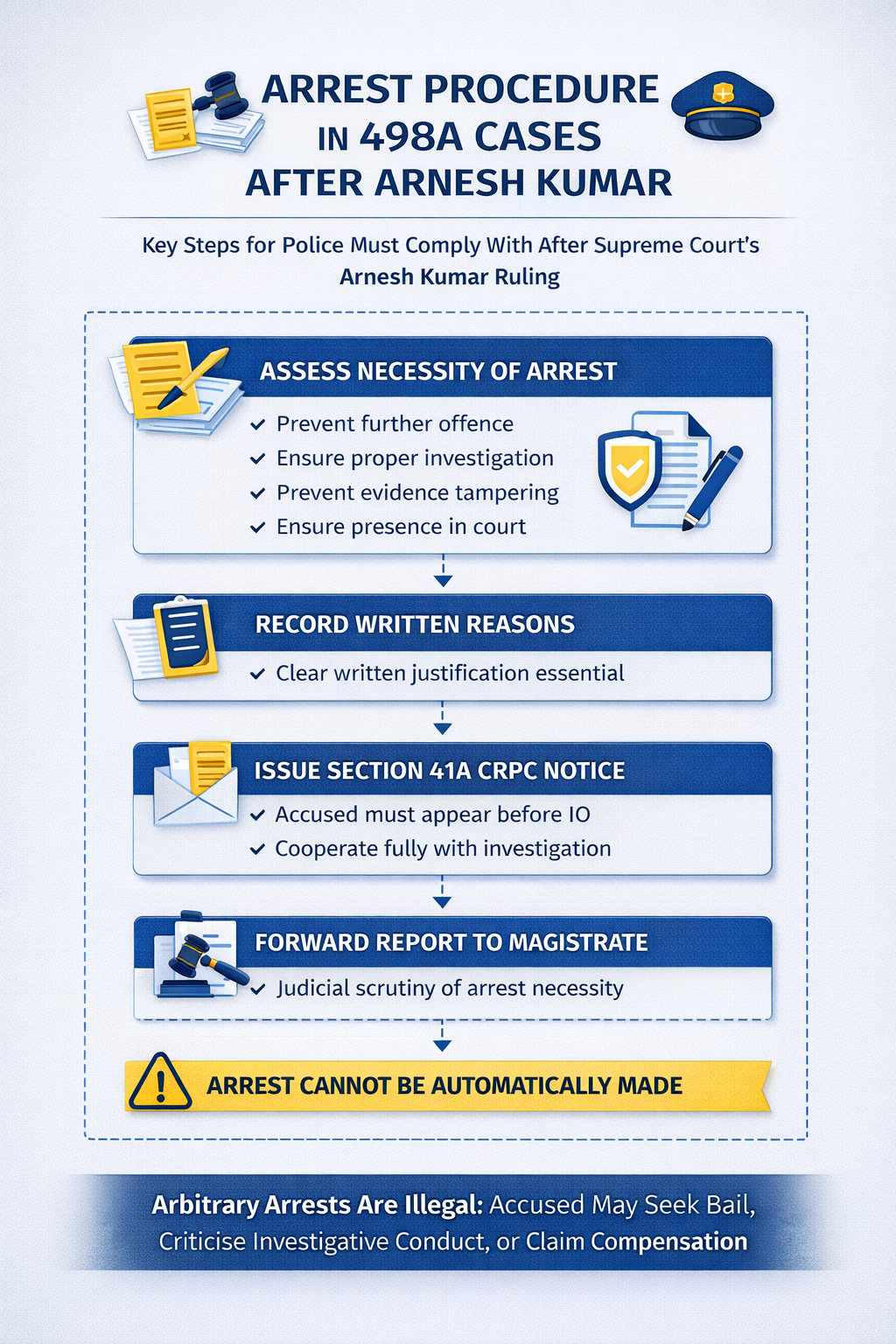
Arrest Procedure in 498A cases after Arnesh Kumar

Posted on February 26 by Suprajaa Rajan

Understanding the legal safeguards that protect personal liberty in matrimonial criminal proceedings.

Arrest in matrimonial disputes under Section 498A of the Indian Penal Code was once routine and immediate. Complaints often led to mechanical arrests of husbands and relatives.

The legal landscape changed significantly after the Supreme Court’s landmark ruling in:

Arnesh Kumar v. State of Bihar

In this case, the judgment reshaped arrest jurisprudence in matrimonial offences and reinforced constitutional protection under Article 21.

This article explains the law thereafter, the procedural safeguards under the Code of Criminal Procedure, 1973, and what accused persons must know.

I. The Legal Position Before Arnesh Kumar

Indian Penal Code

Section 498A IPC is cognizable, non-bailable and non-compoundable. Since the offence is cognizable, police had wide discretion to arrest without warrant. Accordingly, in practice, arrest often followed immediately after FIR registration.

Courts observed misuse through mechanical implication of elderly parents, married sisters living separately and distant relatives. This raised serious concerns regarding the abuse of process.

II. The Turning Point: Arnesh Kumar Judgment

In Arnesh Kumar, the Supreme Court held that:

  • Arrest is not mandatory in every 498A case.

  • Police must justify necessity of arrest under Section 41 CrPC.

  • Failure to comply may invite departmental action.

The Court emphasised that personal liberty cannot be curtailed casually. Additionally, this ruling applies not only to 498A but to all offences punishable up to seven years.

III. Section 41 CrPC – When Can Police Arrest?

Code of Criminal Procedure, 1973

Under Section 41(1)(b) CrPC, police may arrest only if they believe it is necessary to:

  • Prevent further offence

  • Ensure proper investigation

  • Prevent tampering of evidence

  • Prevent inducement or threat to witnesses

  • Ensure presence in court

Police must record reasons in writing and the arrest cannot be automatic.

IV. Section 41A CrPC – Notice of Appearance

Instead of immediate arrest, police must ordinarily issue:

Notice under Section 41A CrPC

The accused must:

  • Appear before the Investigating Officer and,

  • Cooperate with investigation

If the accused complies, arrest should not follow unless justified by fresh reasons.

V. Checklist Police Must Follow

After Arnesh Kumar, police must:

  • Assess necessity of arrest
  • Record written reasons
  • Issue 41A notice
  • Avoid mechanical detention
  • Forward reasons to Magistrate

The Magistrate must independently examine whether arrest is justified.

VI. What Happens If Police Violate These Safeguards?

If arrest occurs without compliance:

  • Accused may seek immediate bail

  • Courts may criticise investigative conduct

  • Departmental action may follow

  • Compensation may be claimed in extreme cases

Violation of procedure can strengthen defence during trial.

VII. Protection for Relatives and Senior Citizens

Courts frequently reiterate that distant relatives cannot be arrested without specific allegations. General and omnibus accusations are insufficient grounds for custodial arrest. High Courts often intervene under Section 482 CrPC to prevent abuse.

VIII. Practical Steps If You Receive 41A Notice

If you receive a Section 41A notice:

  1. Do not ignore it.

  2. Consult legal counsel immediately.

  3. Appear as required.

  4. Cooperate with investigation.

  5. Preserve documentary evidence.

Non-compliance may weaken your position.

IX. Anticipatory Bail Still Remains Important

Even after Arnesh Kumar, anticipatory bail remains a vital safeguard.

Where there is:

  • Risk of arbitrary arrest

  • Threat of custodial harassment

  • Multiple accused family members

Filing under Section 438 CrPC ensures additional protection.

Read also : Anticipatory Bail in Matrimonial Offences – Complete Guide

X. Judicial Approach After Arnesh Kumar

Post-2014, courts increasingly:

  • Scrutinise arrest memos

  • Examine compliance with Section 41

  • Criticise routine detention

  • Emphasise proportionality

The guiding principle remains: Arrest is an exception, not the rule.

Conclusion

The decision in Arnesh Kumar v. State of Bihar, hence, marked a watershed moment in matrimonial criminal jurisprudence. Altogether, it restored balance between protection of complainants and preservation of personal liberty.

Section 498A remains a serious offence. However, arrest cannot be mechanical or punitive. Police must undeniably demonstrate necessity. Magistrates must exercise independent scrutiny.

Understanding arrest procedure subsequently empowers accused persons to assert their constitutional rights lawfully and strategically.


Frequently Asked Questions

No. They must comply with Section 41 CrPC and consider issuing notice under Section 41A.

No. Arrest is permissible where statutory conditions are satisfied.

It applies to offences punishable up to seven years.

Courts may treat such arrest as illegal and grant relief.


Index of Legal Strategies and Defence is here.


Key Contributor :

Mrs. Suprajaa Rajan B.Com., LL.B., LL.M.

+91-9606345150

Posted in Legal Procedure | Tagged 498A arrest procedure Arnesh Kumar Vs State Of Bihar and Anr Criminal Procedure CrPC 438 - Anticipatory Bail Matrimonial Criminal Law Matrimonial law Section 41 CrPC Section 41A Notice | Leave a comment

Anticipatory Bail in Matrimonial Offences – Complete Guide

Posted on February 24 by Suprajaa Rajan

Strategic legal protection to safeguard your liberty before arrest in matrimonial criminal proceedings.

Matrimonial disputes frequently escalate into criminal complaints under provisions such as Section 498A IPC, the Dowry Prohibition Act, or allied offences. In many cases, accused individuals face the threat of immediate arrest.

Anticipatory bail serves as a critical safeguard. It protects personal liberty while the investigation proceeds.

This guide explains the legal framework, judicial principles, procedure, and strategic considerations involved in seeking anticipatory bail in matrimonial cases.

I. What Is Anticipatory Bail?

Anticipatory bail is pre-arrest protection granted by a Court under:

Code of Criminal Procedure, 1973. Specifically under Section 438 CrPC. It allows a person to seek bail in anticipation of arrest, even before police take them into custody. Unlike regular bail, anticipatory bail prevents detention itself.

II. Why Is Anticipatory Bail Crucial in Matrimonial Cases?

Offences commonly invoked include:

  • Section 498A IPC (Cruelty)

  • Section 406 IPC (Criminal breach of trust)

  • Sections 3 & 4 of the Dowry Prohibition Act

These offences are:

  • Cognizable

  • Non-bailable

Arrest can severely impact:

  • Employment

  • Passport status

  • Reputation

  • Elderly parents and relatives

Therefore, immediate pre-arrest strategy becomes essential.

III. Supreme Court Safeguards Against Arbitrary Arrest

The landmark judgment in Arnesh Kumar v. State of Bihar transformed arrest jurisprudence in 498A cases.

The Supreme Court held:

  • Police cannot automatically arrest the accused.

  • They must satisfy conditions under Section 41 CrPC.

  • Notice under Section 41A CrPC should ordinarily precede arrest.

This decision strengthened the constitutional protection of personal liberty under Article 21.

Read also : “Arrest Procedure in 498A Cases After Arnesh Kumar”

IV. When Should You Apply for Anticipatory Bail?

You should apply immediately if:

  • FIR has been registered.

  • Police have issued a notice.

  • There is apprehension of arrest.

  • Multiple family members are named without specific allegations.

Delay may weaken your legal position. Early filing signals cooperation and preparedness.

V. Which Court Has Jurisdiction?

Application may be filed before:

  • Sessions Court

  • High Court

Generally, the Sessions Court is approached first unless exceptional circumstances justify direct High Court intervention.

VI. What Factors Do Courts Consider?

Courts evaluate:

  • Nature and gravity of allegations
  • Specificity of accusations
  • Role attributed to each accused
  • Possibility of absconding
  • Likelihood of tampering with evidence
  • Criminal antecedents

Vague and omnibus allegations often strengthen the case for anticipatory bail. Courts increasingly recognise that matrimonial disputes sometimes involve exaggerated complaints.

VII. Conditions Imposed by Courts

Anticipatory bail orders may include:

  • Cooperation with investigation

  • No contact with complainant

  • No tampering with evidence

  • Travel restrictions

Violation of conditions can lead to cancellation of bail.

VIII. Protection for Parents and Relatives

Courts frequently observe misuse through mechanical implication of:

  • Elderly parents

  • Married sisters living separately 

  • Distant relatives

Where allegations lack specific overt acts, courts are inclined to grant protection.

IX. Common Mistakes to Avoid

  • Ignoring police notice
  • Filing incomplete application
  • Suppressing facts
  • Adopting aggressive or retaliatory approach

Strategic transparency strengthens credibility before the Court.

X. Can Anticipatory Bail Be Cancelled?

Yes. Anticipatory bail can be cancelled if :

  • Conditions are violated

  • False information was provided

  • Accused obstructs investigation

Courts retain the power to cancel protection.

XI. Strategic Considerations in Matrimonial Cases

Anticipatory bail must align with broader litigation strategy, especially where parallel proceedings exist:

  • Domestic Violence cases

  • Maintenance proceedings

  • Divorce petitions

Coordinated legal planning prevents contradictions across cases.

Conclusion

Anticipatory bail in matrimonial offences is not merely a procedural remedy. It is a constitutional shield against unnecessary arrest.

Courts recognise the need to balance protection of genuine victims with safeguards against abuse of process. Early, structured legal action significantly improves the likelihood of securing protection.

Liberty once lost is difficult to restore. Strategic defence must begin before arrest.


Index of Legal Strategies and Defence is here. 

Frequently Asked Questions

No. It depends on facts and judicial discretion.

Yes, if allegations are general and lack specificity.

Usually yes, unless exempted by the Court.

Yes. Courts may consider bona fide settlement while granting protection.

Posted in Legal Procedure | Tagged 498A arrest procedure CrPC 438 - Anticipatory Bail Dowry Case bail legal strategy and defence | Leave a comment

What To Do If You Are Falsely Accused Under Section 498A IPC

Posted on February 23 by Suprajaa Rajan

Introduction

Being named in an FIR under Section 498A of the Indian Penal Code can be legally and emotionally overwhelming. The provision deals with cruelty by a husband or his relatives toward a married woman. It is cognizable and non-bailable, which means arrest is legally permissible without a warrant.

However, courts have repeatedly recognised that vague and omnibus allegations should not automatically result in arrest or prosecution.

If you believe the complaint is false or exaggerated, you must act strategically and immediately. This guide explains the precise legal steps you should take.

I. Understand the Nature of Section 498A IPC

Indian Penal Code :

Section 498A defines cruelty as:

  • Wilful conduct likely to drive a woman to suicide, or

  • Harassment in connection with unlawful dowry demands.

Mere marital discord, incompatibility, or trivial disputes do not automatically amount to statutory cruelty.

II. Do Not Panic or Engage in Direct Confrontation

Avoid contacting the complainant to “settle” the issue emotionally. Any communication may later be produced as evidence.

Do not:

  • Threaten

  • Argue

  • Attempt private coercive settlement

Instead, consult a criminal law practitioner immediately.

III. Secure Anticipatory Bail Without Delay

If arrest appears imminent, file for anticipatory bail under:

Code of Criminal Procedure, 1973

Specifically under Section 438 CrPC.

The Supreme Court in Arnesh Kumar v. State of Bihar held that automatic arrests in 498A cases violate personal liberty. Police must comply with Section 41 and 41A CrPC safeguards before arrest.

Anticipatory bail protects you from custodial detention during investigation.

Read also : “Anticipatory Bail in Matrimonial Offences – Complete Guide”

IV. Collect and Preserve Documentary Evidence

Your defence begins with documentation.

Secure:

  • WhatsApp chats and emails

  • Call records

  • Bank transactions

  • Proof of financial transfers

  • Travel history

  • Medical records

  • Photographs and CCTV footage

  • Witness details

Preserve electronic evidence in original format. Do not tamper with devices.

V. Evaluate Grounds for Quashing the FIR

If the complaint contains:

  • Vague allegations

  • No specific date or incident

  • General accusations against distant relatives

  • No specific dowry demand

You may approach the High Court under Section 482 CrPC seeking quashing.

The Supreme Court in State of Haryana v. Bhajan Lal laid down categories where criminal proceedings may be quashed, especially when allegations do not disclose a prima facie offence or appear mala fide.

Read also : “File a Discharge or Quash petition”

VI. Challenge Illegal Arrest or Procedural Violations

If police arrest without complying with Section 41 CrPC safeguards, you may:

  • Seek immediate bail

  • Move for departmental action

  • File writ petition for violation of Article 21 rights

Personal liberty remains constitutionally protected.

VII. Avoid Counter-Litigation in Anger

Filing multiple retaliatory complaints may weaken your credibility.

Instead, take structured legal action such as:

  • Defamation proceedings (in appropriate cases)

  • Petition for restitution or divorce

  • Application for discharge at charge stage

Each step must align with long-term strategy.

VIII. Understand the Investigation Process

After FIR registration:

  1. Police record statements under Section 161 CrPC

  2. Evidence is collected

  3. Charge sheet may be filed before Magistrate

If evidence is weak, you may seek discharge before trial begins.

Read also : “Lifecycle stages of a Section 498A IPC case”

IX. Protect Elderly Parents and Relatives

Courts frequently criticise the practice of implicating all family members without specific allegations.

If distant relatives are named without overt acts, this strengthens grounds for quashing.

Courts consistently hold that criminal law cannot be used as a tool for matrimonial pressure.

X. Maintain Dignity and Composure

498A litigation often accompanies:

  • Domestic Violence proceedings

  • Maintenance claims

  • Divorce petitions

Coordinate defence strategy across all proceedings. Fragmented legal responses create contradictions.

Conclusion

A false accusation under Section 498A IPC demands calm, structured, and legally sound action. Panic or retaliation worsens the situation.

Indian courts recognise misuse concerns. They insist on procedural safeguards and evidentiary scrutiny. Early anticipatory bail, evidence preservation, and strategic litigation under Section 482 CrPC can prevent prolonged harassment.

Criminal law must protect genuine victims. It must not become an instrument of coercion in matrimonial disputes.


Frequently Asked Questions

No. After Arnesh Kumar, police must justify arrest under Section 41 CrPC.

Yes. High Courts exercise inherent powers under Section 482 CrPC where allegations fail to disclose an offence.

It is generally non-compoundable, but courts may quash proceedings in case of genuine settlement.

Courts discourage prosecution based on vague or omnibus statements.

Posted in Legal Procedure | Tagged bhajan lal principles CrPC 438 - Anticipatory Bail Dowry Case Law False 498A case Quashing of FIR Section 498A IPC | Leave a comment

Priya Indoria Vs State of Karnataka and Ors on 20 Nov 2023

Posted on November 23, 2023 by ShadesOfKnife

A division bench of Supreme Court passed this Judgment around filing of anticipatory bail petition u/s 438 Cr.P.C.

From Paras 40-41, 44-47, (Regd grant of limited Anticipatory bail in HC/Sessions Court in accused’s local State, outside the State in which FIR is registered)

40. We are conscious that this may also lead the accused to choose the Court of his choice for seeking anticipatory bail. Forum shopping may become the order of the day as the accused would choose the most convenient Court for seeking anticipatory bail. This would also make the concept of territorial jurisdiction which is of importance under the CrPC pale into insignificance. Therefore, in order to avoid the abuse of the process of the Court as well as the law by the accused, it is necessary for the Court before which the plea for anticipatory bail is made, to ascertain the territorial connection or proximity between the accused and the territorial jurisdiction of the Court which is approached for seeking such a relief. Such a link with the territorial jurisdiction of the Court could be by way of place of residence or occupation/work/profession. By this, we imply that the accused cannot travel to any other State only for the purpose of seeking anticipatory bail. The reason as to why he is seeking such bail from a Court within whose territorial jurisdiction the FIR has not been filed must be made clear and explicit to such a Court. Also there must be a reason to believe or an imminent apprehension of arrest for a non-bailable offence made out by the accused for approaching the Court within whose territorial jurisdiction the FIR is not lodged or the inability to approach the Court where the FIR is lodged immediately.
41. Having regard to the vastness of our country and the length and breadth of it and bearing in mind the complex nature of life of the citizens, if an offence has been committed by a person in a particular State and if the FIR is filed in another State and the accused is a resident in a third State, bearing in mind access to justice, the accused who is residing in the third State or who is present there for a legitimate purpose should be enabled to seek the relief of limited anticipatory bail of transitory nature in the third State.
44. Further, on a reading of Section 438 of CrPC, we do not find that the expression “the High Court” or “the Court of Session” is restricted vis-à-vis the local limits or any particular territorial jurisdiction. However, this does not mean that if an FIR is lodged in one State then the accused can approach the Court in another State for seeking anticipatory bail. He can do so, if at the time of lodging of the FIR in any State, he is residing or is present there for a legitimate purpose in any other State. In fact, on a reading of Section 438 of CrPC, it does not emerge that the expression “the High Court” or “the Court of Session” must have reference only to the place or territorial jurisdiction within which the FIR is lodged. If that was the implication, the same would have been expressly evident in the Section itself or by a necessary implication. Further use of the word “the” before the words “High Court” and “Court of Session” also does not mean that only the High Court or the Court of Session, as the case may be, within whose jurisdiction the FIR is filed, is competent to exercise jurisdiction for the grant of transit anticipatory bail.
45. At the same time, we are also mindful of the fact that the accused cannot seek full-fledged anticipatory bail in a State where he is a resident when the FIR has been registered in a different State. However, in view of what we have discussed above, he would be entitled to seek a transit anticipatory bail from the Court of Session or High Court in the State where he is a resident which necessarily has to be of a limited duration so as to seek regular anticipatory bail from the Court of competent jurisdiction. The need for such a provision is to secure the liberty of the individual concerned. Since anticipatory bail as well as transit anticipatory bail are intrinsically linked to personal liberty under Article 21 of the Constitution of India and since we have extended the concept of access to justice to such a situation and bearing in mind Article 14 thereof it would be necessary to give a constitutional imprimatur to the evolving provision of transit anticipatory bail. Otherwise, in a deserving case, there is likelihood of denial of personal liberty as well as access to justice for, by the time the person concerned approaches the Court of competent jurisdiction to seek anticipatory bail, it may well be too late as he may be arrested. Needless to say, the Court granting transit anticipatory bail would obviously examine the degree and seriousness of the apprehension expressed by the person who seeks transit anticipatory bail; while the object underlying exercise of such jurisdiction is to thwart arbitrary police action and to protect personal liberty besides providing immediate access to justice though within a limited conspectus.
46. If a rejection of the plea for limited/transitory anticipatory bail is made solely with reference to the concept of territorial jurisdiction it would be adding a restriction to the exercise of powers under Section 438. This, in our view, would result in miscarriage and travesty of justice, aggravating the adversity of the accused who is apprehending arrest. It would also be against the principles of access to justice. We say so for the reason that an accused is presumed to be innocent until proven guilty beyond reasonable doubt and in accordance with law. In the circumstances, we hold that the Court of Session or the High Court, as the case may be, can exercise jurisdiction and entertain a plea for limited anticipatory bail even if the FIR has not been filed within its territorial jurisdiction and depending upon the facts and circumstances of the case, if the accused apprehending arrest makes out a case for grant of anticipatory bail but having regard to the fact that the FIR has not been registered within the territorial jurisdiction of the High Court or Court of Session, as the case may, at the least consider the case of the accused for grant of transit anticipatory bail which is an interim protection of limited duration till such accused approaches the competent Sessions Court or the High Court, as the case may be, for seeking full-fledged anticipatory bail.
47. There can also be a case where the accused is facing multiple FIRs for the same offence in several States. He may seek an interim protection from a particular Sessions Court or the High Court in a State. Does he have to move from State to State for the purpose of seeking anticipatory bail or seek multiple pre-arrest bails? We would not attempt to give an answer to such a situation as the facts of the present case do not involve such a situation.

From Para 48, (Regd diluting the jurisdiction of Court to try the Sec 498a IPC cases, by going against many earlier judgments)

48. Another issue that calls for reiteration is, whether, the ordinary place of inquiry and trial would include the place where the complainant-wife resides after being separated from her husband. The position of law regarding the ordinary place of investigation and trial as per Section 177 of the CrPC, especially in matrimonial cases alleging cruelty and domestic violence, alleged by the wife, has advanced from the view held in the case of State of Bihar vs. Deokaran Nenshi, (1972) 2 SCC 890; Sujata Mukherjee (Smt.) vs. Prashant Kumar Mukherjee, (1997) 5 SCC 30; Y. Abraham Ajith vs. Inspector of Police, Chennai, (2004) 8 SCC 100, Ramesh vs. State of T.N. (2005) 3 SCC 507; Manish Ratan vs. State of M.P., (2007) 1 SCC 262 that if none of the ingredients constituting the offence can be said to have occurred within the local jurisdiction, that jurisdiction cannot be the ordinary place of investigation and trial of a matrimonial offence. A three judge Bench of this Court has however clarified in Rupali Devi vs. State of U.P., (2019) 5 SCC 384 (Rupali Devi) that adverse effects on mental health of the wife even while residing in her parental home on account of the acts committed in the matrimonial home would amount to commission of cruelty within the meaning of Section 498A at the parental home. It was held that the Courts at the place where the wife takes shelter after leaving or being driven away from the matrimonial home on account of acts of cruelty committed by the husband or his relatives, would, depending on the factual situation, also have jurisdiction to entertain a complaint alleging commission of offences under Section 498-A of the IPC.

Priya Indoria Vs State of Karnataka and Ors on 20 Nov 2023

Citations:

Other Sources:


Posted in Supreme Court of India Judgment or Order or Notification | Tagged 2-Judge (Division) Bench Decision CrPC 177 - Ordinary Place of Inquiry and Trial CrPC 438 - Anticipatory Bail Misinterpretation of Earlier Judgment or Settle Principle of Law or Per Incuriam Priya Indoria Vs State of Karnataka and Ors Reportable Judgement or Order | Leave a comment

Post navigation

  • Older posts

Search within entire Content of “Shades of Knife”

My Legal X Timeline

Advocate Sandeep Pamarati 🇮🇳💪👨🏻‍🎓 Follow

AP High Court Advocate with M Tech (CS) || 12 years in 'Software Industry' as Solution Architect || Blogs at https://t.co/29CB9BzK4w || #TDPTwitter

SandeepPamarati
Retweet on Twitter Advocate Sandeep Pamarati 🇮🇳💪👨🏻‍🎓 Retweeted
futurestacked Future Stacked @futurestacked ·
21h

Your Gmail account is not an email account.

It is the master key to your bank, your crypto, your Apple ID, your PayPal, and every password you have ever saved.

One breach and all your passwords are gone.

Lock it down with these 7 easy steps 👇

Reply on Twitter 2069354786743374317 Retweet on Twitter 2069354786743374317 104 Like on Twitter 2069354786743374317 260 X 2069354786743374317
Retweet on Twitter Advocate Sandeep Pamarati 🇮🇳💪👨🏻‍🎓 Retweeted
thisguyknowsai Brady Long @thisguyknowsai ·
22 Jun

A German psychologist proved in 1885 that cramming erases what you learned within 48 hours. He published the fix in the same book. Almost no school on Earth has adopted it in 140 years.

His name was Hermann Ebbinghaus.

He had no lab. No funding. No colleagues.

He worked alone

Reply on Twitter 2068965021514891696 Retweet on Twitter 2068965021514891696 958 Like on Twitter 2068965021514891696 2820 X 2068965021514891696
Retweet on Twitter Advocate Sandeep Pamarati 🇮🇳💪👨🏻‍🎓 Retweeted
factcheckapgov FactCheck.AP.Gov.in @factcheckapgov ·
22 Jun

ఎంతో ప్రతిష్టాత్మకంగా నిర్వహించి ప్రజల ఆరోగ్యం పట్ల అవగాహన కల్పించిన అంతర్జాతీయ యోగా దినోత్సవం సందర్భంగా రాష్ట్రం లో పలుచోట్ల నిర్వహించిన యోగా కార్యక్రమం పై కొందరు తప్పుడు ప్రచారం చేస్తున్నారు. ఈ కార్యక్రమం కోసం రూ. 600 కోట్లు ఖర్చు అయినట్లు చెప్పడం పూర్తిగా అసత్యం. రాష్ట్రంలో

Reply on Twitter 2068972932827869255 Retweet on Twitter 2068972932827869255 38 Like on Twitter 2068972932827869255 85 X 2068972932827869255
Retweet on Twitter Advocate Sandeep Pamarati 🇮🇳💪👨🏻‍🎓 Retweeted
jaitdp Telugu Desam Party @jaitdp ·
22 Jun

చీఫ్ మినిస్టర్.. టీచర్ అయిన వేళ

అంగన్వాడీ కేంద్రాన్ని సందర్శించిన సీఎం చంద్రబాబు కాసేపు టీచర్‌గా మారి, పిల్లల అభ్యసనం ఎలా ఉందో తెలుసుకున్నారు. ఇంగ్లీష్ ఆల్ఫాబెట్స్ చెప్పమని సీఎం అడిగేసరికి పిల్లలు చక్కగా చెప్పారు.
#ChandrababuNaidu
#AndhraPradesh

Reply on Twitter 2068873963246399922 Retweet on Twitter 2068873963246399922 73 Like on Twitter 2068873963246399922 310 X 2068873963246399922
Load More

Recent Posts

  • Pavul Yesu Dhasan Vs Registrar SHRC of TN and Ors on 30 Apr 2025 June 18, 2026
  • Manoj Kumar Vs Nita Bharti on 17 Mar 2026 June 17, 2026
  • Cruelty as a Criminal Offence Explained June 12, 2026
  • Bail Compliance Undertaking Format – Draft, Legal Requirements & Sample Template June 12, 2026
  • Warning Signs of Escalating Matrimonial Litigation – Early Red Flags Every Spouse Should Recognize June 12, 2026

Most Read Posts

  • Reply to Section 41A CrPC Notice – Format with Legal Explanation (4,944 views)
  • Anu Aggarwal Vs Sushant Aggarwal on 20 Jan 2026 (3,487 views)
  • Umme Farva Vs State of U.P. and Anr on 14 Jan 2026 (3,373 views)
  • Charge Sheet and Final Report Explained (2,816 views)
  • Regular Bail Application Format (Section 437/439 CrPC) (2,193 views)
  • Neha Lal Vs Abhishek Kumar on 20 Jan 2026 (2,002 views)
  • Arrest Procedure in 498A cases after Arnesh Kumar (1,935 views)
  • Discharge Application Format in 498A Case – Draft, Procedure & Sample Template (1,776 views)
  • Can You Travel Abroad After an FIR Is Registered? – Legal Position Explained (1,695 views)
  • Atul Kumar Bajpai Vs State of UP and Anr on 17 Sep 2025 (1,540 views)

Tags

Reportable Judgement or Order (433)2-Judge (Division) Bench Decision (413)Legal Procedure Explained - Interpretation of Statutes (382)Landmark Case (381)1-Judge Bench Decision (362)Catena of Landmark Judgments Referred/Cited to (293)Work-In-Progress Article (215)3-Judge (Full) Bench Decision (101)Sandeep Pamarati (92)Article 21 - Protection of life and personal liberty (80)Issued or Recommended Guidelines or Directions or Protocols to be followed (71)Perjury Under 340 CrPC (66)Absurd Or After Thought Or Baseless Or False Or General Or Inherently Improbable Or Improved Or UnSpecific Or Omnibus Or Vague Allegations (61)Reprimands or Setbacks to YCP Govt of Andhra Pradesh (49)Summary Post (47)CrPC 482 - Quash (43)HM Act 13 - Divorce Granted to Husband (42)Legal Terrorism (41)Divorce granted on Cruelty ground (41)Not Authentic copy hence to be replaced (40)

Categories

Supreme Court of India Judgment or Order or Notification (753)Bare Acts or State Amendments or Statutes or GOs or Notifications issued by Central or State Governments (328)High Court of Andhra Pradesh Judgment or Order or Notification (186)High Court of Delhi Judgment or Order or Notification (164)High Court of Bombay Judgment or Order or Notification (112)High Court of Karnataka Judgment or Order or Notification (93)Legal Procedure (77)High Court of Madras Judgment or Order or Notification (70)High Court of Allahabad Judgment or Order or Notification (61)LLB Study Material (59)General Study Material (56)High Court of Punjab & Haryana Judgment or Order or Notification (52)Assorted Court Judgments or Orders or Notifications (50)High Court of Kerala Judgment or Order or Notification (46)Prakasam DV Cases (46)Judicial Activism (for Public Benefit) (45)District or Sessions or Magistrate Court Judgment or Order or Notification (44)High Court of Madhya Pradesh Judgment or Order or Notification (38)High Court of Gujarat Judgment or Order or Notification (28)High Court of Calcutta Judgment or Order or Notification (27)

Recent Comments

  • eCourts India on Compromise-Based Quashing in Matrimonial Cases – Complete Legal Strategy
  • The Divorce Law Firm on Life Cycle Stages of a Divorce case
  • The Divorce Law Firm on Life Cycle Stages of a Divorce case
  • ShadesOfKnife on Sandeep Pamarati Vs Ungrateful Knife (IPC 498A Case)
  • KONURU VINAYKUMAR on Sandeep Pamarati Vs Ungrateful Knife (IPC 498A Case)

Archives of SoK

  • June 2026 (9)
  • May 2026 (24)
  • April 2026 (33)
  • March 2026 (42)
  • February 2026 (30)
  • January 2026 (21)
  • December 2025 (2)
  • November 2025 (3)
  • October 2025 (17)
  • September 2025 (12)
  • August 2025 (5)
  • July 2025 (10)
  • June 2025 (15)
  • May 2025 (3)
  • April 2025 (10)
  • March 2025 (7)
  • February 2025 (8)
  • January 2025 (1)
  • December 2024 (3)
  • November 2024 (4)
  • October 2024 (16)
  • September 2024 (15)
  • August 2024 (14)
  • July 2024 (11)
  • June 2024 (18)
  • May 2024 (13)
  • April 2024 (9)
  • March 2024 (23)
  • February 2024 (15)
  • January 2024 (11)
  • December 2023 (11)
  • November 2023 (9)
  • October 2023 (13)
  • September 2023 (12)
  • August 2023 (15)
  • July 2023 (17)
  • June 2023 (11)
  • May 2023 (6)
  • April 2023 (5)
  • March 2023 (10)
  • February 2023 (9)
  • January 2023 (12)
  • December 2022 (12)
  • November 2022 (8)
  • October 2022 (13)
  • September 2022 (17)
  • August 2022 (10)
  • July 2022 (21)
  • June 2022 (27)
  • May 2022 (23)
  • April 2022 (32)
  • March 2022 (17)
  • February 2022 (6)
  • January 2022 (2)
  • December 2021 (7)
  • November 2021 (7)
  • October 2021 (6)
  • September 2021 (10)
  • August 2021 (31)
  • July 2021 (45)
  • June 2021 (17)
  • May 2021 (17)
  • April 2021 (18)
  • March 2021 (58)
  • February 2021 (14)
  • January 2021 (50)
  • December 2020 (35)
  • November 2020 (68)
  • October 2020 (67)
  • September 2020 (28)
  • August 2020 (41)
  • July 2020 (20)
  • June 2020 (36)
  • May 2020 (40)
  • April 2020 (38)
  • March 2020 (26)
  • February 2020 (43)
  • January 2020 (35)
  • December 2019 (34)
  • November 2019 (4)
  • October 2019 (18)
  • September 2019 (57)
  • August 2019 (33)
  • July 2019 (12)
  • June 2019 (18)
  • May 2019 (5)
  • April 2019 (19)
  • March 2019 (58)
  • February 2019 (11)
  • January 2019 (90)
  • December 2018 (97)
  • November 2018 (43)
  • October 2018 (31)
  • September 2018 (73)
  • August 2018 (47)
  • July 2018 (143)
  • June 2018 (92)
  • May 2018 (97)
  • April 2018 (59)
  • March 2018 (8)

Blogroll

  • Daaman Promoting Harmony 0
  • Fight against Legal Terrorism Fight against Legal Terrorism along with MyNation Foundation 0
  • Good Morning Good Morning News 0
  • Insaaf India Insaaf Awareness Movement 0
  • MyNation Hope Foundation Wiki 0
  • MyNation.net Equality, Justice and Harmony 0
  • Sarvepalli Legal 0
  • Save Indian Family Save Indian Family Movement 0
  • SIF Chandigarh SIF Chandigarh 0
  • The Male Factor The Male Factor 0
  • Unitedmen Foundation a dedicated community forged with the mission to unite men facing legal challenges in marital disputes. 0
  • Vaastav Foundation The Social Reality 0
  • Vinayak my2centsworth – This blog is for honest law abiding men, married or planning to get married 0
  • Voice4india Indian Laws, Non-profits, Environment 0
  • Writing Law Writing Law by Ankur 0

RSS Cloudflare Status

  • ARN (Stockholm) on 2026-06-25 June 25, 2026
    THIS IS A SCHEDULED EVENT Jun 25, 00:00 - 05:00 UTC Jun 19, 14:18 UTC Scheduled - We will be performing scheduled maintenance in ARN (Stockholm) datacenter on 2026-06-25 between 00:00 and 05:00 UTC.Traffic might be re-routed from this location, hence there is a possibility of a slight increase in latency during this maintenance window […]
  • ARN (Stockholm) on 2026-06-24 June 24, 2026
    THIS IS A SCHEDULED EVENT Jun 24, 00:00 - 05:00 UTC Jun 19, 13:08 UTC Scheduled - We will be performing scheduled maintenance in ARN (Stockholm) datacenter on 2026-06-24 between 00:00 and 05:00 UTC.Traffic might be re-routed from this location, hence there is a possibility of a slight increase in latency during this maintenance window […]
  • Network Performance Issues - Increased HTTP 5XX Errors in Ashburn, US June 23, 2026
    Jun 23, 16:00 UTC Resolved - Between 17:07 and 17:45 UTC, Cloudflare experienced network performance issues in the Ashburn, US region, resulting in an elevated rate of 5xx errors for a subset of traffic. During this time, impacted users may have encountered intermittent connectivity issues or unexpected server responses. The underlying issue was successfully mitigated, […]

RSS List of Spam Server IPs from Project Honeypot

  • 34.106.192.29 | SD June 23, 2026
    Event: Bad Event | Total: 6 | First: 2026-06-23 | Last: 2026-06-23
  • 182.161.69.73 | S June 23, 2026
    Event: Bad Event | Total: 16 | First: 2011-01-28 | Last: 2026-06-23
  • 34.80.202.241 | SD June 23, 2026
    Event: Bad Event | Total: 6 | First: 2026-06-23 | Last: 2026-06-23
Owned and Operated by Advocate Sandeep Pamarati
Proudly powered by WordPress
Theme: Flint by Star Verte LLC

Bad Behavior has blocked 1432 access attempts in the last 7 days.

pixel