These are the recommendations prepared by Amicus curie in March 2020.
Supreme Court issued notices to all HCs and State Administrations to hear them and then pass Draft Rules.
Final Decision on 24-Apr-2021. [(2021) 10 SCC 598]
These are the recommendations prepared by Amicus curie in March 2020.
Supreme Court issued notices to all HCs and State Administrations to hear them and then pass Draft Rules.
Final Decision on 24-Apr-2021. [(2021) 10 SCC 598]
Rajasthan High Court passed a direction to all trial Courts in Rajasthan that, in all Bail matters u/s 437/438, a detailed report on antecedents of the accused is to be filed along with judgment.
There is no mention regarding the status of criminal antecedents of the present petitioner in the impugned order. It is often seen by this Court that the learned courts below are not specific in regard to antecedents of the accused persons, which causes delay in the disposal of the bail applications, as, if the person is not having antecedents and his antecedents are called, receiving of such antecedents reports takes quite some time. Though the antecedent alone is not a ground of rejecting or accepting a bail, but it is must that the Hon’ble High Court should have the antecedent report to check the applicability of Section 437 (1) of Cr.P.C. as well as to weigh the case of the accused person with overall perspective of the allegations levelled.
Thus, this Court directs that all learned trial courts shall, while allowing or disallowing any regular/anticipatory bail application of any accused person,give the complete details of the antecedents, if any, and also record that there are no antecedents of the accused person in case of none being there. If there are antecedents of the accused, then the complete details of the antecedents i.e. FIR Number(s) & Case Number(s), Section(s), date(s), status and date of arrest & release on any previous occasion, if any, in the chart form shall be prepared and incorporated in the learned trial courts’ order, while granting or dismissing the bail application.
This order shall be conveyed by the Registry of this Court to all learned District & Sessions Judges of the State, who shall ensure the immediate implementation of this order amongst all the judicial officers and all courts in their respective jurisdiction, which are hearing the bail applications. The detailed antecedents report in aforesaid format so provided in the trial courts’ order shall be the requirement of disposal of any bail application in State of Rajasthan. It is also directed that the learned Public Prosecutors all over the State shall call for the antecedents report well in advance in every case of bail, so as to enable the courts to have a definite and correct information regarding previous criminal antecedents of the accused. A certified copy of this order be also sent by the Registry to the Director of the Prosecution Department of the State for necessary compliance, amongst the learned Public Prosecutors all over the State of Rajasthan.
The Registry of this Hon’ble Court shall ensure compliance of this order, in its letter and spirit, and submit such compliance before this Court on 05.01.2021.
A consensual sexual act is given a color of a rape in this case and the accused got bail u/s 439 CrPC on his third attempt, as this very same judge was not inclined to grant bail in earlier two instance and hence the bail applications were withdrawn.
After Ex Gratia Law Journal’s 1st Judgement Writing Competition 2020 here, I participated in this Judgement Writing Competition here with my partners Yashika Bhartia [idea of 46(3) Cr.P.C. and initial discussions] and Swathi Pudipeddi [Drafting, Research and multiple reviews of the Draft PIL Petition] and here is the problem statement.
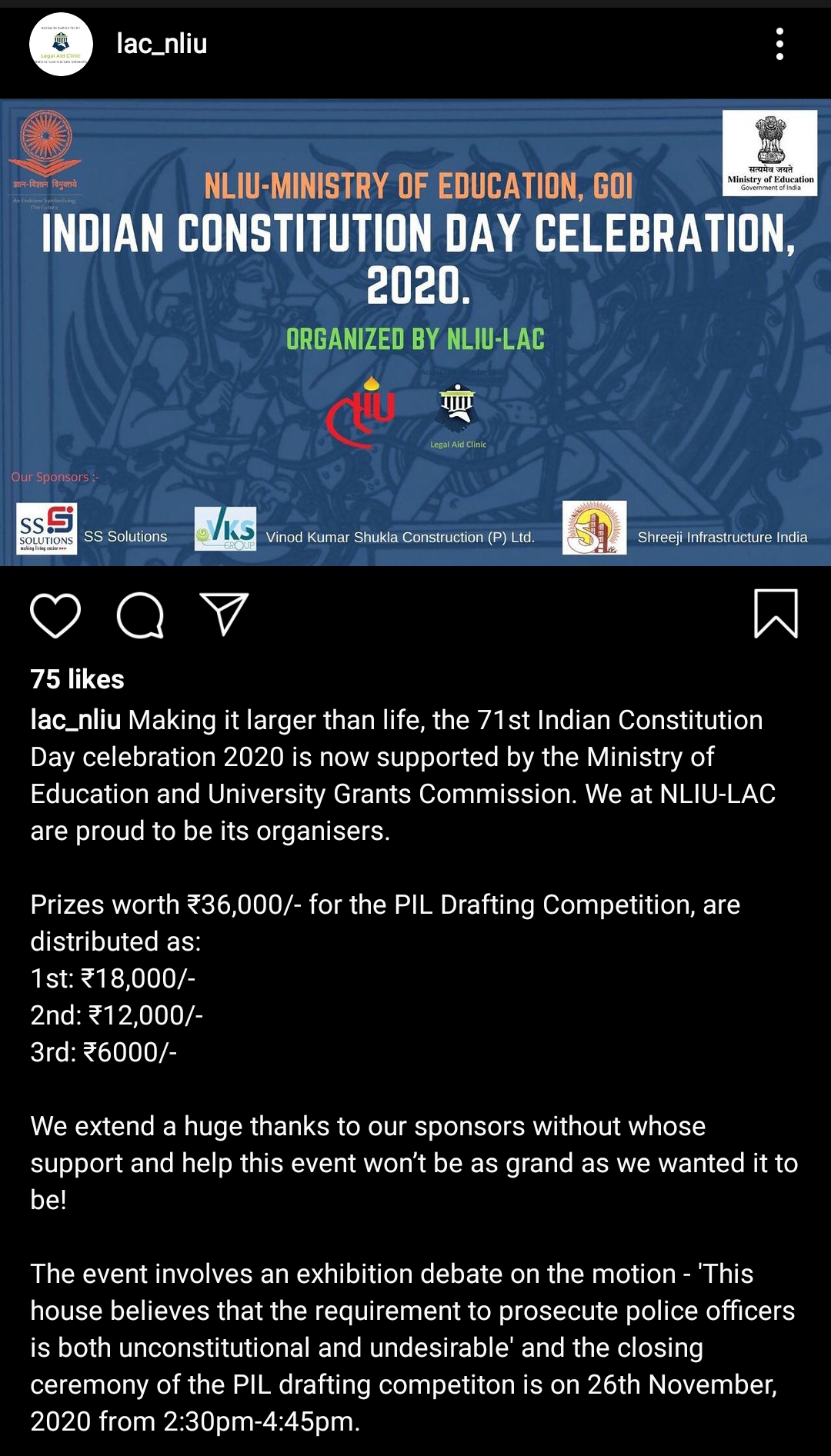
Here is the PIL I wrote. It is password-protected to prevent misuse like plagiarism. If you want to read it, contact me for password.
I couldn’t make my Team win any prizes this time around. The winners are declared on official social media handles here and here.
Getting ready for next competition here.
Government Guesthouse at Kapuluppada, Visakhapatnam
Single-judge bench of Andhra Pradesh held that, cross-examination need not be confined to the facts to which the witness testified on his examination-in-chief.
From Para 3,
3. Since O.S. No. 1141 of 2000, later renumbered as O.S. No. 20 of 2003, was ordered to be tried along with O.S. No. 47 of 1998, obviously common evidence is being recorded in both the suits. When two suits are clubbed and tried together, all the parties to the suits have a right to cross-examine the witness examined by the adversary, because Section 138 of the Evidence Act, 1872 (‘the Act’) confers such right on them. As per that Section 138 of the Act the witness called by a party shall first be examined-in-chief and if the adverse party so desires he can cross-examine him and then if the party calling him so desires, can re-examine him. That section specifically lays down that Chief examination and cross-examination must relate to relevant facts, but cross-examination need not be confined to the facts to which the witness testified on his examination-in-chief.
Casemine copy:
Legal Crystal copy:
Citations : [2006 ALD 1 370], legalcrystal.com/442436
Other Sources :
https://indiankanoon.org/doc/1166172/
https://www.casemine.com/judgement/in/5608f85de4b01497111422e0
https://www.legalcrystal.com/case/442436/k-c-kanniyappa-vs-lalitha-anr
Supreme Court in this Suo moto Civil Writ Petition, had extended the limitation period from 15 March 2020 until further orders, due to the situation created by COVID-19
On 06-05-2020, The limitation was extended for all periods of limitation prescribed under the Arbitration and Conciliation Act, 1996 and under section 138 of the Negotiable Instruments Act 1881 shall be extended with effect from 15.03.2020 till further orders.
RBI was allowed to decide on the extension of any limitation that may be available under Banking Regulation Act,1949.
With reference to the prayer, that the period of validity of a cheque be extended, we find that the said period has not been prescribed by any Statute but it is a period prescribed by the Reserve Bank of India under Section 35-A of the Banking Regulation Act,1949. We do not consider it appropriate to interfere with the period prescribed by the Reserve Bank of India, particularly, since the entire banking system functions on the basis of the period so prescribed.
The Reserve Bank of India may in its discretion, alter such period as it thinks fit. Ordered accordingly.
Also on 20-07-2020, Whatsapp was allowed as one of the mode of serving notices.
Service of notices, summons and exchange of pleadings/documents, is a requirement of virtually every legal proceeding. Service of notices, summons
and pleadings etc. have not been possible during the period of lockdown because this involves visits to post offices, courier companies or physical delivery of notices, summons and pleadings. We, therefore, consider it appropriate to direct that such services of all the above may be effected by e-mail, FAX, commonly used instant messaging services, such as WhatsApp, Telegram, Signal etc. However, if a party intends to effect service by means of said instant messaging services, we direct that in addition thereto, the party must also effect service of the same document/documents by e-mail, simultaneously on the same date.
Supreme Court heard arguments and reserved it’s orders. Related news here.
Final Order passed on 08-03-2021.
On 27-04-2021, within 1 month of passing final order and disposing the petition, COVID-19 cases started to rise, so Supreme Court had to restore the Order passed on 23 Mar 2020
On 23-09-2021, Supreme Court ended the relaxation given to the limitation via March 8th Order.
On 10-01-2022, Supreme Court had to restore the order dt: 23-03-2020 given relaxation to the limitation, until 28-02-2022.
Constitutional Validity of provisions of ‘Right of Children to Free and Compulsory Education Act, 2009 (for short “the 2009 Act”) with respect to the unaided non-minority schools is decided in affirmative in this judgment by a 3-judge bench with a 2-1 majority.
Citations : [2012 AIOL 168], [2012 SUPREME 3 305], [2012 AIR SC 3445], [2012 SCC 6 102], [2012 SCALE 4 272], [2012 SCC 6 1], [2012 SLT 3 370], [2012 AIR SC 3400], [2012 RCR CIVIL SC 2 775], [2012 BOMCR SC 6 711], [2012 JT 4 137], [2012 SCC ONLINE SC 340], [2012 CUTLT 114 862], [2012 AWC SC 4 4260], [2012 MLJ SC 3 993], [2012 CLT 114 862], [2012 KARLJ 3 177], [2012 JLJR 2 324], [2012 CUT LT 114 862], [2012 AIR SCW 3400]
Other Sources :
https://indiankanoon.org/doc/154958944/
https://www.casemine.com/judgement/in/5609af1ee4b0149711415aa3
Society for Un-aided Private Schools of Rajasthan v. Union of India and Anr.
All the members of the family accused of 498A IPC offence were discharged as there was no material to prosecute them.
There was once a time when copy of complaint in a 498A IPC case was not given to accused, to exercise FIR Quash etc. Had to file RTI application to Police CPIO !!!
Bad Behavior has blocked 278 access attempts in the last 7 days.

