web analytics

Menu

Skip to content
Shades of Knife
  • Home
  • True Colors of a Vile Wife
  • Need Inspiration?
  • Blog Updates
  • SOK Gallery
  • Vile News Reporter
  • About Me
  • Contact Me

Shades of Knife

True Colors of a Vile Wife

Tag: CrPC 439 – Special powers of High Court or Court of Session regarding bail

How to Protect Reputation During Criminal Litigation – A Complete Legal & Practical Strategy

Posted on May 21 by Suprajaa Rajan

Criminal litigation affects more than just legal rights—it can deeply impact a person’s reputation, career, family relationships, social standing, mental peace, and professional future. In many cases, especially involving:

  • Matrimonial disputes
  • Financial allegations
  • Corporate complaints
  • Sexual offence accusations
  • Social media controversies
  • Publicised arrests

the reputational damage begins long before trial concludes.

Unfortunately, many accused persons focus only on the courtroom battle while ignoring the parallel battle for reputation management. However, in modern litigation, public perception, digital footprints, media exposure, and social conduct can significantly influence both personal and professional consequences.

Therefore, understanding how to protect reputation during criminal litigation becomes just as important as preparing legal defence.

This article explains the legal safeguards, strategic precautions, media risks, digital reputation protection, workplace considerations, social media strategy, and practical defence measures, with references to the Code of Criminal Procedure, 1973 (CrPC) and the Bharatiya Nagarik Suraksha Sanhita, 2023 (BNSS).
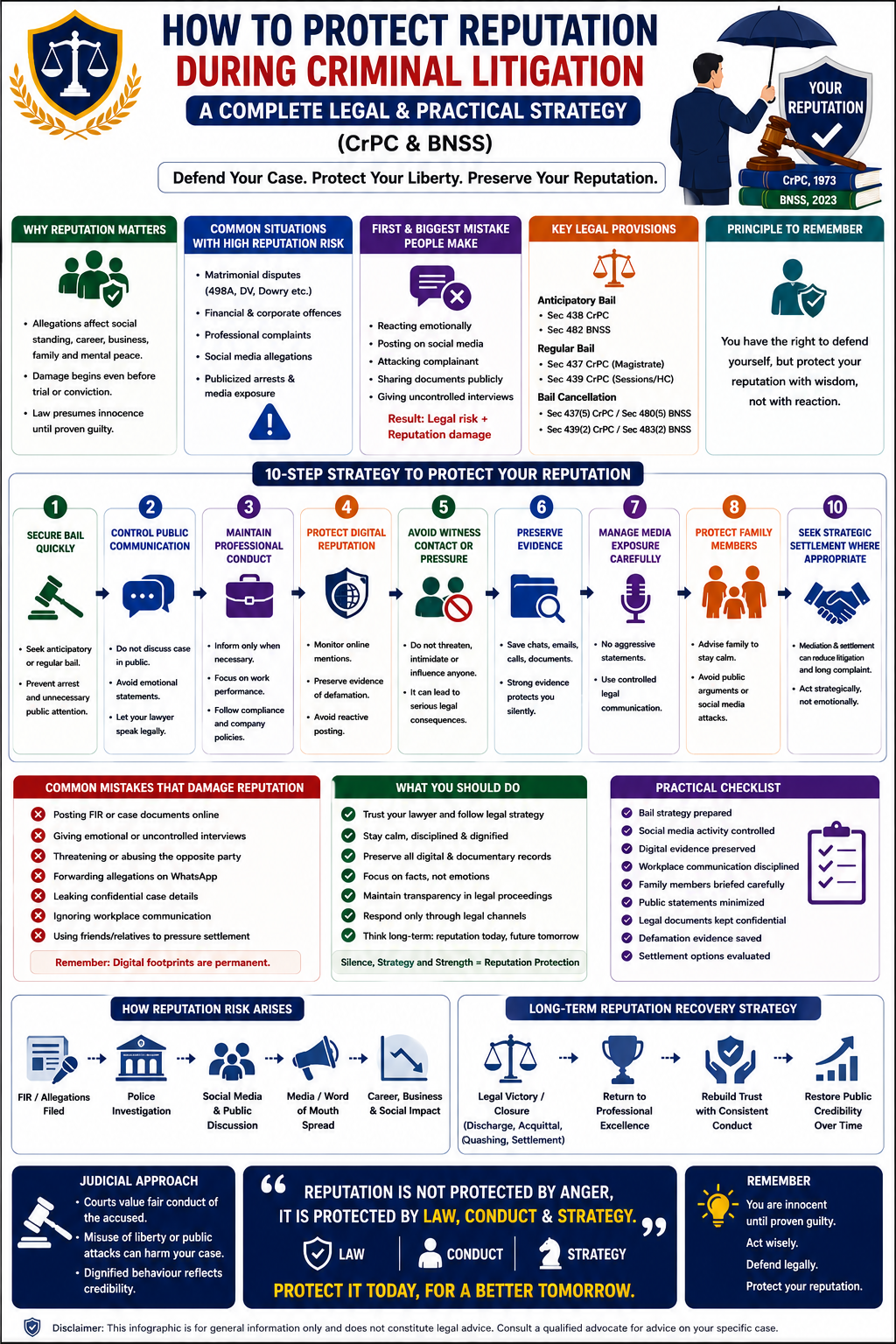
Why Reputation Protection Matters During Criminal Litigation

Criminal allegations often trigger immediate consequences such as:

  • Social stigma
  • Workplace scrutiny
  • Suspension from employment
  • Loss of business relationships
  • Family pressure
  • Media exposure
  • Online defamation
  • Emotional isolation

Even before conviction, many people face “social punishment.”

However, Indian criminal law follows a foundational principle:

An accused is presumed innocent until proven guilty.

Therefore, protecting reputation lawfully and strategically becomes essential.

Common Situations Where Reputation Risks Arise

Reputation concerns frequently arise in:

Matrimonial Cases

Examples:

  • Section 498A allegations
  • Domestic violence complaints
  • Dowry accusations

Financial & Corporate Cases

Examples:

  • Fraud allegations
  • Cheating complaints
  • Breach of trust allegations

Professional Complaints

Examples:

  • Workplace harassment complaints
  • Regulatory proceedings

Public or Political Disputes

Examples:

  • Viral social media allegations
  • Media trials
  • Public accusations

Immediate Mistake Most Accused Persons Make

Many accused react emotionally by:

  • Posting online explanations
  • Uploading case documents
  • Attacking complainants publicly
  • Sending threatening messages
  • Giving uncontrolled interviews

These reactions often worsen both:

  • Legal exposure
  • Reputational damage

Therefore, controlled conduct becomes the first rule of reputation defence.

Step 1: Understand the Difference Between Legal Defence and Public Defence

Winning in court and protecting reputation are related—but different—objectives.

Legal Defence Focuses On:

  • Evidence
  • Procedure
  • Bail
  • Trial strategy

Reputation Protection Focuses On:

  • Public conduct
  • Professional stability
  • Digital footprint
  • Communication discipline
  • Social perception

A smart defence strategy addresses both simultaneously.

Step 2: Secure Bail Quickly

Arrest often causes the greatest reputational damage.

Therefore, obtaining timely bail becomes critical.

Relevant provisions include:

Anticipatory Bail

  • Section 438 CrPC (Section 482 BNSS)

Regular Bail

  • Section 437 CrPC (Section 480 BNSS)
  • Section 439 CrPC (Section 483 BNSS)

Prompt legal protection may help:

  • Prevent custodial humiliation
  • Reduce public escalation
  • Maintain employment stability
  • Avoid unnecessary media attention

Step 3: Control Public Communication

One of the most important rules:

Do not litigate emotionally in public.

Avoid:

  • Social media rants
  • Public accusations
  • Aggressive WhatsApp forwards
  • Emotional videos
  • Publishing confidential documents

Why?

Because these actions may:

  • Become evidence
  • Trigger fresh allegations
  • Harm settlement opportunities
  • Damage judicial perception

Step 4: Maintain Professional Conduct

If you are employed or running a business:

Inform Only When Necessary

Disclose matters carefully and professionally.

Avoid Emotional Narratives at Workplace

Keep communication factual.

Preserve Performance Records

Strong professional records support credibility.

Follow Internal Compliance Processes

Especially in regulated sectors.

Professional stability often protects reputation better than public defence.

Step 5: Protect Digital Reputation

Modern criminal litigation increasingly unfolds online.

Therefore, digital reputation management is essential.

Monitor Social Media Exposure

Check for:

  • Viral allegations
  • Fake posts
  • Defamatory content
  • Impersonation accounts

Preserve Evidence of Online Defamation

Save:

  • Screenshots
  • URLs
  • Timestamps
  • Comments
  • Shared posts

This may later support legal remedies.

Avoid Reactive Posting

Never respond impulsively.

Silence often protects credibility better than emotional explanation.

Step 6: Avoid Witness Contact or Pressure

After litigation begins, avoid:

  • Direct confrontation
  • Emotional calls
  • Threatening language
  • Settlement coercion

Such conduct may lead to allegations involving:

  • Witness intimidation
  • Obstruction
  • Bail cancellation

Relevant provisions include:

  • Section 437(5) CrPC (Section 480(5) BNSS)
  • Section 439(2) CrPC (Section 483(2) BNSS)

Controlled communication protects both liberty and reputation.

Step 7: Preserve Documentary and Digital Evidence

Strong evidence quietly protects reputation over time.

Preserve:

  • WhatsApp chats
  • Emails
  • Financial records
  • Employment documents
  • Call logs
  • Travel history
  • Medical records
  • Social media records

Well-preserved evidence often defeats false narratives.

Step 8: Manage Media Exposure Carefully

In high-profile cases, media involvement may become unavoidable.

If media attention arises:

Avoid Aggressive Public Statements

Statements made emotionally may later backfire.

Use Controlled Legal Communication

Only authorised legal responses should be issued.

Avoid Leaking Documents

Unauthorised disclosure may create complications.

Maintain Dignity

Courts often observe public conduct indirectly.

Step 9: Protect Family Members From Escalation

In matrimonial or family disputes, relatives often become emotionally involved.

Common mistakes include:

  • Public arguments
  • Social media attacks
  • Community pressure tactics
  • Verbal confrontations

These actions may:

  • Escalate litigation
  • Create additional evidence
  • Harm settlement possibilities

A disciplined family response matters.

Step 10: Use Legal Remedies Against False Public Allegations

If defamatory allegations spread publicly, legal remedies may be available.

Possible actions may include:

  • Defamation proceedings
  • Injunction applications
  • Takedown requests
  • Cyber complaints

However, strategy matters.

Not every public statement requires immediate aggressive litigation.

Sometimes controlled restraint works better.

Reputation Risks in Matrimonial Cases

Matrimonial criminal litigation creates unique reputational risks because allegations often involve:

  • Cruelty
  • Dowry harassment
  • Domestic violence
  • Emotional abuse

Social assumptions arise quickly—even before evidence is examined.

Therefore, accused persons should focus on:

Maintaining Dignified Conduct

Avoid retaliation.

Preserving Financial Transparency

Hidden financial conduct damages credibility.

Avoiding Public Character Assassination

Courts dislike vindictive conduct.

Pursuing Structured Settlement Where Appropriate

Strategic settlement often limits long-term reputational harm.

Reputation Risks for Professionals

Professionals such as:

  • Doctors
  • Lawyers
  • Government employees
  • Corporate executives
  • Teachers
  • Public figures

may face additional consequences.

Possible impacts include:

  • Suspension
  • Departmental inquiry
  • Licensing scrutiny
  • Client loss
  • Contract termination

Therefore, coordination between:

  • Criminal defence
  • Employment strategy
  • Regulatory compliance

becomes essential.

Common Mistakes That Damage Reputation Further

Avoid:

Publicly Sharing FIR Copies

May escalate online circulation.

Giving Uncontrolled Interviews

Statements may later contradict defence.

Posting Emotional Content Online

Digital footprints remain permanent.

Threatening the Opposite Party

May trigger fresh allegations.

Using Friends or Relatives to Pressure Settlement

Indirect intimidation can backfire.

Ignoring Professional Compliance

Silence at workplace may create suspicion.

Practical Reputation Protection Checklist

If facing criminal litigation, ensure:

  • Bail strategy prepared
  • Social media activity controlled
  • Digital evidence preserved
  • Workplace communication disciplined
  • Family members briefed carefully
  • Public statements minimized
  • Legal documents kept confidential
  • Defamation evidence archived
  • Settlement options evaluated strategically

Judicial Approach

Courts increasingly recognise:

  • Media trials
  • Social stigma
  • Online harassment
  • Misuse of digital narratives

At the same time, courts also examine:

  • Conduct of accused
  • Communication behaviour
  • Witness interaction
  • Digital activity

Therefore, reputation protection must always remain lawful and ethical.

Long-Term Reputation Recovery Strategy

Even after litigation stabilises, rebuilding reputation takes time.

Focus on:

Professional Consistency

Continue lawful work and responsibilities.

Controlled Public Presence

Avoid unnecessary public commentary.

Legal Closure

Seek:

  • Discharge
  • Acquittal
  • Quashing
  • Settlement where appropriate

Digital Clean-Up

Monitor online search visibility over time.

Conclusion

Criminal litigation can, thus, create serious reputational pressure—but panic, emotional reactions, and uncontrolled public conduct often make the situation worse.

By:

  • Securing timely legal protection
  • Preserving evidence
  • Maintaining disciplined communication
  • Avoiding social media escalation
  • Protecting professional credibility
  • Responding strategically rather than emotionally

an accused person can significantly reduce long-term reputational harm.

In modern criminal litigation, reputation is protected not by public anger—but by disciplined legal strategy and controlled conduct.


Index of Legal Strategies and Defence is here. 


Key Contributor : 

Mrs. Suprajaa Rajan B.Com., LL.B., LL.M.

+91-9606345150

Posted in Legal Procedure | Tagged CrPC 437 - Valid Duration For Regular Bail CrPC 438 - Anticipatory Bail CrPC 439 - Special powers of High Court or Court of Session regarding bail Legal Strategies and Defence Matrimonial Criminal Law Matrimonial Litigation India | Leave a comment

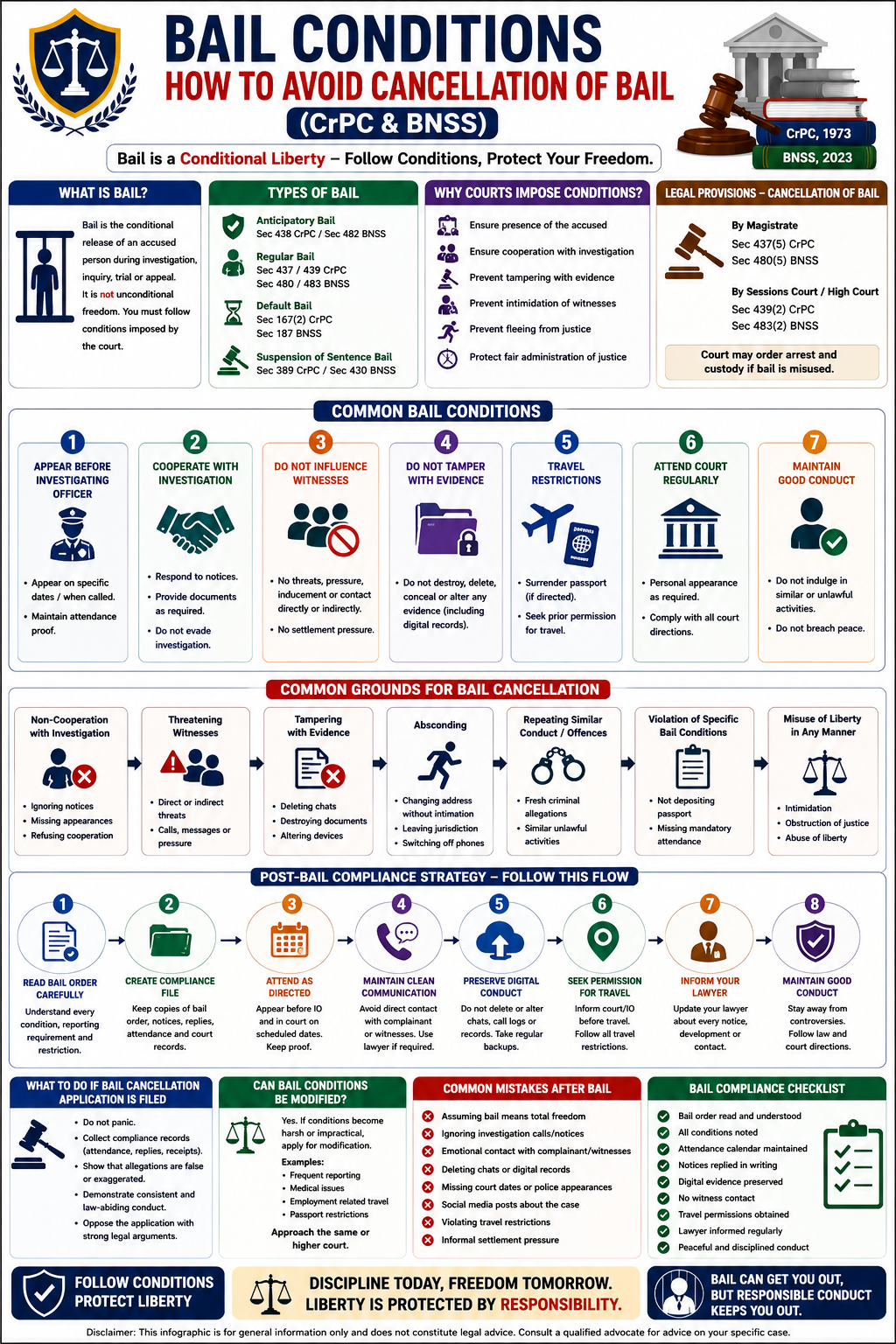
Bail Conditions – How to Avoid Cancellation of Bail

Posted on May 8 by Suprajaa Rajan

Obtaining bail is often the first major legal relief in criminal litigation. Whether the accused secures anticipatory bail, regular bail, interim bail, or default bail, the grant of bail does not end legal responsibility. In fact, the real challenge begins after bail is granted.

Many accused persons mistakenly believe:

“Once I get bail, the risk is over.”

Legally, that assumption can be dangerous.

Courts may cancel bail if the accused violates conditions, misuses liberty, interferes with investigation, intimidates witnesses, or attempts to obstruct justice.

Therefore, understanding bail conditions and how to avoid cancellation of bail becomes critical for every accused person, family member, and defence lawyer.

This article explains the legal framework, common bail conditions, cancellation grounds, compliance strategy, defence tactics, and practical safeguards, with references to both the Code of Criminal Procedure, 1973 (CrPC) and the Bharatiya Nagarik Suraksha Sanhita, 2023 (BNSS).

What Does Bail Actually Mean?

Bail is the conditional release of an accused person during:

  • Investigation
  • Inquiry
  • Trial
  • Appeal

The court allows liberty while ensuring:

  • Presence during proceedings
  • Cooperation with investigation
  • Protection of evidence
  • Fair administration of justice

However, bail is conditional liberty—not unconditional freedom.

Types of Bail Where Conditions May Apply

Conditions may be imposed in:

Anticipatory Bail

  • Section 438 CrPC (BNSS Section 482)

Regular Bail

  • Section 437 CrPC (BNSS Section 480) – Magistrate
  • Section 439 CrPC (BNSS Section 483) – Sessions Court/High Court

Default Bail

  • Section 167(2) CrPC (BNSS Section 187)

Suspension of Sentence Bail

  • Section 389 CrPC (BNSS Section 430)

Each form of bail may carry specific conditions.

Why Courts Impose Bail Conditions

Courts impose conditions to ensure that the accused:

  • Appears when required
  • Cooperates with investigation
  • Does not tamper with evidence
  • Does not threaten witnesses
  • Does not repeat alleged offences
  • Does not flee jurisdiction

Courts balance:

Personal liberty vs administration of justice

Common Bail Conditions

Although conditions vary by case, courts frequently direct:

Condition 1: Appear Before Investigating Officer

Particularly in anticipatory bail matters.

Examples:

  • Weekly appearance
  • Appearance on specific dates
  • Appearance when called

Failure may be treated as non-cooperation.

Practical Tip

Always maintain:

  • Attendance proof
  • Signed appearance records
  • Written communication with investigating officer

Condition 2: Cooperate With Investigation

Courts often direct:

“The accused shall cooperate with investigation.”

This may include:

  • Responding to notices
  • Producing documents
  • Giving specimen signatures
  • Providing electronic devices where lawfully required

Relevant notice provision:

  • Section 41A CrPC (BNSS Section 35)

Ignoring notices may trigger cancellation attempts.

Condition 3: Do Not Influence Witnesses

Courts routinely prohibit:

  • Direct contact
  • Threats
  • Pressure
  • Financial inducement
  • Settlement coercion

Even indirect contact through relatives may create problems.

Condition 4: Do Not Tamper With Evidence

Examples include:

  • Deleting chats
  • Destroying documents
  • Altering devices
  • Influencing documentary records

Digital evidence preservation is increasingly important.

Condition 5: Travel Restrictions

Courts may require:

  • Passport surrender
  • Prior permission for foreign travel
  • Travel disclosure

Especially in:

  • Economic offences
  • NRI matrimonial disputes
  • Fraud allegations

Condition 6: Attend Court Regularly

Courts expect:

  • Personal appearance where required
  • Compliance with exemptions

Relevant provision:

  • Section 205 CrPC (BNSS Section 227) – Exemption from personal appearance

Repeated absence can create complications.

Condition 7: Maintain Good Conduct

Courts may direct:

  • No similar offence
  • No unlawful activity
  • No breach of peace

Fresh criminal allegations may trigger cancellation proceedings.

Can Bail Be Cancelled?

Yes.

Bail can be cancelled if liberty is misused.

Relevant provisions:

Magistrate Bail Cancellation

  • Section 437(5) CrPC (BNSS Section 480(5))

Sessions Court/High Court Bail Cancellation

  • Section 439(2) CrPC (BNSS Section 483(2))

These courts may direct:

Arrest and custody of the accused.

Therefore, compliance after bail becomes essential.

Common Grounds for Bail Cancellation

Ground 1: Non-Cooperation With Investigation

Examples:

  • Ignoring notices
  • Missing appearances
  • Refusing lawful cooperation

Defence Strategy

Always:

  • Reply in writing
  • Preserve acknowledgments
  • Inform counsel immediately

Ground 2: Threatening Witnesses

Examples:

  • Calls
  • WhatsApp messages
  • Social media posts
  • Third-party pressure

Even emotional messages may be misinterpreted.

Defence Strategy

After bail:

  • Avoid direct communication
  • Use lawyers for settlement discussions
  • Preserve communication records

Ground 3: Tampering With Evidence

Examples:

  • Deleting messages
  • Altering files
  • Removing financial records

Courts take digital tampering seriously.

Defence Strategy

Preserve:

  • Devices
  • Chats
  • Emails
  • Cloud backups

Ground 4: Absconding

Examples:

  • Changing address without intimation
  • Leaving jurisdiction secretly
  • Switching off phones continuously

Defence Strategy

Always update:

  • Address
  • Phone number
  • Email

Maintain availability.

Ground 5: Repeating Similar Conduct

Examples:

  • Fresh harassment allegations
  • New criminal complaints
  • Violent confrontations

Defence Strategy

Maintain strict personal discipline.

Ground 6: Violation of Specific Bail Conditions

Examples:

  • Failure to deposit passport
  • Missing mandatory attendance
  • Violating travel restrictions

Defence Strategy

Maintain a compliance calendar.

Special Risk in Matrimonial Cases

In matrimonial litigation, bail cancellation applications commonly allege:

  • Threats to complainant
  • Settlement pressure
  • Contact through relatives
  • Social media harassment
  • Financial coercion
  • Return of stridhan disputes

These allegations may be exaggerated.

Therefore, accused persons must act cautiously.

Practical Post-Bail Compliance Strategy

Step 1: Read the Bail Order Carefully

Do not rely on verbal explanations.

Read:

  • Every condition
  • Every reporting requirement
  • Every travel restriction

Keep digital and printed copies.

Step 2: Create a Bail Compliance File

Maintain:

  • Bail order
  • Attendance proofs
  • Investigation notices
  • Replies
  • Court attendance records

Documentation defeats false allegations.

Step 3: Maintain Controlled Communication

If communication is unavoidable:

Use:

  • Email
  • Lawyer correspondence
  • Recorded written communication

Avoid:

  • Emotional phone calls
  • Voice notes
  • Informal intermediaries

Step 4: Preserve Digital Conduct

Do not:

  • Delete chats
  • Remove call logs
  • Change devices carelessly

Instead:

  • Create backups
  • Preserve originals
  • Maintain metadata

Step 5: Seek Permission Before Travel

If the bail order restricts travel:

Apply before:

  • Domestic relocation
  • Foreign travel
  • Extended absence

Never assume permission.

Step 6: Inform Counsel About Every Development

Inform your lawyer immediately if:

  • Police call you
  • Witness contacts you
  • New allegations arise
  • Settlement discussions begin

Early response prevents escalation.

What to Do If Someone Files for Bail Cancellation

Do not panic.

Take immediate action:

Collect Compliance Records

Produce:

  • Attendance records
  • Call logs
  • Emails
  • Travel permissions
  • Investigation replies

Challenge False Allegations

Demonstrate:

  • No contact
  • No tampering
  • No evasion

Show Consistent Conduct

Highlight:

  • Regular appearances
  • Cooperation
  • Stable residence
  • No fresh offences

Courts value conduct.

Can Bail Conditions Be Modified?

Yes.

If conditions become impractical, seek modification.

Examples:

  • Frequent police attendance
  • Passport restrictions
  • Medical limitations
  • Employment-related travel

Apply before the same court or appropriate superior court.

Common Mistakes After Bail

Avoid:

Assuming Bail Means Total Freedom

Bail remains conditional.

Ignoring Investigation Calls

Non-cooperation creates risk.

Emotional Contact With Complainant

Messages may become evidence.

Informal Settlement Pressure

Can be portrayed as intimidation.

Missing Court Dates

Repeated absence creates adverse perception.

Social Media Commentary

Public posts may backfire.

Practical Bail Compliance Checklist

After securing bail, ensure:

  • Bail order copied and reviewed
  • Conditions explained clearly
  • Attendance calendar created
  • Passport compliance completed
  • Digital evidence preserved
  • No direct witness contact
  • Travel restrictions understood
  • Lawyer updated regularly

Judicial Approach

The Courts generally protect liberty—but only when liberty is responsibly exercised.

Courts look for:

  • Cooperation
  • Transparency
  • Consistency
  • Respect for process

Courts act strictly against:

  • Intimidation
  • Delay tactics
  • Evidence destruction
  • Abuse of judicial protection

Your conduct after bail often influences the entire trial.

Conclusion

Securing bail is a major relief—but keeping bail intact requires discipline.

Many accused lose strategic advantage not because of weak legal arguments, but because of careless post-bail conduct.

By:

  • Understanding every bail condition
  • Maintaining written compliance
  • Avoiding emotional reactions
  • Preserving digital evidence
  • Respecting court directions

you can significantly reduce the risk of cancellation.

In criminal litigation, bail protects liberty—but disciplined conduct protects bail.


Index of Legal Strategies and Defence is here. 


Key Contributor : 

Mrs. Suprajaa Rajan B.Com., LL.B., LL.M.

+91-9606345150


Posted in Legal Procedure | Tagged BNSS CrPC 167 - Default Bail CrPC 167(2) - Default or Statutory Bail CrPC 389 - Suspension of sentence pending the appeal; release of appellant on bail CrPC 438 - Anticipatory Bail CrPC 439 - Special powers of High Court or Court of Session regarding bail Legal Strategies and Defence Regular Bail Orders u/s 437 | Leave a comment

Reply to Bail Cancellation Application – Format, Procedure & Sample Draft

Posted on May 7 by Suprajaa Rajan

A practical guide to defending an application seeking cancellation of bail and protecting personal liberty.

Once a court grants bail, the accused obtains a valuable protection of personal liberty. However, the prosecution, complainant, or an aggrieved party may subsequently file an application seeking cancellation of bail on grounds such as alleged misuse of liberty, non-compliance with conditions, witness intimidation, or changed circumstances. In such situations, filing a well-drafted reply to the bail cancellation application becomes critical.

A properly prepared reply not only rebuts the allegations but also demonstrates continued compliance, bona fide conduct, and absence of any supervening circumstances warranting cancellation.

This article explains the legal framework, grounds of opposition, drafting strategy, and provides a ready-to-use sample format with copy-to-clipboard functionality.

I. Legal Framework

Cancellation of bail is governed by the following provisions:

Under the Code of Criminal Procedure, 1973

  • Section 437(5) CrPC – Power of Magistrate to direct arrest and commit to custody
  • Section 439(2) CrPC – Power of Sessions Court or High Court to cancel bail

Corresponding Provisions under BNSS, 2023

  • Section 480(5) BNSS – Powers relating to cancellation of bail
  • Section 483(3) BNSS – Powers of Sessions Court and High Court regarding bail

Thus, while courts retain the power to cancel bail, such power must be exercised judicially, cautiously, and only upon compelling circumstances.

II. When is a Bail Cancellation Application Filed?

A bail cancellation application is commonly filed on allegations that the accused has:

  • Violated bail conditions
  • Failed to appear before court
  • Attempted to influence witnesses
  • Tampered with evidence
  • Committed another offence during bail
  • Misused liberty granted by the court

However, mere allegations or dissatisfaction with the bail order are not sufficient. The applicant must show subsequent misconduct or supervening circumstances.

III. When Should You File a Reply?

You should file a reply immediately when:

  • Notice of bail cancellation is received
  • The complainant files allegations of misuse
  • The prosecution alleges non-cooperation
  • New facts are being projected to seek custody

Therefore, prompt filing protects both liberty and procedural rights.

IV. Grounds to Oppose Bail Cancellation

A reply may highlight:

  • Full compliance with all bail conditions
  • Regular appearance before court or Investigating Officer
  • No contact with witnesses or complainant
  • No attempt to influence investigation
  • False, exaggerated, or retaliatory allegations
  • Absence of any supervening circumstances

Therefore, the defence should focus on conduct after grant of bail, not the merits of the original case.

V. Key Factors Considered by Courts

While deciding cancellation, courts generally examine:

  • Conduct of the accused after bail
  • Nature of alleged violation
  • Documentary proof of misconduct
  • Possibility of absconding
  • Risk of tampering with evidence
  • Public interest and fairness of trial

Consequently, documentary proof of compliance often plays a decisive role.

VI. Essential Elements of the Reply

Before drafting, you should include:

  • Details of the original bail order
  • Date of grant of bail
  • Summary of allegations in cancellation application
  • Point-wise rebuttal
  • Details of compliance with bail conditions
  • Undertaking to continue cooperation

These elements make the reply structured, factual, and persuasive.

VII. Drafting Strategy

While drafting:

  • Respond paragraph-wise to allegations
  • Use facts and records, not emotional arguments
  • Highlight continued compliance
  • Avoid attacking the complainant personally
  • Focus on absence of misuse of liberty

A strong reply demonstrates discipline, credibility, and respect for the judicial process.

VIII. Sample Draft Format – Reply to Bail Cancellation Application


Sample Draft – Reply to Bail Cancellation Application

BEFORE THE HONOURABLE COURT OF [COURT NAME] AT [CITY]

Criminal Misc. Application No.: [____]

In the matter of:

[Name of Applicant/Complainant/State]
…Applicant

Versus

[Name of Accused]
…Respondent/Accused


REPLY ON BEHALF OF RESPONDENT TO APPLICATION SEEKING CANCELLATION OF BAIL

Most Respectfully Submitted:

1. That the present reply is being filed in response to the application seeking cancellation of bail granted to the Respondent vide order dated [____].

2. At the outset, it is respectfully submitted that the allegations made in the present application are false, baseless, and devoid of material particulars.

3. The Respondent has strictly complied with all conditions imposed by this Hon’ble Court and has regularly appeared before the concerned authorities as and when required.

4. The Respondent has neither attempted to influence any witness nor tampered with any evidence.

5. No supervening circumstance has arisen after grant of bail that would justify cancellation of the liberty already granted by this Hon’ble Court.

6. The present application appears to have been filed with an ulterior motive and does not disclose any legally sustainable ground for cancellation of bail.

7. The Respondent undertakes to continue complying with all conditions imposed by this Hon’ble Court.

PRAYER

In view of the above, it is most respectfully prayed that this Hon’ble Court may be pleased to dismiss the present application seeking cancellation of bail in the interest of justice.


Place: [City]
Date: [Date]


Counsel for the Respondent
[Signature]

✔ Draft Copied Successfully!


IX. Common Mistakes to Avoid

Avoid:

  • Giving a vague or generic denial
  • Ignoring specific allegations raised by the applicant
  • Arguing the merits of the original criminal case
  • Failing to produce proof of compliance
  • Using aggressive or accusatory language

Instead, focus on documented compliance, factual rebuttal, and judicial discipline.

Conclusion

A Reply to Bail Cancellation Application is often the last line of defence against loss of personal liberty. Therefore, a carefully drafted reply supported by facts, compliance records, and legal principles can effectively demonstrate that no circumstance exists to justify cancellation of bail.


Index of All Legal templates and Drafting is here. 


Disclaimer

These templates are provided for educational and informational purposes. Every case depends on specific facts and procedural posture. Professional legal advice should be obtained before filing any application.


Key Contributor :

Mrs.Suprajaa Rajan B.Com., LL.B., LL.M.

+91-9606345150


Posted in Legal Procedure | Tagged Bail Cancellation CrPC 439 - Special powers of High Court or Court of Session regarding bail legal drafting Legal templates and drafting | Leave a comment

Harish Chander @ Suraj Bhatt Vs State NCT of Delhi on 06 Dec 2023

Posted on December 26, 2023 by ShadesOfKnife

A single bench judge of Delhi High Court held as follows while disposing a Regular Bail petition,

From Paras 8 to 13,

8. In the present case, this Court is of the opinion that a perusal of the statement of the victim, under Section 164 of Cr.P.C., reveals that the accused herein had introduced himself, to the complainant/mother and the victim, as a munshi of a Judge of the High Court of Delhi; and that he could get their work done i.e. get them compensation by asking the Judge with whom he was attached. Thereafter, he had insisted on procuring the nude videos of the victim, on the pretext of showing them to the Judge Sahab. victim in her statement recorded under Section 164 of Cr.P.C. The victim had also disclosed that the applicant had made her talk to ‘Judge Sahab’ on a conference call after which the applicant had asked the victim to prepare two nude videos of 15 minutes each and had also told her how to prepare such videos. Later on, he had started blackmailing the complainant and had demanded Rs. 25,000/-, for deleting the videos. He had also threatened them, that in case he will not be paid money, he will post the said videos on social media, and send these to High Court and Supreme Court. He had kept on continuously sending the videos and photographs to the family members of the victim, and had also threatened them with dire consequences.
9. A perusal of the FSL report reveals that though the mobile phone which was used for the commission of offence had been formatted, the phone had been sent for cyber forensic analysis and the Cyber Forensic Division of Forensic Science Laboratory, Delhi has given a finding that obscene images and video files were retrieved from the mobile phone in question belonging to the present accused. Thus, thanks to the advanced technology, that the investigation revealed the prima facie truth of statement of the victim. The detailed forensic report is not being reproduced or discussed in the present order, lest it affects the trial of the case, at a later stage.
10. Moreover, in the facts and circumstances of the case, it is unlikely that the mother of the victim would herself prepare the nude photographs of her daughter. Further, in light of the specific allegation that the accused herein had misrepresented to the victim that he was making her speak to a High Court Judge, and that he was working with a High Court Judge, who will ensure that compensation is granted in a pending case before a District Court when the videos will be sent to the Judge, are in themselves grave and serious allegations, which undoubtedly bring the judicial system into disrepute. It also reflects how unassuming or illiterate persons are allured in the name of the Judges for blackmailing and for commission of offences, as the present one.
11. This Court also notes that in case the present case was not registered or the truth was not brought out through police investigation and FSL report, the accused herein would have succeeded in giving an impression that the judicial system was indulging in such abhorring acts. The judicial system or the name of any judge or judicial officer used by unscrupulous persons brings disrepute to the system which cannot be allowed at any cost. This case and order would also serve as a reminder that general public should not believe unscrupulous persons and give them money, even if they are assured that they will get some work done from within the judicial system by such payment. Such persons and such acts are a threat to the judicial system which shake the faith of the community in the judicial system. The justice delivery system has to be stubbornly safeguarded from such acts and persons.
12. Considering the overall facts and circumstances of the case, the conduct of the accused, and the fact that charges are yet to be framed and the victim is yet to be examined, no ground for grant of bail is made out at this stage.
13. Accordingly, the present bail application is dismissed.

Harish Chander @ Suraj Bhatt Vs State NCT of Delhi on 06 Dec 2023

Citations:

Other Sources:

Posted in High Court of Delhi Judgment or Order or Notification | Tagged 1-Judge Bench Decision CrPC 439 - Special powers of High Court or Court of Session regarding bail Harish Chander @ Suraj Bhatt Vs State NCT of Delhi Regular Bail Denied | Leave a comment

P.K. Shaji Vs State of Kerala on 27 Oct 2005

Posted on July 15, 2021 by ShadesOfKnife

A division bench of the Apex Court held that a superior court always has power to give directions to lower court to pass appropriate orders. In this case, to check if the bail conditions are violated and cancel the bail.

The order of the Sessions Court shows that the learned Magistrate has been empowered to consider the question of violation of any of the conditions imposed by the Sessions Court and was given powers to pass appropriate orders. The plea raised by the appellant’s learned Counsel is that when the learned Magistrate had no such power, the Sessions Court was not empowered to invest that power in the Magistrate. We do not find any force in this contention. The superior court can always give directions of this nature and authorise the subordinate court to pass appropriate orders and the trial Magistrate would be the competent authority to decide whether any condition had been violated by the person who had been released on bail. When there is a specific direction to pass appropriate orders as if the conditions for granting bail had been imposed by the learned Magistrate himself, the impugned Order is legal and valid.

P.K. Shaji Vs State of Kerala on 27 Oct 2005

Citations : [2005 JT 9 481], [2006 AIR SC 100], [2005 SCC 13 283], [2005 SCALE 8 724], [2005 CRLJ SC 5063], [2005 SCR SUPP 4 840], [2005 CRIMES SC 4 184], [2005 SUPREME 7 2652005 AIOL 534], [2005 AIR SC 5560], [2006 SCC CRI 2 174], [2005 KERLT 4 856], [2005 CRILJ 5063], [2005 ALD CRI 2 517], [2005 JT SC 7 282], [2005 SCC 12 461], [2005 UJ 2 1136], [2006 SCC CRI 174], [2005 CRI LJ 5063], [2005 KLT 4 856], [2005 AIR SCW 5560]

Other Sources :

https://indiankanoon.org/doc/440533/

https://www.casemine.com/judgement/in/5609ae1ee4b0149711413041

Posted in Supreme Court of India Judgment or Order or Notification | Tagged 2-Judge (Division) Bench Decision CrPC 439 - Special powers of High Court or Court of Session regarding bail Landmark Case Legal Procedure Explained - Interpretation of Statutes P.K. Shaji Vs State of Kerala Reportable Judgement or Order | Leave a comment

Rakesh Kumar Paul Vs State of Assam on 16 Aug 2017

Posted on March 18, 2021 by ShadesOfKnife

A 3-judge bench of Apex Court held as follows regards to default bail u/s 167 CrPC,

From Para 4,

Therefore, the question before us is whether, pending investigation, the petitioner could be kept in custody for a maximum period of 60 days in terms of clause (ii) of proviso (a) to Section 167(2) of the Cr.P.C. or for 90 days in terms of clause (i) of proviso (a) to Section 167(2) of the Cr.P.C. without a charge sheet being filed.

From Para 25,

25. While it is true that merely because a minimum sentence is provided for in the statute it does not mean that only the minimum sentence is imposable. Equally, there is also nothing to suggest that only the maximum sentence is imposable. Either punishment can be imposed and even something in between. Where does one strike a balance? It was held that it is eventually for the court to decide what sentence should be imposed given the range available. Undoubtedly, the Legislature can bind the sentencing court by laying down the minimum sentence (not less than) and it can also lay down the maximum sentence. If the minimum is laid down, the sentencing judge has no option but to give a sentence “not less than” that sentence provided for. Therefore, thewords “not less than” occurring in Clause (i) to proviso (a) of Section 167(2) of the Cr.P.C. (and in other provisions) must be given their natural and obvious meaning which is to say, not below a minimum threshold and in the case of Section 167 of the Cr.P.C. these words must relate to an offence punishable witha minimum of 10 years imprisonment.

From Para 31,

31. In the 154th Report, the Law Commission noted that the unanimous opinion of members of the Bench and the Bar, prosecuting agencies and senior police officers during legal workshops held at various places was that the investigation of serious offences punishable with a sentence of 7 years or more should invariably be undertaken by senior officers. The Law Commission concluded, as a result of these extensive discussions, that it was desirable toseparate the investigating police from the law and order police and as many as seven reasons were given for arriving at this conclusion in Chapter II of the Report.

From Paras 40 and 41,

40. In the present case, it was also argued by learned counsel for the State that the petitioner did not apply for ‘default bail’ on or after 4th January, 2017 till 24th January, 2017 on which date his indefeasible right got extinguished on the filing of the charge sheet. Strictly speaking this is correct since the petitioner applied for regular bail on 11th January, 2017 in the Gauhati High Court – he made no specific application for grant of ‘default bail’. However, the application for regular bail filed by the accused on 11th January, 2017 did advert to the statutory period for filing a charge sheet having expired and that perhaps no charge sheet had in fact being filed. In any event, this issue was argued by learned counsel for the petitioner in the High Court and it was considered but not accepted by the High Court. The High Court did not reject the submission on the ground of maintainability but on merits. Therefore it is not as if the petitioner did not make any application for default bail – such an application was definitely made (if not in writing) then at least orally before the High Court. In our opinion, in matters of personal liberty, we cannot and  should not be too technical and must lean in favour of personal liberty. Consequently, whether the accused makes a written application for ‘default bail’ or an oral application for ‘default bail’ is of no consequence. The concerned court must deal with such an application by considering the statutory requirements namely, whether the statutory period for filing a charge sheet or challan has expired, whether the charge sheet or challan has been filed and whether the accused is prepared to and does furnish bail.
41. We take this view keeping in mind that in matters of personal liberty and Article 21 of the Constitution, it is not always advisable to be formalistic or technical. The history of the personal liberty jurisprudence of this Court and other constitutional courts includes petitions for a writ of habeas corpus and for other writs being entertained even on the basis of a letter addressed to the Chief Justice or the Court.

Then finally in Paras 46 and 47,

46. It was submitted that as of today, a charge sheet having been filed against the petitioner, he is not entitled to ‘default bail’ but must apply for regular bail – the ‘default bail’ chapter being now closed. We cannot agree for the simple reason that we are concerned with the interregnum between 4th January, 2017 and 24th January, 2017 when no charge sheet had been filed, during which period he had availed of his indefeasible right of ‘default bail’. It would have been another matter altogether if the petitioner had not applied for ‘default bail’ for whatever reason during this interregnum. There could be a situation (however rare) where an accused is not prepared to be bailed out perhaps for his personal security since he or she might be facing some threat outside the correction home or for any other reason. But then in such an event, the accused voluntarily gives up the indefeasible right for default bail and having forfeited that right the accused cannot, after the charge sheet or challan has been filed, claim a resuscitation of the indefeasible right. But that is not the case insofar as the petitioner is concerned, since he did not give up his indefeasible right for ‘default bail’ during the interregnum between 4th January, 2017 and 24th January, 2017 as is evident from the decision of the High Court rendered on 11th January, 2017. On the contrary, he had availed of his right to ‘default bail’ which could not have been defeated on 11th January, 2017 and which we are today compelled to acknowledge and enforce.
47. Consequently, we are of opinion that the petitioner had satisfied all the requirements of obtaining ‘default bail’ which is that on 11th January, 2017 he had put in more than 60 days in custody pending investigations into an alleged offence not punishable with imprisonment for a minimum period of 10 years, no charge sheet had been filed against him and he was prepared to furnish bail for his release, as such, he ought to have been released by the High Court on reasonable terms and conditions of bail.

Rakesh Kumar Paul Vs State of Assam on 16 Aug 2017

Citations : [2017 SCC ONLINE SC 924], [2017 ALLCC 101 287], [2017 ACR 3 2474], [2017 ALT CRL AP 3 141], [2017 CCR SC 3 371], [2017 DLT 242 79], [2017 ILR KER 3 673], [2017 JLJR 4 37], [2017 KHC 4 470], [2017 KLT 4 284], [2017 MLJ CRL 4 62], [2017 PLJR 4 53], [2017 RCR CRIMINAL 3 996], [2017 SCALE 9 24], [2017 UC 3 1756], [2017 SCC 15 67], [2018 SCC CRI 1 401], [2017 AIR SC 3948], [2017 AIC 178 75], [2018 CRI LJ 155]

Other Sources :

https://indiankanoon.org/doc/194334432/

https://www.casemine.com/judgement/in/599a9dfd4a93262f6c14fba6

https://www.indianemployees.com/judgments/details/rakesh-kumar-paul-versus-state-of-assam

Posted in Supreme Court of India Judgment or Order or Notification | Tagged 3-Judge (Full) Bench Decision Catena of Landmark Judgments Referred/Cited to CrPC 167 - Default Bail CrPC 167 - Default Bail on Oral request or application CrPC 439 - Special powers of High Court or Court of Session regarding bail Landmark Case Legal Procedure Explained - Interpretation of Statutes Prakash Singh and Ors Vs Union of India and Ors Rakesh Kumar Paul Vs State of Assam Reportable Judgement or Order | Leave a comment

Jugal Vs State of Rajasthan on 25 Nov 2020

Posted on November 28, 2020 by ShadesOfKnife

Rajasthan High Court passed a direction to all trial Courts in Rajasthan that, in all Bail matters u/s 437/438,  a detailed report on antecedents of the accused is to be filed along with judgment.

There is no mention regarding the status of criminal antecedents of the present petitioner in the impugned order. It is often seen by this Court that the learned courts below are not specific in regard to antecedents of the accused persons, which causes delay in the disposal of the bail applications, as, if the person is not having antecedents and his antecedents are called, receiving of such antecedents reports takes quite some time. Though the antecedent alone is not a ground of rejecting or accepting a bail, but it is must that the Hon’ble High Court should have the antecedent report to check the applicability of Section 437 (1) of Cr.P.C. as well as to weigh the case of the accused person with overall perspective of the allegations levelled.

Thus, this Court directs that all learned trial courts shall, while allowing or disallowing any regular/anticipatory bail application of any accused person,give the complete details of the antecedents, if any, and also record that there are no antecedents of the accused person in case of none being there. If there are antecedents of the accused, then the complete details of the antecedents i.e. FIR Number(s) & Case Number(s), Section(s), date(s), status and date of arrest & release on any previous occasion, if any, in the chart form shall be prepared and incorporated in the learned trial courts’ order, while granting or dismissing the bail application.
This order shall be conveyed by the Registry of this Court to all learned District & Sessions Judges of the State, who shall ensure the immediate implementation of this order amongst all the judicial officers and all courts in their respective jurisdiction, which are hearing the bail applications. The detailed antecedents report in aforesaid format so provided in the trial courts’ order shall be the requirement of disposal of any bail application in State of Rajasthan. It is also directed that the learned Public Prosecutors all over the State shall call for the antecedents report well in advance in every case of bail, so as to enable the courts to have a definite and correct information regarding previous criminal antecedents of the accused. A certified copy of this order be also sent by the Registry to the Director of the Prosecution Department of the State for necessary compliance, amongst the learned Public Prosecutors all over the State of Rajasthan.
The Registry of this Hon’ble Court shall ensure compliance of this order, in its letter and spirit, and submit such compliance before this Court on 05.01.2021.

Jugal Vs State of Rajasthan on 25 Nov 2020
Posted in High Court of Rajasthan Judgment or Order or Notification | Tagged 1-Judge Bench Decision CrPC 439 - Special powers of High Court or Court of Session regarding bail Issued or Recommended Guidelines or Directions or Protocols to be followed Jugal Vs State of Rajasthan Work-In-Progress Article | Leave a comment

Pradeepkumar Vs State of Kerala on 23 Nov 2020

Posted on November 27, 2020 by ShadesOfKnife

A consensual sexual act is given a color of a rape in this case and the accused got bail u/s 439 CrPC on his third attempt, as this very same judge was not inclined to grant bail in earlier two instance and hence the bail applications were withdrawn.

Pradeepkumar Vs State of Kerala on 23 Nov 2020
Posted in High Court of Kerala Judgment or Order or Notification | Tagged CrPC 439 - Special powers of High Court or Court of Session regarding bail False Incest Or Rape Or Sexual Or Sexual Harassment Allegations Legal Terrorism Misuse of Women-Centric Laws Pradeepkumar Vs State of Kerala | Leave a comment

Subhranshu Rout @ Gugul Vs State of Odisha on 23 Nov 2020

Posted on November 25, 2020 by ShadesOfKnife

Single judge bench of Orissa High Court, in this bail matter, held that right to be forgotten (or left alone) is part of bouquet of rights enshrined in Article 21 of the Constitution.

From Para 5,

5. While examining the pages of the case records, prima facie, it appears that the petitioner has uploaded the said photos/videos on a social media platform i.e. Facebook and with the intervention of the police, after some days, he deleted the said objectionable contents from the Facebook. In fact, the information in the public domain is like toothpaste, once it is out of the tube one can’t get it back in and once the information is in the public domain it will never go away. Under the Indian Criminal Justice system a strong penal action is prescribed against the accused for such heinous crime but there is no mechanism available with respect to the right of the victim to get the objectionable photographs deleted from the server of the Facebook. The different types of harassment, threats and assaults that frighten citizens in regard to their online presence pose serious concerns for
citizens. There is an unprecedented escalation of such insensitive behavior on the social media platforms and the victim like the present one could not get those photos deleted permanently from server of such social media platforms like facebook. Though the statute prescribes penal action for the
accused for such crimes, the rights of the victim, especially, her right to privacy which is intricately linked to her right to get deleted in so far as those objectionable photos have been left unresolved. There is a widespread and seemingly consensual convergence towards an adoption and enshrinement of the right to get deleted or forgotten but hardly any effort has been undertaken in India till recently, towards adoption of such a right, despite such an issue has inexorably posed in the technology dominated world. Presently, there is no statute in India which provides for the right to be forgotten/getting the photos erased from the server of the social media platforms permanently. The legal possibilities of being forgotten on line or off line cries for a widespread debate. It is also an undeniable fact that the implementation of right to be forgotten is a thorny issue in terms of practicality and technological nuances. In fact, it cries for a clear cut demarcation of institutional boundaries and redressal of many delicate issues which hitherto remain unaddressed in Indian jurisdiction. The dynamics of hyper connectivity- the abundance, pervasiveness and accessibility of communication network have redefined the memory and the prescriptive mandate to include in the technological contours is of pressing importance.

From Para 14,

14. Section 27 of the draft Personal Data Protection Bill, 2018 contains the right to be forgotten. Under Section 27, a data principal (an individual) has the right to prevent continuing disclosure of personal data by a data fiduciary. The aforesaid provision which falls under Chapter VI (Data Principal Rights) of the Bill, distinctly carves out the “right to be forgotten” in no uncertain terms. In terms of this provision, every data principal shall have the right to restrict or prevent continuing disclosure of personal data (relating to such data principal) by any data fiduciary if such disclosure meets any one of the following three conditions, namely if the disclosure of personal data:
(i) has served the purpose for which it was made or is no longer necessary; or
(ii) was made on the basis of the data  principal’s consent and such consent has since been withdrawn; or
(iii) was made contrary to the provisions of the bill or any other law in force.
In addition to this, Section 10 of the Bill provides that a data fiduciary shall retain personal data only as long as may be reasonably necessary to satisfy the purpose for which it is  processed. Further, it imposes an obligation on every data fiduciary to undertake periodic reviews in order to  determine whether it is necessary to retain the personal data in its possession. If it is not necessary for personal data to be retained by a data fiduciary, then such personal data must be deleted in a manner as may be specified.


Subhranshu Rout @ Gugul Vs State of Odisha on 23 Nov 2020

Index of Article 21 case laws is here.

Posted in High Court of Orissa Judgment or Order or Notification | Tagged 1-Judge Bench Decision Article 21 - Protection of life and personal liberty CrPC 439 - Special powers of High Court or Court of Session regarding bail Right to be Forgotten Right to be left alone Right to Personal Liberty Subhranshu Rout @ Gugul Vs State of Odisha | Leave a comment

Arnab Manoranjan Goswami Vs State of Maharashtra and Ors on 11 Nov 2020

Posted on November 11, 2020 by ShadesOfKnife

Supreme Court granted interim bail to Arnab Goswami, after he suffered judicial custody for 7 days.

Here is the Order.

Arnab Manoranjan Goswami Vs State of Maharashtra and Ors on 11 Nov 2020

Here is the Judgment with reasons.

Arnab Manoranjan Goswami Vs State of Maharashtra and Ors on 27 Nov 2020

Index of Quash judgments here.

Posted in Supreme Court of India Judgment or Order or Notification | Tagged 2-Judge (Division) Bench Decision Arnab Manoranjan Goswami Vs State of Maharashtra and Ors Article 226 - Power of High Courts to issue certain writs Article 227 - Power of superintendence over all courts by the High Court CrPC 439 - Special powers of High Court or Court of Session regarding bail CrPC 482 - FIR Can Be Quashed Interim Bail Reportable Judgement or Order Work-In-Progress Article | Leave a comment

Post navigation

  • Older posts

Search within entire Content of “Shades of Knife”

My Legal X Timeline

Advocate Sandeep Pamarati 🇮🇳💪👨🏻‍🎓 Follow

AP High Court Advocate with M Tech (CS) || 12 years in 'Software Industry' as Solution Architect || Blogs at https://t.co/29CB9BzK4w || #TDPTwitter

SandeepPamarati
Retweet on Twitter Advocate Sandeep Pamarati 🇮🇳💪👨🏻‍🎓 Retweeted
futurestacked Future Stacked @futurestacked ·
23 Jun

Your Gmail account is not an email account.

It is the master key to your bank, your crypto, your Apple ID, your PayPal, and every password you have ever saved.

One breach and all your passwords are gone.

Lock it down with these 7 easy steps 👇

Reply on Twitter 2069354786743374317 Retweet on Twitter 2069354786743374317 104 Like on Twitter 2069354786743374317 260 X 2069354786743374317
Retweet on Twitter Advocate Sandeep Pamarati 🇮🇳💪👨🏻‍🎓 Retweeted
thisguyknowsai Brady Long @thisguyknowsai ·
22 Jun

A German psychologist proved in 1885 that cramming erases what you learned within 48 hours. He published the fix in the same book. Almost no school on Earth has adopted it in 140 years.

His name was Hermann Ebbinghaus.

He had no lab. No funding. No colleagues.

He worked alone

Reply on Twitter 2068965021514891696 Retweet on Twitter 2068965021514891696 958 Like on Twitter 2068965021514891696 2820 X 2068965021514891696
Retweet on Twitter Advocate Sandeep Pamarati 🇮🇳💪👨🏻‍🎓 Retweeted
factcheckapgov FactCheck.AP.Gov.in @factcheckapgov ·
22 Jun

ఎంతో ప్రతిష్టాత్మకంగా నిర్వహించి ప్రజల ఆరోగ్యం పట్ల అవగాహన కల్పించిన అంతర్జాతీయ యోగా దినోత్సవం సందర్భంగా రాష్ట్రం లో పలుచోట్ల నిర్వహించిన యోగా కార్యక్రమం పై కొందరు తప్పుడు ప్రచారం చేస్తున్నారు. ఈ కార్యక్రమం కోసం రూ. 600 కోట్లు ఖర్చు అయినట్లు చెప్పడం పూర్తిగా అసత్యం. రాష్ట్రంలో

Reply on Twitter 2068972932827869255 Retweet on Twitter 2068972932827869255 38 Like on Twitter 2068972932827869255 85 X 2068972932827869255
Retweet on Twitter Advocate Sandeep Pamarati 🇮🇳💪👨🏻‍🎓 Retweeted
jaitdp Telugu Desam Party @jaitdp ·
22 Jun

చీఫ్ మినిస్టర్.. టీచర్ అయిన వేళ

అంగన్వాడీ కేంద్రాన్ని సందర్శించిన సీఎం చంద్రబాబు కాసేపు టీచర్‌గా మారి, పిల్లల అభ్యసనం ఎలా ఉందో తెలుసుకున్నారు. ఇంగ్లీష్ ఆల్ఫాబెట్స్ చెప్పమని సీఎం అడిగేసరికి పిల్లలు చక్కగా చెప్పారు.
#ChandrababuNaidu
#AndhraPradesh

Reply on Twitter 2068873963246399922 Retweet on Twitter 2068873963246399922 73 Like on Twitter 2068873963246399922 310 X 2068873963246399922
Load More

Recent Posts

  • Vijay R. Nair Vs Lijitha on 12 Jun 2026 June 24, 2026
  • Pavul Yesu Dhasan Vs Registrar SHRC of TN and Ors on 30 Apr 2025 June 18, 2026
  • Manoj Kumar Vs Nita Bharti on 17 Mar 2026 June 17, 2026
  • Cruelty as a Criminal Offence Explained June 12, 2026
  • Bail Compliance Undertaking Format – Draft, Legal Requirements & Sample Template June 12, 2026

Most Read Posts

  • Reply to Section 41A CrPC Notice – Format with Legal Explanation (4,946 views)
  • Anu Aggarwal Vs Sushant Aggarwal on 20 Jan 2026 (3,487 views)
  • Umme Farva Vs State of U.P. and Anr on 14 Jan 2026 (3,373 views)
  • Charge Sheet and Final Report Explained (2,821 views)
  • Regular Bail Application Format (Section 437/439 CrPC) (2,199 views)
  • Neha Lal Vs Abhishek Kumar on 20 Jan 2026 (2,004 views)
  • Arrest Procedure in 498A cases after Arnesh Kumar (1,937 views)
  • Discharge Application Format in 498A Case – Draft, Procedure & Sample Template (1,778 views)
  • Can You Travel Abroad After an FIR Is Registered? – Legal Position Explained (1,699 views)
  • Atul Kumar Bajpai Vs State of UP and Anr on 17 Sep 2025 (1,540 views)

Tags

Reportable Judgement or Order (433)2-Judge (Division) Bench Decision (414)Legal Procedure Explained - Interpretation of Statutes (382)Landmark Case (381)1-Judge Bench Decision (362)Catena of Landmark Judgments Referred/Cited to (293)Work-In-Progress Article (215)3-Judge (Full) Bench Decision (101)Sandeep Pamarati (92)Article 21 - Protection of life and personal liberty (80)Issued or Recommended Guidelines or Directions or Protocols to be followed (71)Perjury Under 340 CrPC (66)Absurd Or After Thought Or Baseless Or False Or General Or Inherently Improbable Or Improved Or UnSpecific Or Omnibus Or Vague Allegations (61)Reprimands or Setbacks to YCP Govt of Andhra Pradesh (49)Summary Post (47)CrPC 482 - Quash (43)HM Act 13 - Divorce Granted to Husband (42)Legal Terrorism (41)Divorce granted on Cruelty ground (41)Not Authentic copy hence to be replaced (40)

Categories

Supreme Court of India Judgment or Order or Notification (753)Bare Acts or State Amendments or Statutes or GOs or Notifications issued by Central or State Governments (328)High Court of Andhra Pradesh Judgment or Order or Notification (186)High Court of Delhi Judgment or Order or Notification (164)High Court of Bombay Judgment or Order or Notification (112)High Court of Karnataka Judgment or Order or Notification (93)Legal Procedure (77)High Court of Madras Judgment or Order or Notification (70)High Court of Allahabad Judgment or Order or Notification (61)LLB Study Material (59)General Study Material (56)High Court of Punjab & Haryana Judgment or Order or Notification (52)Assorted Court Judgments or Orders or Notifications (50)High Court of Kerala Judgment or Order or Notification (47)Prakasam DV Cases (46)Judicial Activism (for Public Benefit) (45)District or Sessions or Magistrate Court Judgment or Order or Notification (44)High Court of Madhya Pradesh Judgment or Order or Notification (38)High Court of Gujarat Judgment or Order or Notification (28)High Court of Calcutta Judgment or Order or Notification (27)

Recent Comments

  • eCourts India on Compromise-Based Quashing in Matrimonial Cases – Complete Legal Strategy
  • The Divorce Law Firm on Life Cycle Stages of a Divorce case
  • The Divorce Law Firm on Life Cycle Stages of a Divorce case
  • ShadesOfKnife on Sandeep Pamarati Vs Ungrateful Knife (IPC 498A Case)
  • KONURU VINAYKUMAR on Sandeep Pamarati Vs Ungrateful Knife (IPC 498A Case)

Archives of SoK

  • June 2026 (10)
  • May 2026 (24)
  • April 2026 (33)
  • March 2026 (42)
  • February 2026 (30)
  • January 2026 (21)
  • December 2025 (2)
  • November 2025 (3)
  • October 2025 (17)
  • September 2025 (12)
  • August 2025 (5)
  • July 2025 (10)
  • June 2025 (15)
  • May 2025 (3)
  • April 2025 (10)
  • March 2025 (7)
  • February 2025 (8)
  • January 2025 (1)
  • December 2024 (3)
  • November 2024 (4)
  • October 2024 (16)
  • September 2024 (15)
  • August 2024 (14)
  • July 2024 (11)
  • June 2024 (18)
  • May 2024 (13)
  • April 2024 (9)
  • March 2024 (23)
  • February 2024 (15)
  • January 2024 (11)
  • December 2023 (11)
  • November 2023 (9)
  • October 2023 (13)
  • September 2023 (12)
  • August 2023 (15)
  • July 2023 (17)
  • June 2023 (11)
  • May 2023 (6)
  • April 2023 (5)
  • March 2023 (10)
  • February 2023 (9)
  • January 2023 (12)
  • December 2022 (12)
  • November 2022 (8)
  • October 2022 (13)
  • September 2022 (17)
  • August 2022 (10)
  • July 2022 (21)
  • June 2022 (27)
  • May 2022 (23)
  • April 2022 (32)
  • March 2022 (17)
  • February 2022 (6)
  • January 2022 (2)
  • December 2021 (7)
  • November 2021 (7)
  • October 2021 (6)
  • September 2021 (10)
  • August 2021 (31)
  • July 2021 (45)
  • June 2021 (17)
  • May 2021 (17)
  • April 2021 (18)
  • March 2021 (58)
  • February 2021 (14)
  • January 2021 (50)
  • December 2020 (35)
  • November 2020 (68)
  • October 2020 (67)
  • September 2020 (28)
  • August 2020 (41)
  • July 2020 (20)
  • June 2020 (36)
  • May 2020 (40)
  • April 2020 (38)
  • March 2020 (26)
  • February 2020 (43)
  • January 2020 (35)
  • December 2019 (34)
  • November 2019 (4)
  • October 2019 (18)
  • September 2019 (57)
  • August 2019 (33)
  • July 2019 (12)
  • June 2019 (18)
  • May 2019 (5)
  • April 2019 (19)
  • March 2019 (58)
  • February 2019 (11)
  • January 2019 (90)
  • December 2018 (97)
  • November 2018 (43)
  • October 2018 (31)
  • September 2018 (73)
  • August 2018 (47)
  • July 2018 (143)
  • June 2018 (92)
  • May 2018 (97)
  • April 2018 (59)
  • March 2018 (8)

Blogroll

  • Daaman Promoting Harmony 0
  • Fight against Legal Terrorism Fight against Legal Terrorism along with MyNation Foundation 0
  • Good Morning Good Morning News 0
  • Insaaf India Insaaf Awareness Movement 0
  • MyNation Hope Foundation Wiki 0
  • MyNation.net Equality, Justice and Harmony 0
  • Sarvepalli Legal 0
  • Save Indian Family Save Indian Family Movement 0
  • SIF Chandigarh SIF Chandigarh 0
  • The Male Factor The Male Factor 0
  • Unitedmen Foundation a dedicated community forged with the mission to unite men facing legal challenges in marital disputes. 0
  • Vaastav Foundation The Social Reality 0
  • Vinayak my2centsworth – This blog is for honest law abiding men, married or planning to get married 0
  • Voice4india Indian Laws, Non-profits, Environment 0
  • Writing Law Writing Law by Ankur 0

RSS Cloudflare Status

  • ARN (Stockholm) on 2026-06-25 June 25, 2026
    THIS IS A SCHEDULED EVENT Jun 25, 00:00 - 05:00 UTC Jun 19, 14:18 UTC Scheduled - We will be performing scheduled maintenance in ARN (Stockholm) datacenter on 2026-06-25 between 00:00 and 05:00 UTC.Traffic might be re-routed from this location, hence there is a possibility of a slight increase in latency during this maintenance window […]
  • ARN (Stockholm) on 2026-06-24 June 24, 2026
    Jun 24, 05:00 UTC Completed - The scheduled maintenance has been completed. Jun 24, 00:00 UTC In progress - Scheduled maintenance is currently in progress. We will provide updates as necessary. Jun 19, 13:08 UTC Scheduled - We will be performing scheduled maintenance in ARN (Stockholm) datacenter on 2026-06-24 between 00:00 and 05:00 UTC.Traffic might […]
  • Network Performance Issues - Increased HTTP 5XX Errors in Ashburn, US June 23, 2026
    Jun 23, 16:00 UTC Resolved - Between 17:07 and 17:45 UTC, Cloudflare experienced network performance issues in the Ashburn, US region, resulting in an elevated rate of 5xx errors for a subset of traffic. During this time, impacted users may have encountered intermittent connectivity issues or unexpected server responses. The underlying issue was successfully mitigated, […]

RSS List of Spam Server IPs from Project Honeypot

  • 34.106.192.29 | SD June 23, 2026
    Event: Bad Event | Total: 6 | First: 2026-06-23 | Last: 2026-06-23
  • 182.161.69.73 | S June 23, 2026
    Event: Bad Event | Total: 16 | First: 2011-01-28 | Last: 2026-06-23
  • 34.80.202.241 | SD June 23, 2026
    Event: Bad Event | Total: 6 | First: 2026-06-23 | Last: 2026-06-23
Owned and Operated by Advocate Sandeep Pamarati
Proudly powered by WordPress
Theme: Flint by Star Verte LLC

Bad Behavior has blocked 1471 access attempts in the last 7 days.

pixel