A division bench of Apex Court passed this reportable judgment.
From Para 10.2,
10.2 It is pertinent to underscore the important role played by the legal fraternity in bringing down the overall pendency of the cases in the Family Courts and criminal cases which are an adjunct to matrimonial disputes by weeding out unimportant and vexatious proceedings undertaken in pursuance of a personal vendetta by unscrupulous litigants so as to fillip attention of the courts towards genuine litigation and pressing issues and adjudication of claims. This would lead to increasing the overall efficiency and disposal of cases while at the same time preventing infraction of the interests of justice and abuse of process of law.
In Charul Shukla vs State of U.P. & Others (2026), the Supreme Court set aside the Allahabad High Court’s refusal to quash criminal proceedings against the complainant’s sister-in-law and parents-in-law. The case alleged offences under Sections 498A, 323, 354 IPC and Sections 3 & 4 of the Dowry Prohibition Act.
The Court carefully examined whether the allegations—filed after a delay of over six years—were supported by material evidence. It found that the accusations were largely vague, omnibus, and unsubstantiated, particularly against relatives who were either living separately or were senior citizens.
“21. At the same time, the said allegations also have to be juxtaposed with the fact that the complaint was registered by the complainant only on 15.11.2023 i.e. after a delay of more than six years and seven months from the alleged dowry demand. The prosecution has failed to put forth any sufficient cause for such delay and this casts aspersions on their story. At this juncture, we find it apposite to underline the importance of taking an early recourse to pursue and prosecute criminal complaints.”
“22. Time and again, this Court has observed that merely stating certain vague and omnibus allegations without any cogent material evidence to support the same should not become a fillip to jump-start the criminal machinery of the State.”
“23. Upon bare perusal of the Chargesheet No.01/2024 and the medical examination report annexed thereto, no offence under Section 313 of IPC has been made out. The attached medical examination report fails to ascribe or delineate any particular injury that relates to or supports the claim of the complainant either. We must hasten to add that upon completion of the investigation, the investigating officer also deemed it fit to drop the charges under Section 313 of IPC against the accused/appellants.”
“24. It would not be out of place to mention that the delay of almost seven years between the alleged incident and lodgment of the FIR has not been explained sufficiently by the complainant.”
“25. It is merely stated that the father- in-law held her hands and tried to commit obscene acts with her. The complainant has failed to elaborate upon said ‘obscene acts’ allegedly committed by him. It is trite that the FIR cannot be an encyclopaedia of the events but even upon the perusal of the chargesheet as presented by the investigation officer, the counsel for prosecution/State has not been able to substantiate or discern any substantive material in support of the allegation under Section 354 of IPC. At this juncture, it would not be out of place to mention that the complainant herself has failed to enter appearance in the present proceedings despite service of notice upon her. The said non-appearance, despite the service of notice being complete upon her, inevitably draws our attention towards an adverse inference that the complainant herself is indifferent and uninterested in contesting the said appeals.”
Decision
Importantly, the Court emphasized that:
Mere allegations without supporting evidence cannot justify criminal prosecution.
Delay in lodging FIR, especially in matrimonial disputes, must be satisfactorily explained.
Courts must guard against misuse of criminal law to harass family members.
Applying the principles laid down in Bhajan Lal, the Court concluded that continuing the proceedings would amount to abuse of process of law and quashed the FIR and all consequential proceedings against the appellants.
498A IPC: Karnataka High Court Quashes Case Against Neighbour Under CrPC 482 (BNSS 528)
In Asha G Vs State of Karnataka, the High Court of Karnataka addressed a crucial legal issue regarding the misuse of Section 498A IPC in matrimonial disputes.
The petitioner, who was merely a neighbour of the complainant, sought quashing of criminal proceedings under Section 482 of the Code of Criminal Procedure (CrPC) (now BNSS Section 528). The allegations against her were limited to instigating the husband, without any direct involvement in matrimonial cruelty or dowry harassment.
After examining the complaint and charge sheet, the Court observed that:
The petitioner was not a relative of the husband.
Allegations were vague and omnibus, lacking specific acts.
Inclusion of the petitioner amounted to misuse of criminal law.
Consequently, the Court held that continuing proceedings against the neighbour would be an abuse of process of law, and therefore quashed the case against her.
“The name of this petitioner is nowhere found except contending that she has instigated the husband… otherwise the petitioner would not fit into the definition of family as is obtaining under Section 498A of the IPC.”
“Neighbours of the husband’s family are not relatives of the husband and cannot be implicated for offences under Section 498A of the IPC.”
“Permitting further proceedings against this petitioner would become an abuse of the process of the law and result in miscarriage of justice.”
The Delhi High Court in Sandeep Pathak and Ors Vs Lalitha Tiwari quashed criminal proceedings under Section 498A IPC (Section 85 BNS), Section 406 IPC (Section 316 BNS), and the DV Act.
The Court held that vague and omnibus allegations cannot establish cruelty or criminal breach of trust. It also ruled that DV Act proceedings cannot survive after divorce, as the domestic relationship ceases.
Further, the Court found that the wife filed proceedings after the divorce decree. Therefore, it treated the case as an abuse of process under Section 482 CrPC (Section 528 BNSS).
“45. From the entire allegations as discussed above, it emerges that the essential ingredients of Section 498A IPC are not made out from the Complaint made by Respondent No.2.”
“46. In light of the above findings, it is concluded that it is clearly a case which comes in the category of abuse of the process of law, meriting quashing of the FIR.”
“52. Thus, aside from omnibus allegations, no prima facie case of entrustment of jewellery has been made out. Thus, no offence under Section 406 IPC is made out in the Complaint against the Petitioners.”
“55. As discussion above in detail, there is not an iota of even a prima facie case of cruelty or of harassment of the Complainant by the Petitioners. There is also no element of cruelty or entrustment made out from the facts alleged by the Respondent in her Complaint. Moreover, as discussed above from the facts, when comprehensively considered, reflects that it is a case of abuse of process of law, justifying the quashing of the FIR and the Chargesheet filed therein.”
“69. Thus, the chronology of events clearly indicates that the criminal and DV proceedings were initiated after the marital relationship had already been dissolved by a decree of divorce, and is a subsequent attempt to revive matrimonial disputes through criminal proceedings, which is clearly an abuse of the process of law and an afterthought.”
“70. In view of the above discussion, the Complaint under the DV Act is based on the same vague and omnibus allegations which have already been examined in the context of the FIR. Further, the Complaint has been instituted after the decree of divorce dated 05.09.2012, which has attained finality, thereby bringing the domestic relationship between the parties to an end. In the absence of any specific allegations of domestic violence and a subsisting domestic relationship, continuation of the present proceedings would amount to an abuse of the process of law.”
Decision
The Court allowed both petitions. It quashed the FIR and DV Act complaint, held that the allegations were vague and legally insufficient. It also held that the domestic relationship had ended due to divorce.
Therefore, continuation of proceedings would amount to abuse of process under Section 482 CrPC ( Section 528 BNSS).
Calcutta High Court: Stamp Paper Marriage Has No Legal Validity; Bigamy Case Quashed
A single-judge Bench of the Calcutta High Court held that a marriage executed only through an agreement on stamp paper has no legal recognition under the Hindu Marriage Act, 1955.
The complainant claimed that she married the petitioner through a written agreement on stamp paper. Later, the petitioner entered into a registered marriage with another woman. The complainant then filed a criminal case alleging bigamy under Section 494 IPC and cruelty under Section 498A IPC.
However, the Court clarified that Hindu law requires solemnisation of marriage through recognised rites and ceremonies. A mere written agreement cannot create a valid marriage. Therefore, criminal liability for bigamy cannot arise from such an arrangement. As a result, the Court held that continuation of the criminal case would amount to an abuse of the process of law.
“A marriage by signature on an agreement paper is a mode of union unrecognised under this Act. It is a procedure unknown to Hindu Law; consequently, a ‘contractual marriage’ is a legal nullity.” (Para 13)
“Unless the marriage is ‘solemnized’ in the legal sense, it cannot be said to be a marriage for the purposes of the penal section.” (Para 14)
“There is a vital distinction between a marriage that is technically void… and a union that is legally non-existent from the start.” (Para 17)
“The shift from a ‘stamp paper marriage’ in the FIR to a ‘temple marriage’ in subsequent witness statements is a transparent attempt to cure a fatal legal infirmity.” (Para 18)
Decision of the Court
Therefore, the Calcutta High Court held that the alleged stamp-paper marriage had no legal validity under Hindu law. Consequently, the ingredients of Section 494 IPC and Section 498A IPC were not satisfied.
The Court thus exercised its inherent powers under Section 482 CrPC (Section 528 BNSS) and quashed the criminal proceedings against the petitioner. However, the Court clarified that the complainant may pursue other remedies available in law, if applicable.
The Calcutta High Court held that criminal proceedings cannot continue when the complaint lacks specific material and shows serious inconsistencies. The Court found that the complainant had filed two complaints regarding the same alleged incident without proper explanation.
The Court also noted contradictions in the statements recorded during investigation. It observed that courts must prevent misuse of criminal law in matrimonial disputes. Exercising its inherent powers under Section 482 CrPC (Section 528 BNSS), the Court held that continuation of the proceedings would amount to abuse of the process of law and therefore quashed the case.
The following paragraphs explain the reasoning that led to the decision.
“On careful perusal of the materials on record, it can be found that the Opposite Party no. 2 lodged the complaint before Sagar Police Station… The subsequent complaint was filed before the Court of Learned ACJM at Ranaghat under Section 156(3) Cr.P.C… also in respect of the incident dated March 18, 2022.”
“No satisfactory explanation can be found as to why the de-facto complainant had to lodge two different complaint before different places in respect of self-same incident within a gap of 2 months.”
“It is also a settled law that in case it is found that the nature of complaint primarily found to be of vexatious and frivolous, the courts owes a duty to look into the other evidences collected and did not have to be confined within the content of the written complaint.”
“Therefore on the cumulative assessment of the entire facts and circumstances this Court do not find any material or sufficient material to allow the proceedings to continue further since it would otherwise be absolute abuse of the process of law.”
Decision
The Calcutta High Court allowed the criminal revision petition.
The Court quashed the criminal proceedings pending before the Magistrate. The Court held that continuation of the case would amount to abuse of the process of law.
Understanding the scope, grounds, and judicial principles governing quashing of criminal proceedings.
Criminal prosecution can severely affect personal liberty, reputation, and professional life. However, not every FIR discloses a legally sustainable offence. In such situations, the law provides a constitutional safeguard.
The remedy lies under:
Code of Criminal Procedure, 1973
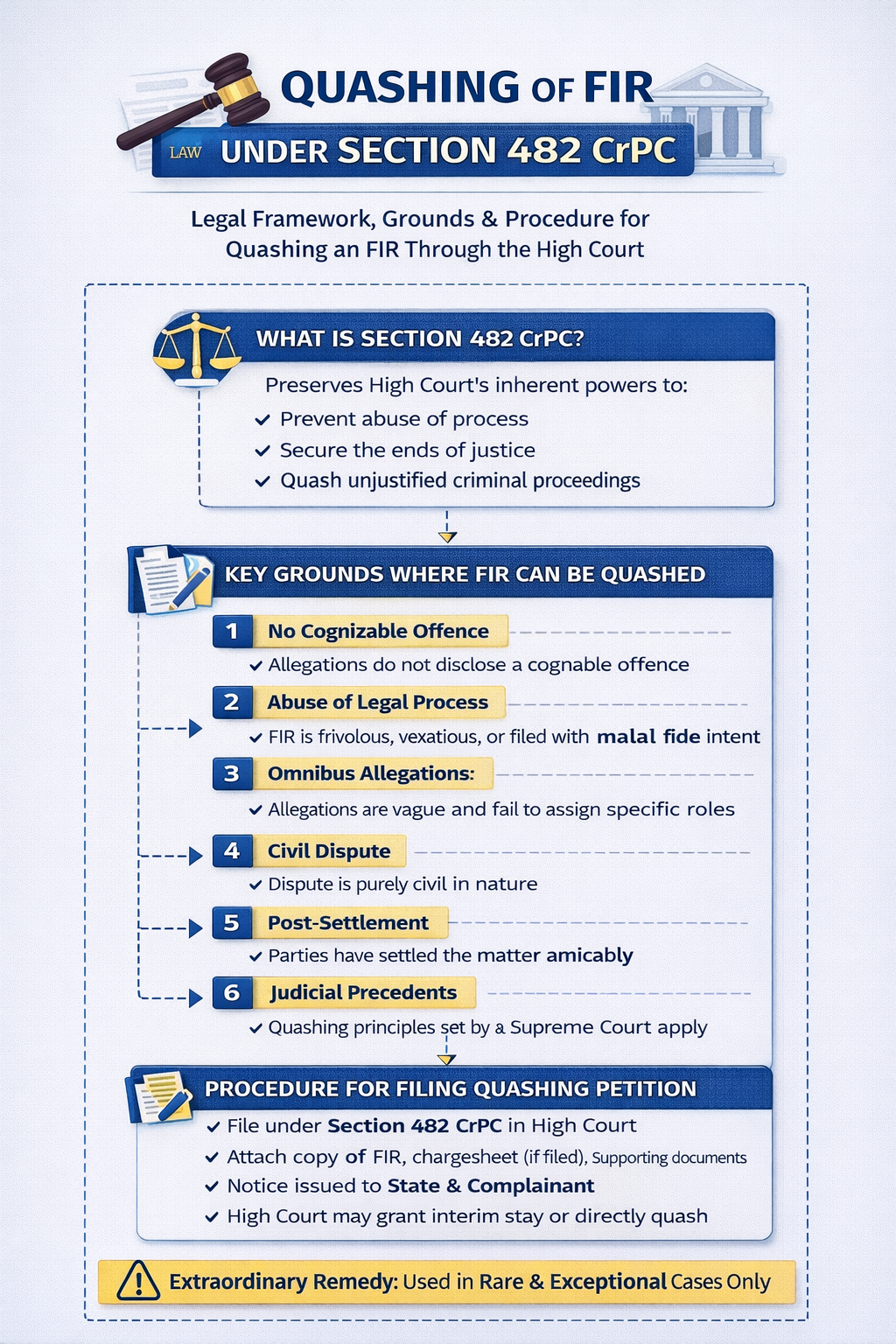
Specifically, Section 482 CrPC, which preserves the inherent powers of the High Court to:
Prevent abuse of process of law
Secure the ends of justice
Quash criminal proceedings where continuation is unjustified
This article explains the legal framework, judicial tests, landmark precedents, and strategic considerations for filing a quashing petition in brief.
I. What Is Section 482 CrPC?
Section 482 states that nothing in the Code shall limit the inherent powers of the High Court.
These powers are extraordinary in nature and must be exercised:
Sparingly
With caution
Only in rare and exceptional cases
Nevertheless, it is not an appellate power. In fact, it is a supervisory and preventive jurisdiction.
II. When Can FIR Be Quashed?
The Supreme Court laid down guiding principles in:
This judgment identified illustrative categories where quashing may be justified.
Key Grounds for Quashing:
Allegations do not disclose a cognizable offence
FIR is manifestly attended with mala fide intent
Allegations are absurd or inherently improbable
There is no legal evidence supporting prosecution
Proceedings amount to abuse of process
Dispute is purely civil in nature
Parties have settled the dispute (in appropriate cases)
III. Quashing in Matrimonial Offences (498A Cases)
Quashing petitions frequently arise in complaints under:
Section 498A IPC
Section 406 IPC
Section 34 IPC
Courts have repeatedly cautioned against mechanical implication of relatives.
In Arnesh Kumar v. State of Bihar, the Supreme Court addressed misuse in matrimonial litigation and emphasised procedural safeguards.
High Courts often quash proceedings where:
Allegations are omnibus
No specific role is attributed
Distant relatives reside separately
Complaint lacks prima facie material
IV. Settlement-Based Quashing
Even though Section 498A IPC is non-compoundable, courts permit quashing where matrimonial disputes are amicably resolved.
In Gian Singh v. State of Punjab, the Supreme Court held that High Courts may quash non-compoundable offences if the dispute is personal and continuation would serve no purpose.
Similarly, in Narinder Singh v. State of Punjab, guidelines were laid down for compromise-based quashing.
The principle: criminal law should not be used as a weapon once parties have settled significantly.
V. Can FIR Be Quashed After Chargesheet?
Yes. Quashing is maintainable even after filing of chargesheet under Section 173 CrPC.
However, courts are more cautious once investigation is complete.
The test becomes:
Whether materials collected disclose a prima facie case
Whether continuation would amount to injustice
In case the evidence supports trial, courts may refuse interference.
VI. Procedure for Filing Quashing Petition
A petition under Section 482 CrPC is filed before the jurisdictional High Court.
Quash proceedings partially against specific accused
VII. Judicial Caution: What Courts Will Not Do
High Courts will not:
Conduct mini-trials
Examine disputed facts
Evaluate credibility of witnesses
Weigh evidence
If allegations disclose prima facie offence, trial must proceed. In any case, section 482 is not a substitute for trial.
VIII. Strategic Considerations Before Filing
Filing a premature petition may weaken credibility.
Consider:
Stage of investigation
Strength of allegations
Documentary contradictions
Settlement possibilities
Parallel civil proceedings
Thus strategic timing is undoubtedly crucial.
IX. Common Mistakes in Quashing Petitions
Raising factual disputes requiring evidence
Filing without examining FIR carefully
Over-reliance on defence documents
Ignoring Supreme Court precedents
Filing multiple repetitive petitions
Subsequently, courts may impose costs for frivolous petitions.
X. Recent Judicial Approach
Courts increasingly:
Protect distant relatives in 498A cases
Scrutinise omnibus allegations
Encourage settlement in matrimonial disputes
Emphasise that criminal law should not become harassment
However, courts remain strict where allegations show serious cruelty or violence.
Conclusion
Section 482 CrPC ,thus, acts as a constitutional safety valve against misuse of criminal process. Additionally, it ensures that criminal law does not become a tool of oppression.
However, it is an extraordinary remedy. Courts exercise it with restraint. A well-structured petition grounded in settled principles significantly improves prospects.
The guiding test remains:
Does continuation of prosecution serve justice — or defeat it?
Therefore, when proceedings lack legal foundation or arise from matrimonial vendetta, inherent powers of the High Court restore balance.
A full bench of Apex Court ruled that none of the offences in the FIR were made out against the Petitioners.
From Paras 8-12,
8. Having heard the learned counsel for the parties and having perused the FIR dated 06.02.2022 as well as the final report, we are of the considered opinion that the criminal proceedings initiated against the appellants pursuant to the registration of offence punishable under Sections 498-A, 377 and 506 read with Section 34 of the Penal Code deserve to be quashed. 9. Before examining the FIR along with the complaint of the complainant, we may refer to the parameters that are to be borne in mind while entertaining the prayer for quashing of the FIR. If the allegations made in the FIR or the complaint, even when taken at their face value and accepted in their entirety donot prima facie constitute any offence or make out any case against the accused, quashing of the proceedings would be justified. Vague and general allegations cannot lead to forming of a prima facie case. As regards the ingredients for making out an offence punishable under Section 498-A of the Penal Code is concerned, the requirement is that there has to be cruelty inflicted against the victim which either drives her to commit suicide or cause grave injury to herself or lead to such conduct that would cause grave injury or danger to life, limb or health. The latter part of the provision refers to harassment with a view to satisfy an unlawful demand for any property or valuable security raised by the husband or his relatives. These aspects have been considered in detail in a recent decision in Digambar and Another (supra) (to which one of us, B.R. Gavai, J, as he then was, was a party). 10. A perusal of the FIR and its consideration in entirety indicates that statements of a general nature have been made therein as against the present appellants. The complainant states that on 07.08.2021 when she had gone to her parental house, she had received a call from her mother-in-law raising a demand for clothes and jewellery. When she returned to her matrimonial house on 30.08.2021, she had taken few clothes for the family members. Except this statement, all other statements are of a general nature as well as vague without any particulars. There are other omnibus statements made in the complaint without any particulars whatsoever. It is also to be noted that for the purpose of constituting an offence punishable under Section 498-A of the Penal Code, cruelty as indicated in the Explanation to the said provision must be stated to be inflicted. The cruelty caused by the husband and his family members should be of such nature that it is inflicted with the intention to cause grave injury or drive the victim to commit suicide or inflict grave injury to herself. Such allegations are absent in the present case. We do not find that on a complete reading of the complaint, a prima facie case for proceeding under Section 498-A of the Penal Code has been made out against the appellants. 11. As regards the offence punishable under Sections 377 and 506 read with Section 34 of the Penal Code is concerned, it is seen that the allegations in this regard have been made only against the complainant’s husband and not against the present appellants. The entire tenor of the complaint in that regard seeks to implicate the complainant’s husband and all incidents stated therein relate to him. There is no allegation whatsoever in that context against the appellants that would require them to face trial on that count. The proceedings insofar as the present appellants are concerned, thus, deserve to be quashed in their entirety. In our view, the High Court failed to notice this aspect of the matter while declining to quash the proceedings against the appellants. 12. For the aforesaid reasons, we are satisfied that on the touchstone of the law laid down in State of Haryana and Others vs. Bhajan Lal and Others2, a case has been made out by the appellants for quashing of the criminal proceedings lodged against them under Sections 498-A, 377 and 506 read with Section 34 of the Penal Code. Continuation of these proceedings would amount to an abuse of the process of law and, hence, the appellants are entitled to relief.
A division bench of Bombay High Court at Aurangabab held that
From Para 6,
6. Apart from this, the learned A.P.P. has also placed reliance on judgment of Hon’ble Supreme Court in the matter of Rupali Devi Vs. State of Uttar pradesh reported in AIR OnLine (2019) SC 394.
From Paras 9 and 10,
9. As regards Section 472 of the Cr. P. C, contention of the learned A.P.P. that offence under Section 498-A of the IPC is a continuing wrong will have to be accepted, but only with a rider. Although the offence under Section 498-A of the IPC is a continuing wrong, it would not mean that limitation would continue to run perennially.The correct interpretation of the provision is provided in the matter of Arun Vyas and another Vs. Anita Vyas (supra) which sates that in case of offence under Section 498-A, a new starting point of limitation is start on every occasion when the wrong is committed and the period of limitation needs to be computed from the last such wrong. We may profitably quote paragraph 13 of the said decision, which reads asunder :- “ The essence of the offence in Section 498-A is cruelty as defined in the explanation appended to that section. It is a continuing offence and on each occasion onwhich the respondent was subjected to cruelty, she would have a new starting point of limitation. The last act of cruelty was committed against the respondent, within the meaning of the explanation, on October 13, 1988 when, on the allegation made by the respondent in the complaint to Additional Chief Judicial Magistrate, she was forced to leave the matrimonial home. Having regard to the provisions of Sections 469 and 472 the period of limitation commenced for offences under Sections 406 and 498-A from October 13, 1988 and ended on October 12, 1991. But the charge sheet was filed on December 22, 1995,therefore, it was clearly barred by limitation under Section 468(2)(c) Cr. P. C.’’ 10. Thereafter, the Hon’ble Supreme Court has further stated inparagraph No. 14 that in complaints under Section 498-A the wife will invariably be oppressed, who is subjected to cruelty and,therefore, Section 473 of the Cr. P.C should be construed liberally in favour of wife. However, the Hon’ble Supreme Court has also cautioned that the words interest of justice employed in Section 473 of the Cr. P. C. cannot mean in the interest of prosecution and the true object of the provision is to advance the cause of justice by protecting the oppressed and punishing the offender. The Hon’ble Supreme Court has also referred to its earlier judgment in the matter of Onkar Radha Manohari (Smt) Vs. Venka Venkata Reddy reported in 1993 AIR SCW 3595 that while dealing with Section 498-A of the Indian Penal Code, the Court should not only examine as to whether delay is properly explained, but also as to whether it is necessary to entertain a time barred matter in the interest of justice.
From Paras 13 and 14,
13. These observations have been made in the context of territorial jurisdiction. The judgment does not deal with the aspect of limitation. Provisions of Sections 468, 472 and 473 ofthe Cr. P.C did not fall for consideration in this case. As against this in the cases of Arun Vyas and another Vs Anita Vyas (supra) andRamesh and other Vs. state of Tamil Nadu (supra), the question of limitation was directly involved and the same is answered referring to the relevant statutory provisions. It is settled legalprinciple that judgments of the Courts have to be interpreted in the backdrop of facts of the particular case. Ratio of a case has tobe understood and appreciated in the backdrop of the facts in which the judgment is delivered. The law laid down in thejudgment cannot be divorced from the facts of the case in which it is delivered. A judgment cannot be interpreted like a statute. It cannot be applied uniformly every where like Euclid’s theorems ofgeometry. Therefore, while dealing with aforesaid three judgments cited during the course of hearing, we are of theconsidered opinion that the ratio laid down in the matters of Arun Vyas and Ramesh which directly deal with the question of limitation will have to be accepted. The judgment in the matterof Rupali Devi is relating to territorial jurisdiction of a Court to deal with offence under Section 498-A of the IPC. 14. In the light of above, we are of the opinion that limitationfor offence punishable under Section 498-A of the IPC shall commence from the last act of cruelty. Offence under Section498-A of the IPC is a continuing offence implies that each act of cruelty would offer new starting point of limitation. Limitationfor prosecution under Section 498-A does not continue for indefinite period. Such interpretation will render Section 468 of the Cr. P.C. nugatory or otiose for the purpose of Section 498-A ofthe Indian Penal Code which does not appear to be the intention of legislature. Had there been intention to exclude Section 498-Aof the IPC from the sweep of Section 468 of the Cr. P.C express provision could have been made for the said purpose.
A single judge bench of the Telangana High Court held as follows,
From Paras 3-6,
3. Sri K. Venumadhav, learned counsel for the petitioners would submit that the 2nd respondent herself filed a petition vide FCOP.No.1267 of 2017 seeking dissolution of marriage on the ground of cruelty and the same was decreed on 12.04.2018 and the said order and decree attained finality. Therefore, the continuation of proceedings against the petitioners for the offences under Sections 498-A of IPC and Sections 4 and 6 of Dowry Prohibition Act, 1961 is not permissible. In support of his contentions he has relied on the principle laid down by the Hon’ble Apex Court in Mohammad Miyan and others v. State of Uttar Pradesh and another1. There are no allegations, much less specific allegations against the petitioners 2 and 3 herein, who are the aged parents of A-1.
4. The 2nd respondent has filed counter affidavit stating that she has filed FCOP.No.1267 of 2017 and the same was decreed and she has received an amount of Rs.2 lakhs as per the settlement taken place between the petitioners and the de-facto complainant. She has also filed a petition vide M.C.No.39 of 2020 and also O.P.No.831 of 2018 on behalf of her son K.Naga Satya Sai towards maintenance and the said OP was closed on receipt of said amount of Rs.2 lakhs.
5. With the said submissions, the 2nd respondent specifically contended that she has no interest in continuing the present proceedings in Cr.No.800 of 2019 against the petitioners herein.
6. Considering the said aspects and also the fact that the marriage of the 1st petitioner with the 2nd respondent was dissolved vide decree and order dt.12.04.2018 in FCOP.No.1267 of 2017 and in view of the principle laid down by the Hon’ble Apex Court in Mohammad Miyan’s case (supra) and also considering the contents of the counter affidavit, this Criminal Petition is allowed and the proceedings 2019(1) ALT (Crl.)276 (SC) in Cr.No.800 of 2019, pending on the file of WPS, DD, Hyderabad, against the petitioners herein are quashed.