Biggest threat from supposedly-protective Police is the misuse of the official power that they are delegated with, as per law. The following are some of the aspects that may be helpful for you to deal with this misuse of powers menace. List of Police websites is here.
BNSS is available here.
Note: If you need some reliefs from Judiciary, go here.
Threats of all kinds
- Generally, some Police calls you up and demands your appearance in the Police Station. He/She gives threats if you disobey such demands. Be clever and ensure you create electronic evidence of such threats and in this digital age, it is easy to get such corrupt/abusive police out of department. That is, only if you want to do that. If you have fear of later consequences, do not do this and suffer later.
Routine Violation of Guidelines issued by Supreme Court of India in it’s Judgments/Orders
- No automatic arrest should be effected for any offence in India which carries a punishment of 7 years or less. In such cases, strict adherence of procedure laid down in 41A CrPC is to be followed. This is as per Arnesh Kumar judgment. All the baseless false and motivated cases fall within this bracket. So, if any police violates this guideline, there are consequences listed in the same judgment. So, invoke this judgment, if the offences listed in FIR carry punishment of 7 years or less. This protection is reinforced by this judgment here. Read this page too. The procedure to be followed by police while arresting is elucidated in the landmark judgements here and here.
- To overcome this hurdle placed by the Hon’ble Supreme Court, Police add at least one section which carries punishment more than 7 years or less. If that case, immediately obtain Anticipatory Bail u/s 438 for all the accused persons mentioned in the FIR and this is not a stage where you can argue that allegations on accused other than A1 (most probably your parents and siblings) do not make out the said offence/section. Read about Anticipatory Bail in the below section. Make good use of the efiling facility, during COVID-19 times, as Bails are categorized as Urgent matters, with the help of any advocate in your favorable/local area.
- Even if civil matters are pending in courts between parties like DVC, Maintenance, Divorce, Custody, Succession, Police cannot deny to register FIR. 3-Judge bench of SC says so here.
- Use this latest judgment here if Police tinker with 41A CrPC/35 BNSS Notices. Police have to attach FIR copy along with 41A CrPC/35 BNSS Notice.
Get FIR from Police websites
Obtain a copy of FIR from the websites of the respective police departments. The list is here. Show them this landmark judgment here, if they act smart.
Use RTI to Obtain Complaint Copy and FIR
One can file a RTI application to the Public Information Officer (PIO) designated to every Police station and seek a copy of Complaint and FIR laid against you. It will take 30 days or less for this, as stipulated in the RTI Act. You can invoke Sec 7 – Risk to live or personal liberty to obtain the above documents in 48 hours.
Compoundability of Offences u/s 320 Cr.P.C.
Not all people can dare to go through the rigors of an Criminal trial for obvious reasons. Cr.P.C provides section 320 which has a list of offences that can be compounded by settling the matter amicable in a Lok Adalat.
In Andhra Pradesh, 494 IPC and 498A IPC are made compoundable via a State amendment here on the recommendation of the Chairperson, AP Women’s Commission.
Bail
Go here.
Additionally, stop all further communication with the gang of Opposite party family, as it is easy for them, on that fact alone (can claim a ground that you threatened them with what-not) to get your bail cancelled. Do NOT be a emotional dumbo and screw your (and your family/parent’s) bail. Please.
And once an Anticipatory Bail is granted, it protected the grantee/accused until the end of trial and there is no need to obtain Regular Bail, after Charge sheet is filed by Police into the Court. Case law here.
Register a complaint against Public Servant (No sanction from Government required!!!)
If any Public servant (read as Judge, Magistrate or Police) does something to violate their duty as prescribed u/s 197 CrPC, they are liable for criminal prosecution u/s 166A IPC. Read full details here.
Additionally, you can invoke section 29 of Police Act 1861 here or/and Section 4 of Police-Forces (Restriction of Rights) Act, 1966 here.
Beauty of Zero FIR
In Lalita Kumari judgement here, Supreme Court held that if a cognizable offence is reported or brought to the notice of a police station, the IO of that station has to register an FIR. If the said police station does not have territorial jurisdiction, it has to register a FIR with zero ‘0’ number and then transfer it to the police station which has territorial jurisdiction. Other judgments on same principle here or listed in chronological order here.
Possibility of Quashing the FIR and the subsequent proceedings
Once you (and/or your family members) are safe from Police clutches, evaluate the possibilities of Quashing the entire proceedings initiated by Police (or Court) u/s 482 CrPC. Begin reading from here to understand what is meant by a Quash Petition and how best to use it (if applicable) in your cases.
If the High Court tries to dispose of your Quash petitions by giving a relief of follow the guidelines issued in ‘Arnesh Kumar‘ judgment, note that this approach is deprecated by Apex Court vide Practical Solutions Inc Vs State of Telangana and Ors on 19 Jan 2026 and Md. Mashood and Ors Vs State of UP and Ors on 25 Feb 2026.
Investigation and Charge sheet
- Police are given certain time to complete investigation, as per Law. No point in poking them with RTI applications seeking progress/evidence collected, copy of Charge sheet etc. as such documents will be anyways given to accused persons (one complete set for each accused person) on your first appearance day in Court, after you receive summons from Court. Check your case details/progress regularly on eCourts app.
- Police may offer to remove sections and/or accused person from charge sheet for some gratification. On payment of bribe, they may follow through on do so as well. What they do not tell you is about a petition/right called as Protect petition that the de-facto complainant has. By filing this petition or by appearing in Court and orally giving statement that Police colluded with accused and removed sections and/or accused person from charge sheet for some gratification, Magistrate/Judge is within their power to restore back the sections and/or accused person on to the charge sheet. Don’t fall for this trap and lose money, as what you get in return is illusory.
- If the I.O. decides to file a charge sheet against you upon completion of investigation, you can request (no demand here) that you be given a copy of charge sheet and other documents (including witness statements recorded u/s 161 CrPC) that are being submitted to Court u/s 173 CrPC.
- This relief lies in 173(7) CrPC which reads as: “(7) Where the police officer investigating the case finds it convenient so to do, he may furnish to the accused copies of all or any of the documents referred to in sub-section (5).”
File a complaint at Police Station
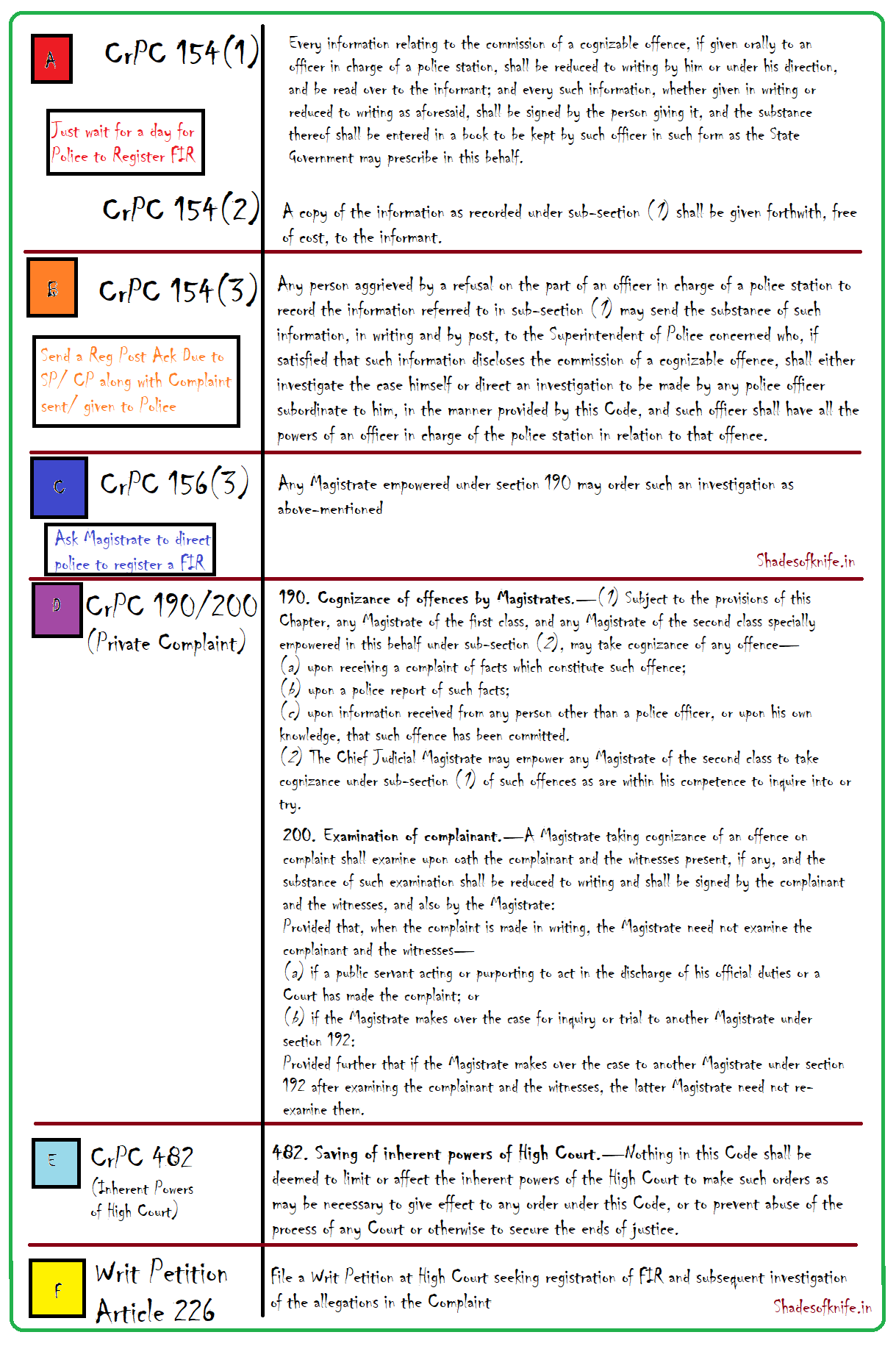
Whenever you have to report a cognizable complaint to Police, just follow the three steps in that very same order quickly. Do not crib or cry, if one step does not work per your liking.
PRE-COGNIZANCE STAGE:
- Register a written/oral Complaint with the nearest police station where the crime has occurred. This is mandatory as per section 154(1) CrPC.
- In the event Police do not register FIR based on your complaint, come back from there and file a Escalation letter (do not send same complaint as-it-is; if you want, you annex a copy of your complaint given at police station to this Escalation letter) to Senior Superintendent of Police of the District or the Commissioner of Police of the Metropolitan City via Registered Post with Acknowledgement Due card. This is mandatory requirement as per section 154(3) CrPC.
- Once your complaint to PS in (1) and escalation to SP/CP/SSP in (2) are exhausted and do not give result (registration of FIR and providing a copy to you, free), then register a complaint with the Magistrate Court which exercises Jurisdiction upto the above PS/SP Officer. The prayer will be to ‘direct the SP to direct the PS to register FIR. This is the procedure as per section 156(3) CrPC. If a FIR is registered in any of the these three scenarios, such case is called a Warrant case.
- The judgments list is here.
POST-COGNIZANCE STAGE:
- If Magistrate does not pass any direction as per above procedures, file a complaint directly u/s 190 CrPC r/w Sec 200 CrPC and Sec 202 CrPC. This is called as Private complaint.
- There is scope for going to High Court u/s 482 CrPC.
- If all of the above steps fail, go to the High Court under Writ Jurisdiction and file a Writ Petition u/Article 226 of the Constitution of India, seeking registration of FIR.
Note: Check the Schedule 1-Table in CrPC book to know if a particular IPC crime is Cognizable of not.
Remedies against Malicious Prosecution in India
Check out this page here.
Your Fundamental Rights Against Police Abuse
Even during investigation or arrest, every citizen in India enjoys constitutional protections. Police powers are not unlimited, and misuse of authority can be challenged in courts.
The following constitutional rights protect individuals from police high-handedness.
Article 14 – Equality Before Law
Every person is equal before the law. Police authorities cannot discriminate based on religion, caste, gender, political opinion, or personal bias.
Article 21 – Right to Life and Personal Liberty
No person can be deprived of life or liberty except according to procedure established by law. Illegal detention, torture, custodial violence, and harassment violate this fundamental right.
Article 22 – Protection Against Arbitrary Arrest
A person arrested by police has the right:
- To be informed of the grounds of arrest
- To consult and be defended by a lawyer
- To be produced before a magistrate within 24 hours
Detention beyond 24 hours without judicial authorization is illegal.
Article 39A – Right to Free Legal Aid
If a person cannot afford legal representation, the State must provide legal aid through Legal Services Authorities.
Rights of Citizens During Police Arrest
The Supreme Court of India has issued several guidelines to prevent abuse of police powers. These safeguards must be followed during arrest and detention.
The Arrest Memo
When a person is arrested, police must prepare an arrest memo containing:
- Date and time of arrest
- Name of arresting officer
- Name of witness
- Signature of the arrested person
Informing Family or Friend
Police must inform a relative, friend, or nominated person about the arrest and place of detention.
Right to Legal Counsel
An arrested person has the right to consult a lawyer during interrogation.
Medical Examination
The arrested person must undergo medical examination periodically while in custody to prevent torture or abuse.
Production Before Magistrate
The accused must be produced before a magistrate within 24 hours of arrest.
Failure to follow these procedures can make the arrest illegal.
Important Supreme Court Judgments Protecting Citizens
Over the years, the Supreme Court has issued several landmark rulings to prevent police misuse of power.
D.K. Basu vs State of West Bengal
This landmark judgment laid down detailed guidelines for arrest and detention to prevent custodial violence.
Joginder Kumar vs State of Uttar Pradesh
The Court held that police cannot arrest someone merely because they have the power to do so. Arrest must be justified.
Arnesh Kumar vs State of Bihar
The Court ruled that police should not make automatic arrests in offences punishable with imprisonment up to seven years. Instead, a notice under Section 41A CrPC should be issued.
Lalita Kumari vs Government of Uttar Pradesh
The Court made it mandatory for police to register an FIR when information discloses a cognizable offence.
What Police Cannot Legally Do
Police powers are limited by law. The following actions may amount to abuse of authority.
Illegal Detention
Police cannot detain a person in the police station without formal arrest.
Arrest Without Proper Grounds
Arrest cannot be used as a tool of intimidation or harassment.
Forced Confessions
Police cannot force a person to sign statements or confessions.
Threats or Coercion
Threatening family members or using intimidation tactics is illegal.
Seizing Property Without Documentation
If property is seized, police must prepare a seizure memo and provide a copy.
If any of these actions occur, the affected person may approach courts for relief.
Special Protections for Women
Indian law provides additional safeguards to protect women from abuse during police investigation.
Arrest of Women at Night
Women should not be arrested after sunset and before sunrise except in exceptional circumstances and with permission of a magistrate.
Female Officers
Search of women must be conducted only by female police officers.
Recording of Statements
Statements of women may be recorded at their residence rather than at a police station in appropriate cases.
Protection of Dignity
The dignity and privacy of women must be respected during investigation.
Violation of these safeguards can lead to disciplinary and legal action against police officers.
How to File a Complaint Against Police Misconduct
If a police officer behaves unlawfully, several remedies are available.
Complaint to Superintendent of Police (SP)
A written complaint can be filed with the district Superintendent of Police describing the misconduct.
Complaint to Police Complaints Authority
Most states have a Police Complaints Authority (PCA) that investigates serious allegations such as:
- Custodial torture
- Illegal detention
- Abuse of power
Approach the Magistrate
A complaint can be filed before a Judicial Magistrate seeking investigation or legal action against the officer.
Human Rights Commission
Complaints can be made to the National Human Rights Commission (NHRC) or State Human Rights Commission in cases involving custodial violence or illegal detention.
Immediate Legal Remedies in Case of Police Harassment
If a person faces harassment or illegal action by police, the following remedies may be used.
Anticipatory Bail
If there is apprehension of arrest in a false case, the person can apply for anticipatory bail under Section 438 CrPC.
Writ Petition in High Court
Under Article 226 of the Constitution, a person may approach the High Court seeking protection from police harassment.
Habeas Corpus
If someone is illegally detained, a Habeas Corpus petition may be filed demanding that the detained person be produced before the court.
Compensation for Custodial Abuse
Courts may award compensation if police violate fundamental rights.
Practical Steps to Protect Yourself from Police Harassment
If police start calling or visiting frequently, it is important to remain calm and act strategically.
Maintain Documentation
Keep records of:
- Call logs
- Messages
- Notices issued by police
- Copies of complaints filed
Record Interactions
If legally permissible, record conversations or interactions to preserve evidence.
Avoid Signing Blank Papers
Never sign blank documents or statements without reading them carefully.
Seek Legal Advice
Consult a lawyer before responding to serious allegations or notices.
Inform Family Members
Always inform family or trusted persons if you are called to a police station.
Evidence That Can Help Prove Police Misconduct
In cases of police abuse, evidence plays a crucial role.
Important forms of evidence include:
- CCTV footage
- Audio or video recordings
- Medical examination reports
- Witness statements
- Phone call records
- Copies of police notices
Preserving such evidence can significantly strengthen a legal case.
When to Approach the High Court
In serious cases of police harassment, approaching the High Court may be necessary.
Situations where High Court intervention may be appropriate include:
- Continuous harassment by police without lawful basis
- Threats of illegal arrest
- Refusal to register FIR
- Illegal detention
- Fabrication of false cases
High Courts have wide powers to issue directions to police authorities and protect citizens’ rights.
Conclusion
Police authorities play a vital role in maintaining law and order, but their powers must always be exercised within the framework of the law. Citizens are not helpless against abuse of authority. The Constitution, criminal procedure laws, and judicial precedents provide strong safeguards against arbitrary police action.
Understanding one’s rights, maintaining proper documentation, and using available legal remedies can effectively protect individuals from police high-handedness.
Anyone facing serious harassment should seek legal advice and take appropriate steps through the legal system to safeguard their rights.
MASTER SITEMAP here.

