web analytics

Menu

Skip to content
Shades of Knife
  • Home
  • True Colors of a Vile Wife
  • Need Inspiration?
  • Blog Updates
  • SOK Gallery
  • Vile News Reporter
  • About Me
  • Contact Me

Shades of Knife

True Colors of a Vile Wife

Tag: IPC 499 – Defamation

When to File Defamation for False Allegations – Legal Strategy

Posted on April 11 by Suprajaa Rajan

Introduction

False allegations in matrimonial and criminal disputes can seriously damage a person’s reputation, dignity, and social standing. While individuals often focus on defending the primary case, they may overlook an important remedy—defamation proceedings.

Therefore, when allegations are false, malicious, and harm reputation, the law allows the aggrieved person to initiate defamation action. However, timing and strategy play a crucial role in ensuring success.

This article explains when to file defamation for false allegations, along with relevant provisions under the Code of Criminal Procedure, 1973 (CrPC) and the Bharatiya Nagarik Suraksha Sanhita, 2023 (BNSS).

What Constitutes Defamation?

Defamation involves making a false statement that harms the reputation of a person.

Under Indian law:

  • Section 499 IPC (to be read with Bharatiya Nyaya Sanhita, 2023) defines defamation
  • Section 500 IPC prescribes punishment

A statement amounts to defamation when:

  • It is false
  • It is made with intent or knowledge to harm reputation
  • It is communicated to a third person

Thus, not every allegation amounts to defamation—only those that are false and damaging.

Types of Defamation Remedies

You can initiate defamation proceedings in two ways:

1. Criminal Defamation

You can file a complaint before a Magistrate.

Relevant procedure:

  • Section 200 CrPC (Section 223 BNSS) – Filing of complaint before Magistrate

2. Civil Defamation

You can file a civil suit seeking damages (compensation) for reputational harm.

Both remedies can run simultaneously, depending on the strategy.

When Should You File Defamation?

Timing plays a critical role. You should not rush to file defamation immediately in every case.

1. When Allegations Are Clearly False

You should initiate defamation only when:

  • Allegations are demonstrably false
  • No supporting evidence exists
  • Statements are malicious in nature

If the matter is still under investigation, courts may advise caution.

2. After Filing of Chargesheet or Closure Report

It is often strategically advisable to wait until:

  • The police file a closure report, or
  • The chargesheet does not support the allegations

Relevant provision:

  • Section 173 CrPC (Section 193 BNSS)

At this stage, you can show that the allegations lack evidentiary support.

3. After Acquittal by Court

The strongest ground for defamation arises after acquittal.

Once the court acquits the accused, it establishes that:

  • The allegations were not proved
  • The prosecution failed to establish guilt

You can then rely on the judgment to initiate defamation proceedings effectively.

4. When False Allegations Are Made Publicly

If the complainant:

  • Publishes allegations on social media
  • Circulates defamatory statements
  • Makes public accusations

you can initiate defamation immediately, as publication is a key element.

Step-by-Step Legal Strategy

Step 1: Collect Evidence of Defamation

First, you must gather proof of:

  • False statements
  • Mode of publication
  • Harm caused to reputation

Evidence may include:

  • Social media posts
  • Emails or messages
  • Public complaints or notices

Step 2: Analyse Whether Exceptions Apply

The law provides exceptions to defamation, such as:

  • Statements made in good faith
  • Statements made for public good
  • Complaints made to lawful authorities

Therefore, you must ensure that the case does not fall within these exceptions.

Step 3: File Criminal Complaint

You can file a criminal complaint before the Magistrate under:

  • Section 200 CrPC (Section 223 BNSS)

The Magistrate may:

  • Record your statement
  • Examine witnesses
  • Issue process against the accused

Step 4: Consider Civil Suit for Damages

In addition to criminal proceedings, you may file a civil suit claiming:

  • Compensation for reputational harm
  • Damages for mental agony

This step strengthens your overall legal strategy.

Step 5: Prepare for Preliminary Evidence Stage

The Magistrate will examine whether sufficient grounds exist to proceed.

Relevant provisions:

  • Section 202 CrPC (Section 225 BNSS) – Inquiry by Magistrate

At this stage, you must present:

  • Supporting documents
  • Witness statements
  • Proof of publication

Strategic Considerations Before Filing

Before initiating defamation, you should consider:

  • Strength of evidence
  • Stage of the main criminal case
  • Possibility of settlement
  • Risk of counter-litigation

Filing defamation prematurely may weaken your case.

Judicial Approach

Courts recognise that false allegations can seriously harm reputation. At the same time, courts also protect:

  • Genuine complainants
  • Statements made in good faith

Therefore, courts strike a balance between:

  • Protecting reputation
  • Preventing misuse of defamation law

Conclusion

Defamation serves as an important legal remedy against false and malicious allegations. However, success depends on timing, evidence, and legal strategy.

You should ideally:

  • Wait for investigation outcome or acquittal
  • Collect strong documentary evidence
  • File complaint under Section 200 CrPC (Section 223 BNSS)
  • Consider both criminal and civil remedies

By adopting a strategic and evidence-based approach, you can effectively protect your reputation and seek legal redress.


Index of Legal Strategies and Defence is here. 


Key Contributor : 

Mrs. Suprajaa Rajan B.Com., LL.B., LL.M.

+91-9606345150
Posted in Legal Procedure | Tagged Criminal complaint CrPC Sec 200 or BNSS Sec 223 - Filing of complaint before Magistrate False Allegations IPC 499 - Defamation Legal Strategies and Defence Matrimonial Litigation India | Leave a comment

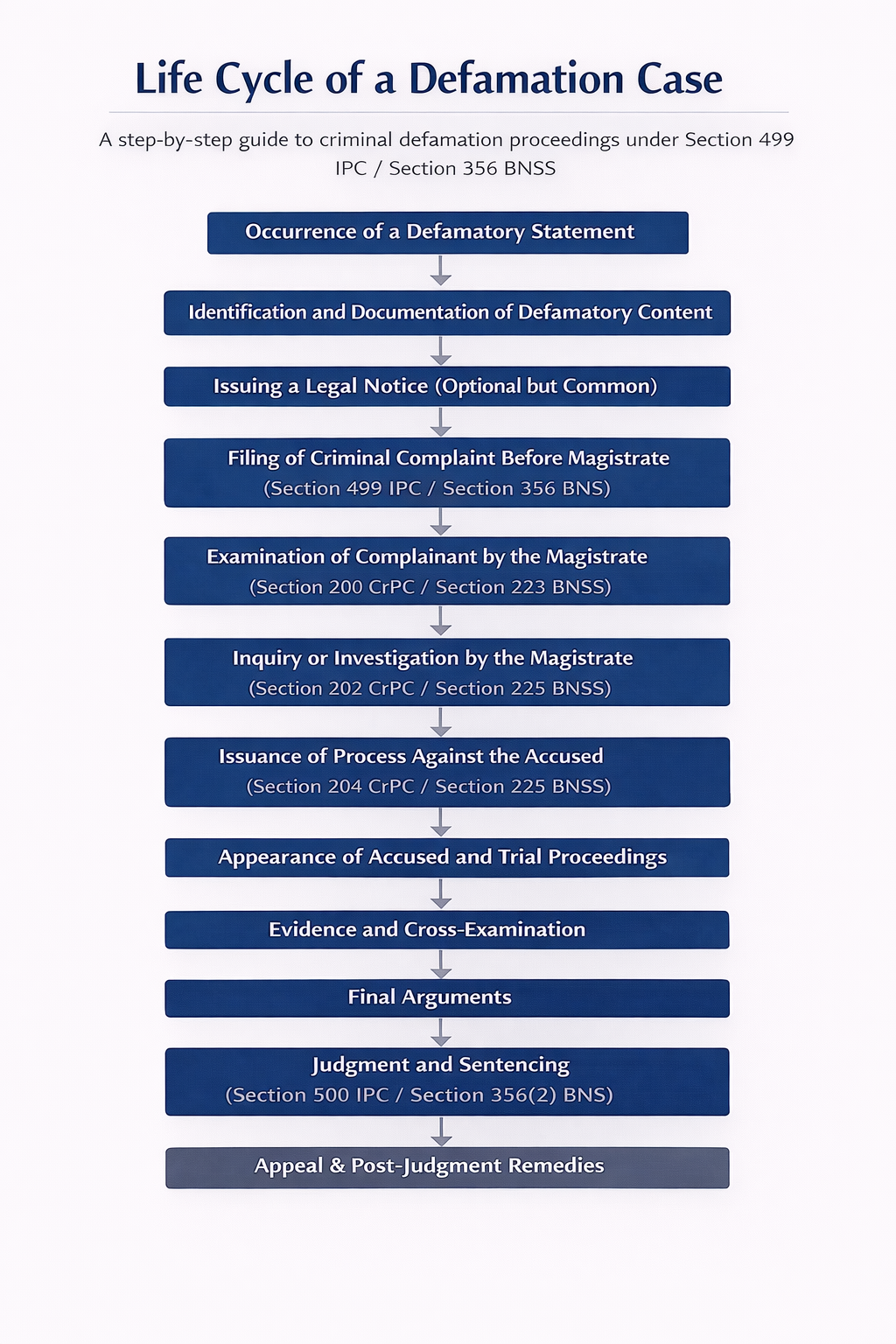
Life Cycle Stages of a Defamation Case

Posted on March 13 by Suprajaa Rajan

A Step-by-Step Guide to Defamation Proceedings Under Indian Law

Understanding the Life Cycle Stages of a defamation case helps individuals protect their reputation and pursue legal remedies when someone harms their reputation through false statements.

Defamation occurs when a person makes or publishes a false statement that harms another person’s reputation in the eyes of society. Indian law recognises defamation as both a civil wrong (tort) and a criminal offence.

Criminal defamation is defined under Section 499 of the Indian Penal Code, 1860, which corresponds to Section 356 of the Bharatiya Nyaya Sanhita, 2023 (BNS). The punishment for defamation appears under Section 500 IPC, which corresponds to Section 356(2) BNS.

Furthermore, the procedural aspects of criminal defamation cases follow the provisions of the Code of Criminal Procedure, 1973 (CrPC) and the Bharatiya Nagarik Suraksha Sanhita, 2023 (BNSS).

The following stages explain the complete life cycle of a criminal defamation case in India.

1. Legal Foundation of Defamation Law

First, it is important to understand the legal framework governing defamation in India.

Under Section 499 IPC / Section 356 BNS, defamation occurs when a person makes or publishes any imputation concerning another person with the intention of harming their reputation.

However, the law also recognises several exceptions. For instance, statements made in good faith for public interest or fair criticism of public conduct may not amount to defamation.

If a statement satisfies the legal ingredients of defamation and does not fall under any exception, the aggrieved person may initiate legal proceedings.

2. Stage One: Occurrence of a Defamatory Statement

Typically, a defamation dispute begins when a person publishes or communicates a harmful statement about another person.

The defamatory statement may appear in various forms. For example, it may appear in newspapers, online posts, social media content, speeches, or written communications.

If the statement damages the reputation of the affected person in the eyes of others, it may constitute defamation.

However, the aggrieved person must demonstrate that the statement is false and that it has caused reputational harm.

3. Stage Two: Identification and Documentation of Defamatory Content

After the defamatory statement becomes known, the aggrieved person must identify and document the content carefully.

For example, the person may collect copies of newspaper publications, screenshots of online posts, or recordings of speeches containing the defamatory statement.

Proper documentation plays an important role because the complainant must later produce this material as evidence before the court.

Therefore, preserving the defamatory material becomes an essential early step in the case.

4. Stage Three: Issuing a Legal Notice (Optional but Common)

Before initiating formal proceedings, the aggrieved person may issue a legal notice to the alleged defamer.

The notice typically demands that the person withdraw the defamatory statement and issue a public apology.

Additionally, the notice may warn that failure to comply will lead to legal proceedings for defamation.

Although the law does not always require such notice, many parties use it to resolve disputes without litigation.

5. Stage Four: Filing of Criminal Complaint Before Magistrate

If the dispute remains unresolved, the aggrieved person may file a criminal complaint for defamation before the appropriate Magistrate.

The complaint alleges the commission of the offence under Section 499 IPC / Section 356 BNS, punishable under Section 500 IPC / Section 356(2) BNS.

Criminal defamation cases generally proceed as private complaints, where the aggrieved person directly approaches the Magistrate.

The Magistrate then examines the complaint and supporting material.

6. Stage Five: Examination of Complainant by the Magistrate

After receiving the complaint, the Magistrate examines the complainant and any supporting witnesses.

This examination occurs under Section 200 of the Code of Criminal Procedure, 1973, which corresponds to Section 223 of the Bharatiya Nagarik Suraksha Sanhita, 2023.

During this stage, the Magistrate records the complainant’s statement under oath.

The purpose of this stage is to determine whether the complaint contains sufficient grounds to proceed further.

7. Stage Six: Inquiry or Investigation by the Magistrate

Next, the Magistrate may conduct a preliminary inquiry to verify the allegations.

This stage occurs under Section 202 CrPC, which corresponds to Section 225 BNSS.

The Magistrate may examine additional witnesses or review documents to determine whether the case merits further proceedings.

This stage prevents frivolous complaints from proceeding to trial.

8. Stage Seven: Issuance of Process Against the Accused

If the Magistrate finds sufficient grounds, the court issues summons to the accused person.

This stage occurs under Section 204 CrPC, which corresponds to Section 227 BNSS.

The summons directs the accused to appear before the court on a specified date.

Once the accused appears before the court, the criminal proceedings formally begin.

9. Stage Eight: Appearance of Accused and Trial Proceedings

After receiving the summons, the accused appears before the Magistrate either personally or through legal counsel.

The court explains the allegations relating to the offence of defamation under Section 500 IPC / Section 356 BNS.

If the accused denies the allegations, the matter proceeds to trial.

During the trial, both parties receive the opportunity to present their evidence.

10. Stage Nine: Evidence and Cross-Examination

At this stage, the complainant presents evidence supporting the allegations of defamation.

For example, the complainant may produce the defamatory publication, witness testimony, and other documentary evidence.

The accused then cross-examines the complainant’s witnesses.

After the complainant completes evidence, the accused may present defence evidence. The defence may rely on statutory exceptions such as truth, public interest, or fair comment.

11. Stage Ten: Final Arguments

After completion of evidence, both parties present their final arguments before the Magistrate.

The complainant argues that the accused intentionally published defamatory statements that harmed reputation.

Conversely, the accused attempts to establish that the statement was true, made in good faith, or protected by legal exceptions.

The court carefully evaluates the evidence, legal provisions, and applicable precedents.

12. Stage Eleven: Judgment and Sentencing

Finally, the Magistrate delivers the judgment after considering the entire record.

If the court finds the accused guilty, it may impose punishment under Section 500 IPC / Section 356(2) BNS.

The punishment may include imprisonment, fine, or both.

However, if the court finds insufficient evidence or accepts a valid legal defence, it may acquit the accused.

13. Appeal and Post-Judgment Remedies

After the judgment, the aggrieved party may challenge the decision before the appellate court.

The appellate court reviews the legality and correctness of the judgment.

Depending on the facts of the case, the appellate court may confirm, modify, or set aside the decision of the trial court.

Conclusion

Defamation law plays an important role in protecting the reputation and dignity of individuals. False and malicious statements can seriously harm a person’s social standing and professional life.

Therefore, Indian law provides a structured mechanism under Section 499 IPC / Section 356 BNS to address such misconduct.

Understanding the life cycle of a defamation case helps individuals take appropriate legal action and protect their reputation through lawful means.


Other Life Cycles: DV Case Lifecycle || Maintenance Case u/s 125 CrPC Lifecycle. Index is here.


Key Contributor :

Mrs. Suprajaa Rajan B.Com., LL.B., LL.M.

+91-9606345150


Posted in Legal Procedure | Tagged defamatory IPC 499 - Defamation judicial procedure Life Cycle Stages of a Defamation case Life Cycles of Various case types | Leave a comment

Rabindra Nath Pal Vs Ratikanta Paul and Ors on 6 Mar 2020

Posted on March 10, 2022 by ShadesOfKnife

Relying on Apex Court’s Surinder Mohan Vikal decision, Calcutta High Court held as follows:

In the instant case, the cause of action arose from the date when First Information Report was registered and not from the date on which the complainant was acquitted from the charge.

Rabindra Nath Pal Vs Ratikanta Paul and Ors on 6 Mar 2020

Citations :

Other Sources :

https://indiankanoon.org/doc/50050401/

https://www.casemine.com/judgement/in/5faa5a1c4653d02a0b1309ab

Posted in High Court of Calcutta Judgment or Order or Notification | Tagged 1-Judge Bench Decision CrPC 468 - Bar to taking cognizance after lapse of the period of limitation IPC 499 - Defamation IPC 500 - Punishment For Defamation Non-Reportable Judgement or Order Rabindra Nath Pal Vs Ratikanta Paul and Ors Surinder Mohan Vikal Vs Ascharaj Lal Chopra | Leave a comment

Ms.Romy Khanna Vs State (Govt of NCT of Delhi) on 4 Jul 2011

Posted on March 10, 2022 by ShadesOfKnife

Relying on Apex Court’s Surinder Mohan Vikal decision, Delhi High Court held that if any offence is made out in a complaint under Section 500 IPC for defamation, Section 468(2) Cr.P.C. is attracted and cognizance of offence should be taken within a period of three years from the date of occurrence.

Ms.Romy Khanna Vs State (Govt of NCT of Delhi) on 4 Jul 2011

Citations : [2011 DLT 182 221], [2012 CRICC 1 85], [2011 RCR CRIMINAL 4 735], [2011 SCC ONLINE DEL 2664], [2011 RCR CRI 4 735]

Other Sources :

https://indiankanoon.org/doc/10503637/

https://www.casemine.com/judgement/in/56090e0ae4b014971117b1c7

Posted in High Court of Delhi Judgment or Order or Notification | Tagged 1-Judge Bench Decision CrPC 468 - Bar to taking cognizance after lapse of the period of limitation IPC 499 - Defamation IPC 500 - Punishment For Defamation Ms.Romy Khanna Vs State (Govt of NCT of Delhi) Reportable Judgement or Order Surinder Mohan Vikal Vs Ascharaj Lal Chopra | Leave a comment

Surinder Mohan Vikal Vs Ascharaj Lal Chopra on 28 Feb 1978

Posted on October 16, 2021 by ShadesOfKnife

A division bench of Supreme Court held that, the defamation has to be filed with in time limitation while also referring to 468, 469 and 470 CrPC.

It would thus appear that the appellant was entitled to the benefit of sub-section (1) of section 468 which prohibits every Court from taking cognizance of an offence of the category specified in sub-section (2) after the expiry of the period of limitation. It is hardly necessary to say that statutes of limitation have legislative policy behind them. For instance, they shut out belated and dormant claims in order to save the accused from unnecessary harassment. They also save the accused from the risk of having to face trial at a time when his evidence might have been lost because of the delay on the part of the prosecutor. As has been stated, a bar to the taking of cognizance has been prescribed under section 468 of the Code of Criminal Procedure and there is no reason why the appellant should not be entitled to it in the facts and circumstances of this case.

Surinder Mohan Vikal Vs Ascharaj Lal Chopra on 28 Feb 1978

Citations : [1978 SCC 2 403], [1978 SCR 3 434], [1978 CAR 113], [1978 CRLR SC 158], [1978 SCC CR 215], [1978 AIR SC 486], [1978 AIR SC 786], [1978 AIR SC 986], [1978 SCC CRI 215], [1978 CRLJ SC 764]

Other Sources :

https://indiankanoon.org/doc/885750/

https://www.casemine.com/judgement/in/5609abcae4b014971140d573

Posted in Supreme Court of India Judgment or Order or Notification | Tagged 2-Judge (Division) Bench Decision CrPC 468 - Bar to taking cognizance after lapse of the period of limitation CrPC 469 - Commencement of the period of limitation CrPC 470 - Exclusion of time in certain cases IPC 499 - Defamation IPC 500 - Punishment For Defamation Landmark Case Surinder Mohan Vikal Vs Ascharaj Lal Chopra | Leave a comment

Balraj Khanna and Ors Vs Moti Ram on 22 Apr 1971

Posted on October 16, 2021 by ShadesOfKnife

A division bench of Apex Court passed this Judgment regd

After a consideration of the various decisions referred to above, we are of the opinion that the propositions laid down in English decisions dealing with libel that the actual words alleged to be used must be stated in the indictment cannot be applied on all fours when dealing with the cases of defamation by spoken words under Section 499 I. P. C. it will be highly desirable no doubt if the actual words stated to have been used by an accused and which are alleged to be defamatory are reproduced by the complainant. The actual words used or the statements made may be reproduced verbatim by the complainant if the words are few and the statement is very brief. But in cases where the words spoken are too many or the statements made are too long, in our opinion, it will be the height of technicality to insist that the actual words and the entire statements should be reproduced verbatim. The object of having, if possible, the actual words or the statements before the court is to enable it to consider whether those words or the statements are defamatory in nature. That purpose or object will be served if the complainant is able to reproduce in his complaint or evidence in a substantial measure the words of imputation alleged to have been uttered. If the statements or the words placed before the court by the complainant are held to be not defamatory, it will mean that the complainant will have to lose. Therefore it is to his interest to get a proper adjudication from, the court that as far as possible the words spoken or the statements actually made and which he alleges to be defamatory are before the court. But a complaint cannot be thrown out on the mere ground that the actual words spoken or the statements made have not been stated in the complaint. From the point of view of accused also it is necessary that the matters alleged to be defamatory in the complaint must be so stated as to enable them to know the nature of the allegations that they have to meet.

Balraj Khanna and Ors Vs Moti Ram on 22 Apr 1971

Other Sources :

https://indiankanoon.org/doc/1946272/

https://www.casemine.com/judgement/in/5609ab73e4b014971140c842

Citations:


Posted in Supreme Court of India Judgment or Order or Notification | Tagged 2-Judge (Division) Bench Decision Balraj Khanna and Ors Vs Moti Ram Catena of Landmark Judgments Referred/Cited to IPC 499 - Defamation IPC 500 - Punishment For Defamation Landmark Case Reportable Judgement or Order Work-In-Progress Article | Leave a comment

Arun Thakur Vs State of Chhattisgarh on 10 July 2019

Posted on December 12, 2020 by ShadesOfKnife

Whether an Advocate, while acting under the instructions of his client and proceeding professionally, can be prosecuted / punished for the offence of defamation punishable under Section 500 of the Indian Penal Code is the precise question involved in this petition which came before High Court of Chhattisgarh.

From Para 10,

10. It appears from the aforesaid genealogical tree that respondent No.2 herein has been shown to be the concubine / wife of Ghanshyam Pandey. This, according to respondent No.2, is defamatory, as she is the legally married wife of Ghanshyam Pandey after the death of his first wife Smt. Tarini Pandey and that led to the present dispute.

From Para 24,

24. In light of above-stated legal analysis, an advocate, who acted professionally as per instructions of his/her client, cannot be made criminally liable for the offence of defamation under Section 500 of the IPC unless contrary is alleged and established.

From Para 26,

….

As such, an Advocate who has acted professionally and drafted plaint making averment as per the instructions of his client, cannot be held liable for the offence of defamation under Section 500 of the IPC.

Finally from Para 33,

33. Admittedly, respondent No.2 claims that the alleged incident happened in the year 2014 and after lapse of 3-4 years, FIR has been lodged which clearly goes to show that there was no intention of the petitioner to cause harm, as in such a case, she would have rushed to the police authority well in time. As such, even it cannot be held that the petitioner has abused and insulted respondent No.2 in terms of Section 506 of the IPC.

Arun Thakur Vs State of Chhattisgarh on 10 July 2019
Posted in High Court of Chhattisgarh Judgment or Order or Notification | Tagged 1-Judge Bench Decision Advocate Antics Arun Thakur Vs State of Chhattisgarh Catena of Landmark Judgments Referred/Cited to IPC 294 - Not Made Out IPC 499 - Defamation IPC 499 - Defamation Not Made Out IPC 506 - Not Made Out IPC 509 - Not Made Out Legal Procedure Explained - Interpretation of Statutes Professional Advice of Advocate | Leave a comment

Arnab Ranjan Goswami Vs UOI and Ors on 19 May 2020

Posted on May 21, 2020 by ShadesOfKnife

Justice Dr Dhananjaya Y Chandrachud, gave this Judgment.

From Para 26,

26. At this stage, it is necessary to note that the attention of Mr Kapil Sibal and Dr Singhvi, learned Senior Counsel was specifically drawn to the fact that the FIRs which were filed in various states by persons professing allegiance to the INC appear, prima facie, to be reproductions of the same language and content. Responding to this, Mr Sibal fairly stated that in the exercise of the jurisdiction under Article 32, this Court may well quash all the other FIRs and allow the investigation into the FIR which has been transferred to the NM Joshi Marg Police Station in Mumbai to proceed in accordance with law. Mr Sibal has also urged that there cannot be any dispute in regard to the legal position that a complaint in regard to the offence of defamation can only be at the behest of the person who is aggrieved. Consequently, the FIR which has been presently under investigation at the NM Joshi Marg Police Station in Mumbai would not cover any offence under Section 499 of the IPC.


Arnab Ranjan Goswami Vs UOI and Ors on 19 May 2020


Citations: [

Other Source links:


Posted in Supreme Court of India Judgment or Order or Notification | Tagged 2-Judge (Division) Bench Decision Arnab Ranjan Goswami Vs UOI and Ors Article 32 - Remedies for enforcement of rights conferred by this Part Avoid Multiplicity Of Litigation Catena of Landmark Judgments Referred/Cited to IPC 499 - Defamation Work-In-Progress Article | Leave a comment

M.C. Verghese Vs T.J. Ponnan and Anr on 13 November 1968

Posted on January 17, 2020 by ShadesOfKnife

In this landmark classic case, Supreme Court has held that,

16. In a recent judgment of the House of Lords Rumping v. Director of Public Prosecutions 1962 3 All ER 256 Rumping the in mate of a Dutch ship was tried for murder committed on board the ship. Part of the evidence for the prosecution admitted at the trial consisted of a letter that Rumping  had written to his wife in Holland which amounted to a confession. Rumping had written the letter on the day of the killing, and had handed the letter in a closed envelope to a member of the crew requesting him to post it as soon as the ship arrived at the port outside England. After the appellant was arrested, the member of the crew handed the envelope to the captain of the ship who handed it over to the police. The member of the crew, the captain and the translator of the letter gave evidence at the trial, but the wife was not called as witness. It was held that the letter was admissible in evidence. Lord Reid, Lord Morris of Borth-Y-Gest, Lord Hodson and Lord Pearce were of the view that at common law there had never been a separate principle or rule that communications between a husband and wife during marriage were inadmissible in evidence on the ground of public policy. Accordingly except where the spouse to whom the communication is made is a witness and claims privilege from disclosure under the Criminal Evidence Act, 1898 (of which the terms are similar to Section 122 of the Indian Evidence Act though not identical), evidence as to communications between husband and wife during marriage is admissible in criminal proceedings.
17. The question whether the complainant in this case is an agent of the wife because he has received the letters from the wife and may be permitted to give evidence is a matter on which no opinion at this stage can be expressed. The complainant claims that he has been defamed by the writing of the letters. The letters are in his possession and are available for being tendered in evidence. We see no reason why inquiry into that complaint should, on the preliminary contentions raised, be prohibited. If the complainant seeks to support his case only upon the evidence of the wife of the accused, he may be met with the bar of Section 122 of the Indian Evidence Act. Whether he will be able to prove the letters in any other manner is a matter which must be left to be determined at the trial and cannot be made the subject-matter of an enquiry at this stage.


Supreme Court of India version:

M.C. Verghese Vs T.J. Ponnan and Anr on 13 November 1968

Case Mine version:

M.C. Verghese Vs T.J. Ponnan and Anr on 13 November 1968 Casemine

Citations: [1969 SCR 2 692], [1970 AIR SC 1876], [968 KERLT 904], [1950 AIR TC 38], [1969 SCC 1 37], [1970 CAR 210], [1970 CRLJ 0 1651], [1970 CRI LJ 1651]

Indiankanoon.org or ILR link: https://indiankanoon.org/doc/1159106/ or http://14.139.60.114:8080/jspui/handle/123456789/21403


The Index for Defamation Judgments is here.


Reproduced in accordance with Section 52(q) of the Copyright Act 1957 (India) from main.sci.gov.in/judgments, judis.nic.in, lobis.nic.in, indiacode.nic.in and other Indian High Court and District Court Websites such as ecourts.gov.in

Posted in Supreme Court of India Judgment or Order or Notification | Tagged CrPC 199 - Defamation IPC 499 - Defamation IPC 500 - Punishment For Defamation Landmark Case Legal Procedure Explained - Interpretation of Statutes M.C. Verghese Vs T.J. Ponnan and Anr

Tiruvengada Mudali Vs Tripurasundari Ammal on 15 February 1926

Posted on January 17, 2020 by ShadesOfKnife

In this landmark judgment by old Madras High Court, it was held that the accusations made in a complaint to Magistrate do NOT have absolute privilege and only have qualified privilege as provided under section 499 of IPC. Such accusations are liable for defamation if NOT protected by exception 8.

Indian Law Review version (Original):

Tiruvengada Mudali Vs Tripurasundari Ammal on 15 February 1926 ILR

Indiankanoon Version:

Tiruvengada Mudali Vs Tripurasundari Ammal on 15 February 1926

Citations: [49 Mad. 728], [A. I. R. (18) 1926 Mad. 906], [1926 (27) Cri LJ 1026], [AIR 1926 Mad 906], [(1926) 51 MLJ 112],

Indiankanoon.org or ILR link: https://indiankanoon.org/doc/1159106/ or http://14.139.60.114:8080/jspui/handle/123456789/21403


The Index for Defamation Judgments is here.


Reproduced in accordance with Section 52(q) of the Copyright Act 1957 (India) from main.sci.gov.in/judgments, judis.nic.in, lobis.nic.in, indiacode.nic.in and other Indian High Court and District Court Websites such as ecourts.gov.in

Posted in High Court of Madras Judgment or Order or Notification | Tagged CrPC 199 - Defamation IPC 499 - Defamation IPC 500 - Punishment For Defamation Landmark Case Legal Procedure Explained - Interpretation of Statutes No Absolute Privilege Tiruvengada Mudali Vs Tripurasundari Ammal

Post navigation

  • Older posts

Search within entire Content of “Shades of Knife”

My Legal X Timeline

Advocate Sandeep Pamarati 🇮🇳💪👨🏻‍🎓 Follow

AP High Court Advocate with M Tech (CS) || 12 years in 'Software Industry' as Solution Architect || Blogs at https://t.co/29CB9BzK4w || #TDPTwitter

SandeepPamarati
Retweet on Twitter Advocate Sandeep Pamarati 🇮🇳💪👨🏻‍🎓 Retweeted
rose_k01 Rosy @rose_k01 ·
10 Jul

Women in the Yao village of China are famous for having the Longest hair in the World averaging 6 feet long. Women in their 80s still don't have a Single grey hair!! Their secret is Fermented Rice water. Watch How they make & use it 🍚🌾💧

Reply on Twitter 2075635918879523325 Retweet on Twitter 2075635918879523325 898 Like on Twitter 2075635918879523325 3901 X 2075635918879523325
Retweet on Twitter Advocate Sandeep Pamarati 🇮🇳💪👨🏻‍🎓 Retweeted
ani ANI @ani ·
12 Jul

Promo | ANI Podcast with R.V.S. Mani, Former Under Secretary, Ministry of Home Affairs, Premieres Today at 5 PM IST

"Narendra Modi and Amit Shah Were the Targets in the Ishrat Jahan Case."

"None of the Files Had the Term 'Hindu Terror' Until 2010."

"Digvijaya Singh Asked Me to

Reply on Twitter 2076177037165994029 Retweet on Twitter 2076177037165994029 614 Like on Twitter 2076177037165994029 1586 X 2076177037165994029
Retweet on Twitter Advocate Sandeep Pamarati 🇮🇳💪👨🏻‍🎓 Retweeted
kolla_ch1 చైతన్య కొల్లా @kolla_ch1 ·
11 Jul

రాష్ట్రం మీద పడి.. అడ్డ గాడిదల్లా... అడ్డ దిడ్డంగా పడి దోచుకున్న అడ్డమైన ఎదవలకు ఊడిగం చేస్తూ

డెలివరీ బాయ్ లను అవమానపర్చే

ఆ నెల తక్కువ సన్నాసి మొహాన కొట్టండయ్యా దీన్ని 🤷‍♂️

Reply on Twitter 2076018293836808437 Retweet on Twitter 2076018293836808437 111 Like on Twitter 2076018293836808437 642 X 2076018293836808437
Retweet on Twitter Advocate Sandeep Pamarati 🇮🇳💪👨🏻‍🎓 Retweeted
shunyta_007 𝐒ɦυ𐓣𝗒𝗍α @shunyta_007 ·
12 Jul

Observation Skills 🔥

Reply on Twitter 2076189650885226496 Retweet on Twitter 2076189650885226496 537 Like on Twitter 2076189650885226496 3146 X 2076189650885226496
Load More

Recent Posts

  • Prahlad Singh Bhati Vs N.C.T. Delhi and Anr on 23 Mar 2001 July 12, 2026
  • Application for Day-to-Day Trial – Format, Procedure & Sample Draft July 8, 2026
  • Pooja Ramesh Singh Vs JnK Bank and Anr on 02 Jul 2026 July 8, 2026
  • A.S.S.K.Durga Prasad Vs NCDRC and Ors on 24 Jun 2026 July 7, 2026
  • Application for Permanent Exemption from Appearance – Format, Procedure & Sample Draft July 7, 2026

Most Read Posts

  • Reply to Section 41A CrPC Notice – Format with Legal Explanation (5,046 views)
  • Anu Aggarwal Vs Sushant Aggarwal on 20 Jan 2026 (3,599 views)
  • Umme Farva Vs State of U.P. and Anr on 14 Jan 2026 (3,529 views)
  • Charge Sheet and Final Report Explained (2,998 views)
  • Regular Bail Application Format (Section 437/439 CrPC) (2,368 views)
  • Neha Lal Vs Abhishek Kumar on 20 Jan 2026 (2,151 views)
  • Arrest Procedure in 498A cases after Arnesh Kumar (2,055 views)
  • Discharge Application Format in 498A Case – Draft, Procedure & Sample Template (1,918 views)
  • Can You Travel Abroad After an FIR Is Registered? – Legal Position Explained (1,864 views)
  • Life Cycle of a Perjury Case (1,782 views)

Tags

Reportable Judgement or Order (436)2-Judge (Division) Bench Decision (422)Legal Procedure Explained - Interpretation of Statutes (386)Landmark Case (383)1-Judge Bench Decision (366)Catena of Landmark Judgments Referred/Cited to (297)Work-In-Progress Article (215)3-Judge (Full) Bench Decision (101)Sandeep Pamarati (91)Article 21 - Protection of life and personal liberty (80)Issued or Recommended Guidelines or Directions or Protocols to be followed (71)Perjury Under 340 CrPC (66)Absurd Or After Thought Or Baseless Or False Or General Or Inherently Improbable Or Improved Or UnSpecific Or Omnibus Or Vague Allegations (62)Reprimands or Setbacks to YCP Govt of Andhra Pradesh (49)Summary Post (47)CrPC 482 - Quash (44)HM Act Sec 13 - Divorce Granted to Husband (42)Divorce Granted on Cruelty ground (42)Legal Terrorism (41)Abuse Or Misuse of Process of Court (40)

Categories

Supreme Court of India Judgment or Order or Notification (758)Bare Acts or State Amendments or Statutes or GOs or Notifications issued by Central or State Governments (329)High Court of Andhra Pradesh Judgment or Order or Notification (187)High Court of Delhi Judgment or Order or Notification (164)High Court of Bombay Judgment or Order or Notification (112)High Court of Karnataka Judgment or Order or Notification (95)Legal Procedure (83)High Court of Madras Judgment or Order or Notification (71)High Court of Allahabad Judgment or Order or Notification (62)LLB Study Material (59)General Study Material (56)High Court of Punjab & Haryana Judgment or Order or Notification (53)Assorted Court Judgments or Orders or Notifications (51)High Court of Kerala Judgment or Order or Notification (47)Judicial Activism (for Public Benefit) (47)Prakasam DV Cases (46)District or Sessions or Magistrate Court Judgment or Order or Notification (44)High Court of Madhya Pradesh Judgment or Order or Notification (38)High Court of Gujarat Judgment or Order or Notification (28)High Court of Telangana Judgment or Order or Notification (28)

Recent Comments

  • eCourts India on Compromise-Based Quashing in Matrimonial Cases – Complete Legal Strategy
  • The Divorce Law Firm on Life Cycle Stages of a Divorce case
  • The Divorce Law Firm on Life Cycle Stages of a Divorce case
  • ShadesOfKnife on Sandeep Pamarati Vs Ungrateful Knife (IPC 498A Case)
  • KONURU VINAYKUMAR on Sandeep Pamarati Vs Ungrateful Knife (IPC 498A Case)

Archives of SoK

  • July 2026 (13)
  • June 2026 (19)
  • May 2026 (24)
  • April 2026 (33)
  • March 2026 (42)
  • February 2026 (30)
  • January 2026 (21)
  • December 2025 (2)
  • November 2025 (3)
  • October 2025 (17)
  • September 2025 (12)
  • August 2025 (5)
  • July 2025 (10)
  • June 2025 (15)
  • May 2025 (3)
  • April 2025 (10)
  • March 2025 (7)
  • February 2025 (8)
  • January 2025 (1)
  • December 2024 (3)
  • November 2024 (4)
  • October 2024 (16)
  • September 2024 (15)
  • August 2024 (14)
  • July 2024 (11)
  • June 2024 (18)
  • May 2024 (13)
  • April 2024 (9)
  • March 2024 (23)
  • February 2024 (15)
  • January 2024 (11)
  • December 2023 (11)
  • November 2023 (9)
  • October 2023 (13)
  • September 2023 (12)
  • August 2023 (15)
  • July 2023 (17)
  • June 2023 (11)
  • May 2023 (6)
  • April 2023 (5)
  • March 2023 (10)
  • February 2023 (9)
  • January 2023 (12)
  • December 2022 (12)
  • November 2022 (8)
  • October 2022 (13)
  • September 2022 (17)
  • August 2022 (10)
  • July 2022 (21)
  • June 2022 (27)
  • May 2022 (23)
  • April 2022 (32)
  • March 2022 (17)
  • February 2022 (6)
  • January 2022 (2)
  • December 2021 (7)
  • November 2021 (7)
  • October 2021 (6)
  • September 2021 (10)
  • August 2021 (31)
  • July 2021 (45)
  • June 2021 (17)
  • May 2021 (17)
  • April 2021 (18)
  • March 2021 (58)
  • February 2021 (14)
  • January 2021 (50)
  • December 2020 (35)
  • November 2020 (68)
  • October 2020 (67)
  • September 2020 (28)
  • August 2020 (41)
  • July 2020 (20)
  • June 2020 (36)
  • May 2020 (40)
  • April 2020 (38)
  • March 2020 (26)
  • February 2020 (43)
  • January 2020 (35)
  • December 2019 (34)
  • November 2019 (4)
  • October 2019 (18)
  • September 2019 (57)
  • August 2019 (33)
  • July 2019 (12)
  • June 2019 (18)
  • May 2019 (5)
  • April 2019 (19)
  • March 2019 (58)
  • February 2019 (11)
  • January 2019 (90)
  • December 2018 (97)
  • November 2018 (43)
  • October 2018 (31)
  • September 2018 (73)
  • August 2018 (47)
  • July 2018 (143)
  • June 2018 (92)
  • May 2018 (97)
  • April 2018 (59)
  • March 2018 (8)

Blogroll

  • Daaman Promoting Harmony 0
  • Fight against Legal Terrorism Fight against Legal Terrorism along with MyNation Foundation 0
  • Good Morning Good Morning News 0
  • Insaaf India Insaaf Awareness Movement 0
  • MyNation Hope Foundation Wiki 0
  • MyNation.net Equality, Justice and Harmony 0
  • Sarvepalli Legal 0
  • Save Indian Family Save Indian Family Movement 0
  • SIF Chandigarh SIF Chandigarh 0
  • The Male Factor The Male Factor 0
  • Unitedmen Foundation a dedicated community forged with the mission to unite men facing legal challenges in marital disputes. 0
  • Vaastav Foundation The Social Reality 0
  • Vinayak my2centsworth – This blog is for honest law abiding men, married or planning to get married 0
  • Voice4india Indian Laws, Non-profits, Environment 0
  • Writing Law Writing Law by Ankur 0

RSS Cloudflare Status

  • Cloudflare Storage Maintenance July 16, 2026
    THIS IS A SCHEDULED EVENT Jul 16, 12:00 - 13:00 UTC Jul 6, 22:38 UTC Scheduled - Cloudflare has scheduled maintenance for our backend storage systems. Services will continue to operate normally, but customers will be unable to create/delete/modify Client-Side Security settings via the Dashboard or the public API for a period of up to […]
    Cloudflare

RSS List of Spam Server IPs from Project Honeypot

  • 188.95.67.196 | S July 13, 2026
    Event: Bad Event | Total: 106 | First: 2025-03-27 | Last: 2026-07-13
Owned and Operated by Advocate Sandeep Pamarati and Advocate Suprajaa Rajan
Proudly powered by WordPress
Theme: Flint by Star Verte LLC

Bad Behavior has blocked 1085 access attempts in the last 7 days.

pixel