An investigation is a critical stage in criminal proceedings, where statements made by an individual can significantly impact the outcome of the case. Many accused persons unknowingly make statements that later weaken their defence or strengthen the prosecution’s case.
Therefore, understanding what to say—and what to avoid saying—during investigation is essential for protecting your legal rights.
This article explains the correct legal approach during police investigation, along with safeguards under the Code of Criminal Procedure, 1973 (CrPC) and the Bharatiya Nagarik Suraksha Sanhita, 2023 (BNSS).
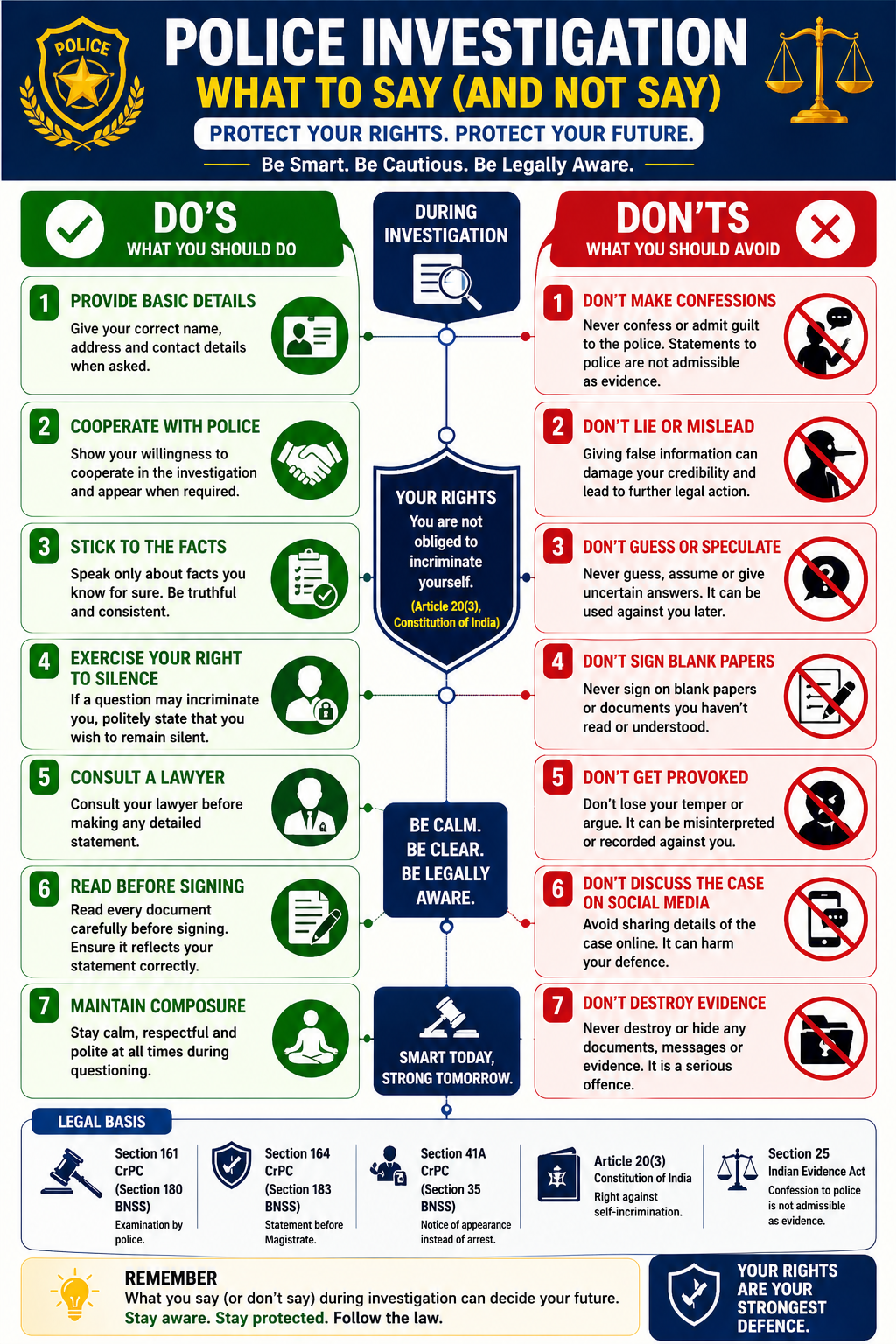
Understanding Your Legal Position During Investigation
During investigation, the police have the authority to:
- Call individuals for questioning
- Record statements
- Collect evidence
Relevant provisions:
- Section 160 CrPC (Section 179 BNSS) – Attendance of witnesses
- Section 161 CrPC (Section 180 BNSS) – Examination by police
However, this power is not unlimited. Individuals have specific rights that protect them from self-incrimination and coercion.
Right Against Self-Incrimination
Under Article 20(3) of the Constitution of India, no person can be compelled to:
- Be a witness against themselves
This means:
- You are not required to confess
- You cannot be forced to make incriminating statements
This principle forms the foundation of your conduct during investigation.
What You Should Say During Investigation
1. Provide Basic Identification Details
You should always provide:
- Name
- Address
- Contact details
This ensures compliance with legal requirements.
2. Confirm Willingness to Cooperate
You should clearly state:
- Your willingness to cooperate with the investigation
- Your readiness to appear when required
This helps avoid adverse inference and unnecessary coercive action.
3. Stick to Verified Facts Only
If you choose to answer questions:
- Speak only about facts you are certain of
- Avoid assumptions or speculation
Consistency is key to maintaining credibility.
4. Exercise Your Right to Silence Where Necessary
If a question may incriminate you, you can:
- Politely decline to answer
- State that you wish to consult your lawyer
This is a legally protected right.
5. Request Legal Assistance
While police questioning may proceed, you can:
- Consult a lawyer before making detailed statements
This ensures that your rights are protected at every stage.
What You Should NOT Say During Investigation
1. Do Not Make Confessions to Police
Statements made to police are generally not admissible as evidence.
Relevant provision:
- Section 25 of the Indian Evidence Act
However, such statements may still:
- Influence investigation
- Lead to recovery of evidence
Therefore, avoid making confessional statements.
2. Do Not Provide False Information
Giving false statements can:
- Damage your credibility
- Lead to additional legal consequences
Always avoid misleading the investigating officer.
3. Do Not Guess or Speculate
Never:
- Assume facts
- Provide uncertain answers
Speculative answers may later be used against you.
4. Do Not Sign Blank or Unread Documents
Before signing any document:
- Read it carefully
- Ensure it reflects your actual statement
Signing incorrect documents can seriously harm your case.
5. Do Not Get Provoked or Intimidated
Maintain composure even if:
- Questioning becomes aggressive
- Pressure is applied
Any emotional reaction can be misinterpreted.
Importance of Statements Under Section 161 CrPC
Statements recorded under:
- Section 161 CrPC (Section 180 BNSS)
are:
- Not signed by the person
- Used for contradiction during trial
Therefore, even informal statements can later affect your defence.
Special Note on Section 164 Statements
If the Magistrate records your statement under:
- Section 164 CrPC (Section 183 BNSS)
it carries higher evidentiary value.
Such statements:
- Are recorded voluntarily
- Can be used as substantive evidence
Hence, extreme caution is required before making such statements.
Role of Notice Under Section 41A
Instead of arrest, police may issue notice under:
- Section 41A CrPC (Section 35 BNSS)
You must:
- Comply with the notice
- Appear before the officer
Cooperation reduces the risk of arrest.
Step-by-Step Practical Strategy
Step 1: Stay Calm and Composed
Do not panic or react impulsively.
Step 2: Understand the Nature of Allegations
Ask for:
- Basic information about the case
- Reason for questioning
Step 3: Avoid Incriminating Statements
Use your right to silence where necessary.
Step 4: Consult a Lawyer
Seek legal advice before making detailed statements.
Step 5: Maintain Consistency
Ensure that all statements remain:
- Accurate
- Consistent
Judicial Approach
Courts recognise that:
- Statements made during investigation can be misused
- Accused persons must be protected from coercion
Courts emphasise:
- Voluntariness of statements
- Protection against self-incrimination
- Fair investigation process
Practical Insight
Many cases are weakened not because of evidence, but due to:
- Incorrect statements
- Inconsistent versions
- Unnecessary admissions
Therefore, careful communication during investigation is a key defence strategy.
Conclusion
What you say during investigation can significantly influence your case. While cooperation is important, protecting your legal rights is equally essential.
By:
- Speaking cautiously
- Avoiding unnecessary disclosures
- Exercising your right to silence
you can ensure that your defence remains strong throughout the proceedings.
A balanced approach—cooperative yet legally aware—is the best strategy during any investigation.
Related Legal Concepts
- Police Investigation
- Reply to Notice under Section 41A
- Rights during police investigation
- First Information Report(FIR)
- Arrest and Custodial procedures
Index of Legal Strategies and Defence is here.
Key Contributor :
Mrs. Suprajaa Rajan B.Com., LL.B., LL.M.
+91-9606345150

