web analytics

Menu

Skip to content
Shades of Knife
  • Home
  • True Colors of a Vile Wife
  • Need Inspiration?
  • Blog Updates
  • SOK Gallery
  • Vile News Reporter
  • About Me
  • Contact Me

Shades of Knife

True Colors of a Vile Wife

Tag: Work-In-Progress Article

Bharat Desai Editor of Times of India and Anr Vs State of Gujarat on 18 Apr 2012

Posted on October 26, 2020 by ShadesOfKnife

Single-judge bench of Gujarat High Court held as follows:

From Para 35,

35. From the contents of the news items published in the Times of India on 30th and 31st May, 2008 in the context of which the above referred two first information reports have been lodged, it is apparent that there is nothing therein which would cause disaffection amongst the members of the police officers against the State Government established by law. The contention that the comments regarding the State Government having appointed a person with a criminal background like the second respondent would induce in the minds of the subordinate officers an impression that they should not obey him and thus, induce disloyalty, does not merit acceptance inasmuch as what is stated in the articles is only an expression of an opinion as regards the act of the Government in appointing the second respondent as Commissioner of Police. If the contention of the second respondent were to be accepted no adverse comment could be made as regards the appointment/promotion of any officer belonging to the police force, which cannot be the intention of the legislature while enacting the said provision. The test for the invoking the said provision would be whether the news items in question has the propensity of evoking amongst the members of the police force feelings of disaffection towards the Government established by law in India or the effect of inducing any member of the police force to withhold his service or to commit a breach of discipline. Besides, the news item has to be read from the stand point of a reasonable man. On a bare reading of the articles in question from the armchair of a reasonable person, the same can, in no manner, be said to have the effect of causing disaffection towards the Government nor can the same be said to have the likelihood of inducing any member of the police force to withhold the service or to commit a breach of discipline. A mere comment on the wisdom of the State Government in appointing the second respondent as Commissioner of Police in the context of his background, can in no manner induce a prudent member of the police force to withhold his service or commit a breach of discipline, nor can such comment have the effect of creating disaffection against the Government. The provisions of section 3 of the said Act would, therefore, not be attracted in the facts of the present cases.

And then in Para 36,

36. Another aspect of the matter is that a perusal of the allegations made in the first information reports shows that the contents of the sections invoked against the applicants have been mentioned therein so as to make out an offence under section 124A IPC and section 3 of the Police (Incitement to Disaffection) Act, 1922. In this regard it may be apposite to refer to the decision of the Supreme Court in Vijaya Rao v. State of Rajasthan and another (supra) wherein it has been held that mere reference to the expressions mentioned in the provision would not disclose commission of an offence, when the ingredients constituting the offence in question are conspicuously lacking. In the facts of the present case, merely
because in the first information reports, it has been stated that the articles in question have been published with the intention to cause hatred against senior police officers of the State Government established by law and that the same have been published as an attempt to cause contempt and hatred against the State Government, the same would not fall within the ambit of section 124A IPC or section 3 of the Police (Incitement to Disaffection) Act, 1922, when the ingredients for constitution of an offence under section 124A IPC and section 3 of the said Act are woefully lacking.

Bharat Desai Editor, Times of India and Anr Vs State of Gujarat on 18 Apr 2012


Posted in High Court of Gujarat Judgment or Order or Notification | Tagged Bharat Desai Editor of Times of India and Anr Vs State of Gujarat Police (Incitement to Disaffection) Act Section 3 - Work-In-Progress Article | Leave a comment

Sankaran Moitra Vs Sadhna Das and Anr on 24 Mar 2006

Posted on October 18, 2020 by ShadesOfKnife

This is the Majority judgment from this 3-judge bench regarding the applicability of sanction from government to prosecute a public servant u/s 197 CrPC.

Sankaran Moitra Vs Sadhna Das and Anr on 24 Mar 2006

Dissenting opinion by Justice C.K. Thakker:

Sankaran Moitra Vs Sadhna Das and Anr on 24 Mar 2006 (Thakker J)

Citations :

2006 AIOL 1722006 SUPREME 4 6452006 SCC CRI 2 3582006 SCC 4 5842006 JT 4 342006 AIR SC 16952006 BOMCR CRI SC 2 4512006 AIR SC 15992006 SCALE 3 4142006 AIR SCW 1695

Other Sources :

https://indiankanoon.org/doc/1179931/

https://indiankanoon.org/doc/1212531/

https://www.casemine.com/judgement/in/5609ae38e4b014971141334c


Earlier Calcutta High Court Judgment here.

Posted in Supreme Court of India Judgment or Order or Notification | Tagged 3-Judge (Full) Bench Decision CrPC 197 - Prosecution of Judges and public servants Sankaran Moitra Vs Sadhna Das and Anr Work-In-Progress Article | Leave a comment

Rizwan Ahmed Javed Shaikh and Ors Vs Jammal Patel and Ors on 12 May 2001

Posted on October 17, 2020 by ShadesOfKnife


Rizwan Ahmed Javed Shaikh and Ors Vs Jammal Patel and Ors on 12 May 2001

Citations : [2002 ACR SC 2 1768], [2001 ALD CRI 1 902], [2001 ALLMR CRI SC 1512], [2001 JT SUPPL SC 1 32], [2001 PLJR 4 2], [2001 RLW SC 2 262], [2001 SCALE 4 205], [2001 SCC 5 7], [2001 SCR 3 766], [2001 UC 2 177], [2001 AIR SC 0 2125], [2001 SCC 0 2198], [2001 SUPREME 4 236], [2001 BOMCR CRI SC 721], [2001 SLT 4 259], [2001 SRJ 6 373], [2001 CCR 2 281], [2001 RCR CRIMINAL 2 681], [2002 CRJ 1 632], [2001 AD SC 5 28], [2001 BLR 4 356], [2001 CRLJ SC 2897], [2001 JT 32], [2001 AIR SC 2198],

Other Sources:

https://indiankanoon.org/doc/522373/

https://www.casemine.com/judgement/in/5609ad93e4b0149711411bdb

Posted in Supreme Court of India Judgment or Order or Notification | Tagged CrPC 197 - Prosecution of Judges and public servants Rizwan Ahmed Javed Shaikh and Ors Vs Jammal Patel and Ors Work-In-Progress Article | Leave a comment

Anil Bharadwaj Vs The High Court of MP and Ors on 13 Oct 2020

Posted on October 14, 2020 by ShadesOfKnife

A District-Judge aspirant lost that opportunity due to a false 498A IPC case from which he got acquitted, after the selection for the post completed.

Anil Bharadwaj Vs The High Court of MP and Ors on 13 Oct 2020

Earlier High Court Judgment dismissing the Writ petition

Anil Bhardwaj Vs The High Court of Madhya Pradesh and Ors on 06 Jan 2020

~~~

Other Source: https://indiankanoon.org/doc/103138593/


Posted in Supreme Court of India Judgment or Order or Notification | Tagged 2-Judge (Division) Bench Decision Anil Bharadwaj Vs The High Court of MP and Ors Catena of Landmark Judgments Referred/Cited to Legal Terrorism Reportable Judgement or Order Work-In-Progress Article | Leave a comment

In Re Alarming Rise in the Number of Reported Child Rape Incidents

Posted on August 25, 2020 by ShadesOfKnife

In this Suo Moto Criminal Writ Petition, Supreme Court took up the cause upon itself and issue directions, one of which is constitution of Special Court to prosecute cases under POCSO Act.

In Re Alarming Rise in the Number of Reported Child Rape Incidents on 25 July 2019

Action taken by Andhra Pradesh Government:

2019-09-26 2019HO_MS121 Sanction of Eight (8) more Special Courts in the Cadre of District Judge under the POCSO Act 2012

2020-08-25 2020HO_MS93 Sanction of Eight (8) more Special Courts in the Cadre of District Judge under the POCSO Act 2012

The Recent Order is from March… after which no update (Not brought before a bench even though the Order clearly says so.

In Re Alarming Rise in the Number of Reported Child Rape Incidents on 06 March 2020
Posted in Supreme Court of India Judgment or Order or Notification | Tagged In Re Alarming Rise in the Number of Reported Child Rape Incidents Suo Moto Proceedings by Supreme Court or High Court Work-In-Progress Article | Leave a comment

Criminal prosecution of Public Servant (includes a Judge or Magistrate or a Police office)

Posted on August 24, 2020 by ShadesOfKnife

Read the 2013 Amendment made to General Penal and Procedural laws of India. All amendments made to CrPC are here.

In this amendment, apart from inserting new sections (around women-protection) into prevailing laws, the following helpful sections were brought in.

  • Judge or Magistrate or a public servant may be prosecuted as per procedure laid out u/s sec 197 CrPC
  • New Cognizable and Bailable offence u/s 166A was inserted into IPC which can be invoke against police if they violate laws.
  • Per the new Explanation given to sec 197(1) CrPC, no sanction is required to prosecute the police. Karnataka High Court clearly explains this here.

Explanation follows…


PART-A

Section 197 CrPC provides the procedure for, When any person who is or was a Judge or Magistrate or a public servant, (who is) not removable from his office save (meaning except) by or with the sanction (meaning permission) of the Government (meaning Central or State Governments) is accused of any offence alleged to have been committed by him, while acting or purporting to act in the discharge of his official duty, no Court shall take cognizance of such offence except with the previous sanction.

So, this mandates that Government permission is must for a Court to take cognizance of such offence by such public servant. Important aspect to note is that, there is no restriction of registering an FIR, only Cognizance needs Government permission to proceed.


PART-B

Now, the same 2013 Amendment to Criminal laws of India also inserted a new section criminalizing three acts/omissions of public servants. It is as follows.

Whoever, being a public servant,—
(a) knowingly disobeys any direction of the law which prohibits him from requiring the attendance at any place of any person for the purpose of investigation into an offence or any other matter, or
(b) knowingly disobeys, to the prejudice of any person, any other direction of the law regulating the manner in which he shall conduct such investigation, or
(c) *****
shall be punished with rigorous imprisonment for a term which shall not be less than six months but which may extend to two years, and shall also be liable to fine.


The entire procedure of how to make arrest in a cognizable case by police is in CHAPTER V – ARREST OF PERSONS. The various sections under this chapter  are few other sections are as follows:

  • Sec 41 CrPC
  • Sec 41A CrPC
  • Sec 41B CrPC
  • Sec 41D CrPC
  • Sec 46 CrPC
  • Sec 160 CrPC

Let’s focus on clauses (a) and (b) alone. I have given meanings for the words used in these two clauses here.

Clause (a) talks about the police disobeys any direction of the law (they are flouting CrPC so let’s consider only judicial decisions) which prohibits him from requiring the attendance at any place of any person for the purpose of investigation into an offence or any other matter.

So, if a Police office disobeys any of these above CrPC provisions such as

  • a male police office arresting female accused,
  • a female arrested after sunset and before sunrise-meaning night time) or
  • no notice issued u/s 41A CrPC to the accused (even WhatsApp, email is also valid service of notice)
  • no notice or communication as mandated u/s 50 CrPC, not given to person being arrested
  • violates judgments which prohibit police in doing something in relation to forcing any person to attend before police for investigation, then such police office is liable for punishment under 166A IPC and a competent Court can take cognizance of his case, without permission from State Government.

Some Judgment (of any High Court or Supreme Court) which established a law/principle regd attendance of a person before police


Clause (b) knowingly disobeys, to the prejudice of any person, any other direction of the law regulating the manner in which he shall conduct such investigation means,

Some Judgments (of any High Court or Supreme Court) which established a law/principle regd investigation

  1. What is Investigation and what is not? [Rajesh Gutta Judgment]
  2. No automatic arrests in a any case which has a maximum imprisonment of 7 years (includes 498A IPC, Sec 3 of DP Act etc) [Arnesh Kumar judgment]


Until the 2013 Amendment to Criminal laws of India, the cases involving public servants were taken cognizance, only after/with Government permission.


PART-C

Now, the 2013 Amendment to Criminal laws of India inserted an Explanation under/after Section 197(1) and before 197(2) [this means that the explanation applies to sec 197(1) only]:

Explanation.—For the removal of doubts, it is hereby declared that no sanction shall be required in case of a public servant accused of any offence alleged to have been committed under section 166A, section 166B, section 354, section 354A, section 354B, section 354C, section 354D, section 370, section 375, section 376, section 376A, section 376AB, section 376C, section 376D, section 376DA, section 376DB or section 509 of the Indian Penal Code (45 of 1860).

Out of the many IPC offences listed in this explanation, Legislature, in it’s endless wisdom, also included Sec 166A also, so that means now, the cases involving public servants can be taken cognizance by Competent Court, without Government permission.

Conclusion

So, get FIRs registered (by making good use of Zero FIR, where appropriate) and prosecute the out-of-line public servant (includes a Judge or Magistrate or a Police office)

Check out the relevant case laws here.

Posted in Bare Acts or State Amendments or Statutes or GOs or Notifications issued by Central or State Governments | Tagged Criminal Law (Amendment) Act 2013 with O and R CrPC 197 - Prosecution of Judges and public servants IPC 166A - Public servant disobeying direction under law Work-In-Progress Article | Leave a comment

All Reliefs from Judiciary

Posted on August 16, 2020 by ShadesOfKnife

Awareness of law involved in the case laid against you is crucial to handle and take charge of your case yourself. The following are some of the general reliefs one can invoke in Andhra Pradesh for sure. They may apply to other states also. List of High Courts is here.


BNSS is available here.


Note: If you need some reliefs from Police High-handedness, go here.


Always remember Article 21 of Constitution of India

Article 21 is what powers Fair treatment of accused during criminal trials. It provides for fair investigation, Fair trial and Fair Judgment. Any violation of Article 21 gives you liberty to invoke Article 226 at High Court and Article 32 at Supreme Court to seek Writ Reliefs. Case laws are available in chronological order here.

It reads as follows:

21. Protection of life and personal liberty.—No person shall be deprived of his life or personal liberty except according to procedure established by law.


Engagement of Advocates

As per Section 32 of Advocates Act 1961, you can appear in your own case.

If a victim wants to engage a private advocate to prosecute their case, yes you can, but only to assist the PP. The sections to back this aspect are to read

  1. Sec 225 CrPC
  2. Proviso to Sec 24(8) CrPC
  3. Sec 301 CrPC
  4. and finally Sec 302 CrPC. In that Order.

Hope this helps clarify the legal position to those of us who filed/intend to file Criminal cases against OP. This is explained in this case law here. The case law is available on my site here.


Engagement of a third-party other than Advocates

As per again Section 32 of Advocates Act 1961, you can appear in some one else’s case, subject to certain conditions.

  1. You must be a non-advocate
  2. You must have some relationship due to which the accused/defendant trusts you
  3. You may be permitted by a Court, an authority or any person
  4. You may be permitted to appear in any particular case; as a corollary, may not be permitted in all cases or for all clients
  5. Prior Court permission is necessary (via a Petition; sample here)

This is laid out by the Legendary Jurist Sri V.R. Krishna Iyer in this celebrated case law here.


Terminating the services of Advocates (through issuing a termination letter discharging existing Advocate from case who earlier filed vakalatnama and communicating the same to advocate)

You have complete freedom to terminate the services of your Advocate and engage another one. Just be cautiously about the local procedures which can differ from High Court to High Court. It means, in some High Courts, there is no need of any No-Objection-Certification (NOC) from your current Advocate before you engage another. Like in Karnataka. But not so in Andhra Pradesh, wherein it is unwritten rule to obtain NOC so as to avoid unpleasant situations/conversations/interactions between you and your advocates (or between the earlier and current Advocates). Nevertheless Supreme Court has laid down a landmark case law here. Use it judiciously. Also take a look at other similar case laws here.


First Appearance in Court

Once the case documents are sent to Court via a Charge sheet or Closure report as mandated u/s 173 CrPC, Court Filing Section staff gives is a case number and list it in the causelist (daily timetable of work) before a competent Magistrate/ Judge.

On your first appearance day in the Court, Court staff will ask questions to identify you and your purpose of attending the Court. Next question is if you have engaged an advocate or need time for this purpose. Finally, case will be adjourned to a future date and each accused person will be given a set of copy of the above case documents which were submitted into Court by Police as mandated u/s 207 CrPC.

And once an Anticipatory Bail is granted, it protected the grantee/accused until the end of trial and there is no need to obtain Regular Bail, after Charge sheet is filed by Police into the Court. Case law here.


Exemption from Personal Appearance in Court

If you do not want to appear even on first appearance for certain obvious and unavoidable reasons, take help from this case law here and here and You can seek exemption for self or other accused from appearing in the Court in a case u/s 205 CrPC of CrPC 205. Vital Case laws are available here. For single-day relief, see Absent Petition below.


Provision u/s 173 CrPC to demand documents from IO to be submitted to Court and to obtain a copy of prosecution documents

Section 173(7) reads as follows:

(7) Where the police officer investigating the case finds it convenient so to do, he may furnish to the accused copies of all or any of the documents referred to in sub-section (5).

How to use it:

If you are good terms with IO, then he/she may find it convenient to furnish to the accused copies of all or any of the documents. Be courteous to IO to make use of this.

Note: Otherwise, as mentioned above, Court will anyways, provide a copy of the entire bunch of prosecution documents to each accused on first appearance.

Section 173(6) reads as follows:

(6) If the police officer is of opinion that any part of any such statement is not relevant to the subject-matter of the proceedings or that its disclosure to the accused is not essential in the interests of justice and is inexpedient in the public interest, he shall indicate that part of the statement and append a note requesting the Magistrate to exclude that part from the copies to be granted to the accused and stating his reasons for making such request.

How to use it:

If you have submitted any documents/made a statement that IO records during inquiry (supposedly u/s 41A CrPC), and such documents are missing in the bunch of documents procured via above section or u/s 207 CrPC, then submit to the Court that such left-out/excluded documents be brought on record of Court. The case law is here.

Even if such seeking of documents is objected to for any legal reason, one can seek for inspection of such documents as held in here.


Protest Petition

After Police file a final report ( be it a Charge sheet or a Closure report), Court notifies the informant/complainant about the same and invites any objections to the same. The informant/complainant can file a protest petition into the Court and object to section/accused removal from Charge sheet or Closure report itself can be objected to. Couple of Landmark judgments are here.


Limited Authority of Registry or Filing Section/Office attached to a Court

A Registry attached to a High Court or a Filing Section attached to a District/Magistrate Court has a limited set of functions on the administration of Justice and authority and they certainly can not exercise judicial function as held by Supreme Court here. Use this judgment, as appropriate, to ensure Court staff perform only their duties and nothing beyond that.


Time-bound disposal provisions in Various Enactments

Check this page here for various provision available in the gender-biased laws which specify time limits for disposal of cases.


Use of Interrogatories in Civil and Criminal cases

Carefully designed Interrogatories are a tool to extract helpful information from OP. Read more info here.

Code of Civil Procedure (CPC) Order XI – Discovery and Inspection (read with Sec 30) has the necessary Rules to be following to file an application for delivery of interrogatories in a Civil case like DVC, HMA24 etc.

Code of Criminal Procedure (CrPC) Section 287 provides a similar provision in Criminal cases in which a commission is issued.

Case laws here.


Usage of Rule 37 of Criminal Rules of Practice and Circular Orders, 1990 (High Court of A.P.)

If you are going to fight your case on your own as Party-in-person, make good use of Rule 37 of the Criminal Rules of Practice and Circular Orders, 1990 (High Court of A.P.), which allows you to represent your co-accused, most probably, your parents or family members.

Same Rules apply to folks in Telangana State too. Some case laws here.


Absent Petition

You can seek exemption for self or other accused from appearing in the Court on a particular singular date in a case u/s 317 CrPC.

You can send your duly-filled, stamped and signed absent petitions to the Office of Superintendent of the Court where your case is going on, well in advance, with a cover letter to place your Absent petition on the Bench.


Non-bailable Warrants (NBWs) for arrest

It is highly possible that trial courts may issue NBWs at the drop of the hat. Despite having bail for the said accused already. So to overcome this issue, once has to file a Recall petition seeking recall of the NBW. Use these judgments here, to tide over this menace.

The general procedure is issue summons first, then bailable warrants and finally non-bailable warrants for arrest of accused. As per BNSS, such serving of these instruments is permissible through electronic means too as per this decision.

In case NBWs are issued and petition for recall of the same (u/s 70(2) CrPC) are refused/dismissed, you can file Revision at the Appellate Court (u/s 397 CrPC). Use these judgments here


Speedy Trial

Our right to Fair and Speedy Trial arises from Article 21 (read with Article 227) . The case laws are here. A landmark judgment is here which also refers to section 483 CrPC. Article 227 also is a remedy.


Arrest unnecessary adjournments

Tareeq pe tareeq epidemic can easily be addressed taking help u/s 309(2) CrPC which is amended by Act 5 of 2009, s. 21 (w.e.f. 1-11-2010). Read the Landmark judgment which insisted on the importance, utility and urgent need of Trial/Session Courts to use the 4th Proviso to this sub-section here (2013). A 2017 reportable decision here. Also Read the other judgments here (included AP HC case law).

Also if prosecution fails to bring the witnesses to Court for examination, Courts can deny granting adjournments as held here.

Also if prosecution or defence try to delay Cross-examination of a witness, Courts can at max defer to 3 days as held here and can also levy heavy fines as held in this tagline here.

It is held by the Apex Court here that, Chief Examination & Cross-Examination Of Witness Must Be Recorded On The Same Day Or Following Day. Another similar case law here.


Recording of Prosecution Evidence

This is a part of the broader Examination Stage, wherein Prosecution brings forward all their Witnesses and Evidences necessary to convict the accused persons. This is mandated u/s 273 CrPC. While the rule says, all evidence taken in the course of the trial or other proceeding shall be taken in the presence of the accused, there is one exception to it, that is, when the attendance of accused is dispensed with (under any of sections 205 or 317), then the prosecution evidence can be recorded by the Court, in the absence of the accused, but in the presence of the pleader of the accused. And such evidence of prosecution may be recorded, when the accused joins the proceedings, virtually through video conferencing. Supporting case law here.


Time-barred Litigation

Time-barred litigation should be attacked using the provision u/s 468 of CrPC.


Register a complaint against Public Servant (No sanction from Government required!!!)

If any Public servant (read as Judge, Magistrate or Police) does something to violate their duty as prescribed u/s 197 CrPC, they are liable for criminal prosecution u/s 166A IPC. Read full details here. Karnataka High Court clearly explains this here.


Discharge Petition

If the prosecution documents do not have any basis to connect you to the allegation listed in Charge sheet by Police, this is one opportunity to find the grounds and file a Discharge Petition and come out the case. Check out the landmark case laws here. Especially, B S Neelakanta judgment.


Case Calendar

The common frustration defence has with Prosecution in a false case is, absconding of the prosecution witnesses from Cross-examination. For obvious reasons, false case filers generally, do not appear for Cross examination. To tackle such scenarios, you can use the Supreme Court judgment to force the Trial judge to come up with case calendar for the entire case, which is available here.


Only 6 months Stay on Proceedings

It is common knowledge that one party goes to higher courts seeking to stay proceedings in lower court. Supreme Court has restricting this behavior of endless stay on proceedings which is impacting the disposal of cases in timely manner in this judgment here.


During Cross examination of Lying witnesses

Make good use of this set of legal weapons from Indian Evidence Act 1872.


59. Proof of facts by oral evidence. –– All facts, except the contents of documents or electronic records, may be proved by oral evidence.

60. Oral evidence must be direct. –– Oral evidence must, in all cases whatever, be direct; that is to say ––
if it refers to a fact which could be seen, it must be the evidence of a witness who says he saw it;
if it refers to a fact which could be heard, it must be the evidence of a witness who says he heard it;
if it refers to a fact which could be perceived by any other sense or in any other manner, it must be the evidence of a witness who says he perceived it by that sense or in that manner;
if it refers to an opinion or to the grounds on which that opinion is held, it must be the evidence of the person who holds that opinion on those grounds:
Provided that the opinions of experts expressed in any treatise commonly offered for sale, and the grounds on which such opinions are held, may be proved by the production of such treatises if the author is dead or cannot be found, or has become incapable of giving evidence, or cannot be called as a witness without an amount of delay or expense which the Court regards as unreasonable.
Provided also that, if oral evidence refers to the existence or condition of any material thing other than a document, the Court may, if it thinks fit, require the production of such material thing for its inspection.

61. Proof of contents of documents. –– The contents of documents may be proved either by primary or by secondary evidence.

101. Burden of proof. –– Whoever desires any Court to give judgment as to any legal right or liability dependent on the existence of facts which he asserts, must prove that those facts exist. When a person is bound to prove the existence of any fact, it is said that the burden of proof lies on that person.

106. Burden of proving fact especially within knowledge. –– When any fact is especially within the knowledge of any person, the burden of proving that fact is upon him.


132. Witness not excused from answering on ground that answer will criminate. –– A witness shall not be excused from answering any question as to any matter relevant to the matter in issue in any suit or in any civil or criminal proceeding, upon the ground that the answer to such question will criminate, or may tend directly or indirectly to criminate, such witness, or that it will expose, or tend directly or indirectly to expose, such witness to a penalty or forfeiture of any kind:
Proviso. –– Provided that no such answer, which a witness shall be compelled to give, shall subject him to any arrest or prosecution, or be proved against him in any criminal proceeding, except a prosecution for giving false evidence by such answer.

138. Order of examinations. –– Witnesses shall be first examined-in-chief, then (if the adverse party so desires) cross-examined, then (if the party calling him so desires) re-examined.
The examination and cross-examination must relate to relevant facts, but the cross-examination need not be confined to the facts to which the witness testified on his examination-in-chief. A landmark judgment is available here.

146. Questions lawful in cross-examination. –– When a witness is cross-examined, he may, in addition to the questions hereinbefore referred to, be asked any questions which tend––
(1) to test his veracity,
(2) to discover who he is and what is his position in life, or
(3) to shake his credit, by injuring his character, although the answer to such questions might tend directly or indirectly to criminate him, or might expose or tend directly or indirectly to expose him to a penalty or forfeiture:
Provided that in a prosecution for an offence under section 376, 3[section 376A, section 376AB section 376B, section 376C, section 376D, section 376DA, section 376DB] or section 376E of the Indian Penal Code (45 of 1860) or for attempt to commit any such offence, where the question of consent is an issue, it shall not be permissible to adduce evidence or to put questions in the cross-examination of the victim as to the general immoral character, or previous sexual experience, of such victim with any person for proving such consent or the quality of consent.

155. Impeaching credit of witness. –– The credit of a witness may be impeached in the following ways by the adverse party, or, with the consent of the Court, by the party who calls him: ––
(1) By the evidence of persons who testify that they, from their knowledge of the witness, believe him to be unworthy of credit;
(2) By proof that the witness has been bribed, or has accepted the offer of a bribe, or has received any other corrupt inducement to give his evidence;
(3) By proof of former statements inconsistent with any part of his evidence which is liable to be contradicted;
Explanation. –– A witness declaring another witness to be unworthy of credit may not, upon his examination-in-chief, give reasons for his belief, but he may be asked his reasons in cross-examination, and the answers which he gives cannot be contradicted, though, if they are false, he may afterwards be charged with giving false evidence.

159. Refreshing memory. –– A witness may, while under examination, refresh his memory by referring to any writing made by himself at the time of the transaction concerning which he is questioned, or so soon afterwards that the Court considers it likely that the transaction was at that time fresh in his memory.
The witness may also refer to any such writing made by any other person, and read by the witness within the time aforesaid, if when he read it he knew it to be correct.
When witness may use copy of document to refresh memory. –– Whenever a witness may refresh his memory by reference to any document, he may, with the permission of the Court, refer to a copy of such document:
Provided the Court be satisfied that there is sufficient reason for the non-production of the original. An expert may refresh his memory by reference to professional treatises.

160. Testimony to facts stated in document mentioned in section 159. ––A witness may also testify to facts mentioned in any such document as is mentioned in section 159, although he has no specific recollection of the facts themselves, if he is sure that the facts were correctly recorded in the document.


Objections raised by Prosecution or Court during the Examination/Evidence Stage:

It is possible that either the Prosecution or the Court may raise objections to the questions put to the Prosecution witnesses during Cross Examination stage. Use this judgment here to get the questions and deposition recorded properly.


Prosecution witnesses absent for the Examination/Evidence Stage:

Cr.P.C. (u/s 284 and 285 onwards) provides for issuing commissions which will go to the place where the prosecution witness resides and record the deposition. Use this sample here to tighten the screws of the lying (and absenting) complainant.


Arguments

Then comes the crucial stage of Arguments. You can submit oral arguments before the Court and also file written arguments which must be made part of the case record/bundle. This is covered under section 314 of Cr.P.C. and the Trial Courts must not refuse them to be brought on record of case. Check these cases here.


Perjury is nearby

Let the OP lie in Court. Just ensure you have the truth (hint: evidences) with you. Perjury will be awaiting just in case an illegal order gets to be passed. Here are the Case laws.


Contempt Jurisdiction to the rescue

If no order gets passed due to Perjury, let the Contempt jurisdiction take care of falsifications, material concealments, forgeries etc. Again do let the OP lie and cheat, which comes to them naturally. You can get punishment and fine levied upon the OP under the following provisions. Few case here.

  1. Article 129 of the Constitution of India (At Supreme Court)
  2. Article 142 of the Constitution of India (At Supreme Court)
  3. Article 215 of the Constitution of India (At High Courts)
  4. Contempt of Courts Act 1971 (here is the Act)

Compensation


Delay in Pronouncing Judgments

Sometimes, Courts take enormous amount of time in pronouncing the Judgments after reserving the same. Supreme Court gave directions that can be used by us. One such landmark judgment is here. This tag here has some more judgments.


Obtaining copy of the Judgment/Order for free

Order passed under

  • Section 204(3) CrPC: Summon (in a summons-case) or Warrant (in a warrants-case) issued u/s 204(1) shall be accompanied by a copy of such complaint. (Also obtain the list of prosecution witnesses !!)
  • Section 248(1) CrPC: Acquittal Order after Trail
  • Section 249 CrPC: Discharge from a non-cognizable or a compoundable case, if the complainant is absent
  • Section 252 CrPC: Conviction Order in case of guilty plea.
  • Section 256 CrPC: Acquittal Order in case of non-appearance or death of complainant
  • Section 257 CrPC: Acquittal Order in case of withdrawal of complaint
  • Section 258 CrPC: Acquittal or Discharge of an accused due to stoppage of proceedings by Magistrate
  • Section 24 of PWDV Act 2005: Court to give copies of order free of cost.

Certified copies of Docket Order

If you want to obtain certified copies of the docket order in any case, no Court can deny because the docket order is very much part of Court record. If the Copy or/and Filing sections rerutn your copy application (CA) by giving an objection like, a permission petition has to be filed, take help from this case laws here.


Reasoned Orders/Judgments

The hallmark of a judicial pronouncement is the quality of reasons given against each issue/charge framed at the beginning of the decision. This decision here is just one which emphasizes the same.


Remedies against Malicious Prosecution in India

Check out this page here.


MASTER SITEMAP here.
Posted in LLB Study Material | Tagged All Reliefs from Judiciary Article 21 - Protection of life and personal liberty Article 227 - Power of superintendence over all courts by the High Court BNSS Sec 530 - Trial and proceedings to be held in electronic mode BNSS Sec 70 - Proof of service in such cases and when serving officer not present Costs For Contempt Of Court CPC Order 11 - Discovery and Inspection Criminal Rules of Practice Rule 37 - One Accused May Be Permitted To Represent Other CrPC 164 - Recording of Confessions and Statements CrPC 173 - Report of Police Officer on Completion of Investigation CrPC 173(5) - Prosecution Can Produce Additional Documents CrPC 197 - Prosecution of Judges and public servants CrPC 205 – Magistrate may dispense with personal attendance of accused CrPC 207 - Supply to the accused of copy of police report and other documents CrPC 239 - When accused shall be discharged CrPC 273 - Evidence to be taken in presence of accused CrPC 284 - When attendance of witness may be dispensed with and commission issued CrPC 285 - Commission to whom to be issued CrPC 287 - Parties may examine witnesses CrPC 309 - Power to Postpone or Adjourn Proceedings CrPC 314 - Oral arguments and memorandum of arguments CrPC 317 - Provision for inquiries and trial being held in the absence of accused in certain cases CrPC 397/399 - Revision CrPC 468 - Bar to taking cognizance after lapse of the period of limitation CrPC 483 - Duty of High Court to exercise continuous superintendence over Courts of Judicial Magistrates CrPC 73 - Warrant may be directed to any person Fine For Contempt Of Court Imprisonment For Contempt Of Court Interrogatories IPC 166A - Public servant disobeying direction under law Perjury Under 340 CrPC Remedies against Malicious Prosecution in India Work-In-Progress Article | 4 Comments

All Protection from Police High-handedness

Posted on August 15, 2020 by ShadesOfKnife

Biggest threat from supposedly-protective Police is the misuse of the official power that they are delegated with, as per law. The following are some of the aspects that may be helpful for you to deal with this misuse of powers menace. List of Police websites is here.


BNSS is available here.


Note: If you need some reliefs from Judiciary, go here.

Threats of all kinds

  1. Generally, some Police calls you up and demands your appearance in the Police Station. He/She gives threats if you disobey such demands. Be clever and ensure you create electronic evidence of such threats and in this digital age, it is easy to get such corrupt/abusive police out of department. That is, only if you want to do that. If you have fear of later consequences, do not do this and suffer later.

Routine Violation of Guidelines issued by Supreme Court of India in it’s Judgments/Orders

  1. No automatic arrest should be effected for any offence in India which carries a punishment of 7 years or less. In such cases, strict adherence of procedure laid down in 41A CrPC is to be followed. This is as per Arnesh Kumar judgment. All the baseless false and motivated cases fall within this bracket. So, if any police violates this guideline, there are consequences listed in the same judgment. So, invoke this judgment, if the offences listed in FIR carry punishment of 7 years or less. This protection is reinforced by this judgment here. Read this page too. The procedure to be followed by police while arresting is elucidated in the landmark judgements here and here.
  2. To overcome this hurdle placed by the Hon’ble Supreme Court, Police add at least one section which carries punishment more than 7 years or less. If that case, immediately obtain Anticipatory Bail u/s 438 for all the accused persons mentioned in the FIR and this is not a stage where you can argue that allegations on accused other than A1 (most probably your parents and siblings) do not make out the said offence/section. Read about Anticipatory Bail in the below section. Make good use of the efiling facility, during COVID-19 times, as Bails are categorized as Urgent matters, with the help of any advocate in your favorable/local area.
  3. Even if civil matters are pending in courts between parties like DVC, Maintenance, Divorce, Custody, Succession, Police cannot deny to register FIR. 3-Judge bench of SC says so here.
  4. Use this latest judgment here if Police tinker with 41A CrPC/35 BNSS Notices. Police have to attach FIR copy along with 41A CrPC/35 BNSS Notice.

Get FIR from Police websites

Obtain a copy of FIR from the websites of the respective police departments. The list is here. Show them this landmark judgment here, if they act smart.


Use RTI to Obtain Complaint Copy and FIR

One can file a RTI application to the Public Information Officer (PIO) designated to every Police station and seek a copy of Complaint and FIR laid against you. It will take 30 days or less for this, as stipulated in the RTI Act. You can invoke Sec 7 – Risk to live or personal liberty to obtain the above documents in 48 hours.


Compoundability of Offences u/s 320 Cr.P.C.

Not all people can dare to go through the rigors of an Criminal trial for obvious reasons. Cr.P.C provides section 320 which has a list of offences that can be compounded by settling the matter amicable in a Lok Adalat.

In Andhra Pradesh, 494 IPC and 498A IPC are made compoundable via a State amendment here on the recommendation of the Chairperson, AP Women’s Commission.


Bail

Go here.

Additionally, stop all further communication with the gang of Opposite party family, as it is easy for them, on that fact alone (can claim a ground that you threatened them with what-not) to get your bail cancelled. Do NOT be a emotional dumbo and screw your (and your family/parent’s) bail. Please.

And once an Anticipatory Bail is granted, it protected the grantee/accused until the end of trial and there is no need to obtain Regular Bail, after Charge sheet is filed by Police into the Court. Case law here.


Register a complaint against Public Servant (No sanction from Government required!!!)

If any Public servant (read as Judge, Magistrate or Police) does something to violate their duty as prescribed u/s 197 CrPC, they are liable for criminal prosecution u/s 166A IPC. Read full details here.

Additionally, you can invoke section 29 of Police Act 1861 here or/and Section 4 of Police-Forces (Restriction of Rights) Act, 1966 here.


Beauty of Zero FIR

In Lalita Kumari judgement here, Supreme Court held that if a cognizable offence is reported or brought to the notice of a police station, the IO of that station has to register an FIR. If the said police station does not have territorial jurisdiction, it has to register a FIR with zero ‘0’ number and then transfer it to the police station which has territorial jurisdiction. Other judgments on same principle here or listed in chronological order here.


Possibility of Quashing the FIR and the subsequent proceedings

Once you (and/or your family members) are safe from Police clutches, evaluate the possibilities of Quashing the entire proceedings initiated by Police (or Court) u/s 482 CrPC. Begin reading from here to understand what is meant by a Quash Petition and how best to use it (if applicable) in your cases.


Investigation and Charge sheet

  1. Police are given certain time to complete investigation, as per Law. No point in poking them with RTI applications seeking progress/evidence collected, copy of Charge sheet etc. as such documents will be anyways given to accused persons (one complete set for each accused person) on your first appearance day in Court, after you receive summons from Court. Check your case details/progress regularly on eCourts app.
  2. Police may offer to remove sections and/or accused person from charge sheet for some gratification. On payment of bribe, they may follow through on do so as well. What they do not tell you is about a petition/right called as Protect petition that the de-facto complainant has. By filing this petition or by appearing in Court and orally giving statement that Police colluded with accused and removed sections and/or accused person from charge sheet for some gratification, Magistrate/Judge is within their power to restore back the sections and/or accused person on to the charge sheet. Don’t fall for this trap and lose money, as what you get in return is illusory.
  3. If the I.O. decides to file a charge sheet against you upon completion of investigation, you can request (no demand here) that you be given a copy of charge sheet and other documents (including witness statements recorded u/s 161 CrPC) that are being submitted to Court u/s 173 CrPC.
    • This relief lies in 173(7) CrPC which reads as: “(7) Where the police officer investigating the case finds it convenient so to do, he may furnish to the accused copies of all or any of the documents referred to in sub-section (5).”

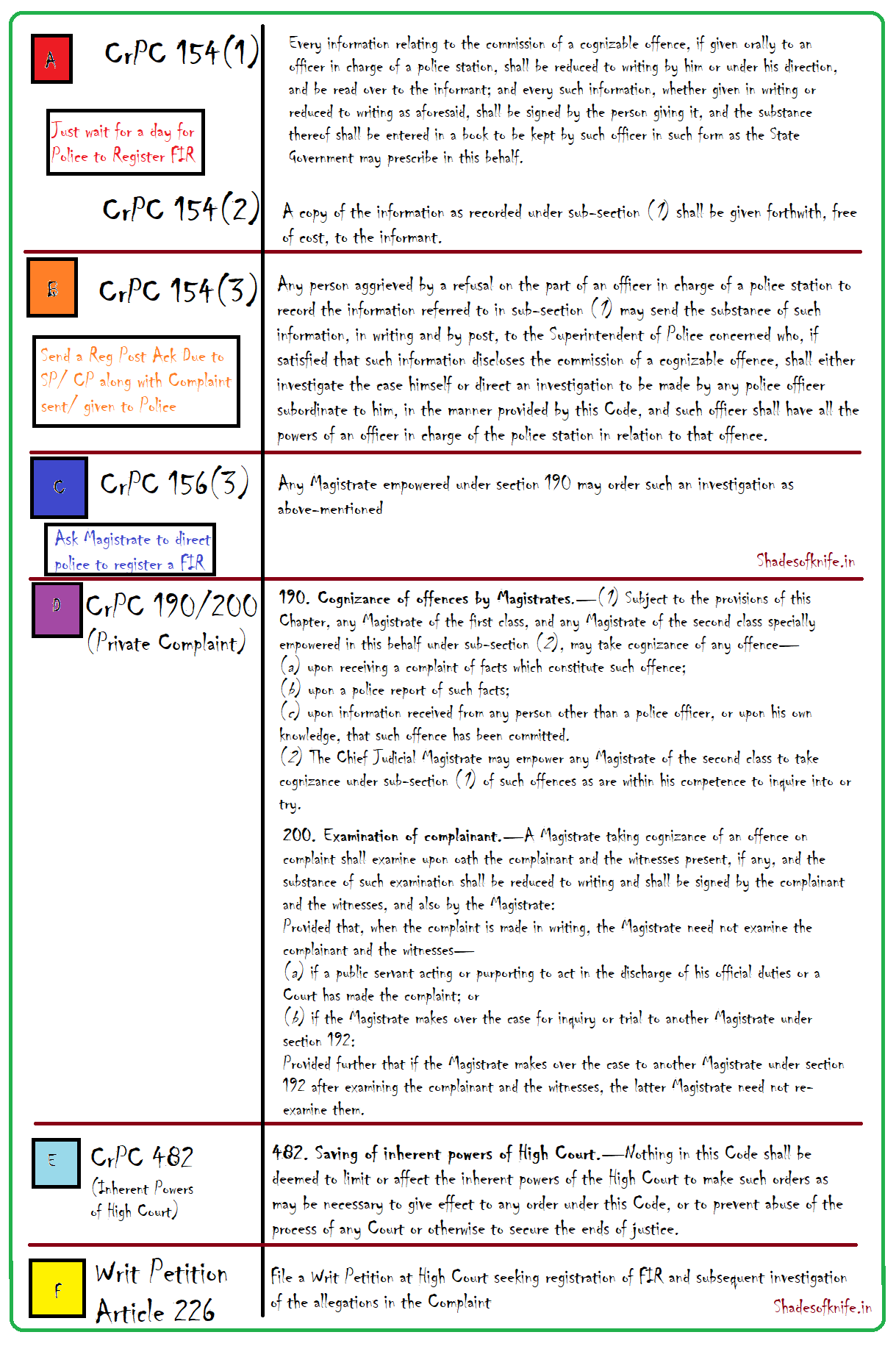
File a complaint at Police Station

Whenever you have to report a cognizable complaint to Police, just follow the three steps in that very same order quickly. Do not crib or cry, if one step does not work per your liking.

PRE-COGNIZANCE STAGE:

  1. Register a written/oral Complaint with the nearest police station where the crime has occurred. This is mandatory as per section 154(1) CrPC.
  2. In the event Police do not register FIR based on your complaint, come back from there and file a Escalation letter (do not send same complaint as-it-is; if you want, you annex a copy of your complaint given at police station to this Escalation letter) to Senior Superintendent of Police of the District or the Commissioner of Police of the Metropolitan City via Registered Post with Acknowledgement Due card. This is mandatory requirement as per section 154(3) CrPC.
  3. Once your complaint to PS in (1) and escalation to SP/CP/SSP in (2) are exhausted and do not give result (registration of FIR and providing a copy to you, free), then register a complaint with the Magistrate Court which exercises Jurisdiction upto the above PS/SP Officer. The prayer will be to ‘direct the SP to direct the PS to register FIR. This is the procedure as per section 156(3) CrPC. If a FIR is registered in any of the these three scenarios, such case is called a Warrant case.
  4. The judgments list is here.

POST-COGNIZANCE STAGE:

  1. If Magistrate does not pass any direction as per above procedures, file a complaint directly u/s 190 CrPC r/w Sec 200 CrPC and Sec 202 CrPC. This is called as Private complaint.
  2. There is scope for going to High Court u/s 482 CrPC.
  3. If all of the above steps fail, go to the High Court under Writ Jurisdiction and file a Writ Petition u/Article 226 of the Constitution of India, seeking registration of FIR.

Note: Check the Schedule 1-Table in CrPC book to know if a particular IPC crime is Cognizable of not.


Remedies against Malicious Prosecution in India

Check out this page here.

Your Fundamental Rights Against Police Abuse

Even during investigation or arrest, every citizen in India enjoys constitutional protections. Police powers are not unlimited, and misuse of authority can be challenged in courts.

The following constitutional rights protect individuals from police high-handedness.

Article 14 – Equality Before Law

Every person is equal before the law. Police authorities cannot discriminate based on religion, caste, gender, political opinion, or personal bias.

Article 21 – Right to Life and Personal Liberty

No person can be deprived of life or liberty except according to procedure established by law. Illegal detention, torture, custodial violence, and harassment violate this fundamental right.

Article 22 – Protection Against Arbitrary Arrest

A person arrested by police has the right:

  • To be informed of the grounds of arrest
  • To consult and be defended by a lawyer
  • To be produced before a magistrate within 24 hours

Detention beyond 24 hours without judicial authorization is illegal.

Article 39A – Right to Free Legal Aid

If a person cannot afford legal representation, the State must provide legal aid through Legal Services Authorities.

Rights of Citizens During Police Arrest

The Supreme Court of India has issued several guidelines to prevent abuse of police powers. These safeguards must be followed during arrest and detention.

The Arrest Memo

When a person is arrested, police must prepare an arrest memo containing:

  • Date and time of arrest
  • Name of arresting officer
  • Name of witness
  • Signature of the arrested person

Informing Family or Friend

Police must inform a relative, friend, or nominated person about the arrest and place of detention.

Right to Legal Counsel

An arrested person has the right to consult a lawyer during interrogation.

Medical Examination

The arrested person must undergo medical examination periodically while in custody to prevent torture or abuse.

Production Before Magistrate

The accused must be produced before a magistrate within 24 hours of arrest.

Failure to follow these procedures can make the arrest illegal.

Important Supreme Court Judgments Protecting Citizens

Over the years, the Supreme Court has issued several landmark rulings to prevent police misuse of power.

D.K. Basu vs State of West Bengal

This landmark judgment laid down detailed guidelines for arrest and detention to prevent custodial violence.

Joginder Kumar vs State of Uttar Pradesh

The Court held that police cannot arrest someone merely because they have the power to do so. Arrest must be justified.

Arnesh Kumar vs State of Bihar

The Court ruled that police should not make automatic arrests in offences punishable with imprisonment up to seven years. Instead, a notice under Section 41A CrPC should be issued.

Lalita Kumari vs Government of Uttar Pradesh

The Court made it mandatory for police to register an FIR when information discloses a cognizable offence.

What Police Cannot Legally Do

Police powers are limited by law. The following actions may amount to abuse of authority.

Illegal Detention

Police cannot detain a person in the police station without formal arrest.

Arrest Without Proper Grounds

Arrest cannot be used as a tool of intimidation or harassment.

Forced Confessions

Police cannot force a person to sign statements or confessions.

Threats or Coercion

Threatening family members or using intimidation tactics is illegal.

Seizing Property Without Documentation

If property is seized, police must prepare a seizure memo and provide a copy.

If any of these actions occur, the affected person may approach courts for relief.

Special Protections for Women

Indian law provides additional safeguards to protect women from abuse during police investigation.

Arrest of Women at Night

Women should not be arrested after sunset and before sunrise except in exceptional circumstances and with permission of a magistrate.

Female Officers

Search of women must be conducted only by female police officers.

Recording of Statements

Statements of women may be recorded at their residence rather than at a police station in appropriate cases.

Protection of Dignity

The dignity and privacy of women must be respected during investigation.

Violation of these safeguards can lead to disciplinary and legal action against police officers.

How to File a Complaint Against Police Misconduct

If a police officer behaves unlawfully, several remedies are available.

Complaint to Superintendent of Police (SP)

A written complaint can be filed with the district Superintendent of Police describing the misconduct.

Complaint to Police Complaints Authority

Most states have a Police Complaints Authority (PCA) that investigates serious allegations such as:

  • Custodial torture
  • Illegal detention
  • Abuse of power

Approach the Magistrate

A complaint can be filed before a Judicial Magistrate seeking investigation or legal action against the officer.

Human Rights Commission

Complaints can be made to the National Human Rights Commission (NHRC) or State Human Rights Commission in cases involving custodial violence or illegal detention.

Immediate Legal Remedies in Case of Police Harassment

If a person faces harassment or illegal action by police, the following remedies may be used.

Anticipatory Bail

If there is apprehension of arrest in a false case, the person can apply for anticipatory bail under Section 438 CrPC.

Writ Petition in High Court

Under Article 226 of the Constitution, a person may approach the High Court seeking protection from police harassment.

Habeas Corpus

If someone is illegally detained, a Habeas Corpus petition may be filed demanding that the detained person be produced before the court.

Compensation for Custodial Abuse

Courts may award compensation if police violate fundamental rights.

Practical Steps to Protect Yourself from Police Harassment

If police start calling or visiting frequently, it is important to remain calm and act strategically.

Maintain Documentation

Keep records of:

  • Call logs
  • Messages
  • Notices issued by police
  • Copies of complaints filed

Record Interactions

If legally permissible, record conversations or interactions to preserve evidence.

Avoid Signing Blank Papers

Never sign blank documents or statements without reading them carefully.

Seek Legal Advice

Consult a lawyer before responding to serious allegations or notices.

Inform Family Members

Always inform family or trusted persons if you are called to a police station.

Evidence That Can Help Prove Police Misconduct

In cases of police abuse, evidence plays a crucial role.

Important forms of evidence include:

  • CCTV footage
  • Audio or video recordings
  • Medical examination reports
  • Witness statements
  • Phone call records
  • Copies of police notices

Preserving such evidence can significantly strengthen a legal case.

When to Approach the High Court

In serious cases of police harassment, approaching the High Court may be necessary.

Situations where High Court intervention may be appropriate include:

  • Continuous harassment by police without lawful basis
  • Threats of illegal arrest
  • Refusal to register FIR
  • Illegal detention
  • Fabrication of false cases

High Courts have wide powers to issue directions to police authorities and protect citizens’ rights.

Conclusion

Police authorities play a vital role in maintaining law and order, but their powers must always be exercised within the framework of the law. Citizens are not helpless against abuse of authority. The Constitution, criminal procedure laws, and judicial precedents provide strong safeguards against arbitrary police action.

Understanding one’s rights, maintaining proper documentation, and using available legal remedies can effectively protect individuals from police high-handedness.

Anyone facing serious harassment should seek legal advice and take appropriate steps through the legal system to safeguard their rights.


MASTER SITEMAP here.

Posted in LLB Study Material | Tagged Misuse of Police Powers Police Act 1861 Police Confiscated Passport Police Reforms Remedies against Malicious Prosecution in India Work-In-Progress Article | Leave a comment

Index of all Summary Case Law Pages on Shades of Knife

Posted on July 18, 2020 by ShadesOfKnife

This can be considered as a sitemap of all Summary pages on my site, Shades of Knife.

Delivery of Justice

  • All Bare Acts of India here.
  • All Compulsory Registration of Marriage in India – Both Acts and Rules here.
  • All Dowry related case laws here.
  • All Dowry Harassment Judgments under Section 498A of IPC here.
  • All Bigamy Judgments under Sections 494 and 495 of IPC here.
  • All Matters related to Exemption from Personal Appearance (u/s 205 CrPC) here.
  • All Bail Matters here.
  • All Condone Delay Judgments here.
  • All Transfer Petition Judgments here.
  • All Look Out Circular Decisions here.
  • All Compensation Judgments for Motor Vehicle Accidents or other mishaps here.
  • All Defamation Judgments here.
  • All Domestic Violence Judgments here.
  • All Divorce Judgments here.
  • All Maintenance Judgments here.
  • All Acquittal from Criminal Matrimonial Cases here.
  • All Perjury Judgments here.
  • All Discharge Judgments u/s 227 Cr.P.C. here.
  • All Discharge Judgments u/s 239 Cr.P.C. here.
  • All Quash Judgment u/s 482 Cr.P.C. here.
  • All Amicable ways of working with Advocates here.
  • All Life Cycles of various cases here.
  • All Passport Judgments here.
  • All Contempt of Court Judgments here.
  • All Legal templates and Drafting here.


Administration of Justice:

  • All Protection from Police High-handedness here.
  • All Reliefs from Judiciary here.
  • All publicly available legal research tools here.
  • All Video Conferencing Guidelines of Courts in India here.
  • Usage of A4 sheets with Double-Sided Printing for all purposed in Court here.
  • eCourts Project
  • AI-based Legalbots
  • Various rights covered under Article 21 (Protection of life and personal liberty) of Constitution of India here.
  • Staff on Administration of Justice, such as Registry Staff can not exercise Judicial functions such as deciding/dismissing applications/petitions based on their maintainability. See here.
  • All Legal strategies and Defence here.
  • All Law Concepts explained here. 


Personal Interest

  • All Legal Goals to Achieve under Judicial Activism (Via Public Interest Litigation) here.
  • All Decisions of High Courts to be made applicable in Other High Courts under Article 227 of the Constitution of India here.
  • All false cases laid on me [Sandeep Pamarati Vs Ungrateful Knife] here.


Posted in Assorted Court Judgments or Orders or Notifications | Tagged Catena of Landmark Judgments Referred/Cited to Summary Post Work-In-Progress Article | 2 Comments

Dowry Prohibition Act Judgments

Posted on July 18, 2020 by ShadesOfKnife

Here are a collection of judgment pertaining to Dowry Prohibition Act 1961 and other cases involving Dowry element.

  1. Sarla Prabhakar Waghmare Vs State of Maharashtra And Others on 10 April 1989 [SC:Cruelty should be such that, as to make woman commit harm to herself]
  2. Sankar Prasad Shaw and Ors Vs The State and Anr on 27 Jul 1990 [CalHC: Agreement is prerequisite for Sec 4 conviction]
  3. Arjun Dhondiba Kamble and Ors Vs The State of Maharashtra on 14 February 1992 [BomHC: Any property demanded not in connection of marriage is not dowry]
  4. Harikumar Vs State of Karnataka on 22 October 1993 [SC: Section 8A of Dowry Prohibition Act is not unconstitutional]
  5. Shamnsaheb M. Multtani Vs State of Karnataka on 24 January 2001 [Presumption does not let Prosecution free from establishing their case before burden of proof shifts to accused]
  6. Pandurang Shivram Kawathkar Vs State of Maharashtra on 5 February 2001 [BomHC: Dowry demand is made out anytime before, during or after marriage, as long it is in connection with marriage]
  7. State of U.P Vs Santosh Kumar and Ors on 3 Sep 2009 [SC: Giving dowry under demand is a crime u/s 3 of DP Act read with Sec 2 of the DP Act]
  8. Pooja Saxena vs State and Anr on 20 October 2010 [DHC: Dowry giver is protected from prosecution]
  9. Sharanappa S. Kallur Vs State of Karnataka on 07 Jun 2011 [KarHC: Relies on this case here]
  10. Uma Devi Vs State and Anr on 01 Aug 2011 [DHC: Dowry giver is protected from prosecution]
  11. Vipin Jaiswal Vs State of A.P. on 13 March 2013 (Overruled)
  12. Manjunath Eshwar Vs State of TN on 16 Apr 2013 [MadHC: Relies on SC decision State of U.P Vs Santosh Kumar and Ors here]
  13. Surinder Singh Vs State of Haryana on 13 November 2013 [Demand for dowry in connection with marriage was available so, Dowry Demand allegation is made out]
  14. Gunakala Durga Rani Vs Gunakala Sudhakar on 6 January 2015 [Dowry not proved in a DV Case]
  15. Rajinder Singh Vs State of Punjab on 26 February 2015 [Landmark: Demand for dowry in connection with marriage]
  16. Sudha Vs State (NCT of Delhi) on 4 January 2016 []
  17. Chembeti Srilakshmi Vs Chembeti Sreenu on 7 January, 2016 [Dowry element is time-barred due to AP DP Rules 1998]
  18. Shaik Mehataj @ Jareena Vs Shaik Humayun on 3 October, 2016 []
  19. Korimerla Videesha Vs State of A.P. and Anr on 12 October, 2018 [Invoked AP DP Rules 1998]
  20. Shivendra Raizada and Others Vs State of U.P. and Anr on 6 December 2018 [Gifts are not Dowry]
  21. M. Sudarshan Goud and Ors Vs The State of AP on 24 April 2020 [Dowry should either be given or agreed to be given at or before or after the marriage in connection with the marriage]
  22. Rajesh Chaddha Vs State of Uttar Pradesh on 13 May 2025 [SC : Vague and omnibus allegations cannot sustain a conviction under Section 498A IPC and Section 4 of the Dowry Prohibition Act.]


Bare Act, Amendments, Rules etc

Dowry Prohibition Act here.

State-enacted Rules are here.


MASTER SITEMAP here.

Frequently Asked Questions – Dowry Prohibition Act (DPA) Jurisprudence in India

The Dowry Prohibition Act, 1961 is a special law enacted to prohibit the giving, taking, or demanding of dowry at the time of marriage or afterward. It criminalizes dowry practices and provides for penalties, including imprisonment and fines, to deter society from this social evil.

Under the Act, dowry means any property or valuable security given, taken, or demanded as a condition for marriage. This includes cash, gifts, ornaments, vehicles, real estate, or any other valuable items provided to the bride or groom’s family. Any demand for additional gifts or money after marriage is also treated as dowry.

In addition to the Dowry Prohibition Act, other penal provisions are often invoked in dowry cases, including:

  • Section 498A IPC – Cruelty by husband or relatives
  • Section 304B IPC – Dowry death
  • Section 34 IPC – Common intention

These sections are commonly applied in conjunction to address cruelty, harassment, and fatal incidents related to dowry demands.

Yes. The demand for dowry alone is an offence under the Act. Even if the dowry is not physically delivered, the mere act of demanding money or valuables in connection with marriage amounts to an offence and attracts legal consequences.

Yes. The law recognizes that dowry harassment may involve multiple persons. Therefore, relatives of the husband, such as in-laws, can also be prosecuted if they actively participate in demanding or pressuring the bride for dowry.

Punishment varies depending on the severity:

  • Simple dowry demand may attract imprisonment and a fine.
  • In cases of dowry death (death within 7 years of marriage due to dowry harassment), enhanced punishment under Section 304B IPC is applied.
    Courts have often noted that dowry offences are serious and socially harmful, justifying strict penalties.

Bail is not automatic in dowry-related offences, especially under serious sections like 304B IPC or when there is strong evidence of cruelty or death. However, both anticipatory bail and regular bail may be considered based on the facts, severity, and compliance with investigation procedures.

Yes. A fair trial entails examination and cross-examination of witnesses. Courts have emphasized that complainants and accused both must be afforded a chance to be heard, and evidence must be tested impartially during trial proceedings.

Refusal to have sexual relations alone does not constitute dowry harassment. However, when such refusal is coupled with coercion, cruelty, or demand for dowry, it may form part of evidence for cruelty under Section 498A IPC or for establishing harassment in dowry practice cases.

Yes. Dowry death convictions have been upheld on circumstantial evidence, especially where:

  • Death occurs within 7 years of marriage,
  • There is proof of harassment, cruelty, and dowry demand,
  • The conduct of the accused suggests involvement.
    Courts have clarified that even in the absence of direct evidence, consistent and cogent circumstantial evidence can lead to conviction.

Medical and forensic evidence often play a critical role, especially in dowry death cases. Courts rely on autopsy reports, injury examinations, and forensic findings to build the prosecution’s case on cause of death, timing of injuries, and whether they align with alleged cruelty or harassment.

Once a dowry-related FIR is registered and investigation begins, the prosecution proceeds in the name of the State, not the complainant. Therefore, withdrawal of an FIR depends on court approval and merits under Section 439/482 CrPC, and is not solely at the complainant’s discretion.

Posted in Assorted Court Judgments or Orders or Notifications | Tagged Catena of Landmark Judgments Referred/Cited to Dowry Prohibition Act 1961 Summary Post Work-In-Progress Article | Leave a comment

Post navigation

  • Older posts
  • Newer posts

Search within entire Content of “Shades of Knife”

My Legal X Timeline

Advocate Sandeep Pamarati 🇮🇳💪👨🏻‍🎓 Follow

AP High Court Advocate with M Tech (CS) || 12 years in 'Software Industry' as Solution Architect || Blogs at https://t.co/29CB9BzK4w || #TDPTwitter

SandeepPamarati
Retweet on Twitter Advocate Sandeep Pamarati 🇮🇳💪👨🏻‍🎓 Retweeted
rkgarimella ramakrishna @rkgarimella ·
31 May

.Take legal action on the mischief mongers? @NCBNOffice @ncbn @OfficeofNL @PawanKalyan @JanaSenaParty @apcpim @CpiAp @AdvocateAsr @SandeepPamarati @apngo_official @AshokParchuri @utfchittoor @Anitha_TDP @Ravinaidu1111 @RamuduM_RCT @IRayachoti @Telugodu1982 @DSGRAJU1 @SVSN_Varma

Reply on Twitter 2060946323273404827 Retweet on Twitter 2060946323273404827 3 Like on Twitter 2060946323273404827 2 X 2060946323273404827
Retweet on Twitter Advocate Sandeep Pamarati 🇮🇳💪👨🏻‍🎓 Retweeted
rkgarimella ramakrishna @rkgarimella ·
31 May

.1.Please provide online facility for RTI Applications in the state.2. Start two regional offices at Vijayawada and Vizag for Lokayukta and APHRC? @NCBNOffice @cbn_updates1 @OfficeofNL @tv5newsnow @RamMNK @ravivallabha @abvrao @nalamotu @AdvocateAsr @SandeepPamarati @gvreddy0406

Reply on Twitter 2060967039142068602 Retweet on Twitter 2060967039142068602 2 Like on Twitter 2060967039142068602 2 X 2060967039142068602
Retweet on Twitter Advocate Sandeep Pamarati 🇮🇳💪👨🏻‍🎓 Retweeted
rkgarimella ramakrishna @rkgarimella ·
31 May

.@SajjanarVC_IPS @SajjanarOffice @CVAnandIPS @bandisanjay_bjp @AdvocateAsr @SandeepPamarati @GvNarasaiah @lawyersrinu @apcpim @CpiAp @BjpVarma @BJP4Andhra @IYRKRao @iTDPVinukonda @SriKrishnaLavu @Collector_Plnd @Palnadu_Police @tv5newsnow @MP_Araku @VasBytes @ravivallabha @ANI

Reply on Twitter 2060993042606428296 Retweet on Twitter 2060993042606428296 2 Like on Twitter 2060993042606428296 2 X 2060993042606428296
Retweet on Twitter Advocate Sandeep Pamarati 🇮🇳💪👨🏻‍🎓 Retweeted
rkgarimella ramakrishna @rkgarimella ·
31 May

.@AdvocateAsr @BhimavaramJSP @bjp4elurujilla @OfficeofNL @JP_LOKSATTA @Anitha_TDP @JSPWestGodavari @KRaghuRaju @BjpVarma @RamanaiduTDP @PawanKalyan @JanaSenaParty @JanasenaBadvel @NagababuPasam @CityJsp @HariramaJogayya @palakollu_NFans @Police_WG @NCBNOffice @VasBytes @DSGRAJU1

Reply on Twitter 2061065013641843078 Retweet on Twitter 2061065013641843078 2 Like on Twitter 2061065013641843078 1 X 2061065013641843078
Load More

Recent Posts

  • Are Offices of Dowry Prohibition Officers in AP designated as Police Stations? June 3, 2026
  • Pune Bar Association Vs Union of India on 22 May 2026 June 2, 2026
  • Chidurala Shyamsubder Vs State of Telangana on 27 Aug 2018 May 28, 2026
  • Birendra Kumar Tiwari Vs Neetu Tiwari on 07 Dec 2022 May 27, 2026
  • Parvinder Singh Khurana Vs Enforcement of Directorate on 19 May 2026 May 26, 2026

Most Read Posts

  • Reply to Section 41A CrPC Notice – Format with Legal Explanation (4,823 views)
  • Anu Aggarwal Vs Sushant Aggarwal on 20 Jan 2026 (3,347 views)
  • Umme Farva Vs State of U.P. and Anr on 14 Jan 2026 (3,179 views)
  • Charge Sheet and Final Report Explained (2,397 views)
  • Jinesh CR Vs Aswathy PR on 19 Nov 2025 (2,122 views)
  • Geddam Jhansi and Anr Vs State of Telangana and Anr on 07 Feb 2025 (2,080 views)
  • Regular Bail Application Format (Section 437/439 CrPC) (1,975 views)
  • Neha Lal Vs Abhishek Kumar on 20 Jan 2026 (1,871 views)
  • Arrest Procedure in 498A cases after Arnesh Kumar (1,773 views)
  • Discharge Application Format in 498A Case – Draft, Procedure & Sample Template (1,552 views)

Tags

Reportable Judgement or Order (433)2-Judge (Division) Bench Decision (411)Legal Procedure Explained - Interpretation of Statutes (381)Landmark Case (381)1-Judge Bench Decision (361)Catena of Landmark Judgments Referred/Cited to (293)Work-In-Progress Article (215)3-Judge (Full) Bench Decision (101)Sandeep Pamarati (92)Article 21 - Protection of life and personal liberty (80)Issued or Recommended Guidelines or Directions or Protocols to be followed (71)Perjury Under 340 CrPC (66)Absurd Or After Thought Or Baseless Or False Or General Or Inherently Improbable Or Improved Or UnSpecific Or Omnibus Or Vague Allegations (61)Reprimands or Setbacks to YCP Govt of Andhra Pradesh (49)Summary Post (47)CrPC 482 - Quash (43)HM Act 13 - Divorce Granted to Husband (42)Legal Terrorism (41)Not Authentic copy hence to be replaced (40)Divorce granted on Cruelty ground (40)

Categories

Supreme Court of India Judgment or Order or Notification (752)Bare Acts or State Amendments or Statutes or GOs or Notifications issued by Central or State Governments (327)High Court of Andhra Pradesh Judgment or Order or Notification (186)High Court of Delhi Judgment or Order or Notification (164)High Court of Bombay Judgment or Order or Notification (112)High Court of Karnataka Judgment or Order or Notification (93)Legal Procedure (73)High Court of Madras Judgment or Order or Notification (70)High Court of Allahabad Judgment or Order or Notification (61)LLB Study Material (58)General Study Material (56)High Court of Punjab & Haryana Judgment or Order or Notification (52)Assorted Court Judgments or Orders or Notifications (50)High Court of Kerala Judgment or Order or Notification (46)Prakasam DV Cases (46)Judicial Activism (for Public Benefit) (45)District or Sessions or Magistrate Court Judgment or Order or Notification (44)High Court of Madhya Pradesh Judgment or Order or Notification (38)High Court of Gujarat Judgment or Order or Notification (28)High Court of Telangana Judgment or Order or Notification (27)

Recent Comments

  • The Divorce Law Firm on Life Cycle Stages of a Divorce case
  • The Divorce Law Firm on Life Cycle Stages of a Divorce case
  • ShadesOfKnife on Sandeep Pamarati Vs Ungrateful Knife (IPC 498A Case)
  • KONURU VINAYKUMAR on Sandeep Pamarati Vs Ungrateful Knife (IPC 498A Case)
  • ShadesOfKnife on Lifecycle Stages of a Section 498A IPC Case

Archives of SoK

  • June 2026 (2)
  • May 2026 (24)
  • April 2026 (33)
  • March 2026 (42)
  • February 2026 (30)
  • January 2026 (21)
  • December 2025 (2)
  • November 2025 (3)
  • October 2025 (17)
  • September 2025 (12)
  • August 2025 (5)
  • July 2025 (10)
  • June 2025 (15)
  • May 2025 (3)
  • April 2025 (10)
  • March 2025 (7)
  • February 2025 (8)
  • January 2025 (1)
  • December 2024 (3)
  • November 2024 (4)
  • October 2024 (16)
  • September 2024 (15)
  • August 2024 (14)
  • July 2024 (11)
  • June 2024 (18)
  • May 2024 (13)
  • April 2024 (9)
  • March 2024 (23)
  • February 2024 (15)
  • January 2024 (11)
  • December 2023 (11)
  • November 2023 (9)
  • October 2023 (13)
  • September 2023 (12)
  • August 2023 (15)
  • July 2023 (17)
  • June 2023 (11)
  • May 2023 (6)
  • April 2023 (5)
  • March 2023 (10)
  • February 2023 (9)
  • January 2023 (12)
  • December 2022 (12)
  • November 2022 (8)
  • October 2022 (13)
  • September 2022 (17)
  • August 2022 (10)
  • July 2022 (21)
  • June 2022 (27)
  • May 2022 (23)
  • April 2022 (32)
  • March 2022 (17)
  • February 2022 (6)
  • January 2022 (2)
  • December 2021 (7)
  • November 2021 (7)
  • October 2021 (6)
  • September 2021 (10)
  • August 2021 (31)
  • July 2021 (45)
  • June 2021 (17)
  • May 2021 (17)
  • April 2021 (18)
  • March 2021 (58)
  • February 2021 (14)
  • January 2021 (50)
  • December 2020 (35)
  • November 2020 (68)
  • October 2020 (67)
  • September 2020 (28)
  • August 2020 (41)
  • July 2020 (20)
  • June 2020 (36)
  • May 2020 (40)
  • April 2020 (38)
  • March 2020 (26)
  • February 2020 (43)
  • January 2020 (35)
  • December 2019 (34)
  • November 2019 (4)
  • October 2019 (18)
  • September 2019 (57)
  • August 2019 (33)
  • July 2019 (12)
  • June 2019 (18)
  • May 2019 (5)
  • April 2019 (19)
  • March 2019 (58)
  • February 2019 (11)
  • January 2019 (90)
  • December 2018 (97)
  • November 2018 (43)
  • October 2018 (31)
  • September 2018 (73)
  • August 2018 (47)
  • July 2018 (143)
  • June 2018 (92)
  • May 2018 (97)
  • April 2018 (59)
  • March 2018 (8)

Blogroll

  • Daaman Promoting Harmony 0
  • Fight against Legal Terrorism Fight against Legal Terrorism along with MyNation Foundation 0
  • Good Morning Good Morning News 0
  • Insaaf India Insaaf Awareness Movement 0
  • MyNation Hope Foundation Wiki 0
  • MyNation.net Equality, Justice and Harmony 0
  • Sarvepalli Legal 0
  • Save Indian Family Save Indian Family Movement 0
  • SIF Chandigarh SIF Chandigarh 0
  • The Male Factor The Male Factor 0
  • Unitedmen Foundation a dedicated community forged with the mission to unite men facing legal challenges in marital disputes. 0
  • Vaastav Foundation The Social Reality 0
  • Vinayak my2centsworth – This blog is for honest law abiding men, married or planning to get married 0
  • Voice4india Indian Laws, Non-profits, Environment 0
  • Writing Law Writing Law by Ankur 0

RSS Cloudflare Status

  • Cloudflare Storage Maintenance June 15, 2026
    THIS IS A SCHEDULED EVENT Jun 15, 12:00 - 13:00 UTC May 28, 22:16 UTC Scheduled - Cloudflare has scheduled maintenance for our backend storage systems. Services will continue to operate normally, but customers will be unable to create/delete/modify tunnels, routes, hostname routes, virtual networks, devices and tunnel configurations via the Dashboard or the public […]
  • Cloudflare Storage Maintenance June 4, 2026
    THIS IS A SCHEDULED EVENT Jun 4, 12:00 - 13:00 UTC May 21, 00:41 UTC Scheduled - Cloudflare has scheduled maintenance for our backend storage systems. Services will continue to operate normally, customers will be unable to modify configurations via the Dashboard or the public API for a period of up to 3 minutes. This […]
  • Audit Log Delays June 3, 2026
    Jun 3, 19:59 UTC Update - We are continuing to investigate this issue. Jun 3, 19:58 UTC Investigating - We are investigating an issue where Cloudflare Audit Log processing is running behind, causing a delay in timely delivery of audit data. These delays do not impact analytics for DNS or Rate Limiting.

RSS List of Spam Server IPs from Project Honeypot

  • 193.193.237.158 | SD June 3, 2026
    Event: Bad Event | Total: 1,352 | First: 2025-11-25 | Last: 2026-06-03
  • 158.94.211.154 | S June 3, 2026
    Event: Bad Event | Total: 987 | First: 2026-01-28 | Last: 2026-06-03
  • 45.164.196.232 | S June 3, 2026
    Event: Bad Event | Total: 5 | First: 2026-06-03 | Last: 2026-06-03
Owned and Operated by Advocate Sandeep Pamarati
Proudly powered by WordPress
Theme: Flint by Star Verte LLC

Bad Behavior has blocked 594 access attempts in the last 7 days.

pixel
