Citations :
Other Sources:
https://indiankanoon.org/doc/1938988/
https://www.casemine.com/judgement/in/5609abcce4b014971140d5d5
Citations :
Other Sources:
https://indiankanoon.org/doc/1938988/
https://www.casemine.com/judgement/in/5609abcce4b014971140d5d5
Governments cannot be allowed to waste State Exchequer
It is an admitted fact that for construction of the Punjab portion of SYL Canal, more than Rs 560 crores have already been spent, as is apparent from Ext. P-13 and the entire money has been paid by the Government of India. It is indeed a matter of great concern that while huge amount of public exchequer has been spent in the construction of the canal and only a few portion of the canal within the territory of Punjab has not been dug, the canal is not being put to use on the mere insistence of the State of Punjab. The attitude of the State of Punjab to say the least, is wholly unreasonable, dogmatic and is against the national interest. It is equally a matter of great concern for this Court that the Central Government is taking an indifferent attitude in the matter and is only trying to while away the time, even though it continues to pay the State of Punjab substantially, even for the maintenance of the operation of canal that has already been dug.
and…
That apart, more than Rs 700 crores of public revenue cannot be allowed to be washed down the drain, when the entire portion of the canal within the territory of Haryana has already been completed and major portion of the said canal within the territory of Punjab also has been dug, leaving only minor patches within the said territory of Punjab to be completed.
Here is the casemine version
Here is the Indiankanoon version
Citations : [2002 SCALE 1 238], [2002 AIR SC 303], [2002 SUPREME 1 14], [2002 SCC 2 507], [2002 AIR SC 685], [2002 AIR SCW 303]
Other Sources :
https://indiankanoon.org/doc/255258/
https://www.casemine.com/judgement/in/5609adaee4b0149711411f5b
Two law students moved Karnataka High Court challenging BCI, KSLU decision to hold intermediate semester exams. Here is the Petition…
The Last status as on posting this message
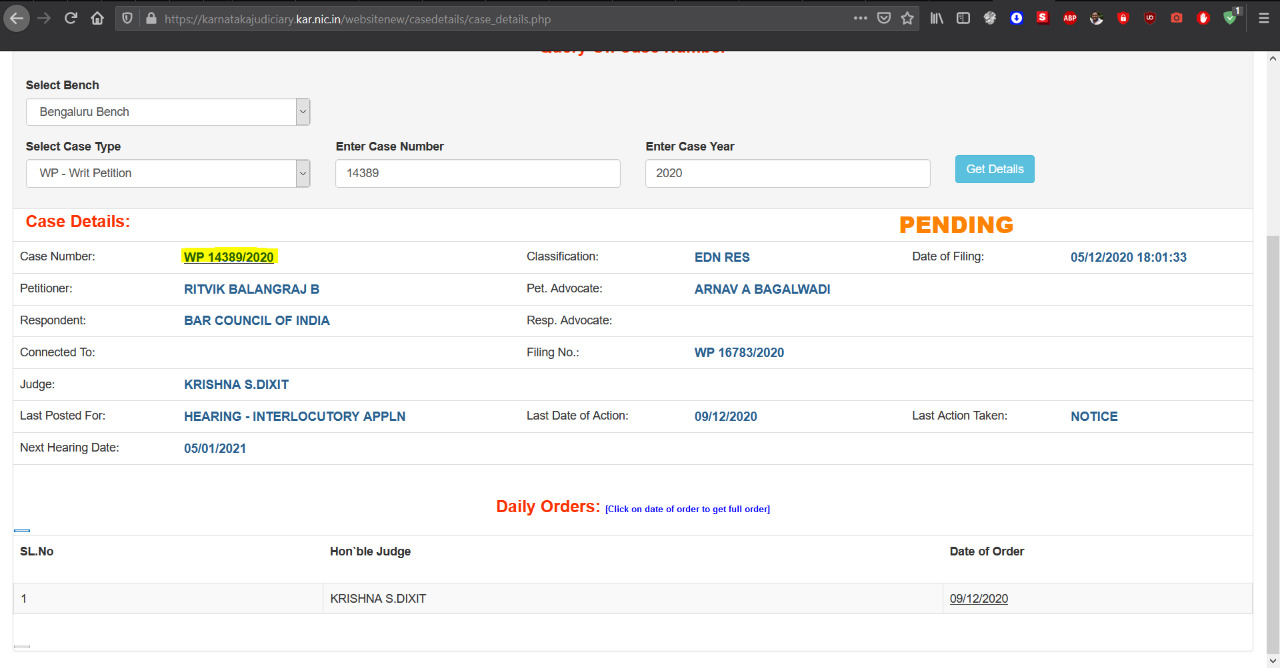
Relevant News report: https://www.barandbench.com/news/litigation/two-law-students-petition-karnataka-hc-circulars-bci-kslu-intermediate-semester-exams
Earlier News Report (wherein the PIL was dismissed): https://www.livelaw.in/news-updates/law-students-move-karnataka-high-court-challenging-kslu-circular-for-holding-exams-165928
Rajasthan High Court passed a direction to all trial Courts in Rajasthan that, in all Bail matters u/s 437/438, a detailed report on antecedents of the accused is to be filed along with judgment.
There is no mention regarding the status of criminal antecedents of the present petitioner in the impugned order. It is often seen by this Court that the learned courts below are not specific in regard to antecedents of the accused persons, which causes delay in the disposal of the bail applications, as, if the person is not having antecedents and his antecedents are called, receiving of such antecedents reports takes quite some time. Though the antecedent alone is not a ground of rejecting or accepting a bail, but it is must that the Hon’ble High Court should have the antecedent report to check the applicability of Section 437 (1) of Cr.P.C. as well as to weigh the case of the accused person with overall perspective of the allegations levelled.
Thus, this Court directs that all learned trial courts shall, while allowing or disallowing any regular/anticipatory bail application of any accused person,give the complete details of the antecedents, if any, and also record that there are no antecedents of the accused person in case of none being there. If there are antecedents of the accused, then the complete details of the antecedents i.e. FIR Number(s) & Case Number(s), Section(s), date(s), status and date of arrest & release on any previous occasion, if any, in the chart form shall be prepared and incorporated in the learned trial courts’ order, while granting or dismissing the bail application.
This order shall be conveyed by the Registry of this Court to all learned District & Sessions Judges of the State, who shall ensure the immediate implementation of this order amongst all the judicial officers and all courts in their respective jurisdiction, which are hearing the bail applications. The detailed antecedents report in aforesaid format so provided in the trial courts’ order shall be the requirement of disposal of any bail application in State of Rajasthan. It is also directed that the learned Public Prosecutors all over the State shall call for the antecedents report well in advance in every case of bail, so as to enable the courts to have a definite and correct information regarding previous criminal antecedents of the accused. A certified copy of this order be also sent by the Registry to the Director of the Prosecution Department of the State for necessary compliance, amongst the learned Public Prosecutors all over the State of Rajasthan.
The Registry of this Hon’ble Court shall ensure compliance of this order, in its letter and spirit, and submit such compliance before this Court on 05.01.2021.
Single-judge bench of Andhra Pradesh held that, cross-examination need not be confined to the facts to which the witness testified on his examination-in-chief.
From Para 3,
3. Since O.S. No. 1141 of 2000, later renumbered as O.S. No. 20 of 2003, was ordered to be tried along with O.S. No. 47 of 1998, obviously common evidence is being recorded in both the suits. When two suits are clubbed and tried together, all the parties to the suits have a right to cross-examine the witness examined by the adversary, because Section 138 of the Evidence Act, 1872 (‘the Act’) confers such right on them. As per that Section 138 of the Act the witness called by a party shall first be examined-in-chief and if the adverse party so desires he can cross-examine him and then if the party calling him so desires, can re-examine him. That section specifically lays down that Chief examination and cross-examination must relate to relevant facts, but cross-examination need not be confined to the facts to which the witness testified on his examination-in-chief.
Casemine copy:
Legal Crystal copy:
Citations : [2006 ALD 1 370], legalcrystal.com/442436
Other Sources :
https://indiankanoon.org/doc/1166172/
https://www.casemine.com/judgement/in/5608f85de4b01497111422e0
https://www.legalcrystal.com/case/442436/k-c-kanniyappa-vs-lalitha-anr
Supreme Court granted interim bail to Arnab Goswami, after he suffered judicial custody for 7 days.
Here is the Order.
Here is the Judgment with reasons.
Index of Quash judgments here.
High Court of Madras observed that, punishment for corrupt practices should be increased to include death sentence also. Wonderful step!
From Para 11,
11. Though the learned Advocate General has referred to about the prevailing Act, namely, the Prevention of Corruption Act and its procedures, the menace of corruption has not come down. Prevention of Corruption Act is a Central Act, enacted by the Central Government as early as in the year 1947, followed by several amendments, with the latest amendment in the year 2018, giving elaborate procedures to be followed along with punishment and penalties. People are compelled to accept corruption as normal one. Corruption has become deep rooted and has spread like Cancer. Every day, it is reported in the media that many officials are caught red handed, while taking bribes. Hence, the punishment needs to be enhanced. Therefore, this Court is of the view that there should be a re-visit and the Act should be strengthened and stringent penalties should be imposed to curb the menace of corruption. The Central Government may consider imposing punishment, such as, “hanging” or “death penalty”, for corrupt practices or for demanding and accepting bribes, like in China, North Korea, Indonesia, Thailand and Morocco. Hence, this Court suo-motu impleads,
i) the Secretary to Government, Ministry of Home Affairs, Union of India, North Block, New Delhi;
ii) the Secretary to Government, Ministry of Law and Justice, Union of India, Shastri Bhawan, New Delhi; and
iii) the Secretary to Government, Ministry of Parliamentary Affairs, Union of India, Parliament House, New Delhi
as party respondents / respondents 5 to 7 to this proceedings.
The following is a table listing granting and withdrawing of their ‘General Consent’ Granted To CBI To Investigate Cases In The State.
Some State governments innocently think by withdrawing ‘General Consent’ Granted To CBI To Investigate Cases In The State, they can stop CBI. Fools !!! Here why.
| State / Union Territory | Consent Granted on | Consent Withdrawn on |
| Andhra Pradesh | 3 Aug 2018 6 Jun 2019 | 16 Nov 2018 (Confidential GO) — |
| Arunachal Pradesh | ||
| Assam | ||
| Bihar | ||
| Chhattisgarh | 2001 | 10 Jan 2019 |
| Goa | ||
| Gujarat | ||
| Haryana | ||
| Himachal Pradesh | ||
| Jharkhand | 5 Nov 2020 | |
| Karnataka | ||
| Kerala | 4 Nov 2020 | |
| Madhya Pradesh | ||
| Maharashtra | 21 Oct 2020 | |
| Manipur | ||
| Meghalaya | ||
| Mizoram | ||
| Nagaland | ||
| Odisha | ||
| Punjab | 6 Nov 2020 | |
| Rajasthan | 19 Sep 2020 | |
| Sikkim | ||
| Tamil Nadu | ||
| Telangana | ||
| Tripura | ||
| Uttar Pradesh | ||
| Uttarakhand | ||
| West Bengal | ||
| Andaman and Nicobar Islands | ||
| Chandigarh | ||
| Dadra Nagar Haveli and Daman Diu | ||
| Delhi | ||
| Jammu and Kashmir | ||
| Ladakh | ||
| Lakshadweep | ||
| Puducherry |
On 6 Jun 2019, Andhra Pradesh granted General Consent.
*****
On 16 Nov 2018, Andhra Pradesh withdrew General Consent.
(Via Confidential GO and a Gazette notification)
*****
On 3 Aug 2018, Andhra Pradesh granted General Consent.
*****
On 5 Dec 2017, Andhra Pradesh granted General Consent.
On 10 Jan 2019, Chattisgarh withdrew General Consent.
On 5 Nov 2020, Jharkhand withdrew General Consent.
On 4 Nov 2020, Kerala withdrew General Consent.
On 21 Oct 2020, Maharashtra withdrew General Consent.
On 19 Sep 2020, Rajasthan withdrew General Consent.
On 6 Nov 2020, Punjab withdrew General Consent.
Section 437 of CrPC from Chapter CHAPTER XXXIII has the provision for getting Regular Bail in non-bailable cases.
Supreme Court of India
Index of all Bail matters is here.
A division bench of Supreme Court held as follows in regards to the protection given to public servants from prosecution u/s 197 CrPC, mandating a sanction from Government.
8. The protection given under Section 197 Cr.P.C. is to protect responsible public servants against the institution of possibly vexatious criminal proceedings for offences alleged to have been committed by them while they are acting or adequate protection to public servants to ensure that they are not prosecuted for anything done by them, in the discharge of their official duties without reasonable cause, and if sanction is granted, to confer on the Government, if it chooses to exercise it, complete control of the prosecution. This protection has certain limits and is available only when the alleged act done by the public servant is reasonably connected with the discharge of his official duty and is not merely a cloak for doing the objectionable act. If in doing his official duty, he acted in excess of his duty, but there is a reasonable connection between the act and the performance of the official duty, the excess will not be a sufficient ground to deprive the public servant from the protection. The question is not as to the nature of the offence such as whether the alleged offence contained an element necessarily dependent upon the offender being a public servant, but whether it was committed by a public servant acting or purporting to act as such in the discharge of his official capacity. Before Section 197 Cr.P.C. can be invoked, it must be shown that the official concerned was accused of an offence alleged to have been committed by him while acting or purporting to act in the discharge of his official capacity. It is not the duty which requires examination so much as the act, because the official act can be performed both in the discharge of the official duty as well as in dereliction of it. The act must fall within the scope and range of the official duties of the public servant concerned. It is the quality of the act which is important and the protection of the section is available if the act falls within the scope and range of his official duty. There cannot be any universal rule to determine whether there is a reasonable connection between the act done and the official duty, nor is it possible to lay down any such rule. One safe and sure test in this regard would be to consider if the omission or neglect on the part of the public servant to commit the act complained of could have made him answerable for a charge of dereliction of his official duty: if the answer to this question is in the affirmative, it may be said that such act was committed by the public servant while acting in the discharge of his official duty and there was every connection with the act complained of and the official duty of the public servant. This aspect makes it clear that the concept of Section 197 Cr.P.C. does not get immediately attracted on institution of the complaint case.
Citations : [2008 RCR CRI 1 1042], [2008 AIR SC 1486], [2008 BLJR 56 1000], [2008 SCC 11 289], [2008 ALD CRI 2 134], [2008 SCALE 2 303], [2008 AICLR 2 150], [2008 MLJ CRI 2 458], [2008 AD SC 3 153], [2008 CCR 2 203], [2008 JT 2 374], [2008 CRIMES 1 346], [2008 SLT 3 680], [2008 AIOL 155], [2008 AIR SC 1375], [2008 BOMCR CRI SC 2 131], [2009 SCC CRI 1 130], [2008 SCR 2 580], [2008 SUPREME 1 572], [2008 AIC SC 63 28], [2008 CRLJ SC 2054], [2008 AIR SCW 1375]
Other Sources :
https://indiankanoon.org/doc/1809946/
https://www.casemine.com/judgement/in/5609ae6ee4b0149711413d79
Bad Behavior has blocked 278 access attempts in the last 7 days.

