A criminal conviction can feel like the final chapter of a case. However, in law, a conviction is not necessarily the end of the road. Indian criminal jurisprudence provides multiple appellate remedies that allow an accused person to challenge findings of guilt, sentence, procedural irregularities, or evidentiary errors.
In fact, many convictions are modified, suspended, or even set aside in appeal when the defence presents a structured appellate strategy supported by law, evidence, and procedural precision.
Therefore, understanding the appeal strategy after conviction becomes essential for accused persons, family members, and defence lawyers navigating criminal litigation.
This article explains the legal framework, grounds of appeal, procedural roadmap, suspension of sentence strategy, document preparation, and practical appellate tactics, with references to both the Code of Criminal Procedure, 1973 (CrPC) and the Bharatiya Nagarik Suraksha Sanhita, 2023 (BNSS).
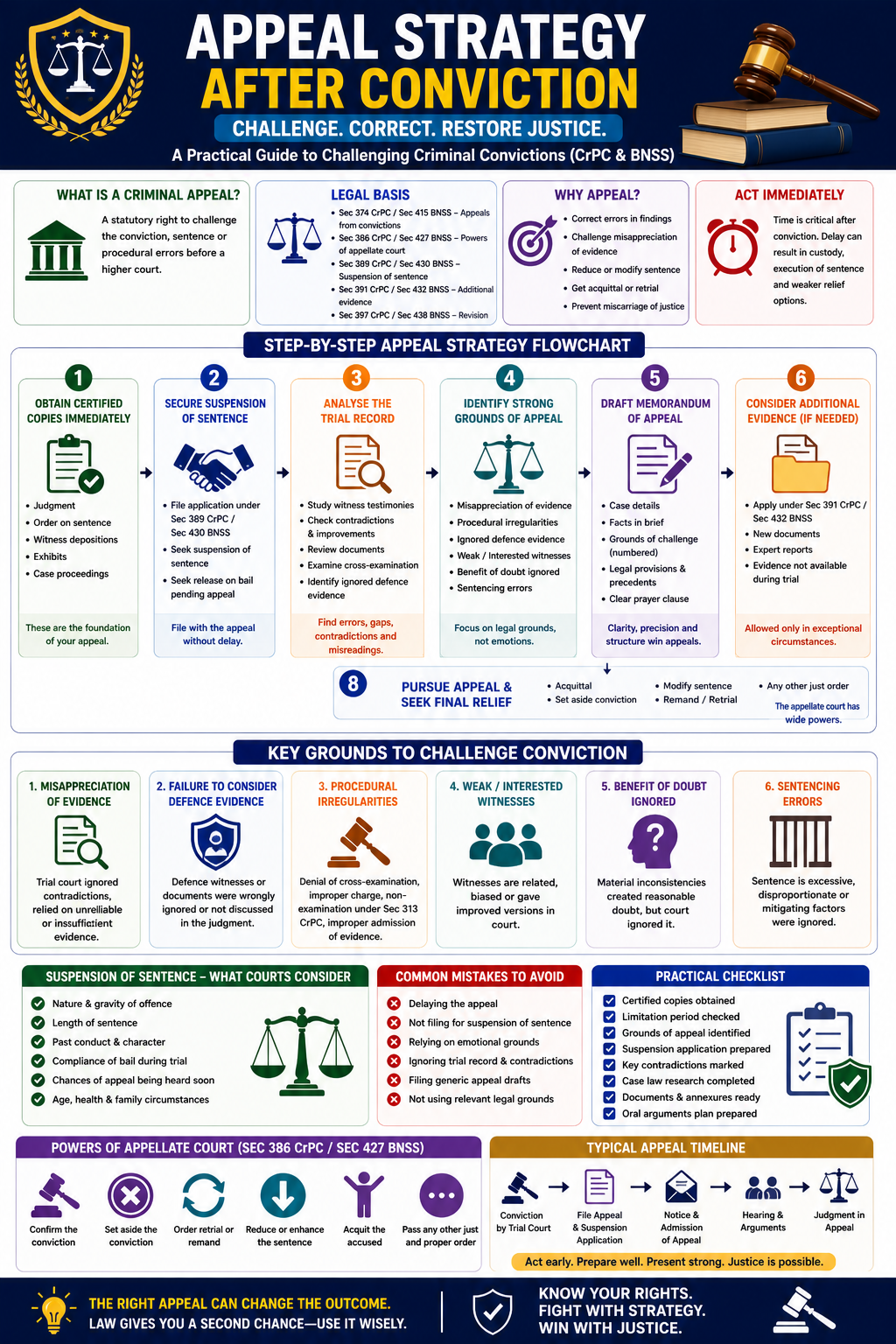
What Is a Criminal Appeal?
A criminal appeal is a statutory remedy that allows a convicted person to challenge:
- Findings of guilt
- Quantum of sentence
- Errors in appreciation of evidence
- Procedural irregularities
- Misapplication of law
- Jurisdictional defects
An appellate court may:
- Confirm conviction
- Set aside conviction
- Modify sentence
- Order retrial
- Acquit the accused
- Remand the matter
Thus, an appeal is not merely a technical formality—it is often the most critical stage after trial.
Legal Framework for Criminal Appeals
Appeals against conviction are governed by:
Appeals from Sessions and Magistrate Courts
- Section 374 CrPC (BNSS Section 415) – Appeals from convictions
Powers of Appellate Court
- Section 386 CrPC (BNSS Section 427) – Powers of appellate court
Suspension of Sentence Pending Appeal
- Section 389 CrPC (BNSS Section 430) – Suspension of sentence
Taking Additional Evidence
- Section 391 CrPC (BNSS Section 432) – Additional evidence in appeal
Revisionary Jurisdiction
- Section 397 CrPC (BNSS Section 438) – Revision powers
These provisions form the backbone of appellate strategy.
When Should You File an Appeal?
A convicted person should act immediately after conviction.
Do not wait for:
- Execution of sentence
- Arrest warrants
- Recovery proceedings
- Bail cancellation
- Delay in obtaining documents
The first few days after conviction often determine whether the accused secures immediate relief.
Step 1: Obtain Certified Copies Immediately
The first strategic step is obtaining certified copies of:
- Judgment
- Order on sentence
- Deposition of witnesses
- Exhibits
- Applications and orders
- Case proceedings
Why is this important?
Because appellate strategy depends on identifying:
- Contradictions
- Procedural defects
- Missing findings
- Evidentiary inconsistencies
Without the complete trial record, appellate grounds remain weak.
Step 2: Secure Suspension of Sentence
If the trial court convicts the accused and imposes imprisonment, the immediate priority becomes:
Suspension of sentence
Apply under:
- Section 389 CrPC (BNSS Section 430)
This application seeks:
- Suspension of sentence
- Release on bail pending appeal
Courts often consider:
- Nature of offence
- Length of sentence
- Past conduct
- Bail compliance during trial
- Chances of appeal being heard soon
Strategic Tip
Always prepare the suspension application simultaneously with the appeal.
Delay can result in unnecessary custody.
Step 3: Analyse the Trial Record Thoroughly
An effective appeal never relies on emotional arguments.
Instead, analyse:
Witness Depositions
Check for:
- Contradictions
- Improvements
- Omissions
- Inconsistencies
Documentary Evidence
Verify:
- Admissibility
- Authenticity
- Chain of custody
- Missing originals
Cross-Examination
Ask:
- Did prosecution witnesses withstand cross-examination?
- Did trial court ignore contradictions?
Judicial Findings
Review:
- Whether findings are reasoned
- Whether crucial defence evidence was ignored
Step 4: Identify Strong Grounds of Appeal
Every appeal must focus on legally sustainable grounds.
Ground 1: Misappreciation of Evidence
Argue that the trial court:
- Ignored contradictions
- Relied on unreliable testimony
- Misread documentary evidence
This is one of the most common appellate grounds.
Ground 2: Failure to Consider Defence Evidence
Challenge findings if:
- Defence witnesses were ignored
- Documentary defence was not discussed
- Exculpatory material was overlooked
Ground 3: Procedural Irregularities
Examples:
- Improper examination of accused
- Denial of cross-examination
- Refusal to summon documents
- Improper framing of charge
Relevant provisions:
- Section 313 CrPC (BNSS Section 351) – Examination of accused
- Section 91 CrPC (BNSS Section 94) – Production of documents
Ground 4: Conviction Based on Weak or Interested Witnesses
Challenge:
- Lack of independent corroboration
- Improvements in testimony
- Motivated witnesses
Ground 5: Benefit of Doubt Ignored
Argue that:
- Material inconsistencies created reasonable doubt
- Trial court applied incorrect burden of proof
Ground 6: Sentencing Errors
Even if conviction survives, sentence may be challenged if:
- Sentence is disproportionate
- Mitigating factors were ignored
- Age, health, or family circumstances were overlooked
Step 5: Draft a Structured Memorandum of Appeal
A strong appeal must contain:
Case Details
- Trial court name
- Case number
- Conviction date
Factual Background
Brief case history.
Grounds of Challenge
Numbered legal grounds.
Prayer Clause
Seek:
- Acquittal
- Suspension of sentence
- Modification of sentence
- Remand or retrial
Clarity matters more than volume.
Step 6: Consider Additional Evidence
In exceptional cases, additional evidence may be necessary.
Apply under:
- Section 391 CrPC (BNSS Section 432)
Examples:
- Newly discovered documents
- Expert reports
- Missing records
- Technical evidence unavailable earlier
However, courts allow this sparingly.
Step 7: Prepare Oral Hearing Strategy
Appeals succeed not only on paper but also in oral arguments.
Focus on:
Three Strong Grounds
Do not overload the court.
Record-Based Arguments
Take the appellate court directly to:
- Deposition pages
- Exhibits
- Contradictions
Legal Precedents
Use relevant case law strategically.
Special Strategy in Matrimonial Criminal Cases
In convictions arising from:
- Section 498A IPC cases
- Dowry harassment prosecutions
- Domestic violence-related proceedings
Focus on:
Omnibus Allegations
Were all relatives treated identically?
Separate Residence
Did accused live elsewhere?
Delayed Complaints
Was there unexplained delay?
Settlement Motive
Was criminal litigation used as pressure?
These factors often become decisive.
Common Mistakes After Conviction
Avoid:
Delaying Appeal
Delay may complicate suspension of sentence.
Filing Emotional Grounds
Appeals require legal defects, not sympathy alone.
Ignoring Trial Record
Grounds must come from evidence.
Filing Generic Drafts
Every appeal must be case-specific.
Neglecting Sentence Suspension
Custody can become unnecessary.
Practical Appellate Checklist
Before filing appeal, ensure:
- Certified copies obtained
- Sentence suspension draft prepared
- Witness contradictions marked
- Exhibits reviewed
- Defence evidence analysed
- Procedural defects identified
- Grounds numbered clearly
- Limitation period checked
Judicial Approach in Appeals
Appellate courts generally examine:
- Whether evidence supports conviction
- Whether law was correctly applied
- Whether findings are perverse
- Whether procedural fairness was maintained
Courts interfere when:
- Findings are unreasonable
- Material evidence was ignored
- Miscarriage of justice appears
Conclusion
A conviction may be serious—but it is not always final. Indian criminal law provides strong appellate safeguards to ensure that errors at trial do not become permanent injustice.
A successful appeal depends on:
- Immediate action
- Careful record analysis
- Strong legal grounds
- Effective sentence suspension strategy
- Focused oral advocacy
By combining timely preparation, procedural accuracy, and strategic legal drafting, a convicted person can significantly improve the chances of reversal, modification, or acquittal.
In criminal litigation, the appeal is often where the real battle begins.
Index of Legal Strategies and Defence is here.
Key Contributor :
Mrs. Suprajaa Rajan B.Com., LL.B., LL.M.
+91-9606345150

