Understanding the scope, grounds, and judicial principles governing quashing of criminal proceedings.
Criminal prosecution can severely affect personal liberty, reputation, and professional life. However, not every FIR discloses a legally sustainable offence. In such situations, the law provides a constitutional safeguard.
The remedy lies under:
Code of Criminal Procedure, 1973
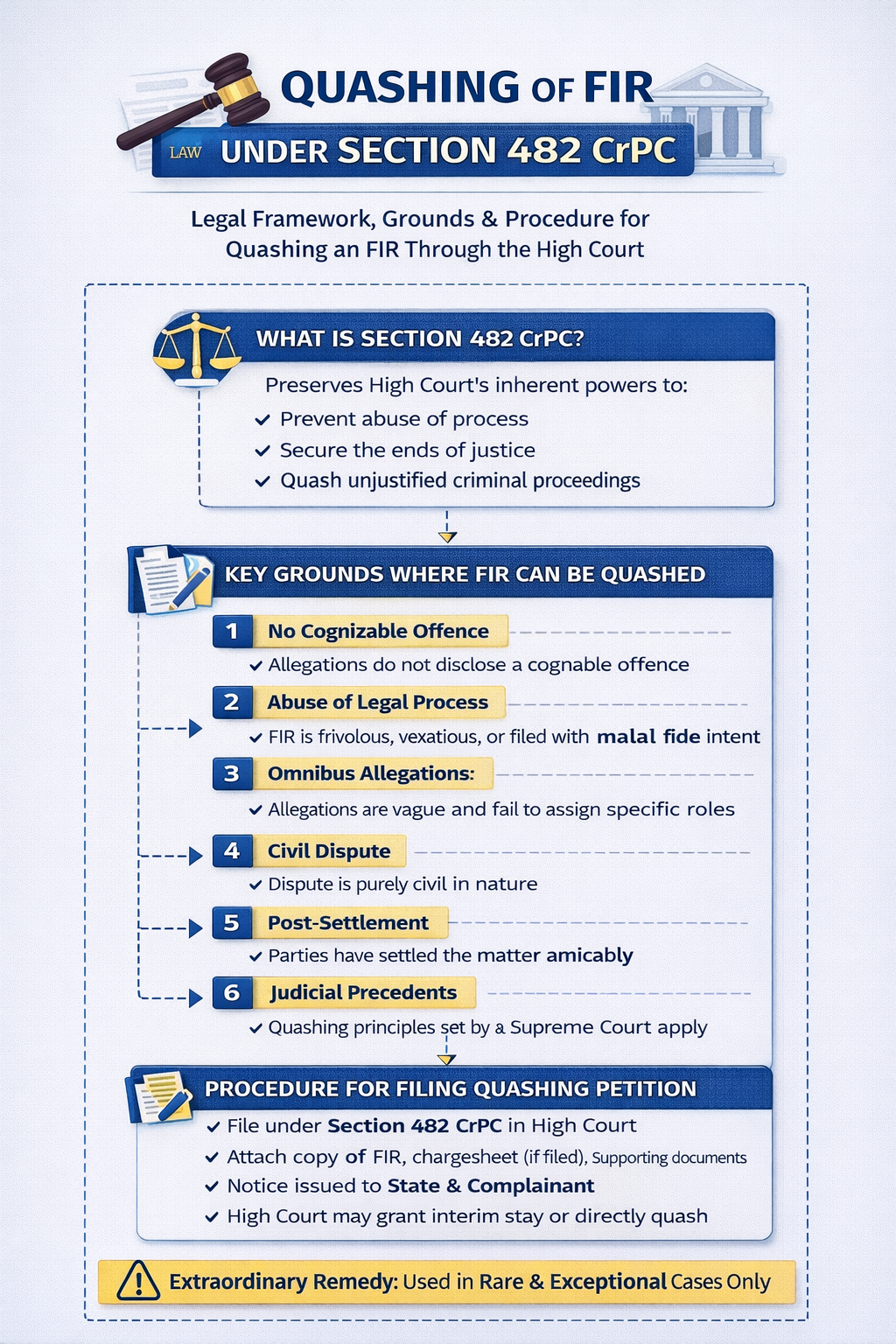
Specifically, Section 482 CrPC, which preserves the inherent powers of the High Court to:
Prevent abuse of process of law
Secure the ends of justice
Quash criminal proceedings where continuation is unjustified
This article explains the legal framework, judicial tests, landmark precedents, and strategic considerations for filing a quashing petition in brief.
I. What Is Section 482 CrPC?
Section 482 states that nothing in the Code shall limit the inherent powers of the High Court.
These powers are extraordinary in nature and must be exercised:
Sparingly
With caution
Only in rare and exceptional cases
Nevertheless, it is not an appellate power. In fact, it is a supervisory and preventive jurisdiction.
II. When Can FIR Be Quashed?
The Supreme Court laid down guiding principles in:
State of Haryana v. Bhajan Lal
This judgment identified illustrative categories where quashing may be justified.
Key Grounds for Quashing:
- Allegations do not disclose a cognizable offence
- FIR is manifestly attended with mala fide intent
- Allegations are absurd or inherently improbable
- There is no legal evidence supporting prosecution
- Proceedings amount to abuse of process
- Dispute is purely civil in nature
- Parties have settled the dispute (in appropriate cases)
III. Quashing in Matrimonial Offences (498A Cases)
Quashing petitions frequently arise in complaints under:
Section 498A IPC
Section 406 IPC
Section 34 IPC
Courts have repeatedly cautioned against mechanical implication of relatives.
In Arnesh Kumar v. State of Bihar, the Supreme Court addressed misuse in matrimonial litigation and emphasised procedural safeguards.
High Courts often quash proceedings where:
Allegations are omnibus
No specific role is attributed
Distant relatives reside separately
Complaint lacks prima facie material
IV. Settlement-Based Quashing
Even though Section 498A IPC is non-compoundable, courts permit quashing where matrimonial disputes are amicably resolved.
In Gian Singh v. State of Punjab, the Supreme Court held that High Courts may quash non-compoundable offences if the dispute is personal and continuation would serve no purpose.
Similarly, in Narinder Singh v. State of Punjab, guidelines were laid down for compromise-based quashing.
The principle: criminal law should not be used as a weapon once parties have settled significantly.
V. Can FIR Be Quashed After Chargesheet?
Yes. Quashing is maintainable even after filing of chargesheet under Section 173 CrPC.
However, courts are more cautious once investigation is complete.
The test becomes:
Whether materials collected disclose a prima facie case
Whether continuation would amount to injustice
In case the evidence supports trial, courts may refuse interference.
VI. Procedure for Filing Quashing Petition
A petition under Section 482 CrPC is filed before the jurisdictional High Court.
Typical Components:
- Copy of FIR
- Chargesheet (if filed)
- Relevant documents
- Affidavit
- Grounds invoking Bhajan Lal principles
Notice is issued to:
State
Complainant
High Court may:
Issue interim stay
Grant protection from coercive steps
Dismiss petition
Quash FIR entirely
Quash proceedings partially against specific accused
VII. Judicial Caution: What Courts Will Not Do
High Courts will not:
Conduct mini-trials
Examine disputed facts
Evaluate credibility of witnesses
Weigh evidence
If allegations disclose prima facie offence, trial must proceed. In any case, section 482 is not a substitute for trial.
VIII. Strategic Considerations Before Filing
Filing a premature petition may weaken credibility.
Consider:
Stage of investigation
Strength of allegations
Documentary contradictions
Settlement possibilities
Parallel civil proceedings
Thus strategic timing is undoubtedly crucial.
IX. Common Mistakes in Quashing Petitions
- Raising factual disputes requiring evidence
- Filing without examining FIR carefully
- Over-reliance on defence documents
- Ignoring Supreme Court precedents
- Filing multiple repetitive petitions
Subsequently, courts may impose costs for frivolous petitions.
X. Recent Judicial Approach
Courts increasingly:
Protect distant relatives in 498A cases
Scrutinise omnibus allegations
Encourage settlement in matrimonial disputes
Emphasise that criminal law should not become harassment
However, courts remain strict where allegations show serious cruelty or violence.
Conclusion
Section 482 CrPC ,thus, acts as a constitutional safety valve against misuse of criminal process. Additionally, it ensures that criminal law does not become a tool of oppression.
However, it is an extraordinary remedy. Courts exercise it with restraint. A well-structured petition grounded in settled principles significantly improves prospects.
The guiding test remains:
Does continuation of prosecution serve justice — or defeat it?
Therefore, when proceedings lack legal foundation or arise from matrimonial vendetta, inherent powers of the High Court restore balance.
Index of Legal Strategies and Defence is here.
Frequently Asked Questions
Not automatic. Court examines genuineness and societal impact.
Yes. Proceedings may be quashed selectively.
No. It terminates proceedings before trial.
Often exempted unless court directs otherwise.
Key Contributor:
Mrs. Suprajaa Rajan B.Com., LL.B., LL.M.
+91-9606345150

