web analytics

Menu

Skip to content
Shades of Knife
  • Home
  • True Colors of a Vile Wife
  • Need Inspiration?
  • Blog Updates
  • SOK Gallery
  • Vile News Reporter
  • About Me
  • Contact Me

Shades of Knife

True Colors of a Vile Wife

Tag: Quashing of FIR

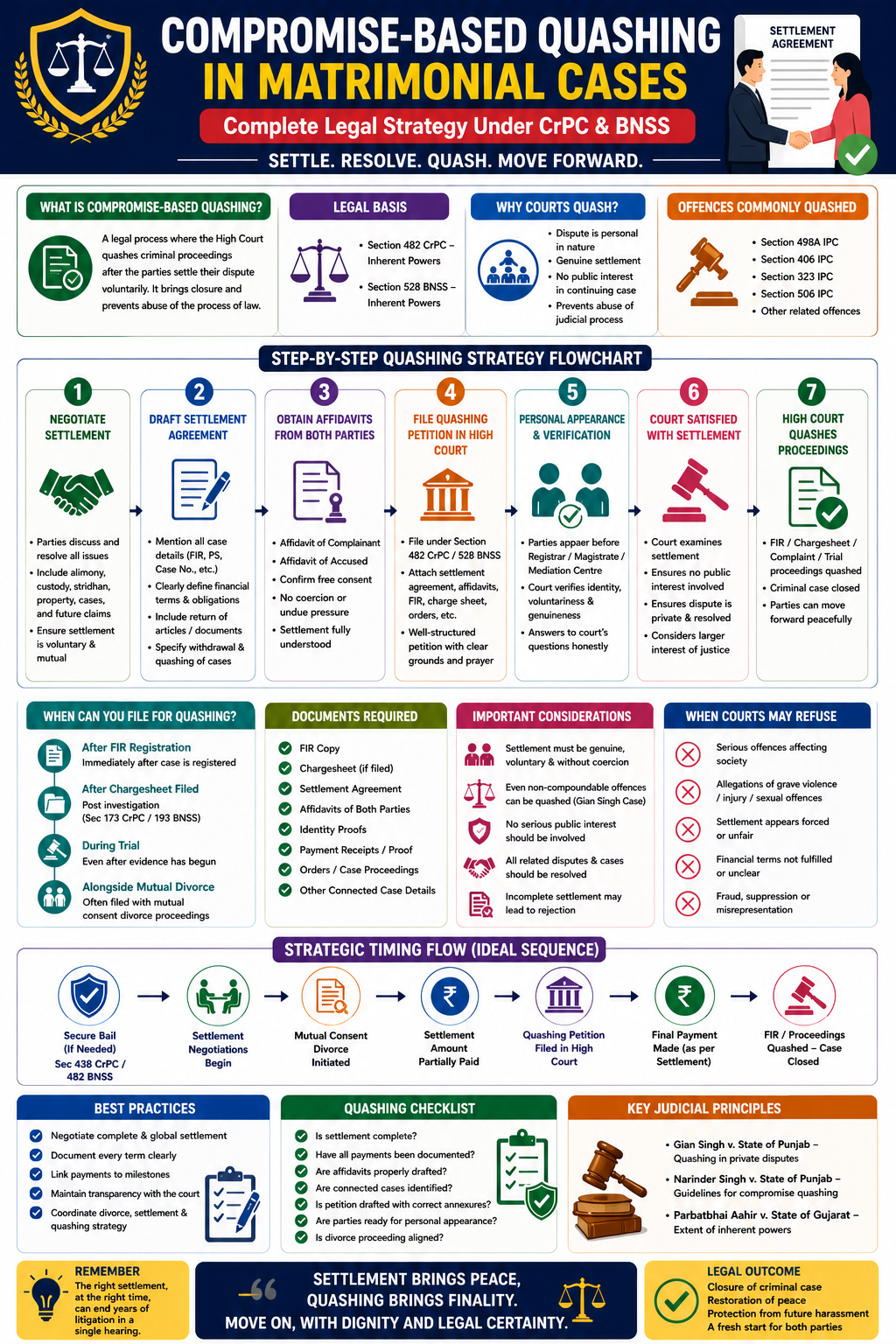
Compromise-Based Quashing in Matrimonial Cases – Complete Legal Strategy

Posted on May 6 by Suprajaa Rajan

Matrimonial disputes often begin as emotional conflicts but eventually transform into multiple legal proceedings—criminal complaints, domestic violence cases, maintenance petitions, custody disputes, and divorce litigation. In many cases, however, parties later decide to resolve their differences through negotiation, mediation, mutual settlement, or divorce by consent.

Once a genuine settlement takes place, the next critical legal question arises:

Can the criminal case also be closed?

The answer is yes—through compromise-based quashing.

Indian High Courts regularly exercise their inherent powers to quash criminal proceedings arising from matrimonial disputes when the parties settle their disputes voluntarily and continuation of prosecution serves no useful purpose.

Therefore, understanding the strategy for compromise-based quashing in matrimonial cases becomes essential for accused persons, complainants, family members, and legal practitioners.

This article explains the legal framework, procedural roadmap, documentation, judicial principles, strategic timing, and practical safeguards, with references to both the Code of Criminal Procedure, 1973 (CrPC) and the Bharatiya Nagarik Suraksha Sanhita, 2023 (BNSS).

What Is Compromise-Based Quashing?

Compromise-based quashing is a legal process where the High Court terminates criminal proceedings after the parties settle their dispute.

The court may quash:

  • FIR
  • Chargesheet
  • Criminal complaint
  • Summoning order
  • Trial proceedings
  • Related criminal proceedings

The purpose is simple:

If the dispute is private, personal, and has been genuinely resolved, continuing prosecution may amount to an abuse of judicial process.

Legal Basis for Quashing

Under CrPC

  • Section 482 CrPC

The High Court exercises inherent powers:

  • To prevent abuse of process
  • To secure the ends of justice

Under BNSS

  • Section 528 BNSS

This provision preserves the High Court’s inherent jurisdiction in similar terms.

Thus, compromise-based quashing continues under the new procedural framework.

Why Matrimonial Cases Are Commonly Quashed

Matrimonial litigation often involves:

  • Emotional allegations
  • Family-wide implication
  • Settlement negotiations
  • Mutual divorce proceedings
  • Financial settlement

Because such disputes are predominantly personal in nature, courts frequently consider compromise-based quashing appropriate.

Typical offences include:

  • Section 498A IPC
  • Section 406 IPC
  • Section 323 IPC
  • Section 506 IPC
  • Section 34 IPC

and their corresponding provisions under the new criminal law framework, where applicable.

Can Non-Compoundable Offences Also Be Quashed?

Yes.

This is the most important legal principle.

Even if an offence is technically non-compoundable, the High Court may still quash proceedings if:

  • The dispute is personal
  • Settlement is genuine
  • No overriding public interest is involved
  • Continuation of prosecution would serve no useful purpose

This principle transformed matrimonial criminal litigation in India.

Leading Judicial Principles

In
Gian Singh v. State of Punjab,
the Supreme Court held that High Courts may quash criminal proceedings involving private disputes if settlement genuinely resolves the controversy.

Later, in
Narinder Singh v. State of Punjab,
the Supreme Court laid down detailed principles governing compromise-based quashing.

Further, in
Parbatbhai Aahir v. State of Gujarat,
the Court clarified how inherent powers should be exercised.

These decisions now guide High Courts across India.

When Should You File for Quashing?

Timing can significantly affect the outcome.

Compromise-based quashing may be filed:

After FIR Registration

If parties settle immediately after criminal proceedings begin.

After Chargesheet

Once investigation is complete.

Relevant provision:

  • Section 173 CrPC (BNSS Section 193) – Police report

During Trial

Even after evidence begins.

Alongside Mutual Divorce

Often strategically synchronised.

Therefore, settlement timing should align with the broader matrimonial strategy.

Step 1: Finalise a Genuine Settlement

Before approaching the High Court, both parties should complete settlement discussions.

Settlement may include:

  • Mutual divorce
  • Permanent alimony
  • Return of stridhan
  • Child custody terms
  • Withdrawal of connected proceedings
  • Property settlement

The settlement should be:

  • Clear
  • Written
  • Voluntary
  • Specific

Ambiguous settlements create future disputes.

Step 2: Draft a Detailed Settlement Agreement

A proper settlement agreement should include:

Case Details

Mention:

  • FIR number
  • Police station
  • Case numbers
  • Pending proceedings

Financial Terms

Specify:

  • Alimony
  • Settlement amount
  • Payment schedule

Property Terms

Clarify:

  • Return of articles
  • Jewellery
  • Documents
  • Shared assets

Litigation Closure

Specify:

  • Cases to be withdrawn
  • Quashing to be pursued

Precision prevents future disputes.

Step 3: Obtain Affidavits from Both Parties

Courts generally expect:

  • Affidavit of accused
  • Affidavit of complainant

Affidavits should confirm:

  • Free consent
  • No coercion
  • Settlement fully understood
  • No further claims

This helps establish genuineness.

Step 4: File Quashing Petition

File before the jurisdictional High Court under:

  • Section 482 CrPC (Section 528 BNSS)

The petition should include:

  • Synopsis
  • List of dates
  • Grounds
  • Settlement deed
  • Affidavits
  • FIR copy
  • Chargesheet (if filed)
  • Relevant orders

A well-organised petition improves credibility.

Step 5: Ensure Personal Appearance

High Courts often direct:

  • Personal presence of parties
  • Verification before Registrar, Magistrate, or Mediation Centre

The court verifies:

  • Identity
  • Voluntariness
  • Settlement authenticity

Therefore, prepare both parties in advance.

Step 6: Verification of Settlement

Courts may ask:

  • Was the settlement voluntary?
  • Has consideration been paid?
  • Are all disputes resolved?
  • Is divorce underway or completed?
  • Are there any pending claims?

Consistency matters.

Contradictory statements can derail the petition.

Step 7: Address Connected Proceedings

Before final hearing, review:

  • Maintenance cases
  • Domestic violence proceedings
  • Custody disputes
  • Execution proceedings
  • Civil claims

Incomplete settlement often creates future litigation.

Therefore, aim for a global settlement strategy.

When Courts May Refuse Quashing

Despite settlement, courts may refuse quashing if:

Serious Public Interest Is Involved

Examples:

  • Grave violence
  • Serious bodily injury
  • Sexual offences
  • Offences affecting society

Settlement Appears Coerced

If the complainant appears reluctant.

Settlement Terms Are Incomplete

If financial obligations remain disputed.

Fraud or Suppression Exists

If material facts are concealed.

Thus, genuineness remains critical.

Strategic Timing in Matrimonial Cases

A strong legal strategy often follows this sequence:

Step 1

Settlement negotiations begin.

Step 2

Interim protection or bail secured.

  • Section 438 CrPC (BNSS Section 482) – Anticipatory bail

Step 3

Mutual consent divorce initiated.

Step 4

Settlement amount partially paid.

Step 5

Joint quashing petition filed.

Step 6

Final payment made at hearing.

Step 7

FIR quashed.

This sequence minimises risk.

Common Defence Mistakes

Avoid:

Filing Before Settlement Is Complete

Incomplete settlements often collapse.

Paying Entire Amount Too Early

Link payments to milestones.

Ignoring Connected Cases

Unresolved proceedings may revive disputes.

Using Generic Settlement Clauses

Every case needs customised drafting.

Contradictory Statements in Court

Consistency is essential.

Practical Quashing Checklist

Before filing, ensure:

  • FIR copy obtained
  • Chargesheet reviewed
  • Settlement deed executed
  • Financial terms documented
  • Payment milestones fixed
  • Affidavits prepared
  • Connected cases identified
  • Personal appearance coordinated
  • Divorce strategy aligned

Judicial Approach in Matrimonial Quashing

High Courts generally favour:

  • Genuine settlements
  • Family dispute resolution
  • Reduction of unnecessary litigation
  • Restoration of peace

Courts recognise that criminal law should not continue merely as leverage once disputes are genuinely resolved.

However, courts carefully ensure:

  • Voluntariness
  • Fairness
  • Completeness of settlement

Practical Defence Strategy

For accused persons, compromise-based quashing works best when you:

Secure Bail First

Avoid coercive pressure.

Negotiate Global Settlement

Resolve all disputes together.

Document Every Payment

Maintain receipts and acknowledgments.

Avoid Informal Verbal Promises

Everything must be written.

Coordinate Timing Carefully

Quashing, divorce, and payment should move together.

Conclusion

Compromise-based quashing has become one of the most effective remedies in matrimonial criminal litigation. It allows parties to:

  • End criminal prosecution
  • Avoid prolonged trial
  • Reduce emotional and financial strain
  • Move forward with certainty

By:

  • Negotiating carefully
  • Drafting precise settlements
  • Filing a structured quashing petition
  • Presenting a genuine compromise

parties can successfully bring criminal matrimonial disputes to a legally secure closure.

In matrimonial litigation, the right settlement—executed at the right time—can end years of litigation in a single hearing.


Index of Legal Strategies and Defence is here. 

Key Contributor : 

Mrs. Suprajaa Rajan B.Com., LL.B., LL.M.

+91-9606345150


Posted in Legal Procedure | Tagged 498A cases criminal defence strategy Legal Procedure Explained - Interpretation of Statutes Legal Strategies and Defence Matrimonial Criminal Law Matrimonial Litigation India matrimonial offences Quashing of FIR | 1 Comment

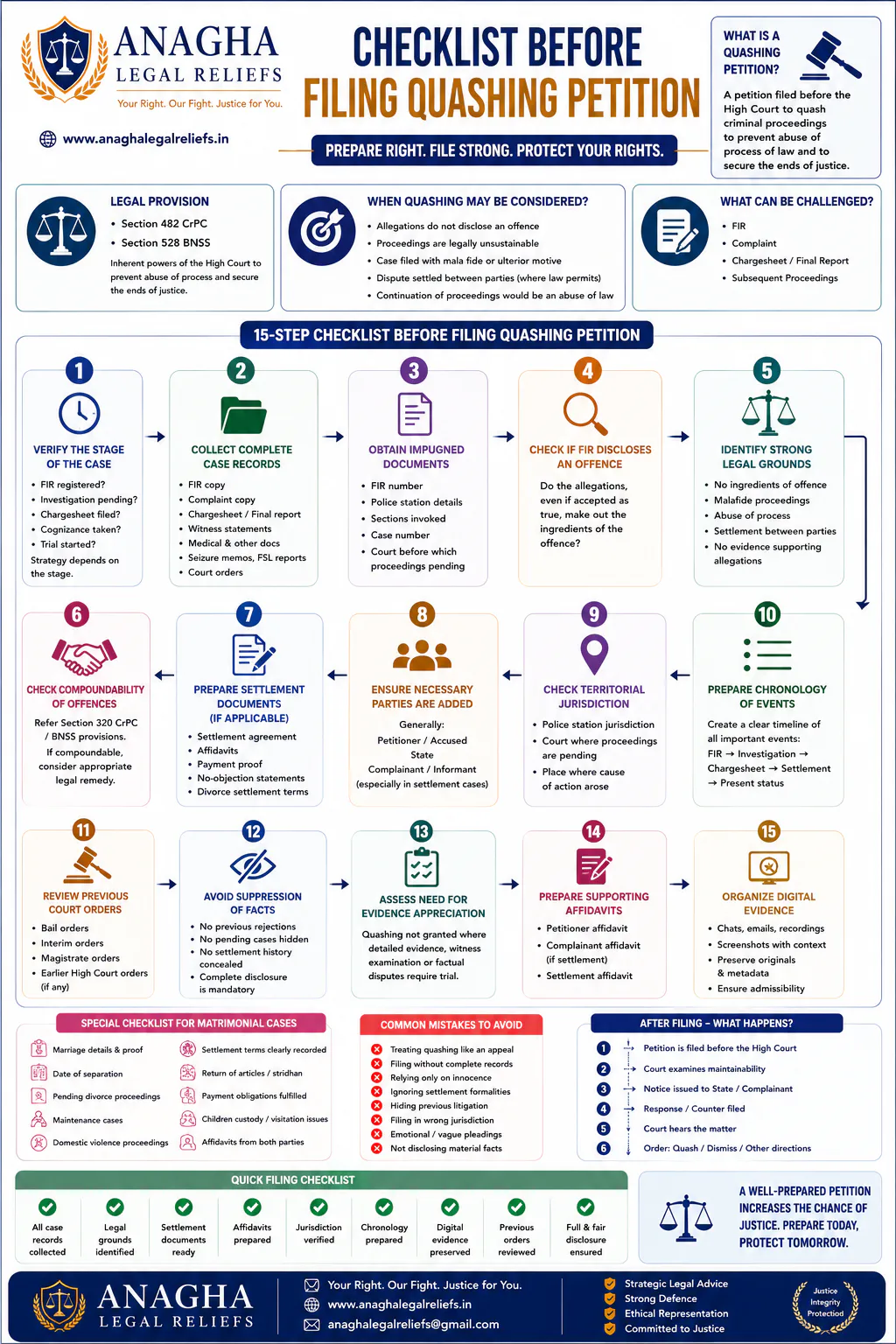
Inherent Powers of High Court

Posted on May 4 by Suprajaa Rajan

The inherent powers of the High Court constitute one of the most important safeguards within the criminal justice system. These powers enable the High Court to ensure that judicial proceedings remain fair, just, and free from misuse.

Under Indian criminal law, these powers are expressly recognised under the Code of Criminal Procedure, 1973 and the corresponding provisions under the Bharatiya Nagarik Suraksha Sanhita, 2023.

The High Court exercises these powers to prevent abuse of process of law and to secure the ends of justice.

Statutory Framework

The legal basis for inherent powers is contained in:

  • Section 482 CrPC (Section 528 BNSS) – Saving of inherent powers of High Court

This provision does not confer new powers. Instead, it recognises and preserves the inherent jurisdiction already vested in the High Court.

The High Court may exercise these powers to:

  • Prevent abuse of process of any court
  • Secure the ends of justice
  • Pass appropriate orders where no specific provision exists

Meaning and Scope of Inherent Powers

“Inherent powers” refer to those powers that are essential for the administration of justice, even if they are not expressly provided in statutory provisions.

These powers are:

  • Residual in nature
  • Extraordinary in character
  • To be exercised sparingly

The High Court invokes these powers only when ordinary remedies are inadequate or unavailable.

Objectives of Exercising Inherent Powers

The High Court primarily exercises inherent powers for the following purposes:

Prevent Abuse of Process

The court intervenes when legal proceedings are used for malicious or improper purposes.

Secure Ends of Justice

The court ensures that justice prevails, even in situations where procedural law is silent.

Fill Procedural Gaps

The court may pass orders where the law does not provide a specific remedy.

Thus, inherent powers function as a safety valve within the legal system.

Common Situations Where Powers Are Invoked

The High Court frequently exercises inherent powers in the following situations:

  • Quashing of FIR or criminal proceedings
  • Preventing multiplicity of proceedings
  • Correcting gross procedural irregularities
  • Intervening in cases of manifest injustice
  • Protecting fundamental rights

These situations demonstrate how inherent powers act as a corrective and preventive mechanism.

Judicial Principles Governing Exercise of Powers

Courts have laid down guiding principles for exercising inherent powers.

In
State of Haryana v. Bhajan Lal, the Supreme Court clarified that these powers must be exercised:

  • With great caution
  • Only in exceptional cases
  • Without interfering in legitimate prosecution

The Court emphasised that inherent powers should not be used to stifle genuine proceedings.

Limitations on Inherent Powers

Although wide, these powers are not unlimited.

The High Court cannot:

  • Override express statutory provisions
  • Conduct a detailed trial or evaluate evidence
  • Interfere in routine matters
  • Substitute appellate or revisional jurisdiction

Therefore, the exercise of inherent powers remains carefully controlled and limited.

Difference Between Inherent Powers and Other Remedies

It is important to distinguish inherent powers from other remedies.

Inherent Powers:

  • Extraordinary and discretionary
  • Invoked under Section 482 CrPC (Section 528 BNSS)
  • Used to prevent injustice

Appeal/Revision:

  • Statutory remedies
  • Governed by specific provisions
  • Follow structured procedure

Thus, inherent powers act as a last resort remedy.

Importance in Criminal Justice System

The inherent powers of the High Court play a crucial role in maintaining the integrity of the legal system.

They:

  • Prevent misuse of judicial process
  • Ensure fairness and justice
  • Protect individuals from harassment
  • Strengthen judicial oversight

Without these powers, courts would be unable to address exceptional situations effectively.

Conclusion

The inherent powers of the High Court serve as a cornerstone of criminal justice. They empower courts to act beyond procedural limitations to ensure that justice prevails.

However, courts exercise these powers with restraint to maintain a balance between preventing misuse of law and allowing legitimate prosecution to proceed.


Related Legal Concepts

Explore related remedies and powers in criminal law:

  • Quashing of FIR
  • Abuse of Process of Law
  • Appeal, Revision & Review
  • Criminal Trial Procedure
  • Cognizable and Non-Cognizable Offences


Index of Law Concepts explained here.


Key Contributor :

Mrs. Suprajaa Rajan B.Com., LL.B., LL.M.

+91-9606345150


Posted in LLB Study Material | Tagged abuse of process Abuse of process of law BNSS Sec 528 – Saving of inherent powers of High Court CrPC 482 - Saving of inherent powers of High Court Law Concepts explained Quashing of FIR | Leave a comment

Quashing of FIR

Posted on April 23 by Suprajaa Rajan

The power to quash an FIR is an extraordinary jurisdiction exercised by High Courts to prevent misuse of criminal law. Courts invoke this power when the continuation of criminal proceedings would result in abuse of process of law or miscarriage of justice.

Under Indian law, this power flows from the inherent jurisdiction of High Courts under the Code of Criminal Procedure, 1973 and corresponding provisions under the Bharatiya Nagarik Suraksha Sanhita, 2023.

Quashing ensures that individuals are not subjected to frivolous or malicious criminal proceedings.

Statutory Framework

The legal basis for quashing of FIR lies in:

  • Section 482 CrPC (Section 528 BNSS) – Inherent powers of High Court

This provision empowers the High Court to:

  • Prevent abuse of process of any court
  • Secure the ends of justice
  • Quash FIRs or criminal proceedings where necessary

This power is extraordinary and discretionary, and courts exercise it with caution.

Meaning of Quashing of FIR

Quashing of FIR refers to the judicial act of setting aside a First Information Report and all consequential proceedings.

When a court quashes an FIR:

  • The criminal case comes to an end
  • Investigation and trial proceedings stop
  • The accused is relieved from further legal action

Thus, quashing acts as a protective remedy against unjust prosecution.

Grounds for Quashing of FIR

Courts may quash an FIR under several circumstances.

Common grounds include:

  • Allegations do not disclose any offence
  • FIR is manifestly false or frivolous
  • Dispute is purely civil in nature
  • Proceedings initiated with mala fide intent
  • Lack of evidence to support allegations
  • Legal bar to institution of proceedings

These grounds ensure that criminal law is not used as a tool of harassment.

Landmark Principles

The Supreme Court laid down guiding principles for quashing in State of Haryana v. Bhajan Lal.

The Court identified illustrative categories where quashing may be justified, including:

  • Where allegations do not constitute an offence
  • Where allegations are absurd or improbable
  • Where proceedings are maliciously instituted

These principles continue to guide High Courts while exercising inherent powers.

Quashing in Matrimonial and Commercial Disputes

Courts frequently encounter quashing petitions in:

  • Matrimonial disputes (e.g., cruelty allegations)
  • Commercial or financial disputes

In such cases, courts examine whether:

  • The dispute has been settled amicably
  • Continuation of proceedings serves any purpose
  • The criminal case is being used to exert pressure

Thus, quashing promotes settlement and prevents unnecessary litigation.

Scope and Limitations

Although the power to quash is wide, it is subject to important limitations.

Courts:

  • Do not conduct a detailed trial
  • Do not evaluate evidence extensively
  • Do not decide disputed facts

Instead, courts examine whether the FIR, on its face, discloses a prima facie offence.

Therefore, quashing is not a substitute for trial but a safeguard against abuse of process.

Procedure for Quashing FIR

A party seeking quashing must file a petition before the High Court under:

  • Section 482 CrPC (Section 528 BNSS)

The process generally involves:

  • Filing of petition with supporting documents
  • Hearing arguments from both sides
  • Court examining the FIR and material on record
  • Passing appropriate orders

The court may:

  • Quash the FIR
  • Dismiss the petition
  • Grant interim protection

Difference Between Quashing and Discharge

Although both remedies protect the accused, they operate at different stages.

Quashing:

  • Invoked before or during investigation
  • Exercised by High Court
  • Ends proceedings at an early stage

Discharge:

  • Invoked after filing of charge sheet
  • Decided by trial court
  • Based on evaluation of material

Thus, quashing acts as an early-stage remedy, while discharge operates later.

Importance in Criminal Law

Quashing of FIR plays a crucial role in maintaining the integrity of the legal system.

It:

  • Prevents misuse of criminal law
  • Protects individuals from harassment
  • Saves judicial time
  • Ensures fairness in proceedings

Therefore, it acts as a powerful safeguard against unjust prosecution.

Conclusion

The power to quash an FIR, thus, reflects the judiciary’s commitment to ensuring that criminal law is not misused. By exercising inherent jurisdiction, High Courts prevent abuse of process and uphold the principles of justice.

However, courts exercise this power cautiously to ensure that genuine cases are not prematurely terminated, thereby maintaining a balance between individual rights and societal interests.


Related Legal Concepts

Explore related remedies and procedural safeguards in criminal law:

  • Abuse of Process of Law
  • First Information Report (FIR)
  • Discharge of Accused
  • Criminal Trial Procedure
  • Appeal, Revision & Review


Index of Law Concepts explained here.


Key Contributor :

Mrs. Suprajaa Rajan B.Com., LL.B., LL.M.

+91-9606345150

Posted in LLB Study Material | Tagged abuse of process Abuse of process of law Criminal law Criminal law in India Law Concepts explained Quashing of FIR | Leave a comment

Abuse of process of Law

Posted on April 21 by Suprajaa Rajan

The doctrine of abuse of process of law plays a vital role in preventing misuse of judicial procedures. Courts invoke this principle when legal processes are used maliciously, vexatiously, or for ulterior purposes, rather than for genuine legal redress.

Under Indian criminal law, courts exercise inherent and supervisory powers to prevent such misuse under the Code of Criminal Procedure, 1973 and corresponding provisions under the Bharatiya Nagarik Suraksha Sanhita, 2023.

This doctrine ensures that the legal system functions to advance justice and not to harass individuals.

Meaning of Abuse of Process

Abuse of process occurs when a party uses legal proceedings:

  • For an improper or ulterior motive
  • To harass, intimidate, or pressurise another party
  • To achieve objectives unrelated to justice

In such situations, courts intervene to prevent the continuation of proceedings that undermine the integrity of the judicial system.

Statutory Framework

The power to prevent abuse of process primarily flows from:

  • Section 482 CrPC (Section 528 BNSS) – Inherent powers of High Court

This provision empowers the High Court to:

  • Prevent abuse of process of any court
  • Secure the ends of justice
  • Quash criminal proceedings where necessary

These powers are extraordinary in nature and must be exercised cautiously.

Scope of Inherent Powers

Under Section 482 CrPC (Section 528 BNSS), the High Court may intervene in exceptional cases.

The court may:

  • Quash FIR or criminal proceedings
  • Prevent misuse of legal machinery
  • Ensure fairness in judicial process

However, the court does not conduct a full trial at this stage. Instead, it examines whether the proceedings are legally sustainable.

Common Instances of Abuse of Process

Courts often identify abuse of process in the following situations:

  • Filing of false or frivolous complaints
  • Initiating criminal proceedings for civil disputes
  • Multiple proceedings on the same cause of action
  • Proceedings initiated with mala fide intent
  • Use of criminal law to exert pressure in personal or commercial disputes

In such cases, continuation of proceedings would result in miscarriage of justice.

Judicial Principles Governing Quashing

Courts have developed guiding principles to determine whether proceedings amount to abuse of process.

In
State of Haryana v. Bhajan Lal, the Supreme Court laid down illustrative categories where courts may quash proceedings.

These include:

  • Where allegations do not disclose any offence
  • Where allegations are absurd or inherently improbable
  • Where proceedings are maliciously instituted

These principles continue to guide courts in exercising inherent powers.

Difference Between Abuse of Process and Legitimate Prosecution

It is important to distinguish between genuine legal action and abuse of process.

Legitimate Prosecution:

  • Based on valid legal grounds
  • Supported by evidence
  • Aims to seek justice

Abuse of Process:

  • Based on ulterior motives
  • Lacks legal foundation
  • Intended to harass or misuse law

Therefore, courts must carefully evaluate facts to ensure that genuine cases are not prematurely terminated.

Role of High Courts

High Courts play a crucial role in preventing abuse of process.

They exercise inherent powers to:

  • Protect individuals from harassment
  • Maintain judicial discipline
  • Prevent misuse of criminal law

However, courts exercise this power sparingly and with caution, as premature interference may affect legitimate prosecution.

Importance in Criminal Justice System

The doctrine of abuse of process ensures that:

  • Courts do not become tools of oppression
  • Legal procedures are not misused
  • Justice remains the primary objective of law

It, therefore, acts as a safeguard against arbitrary and malicious litigation.

Conclusion

Abuse of process of law, hence, undermines the very purpose of the legal system. Therefore, courts exercise inherent powers to prevent misuse and ensure that judicial proceedings serve the cause of justice.

By striking a balance between preventing misuse and allowing genuine cases to proceed, the law upholds the principles of fairness, integrity, and justice.


Related Legal Concepts

Explore related remedies and procedural safeguards in criminal law:

  • Quashing of FIR
  • Discharge of Accused
  • Criminal Trial Procedure
  • Appeal, Revision & Review
  • Cognizable and Non-Cognizable Offences


Index of Law Concepts explained here.


Key Contributor :

Mrs. Suprajaa Rajan B.Com., LL.B., LL.M.

+91-9606345150


Posted in General Study Material LLB Study Material | Tagged Abuse of process of law BNSS Sec 528 – Saving of inherent powers of High Court Criminal law in India CrPC 482 - Saving of inherent powers of High Court Legal Remedies after chargesheet Quashing of FIR Remedies against Malicious Prosecution in India | Leave a comment

How Courts Quash Omnibus Allegations in Matrimonial FIRs – Case Study

Posted on April 18 by Suprajaa Rajan

Introduction

In matrimonial disputes, complainants often make general and sweeping allegations against multiple family members without specifying their individual roles. These are commonly referred to as “omnibus allegations.”

However, courts have consistently held that criminal law cannot be used to implicate entire families without specific evidence. Therefore, High Courts frequently exercise their powers to quash such proceedings at an early stage.

This article explains how courts deal with omnibus allegations, supported by judicial principles and practical defence strategy under the Code of Criminal Procedure, 1973 (CrPC) and the Bharatiya Nagarik Suraksha Sanhita, 2023 (BNSS).

What Are Omnibus Allegations?

Omnibus allegations refer to:

  • Vague and generalised accusations
  • Lack of specific dates, acts, or roles
  • Naming multiple family members without distinction

For example, statements such as:

“All in-laws harassed me for dowry”

without detailing who did what, when, and how, are treated as omnibus allegations. Courts view such allegations with caution because they often indicate misuse of criminal law in matrimonial disputes.

Legal Basis for Quashing

The High Court has inherent powers to quash criminal proceedings under:

  • Section 482 CrPC (Section 528 BNSS)

The court exercises this power when:

  • The FIR does not disclose a prima facie offence
  • Allegations are vague or inherently improbable
  • Proceedings amount to abuse of process

Thus, omnibus allegations form a strong ground for seeking quashing.

Judicial Approach Toward Omnibus Allegations

Courts consistently emphasise that criminal liability must be individual and specific.

In Kahkashan Kausar v. State of Bihar, the Supreme Court held that:

  • Courts must be cautious in proceeding against relatives
  • Vague allegations without specific roles are insufficient
  • Mechanical implication of family members must be discouraged

Similarly, courts often observe that continuation of proceedings based on omnibus allegations leads to injustice.

Case Study: Quashing of FIR Against Family Members

Facts of the Case

In a typical matrimonial dispute:

  • The complainant filed an FIR alleging cruelty and harassment
  • Multiple family members, including elderly parents and distant relatives, were named
  • The complaint contained general allegations without specific acts

Legal Issue

Whether the FIR disclosed sufficient material to proceed against all accused persons.

Court’s Analysis

The High Court examined:

  • The absence of specific allegations against individual accused
  • Lack of dates, incidents, or overt acts
  • No supporting evidence indicating involvement

The court noted that the complaint relied entirely on general and sweeping statements.

Court’s Decision

The High Court exercised its inherent powers under:

  • Section 482 CrPC (Section 528 BNSS)

and held that:

  • The allegations were omnibus in nature
  • No prima facie case existed against the relatives
  • Continuation of proceedings would amount to abuse of process

Accordingly, the court quashed the FIR against the family members.

Step-by-Step Defence Strategy

Step 1: Identify Omnibus Allegations

First, carefully analyse the FIR and identify:

  • Lack of specific roles
  • General statements against multiple accused
  • Absence of supporting details

Step 2: Gather Supporting Evidence

Next, collect evidence showing:

  • Separate residence
  • Lack of interaction with the complainant
  • Absence during alleged incidents

This helps demonstrate that the allegations are false or exaggerated.

Step 3: File Petition for Quashing

You should file a petition before the High Court under:

  • Section 482 CrPC (Section 528 BNSS)

The petition should clearly highlight:

  • Vague nature of allegations
  • Absence of evidence
  • Misuse of criminal law

Step 4: Rely on Judicial Precedents

You should rely on judgments like:

  • Kahkashan Kausar v. State of Bihar
  • Arnesh Kumar v. State of Bihar

These cases strengthen the argument against mechanical implication of relatives.

Step 5: Seek Interim Protection

While the quashing petition is pending, you should seek:

  • Protection from coercive action
  • Stay on further proceedings

This ensures that the accused do not face unnecessary harassment.

Importance of Specific Allegations in Criminal Law

Criminal law requires that:

  • Each accused must have a clearly defined role
  • Allegations must be supported by evidence
  • Courts must apply judicial mind before proceeding

Therefore, omnibus allegations fail to meet the basic threshold required for criminal prosecution.

Practical Insight

Courts increasingly recognise that matrimonial disputes sometimes involve over-implication of family members.

As a result:

  • High Courts actively scrutinise FIRs
  • Relief is granted at an early stage
  • Innocent relatives are protected from prolonged litigation

Conclusion

Omnibus allegations, thus, weaken the foundation of a criminal case because they lack specificity, evidence, and credibility.

By invoking the inherent powers of the High Court under Section 482 CrPC (Section 528 BNSS), accused persons can seek early relief from false and generalised accusations.

A well-drafted quashing petition, supported by evidence and judicial precedents, ensures that criminal law is not misused as a tool of harassment.

Related Legal Concepts

  • First Information Report (FIR)
  • Quashing of FIR
  • Inherent powers of High Court
  • Anticipatory Bail
  • Prima Facie case

Index of Legal Strategies and Defence is here. 

Key Contributor : 

Mrs. Suprajaa Rajan B.Com., LL.B., LL.M.

+91-9606345150


Posted in Legal Procedure | Tagged 498A Defence Absurd Or After Thought Or Baseless Or False Or General Or Inherently Improbable Or Improved Or UnSpecific Or Omnibus Or Vague Allegations Legal Strategies and Defence Quashing of FIR | Leave a comment

Dr.Sushil Kumar Purbey and Anr Vs The State of Bihar and Ors on 9 Mar 2026 – Judgement Summary

Posted on April 9 by Suprajaa Rajan

In Dr. Sushil Kumar Purbey & Anr. vs State of Bihar & Ors. (2026), the Supreme Court addressed the issue of parity in quashing criminal proceedings under Section 482 CrPC [Section 528 BNSS] in matrimonial disputes.

The case arose from a dowry harassment FIR filed by the complainant against her husband and his family members. While the High Court quashed proceedings against the sister-in-law on the ground of vague and omnibus allegations, it declined similar relief to the parents-in-law.

Aggrieved by this differential treatment, the appellants approached the Supreme Court. The Court, upon examining the FIR, held that:

  • The allegations against all accused were identical in nature.
  • No specific role or overt act was attributed to the parents-in-law.
  • Differential treatment by the High Court was unsustainable in law.

Consequently, the Court extended the benefit of quashing to the parents-in-law as well, reiterating that criminal law cannot be invoked on the basis of generalised allegations.

“7. A comparative reading of the FIR reveals that the allegations levelled against the sister-in-law and those against the present appellants are, in all material particulars, identical.”

“7. The lone allegation that stands separately against the present appellants is that they would quarrel. This, however, does not constitute a criminal offence and cannot, by itself, sustain cognizance of the offences.”

“8. The criminal complaint against the appellants was, however, lodged only in March 2022, nearly a year after the filing of the divorce petition. Though this delay, standing alone, would not constitute a sufficient ground for quashing the criminal proceedings against the appellants. However, viewed in conjunction with the absence of any specific allegations attributable to them, the delay lends credence to the submission that the criminal complaint against the in-laws may have been instituted by way of a counter-blast to the divorce proceedings initiated by the husband.”

“10. In view of the foregoing, we are of the considered opinion that the High Court erred in applying different standards to persons who stand on an identical footing insofar as the nature of the allegations against them is concerned.”

Decision

  • The Supreme Court allowed the appeal and set aside the High Court’s order to the extent it denied relief to the parents-in-law. It held that identical allegations must be treated uniformly, and differential treatment is legally unsustainable.
  • The Court emphasized that vague and omnibus allegations without specific roles cannot sustain criminal prosecution. It further noted that the delay in filing the FIR, coupled with absence of specific allegations, supported the inference of misuse.
  • Accordingly, exercising its powers under Section 482 CrPC [Section 528 BNSS], the Court quashed the criminal proceedings against the appellants.
  • However, the Court clarified that proceedings against the husband would continue independently in accordance with law.

Dr.Sushil Kumar Purbey and Anr Vs The State of Bihar and Ors on 9 Mar 2026

Citation : 2026 INSC 212

Other Sources :


Index of Quash judgements is here.


Related Legal Concepts

  • Inherent powers of High Court
  • Quashing of FIR
  • Delay in FIR
  • Omnibus Allegations in matrimonial cases
  • Abuse of Process of Law


Key Contributor :
Mrs. Suprajaa Rajan B.Com., LL.B., LL.M.
+91-9606345150


Posted in Supreme Court of India Judgment or Order or Notification | Tagged 2-Judge (Division) Bench Decision Absurd Or After Thought Or Baseless Or False Or General Or Inherently Improbable Or Improved Or UnSpecific Or Omnibus Or Vague Allegations Dowry Harassment law Dr.Sushil Kumar Purbey and Anr Vs The State of Bihar and Ors Matrimonial dispute Quashing of FIR | Leave a comment

Asha G Vs State of Karnataka on 6 Jan 2026 – Judgement Summary

Posted on April 1 by Suprajaa Rajan

498A IPC: Karnataka High Court Quashes Case Against Neighbour Under CrPC 482 (BNSS 528)

In Asha G Vs State of Karnataka, the High Court of Karnataka addressed a crucial legal issue regarding the misuse of Section 498A IPC in matrimonial disputes.

The petitioner, who was merely a neighbour of the complainant, sought quashing of criminal proceedings under Section 482 of the Code of Criminal Procedure (CrPC) (now BNSS Section 528). The allegations against her were limited to instigating the husband, without any direct involvement in matrimonial cruelty or dowry harassment.

After examining the complaint and charge sheet, the Court observed that:

  • The petitioner was not a relative of the husband.
  • Allegations were vague and omnibus, lacking specific acts.
  • Inclusion of the petitioner amounted to misuse of criminal law.

Consequently, the Court held that continuing proceedings against the neighbour would be an abuse of process of law, and therefore quashed the case against her.

“The name of this petitioner is nowhere found except contending that she has instigated the husband… otherwise the petitioner would not fit into the definition of family as is obtaining under Section 498A of the IPC.”

“Neighbours of the husband’s family are not relatives of the husband and cannot be implicated for offences under Section 498A of the IPC.”

“Permitting further proceedings against this petitioner would become an abuse of the process of the law and result in miscarriage of justice.”


Asha G Vs State of Karnataka on 6 Jan 2026

Index of Quash Judgments is here. 


Related Legal Concepts

  • Quashing of FIR
  • Relative under Section 498A IPC
  • Abuse of Process of Law
  • False Implication in Matrimonial Disputes
  • Requirement of Specific Allegations in FIR/Charge Sheet


Key Contributor :

Mrs. Suprajaa Rajan B.Com., LL.B., LL.M.

+91-9606345150

Posted in High Court of Karnataka Judgment or Order or Notification | Tagged 1-Judge Bench Decision Abuse Or Misuse of Process of Court Asha G Vs State of Karnataka CrPC 482 - Quash CrPC 482 – IPC 498A Quashed Matrimonial Criminal Law Matrimonial dispute Misuse of Section 498A of IPC Quashing of FIR | Leave a comment

Asish Bera and Ors Vs The State of West Bengal and Anr on 30 Jan 2026

Posted on March 9 by Suprajaa Rajan

The Calcutta High Court held that criminal proceedings cannot continue when the complaint lacks specific material and shows serious inconsistencies. The Court found that the complainant had filed two complaints regarding the same alleged incident without proper explanation.

The Court also noted contradictions in the statements recorded during investigation. It observed that courts must prevent misuse of criminal law in matrimonial disputes. Exercising its inherent powers under Section 482 CrPC (Section 528 BNSS), the Court held that continuation of the proceedings would amount to abuse of the process of law and therefore quashed the case.

The following paragraphs explain the reasoning that led to the decision.

“On careful perusal of the materials on record, it can be found that the Opposite Party no. 2 lodged the complaint before Sagar Police Station… The subsequent complaint was filed before the Court of Learned ACJM at Ranaghat under Section 156(3) Cr.P.C… also in respect of the incident dated March 18, 2022.”

“No satisfactory explanation can be found as to why the de-facto complainant had to lodge two different complaint before different places in respect of self-same incident within a gap of 2 months.”

“It is also a settled law that in case it is found that the nature of complaint primarily found to be of vexatious and frivolous, the courts owes a duty to look into the other evidences collected and did not have to be confined within the content of the written complaint.”

“Therefore on the cumulative assessment of the entire facts and circumstances this Court do not find any material or sufficient material to allow the proceedings to continue further since it would otherwise be absolute abuse of the process of law.” 

Decision

The Calcutta High Court allowed the criminal revision petition.

The Court quashed the criminal proceedings pending before the Magistrate. The Court held that continuation of the case would amount to abuse of the process of law.


Asish Bera and Ors Vs The State of West Bengal and Anr on 30 Jan 2026

Citation :2026:CHC-AS:134

Other Sources :


Index of Quash judgments is here.


Key Contributor :

Mrs. Suprajaa Rajan B.Com., LL.B., LL.M.

+91-9606345150


Posted in High Court of Calcutta Judgment or Order or Notification | Tagged 1-Judge Bench Decision Asish Bera & Ors. v. The State of West Bengal & Anr CrPC 482 - Quash CrPC 482 – IPC 498A Quashed Matrimonial dispute Matrimonial disputes law Quashing of FIR | Leave a comment

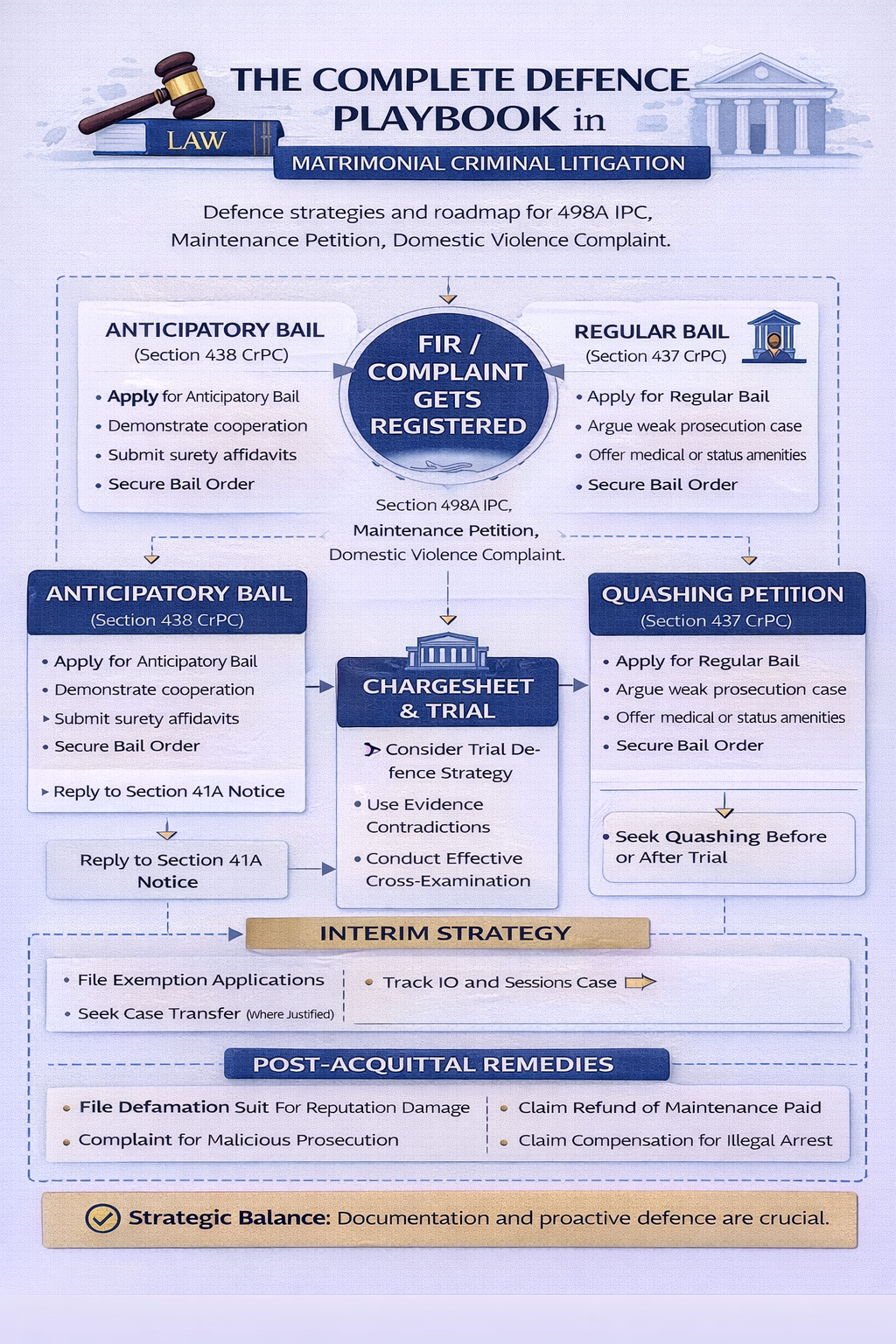
Matrimonial Criminal Litigation – The Complete Defence Guide

Posted on March 5 by Suprajaa Rajan

A structured legal roadmap to protect liberty, reputation, and financial security at every stage of criminal matrimonial proceedings.

Matrimonial criminal litigation in India often begins abruptly — with an FIR under Section 498A IPC, a complaint under the Domestic Violence Act, or a maintenance claim under Section 125 CrPC.

What follows is confusion, pressure, and procedural complexity.

This playbook provides a stage-wise strategic framework for navigating criminal matrimonial disputes lawfully and effectively.

I. Stage One: Immediately After FIR Registration

Most accused individuals panic at this stage. Strategy must, undoubtedly, begin immediately.

Key Legal Provisions:

  • Section 498A IPC

  • Section 406 IPC

  • Section 34 IPC

  • Section 41 & 41A CrPC

Immediate Strategic Steps:

  • Verify FIR contents
  • Assess arrest risk
  • Prepare anticipatory bail strategy
  • Collect documentary evidence
  • Preserve digital communications

The Supreme Court in Arnesh Kumar v. State of Bihar, held that arrest cannot be automatic in offences punishable up to seven years.

Read also : Arrest Procedure in 498A Cases After Arnesh Kumar

II. Stage Two: Bail & Liberty Protection

Personal liberty under Article 21 of the Constitution remains paramount.

Strategic Remedies:

1. Anticipatory Bail – Section 438 CrPC

Filed when arrest apprehension exists.

2. Regular Bail – Section 437/439 CrPC

Filed after arrest.

3. Transit Anticipatory Bail

When FIR is lodged in another State.

Courts evaluate:

  • Specificity of allegations

  • Role of each accused

  • Possibility of tampering

  • Cooperation with investigation

Read also : Anticipatory Bail in Matrimonial Offences – Complete Guide

III. Stage Three: Investigation & Chargesheet

After investigation, police may file chargesheet under:

  • Section 173 CrPC

This stage determines the trial trajectory.

Defence Strategy Includes:

  • Filing discharge application
  • Challenging omnibus allegations
  • Examining absence of specific overt acts
  • Seeking exemption from personal appearance

High Courts frequently quash proceedings against distant relatives where allegations are vague.

Read also : Discharge Application in 498A Cases – Legal Framework

IV. Stage Four: High Court Remedies

Where proceedings amount to abuse of process, remedy lies under:

  • Section 482 CrPC

High Courts exercise inherent powers to prevent miscarriage of justice.

Grounds commonly invoked:

  • Absence of prima facie case

  • Generalised allegations

  • Settlement between parties

  • Malicious prosecution

Read also : Quashing of FIR Under Section 482 CrPC – Explained

V. Parallel Civil & Financial Litigation

Matrimonial disputes rarely remain confined to criminal law.

Parallel proceedings may include:

  • Domestic Violence Act, 2005

  • Section 125 CrPC Maintenance

  • Divorce proceedings under personal laws

Financial Defence Strategy:

  • Accurate income disclosure
  • Challenging inflated claims
  • Contesting interim maintenance
  • Seeking modification upon change of circumstances

VI. Trial Strategy

If matter proceeds to trial, defence must shift from procedural to evidentiary strength.

Key Focus Areas:

  • Cross-examination strategy

  • Contradictions in complaint & deposition

  • Electronic evidence admissibility

  • Medical and documentary inconsistencies

  • Hostile witness handling

Trial requires patience, consistency, and procedural discipline.

VII. Settlement & Strategic Exit

Despite non-compoundable nature of 498A, courts allow quashing upon settlement.

Compromise-based quashing has evolved as a judicially recognised solution where matrimonial disputes are resolved.

Strategic mediation may:

  • Reduce litigation time

  • Protect reputation

  • Avoid prolonged trial

VIII. Common Strategic Mistakes to Avoid

  • Ignoring Section 41A notice
  • Filing multiple inconsistent petitions
  • Aggressive communication with complainant
  • Social media commentary
  • Suppressing financial disclosures
  • Non-cooperation with investigation

IX. Long-Term Reputation & Legal Risk Management

Criminal matrimonial litigation impacts:

  • Passport applications

  • Employment background verification

  • Professional licences

  • Immigration status

Strategic handling at early stages significantly influences long-term outcomes.

X. Guiding Principles of Defence

  1. Arrest is not automatic.

  2. Allegations must be specific.

  3. Liberty is constitutionally protected.

  4. Procedure is a safeguard, not a technicality.

  5. Early strategy prevents prolonged litigation.

Conclusion

Matrimonial criminal litigation, thus, requires structured legal response, not emotional reaction. Each procedural stage offers remedies. Each remedy must be invoked strategically.

The defence playbook lies in:

  • Understanding statutory safeguards

  • Timely filing of appropriate applications

  • Preserving documentary evidence

  • Maintaining procedural discipline

So liberty, reputation, and financial security depend on informed legal action.


Index of Legal Strategies and Defence is here. 


Key Contributor : 

Mrs. Suprajaa Rajan B.Com., LL.B., LL.M.

+91-9606345150


Posted in Legal Procedure | Tagged 498A defence strategy Criminal Trial CrPC 482 - FIR Can Be Quashed Maintenance Defence Matrimonial Criminal Law Matrimonial Litigation India Quashing of FIR | Leave a comment

Quashing of FIR Under Section 482 CrPC

Posted on March 3 by Suprajaa Rajan

Understanding the scope, grounds, and judicial principles governing quashing of criminal proceedings.

Criminal prosecution can severely affect personal liberty, reputation, and professional life. However, not every FIR discloses a legally sustainable offence. In such situations, the law provides a constitutional safeguard.

The remedy lies under:

Code of Criminal Procedure, 1973

Specifically, Section 482 CrPC, which preserves the inherent powers of the High Court to:

  • Prevent abuse of process of law

  • Secure the ends of justice

  • Quash criminal proceedings where continuation is unjustified

This article explains the legal framework, judicial tests, landmark precedents, and strategic considerations for filing a quashing petition in brief.

Steps under Quashing FIR

I. What Is Section 482 CrPC?

Section 482 states that nothing in the Code shall limit the inherent powers of the High Court.

These powers are extraordinary in nature and must be exercised:

  • Sparingly

  • With caution

  • Only in rare and exceptional cases

Nevertheless, it is not an appellate power. In fact, it is a supervisory and preventive jurisdiction.

II. When Can FIR Be Quashed?

The Supreme Court laid down guiding principles in:

State of Haryana v. Bhajan Lal

This judgment identified illustrative categories where quashing may be justified.

Key Grounds for Quashing:

  • Allegations do not disclose a cognizable offence
  • FIR is manifestly attended with mala fide intent
  • Allegations are absurd or inherently improbable
  • There is no legal evidence supporting prosecution
  • Proceedings amount to abuse of process
  • Dispute is purely civil in nature
  • Parties have settled the dispute (in appropriate cases)

III. Quashing in Matrimonial Offences (498A Cases)

Quashing petitions frequently arise in complaints under:

  • Section 498A IPC

  • Section 406 IPC

  • Section 34 IPC

Courts have repeatedly cautioned against mechanical implication of relatives.

In Arnesh Kumar v. State of Bihar, the Supreme Court addressed misuse in matrimonial litigation and emphasised procedural safeguards.

High Courts often quash proceedings where:

  • Allegations are omnibus

  • No specific role is attributed

  • Distant relatives reside separately

  • Complaint lacks prima facie material

IV. Settlement-Based Quashing

Even though Section 498A IPC is non-compoundable, courts permit quashing where matrimonial disputes are amicably resolved.

In Gian Singh v. State of Punjab, the Supreme Court held that High Courts may quash non-compoundable offences if the dispute is personal and continuation would serve no purpose.

Similarly, in Narinder Singh v. State of Punjab, guidelines were laid down for compromise-based quashing.

The principle: criminal law should not be used as a weapon once parties have settled significantly.

V. Can FIR Be Quashed After Chargesheet?

Yes. Quashing is maintainable even after filing of chargesheet under Section 173 CrPC.

However, courts are more cautious once investigation is complete.

The test becomes:

  • Whether materials collected disclose a prima facie case

  • Whether continuation would amount to injustice

In case the evidence supports trial, courts may refuse interference.

VI. Procedure for Filing Quashing Petition

A petition under Section 482 CrPC is filed before the jurisdictional High Court.

Typical Components:

  • Copy of FIR
  • Chargesheet (if filed)
  • Relevant documents
  • Affidavit
  • Grounds invoking Bhajan Lal principles

Notice is issued to:

  • State

  • Complainant

High Court may:

  • Issue interim stay

  • Grant protection from coercive steps

  • Dismiss petition

  • Quash FIR entirely

  • Quash proceedings partially against specific accused

VII. Judicial Caution: What Courts Will Not Do

High Courts will not:

  • Conduct mini-trials

  • Examine disputed facts

  • Evaluate credibility of witnesses

  • Weigh evidence

If allegations disclose prima facie offence, trial must proceed. In any case, section 482 is not a substitute for trial.

VIII. Strategic Considerations Before Filing

Filing a premature petition may weaken credibility.

Consider:

  • Stage of investigation

  • Strength of allegations

  • Documentary contradictions

  • Settlement possibilities

  • Parallel civil proceedings

Thus strategic timing is undoubtedly crucial.

IX. Common Mistakes in Quashing Petitions

  • Raising factual disputes requiring evidence
  • Filing without examining FIR carefully
  • Over-reliance on defence documents
  • Ignoring Supreme Court precedents
  • Filing multiple repetitive petitions

Subsequently, courts may impose costs for frivolous petitions.

X. Recent Judicial Approach

Courts increasingly:

  • Protect distant relatives in 498A cases

  • Scrutinise omnibus allegations

  • Encourage settlement in matrimonial disputes

  • Emphasise that criminal law should not become harassment

However, courts remain strict where allegations show serious cruelty or violence.

Conclusion

Section 482 CrPC ,thus, acts as a constitutional safety valve against misuse of criminal process. Additionally, it ensures that criminal law does not become a tool of oppression.

However, it is an extraordinary remedy. Courts exercise it with restraint. A well-structured petition grounded in settled principles significantly improves prospects.

The guiding test remains:

Does continuation of prosecution serve justice — or defeat it?

Therefore, when proceedings lack legal foundation or arise from matrimonial vendetta, inherent powers of the High Court restore balance.


Index of Legal Strategies and Defence is here. 


Frequently Asked Questions

Not automatic. Court examines genuineness and societal impact.

Yes. Proceedings may be quashed selectively.

No. It terminates proceedings before trial.

Often exempted unless court directs otherwise.


Key Contributor:

Mrs. Suprajaa Rajan B.Com., LL.B., LL.M.

+91-9606345150


Posted in Legal Procedure | Tagged abuse of process Criminal law CrPC 482 – IPC 498A Quashed Matrimonial Litigation India Quashing of FIR Section 482 CrPC | Leave a comment

Post navigation

  • Older posts

Search within entire Content of “Shades of Knife”

My Legal X Timeline

Advocate Sandeep Pamarati 🇮🇳💪👨🏻‍🎓 Follow

AP High Court Advocate with M Tech (CS) || 12 years in 'Software Industry' as Solution Architect || Blogs at https://t.co/29CB9BzK4w || #TDPTwitter

SandeepPamarati
Retweet on Twitter Advocate Sandeep Pamarati 🇮🇳💪👨🏻‍🎓 Retweeted
its_me_jasraj 𝗗𝗿.𝗝𝗮𝘀𝗿𝗮𝗷 𝗣𝗿𝗮𝗷𝗮𝗽𝗮𝘁𝗶 @its_me_jasraj ·
21 Jun

5 Protein Facts They Never Told You ✅

Reply on Twitter 2068689430140080559 Retweet on Twitter 2068689430140080559 120 Like on Twitter 2068689430140080559 402 X 2068689430140080559
Retweet on Twitter Advocate Sandeep Pamarati 🇮🇳💪👨🏻‍🎓 Retweeted
mohiniwealth Mohini Maheshwari @mohiniwealth ·
22 Jun

The Dark Truth 🥷

Reply on Twitter 2068918051966513614 Retweet on Twitter 2068918051966513614 58 Like on Twitter 2068918051966513614 233 X 2068918051966513614
Retweet on Twitter Advocate Sandeep Pamarati 🇮🇳💪👨🏻‍🎓 Retweeted
shree_2_2 श्री @shree_2_2 ·
21 Jun

He spoke on behalf of all nationalists loved this side of Anand sir😅😅😅

Reply on Twitter 2068683121504170027 Retweet on Twitter 2068683121504170027 317 Like on Twitter 2068683121504170027 817 X 2068683121504170027
Retweet on Twitter Advocate Sandeep Pamarati 🇮🇳💪👨🏻‍🎓 Retweeted
shoneekapoor ShoneeKapoor @shoneekapoor ·
20 Jun

Judge Calls Wife’s Beating “Blessing”? Gender Reverse Karke Dekho

A husband tells the court that his wife beats him. In a viral clip from Gwalior Bench proceedings, the judge is heard saying:

“Husband who gets beaten up by his wife is a lucky man. That beating is a blessing.

Reply on Twitter 2068312690423185883 Retweet on Twitter 2068312690423185883 257 Like on Twitter 2068312690423185883 490 X 2068312690423185883
Load More

Recent Posts

  • Pavul Yesu Dhasan Vs Registrar SHRC of TN and Ors on 30 Apr 2025 June 18, 2026
  • Manoj Kumar Vs Nita Bharti on 17 Mar 2026 June 17, 2026
  • Cruelty as a Criminal Offence Explained June 12, 2026
  • Bail Compliance Undertaking Format – Draft, Legal Requirements & Sample Template June 12, 2026
  • Warning Signs of Escalating Matrimonial Litigation – Early Red Flags Every Spouse Should Recognize June 12, 2026

Most Read Posts

  • Reply to Section 41A CrPC Notice – Format with Legal Explanation (4,940 views)
  • Anu Aggarwal Vs Sushant Aggarwal on 20 Jan 2026 (3,473 views)
  • Umme Farva Vs State of U.P. and Anr on 14 Jan 2026 (3,361 views)
  • Charge Sheet and Final Report Explained (2,809 views)
  • Regular Bail Application Format (Section 437/439 CrPC) (2,189 views)
  • Neha Lal Vs Abhishek Kumar on 20 Jan 2026 (1,998 views)
  • Arrest Procedure in 498A cases after Arnesh Kumar (1,929 views)
  • Discharge Application Format in 498A Case – Draft, Procedure & Sample Template (1,772 views)
  • Can You Travel Abroad After an FIR Is Registered? – Legal Position Explained (1,686 views)
  • Atul Kumar Bajpai Vs State of UP and Anr on 17 Sep 2025 (1,536 views)

Tags

Reportable Judgement or Order (433)2-Judge (Division) Bench Decision (413)Legal Procedure Explained - Interpretation of Statutes (382)Landmark Case (381)1-Judge Bench Decision (362)Catena of Landmark Judgments Referred/Cited to (293)Work-In-Progress Article (215)3-Judge (Full) Bench Decision (101)Sandeep Pamarati (92)Article 21 - Protection of life and personal liberty (80)Issued or Recommended Guidelines or Directions or Protocols to be followed (71)Perjury Under 340 CrPC (66)Absurd Or After Thought Or Baseless Or False Or General Or Inherently Improbable Or Improved Or UnSpecific Or Omnibus Or Vague Allegations (61)Reprimands or Setbacks to YCP Govt of Andhra Pradesh (49)Summary Post (47)CrPC 482 - Quash (43)HM Act 13 - Divorce Granted to Husband (42)Legal Terrorism (41)Divorce granted on Cruelty ground (41)Not Authentic copy hence to be replaced (40)

Categories

Supreme Court of India Judgment or Order or Notification (753)Bare Acts or State Amendments or Statutes or GOs or Notifications issued by Central or State Governments (328)High Court of Andhra Pradesh Judgment or Order or Notification (186)High Court of Delhi Judgment or Order or Notification (164)High Court of Bombay Judgment or Order or Notification (112)High Court of Karnataka Judgment or Order or Notification (93)Legal Procedure (77)High Court of Madras Judgment or Order or Notification (70)High Court of Allahabad Judgment or Order or Notification (61)LLB Study Material (59)General Study Material (56)High Court of Punjab & Haryana Judgment or Order or Notification (52)Assorted Court Judgments or Orders or Notifications (50)High Court of Kerala Judgment or Order or Notification (46)Prakasam DV Cases (46)Judicial Activism (for Public Benefit) (45)District or Sessions or Magistrate Court Judgment or Order or Notification (44)High Court of Madhya Pradesh Judgment or Order or Notification (38)High Court of Gujarat Judgment or Order or Notification (28)High Court of Calcutta Judgment or Order or Notification (27)

Recent Comments

  • eCourts India on Compromise-Based Quashing in Matrimonial Cases – Complete Legal Strategy
  • The Divorce Law Firm on Life Cycle Stages of a Divorce case
  • The Divorce Law Firm on Life Cycle Stages of a Divorce case
  • ShadesOfKnife on Sandeep Pamarati Vs Ungrateful Knife (IPC 498A Case)
  • KONURU VINAYKUMAR on Sandeep Pamarati Vs Ungrateful Knife (IPC 498A Case)

Archives of SoK

  • June 2026 (9)
  • May 2026 (24)
  • April 2026 (33)
  • March 2026 (42)
  • February 2026 (30)
  • January 2026 (21)
  • December 2025 (2)
  • November 2025 (3)
  • October 2025 (17)
  • September 2025 (12)
  • August 2025 (5)
  • July 2025 (10)
  • June 2025 (15)
  • May 2025 (3)
  • April 2025 (10)
  • March 2025 (7)
  • February 2025 (8)
  • January 2025 (1)
  • December 2024 (3)
  • November 2024 (4)
  • October 2024 (16)
  • September 2024 (15)
  • August 2024 (14)
  • July 2024 (11)
  • June 2024 (18)
  • May 2024 (13)
  • April 2024 (9)
  • March 2024 (23)
  • February 2024 (15)
  • January 2024 (11)
  • December 2023 (11)
  • November 2023 (9)
  • October 2023 (13)
  • September 2023 (12)
  • August 2023 (15)
  • July 2023 (17)
  • June 2023 (11)
  • May 2023 (6)
  • April 2023 (5)
  • March 2023 (10)
  • February 2023 (9)
  • January 2023 (12)
  • December 2022 (12)
  • November 2022 (8)
  • October 2022 (13)
  • September 2022 (17)
  • August 2022 (10)
  • July 2022 (21)
  • June 2022 (27)
  • May 2022 (23)
  • April 2022 (32)
  • March 2022 (17)
  • February 2022 (6)
  • January 2022 (2)
  • December 2021 (7)
  • November 2021 (7)
  • October 2021 (6)
  • September 2021 (10)
  • August 2021 (31)
  • July 2021 (45)
  • June 2021 (17)
  • May 2021 (17)
  • April 2021 (18)
  • March 2021 (58)
  • February 2021 (14)
  • January 2021 (50)
  • December 2020 (35)
  • November 2020 (68)
  • October 2020 (67)
  • September 2020 (28)
  • August 2020 (41)
  • July 2020 (20)
  • June 2020 (36)
  • May 2020 (40)
  • April 2020 (38)
  • March 2020 (26)
  • February 2020 (43)
  • January 2020 (35)
  • December 2019 (34)
  • November 2019 (4)
  • October 2019 (18)
  • September 2019 (57)
  • August 2019 (33)
  • July 2019 (12)
  • June 2019 (18)
  • May 2019 (5)
  • April 2019 (19)
  • March 2019 (58)
  • February 2019 (11)
  • January 2019 (90)
  • December 2018 (97)
  • November 2018 (43)
  • October 2018 (31)
  • September 2018 (73)
  • August 2018 (47)
  • July 2018 (143)
  • June 2018 (92)
  • May 2018 (97)
  • April 2018 (59)
  • March 2018 (8)

Blogroll

  • Daaman Promoting Harmony 0
  • Fight against Legal Terrorism Fight against Legal Terrorism along with MyNation Foundation 0
  • Good Morning Good Morning News 0
  • Insaaf India Insaaf Awareness Movement 0
  • MyNation Hope Foundation Wiki 0
  • MyNation.net Equality, Justice and Harmony 0
  • Sarvepalli Legal 0
  • Save Indian Family Save Indian Family Movement 0
  • SIF Chandigarh SIF Chandigarh 0
  • The Male Factor The Male Factor 0
  • Unitedmen Foundation a dedicated community forged with the mission to unite men facing legal challenges in marital disputes. 0
  • Vaastav Foundation The Social Reality 0
  • Vinayak my2centsworth – This blog is for honest law abiding men, married or planning to get married 0
  • Voice4india Indian Laws, Non-profits, Environment 0
  • Writing Law Writing Law by Ankur 0

RSS Cloudflare Status

  • ARN (Stockholm) on 2026-06-25 June 25, 2026
    THIS IS A SCHEDULED EVENT Jun 25, 00:00 - 05:00 UTC Jun 19, 14:18 UTC Scheduled - We will be performing scheduled maintenance in ARN (Stockholm) datacenter on 2026-06-25 between 00:00 and 05:00 UTC.Traffic might be re-routed from this location, hence there is a possibility of a slight increase in latency during this maintenance window […]
  • ARN (Stockholm) on 2026-06-24 June 24, 2026
    THIS IS A SCHEDULED EVENT Jun 24, 00:00 - 05:00 UTC Jun 19, 13:08 UTC Scheduled - We will be performing scheduled maintenance in ARN (Stockholm) datacenter on 2026-06-24 between 00:00 and 05:00 UTC.Traffic might be re-routed from this location, hence there is a possibility of a slight increase in latency during this maintenance window […]
  • MSP (Minneapolis) on 2026-06-23 June 23, 2026
    THIS IS A SCHEDULED EVENT Jun 23, 03:00 - 08:00 UTC Jun 18, 18:30 UTC Scheduled - We will be performing scheduled maintenance in MSP (Minneapolis) datacenter on 2026-06-23 between 03:00 and 08:00 UTC.Traffic might be re-routed from this location, hence there is a possibility of a slight increase in latency during this maintenance window […]

RSS List of Spam Server IPs from Project Honeypot

  • 34.14.86.214 | SD June 22, 2026
    Event: Bad Event | Total: 12 | First: 2026-01-12 | Last: 2026-06-22
  • 34.52.210.100 | S June 22, 2026
    Event: Bad Event | Total: 2 | First: 2026-06-22 | Last: 2026-06-22
  • 45.174.88.88 | S June 22, 2026
    Event: Bad Event | Total: 10 | First: 2025-08-07 | Last: 2026-06-22
Owned and Operated by Advocate Sandeep Pamarati
Proudly powered by WordPress
Theme: Flint by Star Verte LLC

Bad Behavior has blocked 1273 access attempts in the last 7 days.

pixel