web analytics

Menu

Skip to content
Shades of Knife
  • Home
  • True Colors of a Vile Wife
  • Need Inspiration?
  • Blog Updates
  • SOK Gallery
  • Vile News Reporter
  • About Me
  • Contact Me

Shades of Knife

True Colors of a Vile Wife

Tag: PWDV act

Evidence Strategy in Domestic Violence Cases – Building, Challenging, and Presenting Proof Effectively

Posted on May 5 by Suprajaa Rajan

In domestic violence litigation, facts alone rarely win cases—evidence does. Whether you represent the aggrieved person seeking protection or the respondent defending against exaggerated, incomplete, or false allegations, the strength of your case often depends on how effectively you collect, preserve, challenge, and present evidence.

Domestic violence proceedings frequently involve:

  • Emotional allegations
  • Private incidents without independent witnesses
  • Digital communication disputes
  • Financial allegations
  • Claims of physical, verbal, emotional, or economic abuse

Therefore, a carefully planned evidence strategy in domestic violence cases can significantly influence interim relief, protection orders, residence rights, maintenance, and even parallel criminal proceedings.

This article explains the complete evidence strategy in domestic violence cases, with practical insights, procedural safeguards, and references to the Code of Criminal Procedure, 1973 (CrPC), the Bharatiya Nagarik Suraksha Sanhita, 2023 (BNSS), and the Protection of Women from Domestic Violence Act, 2005.
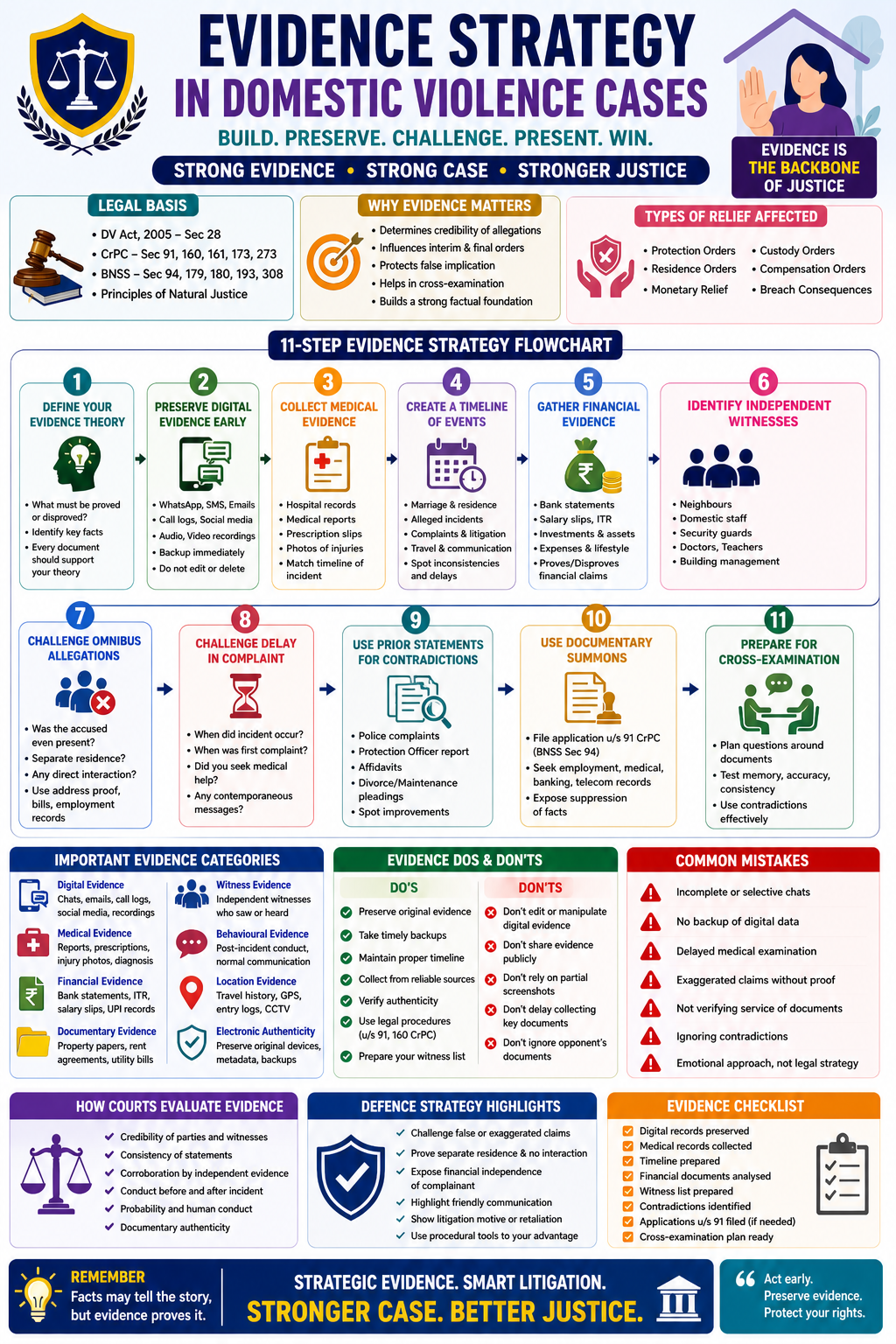
Understanding the Role of Evidence in Domestic Violence Cases

Proceedings under the Protection of Women from Domestic Violence Act, 2005 are often described as quasi-criminal in nature. Although the reliefs may appear civil, the consequences can include:

  • Protection orders
  • Residence orders
  • Monetary relief
  • Compensation orders
  • Custody orders
  • Breach-related criminal consequences

Therefore, evidence becomes central at every stage.

Courts evaluate:

  • Credibility of allegations
  • Consistency of conduct
  • Supporting documents
  • Independent corroboration
  • Digital and financial records

Legal Framework

Domestic violence proceedings generally follow criminal procedural safeguards.

Relevant procedural provisions include:

  • Section 28 of the Domestic Violence Act – Procedure governed by CrPC
  • Section 91 CrPC (BNSS Section 94) – Summons to produce documents
  • Section 160 CrPC (BNSS Section 179) – Attendance of witnesses
  • Section 161 CrPC (BNSS Section 180) – Examination during investigation
  • Section 173 CrPC (BNSS Section 193) – Investigation report, where applicable
  • Section 273 CrPC (BNSS Section 308) – Evidence in presence of accused

Step 1: Build a Clear Evidence Theory Before Collecting Documents

Before collecting documents, define your case theory.

Ask:

What exactly must you prove or disprove?

Examples:

  • No domestic relationship existed
  • Parties lived separately
  • No acts of violence occurred
  • Allegations arose after matrimonial litigation
  • Financial suppression exists
  • Abuse allegations are exaggerated

Every document you collect must support your theory.

Step 2: Preserve Digital Evidence Immediately

In modern domestic violence cases, digital evidence often becomes decisive.

Preserve:

  • WhatsApp chats
  • SMS messages
  • Emails
  • Social media conversations
  • Audio recordings
  • Video recordings
  • Call logs
  • GPS or travel history

Digital evidence may reveal:

  • Normal communication after alleged incidents
  • Settlement discussions
  • Contradictions in timelines
  • Absence of fear or coercion

Practical Strategy

Immediately:

  • Take backups
  • Export chats
  • Save cloud copies
  • Preserve original devices

Do not edit or crop messages.

Authenticity matters.

Step 3: Collect Medical Evidence Carefully

If physical violence is alleged, medical evidence becomes highly relevant.

Preserve:

  • Hospital records
  • Emergency treatment documents
  • Prescription slips
  • Diagnostic reports
  • Photographs of injuries

Important questions include:

  • Was treatment sought immediately?
  • Does the medical record match the allegations?
  • Does the injury timeline match the complaint?

Delayed or inconsistent medical records may affect credibility.

Step 4: Build Timeline Evidence

Prepare a chronological timeline of events.

Include:

  • Marriage date
  • Residence history
  • Alleged incidents
  • Police complaints
  • Travel records
  • Financial transactions
  • Court proceedings

A timeline often exposes:

  • Delayed allegations
  • Contradictory narratives
  • Post-incident normal conduct

A visual chronology can become a powerful courtroom tool.

Step 5: Use Financial Evidence Strategically

Financial disputes often overlap with domestic violence claims.

Collect:

  • Bank statements
  • Salary slips
  • Income tax returns
  • Investment records
  • Property documents
  • UPI/payment records

Financial evidence helps establish:

  • Actual standard of living
  • Financial independence
  • Suppression of income
  • Economic abuse allegations

Step 6: Identify Independent Witnesses

Independent witnesses often strengthen credibility.

Possible witnesses include:

  • Neighbours
  • Security guards
  • Domestic staff
  • Family doctors
  • School authorities
  • Building management

Independent testimony can confirm:

  • Living arrangements
  • Frequency of disputes
  • Physical presence
  • Behavioural patterns

Step 7: Challenge Omnibus Allegations

Many domestic violence cases involve allegations against:

  • Elderly parents
  • Married sisters
  • Distant relatives

Challenge:

  • Physical presence
  • Separate residence
  • Lack of direct interaction
  • Absence of communication

Evidence such as:

  • Aadhaar address
  • Utility bills
  • Employment records
  • Travel records

may help.

Step 8: Challenge Delay in Complaint

Delay can become a critical defence point.

Ask:

  • When did the alleged incident occur?
  • When was the first complaint made?
  • Was any medical treatment sought?
  • Were any contemporaneous messages sent?

Unexplained delay may weaken the case.

Step 9: Use Prior Statements for Contradictions

Compare:

  • Police complaints
  • Protection Officer reports
  • Affidavits
  • Maintenance applications
  • Divorce pleadings
  • FIR statements

Look for:

  • New allegations
  • Changed dates
  • Added names
  • Increased financial claims

Contradictions often become the strongest defence tool.

Step 10: Use Documentary Summons Strategically

If important documents remain unavailable, apply under:

  • Section 91 CrPC (BNSS Section 94)

Seek:

  • Employment records
  • School records
  • Hospital records
  • Telecom records
  • Banking records

This can expose suppression.

Step 11: Prepare Cross-Examination Around Evidence

Evidence collection alone is not enough.

Use documents during cross-examination to test:

  • Memory
  • Accuracy
  • Consistency
  • Credibility

Questions should focus on:

  • Dates
  • Locations
  • Presence of witnesses
  • Subsequent conduct

Common Evidence Mistakes

Avoid:

Selective Screenshot Production

Incomplete chats often backfire.

Editing Digital Material

Manipulation destroys credibility.

Delayed Preservation

Evidence may disappear permanently.

Emotional Documentation Without Strategy

Documents must support legal theory.

Ignoring Opponent’s Documentary Claims

Every document must be verified.

Defence Strategy in False or Exaggerated DV Cases

If defending a false or inflated claim:

Focus on:

Separate Residence

Did the accused even live with the complainant?

Financial Independence

Is the complainant employed?

Contradictory Litigation Positions

Do other cases tell a different story?

Friendly Post-Incident Communication

Do chats contradict fear allegations?

Travel and Social Media Evidence

Does conduct contradict abuse claims?

Judicial Approach

Courts increasingly scrutinise:

  • General allegations
  • Documentary contradictions
  • Digital communication
  • Financial suppression
  • Delayed complaints

Courts prefer evidence-based litigation over emotional allegations.

Practical Evidence Checklist

Before hearing, ensure:

  • Digital records preserved
  • Medical documents collected
  • Timeline prepared
  • Financial documents analysed
  • Witness list prepared
  • Contradictions marked
  • Documentary summons considered
  • Cross-examination plan ready

Conclusion

In domestic violence litigation, evidence often matters more than allegations. A carefully designed evidence strategy can:

  • Strengthen genuine claims
  • Expose exaggeration
  • Challenge false implication
  • Influence interim orders
  • Shape final outcomes

By:

  • Acting early
  • Preserving authentic records
  • Building a coherent theory
  • Using procedural tools strategically

you can dramatically improve your position in domestic violence proceedings.

In court, facts persuade—but evidence proves.


Index of Legal Strategies and Defence is here. 


Key Contributor : 

Mrs. Suprajaa Rajan B.Com., LL.B., LL.M.

+91-9606345150

Posted in Legal Procedure | Tagged False Allegations Legal Strategies and Defence Matrimonial Criminal Law Matrimonial Litigation India matrimonial offences PWDV act | Leave a comment

Sandeep Pathak and Ors Vs Lalitha Tiwari on 10 Mar 2026 – Judgment Summary

Posted on March 23 by Suprajaa Rajan

The Delhi High Court in Sandeep Pathak and Ors Vs Lalitha Tiwari quashed criminal proceedings under Section 498A IPC (Section 85 BNS), Section 406 IPC (Section 316 BNS), and the DV Act.

The Court held that vague and omnibus allegations cannot establish cruelty or criminal breach of trust. It also ruled that DV Act proceedings cannot survive after divorce, as the domestic relationship ceases.

Further, the Court found that the wife filed proceedings after the divorce decree. Therefore, it treated the case as an abuse of process under Section 482 CrPC (Section 528 BNSS).

“45. From the entire allegations as discussed above, it emerges that the essential ingredients of Section 498A IPC are not made out from the Complaint made by Respondent No.2.”

“46. In light of the above findings, it is concluded that it is clearly a case which comes in the category of abuse of the process of law, meriting quashing of the FIR.”

“52. Thus, aside from omnibus allegations, no prima facie case of entrustment of jewellery has been made out. Thus, no offence under Section 406 IPC is made out in the Complaint against the Petitioners.”

“55. As discussion above in detail, there is not an iota of even a prima facie case of cruelty or of harassment of the Complainant by the Petitioners. There is also no element of cruelty or entrustment made out from the facts alleged by the Respondent in her Complaint. Moreover, as discussed above from the facts, when comprehensively considered, reflects that it is a case of abuse of process of law, justifying the quashing of the FIR and the Chargesheet filed therein.”

“69. Thus, the chronology of events clearly indicates that the criminal and DV proceedings were initiated after the marital relationship had already been dissolved by a decree of divorce, and is a subsequent attempt to revive matrimonial disputes through criminal proceedings, which is clearly an abuse of the process of law and an afterthought.”


“70. In view of the above discussion, the Complaint under the DV Act is based on the same vague and omnibus allegations which have already been examined in the context of the FIR. Further, the Complaint has been instituted after the decree of divorce dated 05.09.2012, which has attained finality, thereby bringing the domestic relationship between the parties to an end. In the absence of any specific allegations of domestic violence and a subsisting domestic relationship, continuation of the present proceedings would amount to an abuse of the process of law.”

Decision

The Court allowed both petitions. It quashed the FIR and DV Act complaint, held that the allegations were vague and legally insufficient. It also held that the domestic relationship had ended due to divorce.

Therefore, continuation of proceedings would amount to abuse of process under Section 482 CrPC ( Section 528 BNSS).


Sandeep Pathak and Ors Vs. Lalita Tiwari on 10 Mar 2026

Citation :

Other Sources :


Related Legal Concepts

Explore related stages and concepts in criminal procedure:

  • Quashing of FIR
  • Abuse of process of law
  • Domestic Relationship requirement
  • Abuse of process of law
  • Omnibus allegations in Criminal Law
  • Stridhan and Entrustment


Key Contributor :

Mrs. Suprajaa Rajan B.Com., LL.B., LL.M.

+91-9606345150


Posted in High Court of Delhi Judgment or Order or Notification | Tagged 1-Judge Bench Decision CrPC 482 – IPC 498A Quashed IPC 498A - Cruelty Not Proved PWDV act | Leave a comment

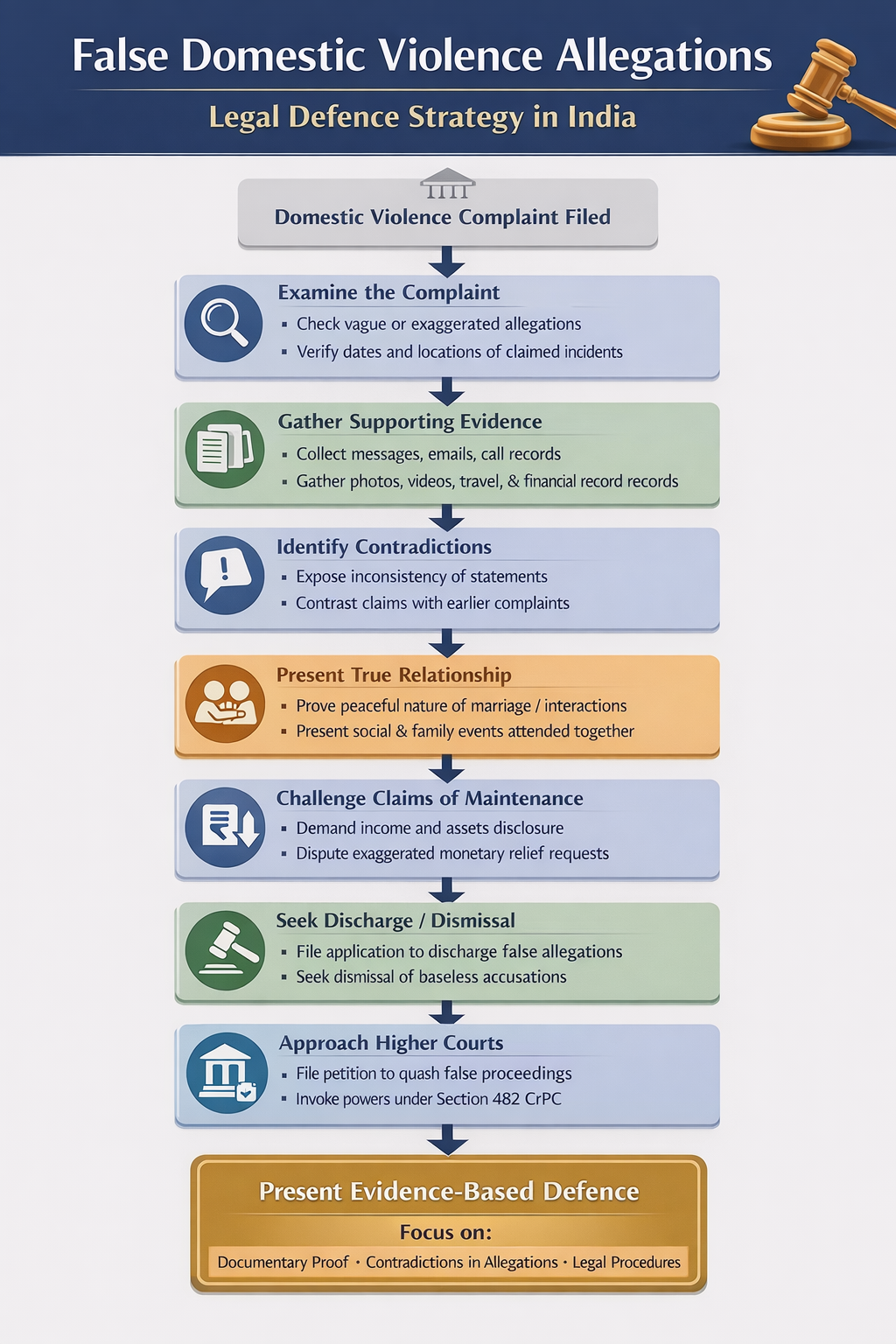
False Domestic Violence Allegations – Legal Defence Strategy in India (A complete guide)

Posted on March 9 by Suprajaa Rajan

False allegations of domestic violence can have serious legal, social, and professional consequences. While the Protection of Women from Domestic Violence Act, 2005 was enacted to protect women from genuine abuse, courts have also acknowledged that misuse of legal provisions may occur in certain cases.

Therefore, when a person faces false or exaggerated domestic violence allegations, it becomes crucial to adopt a structured legal defence strategy. A well-planned approach can help demonstrate the truth, challenge unsupported allegations, and protect the rights of the accused.

This article explains the legal framework governing domestic violence cases in India and the practical defence strategies that can be used when allegations are false or misleading.

Understanding Domestic Violence Law in India

The Protection of Women from Domestic Violence Act, 2005 provides civil remedies to women who experience abuse within a domestic relationship. The law allows courts to grant several types of relief, including:

  • Protection orders

  • Residence orders

  • Monetary relief (maintenance)

  • Compensation orders

  • Custody orders for children

Proceedings under the Act are usually conducted before a Magistrate Court and are meant to provide quick protection and relief to the aggrieved person.

However, because the law is broad in scope, allegations are sometimes exaggerated or unsupported by evidence. In such cases, the respondent must present a strong factual and legal defence.

Common Situations Where False Allegations Arise

False domestic violence allegations often emerge in the context of ongoing matrimonial disputes. For instance, such complaints may arise during:

  • Divorce proceedings

  • Maintenance disputes

  • Property conflicts between spouses

  • Child custody battles

In some situations, the complaint is filed as a litigation strategy to gain leverage in matrimonial negotiations. However, courts generally examine the credibility of allegations and the supporting evidence before granting relief.

Step 1: Carefully Examine the Domestic Violence Complaint

The first step in defending a false case is to analyse the complaint in detail.

Important aspects to examine include:

  • Specific allegations made against the respondent

  • Dates and locations of alleged incidents

  • Whether the allegations are vague or inconsistent

  • Whether other family members are unnecessarily implicated

Often, false complaints contain generalised accusations without specific details, which can be challenged before the court.

Step 2: Gather Documentary and Electronic Evidence

Evidence plays a critical role in defending domestic violence allegations. Therefore, the respondent should collect all relevant documentation that may contradict the claims.

Useful evidence may include:

  • Messages, emails, and call records

  • Photographs or videos

  • Travel records showing absence from the alleged location

  • Financial documents

  • Medical records

Such evidence can demonstrate that the alleged incidents did not occur or were misrepresented.

Step 3: Identify Contradictions in the Allegations

In many false cases, the complaint may contain inconsistent statements or factual contradictions.

For example:

  • Conflicting timelines of alleged incidents

  • Claims that contradict documentary evidence

  • Statements that differ from earlier complaints or legal pleadings

During cross-examination, highlighting these inconsistencies can significantly weaken the credibility of the allegations.

Step 4: Demonstrate the True Nature of the Relationship

Another important defence strategy is to present the actual circumstances of the marital relationship.

This may involve demonstrating:

  • Peaceful interactions between the spouses

  • Continued communication after the alleged incidents

  • Social or family events attended together

Such evidence can indicate that the relationship did not reflect the pattern of abuse alleged in the complaint.

Step 5: Challenge Monetary Relief or Maintenance Claims

Domestic violence complaints frequently include requests for monetary relief or maintenance.

However, courts consider:

  • The financial capacity of both parties

  • Existing maintenance orders in other proceedings

  • The actual needs of the claimant

Guidelines laid down in Rajnesh v. Neha require both parties to disclose income, assets, and liabilities to prevent exaggerated financial claims.

Step 6: Seek Discharge or Dismissal Where Appropriate

If the allegations are clearly baseless, the respondent may request the court to dismiss the complaint or drop certain respondents.

Courts often discharge family members who are falsely implicated without specific allegations.

Additionally, higher courts have repeatedly cautioned against the mechanical implication of multiple relatives in matrimonial disputes.

Step 7: Approach Higher Courts for Relief

In cases where the complaint is clearly malicious or legally unsustainable, the respondent may approach the High Court for relief.

Under Section 482 of the Code of Criminal Procedure – High Courts possess the authority to quash proceedings that amount to abuse of the legal process.

However, this remedy is generally used only when the allegations do not disclose any offence even if accepted at face value.

Importance of Legal Representation

Domestic violence cases often involve complex factual disputes and emotional allegations. Therefore, it is essential to obtain competent legal representation.

An experienced lawyer can:

  • Analyse the complaint strategically

  • Identify weak points in the allegations

  • Present documentary evidence effectively

  • Conduct cross-examination to expose inconsistencies

Professional legal assistance ensures that the defence is structured, credible, and legally sound.

Judicial Approach Toward Misuse of Matrimonial Laws

Indian courts have acknowledged concerns about misuse of certain matrimonial provisions. In the landmark case of Arnesh Kumar v. State of Bihar,
the Supreme Court emphasised the need to prevent unnecessary arrests in matrimonial disputes.

Such judicial observations highlight the importance of balancing the protection of genuine victims with safeguards against misuse of the law.

Conclusion

False domestic violence allegations can place an individual under significant legal and personal pressure. Nevertheless, courts rely heavily on evidence, consistency of statements, and factual credibility when evaluating such complaints.

Therefore, an effective defence strategy should focus on:

  • Careful examination of allegations

  • Strong documentary and electronic evidence

  • Identification of inconsistencies in the complaint

  • Demonstrating the true nature of the marital relationship

By presenting a clear, evidence-based defence, respondents can ensure that courts arrive at a fair and balanced decision based on facts rather than unverified allegations.


Index of Legal Strategies and Defence is here. 


Key Contributor :

Mrs. Suprajaa Rajan B.Com., LL.B., LL.M.

+91-9606345150


Posted in Legal Procedure | Tagged False allegation Legal Strategies and Defence Protection of Women from Domestic Violence Act 2005 PWDV act | Leave a comment

Search within entire Content of “Shades of Knife”

My Legal X Timeline

Advocate Sandeep Pamarati 🇮🇳💪👨🏻‍🎓 Follow

AP High Court Advocate with M Tech (CS) || 12 years in 'Software Industry' as Solution Architect || Blogs at https://t.co/29CB9BzK4w || #TDPTwitter

SandeepPamarati
Retweet on Twitter Advocate Sandeep Pamarati 🇮🇳💪👨🏻‍🎓 Retweeted
futurestacked Future Stacked @futurestacked ·
23 Jun

Your Gmail account is not an email account.

It is the master key to your bank, your crypto, your Apple ID, your PayPal, and every password you have ever saved.

One breach and all your passwords are gone.

Lock it down with these 7 easy steps 👇

Reply on Twitter 2069354786743374317 Retweet on Twitter 2069354786743374317 104 Like on Twitter 2069354786743374317 260 X 2069354786743374317
Retweet on Twitter Advocate Sandeep Pamarati 🇮🇳💪👨🏻‍🎓 Retweeted
thisguyknowsai Brady Long @thisguyknowsai ·
22 Jun

A German psychologist proved in 1885 that cramming erases what you learned within 48 hours. He published the fix in the same book. Almost no school on Earth has adopted it in 140 years.

His name was Hermann Ebbinghaus.

He had no lab. No funding. No colleagues.

He worked alone

Reply on Twitter 2068965021514891696 Retweet on Twitter 2068965021514891696 958 Like on Twitter 2068965021514891696 2820 X 2068965021514891696
Retweet on Twitter Advocate Sandeep Pamarati 🇮🇳💪👨🏻‍🎓 Retweeted
factcheckapgov FactCheck.AP.Gov.in @factcheckapgov ·
22 Jun

ఎంతో ప్రతిష్టాత్మకంగా నిర్వహించి ప్రజల ఆరోగ్యం పట్ల అవగాహన కల్పించిన అంతర్జాతీయ యోగా దినోత్సవం సందర్భంగా రాష్ట్రం లో పలుచోట్ల నిర్వహించిన యోగా కార్యక్రమం పై కొందరు తప్పుడు ప్రచారం చేస్తున్నారు. ఈ కార్యక్రమం కోసం రూ. 600 కోట్లు ఖర్చు అయినట్లు చెప్పడం పూర్తిగా అసత్యం. రాష్ట్రంలో

Reply on Twitter 2068972932827869255 Retweet on Twitter 2068972932827869255 38 Like on Twitter 2068972932827869255 85 X 2068972932827869255
Retweet on Twitter Advocate Sandeep Pamarati 🇮🇳💪👨🏻‍🎓 Retweeted
jaitdp Telugu Desam Party @jaitdp ·
22 Jun

చీఫ్ మినిస్టర్.. టీచర్ అయిన వేళ

అంగన్వాడీ కేంద్రాన్ని సందర్శించిన సీఎం చంద్రబాబు కాసేపు టీచర్‌గా మారి, పిల్లల అభ్యసనం ఎలా ఉందో తెలుసుకున్నారు. ఇంగ్లీష్ ఆల్ఫాబెట్స్ చెప్పమని సీఎం అడిగేసరికి పిల్లలు చక్కగా చెప్పారు.
#ChandrababuNaidu
#AndhraPradesh

Reply on Twitter 2068873963246399922 Retweet on Twitter 2068873963246399922 73 Like on Twitter 2068873963246399922 310 X 2068873963246399922
Load More

Recent Posts

  • Pavul Yesu Dhasan Vs Registrar SHRC of TN and Ors on 30 Apr 2025 June 18, 2026
  • Manoj Kumar Vs Nita Bharti on 17 Mar 2026 June 17, 2026
  • Cruelty as a Criminal Offence Explained June 12, 2026
  • Bail Compliance Undertaking Format – Draft, Legal Requirements & Sample Template June 12, 2026
  • Warning Signs of Escalating Matrimonial Litigation – Early Red Flags Every Spouse Should Recognize June 12, 2026

Most Read Posts

  • Reply to Section 41A CrPC Notice – Format with Legal Explanation (4,946 views)
  • Anu Aggarwal Vs Sushant Aggarwal on 20 Jan 2026 (3,487 views)
  • Umme Farva Vs State of U.P. and Anr on 14 Jan 2026 (3,373 views)
  • Charge Sheet and Final Report Explained (2,818 views)
  • Regular Bail Application Format (Section 437/439 CrPC) (2,195 views)
  • Neha Lal Vs Abhishek Kumar on 20 Jan 2026 (2,002 views)
  • Arrest Procedure in 498A cases after Arnesh Kumar (1,936 views)
  • Discharge Application Format in 498A Case – Draft, Procedure & Sample Template (1,777 views)
  • Can You Travel Abroad After an FIR Is Registered? – Legal Position Explained (1,697 views)
  • Atul Kumar Bajpai Vs State of UP and Anr on 17 Sep 2025 (1,540 views)

Tags

Reportable Judgement or Order (433)2-Judge (Division) Bench Decision (413)Legal Procedure Explained - Interpretation of Statutes (382)Landmark Case (381)1-Judge Bench Decision (362)Catena of Landmark Judgments Referred/Cited to (293)Work-In-Progress Article (215)3-Judge (Full) Bench Decision (101)Sandeep Pamarati (92)Article 21 - Protection of life and personal liberty (80)Issued or Recommended Guidelines or Directions or Protocols to be followed (71)Perjury Under 340 CrPC (66)Absurd Or After Thought Or Baseless Or False Or General Or Inherently Improbable Or Improved Or UnSpecific Or Omnibus Or Vague Allegations (61)Reprimands or Setbacks to YCP Govt of Andhra Pradesh (49)Summary Post (47)CrPC 482 - Quash (43)HM Act 13 - Divorce Granted to Husband (42)Legal Terrorism (41)Divorce granted on Cruelty ground (41)Not Authentic copy hence to be replaced (40)

Categories

Supreme Court of India Judgment or Order or Notification (753)Bare Acts or State Amendments or Statutes or GOs or Notifications issued by Central or State Governments (328)High Court of Andhra Pradesh Judgment or Order or Notification (186)High Court of Delhi Judgment or Order or Notification (164)High Court of Bombay Judgment or Order or Notification (112)High Court of Karnataka Judgment or Order or Notification (93)Legal Procedure (77)High Court of Madras Judgment or Order or Notification (70)High Court of Allahabad Judgment or Order or Notification (61)LLB Study Material (59)General Study Material (56)High Court of Punjab & Haryana Judgment or Order or Notification (52)Assorted Court Judgments or Orders or Notifications (50)High Court of Kerala Judgment or Order or Notification (46)Prakasam DV Cases (46)Judicial Activism (for Public Benefit) (45)District or Sessions or Magistrate Court Judgment or Order or Notification (44)High Court of Madhya Pradesh Judgment or Order or Notification (38)High Court of Gujarat Judgment or Order or Notification (28)High Court of Calcutta Judgment or Order or Notification (27)

Recent Comments

  • eCourts India on Compromise-Based Quashing in Matrimonial Cases – Complete Legal Strategy
  • The Divorce Law Firm on Life Cycle Stages of a Divorce case
  • The Divorce Law Firm on Life Cycle Stages of a Divorce case
  • ShadesOfKnife on Sandeep Pamarati Vs Ungrateful Knife (IPC 498A Case)
  • KONURU VINAYKUMAR on Sandeep Pamarati Vs Ungrateful Knife (IPC 498A Case)

Archives of SoK

  • June 2026 (9)
  • May 2026 (24)
  • April 2026 (33)
  • March 2026 (42)
  • February 2026 (30)
  • January 2026 (21)
  • December 2025 (2)
  • November 2025 (3)
  • October 2025 (17)
  • September 2025 (12)
  • August 2025 (5)
  • July 2025 (10)
  • June 2025 (15)
  • May 2025 (3)
  • April 2025 (10)
  • March 2025 (7)
  • February 2025 (8)
  • January 2025 (1)
  • December 2024 (3)
  • November 2024 (4)
  • October 2024 (16)
  • September 2024 (15)
  • August 2024 (14)
  • July 2024 (11)
  • June 2024 (18)
  • May 2024 (13)
  • April 2024 (9)
  • March 2024 (23)
  • February 2024 (15)
  • January 2024 (11)
  • December 2023 (11)
  • November 2023 (9)
  • October 2023 (13)
  • September 2023 (12)
  • August 2023 (15)
  • July 2023 (17)
  • June 2023 (11)
  • May 2023 (6)
  • April 2023 (5)
  • March 2023 (10)
  • February 2023 (9)
  • January 2023 (12)
  • December 2022 (12)
  • November 2022 (8)
  • October 2022 (13)
  • September 2022 (17)
  • August 2022 (10)
  • July 2022 (21)
  • June 2022 (27)
  • May 2022 (23)
  • April 2022 (32)
  • March 2022 (17)
  • February 2022 (6)
  • January 2022 (2)
  • December 2021 (7)
  • November 2021 (7)
  • October 2021 (6)
  • September 2021 (10)
  • August 2021 (31)
  • July 2021 (45)
  • June 2021 (17)
  • May 2021 (17)
  • April 2021 (18)
  • March 2021 (58)
  • February 2021 (14)
  • January 2021 (50)
  • December 2020 (35)
  • November 2020 (68)
  • October 2020 (67)
  • September 2020 (28)
  • August 2020 (41)
  • July 2020 (20)
  • June 2020 (36)
  • May 2020 (40)
  • April 2020 (38)
  • March 2020 (26)
  • February 2020 (43)
  • January 2020 (35)
  • December 2019 (34)
  • November 2019 (4)
  • October 2019 (18)
  • September 2019 (57)
  • August 2019 (33)
  • July 2019 (12)
  • June 2019 (18)
  • May 2019 (5)
  • April 2019 (19)
  • March 2019 (58)
  • February 2019 (11)
  • January 2019 (90)
  • December 2018 (97)
  • November 2018 (43)
  • October 2018 (31)
  • September 2018 (73)
  • August 2018 (47)
  • July 2018 (143)
  • June 2018 (92)
  • May 2018 (97)
  • April 2018 (59)
  • March 2018 (8)

Blogroll

  • Daaman Promoting Harmony 0
  • Fight against Legal Terrorism Fight against Legal Terrorism along with MyNation Foundation 0
  • Good Morning Good Morning News 0
  • Insaaf India Insaaf Awareness Movement 0
  • MyNation Hope Foundation Wiki 0
  • MyNation.net Equality, Justice and Harmony 0
  • Sarvepalli Legal 0
  • Save Indian Family Save Indian Family Movement 0
  • SIF Chandigarh SIF Chandigarh 0
  • The Male Factor The Male Factor 0
  • Unitedmen Foundation a dedicated community forged with the mission to unite men facing legal challenges in marital disputes. 0
  • Vaastav Foundation The Social Reality 0
  • Vinayak my2centsworth – This blog is for honest law abiding men, married or planning to get married 0
  • Voice4india Indian Laws, Non-profits, Environment 0
  • Writing Law Writing Law by Ankur 0

RSS Cloudflare Status

  • ARN (Stockholm) on 2026-06-25 June 25, 2026
    THIS IS A SCHEDULED EVENT Jun 25, 00:00 - 05:00 UTC Jun 19, 14:18 UTC Scheduled - We will be performing scheduled maintenance in ARN (Stockholm) datacenter on 2026-06-25 between 00:00 and 05:00 UTC.Traffic might be re-routed from this location, hence there is a possibility of a slight increase in latency during this maintenance window […]
  • ARN (Stockholm) on 2026-06-24 June 24, 2026
    Jun 24, 05:00 UTC Completed - The scheduled maintenance has been completed. Jun 24, 00:00 UTC In progress - Scheduled maintenance is currently in progress. We will provide updates as necessary. Jun 19, 13:08 UTC Scheduled - We will be performing scheduled maintenance in ARN (Stockholm) datacenter on 2026-06-24 between 00:00 and 05:00 UTC.Traffic might […]
  • Network Performance Issues - Increased HTTP 5XX Errors in Ashburn, US June 23, 2026
    Jun 23, 16:00 UTC Resolved - Between 17:07 and 17:45 UTC, Cloudflare experienced network performance issues in the Ashburn, US region, resulting in an elevated rate of 5xx errors for a subset of traffic. During this time, impacted users may have encountered intermittent connectivity issues or unexpected server responses. The underlying issue was successfully mitigated, […]

RSS List of Spam Server IPs from Project Honeypot

  • 34.106.192.29 | SD June 23, 2026
    Event: Bad Event | Total: 6 | First: 2026-06-23 | Last: 2026-06-23
  • 182.161.69.73 | S June 23, 2026
    Event: Bad Event | Total: 16 | First: 2011-01-28 | Last: 2026-06-23
  • 34.80.202.241 | SD June 23, 2026
    Event: Bad Event | Total: 6 | First: 2026-06-23 | Last: 2026-06-23
Owned and Operated by Advocate Sandeep Pamarati
Proudly powered by WordPress
Theme: Flint by Star Verte LLC

Bad Behavior has blocked 1448 access attempts in the last 7 days.

pixel