A structured guide explaining how matrimonial criminal cases are initiated, investigated, and prosecuted under Indian criminal law.
Matrimonial disputes often escalate into criminal litigation involving allegations of cruelty, dowry harassment, domestic violence, or financial neglect. Consequently, effective prosecution requires not only filing complaints but also building a coherent legal strategy supported by documentary and oral evidence.
This playbook outlines the procedural roadmap, legal remedies, and strategic considerations available to the prosecution side in matrimonial criminal litigation. Furthermore, it highlights how complainants can navigate investigations, bail proceedings, trial stages, and post-judgment remedies effectively.
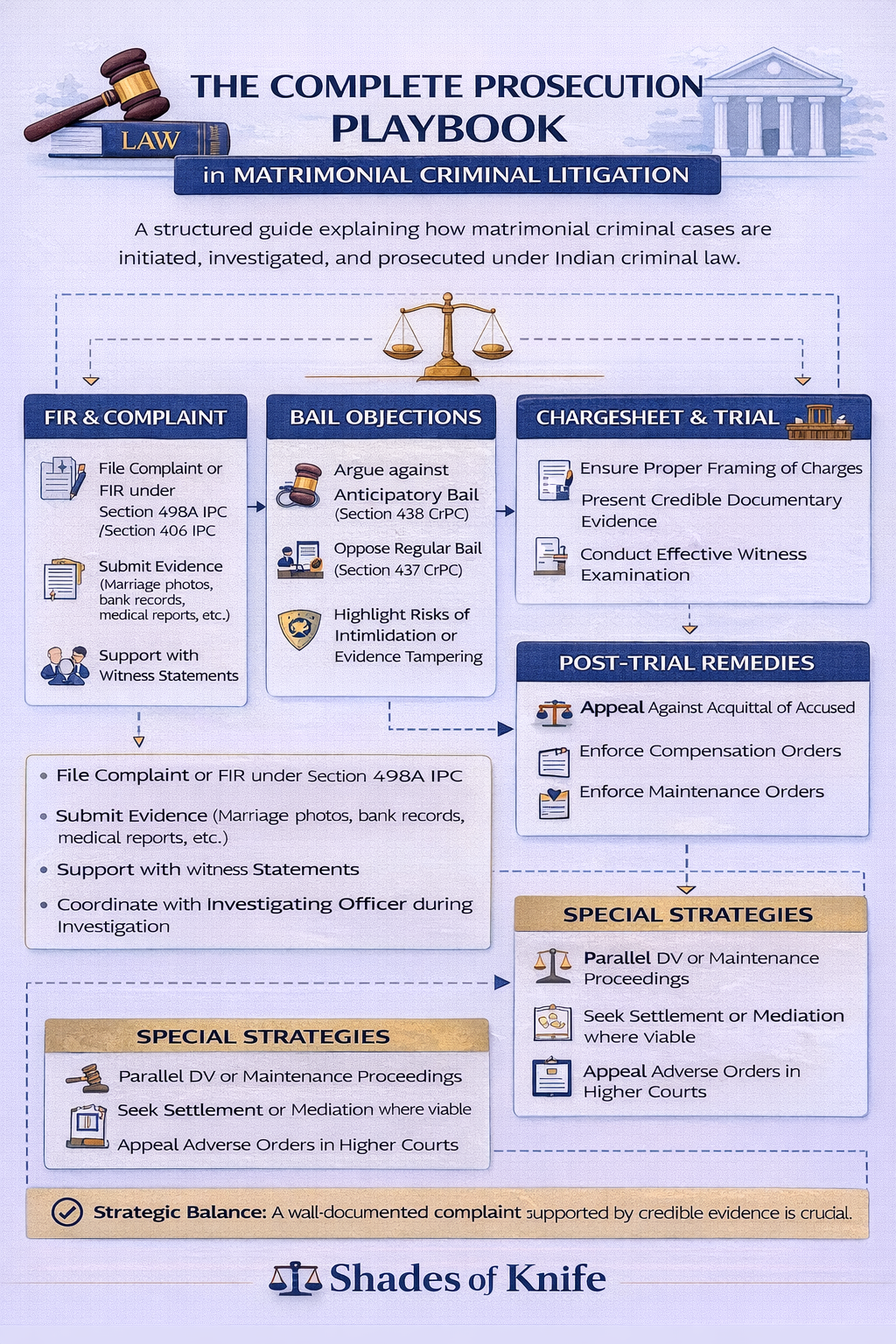
I. Initiating Criminal Proceedings
At the outset, the prosecution must ensure that allegations are clearly articulated and supported by preliminary material. Therefore, initiating proceedings correctly becomes crucial.
1. Filing a Complaint or FIR
A criminal case may be initiated through:
Registration of an FIR under Section 498A IPC
Complaint for criminal breach of trust under Section 406 IPC
Filing a Domestic Violence complaint under the Protection of Women from Domestic Violence Act, 2005
Maintenance proceedings under Section 125 CrPC
These provisions collectively aim to address cruelty, financial neglect, and unlawful retention of dowry articles.
However, the complainant must ensure that the complaint contains:
Specific incidents of cruelty
Dates and locations of harassment
Details of dowry demands
Names and roles of accused persons
Without these particulars, the prosecution case may appear vague during investigation or trial.
II. Investigation Stage: Strengthening the Prosecution Case
Once an FIR is registered, the matter enters the investigation phase. At this stage, the complainant should actively assist the investigating authorities.
1. Providing Documentary Evidence
The prosecution should gather and submit:
Marriage photographs and invitations
Bank transfers or financial transactions
Medical records of injuries
WhatsApp chats, emails, or messages
Audio or video recordings (where available)
Consequently, documentary evidence often plays a decisive role in corroborating allegations.
2. Witness Statements
Additionally, statements of the following witnesses may support the prosecution case:
Parents and relatives
Neighbours
Friends aware of the dispute
Independent witnesses present during incidents
Strong witness testimony strengthens the prosecution narrative during trial.
III. Responding to Bail Proceedings
In many matrimonial criminal cases, the accused may seek anticipatory bail or regular bail. Accordingly, the prosecution must present strong objections.
1. Opposing Anticipatory Bail
While opposing bail under Section 438 CrPC, the complainant may argue:
Seriousness of allegations
Continuous harassment or cruelty
Risk of intimidation of witnesses
Possibility of evidence tampering
Furthermore, the prosecution may highlight the need for custodial interrogation if recovery of dowry articles is required.
2. Conditions on Bail
Even when bail is granted, the prosecution can request conditions such as:
No contact with the complainant
Regular cooperation with investigation
Restrictions on leaving jurisdiction
These conditions help protect the complainant during ongoing proceedings.
IV. Parallel Civil and Criminal Remedies
Matrimonial litigation often involves multiple simultaneous proceedings. Therefore, the prosecution side may pursue parallel remedies.
1. Domestic Violence Proceedings
Under the Protection of Women from Domestic Violence Act, 2005, the complainant may seek:
Protection orders
Residence orders
Monetary relief
Compensation for mental cruelty
These remedies provide immediate relief even before completion of criminal trials.
2. Maintenance Claims
Additionally, financial support can be sought through:
Section 125 CrPC
Interim maintenance in domestic violence proceedings
Maintenance under personal laws
Maintenance proceedings ensure financial security for the complainant and dependents.
V. Chargesheet and Trial Strategy
After investigation, the police may file a chargesheet before the Magistrate. At this stage, the prosecution strategy shifts toward trial preparation.
1. Ensuring Proper Framing of Charges
The prosecution must ensure that charges are framed appropriately under relevant provisions, including:
Section 498A IPC
Section 406 IPC
Other applicable offences based on evidence
Clear framing of charges defines the scope of the trial.
2. Examination of Witnesses
During trial, the prosecution must:
Present witnesses in logical sequence
Ensure consistency in statements
Address contradictions promptly
Effective witness examination significantly influences the outcome of the case.
3. Documentary Evidence
Moreover, documentary evidence must be properly marked and proved during trial.
Failure to prove documents may weaken the prosecution case even if the allegations are otherwise serious.
VI. Settlement and Mediation
Although matrimonial criminal cases are serious in nature, courts sometimes encourage mediation or settlement, particularly when reconciliation or mutual divorce is possible.
In such circumstances, the parties may enter into:
Compromise agreements
Mutual consent divorce settlements
Withdrawal or quashing of proceedings before the High Court
However, the complainant must ensure that financial settlements and legal protections are clearly documented before agreeing to any compromise.
VII. Post-Trial Remedies
After the trial concludes, the prosecution may still have legal remedies depending on the outcome.
1. Appeal Against Acquittal
If the accused is acquitted, the complainant may seek appeal against acquittal before the appropriate appellate court.
2. Enforcement of Compensation Orders
Courts may also grant compensation under criminal law provisions. Consequently, the complainant may initiate execution proceedings to enforce such orders.
3. Enforcement of Maintenance Orders
Maintenance orders can be enforced through:
Execution proceedings
Recovery warrants
Attachment of salary or property
These remedies ensure compliance with court directions.
VIII. Strategic Considerations for the Prosecution
To ensure a strong prosecution case, the complainant should follow certain strategic principles.
First, allegations must remain consistent across FIRs, complaints, and witness statements. Secondly, documentary evidence should be preserved from the earliest stage of the dispute.
Furthermore, complainants should avoid exaggeration or inclusion of unrelated family members without evidence, as courts increasingly scrutinize such allegations.
Ultimately, a well-structured prosecution case depends on credible evidence, procedural compliance, and effective presentation before the court.
Conclusion
Matrimonial criminal litigation requires careful navigation of criminal procedure, evidentiary rules, and parallel civil remedies. Therefore, the prosecution side must adopt a structured legal strategy from the very beginning.
By documenting incidents, cooperating with investigators, and presenting consistent evidence, complainants can significantly strengthen their case.
In conclusion, the prosecution playbook in matrimonial litigation is not merely about initiating proceedings. Rather, it involves systematic preparation, strategic litigation, and effective utilisation of statutory remedies available under Indian law.
Index of Legal Strategies and Defence is here.
Key Contributor :
Mrs. Suprajaa Rajan B.Com., LL.B., LL.M.
+91-9606345150

