web analytics

Menu

Skip to content
Shades of Knife
  • Home
  • True Colors of a Vile Wife
  • Need Inspiration?
  • Blog Updates
  • SOK Gallery
  • Vile News Reporter
  • About Me
  • Contact Me

Shades of Knife

True Colors of a Vile Wife

Tag: Police Investigation

Affidavit of Cooperation with Investigation – Format, Legal Requirements & Sample Draft

Posted on June 25 by Suprajaa Rajan

A practical legal document through which a person assures the investigating authority and court of complete cooperation during criminal proceedings.

During criminal investigation, courts and investigating agencies often consider the conduct of the accused while deciding matters such as bail, anticipatory bail, interim protection, and other criminal remedies. In such situations, an Affidavit of Cooperation with Investigation can be filed to formally record the accused’s willingness to cooperate with the investigation.

This affidavit helps demonstrate good faith, respect for legal procedure, and commitment to comply with lawful directions. It is commonly used in matters involving anticipatory bail applications, notices under Section 41A CrPC, bail proceedings, and representations before investigating authorities.

This article explains the legal framework, purpose, drafting strategy, and provides a ready-to-use sample format with copy-to-clipboard functionality.

I. Legal Framework

The obligation to cooperate with investigation arises from the criminal procedure framework.

Under the Code of Criminal Procedure, 1973

  • Section 41 CrPC – Arrest without warrant
  • Section 41A CrPC – Notice of appearance before police officer
  • Section 160 CrPC – Attendance of witnesses before police officer
  • Section 161 CrPC – Examination of witnesses
  • Section 438 CrPC – Direction for grant of anticipatory bail

Corresponding Provisions under BNSS, 2023

  • Section 35 BNSS – Arrest without warrant
  • Section 35(3) BNSS – Notice of appearance before police officer
  • Section 179 BNSS – Attendance of persons acquainted with facts
  • Section 180 BNSS – Examination of witnesses
  • Section 482 BNSS – Direction for grant of anticipatory bail

Therefore, cooperation with investigation is an important factor considered by courts while balancing personal liberty and investigative requirements.

II. What is an Affidavit of Cooperation with Investigation?

An Affidavit of Cooperation is a sworn declaration submitted by the accused or concerned person stating that they will:

  • Appear before the Investigating Officer when required
  • Participate in investigation proceedings
  • Provide necessary information and documents
  • Not obstruct the investigation
  • Not influence witnesses or tamper with evidence

The affidavit does not amount to an admission of guilt. Instead, it records the person’s willingness to follow the legal process.

III. When is this Affidavit Used?

This affidavit is commonly filed in:

  • Anticipatory bail proceedings
  • Reply to police notices
  • Bail applications
  • Matrimonial criminal disputes
  • Economic offence matters
  • Applications seeking protection from arrest
  • Cases where the accused is willing to cooperate but apprehends coercive action

Therefore, it becomes an important document to show responsible conduct before authorities.

IV. Why is This Affidavit Important?

An affidavit of cooperation helps to:

  • Show bona fide intention
  • Support a request for protection from arrest
  • Reduce concerns of absconding
  • Demonstrate respect for investigation
  • Strengthen bail-related submissions

Additionally, courts often consider cooperation as a relevant factor while deciding whether custodial interrogation is necessary.

V. Important Undertakings Usually Included

A cooperation affidavit generally contains undertakings such as:

  • The deponent will appear whenever called lawfully
  • The deponent will not evade investigation
  • The deponent will not destroy or manipulate evidence
  • The deponent will not contact witnesses improperly
  • The deponent will inform authorities about change of address

However, the undertaking should always remain consistent with the facts of the case.

VI. Essential Elements of the Affidavit

Before drafting, include:

  • Name and details of deponent
  • FIR details (if available)
  • Police station details
  • Statement of willingness to cooperate
  • Specific undertakings
  • Verification clause

These elements make the affidavit clear, complete, and legally useful.

VII. Drafting Strategy

While drafting:

  • Avoid unnecessary factual admissions
  • Use respectful and neutral language
  • Clearly state willingness to cooperate
  • Do not make promises beyond legal requirements
  • Keep the affidavit consistent with bail pleadings

A carefully drafted affidavit protects rights while demonstrating procedural compliance.

VIII. Sample Draft Format – Affidavit of Cooperation with Investigation

Sample Draft – Affidavit of Cooperation with Investigation

AFFIDAVIT OF COOPERATION WITH INVESTIGATION

I, [Name of Deponent], aged about [___] years, residing at [Full Address], do hereby solemnly affirm and state as under:

1. That I am aware of the investigation being conducted in connection with FIR No. [____] registered at [Police Station].

2. That I am a law-abiding citizen and have full respect for the legal process and investigating authorities.

3. That I undertake to fully cooperate with the investigation and shall appear before the Investigating Officer whenever required in accordance with law.

4. That I shall provide necessary information, documents, or clarification required for the purpose of investigation.

5. That I shall not obstruct the investigation in any manner and shall not tamper with any evidence connected with the matter.

6. That I shall not influence, threaten, or attempt to contact any witness in relation to the proceedings.

7. That I shall comply with all lawful directions issued by the Investigating Officer or the Hon’ble Court.

8. That this affidavit is being executed voluntarily and without any pressure or coercion.


DEPONENT


VERIFICATION

I, the above-named deponent, verify that the contents of this affidavit are true and correct to my knowledge and belief and nothing material has been concealed.


Verified at: [Place]
Date: [____]


DEPONENT

✔ Draft Copied Successfully!

setTimeout(function() { message.style.display = "none"; }, 2000); }); }

IX. Common Mistakes to Avoid

Avoid:

  • Making unnecessary admissions
  • Giving incorrect facts
  • Promising unconditional compliance beyond law
  • Ignoring the actual bail order conditions
  • Using aggressive language against authorities

Instead, maintain a balance between cooperation and protection of legal rights.

Conclusion

An Affidavit of Cooperation with Investigation is an effective procedural document that reflects willingness to participate in the investigation while safeguarding personal liberty. Therefore, a properly drafted affidavit can strengthen bail proceedings and demonstrate a genuine commitment to follow the legal process.


Index of All Legal templates and Drafting is here. 


Disclaimer

These templates are provided for educational and informational purposes. Every case depends on specific facts and procedural posture. Professional legal advice should be obtained before filing any application.

Posted in Legal Procedure | Tagged CrPC 160 - Police officer’s Power to require Attendance of Witnesses CrPC 161 - Examination of Witnesses By Police CrPC 41 - When police may arrest without warrant CrPC 41A - Notice of appearance before police officer CrPC Sec 438 - Anticipatory Bail Legal templates and drafting Police Investigation Right to Fair Investigation What is Investigation | Leave a comment

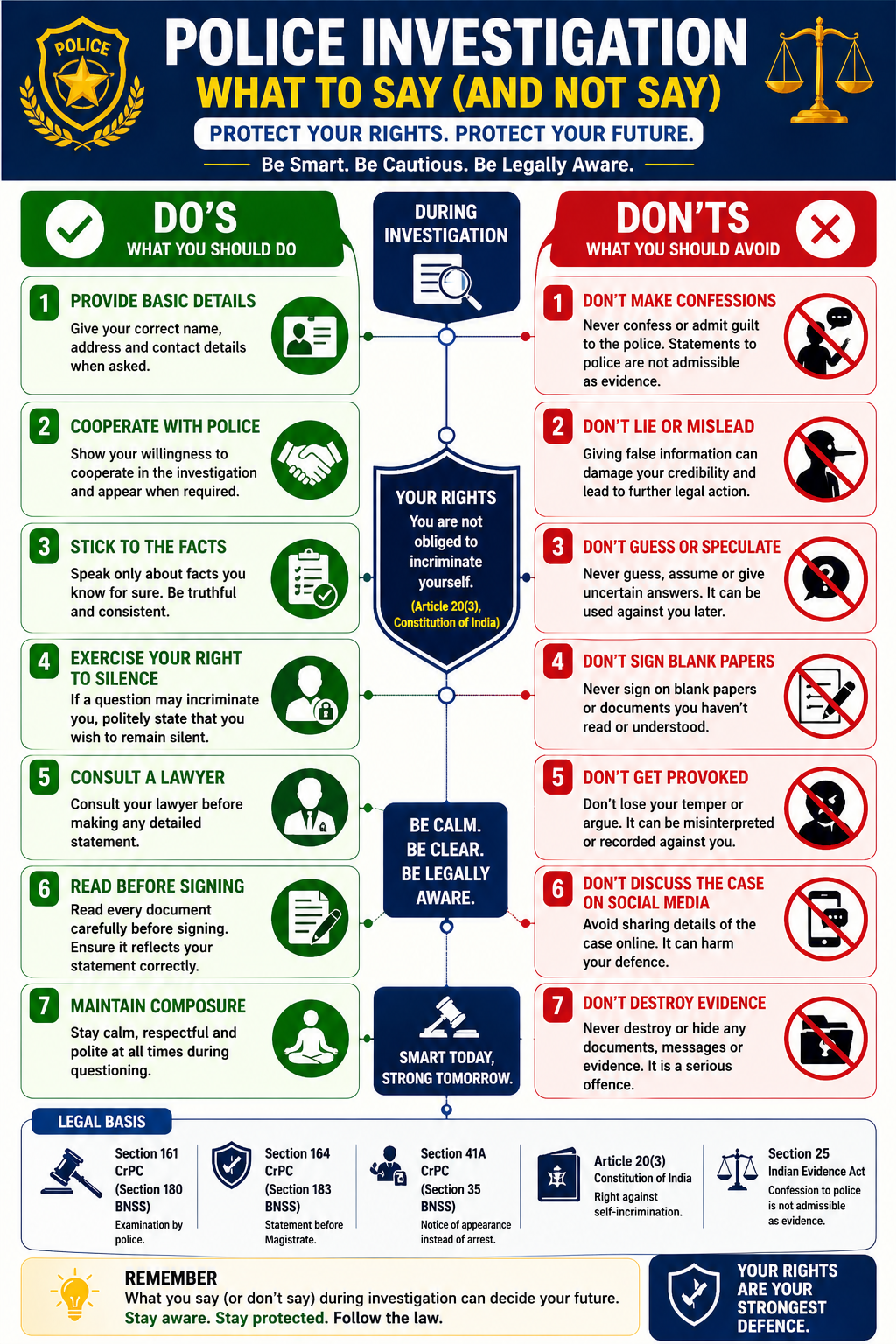
What to Say (and Not Say) During Investigation – A Practical Legal Guide

Posted on April 29 by Suprajaa Rajan

An investigation is a critical stage in criminal proceedings, where statements made by an individual can significantly impact the outcome of the case. Many accused persons unknowingly make statements that later weaken their defence or strengthen the prosecution’s case.

Therefore, understanding what to say—and what to avoid saying—during investigation is essential for protecting your legal rights.

This article explains the correct legal approach during police investigation, along with safeguards under the Code of Criminal Procedure, 1973 (CrPC) and the Bharatiya Nagarik Suraksha Sanhita, 2023 (BNSS).

Understanding Your Legal Position During Investigation

During investigation, the police have the authority to:

  • Call individuals for questioning
  • Record statements
  • Collect evidence

Relevant provisions:

  • Section 160 CrPC (Section 179 BNSS) – Attendance of witnesses
  • Section 161 CrPC (Section 180 BNSS) – Examination by police

However, this power is not unlimited. Individuals have specific rights that protect them from self-incrimination and coercion.

Right Against Self-Incrimination

Under Article 20(3) of the Constitution of India, no person can be compelled to:

  • Be a witness against themselves

This means:

  • You are not required to confess
  • You cannot be forced to make incriminating statements

This principle forms the foundation of your conduct during investigation.

What You Should Say During Investigation

1. Provide Basic Identification Details

You should always provide:

  • Name
  • Address
  • Contact details

This ensures compliance with legal requirements.

2. Confirm Willingness to Cooperate

You should clearly state:

  • Your willingness to cooperate with the investigation
  • Your readiness to appear when required

This helps avoid adverse inference and unnecessary coercive action.

3. Stick to Verified Facts Only

If you choose to answer questions:

  • Speak only about facts you are certain of
  • Avoid assumptions or speculation

Consistency is key to maintaining credibility.

4. Exercise Your Right to Silence Where Necessary

If a question may incriminate you, you can:

  • Politely decline to answer
  • State that you wish to consult your lawyer

This is a legally protected right.

5. Request Legal Assistance

While police questioning may proceed, you can:

  • Consult a lawyer before making detailed statements

This ensures that your rights are protected at every stage.

What You Should NOT Say During Investigation

1. Do Not Make Confessions to Police

Statements made to police are generally not admissible as evidence.

Relevant provision:

  • Section 25 of the Indian Evidence Act

However, such statements may still:

  • Influence investigation
  • Lead to recovery of evidence

Therefore, avoid making confessional statements.

2. Do Not Provide False Information

Giving false statements can:

  • Damage your credibility
  • Lead to additional legal consequences

Always avoid misleading the investigating officer.

3. Do Not Guess or Speculate

Never:

  • Assume facts
  • Provide uncertain answers

Speculative answers may later be used against you.

4. Do Not Sign Blank or Unread Documents

Before signing any document:

  • Read it carefully
  • Ensure it reflects your actual statement

Signing incorrect documents can seriously harm your case.

5. Do Not Get Provoked or Intimidated

Maintain composure even if:

  • Questioning becomes aggressive
  • Pressure is applied

Any emotional reaction can be misinterpreted.

Importance of Statements Under Section 161 CrPC

Statements recorded under:

  • Section 161 CrPC (Section 180 BNSS)

are:

  • Not signed by the person
  • Used for contradiction during trial

Therefore, even informal statements can later affect your defence.

Special Note on Section 164 Statements

If the Magistrate records your statement under:

  • Section 164 CrPC (Section 183 BNSS)

it carries higher evidentiary value.

Such statements:

  • Are recorded voluntarily
  • Can be used as substantive evidence

Hence, extreme caution is required before making such statements.

Role of Notice Under Section 41A

Instead of arrest, police may issue notice under:

  • Section 41A CrPC (Section 35 BNSS)

You must:

  • Comply with the notice
  • Appear before the officer

Cooperation reduces the risk of arrest.

Step-by-Step Practical Strategy

Step 1: Stay Calm and Composed

Do not panic or react impulsively.

Step 2: Understand the Nature of Allegations

Ask for:

  • Basic information about the case
  • Reason for questioning

Step 3: Avoid Incriminating Statements

Use your right to silence where necessary.

Step 4: Consult a Lawyer

Seek legal advice before making detailed statements.

Step 5: Maintain Consistency

Ensure that all statements remain:

  • Accurate
  • Consistent

Judicial Approach

Courts recognise that:

  • Statements made during investigation can be misused
  • Accused persons must be protected from coercion

Courts emphasise:

  • Voluntariness of statements
  • Protection against self-incrimination
  • Fair investigation process

Practical Insight

Many cases are weakened not because of evidence, but due to:

  • Incorrect statements
  • Inconsistent versions
  • Unnecessary admissions

Therefore, careful communication during investigation is a key defence strategy.

Conclusion

What you say during investigation can significantly influence your case. While cooperation is important, protecting your legal rights is equally essential.

By:

  • Speaking cautiously
  • Avoiding unnecessary disclosures
  • Exercising your right to silence

you can ensure that your defence remains strong throughout the proceedings.

A balanced approach—cooperative yet legally aware—is the best strategy during any investigation.


Related Legal Concepts

  • Police Investigation
  • Reply to Notice under Section 41A
  • Rights during police investigation
  • First Information Report(FIR)
  • Arrest and Custodial procedures


Index of Legal Strategies and Defence is here. 


Key Contributor : 

Mrs. Suprajaa Rajan B.Com., LL.B., LL.M.

+91-9606345150

Posted in Legal Procedure | Tagged Legal Rights Legal Strategies and Defence Police Investigation Section 160 CrPC Section 41A Notice | Leave a comment

Police Investigation in Criminal Law

Posted on March 18 by Suprajaa Rajan

Police investigation is a fundamental stage in the criminal justice process, commencing after the registration of a First Information Report. It involves the systematic collection of facts, evidence, and material necessary to determine whether a criminal offence has been committed and to identify the person responsible.

The process of investigation is governed by the provisions of the Code of Criminal Procedure, 1973, particularly Sections 156 to 173. These provisions empower the police to investigate cognizable offences and lay down the procedure to be followed during such investigation.

Investigation serves as the foundation of a criminal case, as the material collected during this stage forms the basis for further judicial proceedings.

Meaning and Scope of Investigation

The term “investigation” refers to all proceedings undertaken by the police for the purpose of collecting evidence relating to an offence.

It includes:

  • Collection of information and evidence

  • Examination of witnesses

  • Inspection of the scene of occurrence

  • Arrest of the accused, where necessary

  • Formation of an opinion as to whether there is sufficient evidence to proceed

Investigation is not limited to proving guilt. Instead, it is aimed at discovering the truth of the allegations, whether they support or negate the commission of an offence.

Statutory Framework Governing Investigation

The legal basis of police investigation is contained in the
Code of Criminal Procedure, 1973.

Important provisions include:

  • Section 156 CrPC – Power of police to investigate cognizable offences

  • Section 157 CrPC – Procedure for investigation

  • Section 161 CrPC – Examination of witnesses by police

  • Section 165 CrPC – Search by police officer

  • Section 173 CrPC – Submission of final report

These provisions collectively regulate how investigation must be conducted and ensure that it follows procedural safeguards recognised by law.

Commencement of Investigation

Investigation generally begins after the registration of a First Information Report under Section 154 of the Code of Criminal Procedure, 1973.

Once an FIR discloses the commission of a cognizable offence, the police are empowered to initiate investigation without prior approval from a Magistrate.

However, in certain cases, the police may conduct a preliminary inquiry before registering an FIR. The scope of such inquiry has been clarified by the Supreme Court in Lalita Kumari v. Government of Uttar Pradesh.

Powers of Police During Investigation

During the course of investigation, the police possess various statutory powers that enable them to collect evidence effectively.

These powers include:

Examination of Witnesses

The police may record statements of witnesses acquainted with the facts of the case. These statements assist in reconstructing the sequence of events.

Search and Seizure

The police may conduct searches and seize material objects relevant to the investigation in accordance with legal procedure.

Arrest of Accused

In appropriate cases, the police may arrest the accused if it is necessary for investigation or to prevent further offences.

Collection of Evidence

This includes gathering documentary evidence, forensic material, and other relevant records.

These powers must be exercised in accordance with legal safeguards and constitutional protections.

Recording of Statements

Statements of witnesses are recorded under Section 161 CrPC. These statements are not taken on oath and are primarily used during investigation.

In certain cases, statements may also be recorded before a Magistrate under Section 164 CrPC, which carry greater evidentiary value.

The accuracy and consistency of witness statements play a significant role in the evaluation of evidence during trial.

Role of Evidence in Investigation

The objective of investigation is to collect evidence that may later be presented before the court.

Evidence collected during investigation may include:

  • Oral statements of witnesses

  • Documentary records

  • Electronic evidence

  • Forensic and scientific material

The quality of investigation directly impacts the strength of the prosecution’s case during trial.

Completion of Investigation

Upon completion of investigation, the police are required to submit a report before the Magistrate under
Section 173 of the Code of Criminal Procedure, 1973.

This report may take one of the following forms:

  • Charge Sheet – Filed when sufficient evidence exists against the accused

  • Closure Report – Filed when no sufficient evidence is found

The submission of this report marks the end of the investigation stage and the beginning of judicial proceedings.

Judicial Oversight of Investigation

Although investigation is primarily conducted by the police, courts exercise limited supervisory control to ensure fairness and legality.

Courts may:

  • Monitor investigation in exceptional cases

  • Direct further investigation

  • Examine the validity of the final report

This ensures that investigation is conducted in a manner that is fair, impartial, and consistent with legal principles.

Importance of Fair Investigation

A fair investigation is essential to uphold the integrity of the criminal justice system. Courts have repeatedly emphasised that investigation must be:

  • Impartial

  • Objective

  • Free from bias or external influence

The purpose of investigation is not to secure a conviction at any cost, but to ensure that justice is served based on truth and evidence.

Role of Investigation in Criminal Justice Process

Investigation forms the foundation of a criminal case. The material collected during this stage determines whether the case proceeds to trial and influences the outcome of judicial proceedings.

A properly conducted investigation ensures that:

  • Genuine cases are prosecuted effectively

  • Innocent persons are not subjected to unnecessary trial

  • Courts receive reliable and relevant evidence

Thus, investigation plays a critical role in maintaining the balance between individual rights and societal interest in the administration of justice.

Related Legal Concepts

Readers seeking to understand the broader framework of criminal procedure may also refer to:

  • First Information Report (FIR)
  • Charge Sheet and Final Report
  • Discharge of Accused
  • Framing of Charges
  • Criminal Trial Procedure


Index of Law Concepts explained here.


Key Contributor :

Mrs. Suprajaa Rajan B.Com., LL.B., LL.M.

+91-9606345150


Posted in LLB Study Material | Tagged Code of Criminal Procedure Law Concepts explained Police Investigation | Leave a comment

Search within entire Content of “Shades of Knife”

My Legal X Timeline

Advocate Sandeep Pamarati 🇮🇳💪👨🏻‍🎓 Follow

AP High Court Advocate with M Tech (CS) || 12 years in 'Software Industry' as Solution Architect || Blogs at https://t.co/29CB9BzK4w || #TDPTwitter

SandeepPamarati
Retweet on Twitter Advocate Sandeep Pamarati 🇮🇳💪👨🏻‍🎓 Retweeted
rose_k01 Rosy @rose_k01 ·
10 Jul

Women in the Yao village of China are famous for having the Longest hair in the World averaging 6 feet long. Women in their 80s still don't have a Single grey hair!! Their secret is Fermented Rice water. Watch How they make & use it 🍚🌾💧

Reply on Twitter 2075635918879523325 Retweet on Twitter 2075635918879523325 898 Like on Twitter 2075635918879523325 3901 X 2075635918879523325
Retweet on Twitter Advocate Sandeep Pamarati 🇮🇳💪👨🏻‍🎓 Retweeted
ani ANI @ani ·
12 Jul

Promo | ANI Podcast with R.V.S. Mani, Former Under Secretary, Ministry of Home Affairs, Premieres Today at 5 PM IST

"Narendra Modi and Amit Shah Were the Targets in the Ishrat Jahan Case."

"None of the Files Had the Term 'Hindu Terror' Until 2010."

"Digvijaya Singh Asked Me to

Reply on Twitter 2076177037165994029 Retweet on Twitter 2076177037165994029 614 Like on Twitter 2076177037165994029 1586 X 2076177037165994029
Retweet on Twitter Advocate Sandeep Pamarati 🇮🇳💪👨🏻‍🎓 Retweeted
kolla_ch1 చైతన్య కొల్లా @kolla_ch1 ·
11 Jul

రాష్ట్రం మీద పడి.. అడ్డ గాడిదల్లా... అడ్డ దిడ్డంగా పడి దోచుకున్న అడ్డమైన ఎదవలకు ఊడిగం చేస్తూ

డెలివరీ బాయ్ లను అవమానపర్చే

ఆ నెల తక్కువ సన్నాసి మొహాన కొట్టండయ్యా దీన్ని 🤷‍♂️

Reply on Twitter 2076018293836808437 Retweet on Twitter 2076018293836808437 111 Like on Twitter 2076018293836808437 642 X 2076018293836808437
Retweet on Twitter Advocate Sandeep Pamarati 🇮🇳💪👨🏻‍🎓 Retweeted
shunyta_007 𝐒ɦυ𐓣𝗒𝗍α @shunyta_007 ·
12 Jul

Observation Skills 🔥

Reply on Twitter 2076189650885226496 Retweet on Twitter 2076189650885226496 537 Like on Twitter 2076189650885226496 3146 X 2076189650885226496
Load More

Recent Posts

  • Prahlad Singh Bhati Vs N.C.T. Delhi and Anr on 23 Mar 2001 July 12, 2026
  • Application for Day-to-Day Trial – Format, Procedure & Sample Draft July 8, 2026
  • Pooja Ramesh Singh Vs JnK Bank and Anr on 02 Jul 2026 July 8, 2026
  • A.S.S.K.Durga Prasad Vs NCDRC and Ors on 24 Jun 2026 July 7, 2026
  • Application for Permanent Exemption from Appearance – Format, Procedure & Sample Draft July 7, 2026

Most Read Posts

  • Reply to Section 41A CrPC Notice – Format with Legal Explanation (5,046 views)
  • Anu Aggarwal Vs Sushant Aggarwal on 20 Jan 2026 (3,601 views)
  • Umme Farva Vs State of U.P. and Anr on 14 Jan 2026 (3,529 views)
  • Charge Sheet and Final Report Explained (2,999 views)
  • Regular Bail Application Format (Section 437/439 CrPC) (2,370 views)
  • Neha Lal Vs Abhishek Kumar on 20 Jan 2026 (2,151 views)
  • Arrest Procedure in 498A cases after Arnesh Kumar (2,055 views)
  • Discharge Application Format in 498A Case – Draft, Procedure & Sample Template (1,919 views)
  • Can You Travel Abroad After an FIR Is Registered? – Legal Position Explained (1,864 views)
  • Life Cycle of a Perjury Case (1,784 views)

Tags

Reportable Judgement or Order (436)2-Judge (Division) Bench Decision (422)Legal Procedure Explained - Interpretation of Statutes (386)Landmark Case (383)1-Judge Bench Decision (366)Catena of Landmark Judgments Referred/Cited to (297)Work-In-Progress Article (215)3-Judge (Full) Bench Decision (101)Sandeep Pamarati (91)Article 21 - Protection of life and personal liberty (80)Issued or Recommended Guidelines or Directions or Protocols to be followed (71)Perjury Under 340 CrPC (66)Absurd Or After Thought Or Baseless Or False Or General Or Inherently Improbable Or Improved Or UnSpecific Or Omnibus Or Vague Allegations (62)Reprimands or Setbacks to YCP Govt of Andhra Pradesh (49)Summary Post (47)CrPC 482 - Quash (44)HM Act Sec 13 - Divorce Granted to Husband (42)Divorce Granted on Cruelty ground (42)Legal Terrorism (41)Abuse Or Misuse of Process of Court (40)

Categories

Supreme Court of India Judgment or Order or Notification (758)Bare Acts or State Amendments or Statutes or GOs or Notifications issued by Central or State Governments (329)High Court of Andhra Pradesh Judgment or Order or Notification (187)High Court of Delhi Judgment or Order or Notification (164)High Court of Bombay Judgment or Order or Notification (112)High Court of Karnataka Judgment or Order or Notification (95)Legal Procedure (83)High Court of Madras Judgment or Order or Notification (71)High Court of Allahabad Judgment or Order or Notification (62)LLB Study Material (59)General Study Material (56)High Court of Punjab & Haryana Judgment or Order or Notification (53)Assorted Court Judgments or Orders or Notifications (51)High Court of Kerala Judgment or Order or Notification (47)Judicial Activism (for Public Benefit) (47)Prakasam DV Cases (46)District or Sessions or Magistrate Court Judgment or Order or Notification (44)High Court of Madhya Pradesh Judgment or Order or Notification (38)High Court of Gujarat Judgment or Order or Notification (28)High Court of Telangana Judgment or Order or Notification (28)

Recent Comments

  • eCourts India on Compromise-Based Quashing in Matrimonial Cases – Complete Legal Strategy
  • The Divorce Law Firm on Life Cycle Stages of a Divorce case
  • The Divorce Law Firm on Life Cycle Stages of a Divorce case
  • ShadesOfKnife on Sandeep Pamarati Vs Ungrateful Knife (IPC 498A Case)
  • KONURU VINAYKUMAR on Sandeep Pamarati Vs Ungrateful Knife (IPC 498A Case)

Archives of SoK

  • July 2026 (13)
  • June 2026 (19)
  • May 2026 (24)
  • April 2026 (33)
  • March 2026 (42)
  • February 2026 (30)
  • January 2026 (21)
  • December 2025 (2)
  • November 2025 (3)
  • October 2025 (17)
  • September 2025 (12)
  • August 2025 (5)
  • July 2025 (10)
  • June 2025 (15)
  • May 2025 (3)
  • April 2025 (10)
  • March 2025 (7)
  • February 2025 (8)
  • January 2025 (1)
  • December 2024 (3)
  • November 2024 (4)
  • October 2024 (16)
  • September 2024 (15)
  • August 2024 (14)
  • July 2024 (11)
  • June 2024 (18)
  • May 2024 (13)
  • April 2024 (9)
  • March 2024 (23)
  • February 2024 (15)
  • January 2024 (11)
  • December 2023 (11)
  • November 2023 (9)
  • October 2023 (13)
  • September 2023 (12)
  • August 2023 (15)
  • July 2023 (17)
  • June 2023 (11)
  • May 2023 (6)
  • April 2023 (5)
  • March 2023 (10)
  • February 2023 (9)
  • January 2023 (12)
  • December 2022 (12)
  • November 2022 (8)
  • October 2022 (13)
  • September 2022 (17)
  • August 2022 (10)
  • July 2022 (21)
  • June 2022 (27)
  • May 2022 (23)
  • April 2022 (32)
  • March 2022 (17)
  • February 2022 (6)
  • January 2022 (2)
  • December 2021 (7)
  • November 2021 (7)
  • October 2021 (6)
  • September 2021 (10)
  • August 2021 (31)
  • July 2021 (45)
  • June 2021 (17)
  • May 2021 (17)
  • April 2021 (18)
  • March 2021 (58)
  • February 2021 (14)
  • January 2021 (50)
  • December 2020 (35)
  • November 2020 (68)
  • October 2020 (67)
  • September 2020 (28)
  • August 2020 (41)
  • July 2020 (20)
  • June 2020 (36)
  • May 2020 (40)
  • April 2020 (38)
  • March 2020 (26)
  • February 2020 (43)
  • January 2020 (35)
  • December 2019 (34)
  • November 2019 (4)
  • October 2019 (18)
  • September 2019 (57)
  • August 2019 (33)
  • July 2019 (12)
  • June 2019 (18)
  • May 2019 (5)
  • April 2019 (19)
  • March 2019 (58)
  • February 2019 (11)
  • January 2019 (90)
  • December 2018 (97)
  • November 2018 (43)
  • October 2018 (31)
  • September 2018 (73)
  • August 2018 (47)
  • July 2018 (143)
  • June 2018 (92)
  • May 2018 (97)
  • April 2018 (59)
  • March 2018 (8)

Blogroll

  • Daaman Promoting Harmony 0
  • Fight against Legal Terrorism Fight against Legal Terrorism along with MyNation Foundation 0
  • Good Morning Good Morning News 0
  • Insaaf India Insaaf Awareness Movement 0
  • MyNation Hope Foundation Wiki 0
  • MyNation.net Equality, Justice and Harmony 0
  • Sarvepalli Legal 0
  • Save Indian Family Save Indian Family Movement 0
  • SIF Chandigarh SIF Chandigarh 0
  • The Male Factor The Male Factor 0
  • Unitedmen Foundation a dedicated community forged with the mission to unite men facing legal challenges in marital disputes. 0
  • Vaastav Foundation The Social Reality 0
  • Vinayak my2centsworth – This blog is for honest law abiding men, married or planning to get married 0
  • Voice4india Indian Laws, Non-profits, Environment 0
  • Writing Law Writing Law by Ankur 0

RSS Cloudflare Status

  • Cloudflare Storage Maintenance July 16, 2026
    THIS IS A SCHEDULED EVENT Jul 16, 12:00 - 13:00 UTC Jul 6, 22:38 UTC Scheduled - Cloudflare has scheduled maintenance for our backend storage systems. Services will continue to operate normally, but customers will be unable to create/delete/modify Client-Side Security settings via the Dashboard or the public API for a period of up to […]
    Cloudflare

RSS List of Spam Server IPs from Project Honeypot

  • 188.95.67.196 | S July 13, 2026
    Event: Bad Event | Total: 106 | First: 2025-03-27 | Last: 2026-07-13
Owned and Operated by Advocate Sandeep Pamarati and Advocate Suprajaa Rajan
Proudly powered by WordPress
Theme: Flint by Star Verte LLC

Bad Behavior has blocked 1092 access attempts in the last 7 days.

pixel