web analytics

Menu

Skip to content
Shades of Knife
  • Home
  • True Colors of a Vile Wife
  • Need Inspiration?
  • Blog Updates
  • SOK Gallery
  • Vile News Reporter
  • About Me
  • Contact Me

Shades of Knife

True Colors of a Vile Wife

Tag: Matrimonial Litigation India

Cross-Examination Strategy in 498A Trials – Defence Tactics That Can Change the Outcome

Posted on May 4 by Suprajaa Rajan

In criminal trials arising out of matrimonial disputes, cross-examination often determines the final outcome more than the FIR itself. While allegations under Section 498A of the IPC may appear serious at the initial stage, many prosecutions weaken when witnesses face a structured and legally sound cross-examination.

A well-planned cross-examination can:

  • Expose exaggerations and contradictions
  • Reveal omissions in prior statements
  • Test credibility of prosecution witnesses
  • Challenge documentary evidence
  • Build a foundation for acquittal

Therefore, understanding the cross-examination strategy in 498A trials becomes critical for every accused person, defence lawyer, and family member involved in matrimonial criminal litigation.

This article explains the legal framework, strategic approach, practical techniques, and common mistakes to avoid, with references to both the Code of Criminal Procedure, 1973 (CrPC) and the Bharatiya Nagarik Suraksha Sanhita, 2023 (BNSS).

Understanding Cross-Examination in Criminal Trials

Cross-examination is the process where the defence questions prosecution witnesses after examination-in-chief.

In criminal trials, evidence is recorded before the trial court under:

  • Section 273 CrPC (BNSS Section 308) – Evidence to be taken in presence of accused
  • Section 231 CrPC (BNSS Section 254) – Evidence for prosecution in Sessions trial
  • Section 242 CrPC (BNSS Section 265) – Evidence in warrant cases instituted otherwise than on police report
  • Section 246 CrPC (BNSS Section 269) – Evidence in warrant cases on police report

Cross-examination forms a core part of the constitutional guarantee of a fair trial.

Why Cross-Examination Is Crucial in 498A Cases

In many matrimonial prosecutions, allegations involve:

  • Mental cruelty
  • Physical harassment
  • Dowry demands
  • Emotional abuse
  • Family-wide allegations against relatives

However, many complaints also contain:

  • General allegations
  • Omnibus accusations
  • Emotional exaggerations
  • Lack of dates, places, and specific incidents

A strategic cross-examination can expose these weaknesses.

Step 1: Study the Entire Prosecution Record

Before asking even one question, the defence must thoroughly analyse:

FIR

Compare:

  • Dates of incidents
  • Sequence of allegations
  • Names of accused persons
  • Specific acts attributed to each accused

Relevant provision:

  • Section 154 CrPC (BNSS Section 173) – Registration of FIR

Statements During Investigation

Compare witness statements recorded under:

  • Section 161 CrPC (BNSS Section 180) – Police statements

Look for:

  • Improvements
  • Omissions
  • Contradictions

Documents Filed with Chargesheet

Review:

  • Medical records
  • Chat records
  • Emails
  • Financial documents
  • Photographs
  • Call records

Chargesheet filed under:

  • Section 173 CrPC (BNSS Section 193)

Step 2: Identify the Defence Theory First

Cross-examination should never be random.

First establish:

What is your defence?

Examples:

  • False implication after matrimonial dispute
  • Property dispute disguised as criminal complaint
  • Pressure for settlement
  • Retaliation after divorce proceedings
  • Inclusion of distant relatives without role

Every question must support this theory.

Step 3: Challenge Specificity of Allegations

One of the strongest strategies in 498A trials is to expose vague allegations.

Ask questions such as:

  • On what exact date did this happen?
  • At what location?
  • Who was present?
  • What exact words were spoken?
  • Was any complaint made immediately?

If the witness cannot answer clearly, credibility weakens.

Step 4: Expose Omnibus Allegations Against Family Members

In many 498A cases, multiple relatives are implicated.

Cross-examination should establish:

  • Whether the accused lived separately
  • Whether the accused was even present
  • Whether there was direct interaction

Ask:

  • Did the accused live in the matrimonial home?
  • Can you produce any communication with this accused?
  • How many times did you personally meet them?

This becomes especially important for:

  • Elderly parents
  • Married sisters
  • Relatives living in other cities

Step 5: Use Prior Contradictions Effectively

Contradictions are powerful tools.

If the witness changes the story from earlier statements recorded under:

  • Section 161 CrPC (BNSS Section 180)

the defence may confront them with prior omissions.

Examples:

FIR says:

“Dowry demanded.”

Court testimony says:

“₹10 lakhs demanded in front of relatives.”

If amount, date, or persons were missing earlier, the defence should highlight the improvement.

Step 6: Test Delay in Complaint

Delay often matters in matrimonial litigation.

Ask:

  • When did the alleged incident occur?
  • When did you first tell your parents?
  • Did you visit police immediately?
  • Did you seek medical treatment?
  • Did you send any written complaint?

Unexplained delay may weaken prosecution.

Step 7: Challenge Documentary Evidence

If chats, emails, audio clips, or financial documents are produced:

Question:

  • Who created this document?
  • Is it original?
  • Was it altered?
  • Who had access?
  • When was it first disclosed?

This becomes crucial in digital evidence disputes.

Step 8: Test Conduct After Alleged Cruelty

Human conduct often reveals inconsistencies.

Ask:

  • Did you continue living with the accused?
  • Did you travel together afterward?
  • Did you celebrate festivals together?
  • Did you exchange affectionate messages later?

Post-incident conduct may contradict allegations.

Step 9: Cross-Examine Independent Witnesses

Independent witnesses often strengthen or weaken the case.

Question:

  • Were you personally present?
  • Did you hear the alleged demand directly?
  • Are you related to the complainant?
  • Did you make any written complaint?

This helps distinguish hearsay from direct evidence.

Step 10: Maintain Courtroom Discipline

A strong cross-examination is:

  • Calm
  • Structured
  • Precise
  • Non-argumentative

Never:

  • Intimidate the witness
  • Ask emotional or irrelevant questions
  • Repeat questions unnecessarily

Judges observe both content and conduct.

Common Defence Mistakes

Avoid these mistakes:

Asking Questions Without Purpose

Every question must support your defence.

Asking Open-Ended Questions

Open questions may allow witnesses to repair weak testimony.

Revealing Defence Too Early

Do not disclose your entire strategy at the beginning.

Ignoring Documentary Contradictions

Documents often defeat oral exaggerations.

Emotional Cross-Examination

Aggressive questioning may backfire.

Judicial Approach in 498A Trials

Courts increasingly scrutinise:

  • Vague allegations
  • Mechanical implication of relatives
  • Improvements in testimony
  • Delayed complaints

Courts expect prosecution witnesses to withstand cross-examination with consistency.

Practical Defence Checklist

Before cross-examination, ensure:

  • FIR analysed
  • Section 161 statements compared
  • Chargesheet reviewed
  • Timeline prepared
  • Contradictions marked
  • Documentary evidence examined
  • Defence theory finalised

Conclusion

In 498A trials, cross-examination is not merely a procedural stage—it is often the turning point of the case.

A carefully planned cross-examination can:

  • Break the prosecution narrative
  • Expose exaggeration
  • Separate genuine allegations from omnibus accusations
  • Create reasonable doubt

By combining legal preparation, factual precision, and courtroom discipline, the defence can significantly improve the chances of acquittal.

In criminal trials, facts matter—but how those facts are tested in cross-examination often matters even more.


Index of Legal Strategies and Defence is here. 


Key Contributor : 

Mrs. Suprajaa Rajan B.Com., LL.B., LL.M.

+91-9606345150

Posted in Legal Procedure | Tagged 498A cases 498A Defence 498A defence strategy Cross-examination strategy Legal Strategies and Defence Matrimonial Litigation India | Leave a comment

Sivaraman Nair and Ors Vs State of Kerala and Anr on 24 Apr 2026 – Judgement Summary

Posted on April 29 by Suprajaa Rajan

In Sivaraman Nair & Ors. v. State of Kerala & Anr., the Supreme Court examined whether criminal proceedings for offences under Sections 498A, 494 read with 34 IPC (now corresponding provisions under Bharatiya Nyaya Sanhita (BNS)) could be sustained against the husband’s relatives in the absence of specific allegations.

The case arose from an FIR alleging dowry harassment, cruelty, and bigamy. While detailed accusations were made against the husband, the allegations against the in-laws were largely general, vague, and based on their familial relationship.

The accused-appellants approached the High Court under Section 482 CrPC (now Section 528 BNSS) seeking quashing of proceedings, but the High Court refused. On appeal, the Supreme Court re-evaluated whether the continuation of proceedings amounted to abuse of process of law.

The Court ultimately held that mere presence, passive knowledge, or general allegations are insufficient to prosecute relatives in matrimonial disputes. Consequently, it quashed proceedings against the in-laws while allowing the case against the husband to continue.

“21. That the inherent powers of the Court under section 482 CrPC are to be exercised ‘to prevent the abuse of the process of any court or otherwise to secure the ends of justice.”

“24. The FIR does not attribute to them any specific act of demand, threat, or physical assault on any identifiable occasion.”

“25. Accused-appellant no. 3, the sister-in-law, is alleged to have received money for the purchase of a flat from the proceeds of the sale of gold, but no specific act of cruelty or coercion on her part has been alleged.”

“26….the complainant is required to prima facie prove the overt act or omission of the accused persons in the second marriage ceremony. The prosecution has failed to provide any cogent evidence to establish such overt act or intention on part of the accused-appellants.”

“27. However, such inferential knowledge, without more, is insufficient to satisfy the threshold established in S. Nitheen (supra), which requires evidence of an overt act or omission. While it has been alleged that the accused-appellants were aware of the second marriage, mere knowledge that an act is being or has been committed by another person does not, by itself, establish the requisite common intention.”

Decision

The Supreme Court allowed the appeal and held that:

  • Proceedings against the in-laws lacked specific, credible allegations necessary to constitute offences under Sections 498A and 494 IPC (read with Section 34 IPC) [BNS equivalents].
  • The continuation of such proceedings would amount to abuse of process of law under Section 482 CrPC (Section 528 BNSS).
  • Mere familial relationship, presence, or passive knowledge does not establish criminal liability.
  • No material existed to show active participation in the alleged second marriage, a requirement for Section 494 IPC.

Accordingly, the Court quashed the criminal proceedings qua the accused-appellants (in-laws) while leaving the case against the husband unaffected.


Sivaraman Nair and Ors Vs State of Kerala and Anr on 24 Apr 2026

Citation : 2026 INSC 412

Other Sources :


Index of Quash judgements is here.


Related Legal Concepts

Explore related remedies and procedural safeguards in criminal law:

  • Abuse of Process of Law
  • First Information Report (FIR)
  • Quashing of FIR
  • Inherent Powers of High Court


Key Contributor :
Mrs. Suprajaa Rajan B.Com., LL.B., LL.M.
+91-9606345150


Posted in Supreme Court of India Judgment or Order or Notification | Tagged 2-Judge (Division) Bench Decision Abuse Or Misuse of Process of Court CrPC 482 - Quash Matrimonial disputes law Matrimonial Litigation India Sivaraman Nair and Ors Vs State of Kerala and Anr | Leave a comment

When to File Defamation for False Allegations – Legal Strategy

Posted on April 11 by Suprajaa Rajan

Introduction

False allegations in matrimonial and criminal disputes can seriously damage a person’s reputation, dignity, and social standing. While individuals often focus on defending the primary case, they may overlook an important remedy—defamation proceedings.

Therefore, when allegations are false, malicious, and harm reputation, the law allows the aggrieved person to initiate defamation action. However, timing and strategy play a crucial role in ensuring success.

This article explains when to file defamation for false allegations, along with relevant provisions under the Code of Criminal Procedure, 1973 (CrPC) and the Bharatiya Nagarik Suraksha Sanhita, 2023 (BNSS).

What Constitutes Defamation?

Defamation involves making a false statement that harms the reputation of a person.

Under Indian law:

  • Section 499 IPC (to be read with Bharatiya Nyaya Sanhita, 2023) defines defamation
  • Section 500 IPC prescribes punishment

A statement amounts to defamation when:

  • It is false
  • It is made with intent or knowledge to harm reputation
  • It is communicated to a third person

Thus, not every allegation amounts to defamation—only those that are false and damaging.

Types of Defamation Remedies

You can initiate defamation proceedings in two ways:

1. Criminal Defamation

You can file a complaint before a Magistrate.

Relevant procedure:

  • Section 200 CrPC (Section 223 BNSS) – Filing of complaint before Magistrate

2. Civil Defamation

You can file a civil suit seeking damages (compensation) for reputational harm.

Both remedies can run simultaneously, depending on the strategy.

When Should You File Defamation?

Timing plays a critical role. You should not rush to file defamation immediately in every case.

1. When Allegations Are Clearly False

You should initiate defamation only when:

  • Allegations are demonstrably false
  • No supporting evidence exists
  • Statements are malicious in nature

If the matter is still under investigation, courts may advise caution.

2. After Filing of Chargesheet or Closure Report

It is often strategically advisable to wait until:

  • The police file a closure report, or
  • The chargesheet does not support the allegations

Relevant provision:

  • Section 173 CrPC (Section 193 BNSS)

At this stage, you can show that the allegations lack evidentiary support.

3. After Acquittal by Court

The strongest ground for defamation arises after acquittal.

Once the court acquits the accused, it establishes that:

  • The allegations were not proved
  • The prosecution failed to establish guilt

You can then rely on the judgment to initiate defamation proceedings effectively.

4. When False Allegations Are Made Publicly

If the complainant:

  • Publishes allegations on social media
  • Circulates defamatory statements
  • Makes public accusations

you can initiate defamation immediately, as publication is a key element.

Step-by-Step Legal Strategy

Step 1: Collect Evidence of Defamation

First, you must gather proof of:

  • False statements
  • Mode of publication
  • Harm caused to reputation

Evidence may include:

  • Social media posts
  • Emails or messages
  • Public complaints or notices

Step 2: Analyse Whether Exceptions Apply

The law provides exceptions to defamation, such as:

  • Statements made in good faith
  • Statements made for public good
  • Complaints made to lawful authorities

Therefore, you must ensure that the case does not fall within these exceptions.

Step 3: File Criminal Complaint

You can file a criminal complaint before the Magistrate under:

  • Section 200 CrPC (Section 223 BNSS)

The Magistrate may:

  • Record your statement
  • Examine witnesses
  • Issue process against the accused

Step 4: Consider Civil Suit for Damages

In addition to criminal proceedings, you may file a civil suit claiming:

  • Compensation for reputational harm
  • Damages for mental agony

This step strengthens your overall legal strategy.

Step 5: Prepare for Preliminary Evidence Stage

The Magistrate will examine whether sufficient grounds exist to proceed.

Relevant provisions:

  • Section 202 CrPC (Section 225 BNSS) – Inquiry by Magistrate

At this stage, you must present:

  • Supporting documents
  • Witness statements
  • Proof of publication

Strategic Considerations Before Filing

Before initiating defamation, you should consider:

  • Strength of evidence
  • Stage of the main criminal case
  • Possibility of settlement
  • Risk of counter-litigation

Filing defamation prematurely may weaken your case.

Judicial Approach

Courts recognise that false allegations can seriously harm reputation. At the same time, courts also protect:

  • Genuine complainants
  • Statements made in good faith

Therefore, courts strike a balance between:

  • Protecting reputation
  • Preventing misuse of defamation law

Conclusion

Defamation serves as an important legal remedy against false and malicious allegations. However, success depends on timing, evidence, and legal strategy.

You should ideally:

  • Wait for investigation outcome or acquittal
  • Collect strong documentary evidence
  • File complaint under Section 200 CrPC (Section 223 BNSS)
  • Consider both criminal and civil remedies

By adopting a strategic and evidence-based approach, you can effectively protect your reputation and seek legal redress.


Index of Legal Strategies and Defence is here. 


Key Contributor : 

Mrs. Suprajaa Rajan B.Com., LL.B., LL.M.

+91-9606345150
Posted in Legal Procedure | Tagged Criminal complaint CrPC Sec 200 or BNSS Sec 223 - Filing of complaint before Magistrate False Allegations IPC 499 - Defamation Legal Strategies and Defence Matrimonial Litigation India | Leave a comment

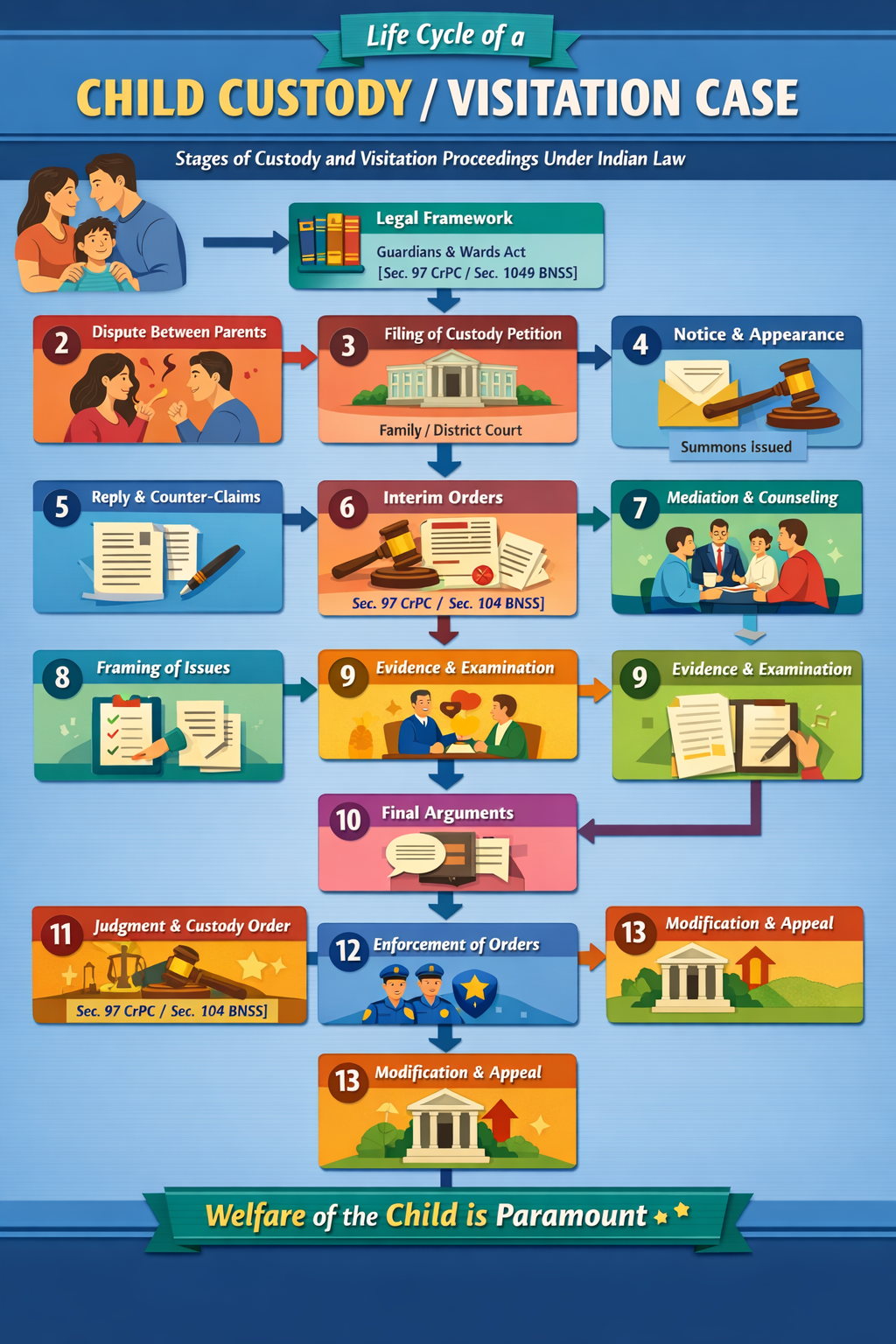
Life Cycle Stages of a Child Custody / Visitation Case

Posted on April 4 by Suprajaa Rajan

A Step-by-Step Guide to Custody Proceedings Under Indian Law

Understanding the procedural journey of a child custody or visitation case helps parents protect the best interests of the child while navigating court proceedings effectively.

Child custody disputes arise when parents disagree on the care, control, and upbringing of a minor child. Indian courts decide such matters based on the welfare and best interests of the child, which remains the paramount consideration.

Custody and visitation matters are governed primarily by the Hindu Minority and Guardianship Act, 1956, the Guardians and Wards Act, 1890, and relevant provisions of procedural law under the Code of Civil Procedure, 1908, along with certain applicable provisions of the Code of Criminal Procedure, 1973 (CrPC) and the Bharatiya Nagarik Suraksha Sanhita, 2023 (BNSS).

The following stages explain the complete life cycle of a child custody or visitation case.

1. Legal Foundation of Child Custody Law

First, it is important to understand the legal framework governing custody disputes.

Courts decide custody matters under the Guardians and Wards Act, 1890, and personal laws applicable to the parties. However, the court always prioritises the welfare of the child over the rights of the parents.

Additionally, in urgent situations, a parent may seek interim protection or custody through procedural provisions. For instance, a party may invoke interim relief mechanisms similar to those under Section 97 CrPC / Section 104 BNSS, where applicable.

Therefore, courts adopt a child-centric approach while deciding custody and visitation matters.

2. Stage One: Dispute Between Parents Regarding Custody

Typically, a custody dispute arises when parents separate or initiate matrimonial proceedings.

For example, disputes often arise during divorce, judicial separation, or domestic conflicts. One parent may retain custody of the child, while the other parent may seek custody or visitation rights.

At this stage, the parties may attempt informal resolution or family mediation. However, if the dispute continues, the aggrieved parent may approach the court.

3. Stage Two: Filing of Custody Petition Before Court

If the dispute remains unresolved, the aggrieved parent files a custody or guardianship petition before the competent Family Court or District Court.

The petition includes details of the child, relationship between parties, and the relief sought. The petitioner may seek permanent custody, joint custody, or visitation rights.

Additionally, the petitioner may file an application for interim custody or visitation.

After filing, the court registers the case and issues notice to the respondent parent.

4. Stage Three: Service of Notice and Appearance of Respondent

Next, the court ensures that the respondent receives proper notice of the proceedings.

The notice specifies the date of hearing and directs the respondent to appear before the court.

The respondent may appear personally or through legal counsel. If the respondent fails to appear, the court may proceed ex parte.

Proper service of notice ensures compliance with principles of natural justice.

5. Stage Four: Filing of Reply and Counter-Claims

After receiving notice, the respondent files a written statement or reply to the petition.

The respondent may oppose the claim for custody or propose alternative arrangements such as shared custody or limited visitation.

In some cases, the respondent may also file counter-claims seeking custody or enhanced visitation rights.

This stage helps the court identify the issues in dispute.

6. Stage Five: Interim Custody and Visitation Orders

Since custody matters involve immediate welfare concerns, courts often pass interim orders at an early stage.

For instance, the court may grant temporary custody to one parent and visitation rights to the other parent.

In urgent situations, a parent may also seek immediate production of the child through remedies similar to Section 97 CrPC / Section 104 BNSS, where unlawful detention is alleged.

The court considers factors such as age of the child, emotional needs, and stability before granting interim relief.

These interim orders remain effective during the pendency of the case.

7. Stage Six: Mediation and Counseling

Subsequently, the court may refer the parties to mediation or counseling.

Family Courts actively encourage amicable settlement in custody disputes. Mediation helps parents arrive at mutually acceptable arrangements for custody and visitation.

Additionally, courts may interact with the child to understand the child’s preferences.

If mediation succeeds, the parties record a settlement before the court. If mediation fails, the case proceeds to trial.

8. Stage Seven: Framing of Issues

If disputes persist, the court frames issues for determination.

These issues may include questions such as which parent can better ensure the welfare of the child and whether visitation rights should be granted.

Framing of issues helps structure the trial and focus on relevant questions.

9. Stage Eight: Evidence and Examination

At this stage, both parties present evidence to support their claims.

For example, parties may produce documents relating to income, living conditions, and educational background. Witnesses may testify regarding the child’s upbringing and parental conduct.

The court may also consider expert reports from child psychologists or welfare officers.

Additionally, the court may interact with the child, depending on the child’s age and maturity.

The opposing party has the right to cross-examine witnesses.

10. Stage Nine: Final Arguments

After completion of evidence, both parties present final arguments before the court.

Each party attempts to demonstrate that their custody arrangement serves the best interests of the child.

The court carefully evaluates all evidence, statutory provisions, and judicial precedents.

The welfare of the child remains the overriding consideration at this stage.

11. Stage Ten: Judgment and Final Custody Order

Finally, the court delivers its judgment after considering all aspects of the case.

The court may grant sole custody, joint custody, or structured visitation rights.

The order may also include directions regarding education, healthcare, and overall welfare of the child.

The court ensures that the final order promotes the child’s physical, emotional, and psychological well-being.

12. Enforcement of Custody and Visitation Orders

After passing the order, both parties must comply with the court’s directions.

If one parent violates the custody or visitation order, the aggrieved parent may approach the court for enforcement.

In appropriate cases, courts may invoke coercive measures. For instance, the court may direct production of the child through mechanisms similar to Section 97 CrPC / Section 104 BNSS, where applicable.

Courts may also modify orders to ensure compliance and protect the child’s welfare.

13. Modification and Appeal

Child custody orders are not final in the strict sense because circumstances may change over time.

Therefore, either parent may seek modification of custody or visitation arrangements if circumstances materially change.

Additionally, an aggrieved party may file an appeal before a higher court challenging the custody order.

The appellate court reviews whether the lower court correctly applied the principle of welfare of the child.

Conclusion

Child custody and visitation cases require careful judicial balancing of parental rights and the welfare of the child. Therefore, courts follow a structured process that includes interim relief, mediation, evidence, and final adjudication.

Understanding the life cycle of a custody case helps parents approach the process with clarity and responsibility. Ultimately, the law ensures that every decision prioritises the best interests and well-being of the child.


Other Life Cycles: DV Case Lifecycle || Maintenance Case u/s 125 CrPC Lifecycle. Index is here.


Key Contributor :
Mrs. Suprajaa Rajan B.Com., LL.B., LL.M.
+91-9606345150


Posted in Legal Procedure | Tagged child custody law Life Cycle stages of a child custody case Matrimonial Criminal Law Matrimonial dispute Matrimonial Litigation India | Leave a comment

Rajesh Chaddha Vs State of Uttar Pradesh on 13 May 2025 – Judgement Summary

Posted on March 13 by Suprajaa Rajan

In Rajesh Chaddha v. State of Uttar Pradesh, the Supreme Court held that vague and omnibus allegations cannot sustain a conviction under Section 498A of the Indian Penal Code, 1860 (IPC) and Section 4 of the Dowry Prohibition Act, 1961.

The Court examined a case where the husband challenged his conviction for alleged cruelty and dowry demand. The prosecution mainly relied on the testimony of the complainant and her father. However, the Court found that the allegations lacked specific dates, incidents, and supporting evidence. Moreover, the complainant failed to produce medical records to support allegations of assault or miscarriage.

Therefore, the Court reiterated that criminal courts must rely on clear, specific, and credible evidence. Mere general accusations cannot justify a conviction under Section 498A IPC.

“In the present case, the allegations made by the Complainant are vague, omnibus and bereft of any material particulars to substantiate this threshold. Apart from claiming that Appellant husband harassed her for want of dowry, the Complainant has not given any specific details or described any particular instance of harassment.”

“It is alleged that the Complainant suffered a miscarriage… however, no medical document from any medical institution or hospital or nursery was produced to substantiate the allegations.” 

“Apart from the statements of PW-1 and PW-2, there is no evidence to substantiate the allegations of harassment and acts of cruelty within the scope of Section 498A of IPC, and Section 4 of the D.P. Act, 1961.” 

“This growing tendency to append every relative of the husband casts serious doubt on the veracity of the allegations made by the Complainant wife or her family members and vitiates the very objective of a protective legislation.” 

Decision of the Court

Ultimately, the Supreme Court found that the prosecution failed to prove cruelty or dowry demand with reliable evidence. The allegations remained vague and unsupported by independent proof.

Therefore, the Court allowed the appeal, set aside the conviction under Section 498A IPC and Section 4 of the Dowry Prohibition Act, 1961, and acquitted the appellant of all charges.


Rajesh Chaddha Vs State of UP on 13 May 2025

Citation :2025 INSC 671

Other Sources :


Index of Dowry Prohibition Act Judgments is here.


Key Contributor :

Mrs. Suprajaa Rajan B.Com., LL.B., LL.M.

+91-9606345150


Posted in Supreme Court of India Judgment or Order or Notification | Tagged Acquitted in IPC 498A Criminal law Dowry Prohibition Act 1961 Matrimonial Criminal Law Matrimonial Litigation India Misuse of Section 498A of IPC | Leave a comment

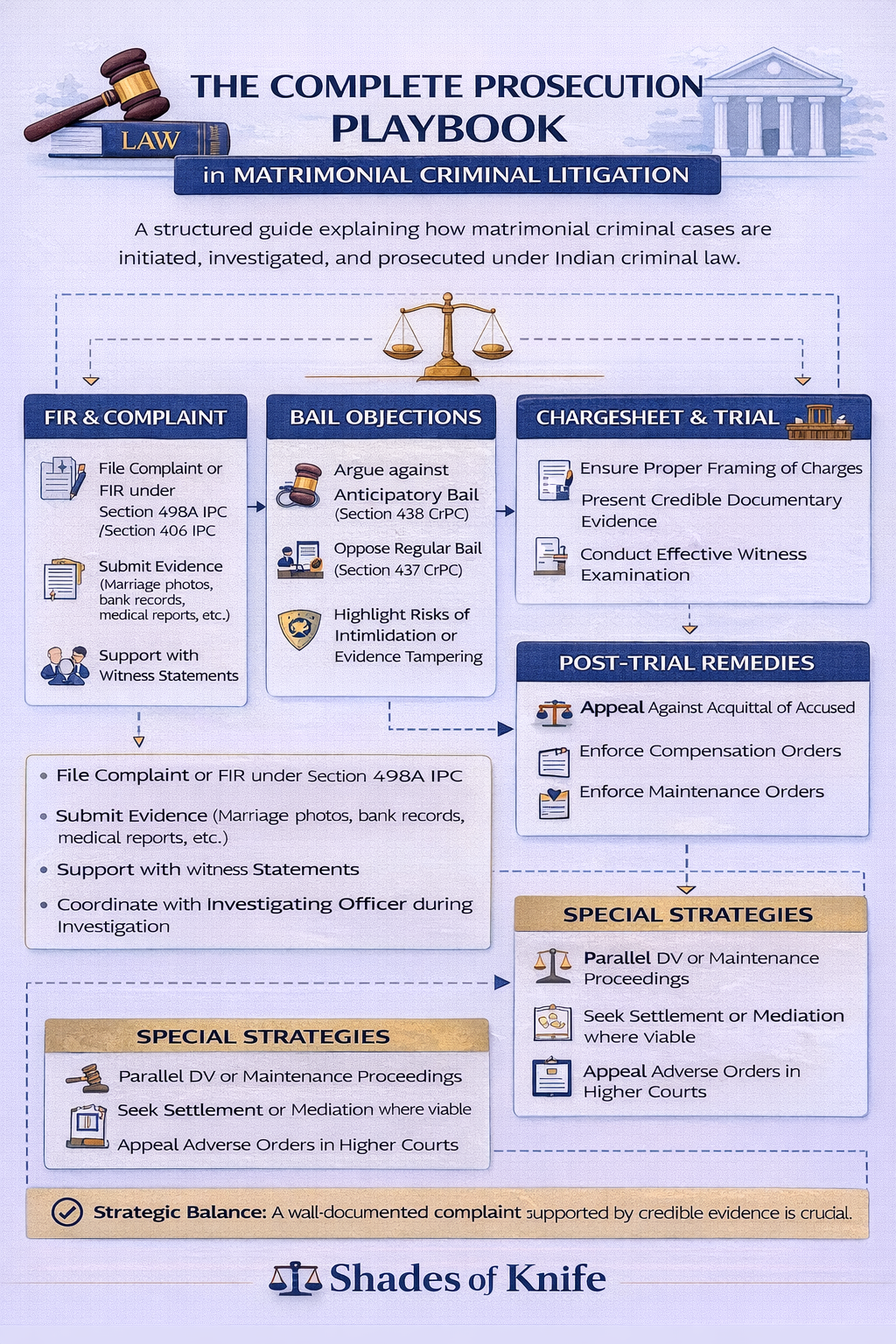
Matrimonial Criminal Litigation – The Complete Prosecution Strategy Guide

Posted on March 5 by Suprajaa Rajan

A structured guide explaining how matrimonial criminal cases are initiated, investigated, and prosecuted under Indian criminal law.

Matrimonial disputes often escalate into criminal litigation involving allegations of cruelty, dowry harassment, domestic violence, or financial neglect. Consequently, effective prosecution requires not only filing complaints but also building a coherent legal strategy supported by documentary and oral evidence.

This playbook outlines the procedural roadmap, legal remedies, and strategic considerations available to the prosecution side in matrimonial criminal litigation. Furthermore, it highlights how complainants can navigate investigations, bail proceedings, trial stages, and post-judgment remedies effectively.

I. Initiating Criminal Proceedings

At the outset, the prosecution must ensure that allegations are clearly articulated and supported by preliminary material. Therefore, initiating proceedings correctly becomes crucial.

1. Filing a Complaint or FIR

A criminal case may be initiated through:

  • Registration of an FIR under Section 498A IPC

  • Complaint for criminal breach of trust under Section 406 IPC

  • Filing a Domestic Violence complaint under the Protection of Women from Domestic Violence Act, 2005

  • Maintenance proceedings under Section 125 CrPC

These provisions collectively aim to address cruelty, financial neglect, and unlawful retention of dowry articles.

However, the complainant must ensure that the complaint contains:

  • Specific incidents of cruelty

  • Dates and locations of harassment

  • Details of dowry demands

  • Names and roles of accused persons

Without these particulars, the prosecution case may appear vague during investigation or trial.

II. Investigation Stage: Strengthening the Prosecution Case

Once an FIR is registered, the matter enters the investigation phase. At this stage, the complainant should actively assist the investigating authorities.

1. Providing Documentary Evidence

The prosecution should gather and submit:

  • Marriage photographs and invitations

  • Bank transfers or financial transactions

  • Medical records of injuries

  • WhatsApp chats, emails, or messages

  • Audio or video recordings (where available)

Consequently, documentary evidence often plays a decisive role in corroborating allegations.

2. Witness Statements

Additionally, statements of the following witnesses may support the prosecution case:

  • Parents and relatives

  • Neighbours

  • Friends aware of the dispute

  • Independent witnesses present during incidents

Strong witness testimony strengthens the prosecution narrative during trial.

III. Responding to Bail Proceedings

In many matrimonial criminal cases, the accused may seek anticipatory bail or regular bail. Accordingly, the prosecution must present strong objections.

1. Opposing Anticipatory Bail

While opposing bail under Section 438 CrPC, the complainant may argue:

  • Seriousness of allegations

  • Continuous harassment or cruelty

  • Risk of intimidation of witnesses

  • Possibility of evidence tampering

Furthermore, the prosecution may highlight the need for custodial interrogation if recovery of dowry articles is required.

2. Conditions on Bail

Even when bail is granted, the prosecution can request conditions such as:

  • No contact with the complainant

  • Regular cooperation with investigation

  • Restrictions on leaving jurisdiction

These conditions help protect the complainant during ongoing proceedings.

IV. Parallel Civil and Criminal Remedies

Matrimonial litigation often involves multiple simultaneous proceedings. Therefore, the prosecution side may pursue parallel remedies.

1. Domestic Violence Proceedings

Under the Protection of Women from Domestic Violence Act, 2005, the complainant may seek:

  • Protection orders

  • Residence orders

  • Monetary relief

  • Compensation for mental cruelty

These remedies provide immediate relief even before completion of criminal trials.

2. Maintenance Claims

Additionally, financial support can be sought through:

  • Section 125 CrPC

  • Interim maintenance in domestic violence proceedings

  • Maintenance under personal laws

Maintenance proceedings ensure financial security for the complainant and dependents.

V. Chargesheet and Trial Strategy

After investigation, the police may file a chargesheet before the Magistrate. At this stage, the prosecution strategy shifts toward trial preparation.

1. Ensuring Proper Framing of Charges

The prosecution must ensure that charges are framed appropriately under relevant provisions, including:

  • Section 498A IPC

  • Section 406 IPC

  • Other applicable offences based on evidence

Clear framing of charges defines the scope of the trial.

2. Examination of Witnesses

During trial, the prosecution must:

  • Present witnesses in logical sequence

  • Ensure consistency in statements

  • Address contradictions promptly

Effective witness examination significantly influences the outcome of the case.

3. Documentary Evidence

Moreover, documentary evidence must be properly marked and proved during trial.

Failure to prove documents may weaken the prosecution case even if the allegations are otherwise serious.

VI. Settlement and Mediation

Although matrimonial criminal cases are serious in nature, courts sometimes encourage mediation or settlement, particularly when reconciliation or mutual divorce is possible.

In such circumstances, the parties may enter into:

  • Compromise agreements

  • Mutual consent divorce settlements

  • Withdrawal or quashing of proceedings before the High Court

However, the complainant must ensure that financial settlements and legal protections are clearly documented before agreeing to any compromise.

VII. Post-Trial Remedies

After the trial concludes, the prosecution may still have legal remedies depending on the outcome.

1. Appeal Against Acquittal

If the accused is acquitted, the complainant may seek appeal against acquittal before the appropriate appellate court.

2. Enforcement of Compensation Orders

Courts may also grant compensation under criminal law provisions. Consequently, the complainant may initiate execution proceedings to enforce such orders.

3. Enforcement of Maintenance Orders

Maintenance orders can be enforced through:

  • Execution proceedings

  • Recovery warrants

  • Attachment of salary or property

These remedies ensure compliance with court directions.

VIII. Strategic Considerations for the Prosecution

To ensure a strong prosecution case, the complainant should follow certain strategic principles.

First, allegations must remain consistent across FIRs, complaints, and witness statements. Secondly, documentary evidence should be preserved from the earliest stage of the dispute.

Furthermore, complainants should avoid exaggeration or inclusion of unrelated family members without evidence, as courts increasingly scrutinize such allegations.

Ultimately, a well-structured prosecution case depends on credible evidence, procedural compliance, and effective presentation before the court.

Conclusion

Matrimonial criminal litigation requires careful navigation of criminal procedure, evidentiary rules, and parallel civil remedies. Therefore, the prosecution side must adopt a structured legal strategy from the very beginning.

By documenting incidents, cooperating with investigators, and presenting consistent evidence, complainants can significantly strengthen their case.

In conclusion, the prosecution playbook in matrimonial litigation is not merely about initiating proceedings. Rather, it involves systematic preparation, strategic litigation, and effective utilisation of statutory remedies available under Indian law.


Index of Legal Strategies and Defence is here.


Key Contributor :

Mrs. Suprajaa Rajan B.Com., LL.B., LL.M.

+91-9606345150

Posted in Legal Procedure | Tagged Criminal Trial Matrimonial Criminal Law Matrimonial Litigation India Prosecution strategy Protection of Women from Domestic Violence Act 2005 | Leave a comment

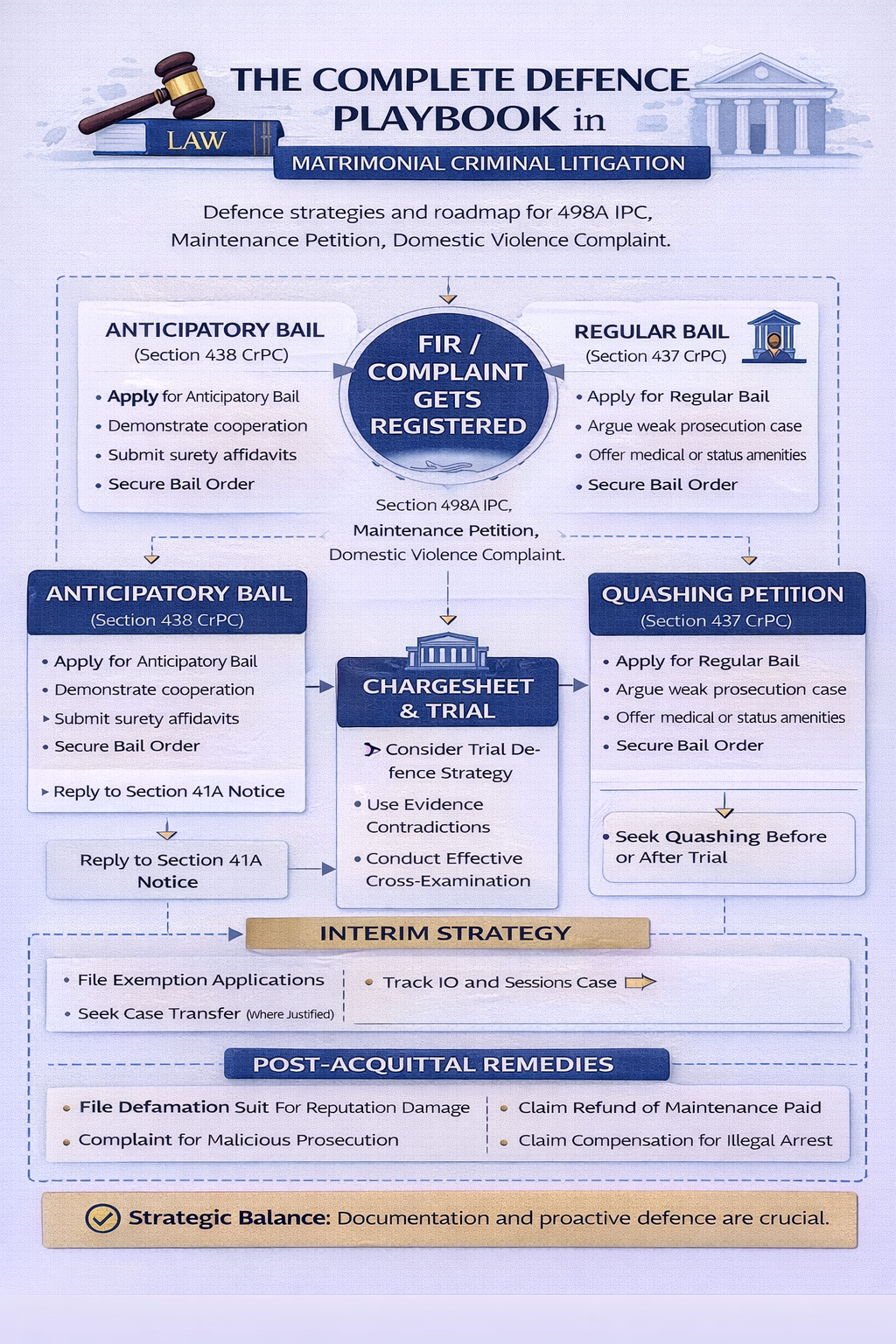
Matrimonial Criminal Litigation – The Complete Defence Guide

Posted on March 5 by Suprajaa Rajan

A structured legal roadmap to protect liberty, reputation, and financial security at every stage of criminal matrimonial proceedings.

Matrimonial criminal litigation in India often begins abruptly — with an FIR under Section 498A IPC, a complaint under the Domestic Violence Act, or a maintenance claim under Section 125 CrPC.

What follows is confusion, pressure, and procedural complexity.

This playbook provides a stage-wise strategic framework for navigating criminal matrimonial disputes lawfully and effectively.

I. Stage One: Immediately After FIR Registration

Most accused individuals panic at this stage. Strategy must, undoubtedly, begin immediately.

Key Legal Provisions:

  • Section 498A IPC

  • Section 406 IPC

  • Section 34 IPC

  • Section 41 & 41A CrPC

Immediate Strategic Steps:

  • Verify FIR contents
  • Assess arrest risk
  • Prepare anticipatory bail strategy
  • Collect documentary evidence
  • Preserve digital communications

The Supreme Court in Arnesh Kumar v. State of Bihar, held that arrest cannot be automatic in offences punishable up to seven years.

Read also : Arrest Procedure in 498A Cases After Arnesh Kumar

II. Stage Two: Bail & Liberty Protection

Personal liberty under Article 21 of the Constitution remains paramount.

Strategic Remedies:

1. Anticipatory Bail – Section 438 CrPC

Filed when arrest apprehension exists.

2. Regular Bail – Section 437/439 CrPC

Filed after arrest.

3. Transit Anticipatory Bail

When FIR is lodged in another State.

Courts evaluate:

  • Specificity of allegations

  • Role of each accused

  • Possibility of tampering

  • Cooperation with investigation

Read also : Anticipatory Bail in Matrimonial Offences – Complete Guide

III. Stage Three: Investigation & Chargesheet

After investigation, police may file chargesheet under:

  • Section 173 CrPC

This stage determines the trial trajectory.

Defence Strategy Includes:

  • Filing discharge application
  • Challenging omnibus allegations
  • Examining absence of specific overt acts
  • Seeking exemption from personal appearance

High Courts frequently quash proceedings against distant relatives where allegations are vague.

Read also : Discharge Application in 498A Cases – Legal Framework

IV. Stage Four: High Court Remedies

Where proceedings amount to abuse of process, remedy lies under:

  • Section 482 CrPC

High Courts exercise inherent powers to prevent miscarriage of justice.

Grounds commonly invoked:

  • Absence of prima facie case

  • Generalised allegations

  • Settlement between parties

  • Malicious prosecution

Read also : Quashing of FIR Under Section 482 CrPC – Explained

V. Parallel Civil & Financial Litigation

Matrimonial disputes rarely remain confined to criminal law.

Parallel proceedings may include:

  • Domestic Violence Act, 2005

  • Section 125 CrPC Maintenance

  • Divorce proceedings under personal laws

Financial Defence Strategy:

  • Accurate income disclosure
  • Challenging inflated claims
  • Contesting interim maintenance
  • Seeking modification upon change of circumstances

VI. Trial Strategy

If matter proceeds to trial, defence must shift from procedural to evidentiary strength.

Key Focus Areas:

  • Cross-examination strategy

  • Contradictions in complaint & deposition

  • Electronic evidence admissibility

  • Medical and documentary inconsistencies

  • Hostile witness handling

Trial requires patience, consistency, and procedural discipline.

VII. Settlement & Strategic Exit

Despite non-compoundable nature of 498A, courts allow quashing upon settlement.

Compromise-based quashing has evolved as a judicially recognised solution where matrimonial disputes are resolved.

Strategic mediation may:

  • Reduce litigation time

  • Protect reputation

  • Avoid prolonged trial

VIII. Common Strategic Mistakes to Avoid

  • Ignoring Section 41A notice
  • Filing multiple inconsistent petitions
  • Aggressive communication with complainant
  • Social media commentary
  • Suppressing financial disclosures
  • Non-cooperation with investigation

IX. Long-Term Reputation & Legal Risk Management

Criminal matrimonial litigation impacts:

  • Passport applications

  • Employment background verification

  • Professional licences

  • Immigration status

Strategic handling at early stages significantly influences long-term outcomes.

X. Guiding Principles of Defence

  1. Arrest is not automatic.

  2. Allegations must be specific.

  3. Liberty is constitutionally protected.

  4. Procedure is a safeguard, not a technicality.

  5. Early strategy prevents prolonged litigation.

Conclusion

Matrimonial criminal litigation, thus, requires structured legal response, not emotional reaction. Each procedural stage offers remedies. Each remedy must be invoked strategically.

The defence playbook lies in:

  • Understanding statutory safeguards

  • Timely filing of appropriate applications

  • Preserving documentary evidence

  • Maintaining procedural discipline

So liberty, reputation, and financial security depend on informed legal action.


Index of Legal Strategies and Defence is here. 


Key Contributor : 

Mrs. Suprajaa Rajan B.Com., LL.B., LL.M.

+91-9606345150

Posted in Legal Procedure | Tagged 498A defence strategy Criminal Trial CrPC 482 - FIR Can Be Quashed Maintenance Defence Matrimonial Criminal Law Matrimonial Litigation India Quashing of FIR | Leave a comment

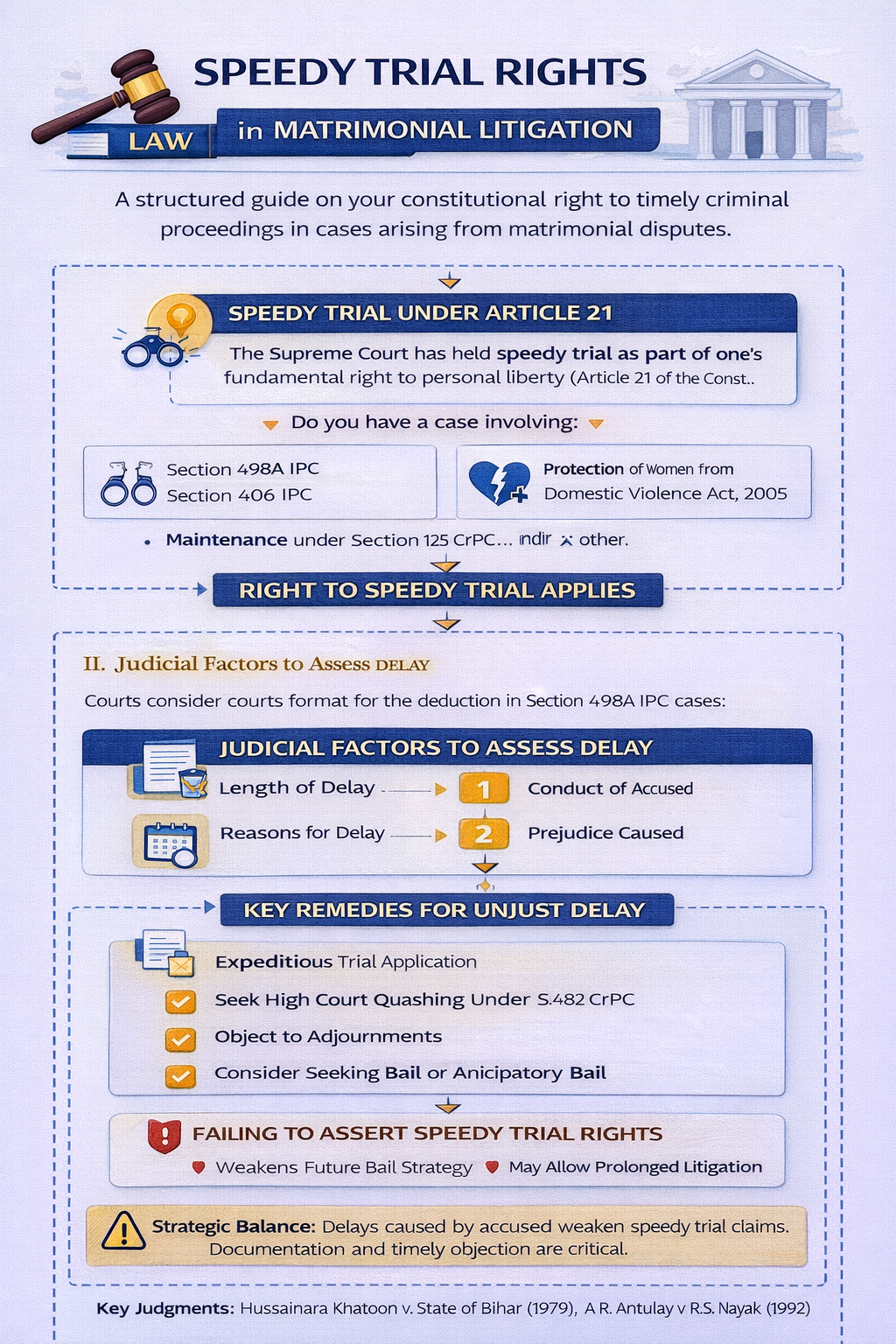
Speedy Trial Rights in Matrimonial Litigation

Posted on March 4 by Suprajaa Rajan

Speedy Trial Rights – Understanding the constitutional guarantee against prolonged criminal and matrimonial proceedings accordingly. 

Litigation arising out of matrimonial disputes often extends for years, undeniably. Criminal complaints under Section 498A IPC, proceedings under the Domestic Violence Act, and maintenance claims under Section 125 CrPC frequently remain pending for prolonged periods.

However, the right to a speedy trial is not merely procedural. It is a constitutional guarantee flowing from Article 21 of the Constitution of India.

This article explains the scope, judicial interpretation, remedies, and strategic use of speedy trial rights in matrimonial criminal litigation.

I. Constitutional Foundation of Speedy Trial

The Supreme Court in Hussainara Khatoon v. State of Bihar recognised that the right to speedy trial is implicit in Article 21.

The Court held that, “A procedure that keeps an accused under prolonged uncertainty violates the guarantee of personal liberty.”

The principle applies equally to matrimonial criminal cases.

II. Applicability in Matrimonial Litigation

Speedy trial rights become relevant in:

  • Criminal complaints under Section 498A IPC

  • Proceedings under Section 406 IPC

  • Cases under the Protection of Women from Domestic Violence Act, 2005

  • Maintenance proceedings under Section 125 CrPC

  • Parallel divorce proceedings impacting criminal defence

Prolonged pendency may undeniably result in:

  • Social stigma

  • Financial burden

  • Career disruption

  • Travel restrictions

  • Psychological distress

Thus, courts recognise that delay itself may amount to prejudice.

III. Judicial Tests for Determining Delay

In A.R. Antulay v. R.S. Nayak, the Supreme Court laid down guiding factors to assess violation of speedy trial rights.

Courts consider:

  • Length of delay
  • Reasons for delay
  • Conduct of the accused
  • Prejudice caused

There is no fixed time limit as such. Each case is assessed on facts.

IV. Can Delay Lead to Quashing?

Yes, in appropriate cases.

Where delay is:

  • Inordinate

  • Unexplained

  • Attributable to prosecution

  • Causing serious prejudice

High Courts may exercise inherent powers under Section 482 CrPC to quash proceedings.

However, mere passage of time is insufficient. The delay must defeat justice.

V. Delay in 498A Trials

Matrimonial criminal cases often suffer delay due to:

  • Repeated adjournments

  • Non-appearance of witnesses

  • Mediation attempts

  • Parallel civil litigation

  • Transfer petitions

Courts have repeatedly emphasised that matrimonial disputes should not become instruments of prolonged harassment.

In Pankaj Kumar v. State of Maharashtra, the Supreme Court reiterated that oppressive delay can violate Article 21.

VI. Speedy Trial in Domestic Violence & Maintenance Proceedings

Proceedings under the Protection of Women from Domestic Violence Act, 2005 are intended to be summary in nature.

Similarly, Section 125 CrPC proceedings aim at immediate relief. Additionally, unjustified delay defeats the object of these provisions.

Respondents may seek:

  • Expedited hearing

  • Time-bound cross-examination

  • Closure of evidence where complainant delays

Hence, courts increasingly discourage unnecessary adjournments.

VII. Remedies Available for Delay

If proceedings are unduly delayed, the accused may:

  • File application for expeditious trial
  • Seek day-to-day hearing
  • Oppose adjournments
  • Approach High Court under Section 482 CrPC
  • Seek discharge where delay impacts fairness

In extreme cases, delay may result in:

  • Quashing of proceedings

  • Reduction of sentence

  • Acquittal due to prejudice

VIII. When Delay Is Attributable to the Accused

The right to speedy trial is reciprocal.

If delay is caused by:

  • Repeated exemption applications

  • Non-cooperation

  • Filing frivolous petitions

  • Seeking adjournments

Undoubtedly, courts will reject speedy trial claims.

Clearly, clean conduct strengthens constitutional argument.

IX. Strategic Importance in Matrimonial Defence

Speedy trial rights become strategically relevant when:

  • Allegations are weak

  • Complainant avoids cross-examination

  • Prosecution witnesses remain absent

  • Case lingers without progress

Also, an application highlighting prejudice may pressure prosecution to proceed diligently.

Delay can weaken prosecution case due to:

  • Fading memory

  • Unavailable witnesses

  • Documentary inconsistencies

However, strategic balance is essential.

X. Practical Checklist for Accused Persons

If your matrimonial criminal case is pending for several years insignificantly:

  • Track hearing dates
  • Maintain record of adjournments
  • Identify cause of delay
  • File written objection to repeated adjournments
  • Seek High Court intervention if necessary

Documenting delay strengthens your case eventually.

XI. Key Judicial Principles

  • Speedy trial is a fundamental right.
  • No rigid time limit exists.
  • Delay must cause prejudice.
  • Conduct of parties is relevant.
  • Courts balance societal interest with individual liberty by all means.

XII. Conclusion

The right to speedy trial, thus, protects individuals from endless criminal litigation. In matrimonial disputes, where personal relationships and reputations are at stake, delay compounds injury.

Also, courts recognise that justice delayed may become justice denied. However, relief depends on facts, conduct, and demonstrable prejudice.

Invoking Article 21 strategically can prevent criminal process from becoming prolonged punishment significantly.


Index of Legal Strategies and Defence is here. 


Frequently Asked Questions

No statutory limit exists, but unreasonable delay may violate Article 21.

Not automatically. Prejudice must be demonstrated.

Yes. Courts often issue directions for expeditious disposal.

Settlement may lead to quashing, rendering speedy trial issue redundant.


Key Contributor :

Mrs. Suprajaa Rajan B.Com., LL.B., LL.M.

+91-9606345150

Posted in Legal Procedure | Tagged Article 21 - Protection of life and personal liberty Criminal Procedure Matrimonial Criminal Law Matrimonial dispute Matrimonial Litigation India Right to Liberty Right to Speedy Trial | Leave a comment

Quashing of FIR Under Section 482 CrPC

Posted on March 3 by Suprajaa Rajan

Understanding the scope, grounds, and judicial principles governing quashing of criminal proceedings.

Criminal prosecution can severely affect personal liberty, reputation, and professional life. However, not every FIR discloses a legally sustainable offence. In such situations, the law provides a constitutional safeguard.

The remedy lies under:

Code of Criminal Procedure, 1973

Specifically, Section 482 CrPC, which preserves the inherent powers of the High Court to:

  • Prevent abuse of process of law

  • Secure the ends of justice

  • Quash criminal proceedings where continuation is unjustified

This article explains the legal framework, judicial tests, landmark precedents, and strategic considerations for filing a quashing petition in brief.

Steps under Quashing FIR

I. What Is Section 482 CrPC?

Section 482 states that nothing in the Code shall limit the inherent powers of the High Court.

These powers are extraordinary in nature and must be exercised:

  • Sparingly

  • With caution

  • Only in rare and exceptional cases

Nevertheless, it is not an appellate power. In fact, it is a supervisory and preventive jurisdiction.

II. When Can FIR Be Quashed?

The Supreme Court laid down guiding principles in:

State of Haryana v. Bhajan Lal

This judgment identified illustrative categories where quashing may be justified.

Key Grounds for Quashing:

  • Allegations do not disclose a cognizable offence
  • FIR is manifestly attended with mala fide intent
  • Allegations are absurd or inherently improbable
  • There is no legal evidence supporting prosecution
  • Proceedings amount to abuse of process
  • Dispute is purely civil in nature
  • Parties have settled the dispute (in appropriate cases)

III. Quashing in Matrimonial Offences (498A Cases)

Quashing petitions frequently arise in complaints under:

  • Section 498A IPC

  • Section 406 IPC

  • Section 34 IPC

Courts have repeatedly cautioned against mechanical implication of relatives.

In Arnesh Kumar v. State of Bihar, the Supreme Court addressed misuse in matrimonial litigation and emphasised procedural safeguards.

High Courts often quash proceedings where:

  • Allegations are omnibus

  • No specific role is attributed

  • Distant relatives reside separately

  • Complaint lacks prima facie material

IV. Settlement-Based Quashing

Even though Section 498A IPC is non-compoundable, courts permit quashing where matrimonial disputes are amicably resolved.

In Gian Singh v. State of Punjab, the Supreme Court held that High Courts may quash non-compoundable offences if the dispute is personal and continuation would serve no purpose.

Similarly, in Narinder Singh v. State of Punjab, guidelines were laid down for compromise-based quashing.

The principle: criminal law should not be used as a weapon once parties have settled significantly.

V. Can FIR Be Quashed After Chargesheet?

Yes. Quashing is maintainable even after filing of chargesheet under Section 173 CrPC.

However, courts are more cautious once investigation is complete.

The test becomes:

  • Whether materials collected disclose a prima facie case

  • Whether continuation would amount to injustice

In case the evidence supports trial, courts may refuse interference.

VI. Procedure for Filing Quashing Petition

A petition under Section 482 CrPC is filed before the jurisdictional High Court.

Typical Components:

  • Copy of FIR
  • Chargesheet (if filed)
  • Relevant documents
  • Affidavit
  • Grounds invoking Bhajan Lal principles

Notice is issued to:

  • State

  • Complainant

High Court may:

  • Issue interim stay

  • Grant protection from coercive steps

  • Dismiss petition

  • Quash FIR entirely

  • Quash proceedings partially against specific accused

VII. Judicial Caution: What Courts Will Not Do

High Courts will not:

  • Conduct mini-trials

  • Examine disputed facts

  • Evaluate credibility of witnesses

  • Weigh evidence

If allegations disclose prima facie offence, trial must proceed. In any case, section 482 is not a substitute for trial.

VIII. Strategic Considerations Before Filing

Filing a premature petition may weaken credibility.

Consider:

  • Stage of investigation

  • Strength of allegations

  • Documentary contradictions

  • Settlement possibilities

  • Parallel civil proceedings

Thus strategic timing is undoubtedly crucial.

IX. Common Mistakes in Quashing Petitions

  • Raising factual disputes requiring evidence
  • Filing without examining FIR carefully
  • Over-reliance on defence documents
  • Ignoring Supreme Court precedents
  • Filing multiple repetitive petitions

Subsequently, courts may impose costs for frivolous petitions.

X. Recent Judicial Approach

Courts increasingly:

  • Protect distant relatives in 498A cases

  • Scrutinise omnibus allegations

  • Encourage settlement in matrimonial disputes

  • Emphasise that criminal law should not become harassment

However, courts remain strict where allegations show serious cruelty or violence.

Conclusion

Section 482 CrPC ,thus, acts as a constitutional safety valve against misuse of criminal process. Additionally, it ensures that criminal law does not become a tool of oppression.

However, it is an extraordinary remedy. Courts exercise it with restraint. A well-structured petition grounded in settled principles significantly improves prospects.

The guiding test remains:

Does continuation of prosecution serve justice — or defeat it?

Therefore, when proceedings lack legal foundation or arise from matrimonial vendetta, inherent powers of the High Court restore balance.


Index of Legal Strategies and Defence is here. 


Frequently Asked Questions

Not automatic. Court examines genuineness and societal impact.

Yes. Proceedings may be quashed selectively.

No. It terminates proceedings before trial.

Often exempted unless court directs otherwise.


Key Contributor:

Mrs. Suprajaa Rajan B.Com., LL.B., LL.M.

+91-9606345150

Posted in Legal Procedure | Tagged abuse of process Criminal law CrPC 482 – IPC 498A Quashed Matrimonial Litigation India Quashing of FIR Section 482 CrPC | Leave a comment

Life Cycle Stages of a Restitution of Conjugal Rights Case

Posted on February 27 by Suprajaa Rajan

A Step-by-Step Guide Under Section 9 of the Hindu Marriage Act, 1955 : Understanding the procedural journey of a Restitution of Conjugal Rights case under Section 9 of Hindu Marriage Act helps spouses navigate matrimonial litigation with clarity and preparedness.

Restitution of Conjugal Rights is a matrimonial remedy available under Section 9 of the Hindu Marriage Act, 1955. This provision allows an aggrieved spouse to seek a court order directing the other spouse to resume cohabitation.

The court grants relief only if it finds that one spouse has withdrawn from the society of the other without reasonable cause. This article explains the complete life cycle of a Restitution of Conjugal Rights case in a structured manner.

1. Legal Foundation of Restitution of Conjugal Rights

Section 9 of the Hindu Marriage Act, 1955 governs this remedy. The petitioner must prove withdrawal from marital society. The withdrawal must lack reasonable excuse.

The court examines whether the marriage remains legally valid. The court also verifies that no legal ground bars relief.

This remedy aims to preserve marriage rather than dissolve it.

2. Stage One: Pre-Filing Consultation and Case Assessment

The process begins with detailed consultation with a matrimonial lawyer. The lawyer evaluates whether the facts satisfy Section 9 requirements.

The petitioner must establish three essential elements:

  • A valid subsisting marriage.

  • Withdrawal by the respondent from marital society.

  • Absence of reasonable cause for such withdrawal.

The petitioner collects supporting documents before filing. These documents may include marriage certificate, communication records, and proof of separation.

Legal preparation strengthens the petition and reduces procedural objections.

3. Stage Two: Filing of Petition Before Family Court

The petitioner files a petition before the competent Family Court. Jurisdiction depends on residence of parties or place of marriage.

The petition contains material facts of the marriage. It specifies the date of marriage and details of separation. It clearly states how the respondent withdrew without reasonable cause. The petitioner prays for a decree directing restitution of conjugal rights.

After scrutiny, the court registers the petition and issues notice.

4. Stage Three: Service of Notice to the Respondent

The court ensures proper service of notice upon the respondent. Service of notice guarantees compliance with principles of natural justice.

The notice specifies the date of first hearing. The respondent must appear personally or through counsel. If the respondent fails to appear, the court may proceed ex parte.

Proper service validates subsequent proceedings.

5. Stage Four: Filing of Written Statement

The respondent files a written statement in response to the petition. The written statement addresses each allegation made by the petitioner. The respondent may deny withdrawal from marital society. The respondent may also assert reasonable cause for separation.

Common defences include cruelty, harassment, or apprehension of harm. The burden shifts to the respondent to prove reasonable excuse.

This stage defines the core dispute between the parties.

6. Stage Five: Reconciliation and Mediation Efforts

Family Courts prioritise reconciliation in matrimonial matters. The court may refer the parties to mediation or counseling. The judge may personally attempt settlement during hearings. The objective is restoration of marital harmony.

If reconciliation succeeds, the parties resume cohabitation. If reconciliation fails, the matter proceeds to trial.

This stage reflects the restorative intent of Section 9.

7. Stage Six: Framing of Issues

If disputes remain, the court frames issues for adjudication. Issues identify disputed questions of fact and law.

Typical issues may include:

  • Whether the respondent withdrew from marital society.

  • Whether such withdrawal lacked reasonable cause.

  • Whether the petitioner is entitled to decree under Section 9.

Framing of issues narrows the scope of trial. It guides the evidence stage systematically.

8. Stage Seven: Evidence and Trial

The petitioner presents evidence first. The petitioner may submit oral testimony and documentary proof. Witnesses may testify regarding separation and conduct of parties. The respondent has the right to cross-examine the petitioner.

After petitioner’s evidence, the respondent presents defence evidence. The respondent may produce documents and witnesses. The petitioner may cross-examine defence witnesses. The Court records all testimonies carefully.

The trial ensures fairness and evidentiary scrutiny.

9. Stage Eight: Final Arguments

After completion of evidence, the court schedules final arguments. Both parties present legal submissions through their advocates. The petitioner argues absence of reasonable cause. The respondent argues justification for withdrawal.

Counsel may rely on judicial precedents interpreting Section 9. The court evaluates facts and legal principles carefully.

Final arguments assist the court in reaching a reasoned decision.

10. Stage Nine: Judgment and Decree

The court delivers judgment after analysing pleadings and evidence. The judgment contains findings on each framed issue. If satisfied, the court grants a decree of restitution of conjugal rights.The decree directs the respondent to resume cohabitation. If the court finds reasonable cause for withdrawal, it dismisses the petition.

The decree is enforceable under civil procedure mechanisms.

11. Enforcement of Decree

The decree does not compel physical force for cohabitation. The law does not permit forced marital relations. The decree operates through attachment of property under execution proceedings. Non-compliance may result in attachment of respondent’s property.

However, courts prioritise voluntary compliance over coercive enforcement.

12. Consequences of Non-Compliance

Non-compliance has important legal consequences. If no cohabitation occurs for one year after decree, either party may seek divorce. Section 13(1A) of the Hindu Marriage Act provides this ground. Thus, restitution proceedings may indirectly lead to divorce.

This provision balances reconciliation with eventual finality.

13. Appeal and Post-Judgment Remedies

An aggrieved party may file an appeal before the appropriate appellate court. Appeals must comply with limitation periods under applicable law. The appellate court reviews legal and factual findings.The court may affirm, modify, or set aside the decree.

Parties may also seek review under limited circumstances.

Conclusion

A Restitution of Conjugal Rights case follows a structured judicial pathway. The remedy aims to preserve marriage rather than dissolve it.Each procedural stage ensures fairness, reconciliation, and legal scrutiny. Understanding the life cycle empowers individuals to approach the process responsibly.

Proper legal advice and timely action significantly influence the outcome of such proceedings.


Other Life Cycles: 498A IPC Case Lifecycle || Maintenance Case u/s 125 CrPC Lifecycle. Index of all life cycles is here.


Key Contributor:
Mrs Suprajaa Rajan B.Com, LL.B., LL.M.
+91-9606345150

Posted in Legal Procedure | Tagged Hindu Marriage Act HM Act 9 - Restitution of conjugal right Matrimonial dispute Matrimonial law Matrimonial Litigation India RCR coverted into Divorce | Leave a comment

Post navigation

  • Older posts
  • Newer posts

Search within entire Content of “Shades of Knife”

My Legal X Timeline

Advocate Sandeep Pamarati 🇮🇳💪👨🏻‍🎓 Follow

AP High Court Advocate with M Tech (CS) || 12 years in 'Software Industry' as Solution Architect || Blogs at https://t.co/29CB9BzK4w || #TDPTwitter

SandeepPamarati
Retweet on Twitter Advocate Sandeep Pamarati 🇮🇳💪👨🏻‍🎓 Retweeted
futurestacked Future Stacked @futurestacked ·
23 Jun

Your Gmail account is not an email account.

It is the master key to your bank, your crypto, your Apple ID, your PayPal, and every password you have ever saved.

One breach and all your passwords are gone.

Lock it down with these 7 easy steps 👇

Reply on Twitter 2069354786743374317 Retweet on Twitter 2069354786743374317 104 Like on Twitter 2069354786743374317 260 X 2069354786743374317
Retweet on Twitter Advocate Sandeep Pamarati 🇮🇳💪👨🏻‍🎓 Retweeted
thisguyknowsai Brady Long @thisguyknowsai ·
22 Jun

A German psychologist proved in 1885 that cramming erases what you learned within 48 hours. He published the fix in the same book. Almost no school on Earth has adopted it in 140 years.

His name was Hermann Ebbinghaus.

He had no lab. No funding. No colleagues.

He worked alone

Reply on Twitter 2068965021514891696 Retweet on Twitter 2068965021514891696 958 Like on Twitter 2068965021514891696 2820 X 2068965021514891696
Retweet on Twitter Advocate Sandeep Pamarati 🇮🇳💪👨🏻‍🎓 Retweeted
factcheckapgov FactCheck.AP.Gov.in @factcheckapgov ·
22 Jun

ఎంతో ప్రతిష్టాత్మకంగా నిర్వహించి ప్రజల ఆరోగ్యం పట్ల అవగాహన కల్పించిన అంతర్జాతీయ యోగా దినోత్సవం సందర్భంగా రాష్ట్రం లో పలుచోట్ల నిర్వహించిన యోగా కార్యక్రమం పై కొందరు తప్పుడు ప్రచారం చేస్తున్నారు. ఈ కార్యక్రమం కోసం రూ. 600 కోట్లు ఖర్చు అయినట్లు చెప్పడం పూర్తిగా అసత్యం. రాష్ట్రంలో

Reply on Twitter 2068972932827869255 Retweet on Twitter 2068972932827869255 38 Like on Twitter 2068972932827869255 85 X 2068972932827869255
Retweet on Twitter Advocate Sandeep Pamarati 🇮🇳💪👨🏻‍🎓 Retweeted
jaitdp Telugu Desam Party @jaitdp ·
22 Jun

చీఫ్ మినిస్టర్.. టీచర్ అయిన వేళ

అంగన్వాడీ కేంద్రాన్ని సందర్శించిన సీఎం చంద్రబాబు కాసేపు టీచర్‌గా మారి, పిల్లల అభ్యసనం ఎలా ఉందో తెలుసుకున్నారు. ఇంగ్లీష్ ఆల్ఫాబెట్స్ చెప్పమని సీఎం అడిగేసరికి పిల్లలు చక్కగా చెప్పారు.
#ChandrababuNaidu
#AndhraPradesh

Reply on Twitter 2068873963246399922 Retweet on Twitter 2068873963246399922 73 Like on Twitter 2068873963246399922 310 X 2068873963246399922
Load More

Recent Posts

  • Checklist Before Filing Quashing Petition – Complete Practical Guide June 25, 2026
  • Affidavit of Cooperation with Investigation – Format, Legal Requirements & Sample Draft June 25, 2026
  • Vijay R. Nair Vs Lijitha on 12 Jun 2026 June 24, 2026
  • Pavul Yesu Dhasan Vs Registrar SHRC of TN and Ors on 30 Apr 2025 June 18, 2026
  • Manoj Kumar Vs Nita Bharti on 17 Mar 2026 June 17, 2026

Most Read Posts

  • Reply to Section 41A CrPC Notice – Format with Legal Explanation (4,948 views)
  • Anu Aggarwal Vs Sushant Aggarwal on 20 Jan 2026 (3,489 views)
  • Umme Farva Vs State of U.P. and Anr on 14 Jan 2026 (3,373 views)
  • Charge Sheet and Final Report Explained (2,822 views)
  • Regular Bail Application Format (Section 437/439 CrPC) (2,199 views)
  • Neha Lal Vs Abhishek Kumar on 20 Jan 2026 (2,004 views)
  • Arrest Procedure in 498A cases after Arnesh Kumar (1,937 views)
  • Discharge Application Format in 498A Case – Draft, Procedure & Sample Template (1,782 views)
  • Can You Travel Abroad After an FIR Is Registered? – Legal Position Explained (1,699 views)
  • Atul Kumar Bajpai Vs State of UP and Anr on 17 Sep 2025 (1,542 views)

Tags

Reportable Judgement or Order (433)2-Judge (Division) Bench Decision (414)Legal Procedure Explained - Interpretation of Statutes (382)Landmark Case (381)1-Judge Bench Decision (362)Catena of Landmark Judgments Referred/Cited to (293)Work-In-Progress Article (215)3-Judge (Full) Bench Decision (101)Sandeep Pamarati (92)Article 21 - Protection of life and personal liberty (80)Issued or Recommended Guidelines or Directions or Protocols to be followed (71)Perjury Under 340 CrPC (66)Absurd Or After Thought Or Baseless Or False Or General Or Inherently Improbable Or Improved Or UnSpecific Or Omnibus Or Vague Allegations (62)Reprimands or Setbacks to YCP Govt of Andhra Pradesh (49)Summary Post (47)CrPC 482 - Quash (44)HM Act Sec 13 - Divorce Granted to Husband (42)Divorce granted on Cruelty ground (42)Legal Terrorism (41)Not Authentic copy hence to be replaced (40)

Categories

Supreme Court of India Judgment or Order or Notification (753)Bare Acts or State Amendments or Statutes or GOs or Notifications issued by Central or State Governments (328)High Court of Andhra Pradesh Judgment or Order or Notification (186)High Court of Delhi Judgment or Order or Notification (164)High Court of Bombay Judgment or Order or Notification (112)High Court of Karnataka Judgment or Order or Notification (93)Legal Procedure (79)High Court of Madras Judgment or Order or Notification (70)High Court of Allahabad Judgment or Order or Notification (61)LLB Study Material (59)General Study Material (56)High Court of Punjab & Haryana Judgment or Order or Notification (52)Assorted Court Judgments or Orders or Notifications (50)High Court of Kerala Judgment or Order or Notification (47)Prakasam DV Cases (46)Judicial Activism (for Public Benefit) (45)District or Sessions or Magistrate Court Judgment or Order or Notification (44)High Court of Madhya Pradesh Judgment or Order or Notification (38)High Court of Gujarat Judgment or Order or Notification (28)High Court of Calcutta Judgment or Order or Notification (27)

Recent Comments

  • eCourts India on Compromise-Based Quashing in Matrimonial Cases – Complete Legal Strategy
  • The Divorce Law Firm on Life Cycle Stages of a Divorce case
  • The Divorce Law Firm on Life Cycle Stages of a Divorce case
  • ShadesOfKnife on Sandeep Pamarati Vs Ungrateful Knife (IPC 498A Case)
  • KONURU VINAYKUMAR on Sandeep Pamarati Vs Ungrateful Knife (IPC 498A Case)

Archives of SoK

  • June 2026 (12)
  • May 2026 (24)
  • April 2026 (33)
  • March 2026 (42)
  • February 2026 (30)
  • January 2026 (21)
  • December 2025 (2)
  • November 2025 (3)
  • October 2025 (17)
  • September 2025 (12)
  • August 2025 (5)
  • July 2025 (10)
  • June 2025 (15)
  • May 2025 (3)
  • April 2025 (10)
  • March 2025 (7)
  • February 2025 (8)
  • January 2025 (1)
  • December 2024 (3)
  • November 2024 (4)
  • October 2024 (16)
  • September 2024 (15)
  • August 2024 (14)
  • July 2024 (11)
  • June 2024 (18)
  • May 2024 (13)
  • April 2024 (9)
  • March 2024 (23)
  • February 2024 (15)
  • January 2024 (11)
  • December 2023 (11)
  • November 2023 (9)
  • October 2023 (13)
  • September 2023 (12)
  • August 2023 (15)
  • July 2023 (17)
  • June 2023 (11)
  • May 2023 (6)
  • April 2023 (5)
  • March 2023 (10)
  • February 2023 (9)
  • January 2023 (12)
  • December 2022 (12)
  • November 2022 (8)
  • October 2022 (13)
  • September 2022 (17)
  • August 2022 (10)
  • July 2022 (21)
  • June 2022 (27)
  • May 2022 (23)
  • April 2022 (32)
  • March 2022 (17)
  • February 2022 (6)
  • January 2022 (2)
  • December 2021 (7)
  • November 2021 (7)
  • October 2021 (6)
  • September 2021 (10)
  • August 2021 (31)
  • July 2021 (45)
  • June 2021 (17)
  • May 2021 (17)
  • April 2021 (18)
  • March 2021 (58)
  • February 2021 (14)
  • January 2021 (50)
  • December 2020 (35)
  • November 2020 (68)
  • October 2020 (67)
  • September 2020 (28)
  • August 2020 (41)
  • July 2020 (20)
  • June 2020 (36)
  • May 2020 (40)
  • April 2020 (38)
  • March 2020 (26)
  • February 2020 (43)
  • January 2020 (35)
  • December 2019 (34)
  • November 2019 (4)
  • October 2019 (18)
  • September 2019 (57)
  • August 2019 (33)
  • July 2019 (12)
  • June 2019 (18)
  • May 2019 (5)
  • April 2019 (19)
  • March 2019 (58)
  • February 2019 (11)
  • January 2019 (90)
  • December 2018 (97)
  • November 2018 (43)
  • October 2018 (31)
  • September 2018 (73)
  • August 2018 (47)
  • July 2018 (143)
  • June 2018 (92)
  • May 2018 (97)
  • April 2018 (59)
  • March 2018 (8)

Blogroll

  • Daaman Promoting Harmony 0
  • Fight against Legal Terrorism Fight against Legal Terrorism along with MyNation Foundation 0
  • Good Morning Good Morning News 0
  • Insaaf India Insaaf Awareness Movement 0
  • MyNation Hope Foundation Wiki 0
  • MyNation.net Equality, Justice and Harmony 0
  • Sarvepalli Legal 0
  • Save Indian Family Save Indian Family Movement 0
  • SIF Chandigarh SIF Chandigarh 0
  • The Male Factor The Male Factor 0
  • Unitedmen Foundation a dedicated community forged with the mission to unite men facing legal challenges in marital disputes. 0
  • Vaastav Foundation The Social Reality 0
  • Vinayak my2centsworth – This blog is for honest law abiding men, married or planning to get married 0
  • Voice4india Indian Laws, Non-profits, Environment 0
  • Writing Law Writing Law by Ankur 0

RSS Cloudflare Status

  • ARN (Stockholm) on 2026-06-25 June 25, 2026
    THIS IS A SCHEDULED EVENT Jun 25, 00:00 - 05:00 UTC Jun 19, 14:18 UTC Scheduled - We will be performing scheduled maintenance in ARN (Stockholm) datacenter on 2026-06-25 between 00:00 and 05:00 UTC.Traffic might be re-routed from this location, hence there is a possibility of a slight increase in latency during this maintenance window […]
  • ARN (Stockholm) on 2026-06-24 June 24, 2026
    Jun 24, 05:00 UTC Completed - The scheduled maintenance has been completed. Jun 24, 00:00 UTC In progress - Scheduled maintenance is currently in progress. We will provide updates as necessary. Jun 19, 13:08 UTC Scheduled - We will be performing scheduled maintenance in ARN (Stockholm) datacenter on 2026-06-24 between 00:00 and 05:00 UTC.Traffic might […]
  • Network Performance Issues - Increased HTTP 5XX Errors in Ashburn, US June 23, 2026
    Jun 23, 16:00 UTC Resolved - Between 17:07 and 17:45 UTC, Cloudflare experienced network performance issues in the Ashburn, US region, resulting in an elevated rate of 5xx errors for a subset of traffic. During this time, impacted users may have encountered intermittent connectivity issues or unexpected server responses. The underlying issue was successfully mitigated, […]

RSS List of Spam Server IPs from Project Honeypot

  • 34.106.192.29 | SD June 23, 2026
    Event: Bad Event | Total: 6 | First: 2026-06-23 | Last: 2026-06-23
  • 182.161.69.73 | S June 23, 2026
    Event: Bad Event | Total: 16 | First: 2011-01-28 | Last: 2026-06-23
  • 34.80.202.241 | SD June 23, 2026
    Event: Bad Event | Total: 6 | First: 2026-06-23 | Last: 2026-06-23
Owned and Operated by Advocate Sandeep Pamarati
Proudly powered by WordPress
Theme: Flint by Star Verte LLC

Bad Behavior has blocked 1476 access attempts in the last 7 days.

pixel