web analytics

Menu

Skip to content
Shades of Knife
  • Home
  • True Colors of a Vile Wife
  • Need Inspiration?
  • Blog Updates
  • SOK Gallery
  • Vile News Reporter
  • About Me
  • Contact Me

Shades of Knife

True Colors of a Vile Wife

Tag: Matrimonial dispute

Legal Templates and Drafting

Posted on March 4 by Suprajaa Rajan

Structured legal formats and drafting guidance for criminal and matrimonial litigation.

Legal drafting is not merely clerical work. It is strategic advocacy in written form. A well-drafted application can protect liberty, prevent arrest, secure interim relief, or even terminate proceedings.

This section provides educational templates, structured formats, and drafting guidance for proceedings under:

  • Section 498A IPC

  • Section 406 IPC

  • Section 438 CrPC

  • Section 482 CrPC

  • Section 125 CrPC

  • Domestic Violence Act, 2005

Each format includes:

  • Legal foundation
  • When to use it
  • Important drafting principles
  • Common mistakes to avoid
  • Sample structure

I. FIR & Investigation Stage Templates

  1. Reply to Section 41A CrPC Notice – Sample Format here.

  2. Application for Certified Copy of FIR here.

  3. Representation to SHO Against Illegal Arrest here.

  4. Complaint Against Harassment During Investigation here. 

  5. Application for Exemption from Personal Appearance During Investigation here.

  6. Representation for Deletion of Name from FIR here.

  7. Application to Police for Fair Investigation here.

  8. Application for Addition of Relevant Documents to Case Record here.

II. Bail-Related Templates

  1. Draft Format of Anticipatory Bail Application (Section 438 CrPC) here. 
  2. Regular Bail Application Format (Section 437/439 CrPC) here.

  3. Interim Bail Application Format here.

  4. Transit Anticipatory Bail Petition Format here.

  5. Application for Modification of Bail Conditions here.

  6. Reply to Bail Cancellation Application here.

  7. Surety Affidavit Format here.

  8. Bail Compliance Undertaking Format here.

  9. Affidavit of Cooperation with Investigation here.

III. Chargesheet & Trial Stage Templates

  1. Discharge Application Format in 498A Case here.
  2. Application for Exemption Under Section 205 CrPC here.

  3. Application for Permanent Exemption from Appearance here.

  4. Application for Day-to-Day Trial here.

  5. Application for Closure of Prosecution Evidence here.

  6. Application for Recall of Witness here.

  7. Cross-Examination Preparation Checklist (Template Form) here.

  8. Application for Supply of Documents Under Section 207 CrPC here.

  9. Application for Adjournment (Properly Drafted Format) here.

IV. Quashing & High Court Templates

  1. Basic Skeleton of Section 482 CrPC Petition here.
  2. Affidavit Format for Quashing Petition here. 

  3. Application for Interim Stay of Proceedings here.

  4. Compromise Affidavit Format for Quashing here.

  5. Joint Memo of Settlement Format here.

  6. Application for Early Hearing in High Court here.

  7. Memo for Partial Quashing Against Specific Accused here.

  8. Application for Urgent Listing here.

V. Domestic Violence Act Templates

  1. Reply to Domestic Violence Complaint Format here.
  2. Application for Modification of Interim Maintenance here.
  3. Application for Dismissal of DV Complaint here.

  4. Affidavit of Income & Assets Format here.

  5. Application Challenging Residence Order here.

  6. Application for Cross-Examination of Complainant here.

  7. Application to Set Aside Ex Parte Order here.

VI. Maintenance Defence Templates

  1. Income Disclosure Affidavit Format here.
  2. Application for Reduction of Maintenance here.

  3. Application for Modification Due to Change in Circumstances here.

  4. Application Seeking Production of Complainant’s Income Documents here.

  5. Application Challenging Interim Maintenance Order here.

  6. Execution Objection Format in Maintenance Proceedings here.

  7. Compromise Format in Maintenance Settlement here.

  8. Application for Stay of Maintenance Order here.

VII. Post-Acquittal & Strategic Templates

  1. Legal Notice for Defamation (Post False 498A) here.
  2. Complaint for Malicious Prosecution here.

  3. Application for Return of Seized Articles here.

  4. Application for Cancellation of Look Out Circular here.

  5. Application for Removal of Passport Restrictions here.

  6. Petition Seeking Compensation for Illegal Arrest here. 

  7. Police Complaint Against False Evidence here.

  8. Representation for Departmental Proceedings here.

  9. Application for Certified Copy of Judgment here. 

VIII. Procedural & Administrative Templates

  1. Vakalatnama Format here.
  2. Memo of Appearance Format here.

  3. Memo to Court Seeking Compliance of Affidavit of Assets & Liabilities here.

  4. Affidavit Verification Format here.

  5. Indexing & Filing Checklist Format here.

  6. Chronology of Events Format here. 

  7. List of Dates Format here.  

  8. Application for Condonation of Delay here.

  9. Application for Transfer of Case here.

  10. Application for Consolidation of Proceedings here.

Drafting Principles – Before You Use Any Template

  1. Facts govern drafting, not format.

  2. Avoid unnecessary emotional language.

  3. Maintain consistency across proceedings.

  4. Verify statutory citations.

  5. Support pleadings with documentary annexures.

A template is a structure. It must be tailored to the case.

Disclaimer

These templates are provided for educational and informational purposes. Every case depends on specific facts and procedural posture. Professional legal advice should be obtained before filing any application.
Posted in Books | Tagged Drafting Legal templates Matrimonial dispute Matrimonial law matrimonial offences | Leave a comment

Speedy Trial Rights in Matrimonial Litigation

Posted on March 4 by Suprajaa Rajan

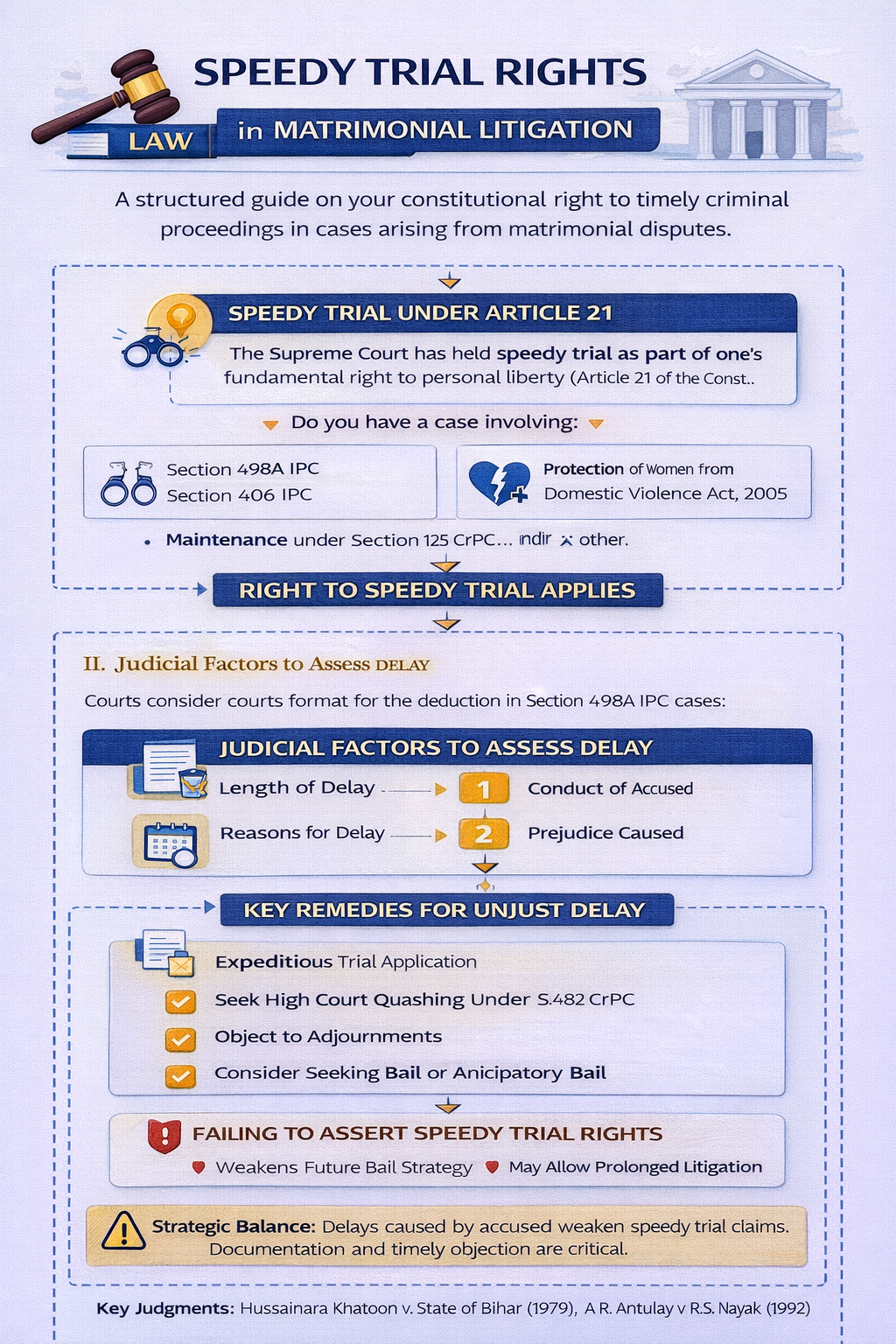
Speedy Trial Rights – Understanding the constitutional guarantee against prolonged criminal and matrimonial proceedings accordingly. 

Litigation arising out of matrimonial disputes often extends for years, undeniably. Criminal complaints under Section 498A IPC, proceedings under the Domestic Violence Act, and maintenance claims under Section 125 CrPC frequently remain pending for prolonged periods.

However, the right to a speedy trial is not merely procedural. It is a constitutional guarantee flowing from Article 21 of the Constitution of India.

This article explains the scope, judicial interpretation, remedies, and strategic use of speedy trial rights in matrimonial criminal litigation.

I. Constitutional Foundation of Speedy Trial

The Supreme Court in Hussainara Khatoon v. State of Bihar recognised that the right to speedy trial is implicit in Article 21.

The Court held that, “A procedure that keeps an accused under prolonged uncertainty violates the guarantee of personal liberty.”

The principle applies equally to matrimonial criminal cases.

II. Applicability in Matrimonial Litigation

Speedy trial rights become relevant in:

  • Criminal complaints under Section 498A IPC

  • Proceedings under Section 406 IPC

  • Cases under the Protection of Women from Domestic Violence Act, 2005

  • Maintenance proceedings under Section 125 CrPC

  • Parallel divorce proceedings impacting criminal defence

Prolonged pendency may undeniably result in:

  • Social stigma

  • Financial burden

  • Career disruption

  • Travel restrictions

  • Psychological distress

Thus, courts recognise that delay itself may amount to prejudice.

III. Judicial Tests for Determining Delay

In A.R. Antulay v. R.S. Nayak, the Supreme Court laid down guiding factors to assess violation of speedy trial rights.

Courts consider:

  • Length of delay
  • Reasons for delay
  • Conduct of the accused
  • Prejudice caused

There is no fixed time limit as such. Each case is assessed on facts.

IV. Can Delay Lead to Quashing?

Yes, in appropriate cases.

Where delay is:

  • Inordinate

  • Unexplained

  • Attributable to prosecution

  • Causing serious prejudice

High Courts may exercise inherent powers under Section 482 CrPC to quash proceedings.

However, mere passage of time is insufficient. The delay must defeat justice.

V. Delay in 498A Trials

Matrimonial criminal cases often suffer delay due to:

  • Repeated adjournments

  • Non-appearance of witnesses

  • Mediation attempts

  • Parallel civil litigation

  • Transfer petitions

Courts have repeatedly emphasised that matrimonial disputes should not become instruments of prolonged harassment.

In Pankaj Kumar v. State of Maharashtra, the Supreme Court reiterated that oppressive delay can violate Article 21.

VI. Speedy Trial in Domestic Violence & Maintenance Proceedings

Proceedings under the Protection of Women from Domestic Violence Act, 2005 are intended to be summary in nature.

Similarly, Section 125 CrPC proceedings aim at immediate relief. Additionally, unjustified delay defeats the object of these provisions.

Respondents may seek:

  • Expedited hearing

  • Time-bound cross-examination

  • Closure of evidence where complainant delays

Hence, courts increasingly discourage unnecessary adjournments.

VII. Remedies Available for Delay

If proceedings are unduly delayed, the accused may:

  • File application for expeditious trial
  • Seek day-to-day hearing
  • Oppose adjournments
  • Approach High Court under Section 482 CrPC
  • Seek discharge where delay impacts fairness

In extreme cases, delay may result in:

  • Quashing of proceedings

  • Reduction of sentence

  • Acquittal due to prejudice

VIII. When Delay Is Attributable to the Accused

The right to speedy trial is reciprocal.

If delay is caused by:

  • Repeated exemption applications

  • Non-cooperation

  • Filing frivolous petitions

  • Seeking adjournments

Undoubtedly, courts will reject speedy trial claims.

Clearly, clean conduct strengthens constitutional argument.

IX. Strategic Importance in Matrimonial Defence

Speedy trial rights become strategically relevant when:

  • Allegations are weak

  • Complainant avoids cross-examination

  • Prosecution witnesses remain absent

  • Case lingers without progress

Also, an application highlighting prejudice may pressure prosecution to proceed diligently.

Delay can weaken prosecution case due to:

  • Fading memory

  • Unavailable witnesses

  • Documentary inconsistencies

However, strategic balance is essential.

X. Practical Checklist for Accused Persons

If your matrimonial criminal case is pending for several years insignificantly:

  • Track hearing dates
  • Maintain record of adjournments
  • Identify cause of delay
  • File written objection to repeated adjournments
  • Seek High Court intervention if necessary

Documenting delay strengthens your case eventually.

XI. Key Judicial Principles

  • Speedy trial is a fundamental right.
  • No rigid time limit exists.
  • Delay must cause prejudice.
  • Conduct of parties is relevant.
  • Courts balance societal interest with individual liberty by all means.

XII. Conclusion

The right to speedy trial, thus, protects individuals from endless criminal litigation. In matrimonial disputes, where personal relationships and reputations are at stake, delay compounds injury.

Also, courts recognise that justice delayed may become justice denied. However, relief depends on facts, conduct, and demonstrable prejudice.

Invoking Article 21 strategically can prevent criminal process from becoming prolonged punishment significantly.


Index of Legal Strategies and Defence is here. 


Frequently Asked Questions

No statutory limit exists, but unreasonable delay may violate Article 21.

Not automatically. Prejudice must be demonstrated.

Yes. Courts often issue directions for expeditious disposal.

Settlement may lead to quashing, rendering speedy trial issue redundant.


Key Contributor :

Mrs. Suprajaa Rajan B.Com., LL.B., LL.M.

+91-9606345150


Posted in Legal Procedure | Tagged Article 21 - Protection of life and personal liberty Criminal Procedure Matrimonial Criminal Law Matrimonial dispute Matrimonial Litigation India Right to Liberty Right to Speedy Trial | Leave a comment

Life Cycle Stages of a Restitution of Conjugal Rights Case

Posted on February 27 by Suprajaa Rajan

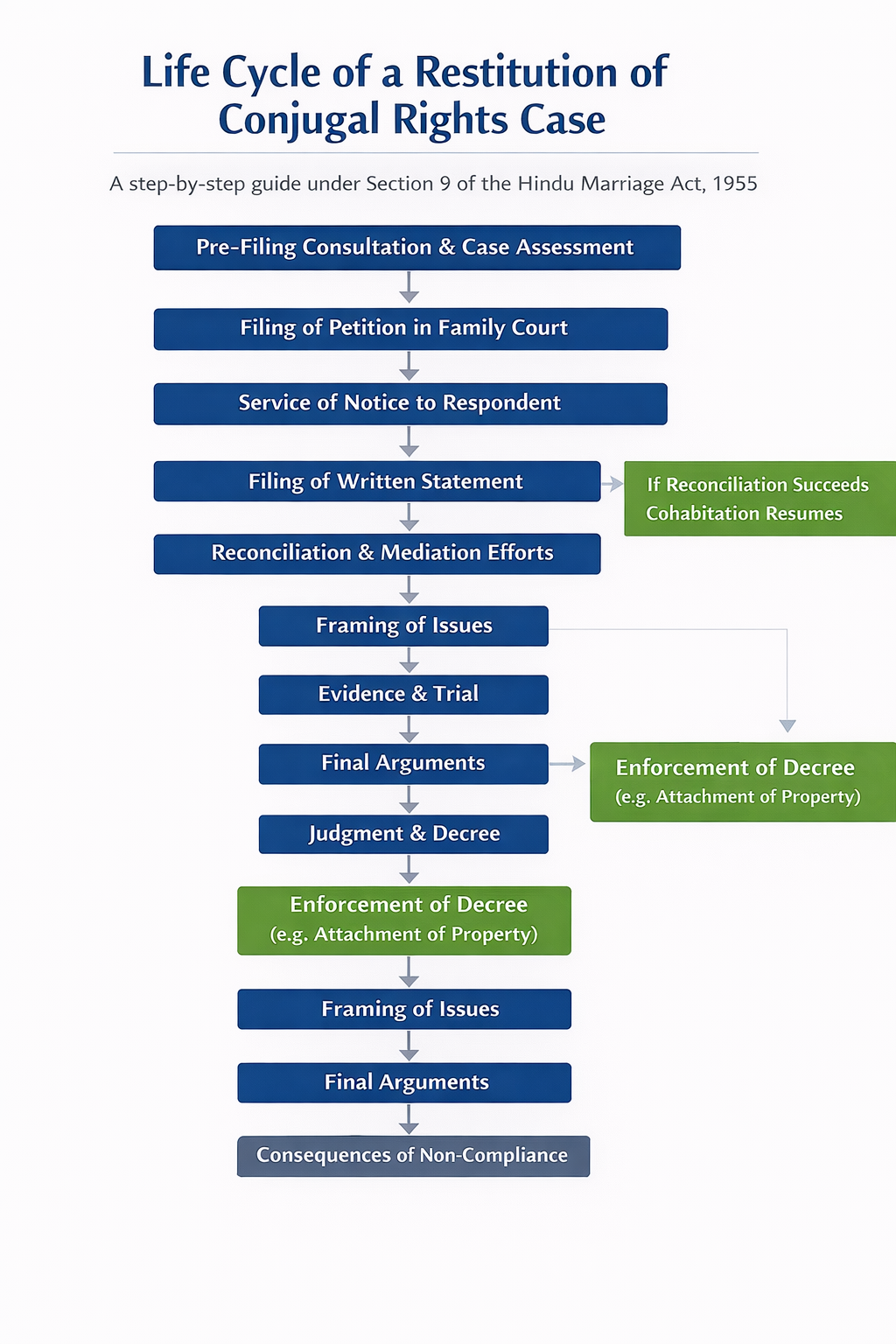
A Step-by-Step Guide Under Section 9 of the Hindu Marriage Act, 1955 : Understanding the procedural journey of a Restitution of Conjugal Rights case under Section 9 of Hindu Marriage Act helps spouses navigate matrimonial litigation with clarity and preparedness.

Restitution of Conjugal Rights is a matrimonial remedy available under Section 9 of the Hindu Marriage Act, 1955. This provision allows an aggrieved spouse to seek a court order directing the other spouse to resume cohabitation.

The court grants relief only if it finds that one spouse has withdrawn from the society of the other without reasonable cause. This article explains the complete life cycle of a Restitution of Conjugal Rights case in a structured manner.

1. Legal Foundation of Restitution of Conjugal Rights

Section 9 of the Hindu Marriage Act, 1955 governs this remedy. The petitioner must prove withdrawal from marital society. The withdrawal must lack reasonable excuse.

The court examines whether the marriage remains legally valid. The court also verifies that no legal ground bars relief.

This remedy aims to preserve marriage rather than dissolve it.

2. Stage One: Pre-Filing Consultation and Case Assessment

The process begins with detailed consultation with a matrimonial lawyer. The lawyer evaluates whether the facts satisfy Section 9 requirements.

The petitioner must establish three essential elements:

  • A valid subsisting marriage.

  • Withdrawal by the respondent from marital society.

  • Absence of reasonable cause for such withdrawal.

The petitioner collects supporting documents before filing. These documents may include marriage certificate, communication records, and proof of separation.

Legal preparation strengthens the petition and reduces procedural objections.

3. Stage Two: Filing of Petition Before Family Court

The petitioner files a petition before the competent Family Court. Jurisdiction depends on residence of parties or place of marriage.

The petition contains material facts of the marriage. It specifies the date of marriage and details of separation. It clearly states how the respondent withdrew without reasonable cause. The petitioner prays for a decree directing restitution of conjugal rights.

After scrutiny, the court registers the petition and issues notice.

4. Stage Three: Service of Notice to the Respondent

The court ensures proper service of notice upon the respondent. Service of notice guarantees compliance with principles of natural justice.

The notice specifies the date of first hearing. The respondent must appear personally or through counsel. If the respondent fails to appear, the court may proceed ex parte.

Proper service validates subsequent proceedings.

5. Stage Four: Filing of Written Statement

The respondent files a written statement in response to the petition. The written statement addresses each allegation made by the petitioner. The respondent may deny withdrawal from marital society. The respondent may also assert reasonable cause for separation.

Common defences include cruelty, harassment, or apprehension of harm. The burden shifts to the respondent to prove reasonable excuse.

This stage defines the core dispute between the parties.

6. Stage Five: Reconciliation and Mediation Efforts

Family Courts prioritise reconciliation in matrimonial matters. The court may refer the parties to mediation or counseling. The judge may personally attempt settlement during hearings. The objective is restoration of marital harmony.

If reconciliation succeeds, the parties resume cohabitation. If reconciliation fails, the matter proceeds to trial.

This stage reflects the restorative intent of Section 9.

7. Stage Six: Framing of Issues

If disputes remain, the court frames issues for adjudication. Issues identify disputed questions of fact and law.

Typical issues may include:

  • Whether the respondent withdrew from marital society.

  • Whether such withdrawal lacked reasonable cause.

  • Whether the petitioner is entitled to decree under Section 9.

Framing of issues narrows the scope of trial. It guides the evidence stage systematically.

8. Stage Seven: Evidence and Trial

The petitioner presents evidence first. The petitioner may submit oral testimony and documentary proof. Witnesses may testify regarding separation and conduct of parties. The respondent has the right to cross-examine the petitioner.

After petitioner’s evidence, the respondent presents defence evidence. The respondent may produce documents and witnesses. The petitioner may cross-examine defence witnesses. The Court records all testimonies carefully.

The trial ensures fairness and evidentiary scrutiny.

9. Stage Eight: Final Arguments

After completion of evidence, the court schedules final arguments. Both parties present legal submissions through their advocates. The petitioner argues absence of reasonable cause. The respondent argues justification for withdrawal.

Counsel may rely on judicial precedents interpreting Section 9. The court evaluates facts and legal principles carefully.

Final arguments assist the court in reaching a reasoned decision.

10. Stage Nine: Judgment and Decree

The court delivers judgment after analysing pleadings and evidence. The judgment contains findings on each framed issue. If satisfied, the court grants a decree of restitution of conjugal rights.The decree directs the respondent to resume cohabitation. If the court finds reasonable cause for withdrawal, it dismisses the petition.

The decree is enforceable under civil procedure mechanisms.

11. Enforcement of Decree

The decree does not compel physical force for cohabitation. The law does not permit forced marital relations. The decree operates through attachment of property under execution proceedings. Non-compliance may result in attachment of respondent’s property.

However, courts prioritise voluntary compliance over coercive enforcement.

12. Consequences of Non-Compliance

Non-compliance has important legal consequences. If no cohabitation occurs for one year after decree, either party may seek divorce. Section 13(1A) of the Hindu Marriage Act provides this ground. Thus, restitution proceedings may indirectly lead to divorce.

This provision balances reconciliation with eventual finality.

13. Appeal and Post-Judgment Remedies

An aggrieved party may file an appeal before the appropriate appellate court. Appeals must comply with limitation periods under applicable law. The appellate court reviews legal and factual findings.The court may affirm, modify, or set aside the decree.

Parties may also seek review under limited circumstances.

Conclusion

A Restitution of Conjugal Rights case follows a structured judicial pathway. The remedy aims to preserve marriage rather than dissolve it.Each procedural stage ensures fairness, reconciliation, and legal scrutiny. Understanding the life cycle empowers individuals to approach the process responsibly.

Proper legal advice and timely action significantly influence the outcome of such proceedings.


Other Life Cycles: 498A IPC Case Lifecycle || Maintenance Case u/s 125 CrPC Lifecycle. Index of all life cycles is here.


Key Contributor:
Mrs Suprajaa Rajan B.Com, LL.B., LL.M.
+91-9606345150

Posted in Legal Procedure | Tagged Hindu Marriage Act HM Act 9 - Restitution of conjugal right Life Cycles of Various case types Matrimonial dispute Matrimonial law Matrimonial Litigation India RCR coverted into Divorce | Leave a comment

Mohammed Azeem Vs Sabeeha & Ors on 22 Sep 2025

Posted on February 18 by ShadesOfKnife

The High Court of Karnataka held that a Family Court has no jurisdiction to issue a Look Out Circular (LOC) for recovery of maintenance under Section 125 Cr.P.C. 

The Court ruled that enforcement of maintenance orders must strictly follow the mechanism provided under Section 125(3) CrPC read with Section 421 CrPC. It permits recovery through attachment and sale of property, and not by issuance of a Look Out Circular.

The Court further observed that continuing an LOC despite a judicial stay order amounts to violation of Article 21 of the Constitution of India. 

Below are the crucial paragraphs that formed the foundation of the Court’s decision:

Para 2

“It is submitted that Section 125(3) provides that in enforcement of the maintenance order Court may issue a warrant for levying the amount due in the manner provided for fines as prescribed under Section 421 of Cr.P.C. Section 421 provides that a warrant for levy of fine by attachment of sale of immovable property.”

“Proviso to Section 421 provides that no such warrant shall be executed by arrest or detention in prison of the offender. The Family Court has no power to issue the look out circular in the process of executing the order of maintenance.”

“The Family Court has no power to issue the look out circular in the process of executing an order that is passed under Section 125 of CrPC.”

“Maintenance orders passed under Section 125 of CrPC is a civil obligation enforced through judicial orders. If party defaults the remedy is to seek execution of the order i.e., attachment of property, warrant of arrest and civil imprisonment.”

“Look out circulars are meant to prevent the accused/offenders from evading criminal process. The LOC cannot be issued for recovering the dues of maintenance.”

Para 6

“Further, continuing the LOC despite the order passed by the Court is illegal and amounts to contempt of Court and it also amounts to violation of rights guaranteed under article 21 of the Constitution of India.”


Mohammed Azeem Vs Saheeba and Ors

Citation :

Other Sources :


Index of Judgments about Look Out Circular notices is here. 


Key Contributor :

Mrs. Suprajaa Rajan B.Com., LL.B., LL.M.,

+91-9606345150


Posted in High Court of Karnataka Judgment or Order or Notification | Tagged 1-Judge Bench Decision Article 21 violation BNSS Sec 144 - Order for maintenance of wives children and parents Criminal Procedure Code 1973 CrPC 125 or BNSS 144 - Order for Maintenance of Wives Children and Parents Family Court jurisdiction LOC in matrimonial disputes Look Out Circular Maintenance recovery Matrimonial dispute Matrimonial law Mohammed Azeem Vs Saheeba and Ors | Leave a comment

Post navigation

  • Newer posts

Search within entire Content of “Shades of Knife”

My Legal X Timeline

Advocate Sandeep Pamarati ๐Ÿ‡ฎ๐Ÿ‡ณ๐Ÿ’ช๐Ÿ‘จ๐Ÿปโ€๐ŸŽ“ Follow

AP High Court Advocate with M Tech (CS) || 12 years in 'Software Industry' as Solution Architect || Blogs at https://t.co/29CB9BzK4w || #TDPTwitter

SandeepPamarati
Retweet on Twitter Advocate Sandeep Pamarati ๐Ÿ‡ฎ๐Ÿ‡ณ๐Ÿ’ช๐Ÿ‘จ๐Ÿปโ€๐ŸŽ“ Retweeted
kanekoathegreat KanekoaTheGreat @kanekoathegreat ·
2 Aug

RFK Jr. blasts CNN's Dana Bash over COVID:

BASH: "You're the HHS security and you're leading to vaccine hesitancy."

KENNEDY: "Do you see your job as ending vaccine hesitancy or telling the truth?"

BASH: "The truth is that there is study after study."

KENNEDY: "You're

Reply on Twitter 2084032302464860218 Retweet on Twitter 2084032302464860218 2081 Like on Twitter 2084032302464860218 9508 X 2084032302464860218
Retweet on Twitter Advocate Sandeep Pamarati ๐Ÿ‡ฎ๐Ÿ‡ณ๐Ÿ’ช๐Ÿ‘จ๐Ÿปโ€๐ŸŽ“ Retweeted
capitallens_ Pratham @capitallens_ ·
16h

Reality Check ๐Ÿค

A men tested 1 batch of Everest Garam Masala in lab costing โ‚น28,000.

After testing, the results that came will shock you:

Azoxystrobin (Pesticide used in Masala):

Limit~ 0.1 mg/kg
Actual~ 0.200 mg/kg
Difference~ 2x

Means according to FSSAI standards limits

Reply on Twitter 2084166590602563711 Retweet on Twitter 2084166590602563711 553 Like on Twitter 2084166590602563711 1825 X 2084166590602563711
Retweet on Twitter Advocate Sandeep Pamarati ๐Ÿ‡ฎ๐Ÿ‡ณ๐Ÿ’ช๐Ÿ‘จ๐Ÿปโ€๐ŸŽ“ Retweeted
sailu_jsp Sailu๐Ÿฆš @sailu_jsp ·
13h

เฐ…เฐฆเฑ‡ Kalyan เฐ—เฐพเฐฐเฑ เฐ…เฐงเฐฟเฐ•เฐพเฐฐเฐ‚เฐฒเฑ‹เฐ•เฐฟ เฐตเฐšเฑเฐšเฐฟเฐจ 24 เฐจเฑ†เฐฒเฐฒเฐฒเฑ‹ เฐˆ เฐ•เฐณเฐพเฐ•เฐพเฐฐเฑเฐฒ เฐ•เฑ‹เฐธเฐ‚ เฐชเฑเฐฐเฐคเฑเฐฏเฑ‡เฐ•เฐ‚เฐ—เฐพ "WoodBanks" เฐเฐฐเฑเฐชเฐพเฐŸเฑเฐšเฑ‡เฐถเฐพเฐฐเฑ๐Ÿ‘๐Ÿป๐Ÿ™๐Ÿป

"เฐฎเฑ€ เฐฆเฐฏ เฐตเฐฒเฐจ เฐ…เฐ‚เฐ•เฑเฐกเฑ เฐ•เฐฐเฑเฐฐเฐ•เฑ เฐเฐคเฑ‡ เฐŽเฐŸเฑเฐตเฐ‚เฐŸเฐฟ เฐ‡เฐฌเฑเฐฌเฐ‚เฐฆเฐฟ เฐฒเฑ‡เฐ•เฑเฐ‚เฐกเฐพ เฐ…เฐฏเฑเฐฏเฐฟเฐ‚เฐฆเฐฟ Sir '"๐Ÿ™๐Ÿป๐Ÿ˜Š

:- AP เฐนเฐธเฑเฐคเฐ•เฐณเฐพ เฐชเฑเฐฐเฐฆเฐฐเฑเฐถเฐจ เฐฎเฐนเฑ‹เฐคเฑเฐธเฐตเฐ‚เฐฒเฑ‹

เฐฎเฐจ Hon'ble @APDeputyCMO เฐถเฑเฐฐเฑ€ @PawanKalyan เฐ—เฐพเฐฐเฐฟเฐคเฑ‹ เฐ•เฐณเฐพเฐ•เฐพเฐฐเฑเฐฒเฑ โฃ๏ธ

Reply on Twitter 2084209810027979069 Retweet on Twitter 2084209810027979069 75 Like on Twitter 2084209810027979069 218 X 2084209810027979069
Retweet on Twitter Advocate Sandeep Pamarati ๐Ÿ‡ฎ๐Ÿ‡ณ๐Ÿ’ช๐Ÿ‘จ๐Ÿปโ€๐ŸŽ“ Retweeted
hunterxtwt hunter @hunterxtwt ·
2 Aug

Reply on Twitter 2083781294614573423 Retweet on Twitter 2083781294614573423 1454 Like on Twitter 2083781294614573423 27719 X 2083781294614573423
Load More

Recent Posts

  • Ishwar Chand Sharma and Ors Vs State of U.P. on 29 May 2026 July 26, 2026
  • Prabhakar Yeshwant Masram and Anr Vs Sou Tula Namdeorao Jaipurkar and Anr on 21 Jul 2026 July 26, 2026
  • Shikha Lall Vs Prince Agarwal on 7 Nov 2024 July 21, 2026
  • Pranjal Poddar and Ors Vs Shivani Gupta on 21 Apr 2026 July 21, 2026
  • Sharad Kumar Pandey Vs Mamta Pandey on 1 Sep 2010 July 21, 2026

Most Read Posts

  • Reply to Section 41A CrPC Notice โ€“ Format with Legal Explanation (5,145 views)
  • Charge Sheet and Final Report Explained (3,169 views)
  • Regular Bail Application Format (Section 437/439 CrPC) (2,548 views)
  • Arrest Procedure in 498A cases after Arnesh Kumar (2,147 views)
  • Discharge Application Format in 498A Case โ€“ Draft, Procedure & Sample Template (2,085 views)
  • Can You Travel Abroad After an FIR Is Registered? โ€“ Legal Position Explained (2,052 views)
  • Life Cycle of a Perjury Case (2,028 views)
  • Application for Certified Copy of FIR โ€“ Format, Procedure and Sample Draft (1,770 views)
  • Appeal, Revision and Review Explained (1,740 views)
  • Life Cycle Stages of a Restitution of Conjugal Rights Case (1,703 views)

Tags

Reportable Judgement or Order (439)2-Judge (Division) Bench Decision (424)Legal Procedure Explained - Interpretation of Statutes (387)Landmark Case (384)1-Judge Bench Decision (370)Catena of Landmark Judgments Referred/Cited to (298)Work-In-Progress Article (215)3-Judge (Full) Bench Decision (101)Sandeep Pamarati (91)Article 21 - Protection of life and personal liberty (80)Issued or Recommended Guidelines or Directions or Protocols to be followed (71)Perjury Under Section 340 CrPC (70)Absurd Or After Thought Or Baseless Or False Or General Or Inherently Improbable Or Improved Or UnSpecific Or Omnibus Or Vague Allegations (62)Reprimands or Setbacks to YCP Govt of Andhra Pradesh (49)Summary Post (47)CrPC 482 - Quash (44)CrPC 125 or BNSS 144 - Order for Maintenance of Wives Children and Parents (43)HM Act Sec 13 - Divorce Granted to Husband (42)Abuse Or Misuse of Process of Court (42)Divorce Granted on Cruelty ground (42)

Categories

Supreme Court of India Judgment or Order or Notification (760)Bare Acts or State Amendments or Statutes or GOs or Notifications issued by Central or State Governments (329)High Court of Andhra Pradesh Judgment or Order or Notification (187)High Court of Delhi Judgment or Order or Notification (167)High Court of Bombay Judgment or Order or Notification (112)High Court of Karnataka Judgment or Order or Notification (95)Legal Procedure (83)High Court of Madras Judgment or Order or Notification (71)High Court of Allahabad Judgment or Order or Notification (63)LLB Study Material (59)General Study Material (56)High Court of Punjab & Haryana Judgment or Order or Notification (53)Assorted Court Judgments or Orders or Notifications (51)High Court of Kerala Judgment or Order or Notification (47)Judicial Activism (for Public Benefit) (47)Prakasam DV Cases (46)District or Sessions or Magistrate Court Judgment or Order or Notification (44)High Court of Madhya Pradesh Judgment or Order or Notification (38)High Court of Gujarat Judgment or Order or Notification (28)High Court of Telangana Judgment or Order or Notification (28)

Recent Comments

  • vinod gupta on Reply to Section 41A CrPC Notice โ€“ Format with Legal Explanation
  • eCourts India on Compromise-Based Quashing in Matrimonial Cases โ€“ Complete Legal Strategy
  • The Divorce Law Firm on Life Cycle Stages of a Divorce case
  • The Divorce Law Firm on Life Cycle Stages of a Divorce case
  • ShadesOfKnife on Sandeep Pamarati Vs Ungrateful Knife (IPC 498A Case)

Archives of SoK

  • July 2026 (19)
  • June 2026 (19)
  • May 2026 (24)
  • April 2026 (33)
  • March 2026 (42)
  • February 2026 (30)
  • January 2026 (21)
  • December 2025 (2)
  • November 2025 (3)
  • October 2025 (17)
  • September 2025 (12)
  • August 2025 (5)
  • July 2025 (10)
  • June 2025 (15)
  • May 2025 (3)
  • April 2025 (10)
  • March 2025 (7)
  • February 2025 (8)
  • January 2025 (1)
  • December 2024 (3)
  • November 2024 (4)
  • October 2024 (16)
  • September 2024 (15)
  • August 2024 (14)
  • July 2024 (11)
  • June 2024 (18)
  • May 2024 (13)
  • April 2024 (9)
  • March 2024 (23)
  • February 2024 (15)
  • January 2024 (11)
  • December 2023 (11)
  • November 2023 (9)
  • October 2023 (13)
  • September 2023 (12)
  • August 2023 (15)
  • July 2023 (17)
  • June 2023 (11)
  • May 2023 (6)
  • April 2023 (5)
  • March 2023 (10)
  • February 2023 (9)
  • January 2023 (12)
  • December 2022 (12)
  • November 2022 (8)
  • October 2022 (13)
  • September 2022 (17)
  • August 2022 (10)
  • July 2022 (21)
  • June 2022 (27)
  • May 2022 (23)
  • April 2022 (32)
  • March 2022 (17)
  • February 2022 (6)
  • January 2022 (2)
  • December 2021 (7)
  • November 2021 (7)
  • October 2021 (6)
  • September 2021 (10)
  • August 2021 (31)
  • July 2021 (45)
  • June 2021 (17)
  • May 2021 (17)
  • April 2021 (18)
  • March 2021 (58)
  • February 2021 (14)
  • January 2021 (50)
  • December 2020 (35)
  • November 2020 (68)
  • October 2020 (67)
  • September 2020 (28)
  • August 2020 (41)
  • July 2020 (20)
  • June 2020 (36)
  • May 2020 (40)
  • April 2020 (38)
  • March 2020 (26)
  • February 2020 (43)
  • January 2020 (35)
  • December 2019 (34)
  • November 2019 (4)
  • October 2019 (18)
  • September 2019 (57)
  • August 2019 (33)
  • July 2019 (12)
  • June 2019 (18)
  • May 2019 (5)
  • April 2019 (19)
  • March 2019 (58)
  • February 2019 (11)
  • January 2019 (90)
  • December 2018 (97)
  • November 2018 (43)
  • October 2018 (31)
  • September 2018 (73)
  • August 2018 (47)
  • July 2018 (143)
  • June 2018 (92)
  • May 2018 (97)
  • April 2018 (59)
  • March 2018 (8)

Blogroll

  • Daaman Promoting Harmony 0
  • Fight against Legal Terrorism Fight against Legal Terrorism along with MyNation Foundation 0
  • Good Morning Good Morning News 0
  • Insaaf India Insaaf Awareness Movement 0
  • MyNation Hope Foundation Wiki 0
  • MyNation.net Equality, Justice and Harmony 0
  • Sarvepalli Legal 0
  • Save Indian Family Save Indian Family Movement 0
  • SIF Chandigarh SIF Chandigarh 0
  • The Male Factor The Male Factor 0
  • Unitedmen Foundation a dedicated community forged with the mission to unite men facing legal challenges in marital disputes. 0
  • Vaastav Foundation The Social Reality 0
  • Vinayak my2centsworth – This blog is for honest law abiding men, married or planning to get married 0
  • Voice4india Indian Laws, Non-profits, Environment 0
  • Writing Law Writing Law by Ankur 0

RSS Cloudflare Status

  • EWR (Newark) on 2026-09-02 September 2, 2026
    THIS IS A SCHEDULED EVENT Sep 2, 05:00 - 09:00 UTC Jul 21, 15:30 UTC Scheduled - We will be performing scheduled maintenance in EWR (Newark) datacenter on 2026-09-02 between 05:00 and 09:00 UTC.Traffic might be re-routed from this location, hence there is a possibility of a slight increase in latency during this maintenance window […]
    Cloudflare

RSS List of Spam Server IPs from Project Honeypot

  • 141.98.84.74 | SD August 3, 2026
    Event: Bad Event | Total: 254 | First: 2026-07-13 | Last: 2026-08-03
Owned and Operated by Advocate Sandeep Pamarati and Advocate Suprajaa Rajan
Proudly powered by WordPress
Theme: Flint by Star Verte LLC

Bad Behavior has blocked 461 access attempts in the last 7 days.

pixel
