web analytics

Menu

Skip to content
Shades of Knife
  • Home
  • True Colors of a Vile Wife
  • Need Inspiration?
  • Blog Updates
  • SOK Gallery
  • Vile News Reporter
  • About Me
  • Contact Me

Shades of Knife

True Colors of a Vile Wife

Tag: Matrimonial dispute

Dr.Sushil Kumar Purbey and Anr Vs The State of Bihar and Ors on 9 Mar 2026 – Judgement Summary

Posted on April 9 by Suprajaa Rajan

In Dr. Sushil Kumar Purbey & Anr. vs State of Bihar & Ors. (2026), the Supreme Court addressed the issue of parity in quashing criminal proceedings under Section 482 CrPC [Section 528 BNSS] in matrimonial disputes.

The case arose from a dowry harassment FIR filed by the complainant against her husband and his family members. While the High Court quashed proceedings against the sister-in-law on the ground of vague and omnibus allegations, it declined similar relief to the parents-in-law.

Aggrieved by this differential treatment, the appellants approached the Supreme Court. The Court, upon examining the FIR, held that:

  • The allegations against all accused were identical in nature.
  • No specific role or overt act was attributed to the parents-in-law.
  • Differential treatment by the High Court was unsustainable in law.

Consequently, the Court extended the benefit of quashing to the parents-in-law as well, reiterating that criminal law cannot be invoked on the basis of generalised allegations.

“7. A comparative reading of the FIR reveals that the allegations levelled against the sister-in-law and those against the present appellants are, in all material particulars, identical.”

“7. The lone allegation that stands separately against the present appellants is that they would quarrel. This, however, does not constitute a criminal offence and cannot, by itself, sustain cognizance of the offences.”

“8. The criminal complaint against the appellants was, however, lodged only in March 2022, nearly a year after the filing of the divorce petition. Though this delay, standing alone, would not constitute a sufficient ground for quashing the criminal proceedings against the appellants. However, viewed in conjunction with the absence of any specific allegations attributable to them, the delay lends credence to the submission that the criminal complaint against the in-laws may have been instituted by way of a counter-blast to the divorce proceedings initiated by the husband.”

“10. In view of the foregoing, we are of the considered opinion that the High Court erred in applying different standards to persons who stand on an identical footing insofar as the nature of the allegations against them is concerned.”

Decision

  • The Supreme Court allowed the appeal and set aside the High Court’s order to the extent it denied relief to the parents-in-law. It held that identical allegations must be treated uniformly, and differential treatment is legally unsustainable.
  • The Court emphasized that vague and omnibus allegations without specific roles cannot sustain criminal prosecution. It further noted that the delay in filing the FIR, coupled with absence of specific allegations, supported the inference of misuse.
  • Accordingly, exercising its powers under Section 482 CrPC [Section 528 BNSS], the Court quashed the criminal proceedings against the appellants.
  • However, the Court clarified that proceedings against the husband would continue independently in accordance with law.

Dr.Sushil Kumar Purbey and Anr Vs The State of Bihar and Ors on 9 Mar 2026

Citation : 2026 INSC 212

Other Sources :


Index of Quash judgements is here.


Related Legal Concepts

  • Inherent powers of High Court
  • Quashing of FIR
  • Delay in FIR
  • Omnibus Allegations in matrimonial cases
  • Abuse of Process of Law


Key Contributor :
Mrs. Suprajaa Rajan B.Com., LL.B., LL.M.
+91-9606345150


Posted in Supreme Court of India Judgment or Order or Notification | Tagged 2-Judge (Division) Bench Decision Absurd Or After Thought Or Baseless Or False Or General Or Inherently Improbable Or Improved Or UnSpecific Or Omnibus Or Vague Allegations Dowry Harassment law Dr.Sushil Kumar Purbey and Anr Vs The State of Bihar and Ors Matrimonial dispute Quashing of FIR | Leave a comment

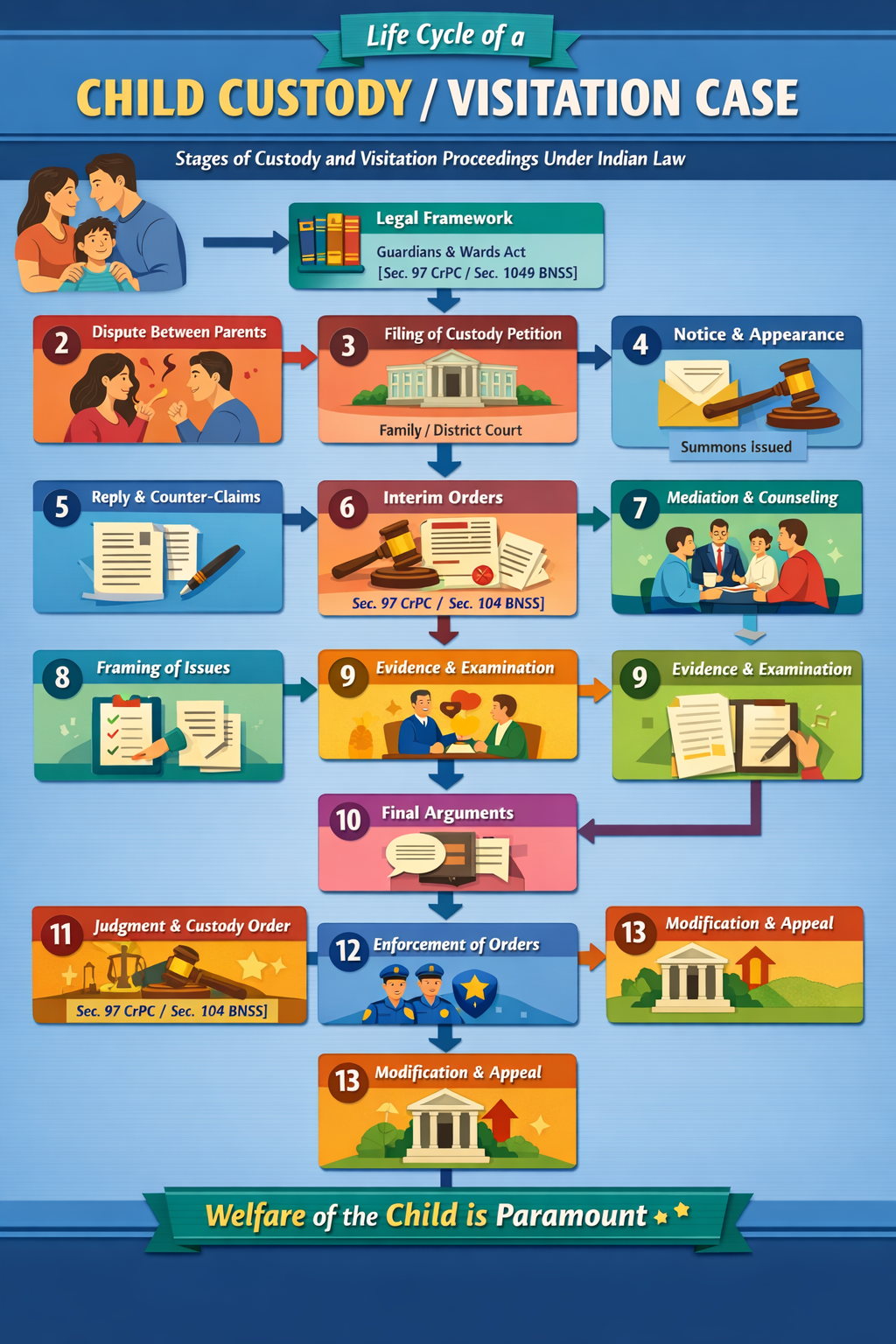
Life Cycle Stages of a Child Custody / Visitation Case

Posted on April 4 by Suprajaa Rajan

A Step-by-Step Guide to Custody Proceedings Under Indian Law

Understanding the procedural journey of a child custody or visitation case helps parents protect the best interests of the child while navigating court proceedings effectively.

Child custody disputes arise when parents disagree on the care, control, and upbringing of a minor child. Indian courts decide such matters based on the welfare and best interests of the child, which remains the paramount consideration.

Custody and visitation matters are governed primarily by the Hindu Minority and Guardianship Act, 1956, the Guardians and Wards Act, 1890, and relevant provisions of procedural law under the Code of Civil Procedure, 1908, along with certain applicable provisions of the Code of Criminal Procedure, 1973 (CrPC) and the Bharatiya Nagarik Suraksha Sanhita, 2023 (BNSS).

The following stages explain the complete life cycle of a child custody or visitation case.

1. Legal Foundation of Child Custody Law

First, it is important to understand the legal framework governing custody disputes.

Courts decide custody matters under the Guardians and Wards Act, 1890, and personal laws applicable to the parties. However, the court always prioritises the welfare of the child over the rights of the parents.

Additionally, in urgent situations, a parent may seek interim protection or custody through procedural provisions. For instance, a party may invoke interim relief mechanisms similar to those under Section 97 CrPC / Section 104 BNSS, where applicable.

Therefore, courts adopt a child-centric approach while deciding custody and visitation matters.

2. Stage One: Dispute Between Parents Regarding Custody

Typically, a custody dispute arises when parents separate or initiate matrimonial proceedings.

For example, disputes often arise during divorce, judicial separation, or domestic conflicts. One parent may retain custody of the child, while the other parent may seek custody or visitation rights.

At this stage, the parties may attempt informal resolution or family mediation. However, if the dispute continues, the aggrieved parent may approach the court.

3. Stage Two: Filing of Custody Petition Before Court

If the dispute remains unresolved, the aggrieved parent files a custody or guardianship petition before the competent Family Court or District Court.

The petition includes details of the child, relationship between parties, and the relief sought. The petitioner may seek permanent custody, joint custody, or visitation rights.

Additionally, the petitioner may file an application for interim custody or visitation.

After filing, the court registers the case and issues notice to the respondent parent.

4. Stage Three: Service of Notice and Appearance of Respondent

Next, the court ensures that the respondent receives proper notice of the proceedings.

The notice specifies the date of hearing and directs the respondent to appear before the court.

The respondent may appear personally or through legal counsel. If the respondent fails to appear, the court may proceed ex parte.

Proper service of notice ensures compliance with principles of natural justice.

5. Stage Four: Filing of Reply and Counter-Claims

After receiving notice, the respondent files a written statement or reply to the petition.

The respondent may oppose the claim for custody or propose alternative arrangements such as shared custody or limited visitation.

In some cases, the respondent may also file counter-claims seeking custody or enhanced visitation rights.

This stage helps the court identify the issues in dispute.

6. Stage Five: Interim Custody and Visitation Orders

Since custody matters involve immediate welfare concerns, courts often pass interim orders at an early stage.

For instance, the court may grant temporary custody to one parent and visitation rights to the other parent.

In urgent situations, a parent may also seek immediate production of the child through remedies similar to Section 97 CrPC / Section 104 BNSS, where unlawful detention is alleged.

The court considers factors such as age of the child, emotional needs, and stability before granting interim relief.

These interim orders remain effective during the pendency of the case.

7. Stage Six: Mediation and Counseling

Subsequently, the court may refer the parties to mediation or counseling.

Family Courts actively encourage amicable settlement in custody disputes. Mediation helps parents arrive at mutually acceptable arrangements for custody and visitation.

Additionally, courts may interact with the child to understand the child’s preferences.

If mediation succeeds, the parties record a settlement before the court. If mediation fails, the case proceeds to trial.

8. Stage Seven: Framing of Issues

If disputes persist, the court frames issues for determination.

These issues may include questions such as which parent can better ensure the welfare of the child and whether visitation rights should be granted.

Framing of issues helps structure the trial and focus on relevant questions.

9. Stage Eight: Evidence and Examination

At this stage, both parties present evidence to support their claims.

For example, parties may produce documents relating to income, living conditions, and educational background. Witnesses may testify regarding the child’s upbringing and parental conduct.

The court may also consider expert reports from child psychologists or welfare officers.

Additionally, the court may interact with the child, depending on the child’s age and maturity.

The opposing party has the right to cross-examine witnesses.

10. Stage Nine: Final Arguments

After completion of evidence, both parties present final arguments before the court.

Each party attempts to demonstrate that their custody arrangement serves the best interests of the child.

The court carefully evaluates all evidence, statutory provisions, and judicial precedents.

The welfare of the child remains the overriding consideration at this stage.

11. Stage Ten: Judgment and Final Custody Order

Finally, the court delivers its judgment after considering all aspects of the case.

The court may grant sole custody, joint custody, or structured visitation rights.

The order may also include directions regarding education, healthcare, and overall welfare of the child.

The court ensures that the final order promotes the child’s physical, emotional, and psychological well-being.

12. Enforcement of Custody and Visitation Orders

After passing the order, both parties must comply with the court’s directions.

If one parent violates the custody or visitation order, the aggrieved parent may approach the court for enforcement.

In appropriate cases, courts may invoke coercive measures. For instance, the court may direct production of the child through mechanisms similar to Section 97 CrPC / Section 104 BNSS, where applicable.

Courts may also modify orders to ensure compliance and protect the child’s welfare.

13. Modification and Appeal

Child custody orders are not final in the strict sense because circumstances may change over time.

Therefore, either parent may seek modification of custody or visitation arrangements if circumstances materially change.

Additionally, an aggrieved party may file an appeal before a higher court challenging the custody order.

The appellate court reviews whether the lower court correctly applied the principle of welfare of the child.

Conclusion

Child custody and visitation cases require careful judicial balancing of parental rights and the welfare of the child. Therefore, courts follow a structured process that includes interim relief, mediation, evidence, and final adjudication.

Understanding the life cycle of a custody case helps parents approach the process with clarity and responsibility. Ultimately, the law ensures that every decision prioritises the best interests and well-being of the child.


Other Life Cycles: DV Case Lifecycle || Maintenance Case u/s 125 CrPC Lifecycle. Index is here.


Key Contributor :
Mrs. Suprajaa Rajan B.Com., LL.B., LL.M.
+91-9606345150


Posted in Legal Procedure | Tagged child custody law Life Cycle Stages of a Child Custody case Life Cycles of Various case types Matrimonial Criminal Law Matrimonial dispute Matrimonial Litigation India | Leave a comment

Vinod Kumar Vs Seema Devi and Anr on 16 Mar 2026 – Judgement Summary

Posted on April 4 by Suprajaa Rajan

In Vinod Kumar Vs Seema Devi and Anr, the Delhi High Court examined whether the maintenance awarded by the Family Court under Section 125 CrPC (now Section 144 BNSS) required interference.

The petitioner (husband) challenged the maintenance granted to his wife and daughter, arguing that:

  • The wife lived separately without justification
  • She had rental income
  • His own income was wrongly assessed

However, the Court found that the wife had consistently alleged cruelty, which justified her separate residence. Moreover, the Court emphasized that an able-bodied husband cannot evade maintenance liability by understating income or taking voluntary retirement.

After analysing income, evidence, and legal principles, the Court upheld the Family Court’s order and dismissed the revision petition.

“9. It is well settled that the object of granting maintenance is to prevent vagrancy by compelling those who can provide support to those who are unable to support themselves and who have a moral claim to support.”

“10. Section 125 of the CrPC elucidates conditions under which a wife may be deemed ineligible for maintenance. These conditions include instances where the wife is engaged in adulterous activities, where she, without any justifiable cause, refuse to cohabit with her husband, or where both parties have agreed to live apart through mutual consent. These provisions delineate clear legal parameters that govern the entitlement or disentitlement of maintenance to ensure that the support is granted only under circumstances that warrant such financial assistance.”

“13. Merely because Respondent No.1 remained in possession of the matrimonial house, the same does not signify that the petitioner did not neglect to maintain the respondents. Even if the contention of the petitioner is taken as correct, the case of the respondents is not helmed on Respondent No.1 leaving the company of the petitioner due to neglect, so as to disentitle her from grant of maintenance. Rather, Respondent No.1 has made categorical allegations of cruelty, which is sufficient to satisfy the threshold of balance of probabilities.”

“18. It appears to be implausible that the petitioner would have taken retirement from his stable well-paying job without securing any other mode of income. As it is a normal tendency of the parties to not disclose their true income in matrimonial disputes, the Courts are permitted to make some guess work and arrive at a figure that a party may reasonably be earning.”

“19. The petitioner is a well- bodied man capable of earning, he cannot shirk his sacrosanct duty to financially support his wife and children by claiming that he has no income after retirement apart from his pension. The petitioner is thus obliged to earn and maintain his family, and the purported lower MSP prices for his land would thus not help his case.”

Decision

The Delhi High Court held that:

  • The maintenance awarded by the Family Court was justified and reasonable
  • The wife’s allegations of cruelty justified her separate residence
  • The husband’s claim of low income was not credible

Accordingly:

  • The Court refused to interfere with the maintenance order
  • The revision petition was dismissed
  • Maintenance (₹10,000 per month each after majority, with 10% increase every two years) was upheld

Vinod Kumar Vs Seema Devi and Anr on 16 Mar 2026

Citation :

Other Sources :


Index of Maintenance Judgements under Sec 125 CrPC is here.


Related Legal Concepts

  • Maintenance under Section 125 CrPC (Section 144 BNSS)
  • Cruelty as Ground for Separate Residence
  • Assessment of Income in Maintenance Cases
  • Doctrine of Social Justice in Family Law
  • Adverse Inference for Non-Disclosure of Income


Key Contributor :
Mrs. Suprajaa Rajan B.Com., LL.B., LL.M.
+91-9606345150


Posted in High Court of Delhi Judgment or Order or Notification | Tagged 1-Judge Bench Decision CrPC 125 or BNSS 144 - Order for Maintenance of Wives Children and Parents cruelty under IPC Matrimonial Criminal Law Matrimonial dispute Vinod Kumar Vs Seema Devi and Anr | Leave a comment

Mariya Zafar and Anr Vs State of UP and Anr on 31 Mar 2026

Posted on April 3 by Suprajaa Rajan

In Mariya Zafar v. State of U.P., the Allahabad High Court (Lucknow Bench) addressed whether a Magistrate can reject an application seeking production of financial documents under Section 91 CrPC (now Section 94 BNSS) in a domestic violence proceeding.

The petitioner-wife alleged domestic violence, dowry harassment, and financial suppression by her husband. She sought disclosure of his bank accounts, Income Tax Returns (ITRs), and GST records to determine his actual income for maintenance proceedings under the Domestic Violence Act.

However, the trial court rejected her application, stating that concealment could instead be dealt with under Section 340 CrPC (now Section 379 BNSS). Challenging this, the petitioner approached the High Court.

The High Court emphasized compliance with the Supreme Court’s ruling in Rajnesh v. Neha, which mandates full financial disclosure in maintenance matters. After examining the husband’s ITRs (produced in sealed cover), the Court found that he had misrepresented his occupation and income. Consequently, the High Court set aside the Magistrate’s order and directed reconsideration.

“11.“…the court below has observed that there is no need to summon the Income Tax Returns of opposite party No. 2 to ascertain the income and the reason has been recorded that in case the opposite party is concealing the material fact, then he will be prosecuted under Section 340 Cr.P.C.”

“14….the opposite party No. 3 is directed to bring the income tax return of the last two years filed by the opposite party No. 2…”

“15.ITRs of opp. party No. 2… indicate that the opposite party No. 2 is an Architect… in the AY 2023-24 his total income was Rs. 4,85,290.00 and in the AY 2024-25 his income was Rs. 5,07,680.00.”

“17. ..the order dated 19-01-2026… is hereby set aside and the said court is directed to take fresh decision in the matter in the light of judgment… within 6 weeks…”

Decision

The Allahabad High Court:

  • Set aside the Magistrate’s order dated 19.01.2026.
  • Directed the trial court to reconsider the application under Section 91 CrPC (Section 94 BNSS) in light of Rajnesh v. Neha.
  • Ordered that the matter be decided within 6 weeks.
  • Allowed the petitioner access to the respondent’s ITRs.
  • Emphasised the importance of truthful financial disclosure in maintenance proceedings.

Mariya Zafar and Anr Vs State of UP and Anr on 31 Mar 2026

Citation :

Other Sources :


Index of Domestic Violence judgments is here.

Related Legal Concepts

Explore related stages and concepts in criminal procedure:

  • Financial Disclosure in Maintenance Proceedings
  • Summoning of Documents 
  • Burden of Proof 
  • Judicial Duty to Ensure Fair Maintenance Adjudication
  • Enforcement of Supreme Court Guidelines (Rajnesh v. Neha)


Key Contributor :

Mrs. Suprajaa Rajan B.Com., LL.B., LL.M.

+91-9606345150

Posted in High Court of Allahabad Judgment or Order or Notification | Tagged 1-Judge Bench Decision Mariya Zafar and Anr Vs State of UP and Anr Matrimonial Criminal Law Matrimonial dispute Rajnesh Vs Neha | Leave a comment

Asha G Vs State of Karnataka on 6 Jan 2026 – Judgement Summary

Posted on April 1 by Suprajaa Rajan

498A IPC: Karnataka High Court Quashes Case Against Neighbour Under CrPC 482 (BNSS 528)

In Asha G Vs State of Karnataka, the High Court of Karnataka addressed a crucial legal issue regarding the misuse of Section 498A IPC in matrimonial disputes.

The petitioner, who was merely a neighbour of the complainant, sought quashing of criminal proceedings under Section 482 of the Code of Criminal Procedure (CrPC) (now BNSS Section 528). The allegations against her were limited to instigating the husband, without any direct involvement in matrimonial cruelty or dowry harassment.

After examining the complaint and charge sheet, the Court observed that:

  • The petitioner was not a relative of the husband.
  • Allegations were vague and omnibus, lacking specific acts.
  • Inclusion of the petitioner amounted to misuse of criminal law.

Consequently, the Court held that continuing proceedings against the neighbour would be an abuse of process of law, and therefore quashed the case against her.

“The name of this petitioner is nowhere found except contending that she has instigated the husband… otherwise the petitioner would not fit into the definition of family as is obtaining under Section 498A of the IPC.”

“Neighbours of the husband’s family are not relatives of the husband and cannot be implicated for offences under Section 498A of the IPC.”

“Permitting further proceedings against this petitioner would become an abuse of the process of the law and result in miscarriage of justice.”


Asha G Vs State of Karnataka on 6 Jan 2026

Index of Quash Judgments is here. 


Related Legal Concepts

  • Quashing of FIR
  • Relative under Section 498A IPC
  • Abuse of Process of Law
  • False Implication in Matrimonial Disputes
  • Requirement of Specific Allegations in FIR/Charge Sheet


Key Contributor :

Mrs. Suprajaa Rajan B.Com., LL.B., LL.M.

+91-9606345150

Posted in High Court of Karnataka Judgment or Order or Notification | Tagged 1-Judge Bench Decision Abuse Or Misuse of Process of Court Asha G Vs State of Karnataka CrPC 482 - Quash CrPC 482 – IPC 498A Quashed Matrimonial Criminal Law Matrimonial dispute Misuse of Section 498A of IPC Quashing of FIR | Leave a comment

Emilda Varghese @ Rajani Vs Varghese P Kuriakose on 6 Oct 2025 – Judgement Summary

Posted on April 1 by Suprajaa Rajan

In a significant ruling, the Kerala High Court adjudicated a batch of matrimonial appeals and revision petitions involving divorce on the ground of cruelty and maintenance rights of the wife.

After carefully evaluating the evidence, the High Court upheld the divorce, concluding that the wife’s conduct amounted to mental cruelty. Importantly, the Court emphasised that ill-treatment of children can constitute cruelty toward the spouse.

The following paragraphs form the core reasoning of the Court:

“The nature of cruelty which would entitle a spouse to divorce must certainly be identical in all religious faiths… The right to live without matrimonial cruelty is a fundamental right under Article 21.”

“If the wife is guilty of ill-treating the children, certainly it would cause reasonable apprehension in the mind of the husband that it would be harmful or injurious for him to live with her.”

“The expression ‘harmful or injurious’ is not confined to physical acts alone, but equally extends to mental torture.”

“The petitioner has proved his allegations not only through his own testimony, but also by examining witnesses who had personal acquaintance with the alleged ill-treatment.”

“It is settled law that making such suicide attempts or threats would amount to cruelty on the spouse.”

Decision

After considering all aspects, the High Court delivered the following decision:

  • Divorce Granted: The Court upheld the dissolution of marriage on the ground of cruelty.
  • Wife’s Challenge to Divorce Rejected: The Court found no merit in her appeal against divorce.
  • Maintenance Enhanced: The Court increased maintenance from ₹6,000 to ₹15,000 per month.
  • Partial Relief to Wife: The revision petition was partly allowed only to the extent of enhancement.

Thus, the Court ensured both marital justice and financial fairness.


Emilda Varghese @ Rajani Vs Varghese P Kuriakose on 6 Oct 2025

Index of Divorce Judgements is here. 


Related Legal Concepts

Explore related stages and concepts in criminal procedure:

  • Matrimonial Cruelty
  • Child abuse
  • Uniform Legal Standard
  • Maintenance
  • Appellate Powers


Key Contributor :

Mrs. Suprajaa Rajan B.Com, LL.B., LL.M.

+91-9606345150


Posted in High Court of Kerala Judgment or Order or Notification | Tagged 2-Judge (Division) Bench Decision Divorce Act 1869 Sec 10 - Grounds for dissolution of marriage Divorce Granted on Cruelty ground Divorce Granted to Wife Emilda Varghese @ Rajani Vs Varghese P Kuriakose Matrimonial dispute | Leave a comment

Deep Dey Vs State of West Bengal and Anr on 6 Mar 2026

Posted on March 15 by Suprajaa Rajan

Calcutta High Court: Stamp Paper Marriage Has No Legal Validity; Bigamy Case Quashed

A single-judge Bench of the Calcutta High Court held that a marriage executed only through an agreement on stamp paper has no legal recognition under the Hindu Marriage Act, 1955.

The complainant claimed that she married the petitioner through a written agreement on stamp paper. Later, the petitioner entered into a registered marriage with another woman. The complainant then filed a criminal case alleging bigamy under Section 494 IPC and cruelty under Section 498A IPC.

However, the Court clarified that Hindu law requires solemnisation of marriage through recognised rites and ceremonies. A mere written agreement cannot create a valid marriage. Therefore, criminal liability for bigamy cannot arise from such an arrangement. As a result, the Court held that continuation of the criminal case would amount to an abuse of the process of law.

“A marriage by signature on an agreement paper is a mode of union unrecognised under this Act. It is a procedure unknown to Hindu Law; consequently, a ‘contractual marriage’ is a legal nullity.” (Para 13)

“Unless the marriage is ‘solemnized’ in the legal sense, it cannot be said to be a marriage for the purposes of the penal section.” (Para 14)

“There is a vital distinction between a marriage that is technically void… and a union that is legally non-existent from the start.” (Para 17)

“The shift from a ‘stamp paper marriage’ in the FIR to a ‘temple marriage’ in subsequent witness statements is a transparent attempt to cure a fatal legal infirmity.” (Para 18)

Decision of the Court

Therefore, the Calcutta High Court held that the alleged stamp-paper marriage had no legal validity under Hindu law. Consequently, the ingredients of Section 494 IPC and Section 498A IPC were not satisfied.

The Court thus exercised its inherent powers under Section 482 CrPC (Section 528 BNSS) and quashed the criminal proceedings against the petitioner. However, the Court clarified that the complainant may pursue other remedies available in law, if applicable.


Deep day Vs State of West Bengal and Anr on 6 Mar 2026

Citation :

Other Sources :


Index of Bigamy Judgments under Sections 494 and 495 of IPC is here.


Key Contributor :

Mrs. Suprajaa Rajan B.Com., LL.B., LL.M.

+91-9606345150


Posted in High Court of Calcutta Judgment or Order or Notification | Tagged 1-Judge Bench Decision CrPC 482 – Criminal Proceeding Quashed CrPC 482 – IPC 498A Quashed Deep Dey Vs State of West Bengal and Anr Hindu Marriage Act Matrimonial dispute Summary Post | Leave a comment

Asish Bera and Ors Vs The State of West Bengal and Anr on 30 Jan 2026

Posted on March 9 by Suprajaa Rajan

The Calcutta High Court held that criminal proceedings cannot continue when the complaint lacks specific material and shows serious inconsistencies. The Court found that the complainant had filed two complaints regarding the same alleged incident without proper explanation.

The Court also noted contradictions in the statements recorded during investigation. It observed that courts must prevent misuse of criminal law in matrimonial disputes. Exercising its inherent powers under Section 482 CrPC (Section 528 BNSS), the Court held that continuation of the proceedings would amount to abuse of the process of law and therefore quashed the case.

The following paragraphs explain the reasoning that led to the decision.

“On careful perusal of the materials on record, it can be found that the Opposite Party no. 2 lodged the complaint before Sagar Police Station… The subsequent complaint was filed before the Court of Learned ACJM at Ranaghat under Section 156(3) Cr.P.C… also in respect of the incident dated March 18, 2022.”

“No satisfactory explanation can be found as to why the de-facto complainant had to lodge two different complaint before different places in respect of self-same incident within a gap of 2 months.”

“It is also a settled law that in case it is found that the nature of complaint primarily found to be of vexatious and frivolous, the courts owes a duty to look into the other evidences collected and did not have to be confined within the content of the written complaint.”

“Therefore on the cumulative assessment of the entire facts and circumstances this Court do not find any material or sufficient material to allow the proceedings to continue further since it would otherwise be absolute abuse of the process of law.” 

Decision

The Calcutta High Court allowed the criminal revision petition.

The Court quashed the criminal proceedings pending before the Magistrate. The Court held that continuation of the case would amount to abuse of the process of law.


Asish Bera and Ors Vs The State of West Bengal and Anr on 30 Jan 2026

Citation :2026:CHC-AS:134

Other Sources :


Index of Quash judgments is here.


Key Contributor :

Mrs. Suprajaa Rajan B.Com., LL.B., LL.M.

+91-9606345150


Posted in High Court of Calcutta Judgment or Order or Notification | Tagged 1-Judge Bench Decision Asish Bera & Ors. v. The State of West Bengal & Anr CrPC 482 - Quash CrPC 482 – IPC 498A Quashed Matrimonial dispute Matrimonial disputes law Quashing of FIR | Leave a comment

Reshma T.R. Vs Ainish M on 26 Dec 2025 – Judgment Summary

Posted on March 9 by Suprajaa Rajan

The Kerala High Court considered a petition filed under its supervisory jurisdiction challenging an order of the Family Court concerning interim custody of a minor child. The petitioner sought judicial intervention regarding the custody arrangement ordered by the Family Court.

During the hearing, the petitioner sought permission to withdraw the petition. The Court examined whether the welfare or security of the child required judicial interference. The Court noted that the Family Court had granted interim custody of the child to the father and found no material to suggest that the child’s welfare was compromised.

The High Court held that no interference was necessary and permitted the petitioner to withdraw the petition.

“After arguing this matter for some time, Sri.A.K.Haridas-learned Counsel for the petitioner, sought permission to withdraw this original petition. He, however, added that his client’s interest is only to ensure that the child is safe and nothing more.”

“We do not find from the order that the security or welfare of the child has been compromised. In fact, the child has been given interim custody to her own father; and do not see why we should distrust him from taking care of her.”

“In such circumstances, we are also of the opinion that the best course forward to the petitioner is to withdraw this original petition.”

Decision

The Kerala High Court dismissed the original petition as withdrawn. The Court found no reason to interfere with the Family Court’s interim custody arrangement.


Reshma T.R Vs Ainish. M on 26 Dec 2025

Citation :2025:KER:98856

Other Sources :


Key Contributor :

Mrs. Suprajaa Rajan B.Com., LL.B., LL.M.

+91-9606345150


Posted in High Court of Kerala Judgment or Order or Notification | Tagged 2-Judge (Division) Bench Decision child custody law Family Court orders Matrimonial Criminal Law Matrimonial dispute Reshma T.R. Vs Ainish M | Leave a comment

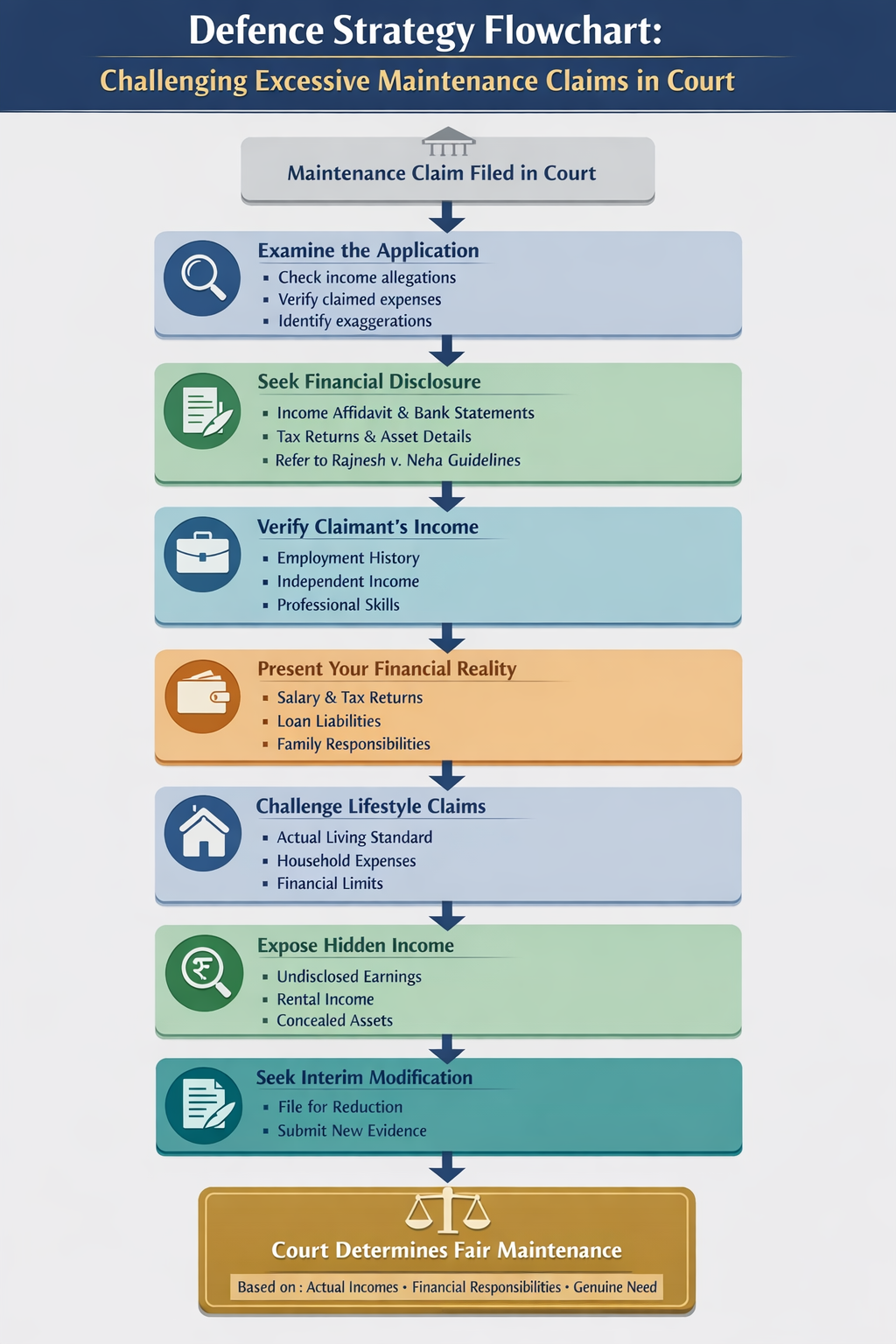
How to Defend Excessive Maintenance Claims in Matrimonial Cases

Posted on March 8 by Suprajaa Rajan

Maintenance disputes are among the most contested aspects of matrimonial litigation. Frequently, one spouse may claim maintenance that is significantly higher than the actual financial capacity of the other spouse. In such situations, it becomes essential to understand how the law evaluates maintenance claims and what legal strategies can be used to challenge excessive demands.

Therefore, defending an exaggerated maintenance claim requires a careful examination of financial records, legal principles, and factual circumstances. This article explains the legal framework governing maintenance in India and the practical strategies that can be used to contest excessive claims before the court.

Understanding Maintenance Under Indian Law

Maintenance is intended to provide financial support to a spouse who lacks sufficient means for sustenance. However, the objective of maintenance law is not to punish one spouse or provide an unjust enrichment to the other.

In India, maintenance may be claimed under several legal provisions, including:

  • Section 125 of the Code of Criminal Procedure

  • Section 24 and Section 25 of the Hindu Marriage Act

  • Section 20 of the Protection of Women from Domestic Violence Act

These provisions aim to ensure that a financially dependent spouse is able to maintain a reasonable standard of living.

However, courts also recognise that maintenance must be proportionate to the paying spouse’s income and financial obligations.

Principles Considered by Courts While Determining Maintenance

Before awarding maintenance, courts usually evaluate several factors. These factors help ensure that the amount awarded is fair and balanced.

Some important considerations include:

  • Actual income of both spouses

  • Standard of living during the marriage

  • Financial liabilities of the respondent

  • Employment and earning capacity of the claimant

  • Number of dependents

  • Educational qualifications and work experience of the spouse claiming maintenance

The Supreme Court in Rajnesh v. Neha laid down detailed guidelines for determining maintenance, including mandatory disclosure of assets and liabilities by both parties.

These guidelines aim to prevent exaggerated or misleading maintenance claims.

Step 1: Demand Full Financial Disclosure

First and foremost, the respondent should insist on complete financial disclosure by the claimant spouse.

This may include:

  • Income tax returns

  • Bank statements

  • Salary slips

  • Investment records

  • Details of movable and immovable property

If the claimant is employed or earning independently, these records can significantly weaken an inflated maintenance claim.

Moreover, courts are increasingly strict about accurate disclosure of financial information.

Step 2: Challenge Incorrect Income Allegations

In many cases, the claimant spouse may overstate the respondent’s income. For example, allegations may be made that the respondent earns large amounts through business or undisclosed sources.

However, such allegations must be supported by documentary evidence.

Therefore, the respondent should submit:

  • Income tax returns

  • Salary certificates

  • Business financial statements

  • Loan repayment records

These documents help the court determine the actual earning capacity of the respondent.

Step 3: Highlight Financial Liabilities

Another important strategy is to demonstrate the existing financial responsibilities of the respondent.

Courts consider various liabilities such as:

  • Housing loans or personal loans

  • Responsibility for elderly parents

  • Educational expenses of children

  • Medical expenses of dependents

When these obligations are properly documented, the court may reduce the maintenance amount to a reasonable level.

Step 4: Show the Claimant’s Earning Capacity

Maintenance is generally awarded when the spouse is unable to maintain herself or himself independently. However, if the claimant is educated, professionally qualified, or capable of earning, courts may reduce or deny excessive maintenance claims.

For instance, if the claimant has:

  • Professional qualifications

  • Prior employment history

  • Independent income sources

the court may conclude that the claimant has the capacity to support themselves partially or fully.

Consequently, exaggerated maintenance demands may be rejected.

Step 5: Point Out Lifestyle Exaggeration

Sometimes, the claimant may attempt to justify a high maintenance demand by claiming an extremely luxurious lifestyle during marriage.

However, the court will examine whether such claims are realistic and supported by evidence.

Therefore, the respondent should present evidence such as:

  • Actual household expenses

  • Standard living conditions during marriage

  • Financial limitations faced during the relationship

This helps demonstrate that the maintenance claim is inflated beyond reality.

Step 6: Seek Interim Relief Modification

If the court has already granted interim maintenance, the respondent may apply for modification if the amount is unreasonable.

Modification may be sought when:

  • Financial circumstances change

  • New evidence regarding income emerges

  • The claimant conceals financial information

Courts may revise interim maintenance orders to ensure fairness.

Step 7: Expose Suppression of Income or Assets

In some cases, the claimant spouse may hide employment or assets while claiming maintenance.

If evidence of such concealment is produced, courts may:

  • Reduce the maintenance amount

  • Dismiss the claim

  • Impose costs

Therefore, conducting proper financial investigation and documentation becomes crucial.

Importance of Documentation in Maintenance Defence

Defending excessive maintenance claims largely depends on documentary evidence. Oral allegations rarely carry much weight unless supported by records.

Important documents include:

  • Income tax returns

  • Salary certificates

  • Bank statements

  • Loan documents

  • Property records

  • Employment history of the claimant spouse

When these records are properly presented, they provide the court with a realistic picture of the financial situation of both parties.

Conclusion

Maintenance laws aim to protect financially dependent spouses. However, they are not meant to enable unreasonable or inflated financial demands. Therefore, defending excessive maintenance claims requires a structured legal approach, accurate financial disclosure, and strategic presentation of evidence.

By demonstrating the true income, financial liabilities, and earning capacity of both spouses, the respondent can ensure that the court determines a fair and reasonable maintenance amount.

Ultimately, courts strive to strike a balance between financial support and fairness, ensuring that maintenance orders reflect genuine need rather than exaggerated claims.


Index of Legal Strategies and Defence is here.


Key Contributor :

Mrs. Suprajaa Rajan B.Com., LL.B., LL.M.

+91-9606345150


Posted in Legal Procedure | Tagged BNSS Sec 144 - Order for maintenance of wives children and parents legal strategy and defence Maintenance Defence Matrimonial Criminal Law Matrimonial dispute matrimonial offences | Leave a comment

Post navigation

  • Older posts
  • Newer posts

Search within entire Content of “Shades of Knife”

My Legal X Timeline

Advocate Sandeep Pamarati 🇮🇳💪👨🏻‍🎓 Follow

AP High Court Advocate with M Tech (CS) || 12 years in 'Software Industry' as Solution Architect || Blogs at https://t.co/29CB9BzK4w || #TDPTwitter

SandeepPamarati
Retweet on Twitter Advocate Sandeep Pamarati 🇮🇳💪👨🏻‍🎓 Retweeted
rose_k01 Rosy @rose_k01 ·
10 Jul

Women in the Yao village of China are famous for having the Longest hair in the World averaging 6 feet long. Women in their 80s still don't have a Single grey hair!! Their secret is Fermented Rice water. Watch How they make & use it 🍚🌾💧

Reply on Twitter 2075635918879523325 Retweet on Twitter 2075635918879523325 897 Like on Twitter 2075635918879523325 3904 X 2075635918879523325
Retweet on Twitter Advocate Sandeep Pamarati 🇮🇳💪👨🏻‍🎓 Retweeted
ani ANI @ani ·
12 Jul

Promo | ANI Podcast with R.V.S. Mani, Former Under Secretary, Ministry of Home Affairs, Premieres Today at 5 PM IST

"Narendra Modi and Amit Shah Were the Targets in the Ishrat Jahan Case."

"None of the Files Had the Term 'Hindu Terror' Until 2010."

"Digvijaya Singh Asked Me to

Reply on Twitter 2076177037165994029 Retweet on Twitter 2076177037165994029 623 Like on Twitter 2076177037165994029 1599 X 2076177037165994029
Retweet on Twitter Advocate Sandeep Pamarati 🇮🇳💪👨🏻‍🎓 Retweeted
kolla_ch1 చైతన్య కొల్లా @kolla_ch1 ·
11 Jul

రాష్ట్రం మీద పడి.. అడ్డ గాడిదల్లా... అడ్డ దిడ్డంగా పడి దోచుకున్న అడ్డమైన ఎదవలకు ఊడిగం చేస్తూ

డెలివరీ బాయ్ లను అవమానపర్చే

ఆ నెల తక్కువ సన్నాసి మొహాన కొట్టండయ్యా దీన్ని 🤷‍♂️

Reply on Twitter 2076018293836808437 Retweet on Twitter 2076018293836808437 111 Like on Twitter 2076018293836808437 643 X 2076018293836808437
Retweet on Twitter Advocate Sandeep Pamarati 🇮🇳💪👨🏻‍🎓 Retweeted
shunyta_007 𝐒ɦυ𐓣𝗒𝗍α @shunyta_007 ·
12 Jul

Observation Skills 🔥

Reply on Twitter 2076189650885226496 Retweet on Twitter 2076189650885226496 537 Like on Twitter 2076189650885226496 3151 X 2076189650885226496
Load More

Recent Posts

  • Prahlad Singh Bhati Vs N.C.T. Delhi and Anr on 23 Mar 2001 July 12, 2026
  • Application for Day-to-Day Trial – Format, Procedure & Sample Draft July 8, 2026
  • Pooja Ramesh Singh Vs JnK Bank and Anr on 02 Jul 2026 July 8, 2026
  • A.S.S.K.Durga Prasad Vs NCDRC and Ors on 24 Jun 2026 July 7, 2026
  • Application for Permanent Exemption from Appearance – Format, Procedure & Sample Draft July 7, 2026

Most Read Posts

  • Reply to Section 41A CrPC Notice – Format with Legal Explanation (5,051 views)
  • Anu Aggarwal Vs Sushant Aggarwal on 20 Jan 2026 (3,607 views)
  • Umme Farva Vs State of U.P. and Anr on 14 Jan 2026 (3,533 views)
  • Charge Sheet and Final Report Explained (3,008 views)
  • Regular Bail Application Format (Section 437/439 CrPC) (2,376 views)
  • Neha Lal Vs Abhishek Kumar on 20 Jan 2026 (2,153 views)
  • Arrest Procedure in 498A cases after Arnesh Kumar (2,058 views)
  • Discharge Application Format in 498A Case – Draft, Procedure & Sample Template (1,927 views)
  • Can You Travel Abroad After an FIR Is Registered? – Legal Position Explained (1,870 views)
  • Life Cycle of a Perjury Case (1,796 views)

Tags

Reportable Judgement or Order (436)2-Judge (Division) Bench Decision (422)Legal Procedure Explained - Interpretation of Statutes (386)Landmark Case (383)1-Judge Bench Decision (366)Catena of Landmark Judgments Referred/Cited to (297)Work-In-Progress Article (215)3-Judge (Full) Bench Decision (101)Sandeep Pamarati (91)Article 21 - Protection of life and personal liberty (80)Issued or Recommended Guidelines or Directions or Protocols to be followed (71)Perjury Under 340 CrPC (66)Absurd Or After Thought Or Baseless Or False Or General Or Inherently Improbable Or Improved Or UnSpecific Or Omnibus Or Vague Allegations (62)Reprimands or Setbacks to YCP Govt of Andhra Pradesh (49)Summary Post (47)CrPC 482 - Quash (44)HM Act Sec 13 - Divorce Granted to Husband (42)Divorce Granted on Cruelty ground (42)Legal Terrorism (41)Abuse Or Misuse of Process of Court (40)

Categories

Supreme Court of India Judgment or Order or Notification (758)Bare Acts or State Amendments or Statutes or GOs or Notifications issued by Central or State Governments (329)High Court of Andhra Pradesh Judgment or Order or Notification (187)High Court of Delhi Judgment or Order or Notification (164)High Court of Bombay Judgment or Order or Notification (112)High Court of Karnataka Judgment or Order or Notification (95)Legal Procedure (83)High Court of Madras Judgment or Order or Notification (71)High Court of Allahabad Judgment or Order or Notification (62)LLB Study Material (59)General Study Material (56)High Court of Punjab & Haryana Judgment or Order or Notification (53)Assorted Court Judgments or Orders or Notifications (51)High Court of Kerala Judgment or Order or Notification (47)Judicial Activism (for Public Benefit) (47)Prakasam DV Cases (46)District or Sessions or Magistrate Court Judgment or Order or Notification (44)High Court of Madhya Pradesh Judgment or Order or Notification (38)High Court of Gujarat Judgment or Order or Notification (28)High Court of Telangana Judgment or Order or Notification (28)

Recent Comments

  • eCourts India on Compromise-Based Quashing in Matrimonial Cases – Complete Legal Strategy
  • The Divorce Law Firm on Life Cycle Stages of a Divorce case
  • The Divorce Law Firm on Life Cycle Stages of a Divorce case
  • ShadesOfKnife on Sandeep Pamarati Vs Ungrateful Knife (IPC 498A Case)
  • KONURU VINAYKUMAR on Sandeep Pamarati Vs Ungrateful Knife (IPC 498A Case)

Archives of SoK

  • July 2026 (13)
  • June 2026 (19)
  • May 2026 (24)
  • April 2026 (33)
  • March 2026 (42)
  • February 2026 (30)
  • January 2026 (21)
  • December 2025 (2)
  • November 2025 (3)
  • October 2025 (17)
  • September 2025 (12)
  • August 2025 (5)
  • July 2025 (10)
  • June 2025 (15)
  • May 2025 (3)
  • April 2025 (10)
  • March 2025 (7)
  • February 2025 (8)
  • January 2025 (1)
  • December 2024 (3)
  • November 2024 (4)
  • October 2024 (16)
  • September 2024 (15)
  • August 2024 (14)
  • July 2024 (11)
  • June 2024 (18)
  • May 2024 (13)
  • April 2024 (9)
  • March 2024 (23)
  • February 2024 (15)
  • January 2024 (11)
  • December 2023 (11)
  • November 2023 (9)
  • October 2023 (13)
  • September 2023 (12)
  • August 2023 (15)
  • July 2023 (17)
  • June 2023 (11)
  • May 2023 (6)
  • April 2023 (5)
  • March 2023 (10)
  • February 2023 (9)
  • January 2023 (12)
  • December 2022 (12)
  • November 2022 (8)
  • October 2022 (13)
  • September 2022 (17)
  • August 2022 (10)
  • July 2022 (21)
  • June 2022 (27)
  • May 2022 (23)
  • April 2022 (32)
  • March 2022 (17)
  • February 2022 (6)
  • January 2022 (2)
  • December 2021 (7)
  • November 2021 (7)
  • October 2021 (6)
  • September 2021 (10)
  • August 2021 (31)
  • July 2021 (45)
  • June 2021 (17)
  • May 2021 (17)
  • April 2021 (18)
  • March 2021 (58)
  • February 2021 (14)
  • January 2021 (50)
  • December 2020 (35)
  • November 2020 (68)
  • October 2020 (67)
  • September 2020 (28)
  • August 2020 (41)
  • July 2020 (20)
  • June 2020 (36)
  • May 2020 (40)
  • April 2020 (38)
  • March 2020 (26)
  • February 2020 (43)
  • January 2020 (35)
  • December 2019 (34)
  • November 2019 (4)
  • October 2019 (18)
  • September 2019 (57)
  • August 2019 (33)
  • July 2019 (12)
  • June 2019 (18)
  • May 2019 (5)
  • April 2019 (19)
  • March 2019 (58)
  • February 2019 (11)
  • January 2019 (90)
  • December 2018 (97)
  • November 2018 (43)
  • October 2018 (31)
  • September 2018 (73)
  • August 2018 (47)
  • July 2018 (143)
  • June 2018 (92)
  • May 2018 (97)
  • April 2018 (59)
  • March 2018 (8)

Blogroll

  • Daaman Promoting Harmony 0
  • Fight against Legal Terrorism Fight against Legal Terrorism along with MyNation Foundation 0
  • Good Morning Good Morning News 0
  • Insaaf India Insaaf Awareness Movement 0
  • MyNation Hope Foundation Wiki 0
  • MyNation.net Equality, Justice and Harmony 0
  • Sarvepalli Legal 0
  • Save Indian Family Save Indian Family Movement 0
  • SIF Chandigarh SIF Chandigarh 0
  • The Male Factor The Male Factor 0
  • Unitedmen Foundation a dedicated community forged with the mission to unite men facing legal challenges in marital disputes. 0
  • Vaastav Foundation The Social Reality 0
  • Vinayak my2centsworth – This blog is for honest law abiding men, married or planning to get married 0
  • Voice4india Indian Laws, Non-profits, Environment 0
  • Writing Law Writing Law by Ankur 0

RSS Cloudflare Status

  • Cloudflare Storage Maintenance July 16, 2026
    THIS IS A SCHEDULED EVENT Jul 16, 12:00 - 13:00 UTC Jul 6, 22:38 UTC Scheduled - Cloudflare has scheduled maintenance for our backend storage systems. Services will continue to operate normally, but customers will be unable to create/delete/modify Client-Side Security settings via the Dashboard or the public API for a period of up to […]
    Cloudflare

RSS List of Spam Server IPs from Project Honeypot

  • 188.95.67.196 | S July 13, 2026
    Event: Bad Event | Total: 106 | First: 2025-03-27 | Last: 2026-07-13
Owned and Operated by Advocate Sandeep Pamarati and Advocate Suprajaa Rajan
Proudly powered by WordPress
Theme: Flint by Star Verte LLC

Bad Behavior has blocked 1085 access attempts in the last 7 days.

pixel