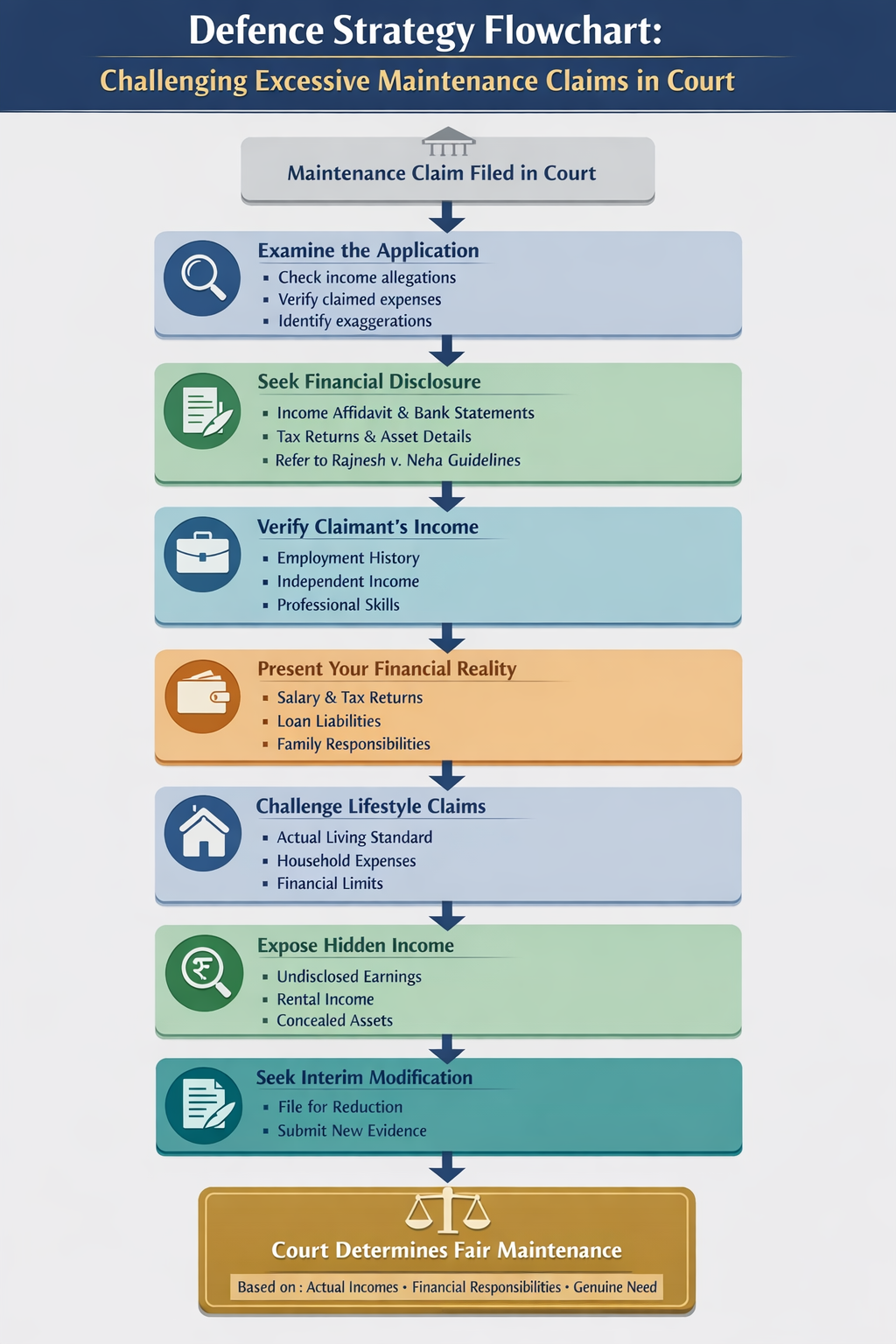
In Vinod Kumar Vs Seema Devi and Anr, the Delhi High Court examined whether the maintenance awarded by the Family Court under Section 125 CrPC (now Section 144 BNSS) required interference.
The petitioner (husband) challenged the maintenance granted to his wife and daughter, arguing that:
- The wife lived separately without justification
- She had rental income
- His own income was wrongly assessed
However, the Court found that the wife had consistently alleged cruelty, which justified her separate residence. Moreover, the Court emphasized that an able-bodied husband cannot evade maintenance liability by understating income or taking voluntary retirement.
After analysing income, evidence, and legal principles, the Court upheld the Family Court’s order and dismissed the revision petition.
“9. It is well settled that the object of granting maintenance is to prevent vagrancy by compelling those who can provide support to those who are unable to support themselves and who have a moral claim to support.”
“10. Section 125 of the CrPC elucidates conditions under which a wife may be deemed ineligible for maintenance. These conditions include instances where the wife is engaged in adulterous activities, where she, without any justifiable cause, refuse to cohabit with her husband, or where both parties have agreed to live apart through mutual consent. These provisions delineate clear legal parameters that govern the entitlement or disentitlement of maintenance to ensure that the support is granted only under circumstances that warrant such financial assistance.”
“13. Merely because Respondent No.1 remained in possession of the matrimonial house, the same does not signify that the petitioner did not neglect to maintain the respondents. Even if the contention of the petitioner is taken as correct, the case of the respondents is not helmed on Respondent No.1 leaving the company of the petitioner due to neglect, so as to disentitle her from grant of maintenance. Rather, Respondent No.1 has made categorical allegations of cruelty, which is sufficient to satisfy the threshold of balance of probabilities.”
“18. It appears to be implausible that the petitioner would have taken retirement from his stable well-paying job without securing any other mode of income. As it is a normal tendency of the parties to not disclose their true income in matrimonial disputes, the Courts are permitted to make some guess work and arrive at a figure that a party may reasonably be earning.”
“19. The petitioner is a well- bodied man capable of earning, he cannot shirk his sacrosanct duty to financially support his wife and children by claiming that he has no income after retirement apart from his pension. The petitioner is thus obliged to earn and maintain his family, and the purported lower MSP prices for his land would thus not help his case.”
Decision
The Delhi High Court held that:
- The maintenance awarded by the Family Court was justified and reasonable
- The wife’s allegations of cruelty justified her separate residence
- The husband’s claim of low income was not credible
Accordingly:
- The Court refused to interfere with the maintenance order
- The revision petition was dismissed
- Maintenance (₹10,000 per month each after majority, with 10% increase every two years) was upheld
Citation :
Other Sources :
Index of Maintenance Judgements under Sec 125 CrPC is here.
Related Legal Concepts
- Maintenance under Section 125 CrPC (Section 144 BNSS)
- Cruelty as Ground for Separate Residence
- Assessment of Income in Maintenance Cases
- Doctrine of Social Justice in Family Law
- Adverse Inference for Non-Disclosure of Income
Key Contributor :
Mrs. Suprajaa Rajan B.Com., LL.B., LL.M.
+91-9606345150