web analytics

Menu

Skip to content
Shades of Knife
  • Home
  • True Colors of a Vile Wife
  • Need Inspiration?
  • Blog Updates
  • SOK Gallery
  • Vile News Reporter
  • About Me
  • Contact Me

Shades of Knife

True Colors of a Vile Wife

Tag: Matrimonial Criminal Law

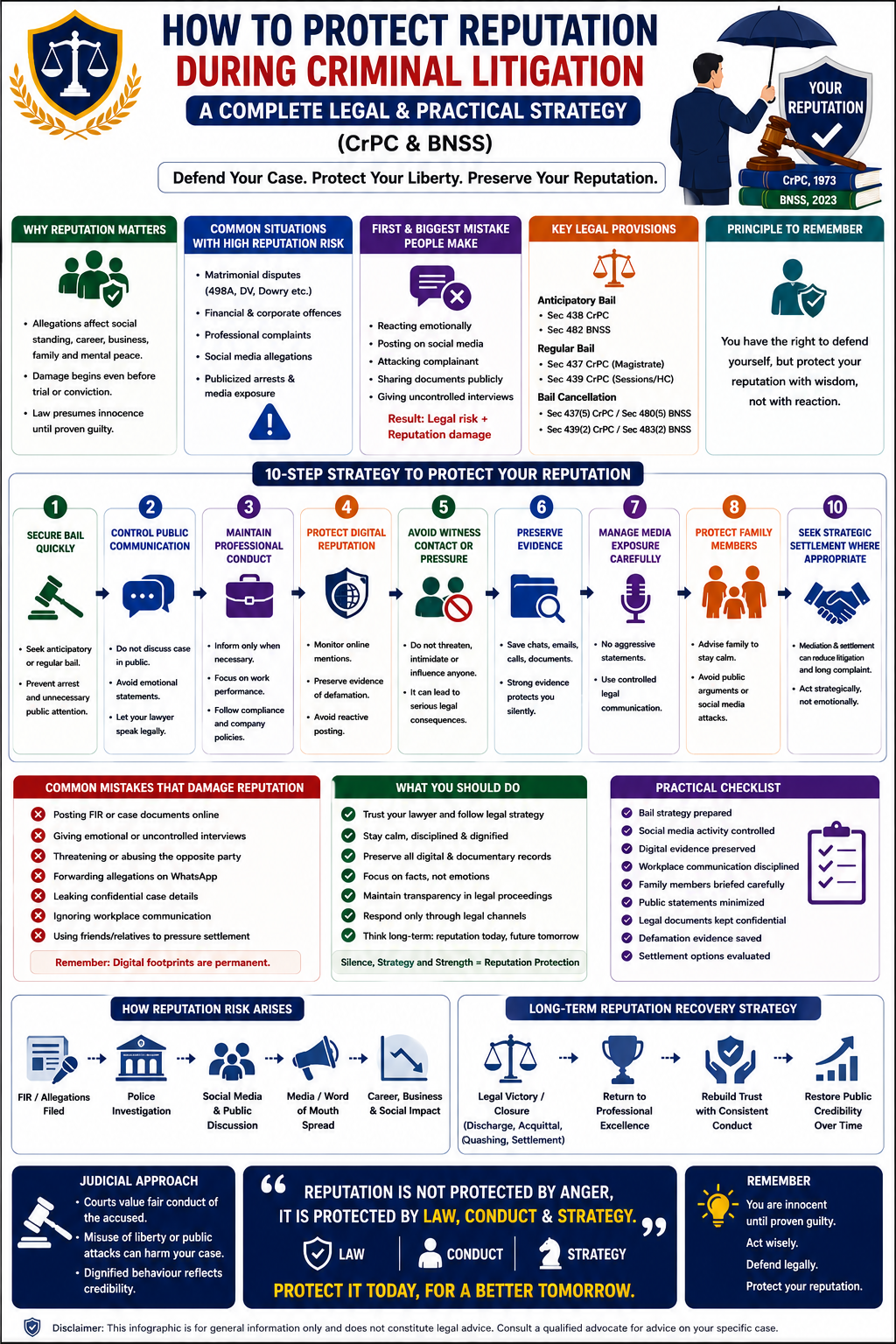
How to Protect Reputation During Criminal Litigation – A Complete Legal & Practical Strategy

Posted on May 21 by Suprajaa Rajan

Criminal litigation affects more than just legal rights—it can deeply impact a person’s reputation, career, family relationships, social standing, mental peace, and professional future. In many cases, especially involving:

  • Matrimonial disputes
  • Financial allegations
  • Corporate complaints
  • Sexual offence accusations
  • Social media controversies
  • Publicised arrests

the reputational damage begins long before trial concludes.

Unfortunately, many accused persons focus only on the courtroom battle while ignoring the parallel battle for reputation management. However, in modern litigation, public perception, digital footprints, media exposure, and social conduct can significantly influence both personal and professional consequences.

Therefore, understanding how to protect reputation during criminal litigation becomes just as important as preparing legal defence.

This article explains the legal safeguards, strategic precautions, media risks, digital reputation protection, workplace considerations, social media strategy, and practical defence measures, with references to the Code of Criminal Procedure, 1973 (CrPC) and the Bharatiya Nagarik Suraksha Sanhita, 2023 (BNSS).

Why Reputation Protection Matters During Criminal Litigation

Criminal allegations often trigger immediate consequences such as:

  • Social stigma
  • Workplace scrutiny
  • Suspension from employment
  • Loss of business relationships
  • Family pressure
  • Media exposure
  • Online defamation
  • Emotional isolation

Even before conviction, many people face “social punishment.”

However, Indian criminal law follows a foundational principle:

An accused is presumed innocent until proven guilty.

Therefore, protecting reputation lawfully and strategically becomes essential.

Common Situations Where Reputation Risks Arise

Reputation concerns frequently arise in:

Matrimonial Cases

Examples:

  • Section 498A allegations
  • Domestic violence complaints
  • Dowry accusations

Financial & Corporate Cases

Examples:

  • Fraud allegations
  • Cheating complaints
  • Breach of trust allegations

Professional Complaints

Examples:

  • Workplace harassment complaints
  • Regulatory proceedings

Public or Political Disputes

Examples:

  • Viral social media allegations
  • Media trials
  • Public accusations

Immediate Mistake Most Accused Persons Make

Many accused react emotionally by:

  • Posting online explanations
  • Uploading case documents
  • Attacking complainants publicly
  • Sending threatening messages
  • Giving uncontrolled interviews

These reactions often worsen both:

  • Legal exposure
  • Reputational damage

Therefore, controlled conduct becomes the first rule of reputation defence.

Step 1: Understand the Difference Between Legal Defence and Public Defence

Winning in court and protecting reputation are related—but different—objectives.

Legal Defence Focuses On:

  • Evidence
  • Procedure
  • Bail
  • Trial strategy

Reputation Protection Focuses On:

  • Public conduct
  • Professional stability
  • Digital footprint
  • Communication discipline
  • Social perception

A smart defence strategy addresses both simultaneously.

Step 2: Secure Bail Quickly

Arrest often causes the greatest reputational damage.

Therefore, obtaining timely bail becomes critical.

Relevant provisions include:

Anticipatory Bail

  • Section 438 CrPC (Section 482 BNSS)

Regular Bail

  • Section 437 CrPC (Section 480 BNSS)
  • Section 439 CrPC (Section 483 BNSS)

Prompt legal protection may help:

  • Prevent custodial humiliation
  • Reduce public escalation
  • Maintain employment stability
  • Avoid unnecessary media attention

Step 3: Control Public Communication

One of the most important rules:

Do not litigate emotionally in public.

Avoid:

  • Social media rants
  • Public accusations
  • Aggressive WhatsApp forwards
  • Emotional videos
  • Publishing confidential documents

Why?

Because these actions may:

  • Become evidence
  • Trigger fresh allegations
  • Harm settlement opportunities
  • Damage judicial perception

Step 4: Maintain Professional Conduct

If you are employed or running a business:

Inform Only When Necessary

Disclose matters carefully and professionally.

Avoid Emotional Narratives at Workplace

Keep communication factual.

Preserve Performance Records

Strong professional records support credibility.

Follow Internal Compliance Processes

Especially in regulated sectors.

Professional stability often protects reputation better than public defence.

Step 5: Protect Digital Reputation

Modern criminal litigation increasingly unfolds online.

Therefore, digital reputation management is essential.

Monitor Social Media Exposure

Check for:

  • Viral allegations
  • Fake posts
  • Defamatory content
  • Impersonation accounts

Preserve Evidence of Online Defamation

Save:

  • Screenshots
  • URLs
  • Timestamps
  • Comments
  • Shared posts

This may later support legal remedies.

Avoid Reactive Posting

Never respond impulsively.

Silence often protects credibility better than emotional explanation.

Step 6: Avoid Witness Contact or Pressure

After litigation begins, avoid:

  • Direct confrontation
  • Emotional calls
  • Threatening language
  • Settlement coercion

Such conduct may lead to allegations involving:

  • Witness intimidation
  • Obstruction
  • Bail cancellation

Relevant provisions include:

  • Section 437(5) CrPC (Section 480(5) BNSS)
  • Section 439(2) CrPC (Section 483(2) BNSS)

Controlled communication protects both liberty and reputation.

Step 7: Preserve Documentary and Digital Evidence

Strong evidence quietly protects reputation over time.

Preserve:

  • WhatsApp chats
  • Emails
  • Financial records
  • Employment documents
  • Call logs
  • Travel history
  • Medical records
  • Social media records

Well-preserved evidence often defeats false narratives.

Step 8: Manage Media Exposure Carefully

In high-profile cases, media involvement may become unavoidable.

If media attention arises:

Avoid Aggressive Public Statements

Statements made emotionally may later backfire.

Use Controlled Legal Communication

Only authorised legal responses should be issued.

Avoid Leaking Documents

Unauthorised disclosure may create complications.

Maintain Dignity

Courts often observe public conduct indirectly.

Step 9: Protect Family Members From Escalation

In matrimonial or family disputes, relatives often become emotionally involved.

Common mistakes include:

  • Public arguments
  • Social media attacks
  • Community pressure tactics
  • Verbal confrontations

These actions may:

  • Escalate litigation
  • Create additional evidence
  • Harm settlement possibilities

A disciplined family response matters.

Step 10: Use Legal Remedies Against False Public Allegations

If defamatory allegations spread publicly, legal remedies may be available.

Possible actions may include:

  • Defamation proceedings
  • Injunction applications
  • Takedown requests
  • Cyber complaints

However, strategy matters.

Not every public statement requires immediate aggressive litigation.

Sometimes controlled restraint works better.

Reputation Risks in Matrimonial Cases

Matrimonial criminal litigation creates unique reputational risks because allegations often involve:

  • Cruelty
  • Dowry harassment
  • Domestic violence
  • Emotional abuse

Social assumptions arise quickly—even before evidence is examined.

Therefore, accused persons should focus on:

Maintaining Dignified Conduct

Avoid retaliation.

Preserving Financial Transparency

Hidden financial conduct damages credibility.

Avoiding Public Character Assassination

Courts dislike vindictive conduct.

Pursuing Structured Settlement Where Appropriate

Strategic settlement often limits long-term reputational harm.

Reputation Risks for Professionals

Professionals such as:

  • Doctors
  • Lawyers
  • Government employees
  • Corporate executives
  • Teachers
  • Public figures

may face additional consequences.

Possible impacts include:

  • Suspension
  • Departmental inquiry
  • Licensing scrutiny
  • Client loss
  • Contract termination

Therefore, coordination between:

  • Criminal defence
  • Employment strategy
  • Regulatory compliance

becomes essential.

Common Mistakes That Damage Reputation Further

Avoid:

Publicly Sharing FIR Copies

May escalate online circulation.

Giving Uncontrolled Interviews

Statements may later contradict defence.

Posting Emotional Content Online

Digital footprints remain permanent.

Threatening the Opposite Party

May trigger fresh allegations.

Using Friends or Relatives to Pressure Settlement

Indirect intimidation can backfire.

Ignoring Professional Compliance

Silence at workplace may create suspicion.

Practical Reputation Protection Checklist

If facing criminal litigation, ensure:

  • Bail strategy prepared
  • Social media activity controlled
  • Digital evidence preserved
  • Workplace communication disciplined
  • Family members briefed carefully
  • Public statements minimized
  • Legal documents kept confidential
  • Defamation evidence archived
  • Settlement options evaluated strategically

Judicial Approach

Courts increasingly recognise:

  • Media trials
  • Social stigma
  • Online harassment
  • Misuse of digital narratives

At the same time, courts also examine:

  • Conduct of accused
  • Communication behaviour
  • Witness interaction
  • Digital activity

Therefore, reputation protection must always remain lawful and ethical.

Long-Term Reputation Recovery Strategy

Even after litigation stabilises, rebuilding reputation takes time.

Focus on:

Professional Consistency

Continue lawful work and responsibilities.

Controlled Public Presence

Avoid unnecessary public commentary.

Legal Closure

Seek:

  • Discharge
  • Acquittal
  • Quashing
  • Settlement where appropriate

Digital Clean-Up

Monitor online search visibility over time.

Conclusion

Criminal litigation can, thus, create serious reputational pressure—but panic, emotional reactions, and uncontrolled public conduct often make the situation worse.

By:

  • Securing timely legal protection
  • Preserving evidence
  • Maintaining disciplined communication
  • Avoiding social media escalation
  • Protecting professional credibility
  • Responding strategically rather than emotionally

an accused person can significantly reduce long-term reputational harm.

In modern criminal litigation, reputation is protected not by public anger—but by disciplined legal strategy and controlled conduct.


Index of Legal Strategies and Defence is here. 


Key Contributor : 

Mrs. Suprajaa Rajan B.Com., LL.B., LL.M.

+91-9606345150


Posted in Legal Procedure | Tagged CrPC 437 - Valid Duration For Regular Bail CrPC 438 - Anticipatory Bail CrPC 439 - Special powers of High Court or Court of Session regarding bail Legal Strategies and Defence Matrimonial Criminal Law Matrimonial Litigation India | Leave a comment

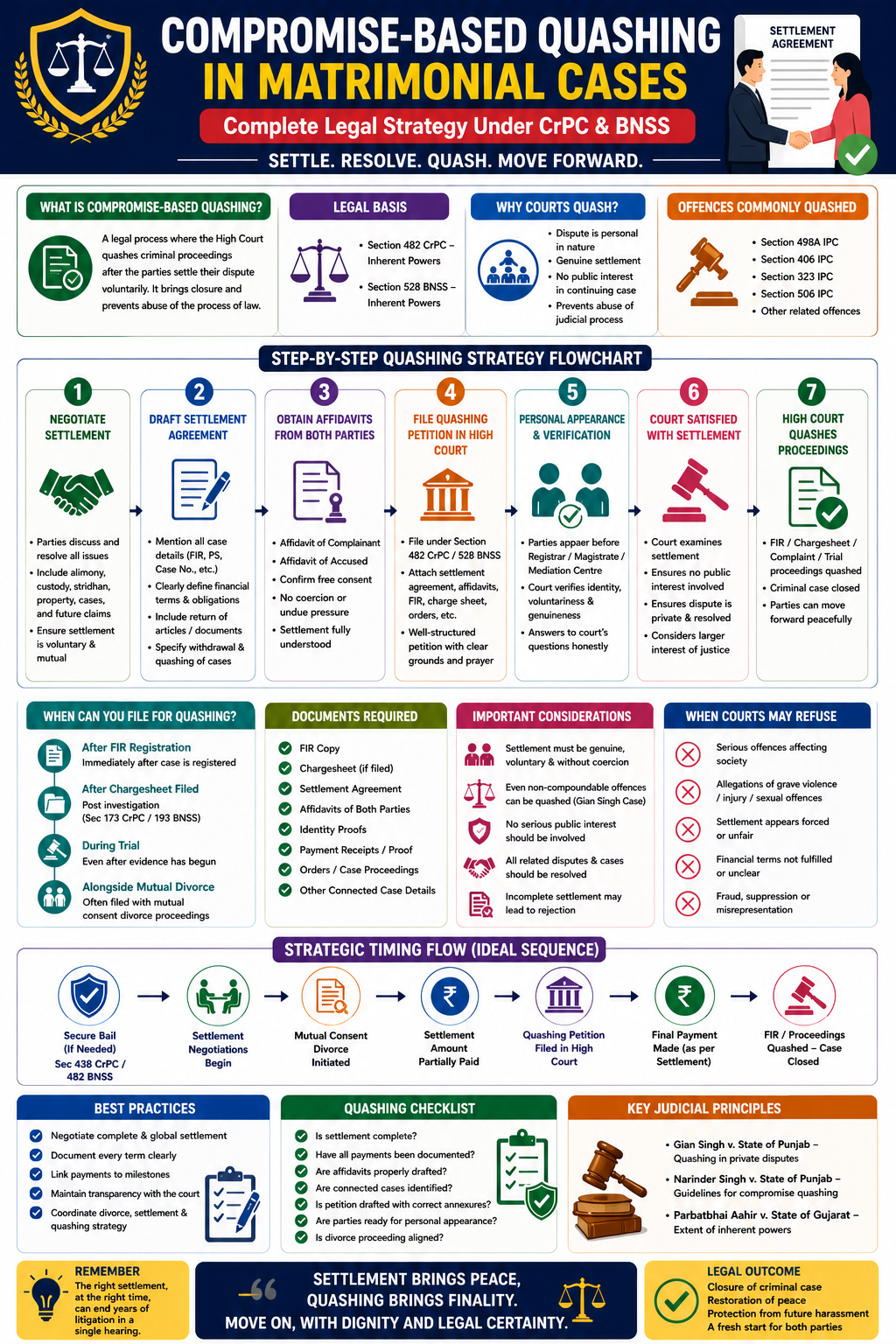
Compromise-Based Quashing in Matrimonial Cases – Complete Legal Strategy

Posted on May 6 by Suprajaa Rajan

Matrimonial disputes often begin as emotional conflicts but eventually transform into multiple legal proceedings—criminal complaints, domestic violence cases, maintenance petitions, custody disputes, and divorce litigation. In many cases, however, parties later decide to resolve their differences through negotiation, mediation, mutual settlement, or divorce by consent.

Once a genuine settlement takes place, the next critical legal question arises:

Can the criminal case also be closed?

The answer is yes—through compromise-based quashing.

Indian High Courts regularly exercise their inherent powers to quash criminal proceedings arising from matrimonial disputes when the parties settle their disputes voluntarily and continuation of prosecution serves no useful purpose.

Therefore, understanding the strategy for compromise-based quashing in matrimonial cases becomes essential for accused persons, complainants, family members, and legal practitioners.

This article explains the legal framework, procedural roadmap, documentation, judicial principles, strategic timing, and practical safeguards, with references to both the Code of Criminal Procedure, 1973 (CrPC) and the Bharatiya Nagarik Suraksha Sanhita, 2023 (BNSS).

What Is Compromise-Based Quashing?

Compromise-based quashing is a legal process where the High Court terminates criminal proceedings after the parties settle their dispute.

The court may quash:

  • FIR
  • Chargesheet
  • Criminal complaint
  • Summoning order
  • Trial proceedings
  • Related criminal proceedings

The purpose is simple:

If the dispute is private, personal, and has been genuinely resolved, continuing prosecution may amount to an abuse of judicial process.

Legal Basis for Quashing

Under CrPC

  • Section 482 CrPC

The High Court exercises inherent powers:

  • To prevent abuse of process
  • To secure the ends of justice

Under BNSS

  • Section 528 BNSS

This provision preserves the High Court’s inherent jurisdiction in similar terms.

Thus, compromise-based quashing continues under the new procedural framework.

Why Matrimonial Cases Are Commonly Quashed

Matrimonial litigation often involves:

  • Emotional allegations
  • Family-wide implication
  • Settlement negotiations
  • Mutual divorce proceedings
  • Financial settlement

Because such disputes are predominantly personal in nature, courts frequently consider compromise-based quashing appropriate.

Typical offences include:

  • Section 498A IPC
  • Section 406 IPC
  • Section 323 IPC
  • Section 506 IPC
  • Section 34 IPC

and their corresponding provisions under the new criminal law framework, where applicable.

Can Non-Compoundable Offences Also Be Quashed?

Yes.

This is the most important legal principle.

Even if an offence is technically non-compoundable, the High Court may still quash proceedings if:

  • The dispute is personal
  • Settlement is genuine
  • No overriding public interest is involved
  • Continuation of prosecution would serve no useful purpose

This principle transformed matrimonial criminal litigation in India.

Leading Judicial Principles

In
Gian Singh v. State of Punjab,
the Supreme Court held that High Courts may quash criminal proceedings involving private disputes if settlement genuinely resolves the controversy.

Later, in
Narinder Singh v. State of Punjab,
the Supreme Court laid down detailed principles governing compromise-based quashing.

Further, in
Parbatbhai Aahir v. State of Gujarat,
the Court clarified how inherent powers should be exercised.

These decisions now guide High Courts across India.

When Should You File for Quashing?

Timing can significantly affect the outcome.

Compromise-based quashing may be filed:

After FIR Registration

If parties settle immediately after criminal proceedings begin.

After Chargesheet

Once investigation is complete.

Relevant provision:

  • Section 173 CrPC (BNSS Section 193) – Police report

During Trial

Even after evidence begins.

Alongside Mutual Divorce

Often strategically synchronised.

Therefore, settlement timing should align with the broader matrimonial strategy.

Step 1: Finalise a Genuine Settlement

Before approaching the High Court, both parties should complete settlement discussions.

Settlement may include:

  • Mutual divorce
  • Permanent alimony
  • Return of stridhan
  • Child custody terms
  • Withdrawal of connected proceedings
  • Property settlement

The settlement should be:

  • Clear
  • Written
  • Voluntary
  • Specific

Ambiguous settlements create future disputes.

Step 2: Draft a Detailed Settlement Agreement

A proper settlement agreement should include:

Case Details

Mention:

  • FIR number
  • Police station
  • Case numbers
  • Pending proceedings

Financial Terms

Specify:

  • Alimony
  • Settlement amount
  • Payment schedule

Property Terms

Clarify:

  • Return of articles
  • Jewellery
  • Documents
  • Shared assets

Litigation Closure

Specify:

  • Cases to be withdrawn
  • Quashing to be pursued

Precision prevents future disputes.

Step 3: Obtain Affidavits from Both Parties

Courts generally expect:

  • Affidavit of accused
  • Affidavit of complainant

Affidavits should confirm:

  • Free consent
  • No coercion
  • Settlement fully understood
  • No further claims

This helps establish genuineness.

Step 4: File Quashing Petition

File before the jurisdictional High Court under:

  • Section 482 CrPC (Section 528 BNSS)

The petition should include:

  • Synopsis
  • List of dates
  • Grounds
  • Settlement deed
  • Affidavits
  • FIR copy
  • Chargesheet (if filed)
  • Relevant orders

A well-organised petition improves credibility.

Step 5: Ensure Personal Appearance

High Courts often direct:

  • Personal presence of parties
  • Verification before Registrar, Magistrate, or Mediation Centre

The court verifies:

  • Identity
  • Voluntariness
  • Settlement authenticity

Therefore, prepare both parties in advance.

Step 6: Verification of Settlement

Courts may ask:

  • Was the settlement voluntary?
  • Has consideration been paid?
  • Are all disputes resolved?
  • Is divorce underway or completed?
  • Are there any pending claims?

Consistency matters.

Contradictory statements can derail the petition.

Step 7: Address Connected Proceedings

Before final hearing, review:

  • Maintenance cases
  • Domestic violence proceedings
  • Custody disputes
  • Execution proceedings
  • Civil claims

Incomplete settlement often creates future litigation.

Therefore, aim for a global settlement strategy.

When Courts May Refuse Quashing

Despite settlement, courts may refuse quashing if:

Serious Public Interest Is Involved

Examples:

  • Grave violence
  • Serious bodily injury
  • Sexual offences
  • Offences affecting society

Settlement Appears Coerced

If the complainant appears reluctant.

Settlement Terms Are Incomplete

If financial obligations remain disputed.

Fraud or Suppression Exists

If material facts are concealed.

Thus, genuineness remains critical.

Strategic Timing in Matrimonial Cases

A strong legal strategy often follows this sequence:

Step 1

Settlement negotiations begin.

Step 2

Interim protection or bail secured.

  • Section 438 CrPC (BNSS Section 482) – Anticipatory bail

Step 3

Mutual consent divorce initiated.

Step 4

Settlement amount partially paid.

Step 5

Joint quashing petition filed.

Step 6

Final payment made at hearing.

Step 7

FIR quashed.

This sequence minimises risk.

Common Defence Mistakes

Avoid:

Filing Before Settlement Is Complete

Incomplete settlements often collapse.

Paying Entire Amount Too Early

Link payments to milestones.

Ignoring Connected Cases

Unresolved proceedings may revive disputes.

Using Generic Settlement Clauses

Every case needs customised drafting.

Contradictory Statements in Court

Consistency is essential.

Practical Quashing Checklist

Before filing, ensure:

  • FIR copy obtained
  • Chargesheet reviewed
  • Settlement deed executed
  • Financial terms documented
  • Payment milestones fixed
  • Affidavits prepared
  • Connected cases identified
  • Personal appearance coordinated
  • Divorce strategy aligned

Judicial Approach in Matrimonial Quashing

High Courts generally favour:

  • Genuine settlements
  • Family dispute resolution
  • Reduction of unnecessary litigation
  • Restoration of peace

Courts recognise that criminal law should not continue merely as leverage once disputes are genuinely resolved.

However, courts carefully ensure:

  • Voluntariness
  • Fairness
  • Completeness of settlement

Practical Defence Strategy

For accused persons, compromise-based quashing works best when you:

Secure Bail First

Avoid coercive pressure.

Negotiate Global Settlement

Resolve all disputes together.

Document Every Payment

Maintain receipts and acknowledgments.

Avoid Informal Verbal Promises

Everything must be written.

Coordinate Timing Carefully

Quashing, divorce, and payment should move together.

Conclusion

Compromise-based quashing has become one of the most effective remedies in matrimonial criminal litigation. It allows parties to:

  • End criminal prosecution
  • Avoid prolonged trial
  • Reduce emotional and financial strain
  • Move forward with certainty

By:

  • Negotiating carefully
  • Drafting precise settlements
  • Filing a structured quashing petition
  • Presenting a genuine compromise

parties can successfully bring criminal matrimonial disputes to a legally secure closure.

In matrimonial litigation, the right settlement—executed at the right time—can end years of litigation in a single hearing.


Index of Legal Strategies and Defence is here. 


Key Contributor : 

Mrs. Suprajaa Rajan B.Com., LL.B., LL.M.

+91-9606345150


Posted in Legal Procedure | Tagged 498A cases criminal defence strategy Legal Procedure Explained - Interpretation of Statutes Legal Strategies and Defence Matrimonial Criminal Law Matrimonial Litigation India matrimonial offences Quashing of FIR | Leave a comment

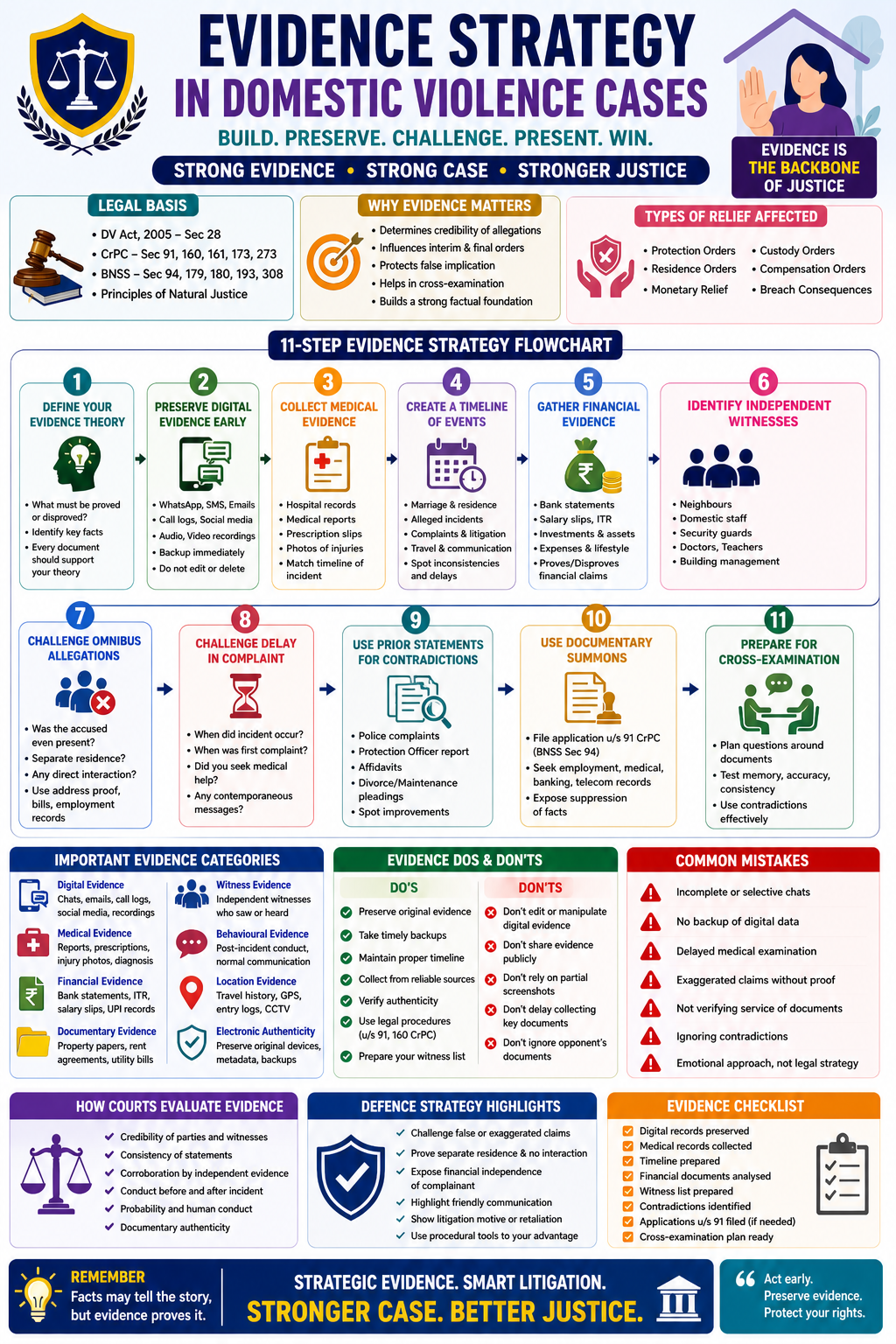
Evidence Strategy in Domestic Violence Cases – Building, Challenging, and Presenting Proof Effectively

Posted on May 5 by Suprajaa Rajan

In domestic violence litigation, facts alone rarely win cases—evidence does. Whether you represent the aggrieved person seeking protection or the respondent defending against exaggerated, incomplete, or false allegations, the strength of your case often depends on how effectively you collect, preserve, challenge, and present evidence.

Domestic violence proceedings frequently involve:

  • Emotional allegations
  • Private incidents without independent witnesses
  • Digital communication disputes
  • Financial allegations
  • Claims of physical, verbal, emotional, or economic abuse

Therefore, a carefully planned evidence strategy in domestic violence cases can significantly influence interim relief, protection orders, residence rights, maintenance, and even parallel criminal proceedings.

This article explains the complete evidence strategy in domestic violence cases, with practical insights, procedural safeguards, and references to the Code of Criminal Procedure, 1973 (CrPC), the Bharatiya Nagarik Suraksha Sanhita, 2023 (BNSS), and the Protection of Women from Domestic Violence Act, 2005.

Understanding the Role of Evidence in Domestic Violence Cases

Proceedings under the Protection of Women from Domestic Violence Act, 2005 are often described as quasi-criminal in nature. Although the reliefs may appear civil, the consequences can include:

  • Protection orders
  • Residence orders
  • Monetary relief
  • Compensation orders
  • Custody orders
  • Breach-related criminal consequences

Therefore, evidence becomes central at every stage.

Courts evaluate:

  • Credibility of allegations
  • Consistency of conduct
  • Supporting documents
  • Independent corroboration
  • Digital and financial records

Legal Framework

Domestic violence proceedings generally follow criminal procedural safeguards.

Relevant procedural provisions include:

  • Section 28 of the Domestic Violence Act – Procedure governed by CrPC
  • Section 91 CrPC (BNSS Section 94) – Summons to produce documents
  • Section 160 CrPC (BNSS Section 179) – Attendance of witnesses
  • Section 161 CrPC (BNSS Section 180) – Examination during investigation
  • Section 173 CrPC (BNSS Section 193) – Investigation report, where applicable
  • Section 273 CrPC (BNSS Section 308) – Evidence in presence of accused

Step 1: Build a Clear Evidence Theory Before Collecting Documents

Before collecting documents, define your case theory.

Ask:

What exactly must you prove or disprove?

Examples:

  • No domestic relationship existed
  • Parties lived separately
  • No acts of violence occurred
  • Allegations arose after matrimonial litigation
  • Financial suppression exists
  • Abuse allegations are exaggerated

Every document you collect must support your theory.

Step 2: Preserve Digital Evidence Immediately

In modern domestic violence cases, digital evidence often becomes decisive.

Preserve:

  • WhatsApp chats
  • SMS messages
  • Emails
  • Social media conversations
  • Audio recordings
  • Video recordings
  • Call logs
  • GPS or travel history

Digital evidence may reveal:

  • Normal communication after alleged incidents
  • Settlement discussions
  • Contradictions in timelines
  • Absence of fear or coercion

Practical Strategy

Immediately:

  • Take backups
  • Export chats
  • Save cloud copies
  • Preserve original devices

Do not edit or crop messages.

Authenticity matters.

Step 3: Collect Medical Evidence Carefully

If physical violence is alleged, medical evidence becomes highly relevant.

Preserve:

  • Hospital records
  • Emergency treatment documents
  • Prescription slips
  • Diagnostic reports
  • Photographs of injuries

Important questions include:

  • Was treatment sought immediately?
  • Does the medical record match the allegations?
  • Does the injury timeline match the complaint?

Delayed or inconsistent medical records may affect credibility.

Step 4: Build Timeline Evidence

Prepare a chronological timeline of events.

Include:

  • Marriage date
  • Residence history
  • Alleged incidents
  • Police complaints
  • Travel records
  • Financial transactions
  • Court proceedings

A timeline often exposes:

  • Delayed allegations
  • Contradictory narratives
  • Post-incident normal conduct

A visual chronology can become a powerful courtroom tool.

Step 5: Use Financial Evidence Strategically

Financial disputes often overlap with domestic violence claims.

Collect:

  • Bank statements
  • Salary slips
  • Income tax returns
  • Investment records
  • Property documents
  • UPI/payment records

Financial evidence helps establish:

  • Actual standard of living
  • Financial independence
  • Suppression of income
  • Economic abuse allegations

Step 6: Identify Independent Witnesses

Independent witnesses often strengthen credibility.

Possible witnesses include:

  • Neighbours
  • Security guards
  • Domestic staff
  • Family doctors
  • School authorities
  • Building management

Independent testimony can confirm:

  • Living arrangements
  • Frequency of disputes
  • Physical presence
  • Behavioural patterns

Step 7: Challenge Omnibus Allegations

Many domestic violence cases involve allegations against:

  • Elderly parents
  • Married sisters
  • Distant relatives

Challenge:

  • Physical presence
  • Separate residence
  • Lack of direct interaction
  • Absence of communication

Evidence such as:

  • Aadhaar address
  • Utility bills
  • Employment records
  • Travel records

may help.

Step 8: Challenge Delay in Complaint

Delay can become a critical defence point.

Ask:

  • When did the alleged incident occur?
  • When was the first complaint made?
  • Was any medical treatment sought?
  • Were any contemporaneous messages sent?

Unexplained delay may weaken the case.

Step 9: Use Prior Statements for Contradictions

Compare:

  • Police complaints
  • Protection Officer reports
  • Affidavits
  • Maintenance applications
  • Divorce pleadings
  • FIR statements

Look for:

  • New allegations
  • Changed dates
  • Added names
  • Increased financial claims

Contradictions often become the strongest defence tool.

Step 10: Use Documentary Summons Strategically

If important documents remain unavailable, apply under:

  • Section 91 CrPC (BNSS Section 94)

Seek:

  • Employment records
  • School records
  • Hospital records
  • Telecom records
  • Banking records

This can expose suppression.

Step 11: Prepare Cross-Examination Around Evidence

Evidence collection alone is not enough.

Use documents during cross-examination to test:

  • Memory
  • Accuracy
  • Consistency
  • Credibility

Questions should focus on:

  • Dates
  • Locations
  • Presence of witnesses
  • Subsequent conduct

Common Evidence Mistakes

Avoid:

Selective Screenshot Production

Incomplete chats often backfire.

Editing Digital Material

Manipulation destroys credibility.

Delayed Preservation

Evidence may disappear permanently.

Emotional Documentation Without Strategy

Documents must support legal theory.

Ignoring Opponent’s Documentary Claims

Every document must be verified.

Defence Strategy in False or Exaggerated DV Cases

If defending a false or inflated claim:

Focus on:

Separate Residence

Did the accused even live with the complainant?

Financial Independence

Is the complainant employed?

Contradictory Litigation Positions

Do other cases tell a different story?

Friendly Post-Incident Communication

Do chats contradict fear allegations?

Travel and Social Media Evidence

Does conduct contradict abuse claims?

Judicial Approach

Courts increasingly scrutinise:

  • General allegations
  • Documentary contradictions
  • Digital communication
  • Financial suppression
  • Delayed complaints

Courts prefer evidence-based litigation over emotional allegations.

Practical Evidence Checklist

Before hearing, ensure:

  • Digital records preserved
  • Medical documents collected
  • Timeline prepared
  • Financial documents analysed
  • Witness list prepared
  • Contradictions marked
  • Documentary summons considered
  • Cross-examination plan ready

Conclusion

In domestic violence litigation, evidence often matters more than allegations. A carefully designed evidence strategy can:

  • Strengthen genuine claims
  • Expose exaggeration
  • Challenge false implication
  • Influence interim orders
  • Shape final outcomes

By:

  • Acting early
  • Preserving authentic records
  • Building a coherent theory
  • Using procedural tools strategically

you can dramatically improve your position in domestic violence proceedings.

In court, facts persuade—but evidence proves.


Index of Legal Strategies and Defence is here. 


Key Contributor : 

Mrs. Suprajaa Rajan B.Com., LL.B., LL.M.

+91-9606345150


Posted in Legal Procedure | Tagged False Allegations Legal Strategies and Defence Matrimonial Criminal Law Matrimonial Litigation India matrimonial offences PWDV act | Leave a comment

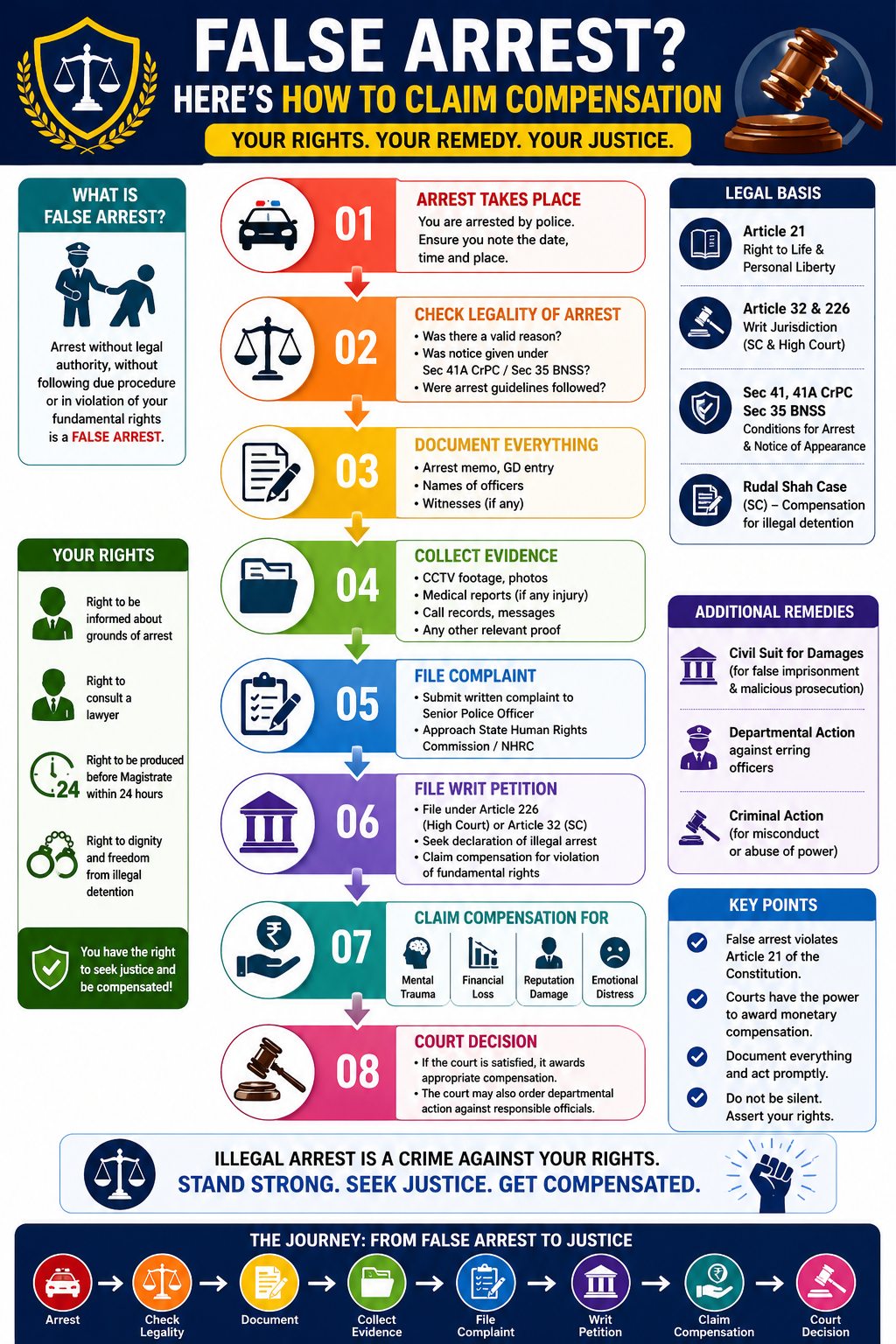
How to Seek Compensation for False Arrest in India

Posted on April 29 by Suprajaa Rajan

Introduction

A false arrest is not just a legal irregularity—it is a serious violation of personal liberty and fundamental rights. Indian law recognizes that unlawful detention can cause reputational damage, mental trauma, and financial loss.

Therefore, individuals who have been falsely arrested can seek compensation and legal remedies through constitutional and statutory mechanisms.

This article explains when an arrest is considered illegal, how to claim compensation, and the legal strategy involved, with reference to the Code of Criminal Procedure, 1973 (CrPC) and the Bharatiya Nagarik Suraksha Sanhita, 2023 (BNSS).

What Is a False Arrest?

A false arrest occurs when a person is detained:

  • Without lawful justification
  • Without following due procedure
  • In violation of legal safeguards

An arrest becomes illegal when authorities fail to comply with:

  • Section 41 CrPC (Section 35 BNSS) – Conditions for arrest
  • Section 41A CrPC (Section 35 BNSS) – Notice of appearance
  • Constitutional protections under Article 21 of the Constitution of India

Thus, any arrest that violates these safeguards may be challenged.

Legal Rights Against False Arrest

Every individual has the right to:

  • Be informed of grounds of arrest
  • Consult a lawyer
  • Be produced before a Magistrate within 24 hours
  • Be protected from arbitrary detention

Failure to comply with these rights strengthens a claim for compensation.

Constitutional Remedy for Compensation

The most effective remedy lies under:

  • Article 32 (Supreme Court)
  • Article 226 (High Courts)

Courts have the power to grant monetary compensation for violation of fundamental rights.

In
Rudal Shah v. State of Bihar,
the Supreme Court awarded compensation for unlawful detention, establishing that public law remedy is available for violation of fundamental rights.

When Can You Claim Compensation?

You can seek compensation if:

1. Arrest Without Legal Basis

If police arrest you without satisfying the conditions under:

  • Section 41 CrPC (Section 35 BNSS)

2. Non-Compliance with Arrest Guidelines

Failure to follow guidelines laid down in
Arnesh Kumar v. State of Bihar
can make the arrest illegal.

3. Detention Beyond 24 Hours

If you are not produced before a Magistrate within 24 hours, it violates:

  • Constitutional safeguards
  • Procedural law

4. Malicious or Bad Faith Arrest

If arrest is made:

  • To harass
  • Without evidence
  • With ulterior motives

it may attract compensation.

Legal Remedies Available

1. Writ Petition for Compensation

File a writ petition under:

  • Article 226 (High Court)

Seek:

  • Compensation
  • Declaration of illegal arrest
  • Action against responsible officers

2. Civil Suit for Damages

You can file a civil suit for:

  • False imprisonment
  • Malicious prosecution

This allows recovery of:

  • Financial loss
  • Mental agony
  • Reputational harm

3. Departmental Action Against Police

You may file complaints seeking:

  • Disciplinary action
  • Inquiry against officers

4. Criminal Action (In Rare Cases)

If misconduct is severe, criminal proceedings may be initiated against officials.

Step-by-Step Strategy to Claim Compensation

Step 1: Document the Illegal Arrest

Immediately record:

  • Date and time of arrest
  • Grounds (if any)
  • Witnesses

Step 2: Collect Evidence

Gather:

  • Arrest memo
  • CCTV footage
  • Medical records (if any harm caused)
  • Communication records

Step 3: File Representation

Submit a written complaint to:

  • Senior police अधिकारियों
  • Human rights authorities

Step 4: File Writ Petition

Approach High Court under:

  • Article 226

Seek:

  • Compensation
  • Declaration of rights violation

Step 5: Consider Civil Damages Suit

For higher compensation, initiate a civil claim for damages.

Judicial Approach

Courts have consistently held that:

  • Personal liberty is paramount
  • State must compensate for illegal detention
  • Abuse of power cannot go unchecked

Courts award compensation to:

  • Deter misconduct
  • Provide relief to victims
  • Uphold rule of law

Key Factors Considered by Courts

Courts evaluate:

  • Duration of illegal detention
  • Nature of violation
  • Conduct of authorities
  • Impact on victim

Higher compensation is awarded in cases involving:

  • Prolonged detention
  • Public humiliation
  • Malicious intent

Practical Considerations

Before filing a claim, consider:

  • Strength of evidence
  • Documentation of arrest
  • Legal costs and time

A well-prepared case significantly improves chances of success.

Conclusion

False arrest, thus, strikes at the heart of personal liberty and constitutional rights. Indian law provides strong remedies to ensure that victims are compensated and authorities are held accountable.

By:

  • Documenting violations
  • Approaching constitutional courts
  • Pursuing civil remedies

you can effectively seek justice and compensation.

Ultimately, such legal action reinforces the principle that no authority is above the law.


Related Legal Concepts

  • Anticipatory Bail
  • Arrest under CrPC
  • Writ Petition
  • Malicious Prosecution
  • Fundamental Right to Liberty


Index of Legal Strategies and Defence is here. 


Key Contributor : 

Mrs. Suprajaa Rajan B.Com., LL.B., LL.M.

+91-9606345150


Posted in Legal Procedure | Tagged CrPC Sec 41 - Conditions for Arrest false arrest Illegal arrest Legal Strategies and Defence Matrimonial Criminal Law Matrimonial disputes law Writ Petition | Leave a comment

Representation to SHO Against Illegal Arrest – Format, Procedure & Sample Draft

Posted on April 27 by Suprajaa Rajan

A practical legal remedy to prevent unlawful arrest and ensure compliance with due process.

In criminal law, arrest is a serious step that directly impacts a person’s personal liberty under Article 21 of the Constitution. However, arrests are sometimes made without proper justification or in violation of procedural safeguards. In such situations, a person may submit a written representation to the Station House Officer (SHO) requesting that no illegal or arbitrary arrest be carried out.

Therefore, a Representation to SHO Against Illegal Arrest acts as a preventive legal measure. It places your objections on record and reminds the police to act strictly in accordance with law.

This article explains the legal framework, drafting strategy, and provides a ready-to-use sample format with copy-to-clipboard functionality.

I. Legal Framework Governing Arrest

Arrest must comply with the safeguards laid down under:

Under the Code of Criminal Procedure, 1973

  • Section 41 CrPC – Conditions for arrest without warrant
  • Section 41A CrPC – Notice of appearance before police
  • Section 50 CrPC – Right to be informed of grounds of arrest

Corresponding Provisions under BNSS, 2023

  • Section 35 BNSS – When police may arrest without warrant
  • Section 35(3) BNSS – Safeguards against unnecessary arrest
  • Section 35(7) BNSS – Notice of appearance (similar to Section 41A CrPC)

Thus, the police must justify arrest based on necessity, not mere allegations.

II. What is a Representation to SHO?

A representation to the SHO is a formal written communication submitted to:

  • Prevent illegal or arbitrary arrest
  • Assert willingness to cooperate with investigation
  • Request compliance with statutory safeguards

Although it is not a statutory application, it serves as important documentary protection.

III. When Should You File This Representation?

You should submit this representation when:

  • You apprehend imminent arrest
  • Police are acting without issuing notice under Section 41A CrPC
  • The allegations are false or exaggerated
  • There is risk of misuse of arrest powers

Therefore, timely submission can help prevent coercive action.

IV. Why is This Representation Important?

Filing this representation helps to:

  • Create a record of cooperation
  • Show that arrest is unnecessary
  • Strengthen your case for anticipatory bail
  • Protect against arbitrary police action

Moreover, courts often consider such conduct while granting relief.

V. Key Judicial Safeguards

The Supreme Court has repeatedly emphasised that:

  • Arrest should not be routine or mechanical
  • Police must record reasons for arrest
  • Notice under Section 41A CrPC should be preferred

These principles ensure that personal liberty is not curtailed unnecessarily.

VI. Essential Elements of the Representation

Before drafting, you should include:

  • Name and address of the applicant
  • FIR details (if known)
  • Clear statement of apprehension of arrest
  • Assertion of innocence
  • Willingness to cooperate
  • Request to follow due process

These elements make the representation clear, effective, and legally relevant.

VII. Drafting Strategy

While drafting this representation:

  • Use a calm and respectful tone
  • Avoid making allegations against police
  • Focus on legal rights and cooperation
  • Refer to relevant provisions (Section 41, 41A CrPC)

This approach increases the credibility of your request.

VIII. Sample Draft Format– Representation to SHO Against Illegal Arrest


Sample Draft – Representation to SHO Against Illegal Arrest

To
The Station House Officer
[Name of Police Station]
[City/District]

Subject: Representation Against Illegal Arrest

Respected Sir/Madam,

I respectfully submit that I apprehend arrest in connection with allegations made against me in relation to [brief details of complaint/FIR, if known].

I submit that I am innocent and have not committed any offence as alleged. The allegations are false and motivated.

I am a law-abiding citizen and am willing to fully cooperate with the investigation.

I respectfully request that no coercive steps be taken against me without following the due process of law, including compliance with Section 41 and 41A of the Code of Criminal Procedure, 1973.

I undertake to appear before the Investigating Officer as and when required.

I request that my representation be taken on record.


Thanking you.


Yours faithfully,
[Name]
[Address]
[Contact Details]
[Signature]

Date: [____]
Place: [____]

✔ Draft Copied Successfully!

IX. Common Mistakes to Avoid

Avoid:

  • Using aggressive or accusatory language
  • Making unverified allegations
  • Ignoring legal provisions
  • Failing to show willingness to cooperate

Instead, focus on legal compliance and good faith conduct.

Conclusion

A Representation to SHO Against Illegal Arrest is a simple yet effective step to safeguard personal liberty. Therefore, by asserting your rights and willingness to cooperate, you can reduce the risk of arbitrary arrest and strengthen your legal position.


Index of Legal Templates and Drafting is here.


Disclaimer

These templates are provided for educational and informational purposes. Every case depends on specific facts and procedural posture. Professional legal advice should be obtained before filing any application.
Key Contributor :

Mrs. Suprajaa Rajan B.Com., LL.B., LL.M.

+91-9606345150


Posted in Legal Procedure | Tagged Criminal law criminal law drafts Legal templates and drafting Matrimonial Criminal Law Matrimonial dispute | Leave a comment

Dinesh Kumar Vs Neeti and Ors on 4 Apr 2026 – Judgment Summary

Posted on April 24 by Suprajaa Rajan

In a significant ruling on interim maintenance, the Delhi High Court dealt with cross-petitions filed by both husband and wife challenging the quantum of maintenance awarded under the Protection of Women from Domestic Violence Act, 2005. While the husband argued that the amount was excessive, the wife contended that it was inadequate considering his actual financial capacity.

The dispute arose after the parties separated in 2016, with the wife seeking maintenance under both Section 125 of the CrPC (now Section 144 BNSS) and proceedings under the Domestic Violence Act. After evaluating the material on record, the High Court took a balanced approach. It neither accepted the husband’s minimal income claim nor the wife’s allegation of extremely high earnings, but instead assessed his income pragmatically.

“12. Thus, the responsibility of their day-to-day care, upbringing and education is being borne by the wife. Secondly, this Court notes that the husband has alleged that the wife is earning about ₹30,000/- per month by giving tuition. However, no document or material has been placed on record by him to substantiate this allegation. In the absence of any supporting material, such assertion cannot be accepted at this stage. Therefore, this Court does not find any infirmity in the finding of the learned Trial Court, as affirmed by the learned Appellate Court, that the income of the wife is to be treated as „Nil‟ for the purpose of deciding interim maintenance.”

“14. Thus, at this stage, while the allegation of the wife regarding the extremely high income of the husband remains unsubstantiated, the claim of the husband that he is earning only ₹12,000/- per month also requires to be examined cautiously in light of the overall facts and circumstances of the case.”

“17. In these circumstances, this Court finds no reason to disagree with the observations of the learned Appellate Court that the husband appears to have withheld material information regarding his actual income and financial status. The material placed on record therefore prima facie indicates that the husband has not made a full and candid disclosure of his financial position.”

“18. Considering the fact that the husband claims to be earning only ₹12,000/- per month, which is even below the minimum wages applicable in Delhi, this Court finds no ground to accept such a claim at this stage. “

Decision

Accordingly, the High Court dismissed both cross-petitions and upheld the Appellate Court’s order granting total interim maintenance of ₹13,000 per month to the wife and two minor children.

Furthermore, the Court clarified that:

  • The maintenance awarded under Section 125 CrPC (Section 144 BNSS) would be adjusted against the amount granted under the Domestic Violence Act.
  • The findings were purely interim in nature and subject to final adjudication after trial.
  • Importantly, the Court reiterated that suppression of income invites adverse inference, and courts may assess earning capacity even in the absence of full disclosure.

Thus, the judgment reinforces the principle that financial responsibility toward dependents cannot be avoided through incomplete or misleading disclosures.


Dinesh kumar Vs Neeti and Ors on 4 Apr 2026

Citation : 2026 DHC 2819

Other Sources :


Index of Maintenance judgements is here. 


Key Contributor :
Mrs. Suprajaa Rajan B.Com., LL.B., LL.M.
+91-9606345150


Posted in High Court of Delhi Judgment or Order or Notification | Tagged 1-Judge Bench Decision CrPC Sec 125 or BNSS Sec 144 - Interim Maintenance Granted Dinesh kumar Vs Neeti and Ors Matrimonial Criminal Law Matrimonial dispute PWDV Act Sec 20 - Maintenance Granted | Leave a comment

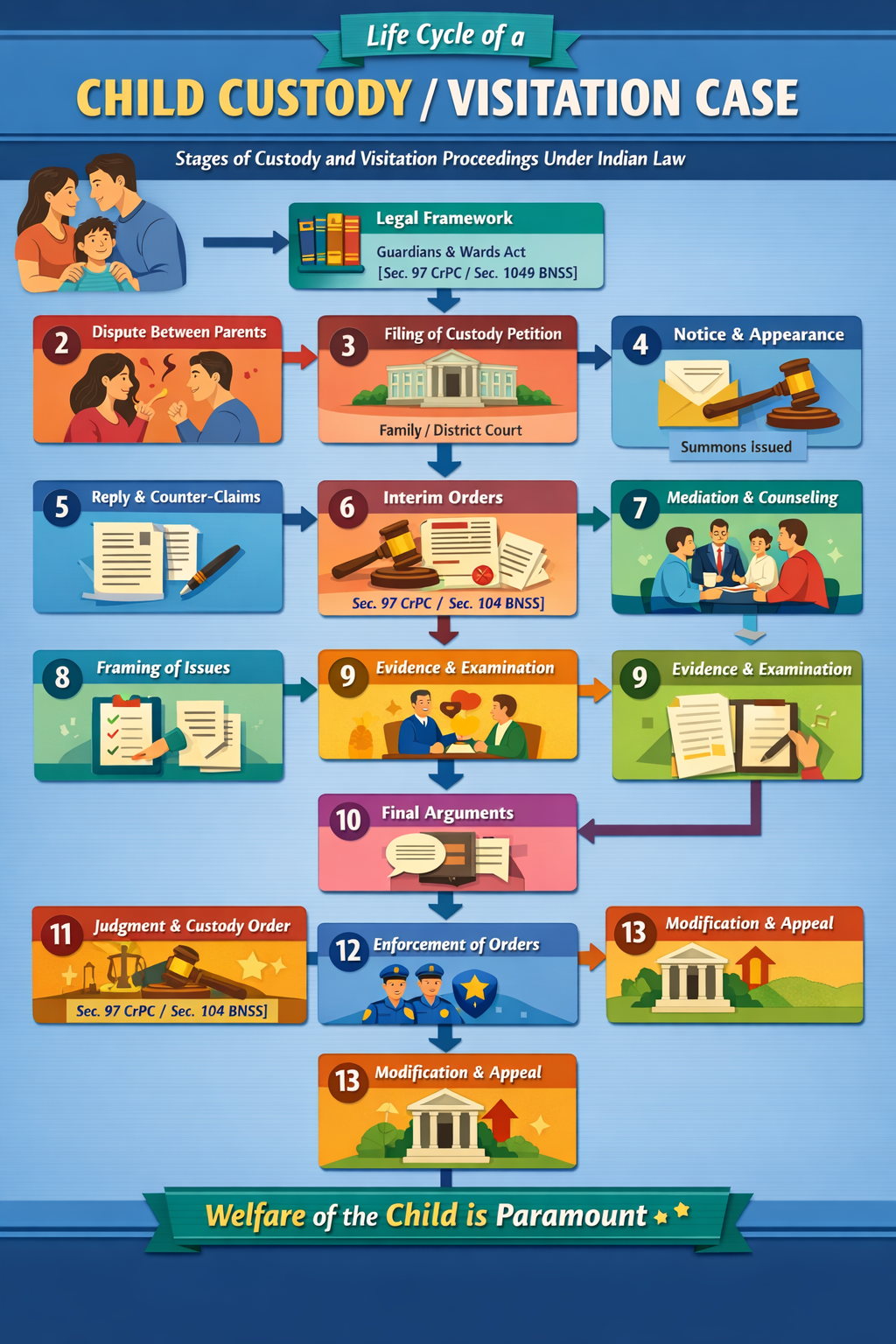
Life Cycle Stages of a Child Custody / Visitation Case

Posted on April 4 by Suprajaa Rajan

A Step-by-Step Guide to Custody Proceedings Under Indian Law

Understanding the procedural journey of a child custody or visitation case helps parents protect the best interests of the child while navigating court proceedings effectively.

Child custody disputes arise when parents disagree on the care, control, and upbringing of a minor child. Indian courts decide such matters based on the welfare and best interests of the child, which remains the paramount consideration.

Custody and visitation matters are governed primarily by the Hindu Minority and Guardianship Act, 1956, the Guardians and Wards Act, 1890, and relevant provisions of procedural law under the Code of Civil Procedure, 1908, along with certain applicable provisions of the Code of Criminal Procedure, 1973 (CrPC) and the Bharatiya Nagarik Suraksha Sanhita, 2023 (BNSS).

The following stages explain the complete life cycle of a child custody or visitation case.

1. Legal Foundation of Child Custody Law

First, it is important to understand the legal framework governing custody disputes.

Courts decide custody matters under the Guardians and Wards Act, 1890, and personal laws applicable to the parties. However, the court always prioritises the welfare of the child over the rights of the parents.

Additionally, in urgent situations, a parent may seek interim protection or custody through procedural provisions. For instance, a party may invoke interim relief mechanisms similar to those under Section 97 CrPC / Section 104 BNSS, where applicable.

Therefore, courts adopt a child-centric approach while deciding custody and visitation matters.

2. Stage One: Dispute Between Parents Regarding Custody

Typically, a custody dispute arises when parents separate or initiate matrimonial proceedings.

For example, disputes often arise during divorce, judicial separation, or domestic conflicts. One parent may retain custody of the child, while the other parent may seek custody or visitation rights.

At this stage, the parties may attempt informal resolution or family mediation. However, if the dispute continues, the aggrieved parent may approach the court.

3. Stage Two: Filing of Custody Petition Before Court

If the dispute remains unresolved, the aggrieved parent files a custody or guardianship petition before the competent Family Court or District Court.

The petition includes details of the child, relationship between parties, and the relief sought. The petitioner may seek permanent custody, joint custody, or visitation rights.

Additionally, the petitioner may file an application for interim custody or visitation.

After filing, the court registers the case and issues notice to the respondent parent.

4. Stage Three: Service of Notice and Appearance of Respondent

Next, the court ensures that the respondent receives proper notice of the proceedings.

The notice specifies the date of hearing and directs the respondent to appear before the court.

The respondent may appear personally or through legal counsel. If the respondent fails to appear, the court may proceed ex parte.

Proper service of notice ensures compliance with principles of natural justice.

5. Stage Four: Filing of Reply and Counter-Claims

After receiving notice, the respondent files a written statement or reply to the petition.

The respondent may oppose the claim for custody or propose alternative arrangements such as shared custody or limited visitation.

In some cases, the respondent may also file counter-claims seeking custody or enhanced visitation rights.

This stage helps the court identify the issues in dispute.

6. Stage Five: Interim Custody and Visitation Orders

Since custody matters involve immediate welfare concerns, courts often pass interim orders at an early stage.

For instance, the court may grant temporary custody to one parent and visitation rights to the other parent.

In urgent situations, a parent may also seek immediate production of the child through remedies similar to Section 97 CrPC / Section 104 BNSS, where unlawful detention is alleged.

The court considers factors such as age of the child, emotional needs, and stability before granting interim relief.

These interim orders remain effective during the pendency of the case.

7. Stage Six: Mediation and Counseling

Subsequently, the court may refer the parties to mediation or counseling.

Family Courts actively encourage amicable settlement in custody disputes. Mediation helps parents arrive at mutually acceptable arrangements for custody and visitation.

Additionally, courts may interact with the child to understand the child’s preferences.

If mediation succeeds, the parties record a settlement before the court. If mediation fails, the case proceeds to trial.

8. Stage Seven: Framing of Issues

If disputes persist, the court frames issues for determination.

These issues may include questions such as which parent can better ensure the welfare of the child and whether visitation rights should be granted.

Framing of issues helps structure the trial and focus on relevant questions.

9. Stage Eight: Evidence and Examination

At this stage, both parties present evidence to support their claims.

For example, parties may produce documents relating to income, living conditions, and educational background. Witnesses may testify regarding the child’s upbringing and parental conduct.

The court may also consider expert reports from child psychologists or welfare officers.

Additionally, the court may interact with the child, depending on the child’s age and maturity.

The opposing party has the right to cross-examine witnesses.

10. Stage Nine: Final Arguments

After completion of evidence, both parties present final arguments before the court.

Each party attempts to demonstrate that their custody arrangement serves the best interests of the child.

The court carefully evaluates all evidence, statutory provisions, and judicial precedents.

The welfare of the child remains the overriding consideration at this stage.

11. Stage Ten: Judgment and Final Custody Order

Finally, the court delivers its judgment after considering all aspects of the case.

The court may grant sole custody, joint custody, or structured visitation rights.

The order may also include directions regarding education, healthcare, and overall welfare of the child.

The court ensures that the final order promotes the child’s physical, emotional, and psychological well-being.

12. Enforcement of Custody and Visitation Orders

After passing the order, both parties must comply with the court’s directions.

If one parent violates the custody or visitation order, the aggrieved parent may approach the court for enforcement.

In appropriate cases, courts may invoke coercive measures. For instance, the court may direct production of the child through mechanisms similar to Section 97 CrPC / Section 104 BNSS, where applicable.

Courts may also modify orders to ensure compliance and protect the child’s welfare.

13. Modification and Appeal

Child custody orders are not final in the strict sense because circumstances may change over time.

Therefore, either parent may seek modification of custody or visitation arrangements if circumstances materially change.

Additionally, an aggrieved party may file an appeal before a higher court challenging the custody order.

The appellate court reviews whether the lower court correctly applied the principle of welfare of the child.

Conclusion

Child custody and visitation cases require careful judicial balancing of parental rights and the welfare of the child. Therefore, courts follow a structured process that includes interim relief, mediation, evidence, and final adjudication.

Understanding the life cycle of a custody case helps parents approach the process with clarity and responsibility. Ultimately, the law ensures that every decision prioritises the best interests and well-being of the child.


Other Life Cycles: DV Case Lifecycle || Maintenance Case u/s 125 CrPC Lifecycle. Index is here.


Key Contributor :
Mrs. Suprajaa Rajan B.Com., LL.B., LL.M.
+91-9606345150


Posted in Legal Procedure | Tagged child custody law Life Cycle stages of a child custody case Matrimonial Criminal Law Matrimonial dispute Matrimonial Litigation India | Leave a comment

Vinod Kumar Vs Seema Devi and Anr on 16 Mar 2026 – Judgement Summary

Posted on April 4 by Suprajaa Rajan

In Vinod Kumar Vs Seema Devi and Anr, the Delhi High Court examined whether the maintenance awarded by the Family Court under Section 125 CrPC (now Section 144 BNSS) required interference.

The petitioner (husband) challenged the maintenance granted to his wife and daughter, arguing that:

  • The wife lived separately without justification
  • She had rental income
  • His own income was wrongly assessed

However, the Court found that the wife had consistently alleged cruelty, which justified her separate residence. Moreover, the Court emphasized that an able-bodied husband cannot evade maintenance liability by understating income or taking voluntary retirement.

After analysing income, evidence, and legal principles, the Court upheld the Family Court’s order and dismissed the revision petition.

“9. It is well settled that the object of granting maintenance is to prevent vagrancy by compelling those who can provide support to those who are unable to support themselves and who have a moral claim to support.”

“10. Section 125 of the CrPC elucidates conditions under which a wife may be deemed ineligible for maintenance. These conditions include instances where the wife is engaged in adulterous activities, where she, without any justifiable cause, refuse to cohabit with her husband, or where both parties have agreed to live apart through mutual consent. These provisions delineate clear legal parameters that govern the entitlement or disentitlement of maintenance to ensure that the support is granted only under circumstances that warrant such financial assistance.”

“13. Merely because Respondent No.1 remained in possession of the matrimonial house, the same does not signify that the petitioner did not neglect to maintain the respondents. Even if the contention of the petitioner is taken as correct, the case of the respondents is not helmed on Respondent No.1 leaving the company of the petitioner due to neglect, so as to disentitle her from grant of maintenance. Rather, Respondent No.1 has made categorical allegations of cruelty, which is sufficient to satisfy the threshold of balance of probabilities.”

“18. It appears to be implausible that the petitioner would have taken retirement from his stable well-paying job without securing any other mode of income. As it is a normal tendency of the parties to not disclose their true income in matrimonial disputes, the Courts are permitted to make some guess work and arrive at a figure that a party may reasonably be earning.”

“19. The petitioner is a well- bodied man capable of earning, he cannot shirk his sacrosanct duty to financially support his wife and children by claiming that he has no income after retirement apart from his pension. The petitioner is thus obliged to earn and maintain his family, and the purported lower MSP prices for his land would thus not help his case.”

Decision

The Delhi High Court held that:

  • The maintenance awarded by the Family Court was justified and reasonable
  • The wife’s allegations of cruelty justified her separate residence
  • The husband’s claim of low income was not credible

Accordingly:

  • The Court refused to interfere with the maintenance order
  • The revision petition was dismissed
  • Maintenance (₹10,000 per month each after majority, with 10% increase every two years) was upheld

Vinod Kumar Vs Seema Devi and Anr on 16 Mar 2026

Citation :

Other Sources :


Index of Maintenance Judgements under Sec 125 CrPC is here.


Related Legal Concepts

  • Maintenance under Section 125 CrPC (Section 144 BNSS)
  • Cruelty as Ground for Separate Residence
  • Assessment of Income in Maintenance Cases
  • Doctrine of Social Justice in Family Law
  • Adverse Inference for Non-Disclosure of Income


Key Contributor :
Mrs. Suprajaa Rajan B.Com., LL.B., LL.M.
+91-9606345150


Posted in High Court of Delhi Judgment or Order or Notification | Tagged 1-Judge Bench Decision CrPC 125 or BNSS 144 - Order for Maintenance of Wives Children and Parents cruelty under IPC Matrimonial Criminal Law Matrimonial dispute Vinod Kumar Vs Seema Devi and Anr | Leave a comment

Mariya Zafar and Anr Vs State of UP and Anr on 31 Mar 2026

Posted on April 3 by Suprajaa Rajan

In Mariya Zafar v. State of U.P., the Allahabad High Court (Lucknow Bench) addressed whether a Magistrate can reject an application seeking production of financial documents under Section 91 CrPC (now Section 94 BNSS) in a domestic violence proceeding.

The petitioner-wife alleged domestic violence, dowry harassment, and financial suppression by her husband. She sought disclosure of his bank accounts, Income Tax Returns (ITRs), and GST records to determine his actual income for maintenance proceedings under the Domestic Violence Act.

However, the trial court rejected her application, stating that concealment could instead be dealt with under Section 340 CrPC (now Section 379 BNSS). Challenging this, the petitioner approached the High Court.

The High Court emphasized compliance with the Supreme Court’s ruling in Rajnesh v. Neha, which mandates full financial disclosure in maintenance matters. After examining the husband’s ITRs (produced in sealed cover), the Court found that he had misrepresented his occupation and income. Consequently, the High Court set aside the Magistrate’s order and directed reconsideration.

“11.“…the court below has observed that there is no need to summon the Income Tax Returns of opposite party No. 2 to ascertain the income and the reason has been recorded that in case the opposite party is concealing the material fact, then he will be prosecuted under Section 340 Cr.P.C.”

“14….the opposite party No. 3 is directed to bring the income tax return of the last two years filed by the opposite party No. 2…”

“15.ITRs of opp. party No. 2… indicate that the opposite party No. 2 is an Architect… in the AY 2023-24 his total income was Rs. 4,85,290.00 and in the AY 2024-25 his income was Rs. 5,07,680.00.”

“17. ..the order dated 19-01-2026… is hereby set aside and the said court is directed to take fresh decision in the matter in the light of judgment… within 6 weeks…”

Decision

The Allahabad High Court:

  • Set aside the Magistrate’s order dated 19.01.2026.
  • Directed the trial court to reconsider the application under Section 91 CrPC (Section 94 BNSS) in light of Rajnesh v. Neha.
  • Ordered that the matter be decided within 6 weeks.
  • Allowed the petitioner access to the respondent’s ITRs.
  • Emphasised the importance of truthful financial disclosure in maintenance proceedings.

Mariya Zafar and Anr Vs State of UP and Anr on 31 Mar 2026

Citation :

Other Sources :


Index of Domestic Violence judgments is here.

Related Legal Concepts

Explore related stages and concepts in criminal procedure:

  • Financial Disclosure in Maintenance Proceedings
  • Summoning of Documents 
  • Burden of Proof 
  • Judicial Duty to Ensure Fair Maintenance Adjudication
  • Enforcement of Supreme Court Guidelines (Rajnesh v. Neha)


Key Contributor :

Mrs. Suprajaa Rajan B.Com., LL.B., LL.M.

+91-9606345150

Posted in High Court of Allahabad Judgment or Order or Notification | Tagged 1-Judge Bench Decision Mariya Zafar and Anr Vs State of UP and Anr Matrimonial Criminal Law Matrimonial dispute Rajnesh Vs Neha | Leave a comment

Asha G Vs State of Karnataka on 6 Jan 2026 – Judgement Summary

Posted on April 1 by Suprajaa Rajan

498A IPC: Karnataka High Court Quashes Case Against Neighbour Under CrPC 482 (BNSS 528)

In Asha G Vs State of Karnataka, the High Court of Karnataka addressed a crucial legal issue regarding the misuse of Section 498A IPC in matrimonial disputes.

The petitioner, who was merely a neighbour of the complainant, sought quashing of criminal proceedings under Section 482 of the Code of Criminal Procedure (CrPC) (now BNSS Section 528). The allegations against her were limited to instigating the husband, without any direct involvement in matrimonial cruelty or dowry harassment.

After examining the complaint and charge sheet, the Court observed that:

  • The petitioner was not a relative of the husband.
  • Allegations were vague and omnibus, lacking specific acts.
  • Inclusion of the petitioner amounted to misuse of criminal law.

Consequently, the Court held that continuing proceedings against the neighbour would be an abuse of process of law, and therefore quashed the case against her.

“The name of this petitioner is nowhere found except contending that she has instigated the husband… otherwise the petitioner would not fit into the definition of family as is obtaining under Section 498A of the IPC.”

“Neighbours of the husband’s family are not relatives of the husband and cannot be implicated for offences under Section 498A of the IPC.”

“Permitting further proceedings against this petitioner would become an abuse of the process of the law and result in miscarriage of justice.”


Asha G Vs State of Karnataka on 6 Jan 2026

Index of Quash Judgments is here. 


Related Legal Concepts

  • Quashing of FIR
  • Relative under Section 498A IPC
  • Abuse of Process of Law
  • False Implication in Matrimonial Disputes
  • Requirement of Specific Allegations in FIR/Charge Sheet


Key Contributor :

Mrs. Suprajaa Rajan B.Com., LL.B., LL.M.

+91-9606345150

Posted in High Court of Karnataka Judgment or Order or Notification | Tagged 1-Judge Bench Decision Abuse Or Misuse of Process of Court Asha G Vs State of Karnataka CrPC 482 - Quash CrPC 482 – IPC 498A Quashed Matrimonial Criminal Law Matrimonial dispute Misuse of Section 498A of IPC Quashing of FIR | Leave a comment

Post navigation

  • Older posts

Search within entire Content of “Shades of Knife”

My Legal X Timeline

Advocate Sandeep Pamarati 🇮🇳💪👨🏻‍🎓 Follow

AP High Court Advocate with M Tech (CS) || 12 years in 'Software Industry' as Solution Architect || Blogs at https://t.co/29CB9BzK4w || #TDPTwitter

SandeepPamarati
Retweet on Twitter Advocate Sandeep Pamarati 🇮🇳💪👨🏻‍🎓 Retweeted
_vatsalasingh Vatsala Singh @_vatsalasingh ·
8 Jun

इस डॉक्टर ने तो हमारी आंखें खोल दी। आज तक किसी ने ऐसा नहीं समझया!!

कृपया सीनियर सिटिजन जरूर सुने, अधूरा नहीं पूरा सुनिए ....!

Reply on Twitter 2063996964807778764 Retweet on Twitter 2063996964807778764 405 Like on Twitter 2063996964807778764 1100 X 2063996964807778764
Retweet on Twitter Advocate Sandeep Pamarati 🇮🇳💪👨🏻‍🎓 Retweeted
factcheckapgov FactCheck.AP.Gov.in @factcheckapgov ·
8 Jun

మెగా డిఎస్సీ 2025పై అపోహలు రేకెత్తించే విధంగా కొందరు తప్పుడు ప్రచారం చేస్తున్నారు. చట్టబద్ధంగా, న్యాయబద్ధంగా నియామకాలు జరిగి ఏడాది గడుస్తున్న సమయంలో ఇప్పుడు తప్పుడు ప్రచారం చేయడం చట్టరీత్యా నేరం. ఉదాహరణకు యర్రిపిల్లి శ్రవణ్ కుమార్ (Visakhapatnam - Physical Science) BC A

Reply on Twitter 2063920473394843894 Retweet on Twitter 2063920473394843894 49 Like on Twitter 2063920473394843894 109 X 2063920473394843894
Retweet on Twitter Advocate Sandeep Pamarati 🇮🇳💪👨🏻‍🎓 Retweeted
lolflix_ Lolflix @lolflix_ ·
8 Jun

92 years old 🗿 Dada ji spitting facts.

Reply on Twitter 2063890767949787585 Retweet on Twitter 2063890767949787585 174 Like on Twitter 2063890767949787585 1046 X 2063890767949787585
Retweet on Twitter Advocate Sandeep Pamarati 🇮🇳💪👨🏻‍🎓 Retweeted
meghupdates Megh Updates 🚨™ @meghupdates ·
8 Jun

Amidst Chinese and Congress Propaganda, India annouces to build a ₹13,000 crore dual-use airport & runway on Great Nicobar Island for Indian Navy & civilian use.

Expected completion in 5 years. Part of the massive ₹72,000–80,000 crore Great Nicobar Development Project, which

Reply on Twitter 2063937305136791873 Retweet on Twitter 2063937305136791873 1790 Like on Twitter 2063937305136791873 6468 X 2063937305136791873
Load More

Recent Posts

  • Objections a Defence Advocate Can Raise When the Prosecution Produces Documentary Evidence – Complete Trial Strategy Guide June 5, 2026
  • How to File a Complaint Against an Advocate in India – A First-Timer’s Complete Guide June 5, 2026
  • Are Offices of Dowry Prohibition Officers in AP designated as Police Stations? June 3, 2026
  • Pune Bar Association Vs Union of India on 22 May 2026 June 2, 2026
  • Chidurala Shyamsubder Vs State of Telangana on 27 Aug 2018 May 28, 2026

Most Read Posts

  • Reply to Section 41A CrPC Notice – Format with Legal Explanation (4,882 views)
  • Anu Aggarwal Vs Sushant Aggarwal on 20 Jan 2026 (3,397 views)
  • Umme Farva Vs State of U.P. and Anr on 14 Jan 2026 (3,247 views)
  • Charge Sheet and Final Report Explained (2,674 views)
  • Regular Bail Application Format (Section 437/439 CrPC) (2,079 views)
  • Neha Lal Vs Abhishek Kumar on 20 Jan 2026 (1,928 views)
  • Arrest Procedure in 498A cases after Arnesh Kumar (1,843 views)
  • Discharge Application Format in 498A Case – Draft, Procedure & Sample Template (1,672 views)
  • Can You Travel Abroad After an FIR Is Registered? – Legal Position Explained (1,583 views)
  • Atul Kumar Bajpai Vs State of UP and Anr on 17 Sep 2025 (1,484 views)

Tags

Reportable Judgement or Order (433)2-Judge (Division) Bench Decision (411)Legal Procedure Explained - Interpretation of Statutes (381)Landmark Case (381)1-Judge Bench Decision (362)Catena of Landmark Judgments Referred/Cited to (293)Work-In-Progress Article (215)3-Judge (Full) Bench Decision (101)Sandeep Pamarati (92)Article 21 - Protection of life and personal liberty (80)Issued or Recommended Guidelines or Directions or Protocols to be followed (71)Perjury Under 340 CrPC (66)Absurd Or After Thought Or Baseless Or False Or General Or Inherently Improbable Or Improved Or UnSpecific Or Omnibus Or Vague Allegations (61)Reprimands or Setbacks to YCP Govt of Andhra Pradesh (49)Summary Post (47)CrPC 482 - Quash (43)HM Act 13 - Divorce Granted to Husband (42)Legal Terrorism (41)Not Authentic copy hence to be replaced (40)Divorce granted on Cruelty ground (40)

Categories

Supreme Court of India Judgment or Order or Notification (752)Bare Acts or State Amendments or Statutes or GOs or Notifications issued by Central or State Governments (328)High Court of Andhra Pradesh Judgment or Order or Notification (186)High Court of Delhi Judgment or Order or Notification (164)High Court of Bombay Judgment or Order or Notification (112)High Court of Karnataka Judgment or Order or Notification (93)Legal Procedure (75)High Court of Madras Judgment or Order or Notification (70)High Court of Allahabad Judgment or Order or Notification (61)LLB Study Material (58)General Study Material (56)High Court of Punjab & Haryana Judgment or Order or Notification (52)Assorted Court Judgments or Orders or Notifications (50)High Court of Kerala Judgment or Order or Notification (46)Prakasam DV Cases (46)Judicial Activism (for Public Benefit) (45)District or Sessions or Magistrate Court Judgment or Order or Notification (44)High Court of Madhya Pradesh Judgment or Order or Notification (38)High Court of Gujarat Judgment or Order or Notification (28)High Court of Calcutta Judgment or Order or Notification (27)

Recent Comments

  • The Divorce Law Firm on Life Cycle Stages of a Divorce case
  • The Divorce Law Firm on Life Cycle Stages of a Divorce case
  • ShadesOfKnife on Sandeep Pamarati Vs Ungrateful Knife (IPC 498A Case)
  • KONURU VINAYKUMAR on Sandeep Pamarati Vs Ungrateful Knife (IPC 498A Case)
  • ShadesOfKnife on Lifecycle Stages of a Section 498A IPC Case

Archives of SoK

  • June 2026 (4)
  • May 2026 (24)
  • April 2026 (33)
  • March 2026 (42)
  • February 2026 (30)
  • January 2026 (21)
  • December 2025 (2)
  • November 2025 (3)
  • October 2025 (17)
  • September 2025 (12)
  • August 2025 (5)
  • July 2025 (10)
  • June 2025 (15)
  • May 2025 (3)
  • April 2025 (10)
  • March 2025 (7)
  • February 2025 (8)
  • January 2025 (1)
  • December 2024 (3)
  • November 2024 (4)
  • October 2024 (16)
  • September 2024 (15)
  • August 2024 (14)
  • July 2024 (11)
  • June 2024 (18)
  • May 2024 (13)
  • April 2024 (9)
  • March 2024 (23)
  • February 2024 (15)
  • January 2024 (11)
  • December 2023 (11)
  • November 2023 (9)
  • October 2023 (13)
  • September 2023 (12)
  • August 2023 (15)
  • July 2023 (17)
  • June 2023 (11)
  • May 2023 (6)
  • April 2023 (5)
  • March 2023 (10)
  • February 2023 (9)
  • January 2023 (12)
  • December 2022 (12)
  • November 2022 (8)
  • October 2022 (13)
  • September 2022 (17)
  • August 2022 (10)
  • July 2022 (21)
  • June 2022 (27)
  • May 2022 (23)
  • April 2022 (32)
  • March 2022 (17)
  • February 2022 (6)
  • January 2022 (2)
  • December 2021 (7)
  • November 2021 (7)
  • October 2021 (6)
  • September 2021 (10)
  • August 2021 (31)
  • July 2021 (45)
  • June 2021 (17)
  • May 2021 (17)
  • April 2021 (18)
  • March 2021 (58)
  • February 2021 (14)
  • January 2021 (50)
  • December 2020 (35)
  • November 2020 (68)
  • October 2020 (67)
  • September 2020 (28)
  • August 2020 (41)
  • July 2020 (20)
  • June 2020 (36)
  • May 2020 (40)
  • April 2020 (38)
  • March 2020 (26)
  • February 2020 (43)
  • January 2020 (35)
  • December 2019 (34)
  • November 2019 (4)
  • October 2019 (18)
  • September 2019 (57)
  • August 2019 (33)
  • July 2019 (12)
  • June 2019 (18)
  • May 2019 (5)
  • April 2019 (19)
  • March 2019 (58)
  • February 2019 (11)
  • January 2019 (90)
  • December 2018 (97)
  • November 2018 (43)
  • October 2018 (31)
  • September 2018 (73)
  • August 2018 (47)
  • July 2018 (143)
  • June 2018 (92)
  • May 2018 (97)
  • April 2018 (59)
  • March 2018 (8)

Blogroll

  • Daaman Promoting Harmony 0
  • Fight against Legal Terrorism Fight against Legal Terrorism along with MyNation Foundation 0
  • Good Morning Good Morning News 0
  • Insaaf India Insaaf Awareness Movement 0
  • MyNation Hope Foundation Wiki 0
  • MyNation.net Equality, Justice and Harmony 0
  • Sarvepalli Legal 0
  • Save Indian Family Save Indian Family Movement 0
  • SIF Chandigarh SIF Chandigarh 0
  • The Male Factor The Male Factor 0
  • Unitedmen Foundation a dedicated community forged with the mission to unite men facing legal challenges in marital disputes. 0
  • Vaastav Foundation The Social Reality 0
  • Vinayak my2centsworth – This blog is for honest law abiding men, married or planning to get married 0
  • Voice4india Indian Laws, Non-profits, Environment 0
  • Writing Law Writing Law by Ankur 0

RSS Cloudflare Status

  • ICN (Seoul) on 2026-06-17 June 17, 2026
    THIS IS A SCHEDULED EVENT Jun 17, 17:00 - 22:00 UTC Jun 4, 13:40 UTC Scheduled - We will be performing scheduled maintenance in ICN (Seoul) datacenter on 2026-06-17 between 17:00 and 22:00 UTC.Traffic might be re-routed from this location, hence there is a possibility of a slight increase in latency during this maintenance window […]
  • SIN (Singapore) on 2026-06-15 June 15, 2026
    THIS IS A SCHEDULED EVENT Jun 15, 18:00 - 23:00 UTC Jun 9, 07:34 UTC Scheduled - We will be performing scheduled maintenance in SIN (Singapore) datacenter on 2026-06-15 between 18:00 and 23:00 UTC.Traffic might be re-routed from this location, hence there is a possibility of a slight increase in latency during this maintenance window […]
  • Cloudflare Storage Maintenance June 15, 2026
    THIS IS A SCHEDULED EVENT Jun 15, 12:00 - 13:00 UTC May 28, 22:16 UTC Scheduled - Cloudflare has scheduled maintenance for our backend storage systems. Services will continue to operate normally, but customers will be unable to create/delete/modify tunnels, routes, hostname routes, virtual networks, devices and tunnel configurations via the Dashboard or the public […]

RSS List of Spam Server IPs from Project Honeypot

  • 15.235.26.212 | S June 9, 2026
    Event: Bad Event | Total: 1,031 | First: 2025-05-09 | Last: 2026-06-09
  • 162.217.167.125 | SD June 9, 2026
    Event: Bad Event | Total: 220 | First: 2026-06-09 | Last: 2026-06-09
  • 162.217.166.205 | SD June 9, 2026
    Event: Bad Event | Total: 37 | First: 2026-06-09 | Last: 2026-06-09
Owned and Operated by Advocate Sandeep Pamarati
Proudly powered by WordPress
Theme: Flint by Star Verte LLC

Bad Behavior has blocked 588 access attempts in the last 7 days.

pixel