Obtaining bail is often the first major legal relief in criminal litigation. Whether the accused secures anticipatory bail, regular bail, interim bail, or default bail, the grant of bail does not end legal responsibility. In fact, the real challenge begins after bail is granted.
Many accused persons mistakenly believe:
“Once I get bail, the risk is over.”
Legally, that assumption can be dangerous.
Courts may cancel bail if the accused violates conditions, misuses liberty, interferes with investigation, intimidates witnesses, or attempts to obstruct justice.
Therefore, understanding bail conditions and how to avoid cancellation of bail becomes critical for every accused person, family member, and defence lawyer.
This article explains the legal framework, common bail conditions, cancellation grounds, compliance strategy, defence tactics, and practical safeguards, with references to both the Code of Criminal Procedure, 1973 (CrPC) and the Bharatiya Nagarik Suraksha Sanhita, 2023 (BNSS).
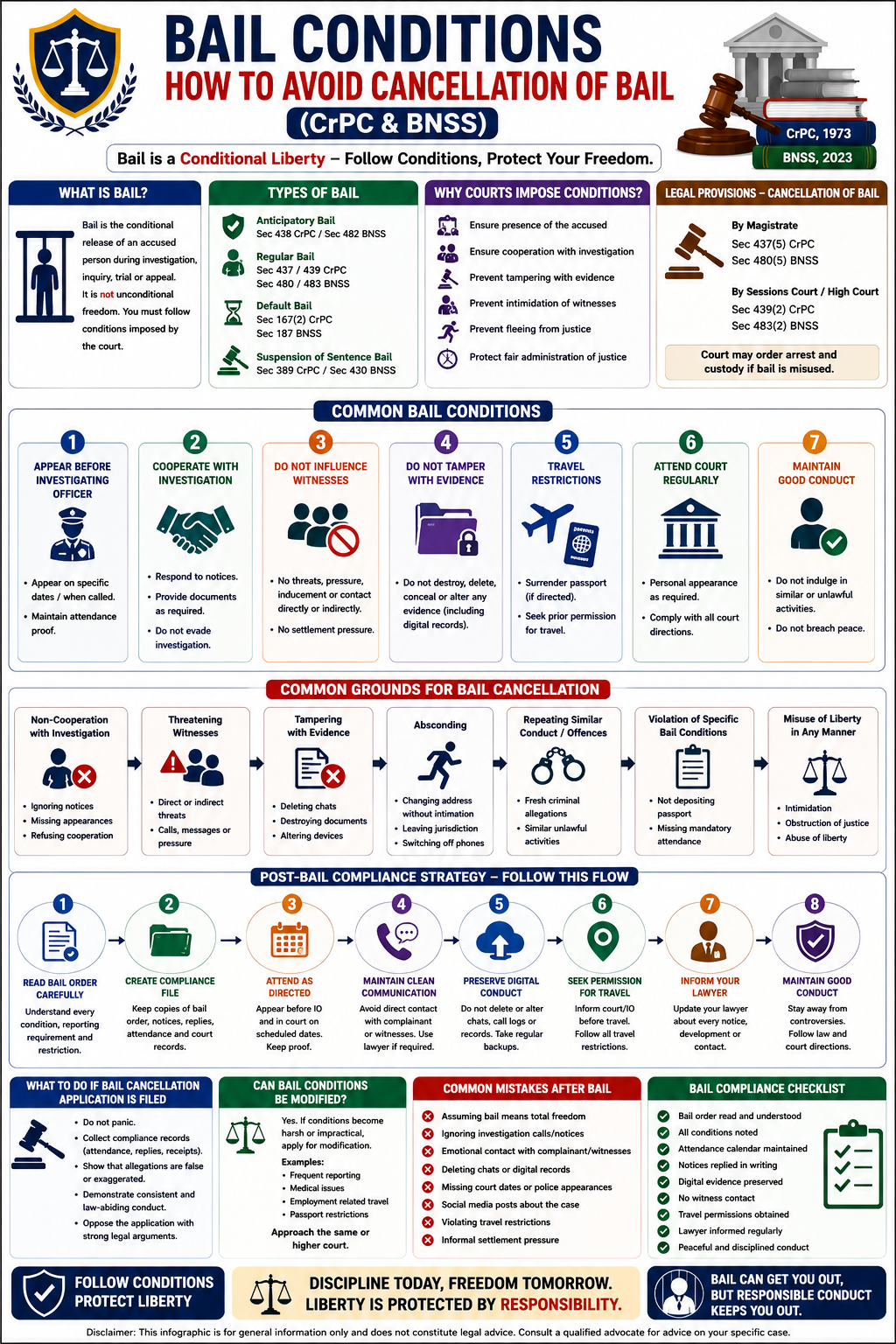
What Does Bail Actually Mean?
Bail is the conditional release of an accused person during:
The court allows liberty while ensuring:
- Presence during proceedings
- Cooperation with investigation
- Protection of evidence
- Fair administration of justice
However, bail is conditional liberty—not unconditional freedom.
Types of Bail Where Conditions May Apply
Conditions may be imposed in:
Anticipatory Bail
- Section 438 CrPC (BNSS Section 482)
Regular Bail
- Section 437 CrPC (BNSS Section 480) – Magistrate
- Section 439 CrPC (BNSS Section 483) – Sessions Court/High Court
Default Bail
- Section 167(2) CrPC (BNSS Section 187)
Suspension of Sentence Bail
- Section 389 CrPC (BNSS Section 430)
Each form of bail may carry specific conditions.
Why Courts Impose Bail Conditions
Courts impose conditions to ensure that the accused:
- Appears when required
- Cooperates with investigation
- Does not tamper with evidence
- Does not threaten witnesses
- Does not repeat alleged offences
- Does not flee jurisdiction
Courts balance:
Personal liberty vs administration of justice
Common Bail Conditions
Although conditions vary by case, courts frequently direct:
Condition 1: Appear Before Investigating Officer
Particularly in anticipatory bail matters.
Examples:
- Weekly appearance
- Appearance on specific dates
- Appearance when called
Failure may be treated as non-cooperation.
Practical Tip
Always maintain:
- Attendance proof
- Signed appearance records
- Written communication with investigating officer
Condition 2: Cooperate With Investigation
Courts often direct:
“The accused shall cooperate with investigation.”
This may include:
- Responding to notices
- Producing documents
- Giving specimen signatures
- Providing electronic devices where lawfully required
Relevant notice provision:
- Section 41A CrPC (BNSS Section 35)
Ignoring notices may trigger cancellation attempts.
Condition 3: Do Not Influence Witnesses
Courts routinely prohibit:
- Direct contact
- Threats
- Pressure
- Financial inducement
- Settlement coercion
Even indirect contact through relatives may create problems.
Condition 4: Do Not Tamper With Evidence
Examples include:
- Deleting chats
- Destroying documents
- Altering devices
- Influencing documentary records
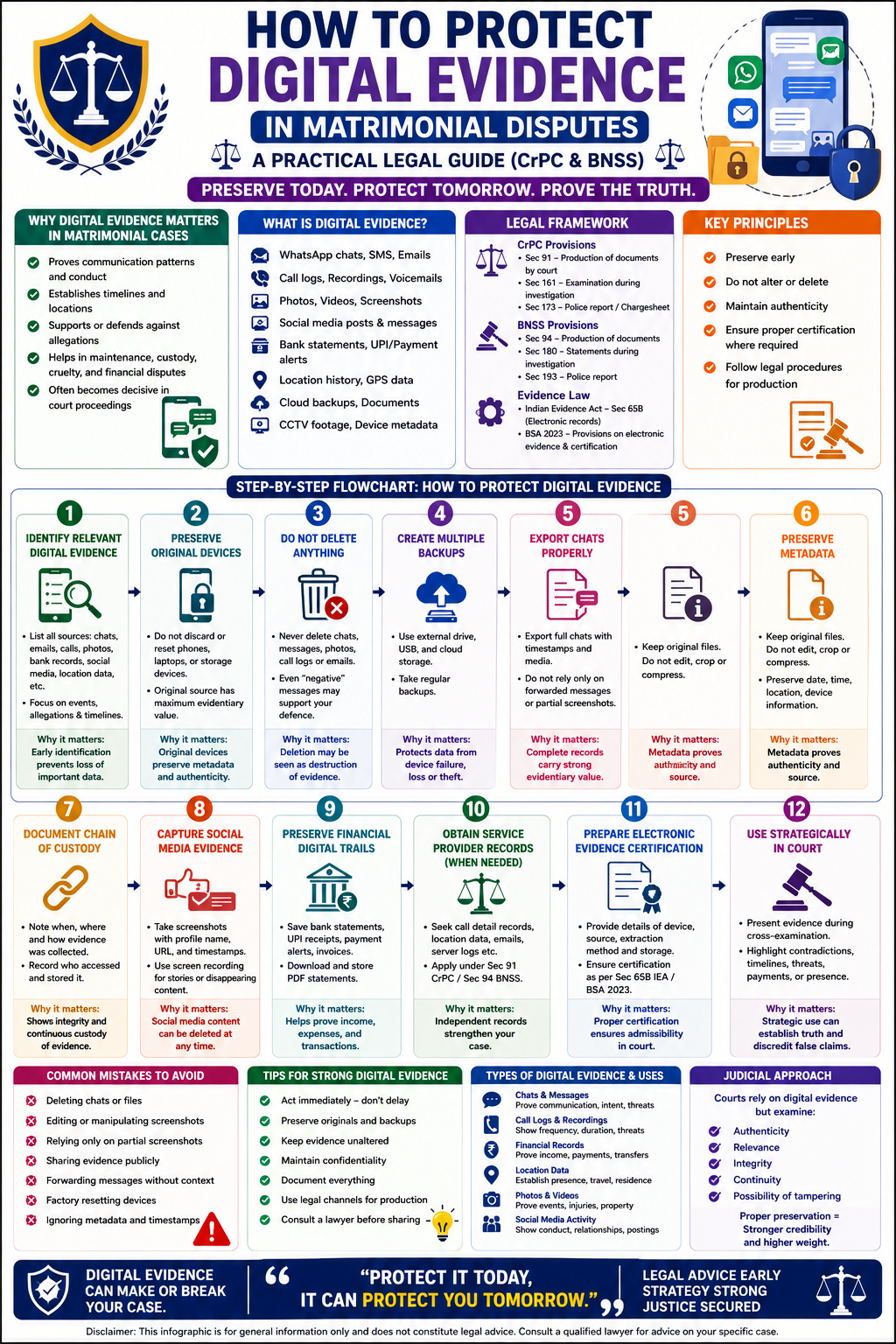
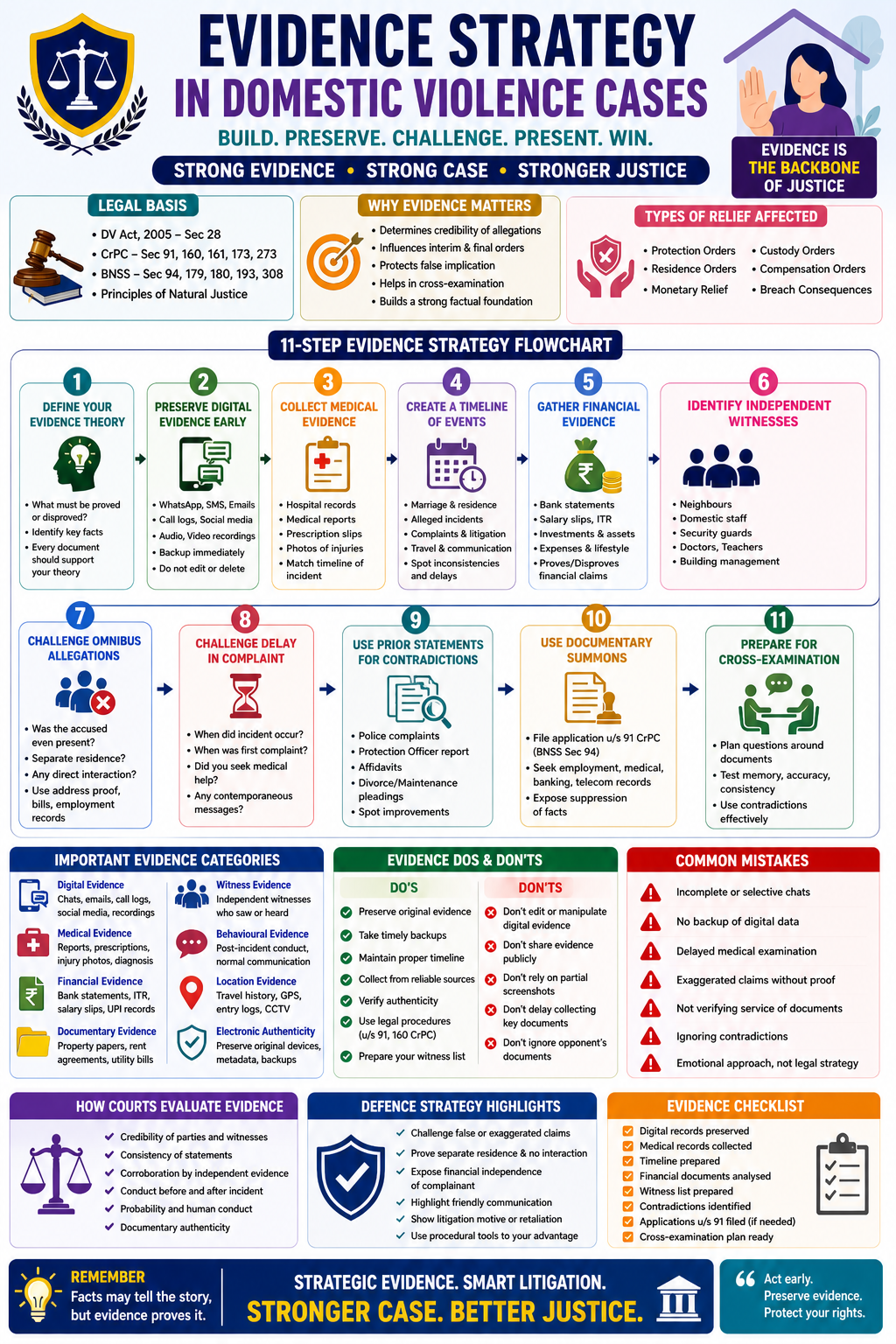
Digital evidence preservation is increasingly important.
Condition 5: Travel Restrictions
Courts may require:
- Passport surrender
- Prior permission for foreign travel
- Travel disclosure
Especially in:
- Economic offences
- NRI matrimonial disputes
- Fraud allegations
Condition 6: Attend Court Regularly
Courts expect:
- Personal appearance where required
- Compliance with exemptions
Relevant provision:
- Section 205 CrPC (BNSS Section 227) – Exemption from personal appearance
Repeated absence can create complications.
Condition 7: Maintain Good Conduct
Courts may direct:
- No similar offence
- No unlawful activity
- No breach of peace
Fresh criminal allegations may trigger cancellation proceedings.
Can Bail Be Cancelled?
Yes.
Bail can be cancelled if liberty is misused.
Relevant provisions:
Magistrate Bail Cancellation
- Section 437(5) CrPC (BNSS Section 480(5))
Sessions Court/High Court Bail Cancellation
- Section 439(2) CrPC (BNSS Section 483(2))
These courts may direct:
Arrest and custody of the accused.
Therefore, compliance after bail becomes essential.
Common Grounds for Bail Cancellation
Ground 1: Non-Cooperation With Investigation
Examples:
- Ignoring notices
- Missing appearances
- Refusing lawful cooperation
Defence Strategy
Always:
- Reply in writing
- Preserve acknowledgments
- Inform counsel immediately
Ground 2: Threatening Witnesses
Examples:
- Calls
- WhatsApp messages
- Social media posts
- Third-party pressure
Even emotional messages may be misinterpreted.
Defence Strategy
After bail:
- Avoid direct communication
- Use lawyers for settlement discussions
- Preserve communication records
Ground 3: Tampering With Evidence
Examples:
- Deleting messages
- Altering files
- Removing financial records
Courts take digital tampering seriously.
Defence Strategy
Preserve:
- Devices
- Chats
- Emails
- Cloud backups
Ground 4: Absconding
Examples:
- Changing address without intimation
- Leaving jurisdiction secretly
- Switching off phones continuously
Defence Strategy
Always update:
- Address
- Phone number
Maintain availability.
Ground 5: Repeating Similar Conduct
Examples:
- Fresh harassment allegations
- New criminal complaints
- Violent confrontations
Defence Strategy
Maintain strict personal discipline.
Ground 6: Violation of Specific Bail Conditions
Examples:
- Failure to deposit passport
- Missing mandatory attendance
- Violating travel restrictions
Defence Strategy
Maintain a compliance calendar.
Special Risk in Matrimonial Cases
In matrimonial litigation, bail cancellation applications commonly allege:
- Threats to complainant
- Settlement pressure
- Contact through relatives
- Social media harassment
- Financial coercion
- Return of stridhan disputes
These allegations may be exaggerated.
Therefore, accused persons must act cautiously.
Practical Post-Bail Compliance Strategy
Step 1: Read the Bail Order Carefully
Do not rely on verbal explanations.
Read:
- Every condition
- Every reporting requirement
- Every travel restriction
Keep digital and printed copies.
Step 2: Create a Bail Compliance File
Maintain:
- Bail order
- Attendance proofs
- Investigation notices
- Replies
- Court attendance records
Documentation defeats false allegations.
Step 3: Maintain Controlled Communication
If communication is unavoidable:
Use:
- Lawyer correspondence
- Recorded written communication
Avoid:
- Emotional phone calls
- Voice notes
- Informal intermediaries
Step 4: Preserve Digital Conduct
Do not:
- Delete chats
- Remove call logs
- Change devices carelessly
Instead:
- Create backups
- Preserve originals
- Maintain metadata
Step 5: Seek Permission Before Travel
If the bail order restricts travel:
Apply before:
- Domestic relocation
- Foreign travel
- Extended absence
Never assume permission.
Step 6: Inform Counsel About Every Development
Inform your lawyer immediately if:
- Police call you
- Witness contacts you
- New allegations arise
- Settlement discussions begin
Early response prevents escalation.
What to Do If Someone Files for Bail Cancellation
Do not panic.
Take immediate action:
Collect Compliance Records
Produce:
- Attendance records
- Call logs
- Emails
- Travel permissions
- Investigation replies
Challenge False Allegations
Demonstrate:
- No contact
- No tampering
- No evasion
Show Consistent Conduct
Highlight:
- Regular appearances
- Cooperation
- Stable residence
- No fresh offences
Courts value conduct.
Can Bail Conditions Be Modified?
Yes.
If conditions become impractical, seek modification.
Examples:
- Frequent police attendance
- Passport restrictions
- Medical limitations
- Employment-related travel
Apply before the same court or appropriate superior court.
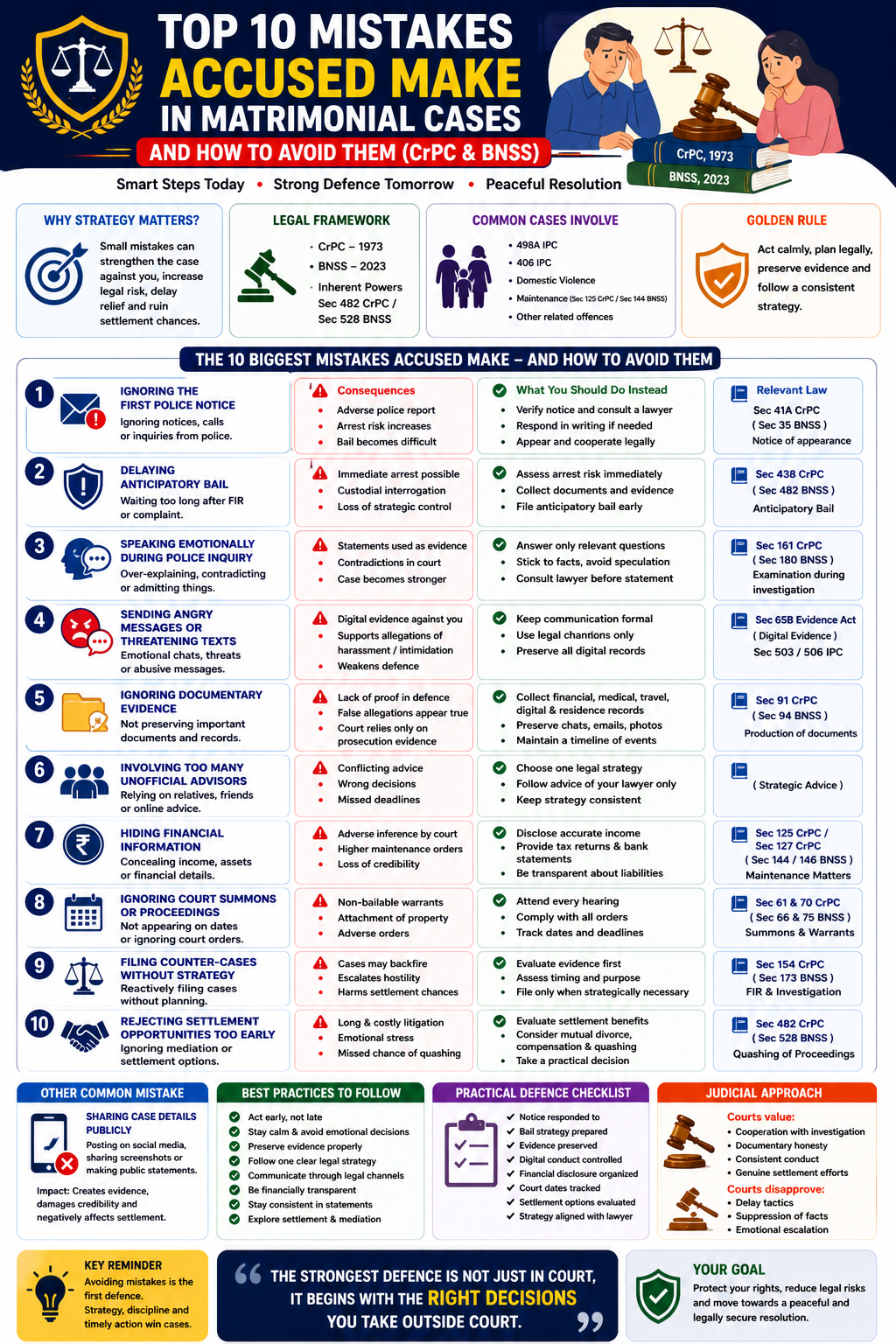
Common Mistakes After Bail
Avoid:
Assuming Bail Means Total Freedom
Bail remains conditional.
Ignoring Investigation Calls
Non-cooperation creates risk.
Emotional Contact With Complainant
Messages may become evidence.
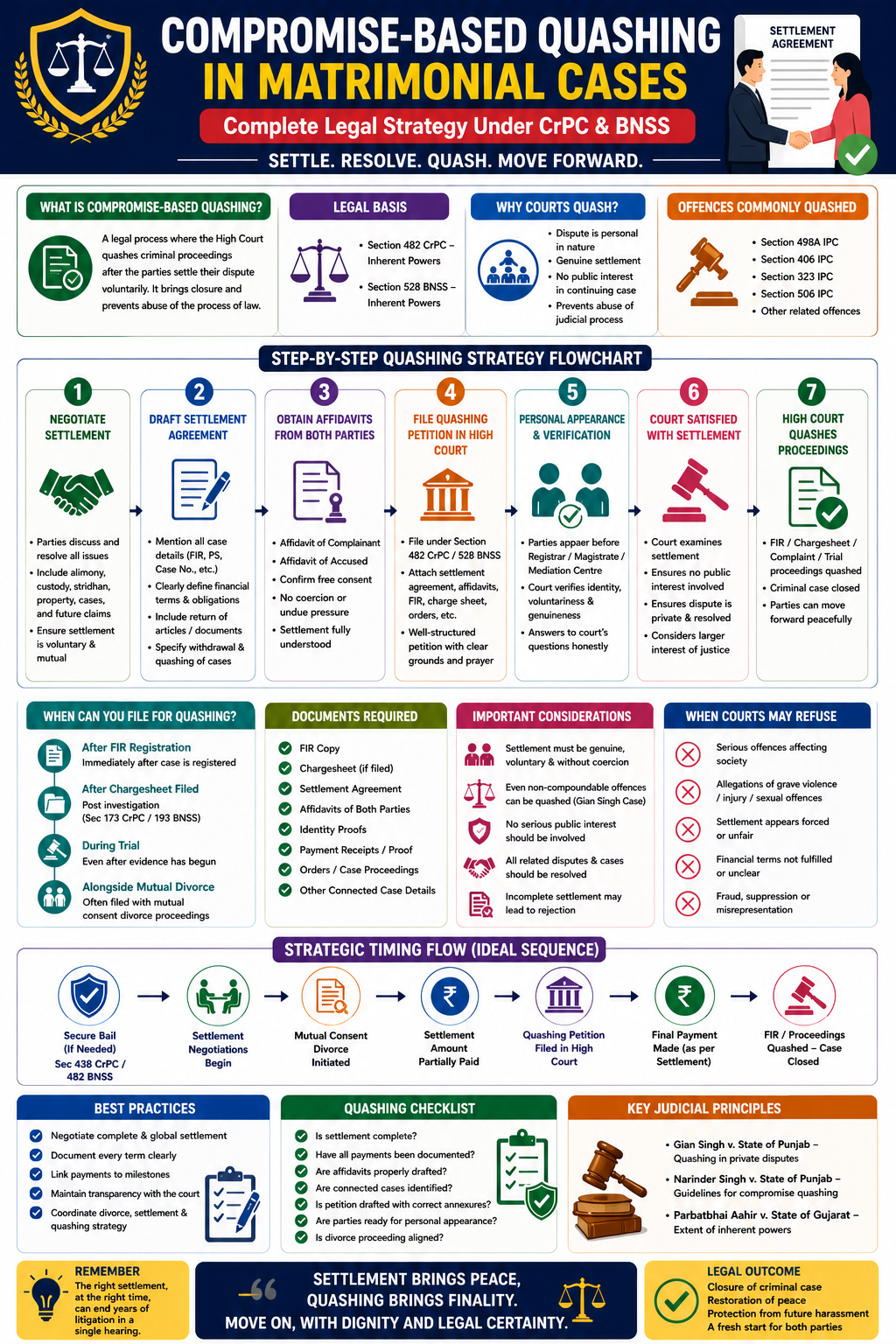
Informal Settlement Pressure
Can be portrayed as intimidation.
Missing Court Dates
Repeated absence creates adverse perception.
Social Media Commentary
Public posts may backfire.
Practical Bail Compliance Checklist
After securing bail, ensure:
- Bail order copied and reviewed
- Conditions explained clearly
- Attendance calendar created
- Passport compliance completed
- Digital evidence preserved
- No direct witness contact
- Travel restrictions understood
- Lawyer updated regularly
Judicial Approach
The Courts generally protect liberty—but only when liberty is responsibly exercised.
Courts look for:
- Cooperation
- Transparency
- Consistency
- Respect for process
Courts act strictly against:
- Intimidation
- Delay tactics
- Evidence destruction
- Abuse of judicial protection
Your conduct after bail often influences the entire trial.
Conclusion
Securing bail is a major relief—but keeping bail intact requires discipline.
Many accused lose strategic advantage not because of weak legal arguments, but because of careless post-bail conduct.
By:
- Understanding every bail condition
- Maintaining written compliance
- Avoiding emotional reactions
- Preserving digital evidence
- Respecting court directions
you can significantly reduce the risk of cancellation.
In criminal litigation, bail protects liberty—but disciplined conduct protects bail.
Index of Legal Strategies and Defence is here.
Key Contributor :
Mrs. Suprajaa Rajan B.Com., LL.B., LL.M.
+91-9606345150