web analytics

Menu

Skip to content
Shades of Knife
  • Home
  • True Colors of a Vile Wife
  • Need Inspiration?
  • Blog Updates
  • SOK Gallery
  • Vile News Reporter
  • About Me
  • Contact Me

Shades of Knife

True Colors of a Vile Wife

Tag: Legal Rights

How to File a Complaint Against an Advocate in India – A First-Timer’s Complete Guide

Posted on June 5 by Suprajaa Rajan

Filing a complaint against an advocate – Advocates play a crucial role in the administration of justice. Clients trust lawyers with sensitive information, financial matters, litigation strategy, and court representation. Most advocates perform their duties professionally and ethically. However, there are situations where a client may genuinely feel aggrieved because of:

  • Professional misconduct
  • Misappropriation of money
  • Non-appearance in court
  • Misleading legal advice
  • Fraudulent conduct
  • Ethical violations
  • Abuse of trust
  • Conflict of interest
  • Harassment or intimidation

In such situations, clients often ask:

“Can I file a complaint against an advocate?”

The answer is yes.

Indian law provides a mechanism to file complaints against advocates before the appropriate State Bar Council under the disciplinary framework governing legal professionals.

However, many people do not understand:

  • Where to file the complaint
  • What documents are required
  • What qualifies as misconduct
  • What relief can be expected
  • Whether compensation is possible
  • How disciplinary proceedings actually work

Therefore, this article acts as a first-timer’s practical guide explaining the complete process of filing a complaint against an advocate in India.
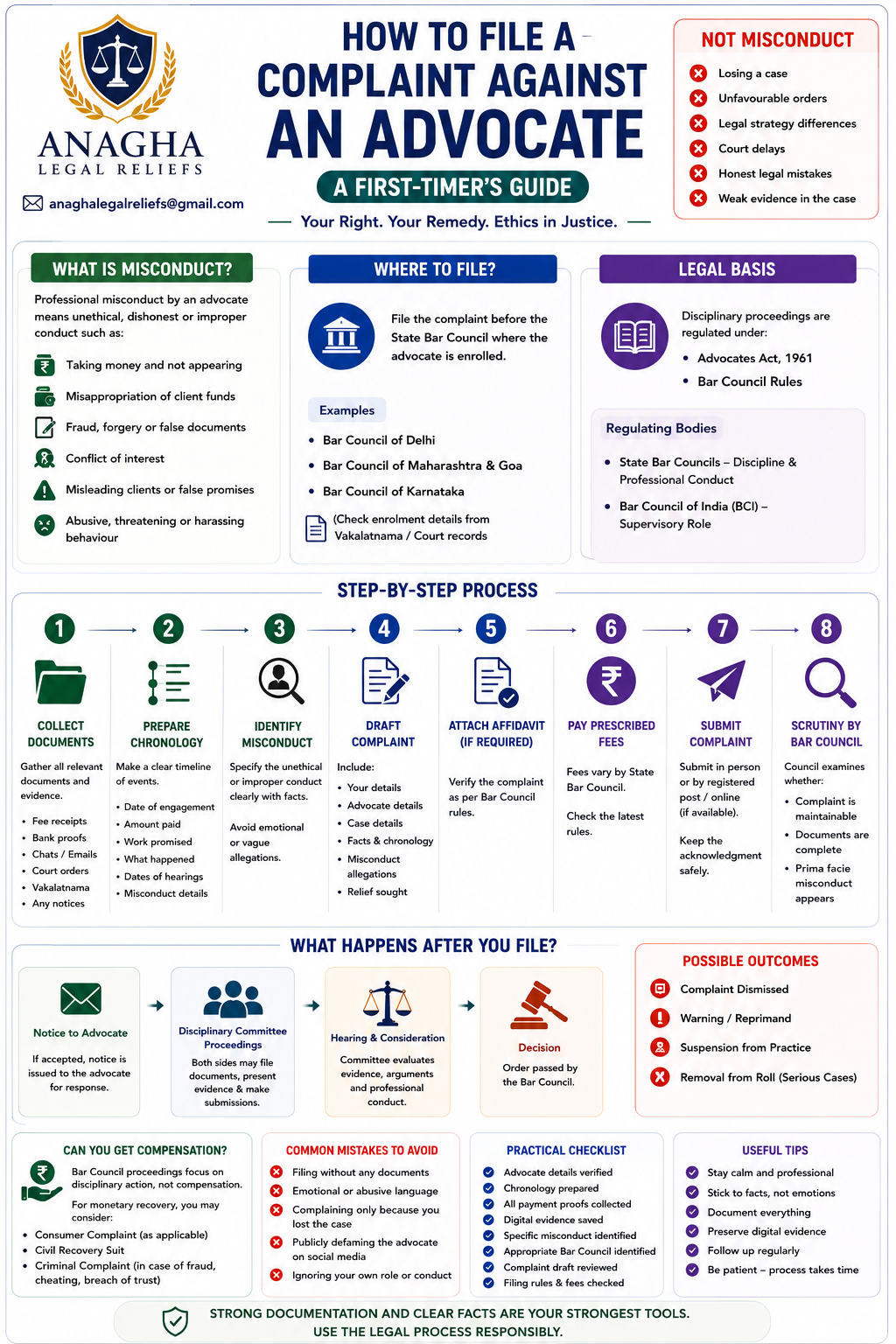
Who Regulates Advocates in India?

Advocates in India are regulated under:

Advocates Act, 1961

The legal profession is supervised through:

State Bar Councils

Each state has its own Bar Council.

Examples include:

  • Bar Council of Delhi
  • Bar Council of Maharashtra & Goa
  • Bar Council of Karnataka

Bar Council of India

The Bar Council of India (BCI) supervises legal education and professional ethics nationally.

What Is “Professional Misconduct” by an Advocate?

Not every mistake or lost case amounts to misconduct.

A lawyer losing a case does not automatically justify disciplinary action.

However, certain acts may amount to professional misconduct.

Common Examples of Advocate Misconduct

1. Taking Money and Not Appearing in Court

Examples:

  • Repeated absence
  • Intentional non-appearance
  • Abandoning the case without notice

2. Misappropriation of Client Funds

Examples:

  • Keeping settlement money
  • Misusing litigation funds
  • Taking money under false promises

3. Fraud or Forgery

Examples:

  • Fake orders
  • Fabricated documents
  • False representation

4. Conflict of Interest

Example:

Representing the opposite party improperly after previously advising you.

5. Professional Negligence Combined With Misconduct

Examples:

  • Deliberate suppression
  • Intentional misleading conduct
  • Gross ethical violations

Simple negligence alone may not always become misconduct.

6. Threatening or Abusive Behaviour

Examples:

  • Intimidation
  • Harassment
  • Abusive communication

7. Misleading Clients

Examples:

  • False claims about case status
  • Fake assurances of guaranteed results
  • False statements regarding court orders

What Does NOT Usually Amount to Misconduct?

Many clients misunderstand this area.

The following usually do NOT automatically amount to misconduct:

  • Losing a case
  • Unfavourable court orders
  • Legal strategy disagreements
  • Delay caused by court system
  • Honest legal mistakes
  • Weak evidence in the case

Bar Councils generally distinguish between:

  • Professional misconduct
    vs
  • Professional error or strategic difference

Where Should You File the Complaint?

Usually before the:

State Bar Council where the advocate is enrolled

Example:

If the advocate is enrolled in Maharashtra, complaint usually goes before:

  • Bar Council of Maharashtra & Goa

Even if the case was handled elsewhere, enrolment details matter.

How to Find an Advocate’s Enrolment Details

You may check:

  • Vakalatnama
  • Court filings
  • Advocate ID details
  • State Bar Council records

Proper identification is important before filing.

Legal Basis for Complaint Against Advocates

Relevant provisions arise under:

Advocates Act, 1961

Particularly disciplinary provisions relating to:

  • Professional misconduct
  • Disciplinary committees
  • Suspension
  • Removal from rolls

Step-by-Step Guide to Filing a Complaint Against an Advocate

Step 1: Collect All Relevant Documents

Before filing, gather all evidence carefully.

Important documents include:

  • Fee receipts
  • Bank transfer proof
  • WhatsApp chats
  • Emails
  • Call recordings (where legally permissible)
  • Court orders
  • Vakalatnama copies
  • Case status documents
  • Notices exchanged
  • Affidavits or undertakings

Strong documentation is critical.

Step 2: Prepare a Chronology of Events

Create a clear timeline.

Include:

  • Date of engagement
  • Amount paid
  • Work promised
  • What actually happened
  • Dates of court hearings
  • Misconduct details

A structured chronology improves credibility.

Step 3: Identify Specific Misconduct

Avoid emotional allegations like:

“The advocate ruined my life.”

Instead, specify conduct precisely.

Example:

 “Advocate accepted fees but remained absent on three hearing dates.”

Specific allegations carry more weight.

Step 4: Draft the Complaint Properly

A proper complaint should include:

Basic Details

  • Your name and address
  • Advocate’s name and enrolment details

Case Information

  • Court details
  • Case number

Facts

Chronological narration.

Misconduct Allegation

Clearly explain ethical violation.

Supporting Documents

Attach copies.

Relief Sought

Mention requested action.

Step 5: Attach Supporting Affidavit (If Required)

Some State Bar Councils require:

  • Verification affidavit
  • Attestation formalities

Always check applicable procedural rules.

Step 6: Pay Prescribed Fees

Most Bar Councils require complaint filing fees.

Fees vary between states.

Check the official State Bar Council rules before filing.

Step 7: Submit Complaint Before Appropriate Authority

Submission may occur through:

  • Physical filing
  • Registered post
  • Online mechanism (where available)

Preserve acknowledgment carefully.

What Happens After Filing the Complaint?

Stage 1: Scrutiny

The Bar Council examines whether:

  • Complaint is maintainable
  • Documents are complete
  • Prima facie misconduct appears

Stage 2: Notice to Advocate

If accepted, notice may be issued to the advocate.

The advocate may file a response.

Stage 3: Disciplinary Committee Proceedings

The matter may proceed before a disciplinary committee.

Both sides may:

  • File documents
  • Present evidence
  • Make submissions

Stage 4: Decision

Possible outcomes include:

Complaint Dismissed

If misconduct not proved.

Warning or Reprimand

Minor misconduct.

Suspension

Temporary prohibition from practice.

Removal From Roll

In serious misconduct cases.

Can You Get Compensation Through Bar Council Complaint?

Usually, Bar Council proceedings primarily address:

  • Professional discipline
  • Ethical accountability

Compensation may not always be the primary remedy.

For monetary recovery, separate proceedings may sometimes be required, such as:

  • Consumer disputes (subject to legal position)
  • Civil recovery proceedings
  • Criminal complaint where fraud exists

Strategy depends on facts.

Can You File Criminal Case Against an Advocate?

In serious situations involving:

  • Fraud
  • Forgery
  • Cheating
  • Criminal breach of trust

criminal remedies may also exist.

However, criminal allegations require evidence—not mere dissatisfaction.

Always proceed carefully.

Important Difference: Misconduct vs Poor Outcome

Courts and Bar Councils repeatedly emphasise:

A lawyer is not automatically guilty merely because the case failed.

Therefore, before filing:

Ask:

  • Was the conduct unethical?
  • Or was the result simply unfavourable?

This distinction matters greatly.

Practical Tips for First-Time Complainants

Stay Professional

Avoid emotional language.

Focus on Documents

Documentary evidence is stronger than oral accusations.

Preserve Digital Evidence

Save:

  • Chats
  • Emails
  • Payment proof
  • Call records

Avoid Social Media Defamation

Do not post allegations publicly without legal basis.

This may create separate legal complications.

Understand Time and Process

Disciplinary proceedings may take time.

Maintain realistic expectations.

Common Mistakes People Make

Avoid:

Filing Without Documents

Weak complaints rarely succeed.

Emotional Allegations Without Facts

Precision matters.

Publicly Threatening the Advocate

Escalation may backfire.

Filing Complaint Only Because Case Was Lost

Loss alone is insufficient.

Suppressing Your Own Conduct

Transparency matters.

Can Complaints Be Settled?

Sometimes disputes resolve through:

  • Fee refund
  • Clarification
  • Professional closure

However, serious ethical misconduct may still proceed independently.

Judicial Approach

Courts generally balance:

  • Protection of clients
    and
  • Independence of legal profession

Therefore:

  • Genuine misconduct is treated seriously
  • Frivolous complaints are discouraged

Credibility and documentation remain crucial.

Practical Checklist Before Filing Complaint

Before proceeding, ensure:

  • Advocate details verified
  • Chronology prepared
  • Fee proof collected
  • Court records obtained
  • Digital evidence preserved
  • Specific misconduct identified
  • Emotional allegations avoided
  • Appropriate Bar Council identified
  • Filing rules checked

Conclusion

Filing a complaint against an advocate is a serious legal step and should be taken carefully, responsibly, and with proper documentation.

While clients absolutely have the right to challenge:

  • Fraud
  • Misconduct
  • Ethical violations
  • Abuse of trust

they must also understand that:

  • Losing a case alone is not misconduct
  • Strategic disagreements are not always disciplinary violations

By:

  • Collecting proper evidence
  • Following the correct procedure
  • Presenting facts clearly
  • Remaining professional throughout

a complainant can effectively pursue legitimate grievances before the appropriate Bar Council.

In legal ethics matters, strong documentation and disciplined presentation are far more powerful than emotional allegations.


Index of Legal Strategies and Defence is here. 


Key Contributor : 

Mrs. Suprajaa Rajan B.Com., LL.B., LL.M.

+91-9606345150

Posted in Legal Procedure | Tagged 1961 Advocates Act Advocates Act Section 32 complaint against advocate Legal Rights Legal Strategies and Defence | Leave a comment

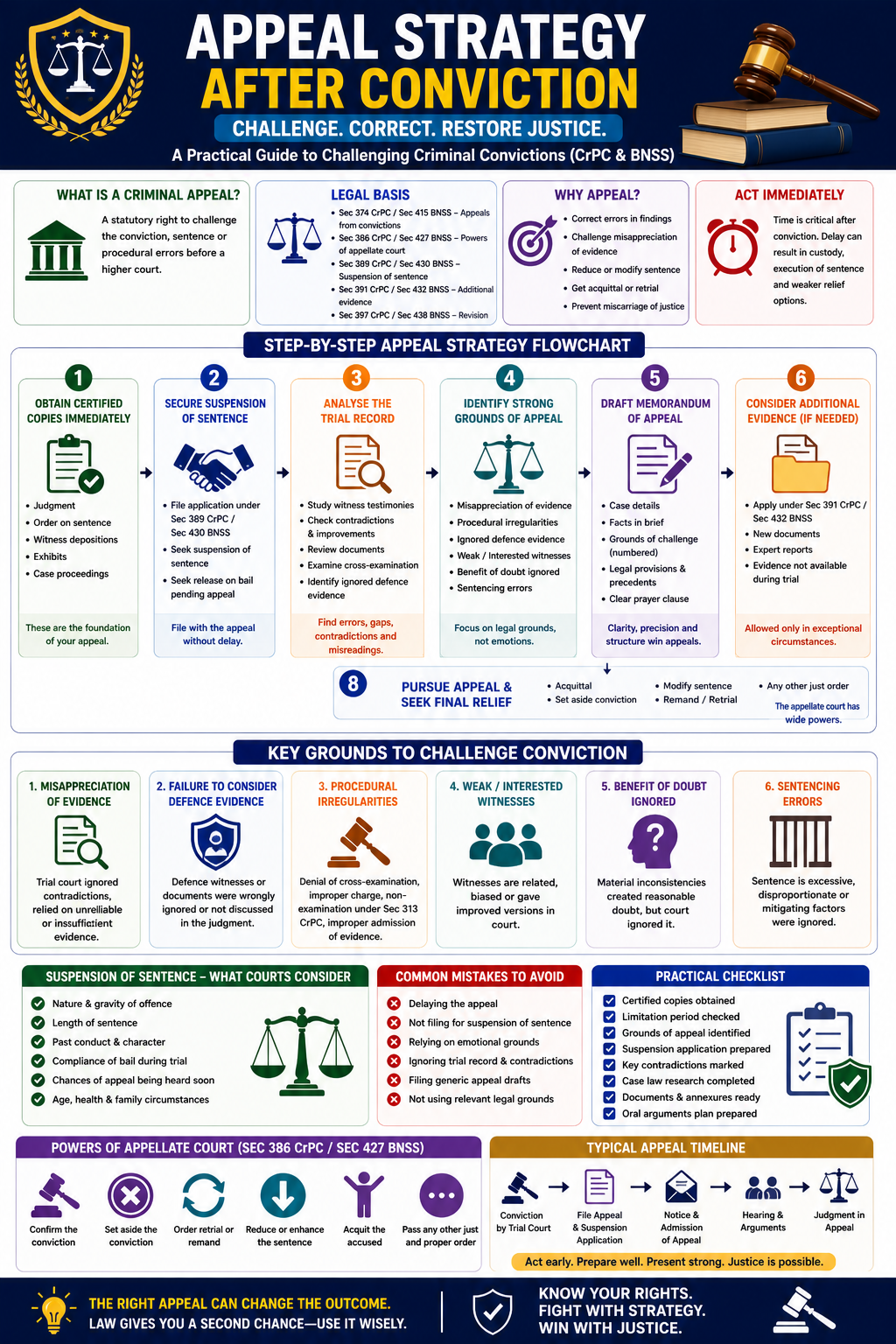
Appeal Strategy After Conviction – A Practical Guide to Challenging Criminal Convictions

Posted on May 5 by Suprajaa Rajan

A criminal conviction can feel like the final chapter of a case. However, in law, a conviction is not necessarily the end of the road. Indian criminal jurisprudence provides multiple appellate remedies that allow an accused person to challenge findings of guilt, sentence, procedural irregularities, or evidentiary errors.

In fact, many convictions are modified, suspended, or even set aside in appeal when the defence presents a structured appellate strategy supported by law, evidence, and procedural precision.

Therefore, understanding the appeal strategy after conviction becomes essential for accused persons, family members, and defence lawyers navigating criminal litigation.

This article explains the legal framework, grounds of appeal, procedural roadmap, suspension of sentence strategy, document preparation, and practical appellate tactics, with references to both the Code of Criminal Procedure, 1973 (CrPC) and the Bharatiya Nagarik Suraksha Sanhita, 2023 (BNSS).

What Is a Criminal Appeal?

A criminal appeal is a statutory remedy that allows a convicted person to challenge:

  • Findings of guilt
  • Quantum of sentence
  • Errors in appreciation of evidence
  • Procedural irregularities
  • Misapplication of law
  • Jurisdictional defects

An appellate court may:

  • Confirm conviction
  • Set aside conviction
  • Modify sentence
  • Order retrial
  • Acquit the accused
  • Remand the matter

Thus, an appeal is not merely a technical formality—it is often the most critical stage after trial.

Legal Framework for Criminal Appeals

Appeals against conviction are governed by:

Appeals from Sessions and Magistrate Courts

  • Section 374 CrPC (BNSS Section 415) – Appeals from convictions

Powers of Appellate Court

  • Section 386 CrPC (BNSS Section 427) – Powers of appellate court

Suspension of Sentence Pending Appeal

  • Section 389 CrPC (BNSS Section 430) – Suspension of sentence

Taking Additional Evidence

  • Section 391 CrPC (BNSS Section 432) – Additional evidence in appeal

Revisionary Jurisdiction

  • Section 397 CrPC (BNSS Section 438) – Revision powers

These provisions form the backbone of appellate strategy.

When Should You File an Appeal?

A convicted person should act immediately after conviction.

Do not wait for:

  • Execution of sentence
  • Arrest warrants
  • Recovery proceedings
  • Bail cancellation
  • Delay in obtaining documents

The first few days after conviction often determine whether the accused secures immediate relief.

Step 1: Obtain Certified Copies Immediately

The first strategic step is obtaining certified copies of:

  • Judgment
  • Order on sentence
  • Deposition of witnesses
  • Exhibits
  • Applications and orders
  • Case proceedings

Why is this important?

Because appellate strategy depends on identifying:

  • Contradictions
  • Procedural defects
  • Missing findings
  • Evidentiary inconsistencies

Without the complete trial record, appellate grounds remain weak.

Step 2: Secure Suspension of Sentence

If the trial court convicts the accused and imposes imprisonment, the immediate priority becomes:

Suspension of sentence

Apply under:

  • Section 389 CrPC (BNSS Section 430)

This application seeks:

  • Suspension of sentence
  • Release on bail pending appeal

Courts often consider:

  • Nature of offence
  • Length of sentence
  • Past conduct
  • Bail compliance during trial
  • Chances of appeal being heard soon

Strategic Tip

Always prepare the suspension application simultaneously with the appeal.

Delay can result in unnecessary custody.

Step 3: Analyse the Trial Record Thoroughly

An effective appeal never relies on emotional arguments.

Instead, analyse:

Witness Depositions

Check for:

  • Contradictions
  • Improvements
  • Omissions
  • Inconsistencies

Documentary Evidence

Verify:

  • Admissibility
  • Authenticity
  • Chain of custody
  • Missing originals

Cross-Examination

Ask:

  • Did prosecution witnesses withstand cross-examination?
  • Did trial court ignore contradictions?

Judicial Findings

Review:

  • Whether findings are reasoned
  • Whether crucial defence evidence was ignored

Step 4: Identify Strong Grounds of Appeal

Every appeal must focus on legally sustainable grounds.

Ground 1: Misappreciation of Evidence

Argue that the trial court:

  • Ignored contradictions
  • Relied on unreliable testimony
  • Misread documentary evidence

This is one of the most common appellate grounds.

Ground 2: Failure to Consider Defence Evidence

Challenge findings if:

  • Defence witnesses were ignored
  • Documentary defence was not discussed
  • Exculpatory material was overlooked

Ground 3: Procedural Irregularities

Examples:

  • Improper examination of accused
  • Denial of cross-examination
  • Refusal to summon documents
  • Improper framing of charge

Relevant provisions:

  • Section 313 CrPC (BNSS Section 351) – Examination of accused
  • Section 91 CrPC (BNSS Section 94) – Production of documents

Ground 4: Conviction Based on Weak or Interested Witnesses

Challenge:

  • Lack of independent corroboration
  • Improvements in testimony
  • Motivated witnesses

Ground 5: Benefit of Doubt Ignored

Argue that:

  • Material inconsistencies created reasonable doubt
  • Trial court applied incorrect burden of proof

Ground 6: Sentencing Errors

Even if conviction survives, sentence may be challenged if:

  • Sentence is disproportionate
  • Mitigating factors were ignored
  • Age, health, or family circumstances were overlooked

Step 5: Draft a Structured Memorandum of Appeal

A strong appeal must contain:

Case Details

  • Trial court name
  • Case number
  • Conviction date

Factual Background

Brief case history.

Grounds of Challenge

Numbered legal grounds.

Prayer Clause

Seek:

  • Acquittal
  • Suspension of sentence
  • Modification of sentence
  • Remand or retrial

Clarity matters more than volume.

Step 6: Consider Additional Evidence

In exceptional cases, additional evidence may be necessary.

Apply under:

  • Section 391 CrPC (BNSS Section 432)

Examples:

  • Newly discovered documents
  • Expert reports
  • Missing records
  • Technical evidence unavailable earlier

However, courts allow this sparingly.

Step 7: Prepare Oral Hearing Strategy

Appeals succeed not only on paper but also in oral arguments.

Focus on:

Three Strong Grounds

Do not overload the court.

Record-Based Arguments

Take the appellate court directly to:

  • Deposition pages
  • Exhibits
  • Contradictions

Legal Precedents

Use relevant case law strategically.

Special Strategy in Matrimonial Criminal Cases

In convictions arising from:

  • Section 498A IPC cases
  • Dowry harassment prosecutions
  • Domestic violence-related proceedings

Focus on:

Omnibus Allegations

Were all relatives treated identically?

Separate Residence

Did accused live elsewhere?

Delayed Complaints

Was there unexplained delay?

Settlement Motive

Was criminal litigation used as pressure?

These factors often become decisive.

Common Mistakes After Conviction

Avoid:

Delaying Appeal

Delay may complicate suspension of sentence.

Filing Emotional Grounds

Appeals require legal defects, not sympathy alone.

Ignoring Trial Record

Grounds must come from evidence.

Filing Generic Drafts

Every appeal must be case-specific.

Neglecting Sentence Suspension

Custody can become unnecessary.

Practical Appellate Checklist

Before filing appeal, ensure:

  • Certified copies obtained
  • Sentence suspension draft prepared
  • Witness contradictions marked
  • Exhibits reviewed
  • Defence evidence analysed
  • Procedural defects identified
  • Grounds numbered clearly
  • Limitation period checked

Judicial Approach in Appeals

Appellate courts generally examine:

  • Whether evidence supports conviction
  • Whether law was correctly applied
  • Whether findings are perverse
  • Whether procedural fairness was maintained

Courts interfere when:

  • Findings are unreasonable
  • Material evidence was ignored
  • Miscarriage of justice appears

Conclusion

A conviction may be serious—but it is not always final. Indian criminal law provides strong appellate safeguards to ensure that errors at trial do not become permanent injustice.

A successful appeal depends on:

  • Immediate action
  • Careful record analysis
  • Strong legal grounds
  • Effective sentence suspension strategy
  • Focused oral advocacy

By combining timely preparation, procedural accuracy, and strategic legal drafting, a convicted person can significantly improve the chances of reversal, modification, or acquittal.

In criminal litigation, the appeal is often where the real battle begins.


Index of Legal Strategies and Defence is here. 


Key Contributor : 

Mrs. Suprajaa Rajan B.Com., LL.B., LL.M.

+91-9606345150

Posted in Legal Procedure | Tagged Appeal Criminal Appeal CrPC 374 - Appeals from convictions Legal Rights Legal Strategies and Defence Suspension of Sentence | Leave a comment

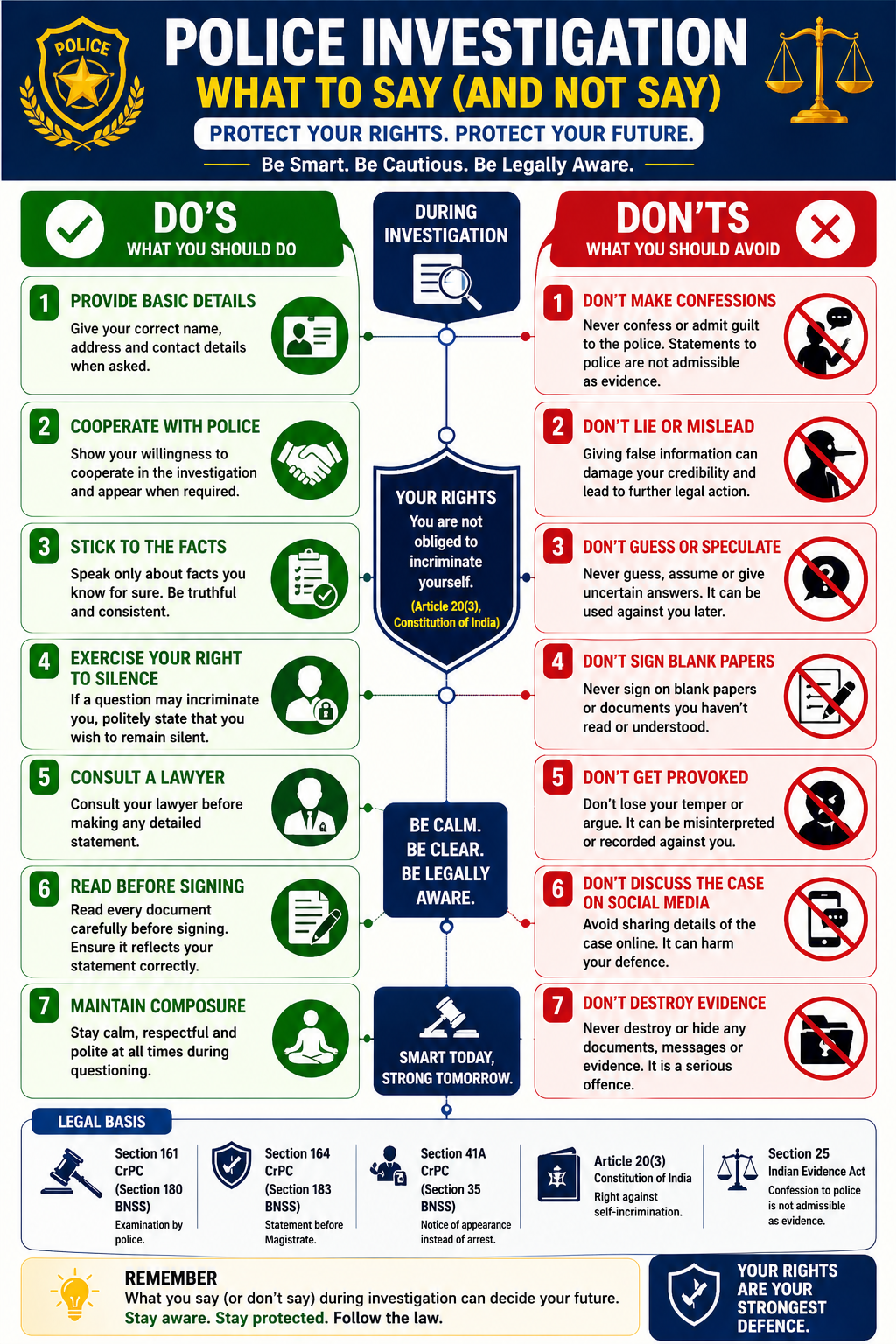
What to Say (and Not Say) During Investigation – A Practical Legal Guide

Posted on April 29 by Suprajaa Rajan

An investigation is a critical stage in criminal proceedings, where statements made by an individual can significantly impact the outcome of the case. Many accused persons unknowingly make statements that later weaken their defence or strengthen the prosecution’s case.

Therefore, understanding what to say—and what to avoid saying—during investigation is essential for protecting your legal rights.

This article explains the correct legal approach during police investigation, along with safeguards under the Code of Criminal Procedure, 1973 (CrPC) and the Bharatiya Nagarik Suraksha Sanhita, 2023 (BNSS).

Understanding Your Legal Position During Investigation

During investigation, the police have the authority to:

  • Call individuals for questioning
  • Record statements
  • Collect evidence

Relevant provisions:

  • Section 160 CrPC (Section 179 BNSS) – Attendance of witnesses
  • Section 161 CrPC (Section 180 BNSS) – Examination by police

However, this power is not unlimited. Individuals have specific rights that protect them from self-incrimination and coercion.

Right Against Self-Incrimination

Under Article 20(3) of the Constitution of India, no person can be compelled to:

  • Be a witness against themselves

This means:

  • You are not required to confess
  • You cannot be forced to make incriminating statements

This principle forms the foundation of your conduct during investigation.

What You Should Say During Investigation

1. Provide Basic Identification Details

You should always provide:

  • Name
  • Address
  • Contact details

This ensures compliance with legal requirements.

2. Confirm Willingness to Cooperate

You should clearly state:

  • Your willingness to cooperate with the investigation
  • Your readiness to appear when required

This helps avoid adverse inference and unnecessary coercive action.

3. Stick to Verified Facts Only

If you choose to answer questions:

  • Speak only about facts you are certain of
  • Avoid assumptions or speculation

Consistency is key to maintaining credibility.

4. Exercise Your Right to Silence Where Necessary

If a question may incriminate you, you can:

  • Politely decline to answer
  • State that you wish to consult your lawyer

This is a legally protected right.

5. Request Legal Assistance

While police questioning may proceed, you can:

  • Consult a lawyer before making detailed statements

This ensures that your rights are protected at every stage.

What You Should NOT Say During Investigation

1. Do Not Make Confessions to Police

Statements made to police are generally not admissible as evidence.

Relevant provision:

  • Section 25 of the Indian Evidence Act

However, such statements may still:

  • Influence investigation
  • Lead to recovery of evidence

Therefore, avoid making confessional statements.

2. Do Not Provide False Information

Giving false statements can:

  • Damage your credibility
  • Lead to additional legal consequences

Always avoid misleading the investigating officer.

3. Do Not Guess or Speculate

Never:

  • Assume facts
  • Provide uncertain answers

Speculative answers may later be used against you.

4. Do Not Sign Blank or Unread Documents

Before signing any document:

  • Read it carefully
  • Ensure it reflects your actual statement

Signing incorrect documents can seriously harm your case.

5. Do Not Get Provoked or Intimidated

Maintain composure even if:

  • Questioning becomes aggressive
  • Pressure is applied

Any emotional reaction can be misinterpreted.

Importance of Statements Under Section 161 CrPC

Statements recorded under:

  • Section 161 CrPC (Section 180 BNSS)

are:

  • Not signed by the person
  • Used for contradiction during trial

Therefore, even informal statements can later affect your defence.

Special Note on Section 164 Statements

If the Magistrate records your statement under:

  • Section 164 CrPC (Section 183 BNSS)

it carries higher evidentiary value.

Such statements:

  • Are recorded voluntarily
  • Can be used as substantive evidence

Hence, extreme caution is required before making such statements.

Role of Notice Under Section 41A

Instead of arrest, police may issue notice under:

  • Section 41A CrPC (Section 35 BNSS)

You must:

  • Comply with the notice
  • Appear before the officer

Cooperation reduces the risk of arrest.

Step-by-Step Practical Strategy

Step 1: Stay Calm and Composed

Do not panic or react impulsively.

Step 2: Understand the Nature of Allegations

Ask for:

  • Basic information about the case
  • Reason for questioning

Step 3: Avoid Incriminating Statements

Use your right to silence where necessary.

Step 4: Consult a Lawyer

Seek legal advice before making detailed statements.

Step 5: Maintain Consistency

Ensure that all statements remain:

  • Accurate
  • Consistent

Judicial Approach

Courts recognise that:

  • Statements made during investigation can be misused
  • Accused persons must be protected from coercion

Courts emphasise:

  • Voluntariness of statements
  • Protection against self-incrimination
  • Fair investigation process

Practical Insight

Many cases are weakened not because of evidence, but due to:

  • Incorrect statements
  • Inconsistent versions
  • Unnecessary admissions

Therefore, careful communication during investigation is a key defence strategy.

Conclusion

What you say during investigation can significantly influence your case. While cooperation is important, protecting your legal rights is equally essential.

By:

  • Speaking cautiously
  • Avoiding unnecessary disclosures
  • Exercising your right to silence

you can ensure that your defence remains strong throughout the proceedings.

A balanced approach—cooperative yet legally aware—is the best strategy during any investigation.


Related Legal Concepts

  • Police Investigation
  • Reply to Notice under Section 41A
  • Rights during police investigation
  • First Information Report(FIR)
  • Arrest and Custodial procedures


Index of Legal Strategies and Defence is here. 


Key Contributor : 

Mrs. Suprajaa Rajan B.Com., LL.B., LL.M.

+91-9606345150

Posted in Legal Procedure | Tagged Legal Rights Legal Strategies and Defence Police Investigation Section 160 CrPC Section 41A Notice | Leave a comment

Search within entire Content of “Shades of Knife”

My Legal X Timeline

Advocate Sandeep Pamarati 🇮🇳💪👨🏻‍🎓 Follow

AP High Court Advocate with M Tech (CS) || 12 years in 'Software Industry' as Solution Architect || Blogs at https://t.co/29CB9BzK4w || #TDPTwitter

SandeepPamarati
Retweet on Twitter Advocate Sandeep Pamarati 🇮🇳💪👨🏻‍🎓 Retweeted
thisguyknowsai Brady Long @thisguyknowsai ·
22 Jun

A German psychologist proved in 1885 that cramming erases what you learned within 48 hours. He published the fix in the same book. Almost no school on Earth has adopted it in 140 years.

His name was Hermann Ebbinghaus.

He had no lab. No funding. No colleagues.

He worked alone

Reply on Twitter 2068965021514891696 Retweet on Twitter 2068965021514891696 901 Like on Twitter 2068965021514891696 2632 X 2068965021514891696
Retweet on Twitter Advocate Sandeep Pamarati 🇮🇳💪👨🏻‍🎓 Retweeted
factcheckapgov FactCheck.AP.Gov.in @factcheckapgov ·
22 Jun

ఎంతో ప్రతిష్టాత్మకంగా నిర్వహించి ప్రజల ఆరోగ్యం పట్ల అవగాహన కల్పించిన అంతర్జాతీయ యోగా దినోత్సవం సందర్భంగా రాష్ట్రం లో పలుచోట్ల నిర్వహించిన యోగా కార్యక్రమం పై కొందరు తప్పుడు ప్రచారం చేస్తున్నారు. ఈ కార్యక్రమం కోసం రూ. 600 కోట్లు ఖర్చు అయినట్లు చెప్పడం పూర్తిగా అసత్యం. రాష్ట్రంలో

Reply on Twitter 2068972932827869255 Retweet on Twitter 2068972932827869255 38 Like on Twitter 2068972932827869255 85 X 2068972932827869255
Retweet on Twitter Advocate Sandeep Pamarati 🇮🇳💪👨🏻‍🎓 Retweeted
jaitdp Telugu Desam Party @jaitdp ·
22 Jun

చీఫ్ మినిస్టర్.. టీచర్ అయిన వేళ

అంగన్వాడీ కేంద్రాన్ని సందర్శించిన సీఎం చంద్రబాబు కాసేపు టీచర్‌గా మారి, పిల్లల అభ్యసనం ఎలా ఉందో తెలుసుకున్నారు. ఇంగ్లీష్ ఆల్ఫాబెట్స్ చెప్పమని సీఎం అడిగేసరికి పిల్లలు చక్కగా చెప్పారు.
#ChandrababuNaidu
#AndhraPradesh

Reply on Twitter 2068873963246399922 Retweet on Twitter 2068873963246399922 69 Like on Twitter 2068873963246399922 304 X 2068873963246399922
Retweet on Twitter Advocate Sandeep Pamarati 🇮🇳💪👨🏻‍🎓 Retweeted
jaynitx Jaynit @jaynitx ·
19h

Marc Andreessen went on Chris Williamson's podcast and broke down exactly how Elon Musk runs multiple companies at once

No other CEO on Earth does this:

1. Every week, Musk shows up at each of his companies, identifies the single biggest problem that company is having that

Reply on Twitter 2069072158735942107 Retweet on Twitter 2069072158735942107 619 Like on Twitter 2069072158735942107 3267 X 2069072158735942107
Load More

Recent Posts

  • Pavul Yesu Dhasan Vs Registrar SHRC of TN and Ors on 30 Apr 2025 June 18, 2026
  • Manoj Kumar Vs Nita Bharti on 17 Mar 2026 June 17, 2026
  • Cruelty as a Criminal Offence Explained June 12, 2026
  • Bail Compliance Undertaking Format – Draft, Legal Requirements & Sample Template June 12, 2026
  • Warning Signs of Escalating Matrimonial Litigation – Early Red Flags Every Spouse Should Recognize June 12, 2026

Most Read Posts

  • Reply to Section 41A CrPC Notice – Format with Legal Explanation (4,941 views)
  • Anu Aggarwal Vs Sushant Aggarwal on 20 Jan 2026 (3,473 views)
  • Umme Farva Vs State of U.P. and Anr on 14 Jan 2026 (3,363 views)
  • Charge Sheet and Final Report Explained (2,809 views)
  • Regular Bail Application Format (Section 437/439 CrPC) (2,189 views)
  • Neha Lal Vs Abhishek Kumar on 20 Jan 2026 (1,998 views)
  • Arrest Procedure in 498A cases after Arnesh Kumar (1,930 views)
  • Discharge Application Format in 498A Case – Draft, Procedure & Sample Template (1,773 views)
  • Can You Travel Abroad After an FIR Is Registered? – Legal Position Explained (1,686 views)
  • Atul Kumar Bajpai Vs State of UP and Anr on 17 Sep 2025 (1,536 views)

Tags

Reportable Judgement or Order (433)2-Judge (Division) Bench Decision (413)Legal Procedure Explained - Interpretation of Statutes (382)Landmark Case (381)1-Judge Bench Decision (362)Catena of Landmark Judgments Referred/Cited to (293)Work-In-Progress Article (215)3-Judge (Full) Bench Decision (101)Sandeep Pamarati (92)Article 21 - Protection of life and personal liberty (80)Issued or Recommended Guidelines or Directions or Protocols to be followed (71)Perjury Under 340 CrPC (66)Absurd Or After Thought Or Baseless Or False Or General Or Inherently Improbable Or Improved Or UnSpecific Or Omnibus Or Vague Allegations (61)Reprimands or Setbacks to YCP Govt of Andhra Pradesh (49)Summary Post (47)CrPC 482 - Quash (43)HM Act 13 - Divorce Granted to Husband (42)Legal Terrorism (41)Divorce granted on Cruelty ground (41)Not Authentic copy hence to be replaced (40)

Categories

Supreme Court of India Judgment or Order or Notification (753)Bare Acts or State Amendments or Statutes or GOs or Notifications issued by Central or State Governments (328)High Court of Andhra Pradesh Judgment or Order or Notification (186)High Court of Delhi Judgment or Order or Notification (164)High Court of Bombay Judgment or Order or Notification (112)High Court of Karnataka Judgment or Order or Notification (93)Legal Procedure (77)High Court of Madras Judgment or Order or Notification (70)High Court of Allahabad Judgment or Order or Notification (61)LLB Study Material (59)General Study Material (56)High Court of Punjab & Haryana Judgment or Order or Notification (52)Assorted Court Judgments or Orders or Notifications (50)High Court of Kerala Judgment or Order or Notification (46)Prakasam DV Cases (46)Judicial Activism (for Public Benefit) (45)District or Sessions or Magistrate Court Judgment or Order or Notification (44)High Court of Madhya Pradesh Judgment or Order or Notification (38)High Court of Gujarat Judgment or Order or Notification (28)High Court of Calcutta Judgment or Order or Notification (27)

Recent Comments

  • eCourts India on Compromise-Based Quashing in Matrimonial Cases – Complete Legal Strategy
  • The Divorce Law Firm on Life Cycle Stages of a Divorce case
  • The Divorce Law Firm on Life Cycle Stages of a Divorce case
  • ShadesOfKnife on Sandeep Pamarati Vs Ungrateful Knife (IPC 498A Case)
  • KONURU VINAYKUMAR on Sandeep Pamarati Vs Ungrateful Knife (IPC 498A Case)

Archives of SoK

  • June 2026 (9)
  • May 2026 (24)
  • April 2026 (33)
  • March 2026 (42)
  • February 2026 (30)
  • January 2026 (21)
  • December 2025 (2)
  • November 2025 (3)
  • October 2025 (17)
  • September 2025 (12)
  • August 2025 (5)
  • July 2025 (10)
  • June 2025 (15)
  • May 2025 (3)
  • April 2025 (10)
  • March 2025 (7)
  • February 2025 (8)
  • January 2025 (1)
  • December 2024 (3)
  • November 2024 (4)
  • October 2024 (16)
  • September 2024 (15)
  • August 2024 (14)
  • July 2024 (11)
  • June 2024 (18)
  • May 2024 (13)
  • April 2024 (9)
  • March 2024 (23)
  • February 2024 (15)
  • January 2024 (11)
  • December 2023 (11)
  • November 2023 (9)
  • October 2023 (13)
  • September 2023 (12)
  • August 2023 (15)
  • July 2023 (17)
  • June 2023 (11)
  • May 2023 (6)
  • April 2023 (5)
  • March 2023 (10)
  • February 2023 (9)
  • January 2023 (12)
  • December 2022 (12)
  • November 2022 (8)
  • October 2022 (13)
  • September 2022 (17)
  • August 2022 (10)
  • July 2022 (21)
  • June 2022 (27)
  • May 2022 (23)
  • April 2022 (32)
  • March 2022 (17)
  • February 2022 (6)
  • January 2022 (2)
  • December 2021 (7)
  • November 2021 (7)
  • October 2021 (6)
  • September 2021 (10)
  • August 2021 (31)
  • July 2021 (45)
  • June 2021 (17)
  • May 2021 (17)
  • April 2021 (18)
  • March 2021 (58)
  • February 2021 (14)
  • January 2021 (50)
  • December 2020 (35)
  • November 2020 (68)
  • October 2020 (67)
  • September 2020 (28)
  • August 2020 (41)
  • July 2020 (20)
  • June 2020 (36)
  • May 2020 (40)
  • April 2020 (38)
  • March 2020 (26)
  • February 2020 (43)
  • January 2020 (35)
  • December 2019 (34)
  • November 2019 (4)
  • October 2019 (18)
  • September 2019 (57)
  • August 2019 (33)
  • July 2019 (12)
  • June 2019 (18)
  • May 2019 (5)
  • April 2019 (19)
  • March 2019 (58)
  • February 2019 (11)
  • January 2019 (90)
  • December 2018 (97)
  • November 2018 (43)
  • October 2018 (31)
  • September 2018 (73)
  • August 2018 (47)
  • July 2018 (143)
  • June 2018 (92)
  • May 2018 (97)
  • April 2018 (59)
  • March 2018 (8)

Blogroll

  • Daaman Promoting Harmony 0
  • Fight against Legal Terrorism Fight against Legal Terrorism along with MyNation Foundation 0
  • Good Morning Good Morning News 0
  • Insaaf India Insaaf Awareness Movement 0
  • MyNation Hope Foundation Wiki 0
  • MyNation.net Equality, Justice and Harmony 0
  • Sarvepalli Legal 0
  • Save Indian Family Save Indian Family Movement 0
  • SIF Chandigarh SIF Chandigarh 0
  • The Male Factor The Male Factor 0
  • Unitedmen Foundation a dedicated community forged with the mission to unite men facing legal challenges in marital disputes. 0
  • Vaastav Foundation The Social Reality 0
  • Vinayak my2centsworth – This blog is for honest law abiding men, married or planning to get married 0
  • Voice4india Indian Laws, Non-profits, Environment 0
  • Writing Law Writing Law by Ankur 0

RSS Cloudflare Status

  • ARN (Stockholm) on 2026-06-25 June 25, 2026
    THIS IS A SCHEDULED EVENT Jun 25, 00:00 - 05:00 UTC Jun 19, 14:18 UTC Scheduled - We will be performing scheduled maintenance in ARN (Stockholm) datacenter on 2026-06-25 between 00:00 and 05:00 UTC.Traffic might be re-routed from this location, hence there is a possibility of a slight increase in latency during this maintenance window […]
  • ARN (Stockholm) on 2026-06-24 June 24, 2026
    THIS IS A SCHEDULED EVENT Jun 24, 00:00 - 05:00 UTC Jun 19, 13:08 UTC Scheduled - We will be performing scheduled maintenance in ARN (Stockholm) datacenter on 2026-06-24 between 00:00 and 05:00 UTC.Traffic might be re-routed from this location, hence there is a possibility of a slight increase in latency during this maintenance window […]
  • EWR (Newark) on 2026-06-22 June 23, 2026
    Jun 23, 09:00 UTC Completed - The scheduled maintenance has been completed. Jun 22, 01:00 UTC In progress - Scheduled maintenance is currently in progress. We will provide updates as necessary. Jun 19, 06:32 UTC Scheduled - We will be performing scheduled maintenance in EWR (Newark) datacenter between 2026-06-22 01:00 and 2026-06-23 09:00 UTC.Traffic might […]

RSS List of Spam Server IPs from Project Honeypot

  • 34.14.86.214 | SD June 22, 2026
    Event: Bad Event | Total: 12 | First: 2026-01-12 | Last: 2026-06-22
  • 34.52.210.100 | S June 22, 2026
    Event: Bad Event | Total: 2 | First: 2026-06-22 | Last: 2026-06-22
  • 45.174.88.88 | S June 22, 2026
    Event: Bad Event | Total: 10 | First: 2025-08-07 | Last: 2026-06-22
Owned and Operated by Advocate Sandeep Pamarati
Proudly powered by WordPress
Theme: Flint by Star Verte LLC

Bad Behavior has blocked 1312 access attempts in the last 7 days.

pixel