web analytics

Menu

Skip to content
Shades of Knife
  • Home
  • True Colors of a Vile Wife
  • Need Inspiration?
  • Blog Updates
  • SOK Gallery
  • Vile News Reporter
  • About Me
  • Contact Me

Shades of Knife

True Colors of a Vile Wife

Tag: Legal Procedure Explained – Interpretation of Statutes

Anu Aggarwal Vs Sushant Aggarwal on 20 Jan 2026

Posted on January 31 by ShadesOfKnife

A single judge bench of Punjab and Haryana High Court held as follows,

From Paras 5 and 6, (Lies about adopting a child!)

5. The evidence brought on record clearly demolishes the case now being sought to be set up by the petitioner. The petitioner had taken a plea that she had adopted a child, who happens to be the daughter of her real sister; however, she has specifically admitted in her cross-examination that the respondent had never given his consent for the said adoption. Admittedly, neither there is any documentary evidence or ceremony performed for the alleged adoption, nor any application was moved to change the details in the official records of the said child to demonstrate that the petitioner’s name was recorded or shown as the mother and the respondent’s name was recorded as a father of the said child.
6. The above-said fact clearly demonstrates the mala fide intent of the petitioner to mislead the Court and seek undue sympathy, which stand belied by her own admissions during cross-examination.

From Paras 7 and 8, (Multiple sources of Income)

7. Further, as regards her entitlement for maintenance, the petitioner has concealed the material facts that she was duly recorded as an employee of Markanda Oil Store. Though it has been vehemently argued by the counsel for the petitioner that the petitioner was never an employee of the said firm, however, in her cross-examination she admitted that she had availed various medical insurance benefits on the basis of the entries recorded in Markanda Oil Store, showing her as an employee. Moreover, the petitioner was also working as a teacher in a school, namely St. Joseph School, Ambala City; however, she failed to disclose the same in her affidavit of income and expenditure.
8. Furthermore, the petitioner has admitted that she holds various Kisan Vikas Patras and a Public Provident Fund account, wherein, the account balance exceeds Rs. 15 lakhs. Apart from these accounts, the petitioner also maintains other bank accounts, which were duly considered by the learned Trial Court, which clearly demonstrate that there was no distress or immediate financial hardship necessitating the grant of maintenance to the petitioner. Admittedly, the petitioner deliberately concealed these facts from the Court. She further admitting a separate salary account with Axis Bank, however, she neither produced proof thereof nor disclose the balance lying therein. Despite a specific suggestion being put to her, she knowingly withheld details regarding her income.

From Paras 10 and 11, (Surprise surprise!)

10. It is indeed strange that while earlier the petitioner was drawing a salary of Rs. 18,000/- per month but now she claims to be earning only Rs. 12,200/- per month, which appears highly improbable. This conduct clearly reflects an attempt to abuse the process of law merely to keep the respondent-husband entangled in continuous litigation and to extract money at her own convenience by misusing the judicial process.
11. The concept of grant of maintenance has been introduced to protect the dignity of women; however, it can’t be permitted to be used as a tool for unjust enrichment. The rising number of false and frivolous cases being filed today not only defeats the very object of the law but also inadvertently undermines a woman’s self-respect, dignity, and self-reliance. The petitioner cannot be permitted to play hide and seek with the Court and abuse the process of law. In the absence of any material to demonstrate that the petitioner is in dire need of financial assistance or maintenance, the very filing of the petition amounts to an abuse of the process of law.

From Para 12, (Settled proposition of law)

12. It is settled proposition of law that maintenance under Section 125 Cr.P.C. is payable only when the wife is unable to maintain herself. The Hon’ble Supreme Court in the case of “Chaturbhuj v. Sita Bai”, (2008) 2 SCC 316 has categorically held that a wife having sufficient independent income or means is not entitled to maintenance. This principle has been reiterated and streamline in “Rajnesh v. Neha”, (2021) 2 SCC 324 wherein, the Hon’ble Supreme Court emphasized full disclosure of income and assets and clarified that Section 125 Cr.P.C. is a measure to prevent destitution and not a source of unjust enrichment.

From Para 13,

13. Moreover, Section 125 Cr.P.C. has been enacted with a specific purpose to protect women and children and to prevent vagrancy and destitution among them. It provides speedy remedy to the destituted and helpless women to establish their claim, it was incumbent upon the petitioner to prove that she is unable to maintain herself and her child but in the present case, the petitioner has concealed her employment and claimed his husband is earning handsome amount, her conduct in suppressing relevant information from the Court and the fact that she is not only qualified but is capable of earning good money. Furthermore, this Court also observed that when a person approaches a Court, he/she should approach the Court not only with clean hands but also with clean mind, clean heart and clean objective. No litigant has a right to draught on the Court’s time and public money in order to get his/her affairs settled in the manner, he or she desires. Therefore, this Court does not find any error in the impugned order passed by the learned Family Court. Moreover, the petitioner has also failed to bring on record any cogent evidence to demonstrate that she was living separately from her husband on account of any situation created by the respondent-husband.

Anu Aggarwal Vs Sushant Aggarwal on 20 Jan 2026

Citations: [2026:PHHC:002754]

Other Sources:


Index of Maintenance Judgments u/s 144 BNSS is here.

Posted in High Court of Punjab & Haryana Judgment or Order or Notification | Tagged 1-Judge Bench Decision Abuse Or Misuse of Process of Court Anu Aggarwal Vs Sushant Aggarwal Catena of Landmark Judgments Referred/Cited to CrPC 125 or BNSS 144 - Maintenance Denied Legal Procedure Explained - Interpretation of Statutes Misuse of Women-Centric Laws Perjury - Not Initiated Suo Moto Reportable Judgement or Order | Leave a comment

Himanshu Kumar and Ors Vs State of Chhattisgarh and Ors on 14 Jul 2022

Posted on October 18, 2025 by ShadesOfKnife

A division bench of the Supreme Court held as follows,

From Para 79,

79. It is true that an affidavit is ‘evidence’ within the meaning of Section 191 of the IPC and a person swearing to a false affidavit is guilty of perjury. But the matter does not rest here. Before initiating the proceedings for perjury, the court concerned has to consider whether it would be expedient in the interest of justice to sanction such prosecution. What the courts have to see at this stage is whether there is evidence in support of the allegations made by the Union of India (respondent herein) to justify the initiation of proceedings against the writ petitioners, more particularly, the writ petitioner no. 1 herein who had filed the affidavit on behalf of himself and the other writ petitioners and not whether the evidence is sufficient to warrant his conviction. However, this does not mean that the court should not prima facie be of the opinion that there are sufficient and reasonable grounds for setting the machinery of criminal law in motion against the accused. As noted above, the Court has further to see that the false statement was deliberate and conscious and the conviction is reasonably probable or likely. In other words, before sanctioning the prosecution there must be a prima facie case of a falsehood on a matter of substance and the court should be satisfied that there is reasonable foundation for the charge. (see S.P. Kohli v. High Court of Punjab & Haryana, (1979) 1 SCC 212 : AIR 1978 SC 1753)

From Paras 86 and 87,

86. The conflict between the two decisions of this Court of equal strength, i.e. Pritish (supra) and Sharad Pawar (supra), was taken notice of by this Court in the case of the State of Punjab v. Jasbir Singh, (2020) 12 SCC 96. A Bench of two Judges of this Court ultimately thought fit to refer the question to a Larger Bench. The Court observed as under :
“14. In any event, given that the decision of the three-Judge Bench in Sharad Pawar (supra) did not assign any reason as to why it was departing from the opinion expressed by a Coordinate Bench in Pritish (supra) regarding the necessity of a preliminary inquiry under Section 340 of the CrPC, as also the observations made by a Constitution Bench of this Court in Iqbal Singh Marwah (supra), we find it necessary that the present matter be placed before a larger Bench for its consideration, particularly to answer the following questions:
14.1 (i) Whether Section 340 of the Code of Criminal Procedure, 1973 mandates a preliminary inquiry and an opportunity of hearing to the would-be accused before a complaint is made under Section 195 of the Code by a Court ?
14.2 (ii) What is the scope and ambit of such preliminary inquiry ?”
87. It appears that the reference on the aforesaid two questions to a larger Bench is still pending.

From Paras 90 and 91,

90. The essential ingredients for invoking Section 211, I.P.C. are that the complaint must have falsely charged a person with having committed an offence. The complainant, at the time of giving the complaint must have known that there is no just or lawful ground for making a charge against the person. This complaint must have been given with an intention to cause injury to a person.
91. The CrPC does not define what constitutes the making of a “charge” of an offence or what amounts to the “institution of criminal proceedings”. But, in our opinion, a false “charge” in this Section must not be understood in any restricted or technical sense, but in its ordinary meaning, of a false accusation made to any authority bound by law to investigate it or to take any steps in regard to it, such as giving information of it to the superior authorities with a view to investigation or other proceedings, and the institution of criminal proceedings includes the setting of the criminal law in motion. The nature of both expressions, and the difference between them has been explained in lucid terms in the decision of the Full Bench of the Calcutta High Court in the case of Karim Buksh v. Queen Emp, 17 C. 574. It points out that there may be a charge which does not amount to the institution of criminal proceedings “and there may be criminal proceedings which do not necessarily involve a charge” of any offence. As an illustration of the former it points out that a charge made to the Judge of a Civil Court or to public officers of other kinds, in order to obtain sanction to prosecute may well be a charge “but is not the institution of criminal proceedings”. It further points out that an aggrieved person may seek to put the criminal law in motion either by making a charge or in the language of the Code giving information to the Police (Section 154 CrPC) “or he may” lay a charge, or as the Code calls it, a complaint (Section 190 CrPC) before a Magistrate”.

From Para 94,

94. Thus, as explained by this Court in Santokh Singh v. Izhar Hussain (supra), the essential ingredient of an offence under Section 211 IPC is to institute or cause, to be instituted any criminal proceeding against a person with intent to cause him injury or with similar intent to falsely charge any person with having committed an offence, knowing that there is no just or lawful ground for such proceeding or charge. Instituting or causing to institute false criminal proceedings assume false charge but false charge may be preferred even when no criminal proceedings result. Now, the expression “falsely charges” in this section, in our opinion, cannot mean giving false evidence as a prosecution witness against an accused person during the course of a criminal trial. “To falsely charge” must refer to the original or initial accusation putting or seeking to put in motion the machinery of criminal investigation and not when seeking to prove the false charge by making deposition in support of the charge framed in that trial. The words “falsely charges” have to be, read along with the expression “institution of criminal proceeding”. Both these expressions, being susceptible of analogous meaning should be understood to have been used in their cognate sense. They get as it were their colour and content from each other. They seem to have been used in a technical sense as commonly understood in our criminal law. The false charge must, therefore, be made initially to a person in authority or to someone who is in a position to get the offender punished by appropriate proceedings. In other words, it must be’ embodied either in a complaint or in a report of a cognizable offence to the police officer or to an officer having authority over the person against whom the allegations are made. The statement in order to constitute the “charges” should be made with the intention and object of setting criminal law in motion.

Himanshu Kumar and Ors Vs State of Chhattisgarh and Ors on 14 Jul 2022

Citations:

Other Sources:

https://www.casemine.com/judgement/in/62d7ae969fca1923f0b04184

https://www.indianemployees.com/judgments/details/himanshu-kumar-and-others-versus-state-of-chhattisgarh-and-others


Index of Perjury Judgment is here.

Posted in Supreme Court of India Judgment or Order or Notification | Tagged 2-Judge (Division) Bench Decision Catena of Landmark Judgments Referred/Cited to CrPC 340 read with CrPC 195 Himanshu Kumar and Ors Vs State of Chhattisgarh and Ors IPC 211 - False charge of offence made with intent to injure Legal Procedure Explained - Interpretation of Statutes Perjury Under 340 CrPC Reportable Judgement or Order | Leave a comment

Rina Kumari Vs Dinesh Kumar Mahto and Anr on 10 Jan 2025

Posted on October 5, 2025 by ShadesOfKnife

A division bench of Supreme Court held that mere passing of a decree for restitution of conjugal rights at the husband’s behest and non-compliance therewith by the wife would not, by itself, be sufficient to attract the disqualification under Section 125(4) Cr.P.C.


Solution is to use same evidence in maintenance case also, that was used in RCR proceedings and win the maintenance case. Simple…
The judiciary (could!) just delayed the inevitable. That’s all.


From Paras 29 and 30,

29. Thus, the preponderance of judicial thought weighs in favour of upholding the wife’s right to maintenance under Section 125 Cr.P.C. and the mere passing of a decree for restitution of conjugal rights at the husband’s behest and non-compliance therewith by the wife would not, by itself, be sufficient to attract the disqualification under Section 125(4) Cr.P.C. It would depend on the facts of the individual case and it would have to be decided, on the strength of the material and evidence available, whether the wife still had valid and sufficient reason to refuse to live with her husband, despite such a decree. There can be no hard and fast rule in this regard and it must invariably depend on the distinctive facts and circumstances obtaining in each particular case. In any event, a decree for restitution of conjugal rights secured by a husband coupled with non-compliance therewith by the wife would not be determinative straightaway either of her right to maintenance or the applicability of the disqualification under Section 125(4) Cr.P.C.
30. Another contention that was urged before us is that the findings in the judgment for restitution of conjugal rights by the Family Court, being a Civil Court, would be binding on the Court seized of the petition under Section 125 Cr.P.C, as they are to be treated as criminal proceedings. This specious argument needs mention only to be rejected outright. No doubt, in Shanti Kumar Panda vs. Shakuntala Devi20, this Court held that a decision by a Criminal Court would not bind the Civil Court while a decision by the Civil Court would bind the Criminal Court. However, maintenance proceedings are essentially civil in nature and the reason for inclusion of the provisions dealing therewith in the Code of Criminal Procedure was clarified by the Law Commission of India in September, 1969. Significantly, as long back as in the year 1963, in Mst. Jagir Kaur and another vs. Jaswant Singh21, a 3-Judge Bench of this Court held that proceedings under Section 488 of the Code of Criminal Procedure, 1898, the precursor to Section 125 Cr.P.C., are in the nature of civil proceedings; the remedy, being a summary one; and the person seeking that remedy, ordinarily being a helpless person. Therefore, even if non-compliance with an order for payment of maintenance entails penal consequences, as may other decrees of a Civil Court, such proceedings would not qualify as or become criminal proceedings. Nomenclature of maintenance proceedings initiated under the Code of Criminal Procedure, as those provisions find place therein, cannot be held to be conclusive as to the nature of such proceedings.


Rina Kumari Vs Dinesh Kumar Mahto and Anr on 10 Jan 2025

Index of HMA judgments is here. Index of Maintenance Judgments is here.

Posted in Supreme Court of India Judgment or Order or Notification | Tagged 2-Judge (Division) Bench Decision HM Act 9 - Restitution of conjugal right Legal Procedure Explained - Interpretation of Statutes Reportable Judgement or Order Rina Kumari Vs Dinesh Kumar Mahto and Anr | Leave a comment

Parvin Kumar Jain Vs Anju Jain on 10 Dec 2024

Posted on October 1, 2025 by ShadesOfKnife

A division bench of the Apex Court did settlement between parties at around 6 Crore rupees, but at least acknowledged and reproduced Delhi High Court observations. Thanks

From Paras 14 and 15,

14. In this case, the High Court observed that the appellant’s income, primarily from employment and investments, demonstrated his ability to provide for the wife and child’s maintenance adequately. The evidence revealed that the appellant earned over ₹4,00,000 (Rupees four lakhs only) per month
between 2007 and 2016. Although he claimed higher living expenses due to his residence in Mauritius, the High Court found his arguments to be unsubstantiated, as his financial resources allowed him to meet maintenance obligations without undue hardship. The High Court further noted several instances of the appellant’s deliberate attempts to mislead the judicial process. He withheld critical financial documents and selectively disclosed information to conceal the full extent of his wealth. The inquiry into the statutory forms of the appellant revealed that he had investments in mutual funds valued at ₹5.10 crores as early as 2009-2010, significant sums deposited in bank accounts, and other financial transactions that were not initially disclosed.
15. The High Court also identified false representations by the appellant regarding his property and income. He denied ownership of a property located at F-146, Richmond Park, Gurgaon, despite evidence of its ownership and rental income accruing to him. Additionally, the appellant misrepresented his association with Prasham Consultants LLP, wherein he continued to receive financial benefits until his father replaced him in 2016. These findings demonstrated a pattern of deliberate suppression of material facts and assets by the appellant, aimed at minimizing his maintenance liability. Such conduct warranted judicial intervention to ensure justice and provide adequate financial support to the wife and child, reflecting principles of fairness, transparency, and equity. Consequently, the High Court directed the appellant to pay interim maintenance that adequately addressed the needs of the wife and child, proportionate to his financial capacity and consistent with the obligations of a responsible spouse and parent.

From Paras 29

29. The main issue between the parties all these years, since separation, is the quantum of maintenance to be paid by the appellant to the respondent. The issue of maintenance pendente lite is now infructuous with the dissolution of marriage, but the financial interest of the wife still needs to be protected through grant of permanent alimony. The learned senior counsels for the parties have made submissions at length regarding the financial condition of both the parties. In order to establish the correct financial position of both the parties, they have filed their respective affidavits of income and assets as ordered by this Court.

From Para 34,

34. In the present case, it is a matter of record and an admitted fact that the respondent is unemployed while the appellant is a well accomplished banker who has worked in multiple senior roles at various banks over the years. We have perused the records of finances produced before us. Even though the records of the DEMAT accounts and the employment letters produced by the appellant are almost ten years ago or earlier, his financial position can be suitably ascertained from them.

Parvin Kumar Jain Vs Anju Jain on 10 Dec 2024

Citations: [2024 INSC 961], [2024 LiveLaw (SC) 969]

Other Sources:

https://indiankanoon.org/doc/102090299/

https://www.casemine.com/judgement/in/6759168762941119016e16ef

https://www.livelaw.in/supreme-court/permanent-alimony-shouldnt-penalize-husband-but-should-ensure-decent-living-for-wife-supreme-court-lists-out-factors-277959

Parvin Kumar Jain vs Anju Jain Divorce Case

https://testbook.com/recent-judgements/parvin-kumar-jain-vs-anju-jain

https://lawbeat.in/supreme-court-judgments/marriage-be-dissolved-if-succumbed-due-long-standing-differences-supreme-court

PARVIN KUMAR JAIN vs. ANJU JAIN

https://www.lawtext.in/judgement.php?bid=1281

Supreme Court Upholds Financial Security in Marriage Breakdown: A Case Study

Alimony Decoded: 8 Critical Guidelines to Ensure Fair Settlements in Divorce Cases


The impugned Order from the Delhi High Court is below. Few relevant Paras from the said Order follow.

41. The Husband disputes the aforesaid finding on concealment. On behalf of the Husband, it has been strenuously urged that the Family Court though takes note of the affidavit dated 11thMay, 2018 filed by the Husband however, it does not deal with the same. We have carefully gone through the said affidavit. In our view, the said affidavit was yet another attempt on the part of the Husband to mislead the Family Court and conceal particulars of his income as well as assets.
47. On behalf of the Husband, it has been vehemently argued that it is the Wife who has filed false affidavits before this Court to the effect that she lives in a rented house and is paying rent on a regular basis. It is further alleged that the Wife has filed a forged Rent Agreement to claim that she is paying monthly rent to one Ms Sudesh Bansal. It is submitted that the Wife has failed to disclose that the house in which she lives has been transferred by Ms Sudesh Bansal in favour of the Wife’s mother vide registered General Power of Attorney and Agreement to Sell dated 25th June, 2009. On the basis of the aforesaid averments, an application has been filed by the Husband under Section 340 of the Cr.P.C before the Family Court, which is yet to be decided.
49. In our view, the explanation offered by the Wife is plausible. A perusal of the Rent Agreement dated 13th December, 2011 shows that the Wife was paying rent of Rs.11,000/- per month. It is not the case of the Husband that the Wife owns the said property or that she has paid any amount towards the purchase of the said property. There is nothing placed on record which would have us believe that what was apparent was not real. The Husband, in our opinion, is seeking to muddy the waters. The Husband’s concealments have been alluded to above. The Husband’s contentions on this count are, therefore, rejected. In our opinion, this cannot be a ground to deny the lawful maintenance to the Wife.
50. It must be emphasized that the discussion above leaves no doubt in our minds that the Husband has grossly concealed the real income as well as his movable and immovable assets in order to avoid paying the rightful amount of maintenance to the wife. The Family Court has correctly returned findings with regard to the earnings of the husband as well as attempts on the part of the Husband to conceal his real income.

Parvin Kumar Jain Vs Anju Jain on 01 Aug 2024

Index of Maintenance and Alimony cases under HMA is here.

Posted in Supreme Court of India Judgment or Order or Notification | Tagged 2-Judge (Division) Bench Decision Catena of Landmark Judgments Referred/Cited to Insist On Income and Assets Affidavit In Matrimonial Cases Landmark Case Legal Procedure Explained - Interpretation of Statutes Parvin Kumar Jain Vs Anju Jain Reportable Judgement or Order | Leave a comment

Arshad Neyaz Khan Vs State of Jharkhand and Anr on 24 Sep 2025

Posted on September 25, 2025 by ShadesOfKnife

A division bench of Apex Court held that IPC 420 and IPC 406 offences cannot co-exist simultaneously in the same set of facts as they are antithetical to each other.

From Para 21,

21. Furthermore, it is pertinent to mention that if it is the case of the complainant/respondent No.2 that the offence of criminal breach of trust as defined under Section 405 IPC, punishable under Section 406 IPC, is committed by the accused, then in the same breath it cannot be said that the accused has also committed the offence of cheating as defined in Section 415, punishable under Section 420 IPC. This Court in Delhi Race Club (1940) Limited vs. State of Uttar Pradesh, (2024) 10 SCC 690 observed that there is a distinction between criminal breach of trust and cheating. For cheating, criminal intention is necessary at the time of making false or misleading representation i.e. since inception. In criminal breach of trust, mere proof of entrustment is sufficient. Thus, in case of criminal breach of trust, the offender is lawfully entrusted with the property, and he dishonestly misappropriates the same. Whereas, in case of cheating, the offender fraudulently or dishonestly induces a person by deceiving him to deliver a property. In such a situation, both offences cannot co-exist simultaneously. Consequently, the complaint cannot contain both the offences that are independent and distinct. The said offences cannot co-exist simultaneously in the same set of facts as they are antithetical to each other.

Arshad Neyaz Khan Vs State of Jharkhand and Anr on 24 Sep 2025

Index of Quash judgments is here.

Posted in Supreme Court of India Judgment or Order or Notification | Tagged 2-Judge (Division) Bench Decision Arshad Neyaz Khan Vs State of Jharkhand and Anr Catena of Landmark Judgments Referred/Cited to IPC 406 - Not Made Out IPC 420 - Cheating and dishonestly inducing delivery of property IPC 420 - Not Made Out Landmark Case Legal Procedure Explained - Interpretation of Statutes Non-Reportable Judgement or Order PC 406 - Criminal Breach of Trust | Leave a comment

Shivkarthik G.S and Anr Vs Nil on 04 Sep 2025

Posted on September 25, 2025 by ShadesOfKnife

A single judge of Madras High Court held that Family Courts do have power to waive the cooling of period in a divorce by mutual consent under Indian Divorce Act.

From Paras 8-10,

8.The only point that arises for consideration is whether the mandatory waiting period of one year from the date of separation has to be compulsorily
sat through by the parties, who have already decided to part ways, by filing a mutual consent divorce petition. The Division Bench of the Kerala High Court in Anup Disalva’s case, took note of an earlier decision of the Division Bench of the Kerala High Court in Saumya Ann Thomas vs Union of India reported in 2010 SCC Online Kerala 5197 and held that the stipulation of a period of two years being a minimum mandatory period under Section 10A is arbitrary and oppressive and that the said two year period has to be read as one year, taking into account the one year period stipulated in similar legislations namely the Special Marriage Act ( Section 28(1) ) Hindu Marriage Act ( Section 13B(1)) and Parsi Marriage Act (Section 32B(1)).
9.The Honourable Division Bench further took note of the fact that an application for divorce by mutual consent presented by both the husband and
wife reflects the will of the parties to separate and get rid of the marriage. The Honourable Division Bench taking note of the entitlement of a spouse to file a petition for divorce under Section 10 on other available grounds, without any waiting period and the entitlement and power of the Court to grant a divorce, even before the period of one year, subject to being satisfied with the ground seeking divorce being made out, held that, while that is the position even for a contested proceeding before the Court, there can be no spokes put, impeding the parties from seeking divorce by mutual consent. The Honourable Division Bench, in fact, declared the stipulation of one year period or more, for the purposes of filing a divorce by mutual consent under Section 10A, as violative of fundamental rights and declared it to be unconstitutional.
10.Though said judgment of the Kerala High Court may not have a binding precedentiary value before this Court, the judgment will definitely have persuasive value, for this Court to take note of the ratio laid down by the Honourable Division Bench.
11.Even otherwise, the Honourable Supreme Court, in Shilpa Sailesh’s case, has clarified the ratio laid down in Amardeep Singh v. Harveen Kaur,
reported in 2017 (8) SCC 746, and held that the Courts can always waive the cooling period of six months under the Hindu Marriage Act to enable the parties to obtain a divorce by mutual consent, earlier.
12.However, the Family Court has relied on Amardeep Singh’s case, to hold that the one year separation period is mandatory under section 13B(1) of
the Hindu Marriage Act and therefore similarly even under the Divorce Act the cooling period cannot be condoned or waived.

From Paras 16-18,

16.Even though there is no decision of this Court toeing the same lines of the Kerala High Court, striking down the provisions of Section 10A regarding the mandatory waiting period, considering the import of the decision of the Hon’ble Supreme Court in Shilpa Sailesh’s case as well as the Hon’ble Division Bench in the Kerala High Court, the Family Court is certainly entitled to waive the mandatory waiting period and cannot compel the parties to sit through the same before presenting a petition for divorce in the form of mutual consent, under Section 10A of the Divorce Act.
17.Independently, I also find that both the petitioners have filed separate affidavits even in this revision, affirming their decision to go separate ways. The interest of any children is also not involved in the present case, since the parties were not blessed with any issues and both the petitioners have categorically asserted that the relationship has become irreconcilable and distressing. In such circumstances, compelling the petitioners to wait for the mandatory period to expire would only further increase their agony. The petitioners have also stated that their decision is voluntary and only based on their free will and there is no fraud, collusion or undue influence brought upon them to file the mutual consent divorce petition.
18.In the light of the above, I am inclined to set aside the docket order of the Family Court, Coimbatore, and I direct the Family Court, Coimbatore, to
number DOP CFR.No.3726 of 2025, if it is otherwise in order. The Family Court, Coimbatore, shall not return / reject the petition on the ground that the parties have to wait for the mandatory period of one year from separation to pass off, before they are entitled to file an application for divorce by mutual consent.

Shivkarthik G.S and Anr Vs Nil on 04 Sep 2025

Index of Divorce judgments is here.

Posted in High Court of Madras Judgment or Order or Notification | Tagged 1-Judge Bench Decision 6 Months Cooling Period is Directional and not Mandatory Divorce Act 1869 Sec 10A - Dissolution of marriage by mutual consent Legal Procedure Explained - Interpretation of Statutes One State High Court Decisions Binding On Other State High Courts Persuasive Value Reportable Judgement or Order Shivkarthik G.S and Anr Vs Nil | Leave a comment

Addl DG Adjudication DRI Vs Suresh Kumar and Co Impex Pvt Ltd and Ors on 20 Aug 2025

Posted on September 10, 2025 by ShadesOfKnife

A division bench of Supreme Court held as follows,

From Para 40-43,

40. Applying the two maxims referred to above, this Court proceeded to take the view that though Section 65B4 is mandatory, yet it would all depend on the facts of each case, how the same could be said to have been duly complied with.
41. In the facts of the said case, this Court said that the respondents had done everything possible to obtain the necessary certificate which was to be given by a third party over whom the respondents therein had no control and, in such circumstances, must be relieved of the mandatory obligation contained in the said subsection.
42. We have already reproduced paras 51 and 52 respectively of Arjun Panditrao Khotkar (supra) above.
43. Keeping the aforesaid in mind, we are of the view and, more particularly, considering the Record of Proceedings duly signed by the respondents, including the various statements of the respondents recorded under Section 108 of the Act, 1962, that there was due compliance of Section 138C(4) of the Act, 1962. When we say due compliance, the same should not mean that a particular certificate stricto senso in accordance with Section 138C(4) must necessarily be on record. The various documents on record in the form of record of proceedings and the statements recorded under Section 108 of the Act, 1962 could be said to be due compliance of Section 138C(4)of the Act, 1962.

From Para 46,

46. At this stage, we must also look into the observations made by this Court in the case of “Kum. Shubha @ Shubhashankar vs. State of Karnataka and Another,” reported in 2025 SSC online SC 1426 relied upon by the learned counsel appearing for the revenue. We quote:-
“A certificate not given in the prescribed format per se will not make it invalid, especially when the authenticity of these marked documents is not in dispute.”

Addl DG DRI Vs Suresh Kumar and Co Impex Pvt Ltd and Ors on 20 Aug 2025

Citations: [2025 INSC 1050]

Other Sources:

https://www.livelaw.in/sc-judgments/2025-livelaw-sc-860-additional-director-general-adjudication-directorate-of-revenue-intelligence-v-suresh-kumar-and-co-impex-pvt-ltd-ors-302591

https://www.supremecourtcases.com/additional-director-general-adjudication-directorate-of-revenue-intelligence-v-suresh-kumar-and-co-impex-pvt-ltd-and-others/


Posted in Supreme Court of India Judgment or Order or Notification | Tagged 2-Judge (Division) Bench Decision Addl DG Adjudication DRI Vs Suresh Kumar and Co Impex Pvt Ltd and Ors BSA Sec 63 - Admissibility of electronic records Evidence Act 65B - Admissibility of electronic records Legal Procedure Explained - Interpretation of Statutes Reportable Judgement or Order | Leave a comment

Kundan Singh Vs State of (NCT) of Delhi on 24 Nov 2015

Posted on August 30, 2025 by ShadesOfKnife

A division bench of Delhi High Court held as follows,

From Para 37,

37. Sub-clause (b) to sub-section (5) is rather ambiguously uses the expression “any official” without explaining what is meant by the said term. However, when we read sub-section (4) to Section 65B, the meaning to be given to the expression “any official” emerges. Subclause (b) applies when information is supplied to “any official” in the course of activities carried on by him, i.e., in the course of “official” activities with a view that the said information shall be stored and processed for the purpose of the activities carried on by that officer or official. It is also elucidated that the information could be beyond or otherwise in the course of the said activities. Even in such cases the information is treated as supplied in the course of the activities of the official. We clarify that the word “official”, as used in clause (b) of sub-section (5) of Section 65B, is not intended to mean or be restricted to a person holding an office or employed in public capacity. It connotes, as exemplified by the use of the same expression (albeit in its adjective form) in sub-section (4), a person primarily responsible for the management or the use, upkeep or operations of such device. It would, thus, cover a computer device containing electronic records in the hands or control of a private individual or entity.

Kundan Singh Vs State of (NCT) of Delhi on 24 Nov 2015

Citations: [2015:DHC:9600-DB], [(2015) 11 DEL CK 0089], [2015 SCC Online Del 13647], [MANU/DE/3674/2015]

Other Sources:

https://indiankanoon.org/doc/10902800/

https://www.casemine.com/judgement/in/5728e3ede56109277ee476fe

https://vlex.in/vid/kundan-singh-vs-the-654461357

https://www.courtkutchehry.com/Judgement/Search/AdvancedV2?docid=998850


Posted in High Court of Delhi Judgment or Order or Notification | Tagged 2-Judge (Division) Bench Decision Catena of Landmark Judgments Referred/Cited to Evidence Act 65B - Admissibility of electronic records Kundan Singh Vs State of (NCT) of Delhi Legal Procedure Explained - Interpretation of Statutes Reportable Judgement or Order | Leave a comment

Gollamudi Ramesh Vs Modukuri Nagamani and Anr on 30 Aug 2017

Posted on June 5, 2025 by ShadesOfKnife

A single Judge of AP High Court (Erstwhile Combined High Court for TS and AP) held that Evidence must not be taken via Affidavit as per Sec 126(2) CrPC in a Sec 125 CrPC case.

From Para 6,

6. Undoubtedly the proceedings before the court below are under section 125 Cr.P.C., though it is registered as FCOP the petition is only under section 125 Cr.P.C., and the procedure followed by the Judge is only under section 126 Cr.P.C. clause [2] the Court shall take evidence in the presence of the person against whom an order for payment of maintenance is proposed to be made, or, when his personal attendance is dispensed with in the presence of his pleader, and shall be recorded in the manner prescribed for summons-cases; therefore, taking advantage of 126 [2] of Cr.P.C., the learned counsel for the petitioner contended that the affidavit of the respondent cannot be permitted to be taken as evidence, like summons cases, this question no more res integra. In V.D. Solomon’s case, supra-1, the learned single Judge after elaborately dealing with section 10 of the Family Courts Act and other provisions held that in maintenance cases the proceedings under section 125 Cr.P.C., the Court has to record the evidence as contemplated under section 126 [2] Cr.P.C., and affidavits cannot be received. In view of the law declared by this Court the procedure adopted by the Judge, Additional Family Court is irregular and contrary to law. This Court in exercise of the powers conferred under section 397 and 401 of Cr.P.C., can set aside the same. Accordingly, the order passed by the court below is set aside.

Gollamudi Ramesh Vs Modukuri Nagamani and Anr on 30 Aug 2017

Citations:

Other Sources:

https://www.casemine.com/judgement/in/5e96d23d4653d053645840b9

https://www.the-laws.com/Encyclopedia/Browse/Case?CaseId=407102273000&Title=GOLLAMUDI-RAMESH-Vs.-MODUKURI-NAGAMANI—MODKURI-GETHA-NAGAMANI


Index of Maintenance Judges is here.

Posted in High Court of Andhra Pradesh Judgment or Order or Notification | Tagged 1-Judge Bench Decision CrPC 125 or BNSS 144 - Order for Maintenance of Wives Children and Parents CrPC 126 - Evidence Via Affidavit Not Allowed CrPC 126 - Procedure Gollamudi Ramesh Vs Modukuri Nagamani and Anr Landmark Case Legal Procedure Explained - Interpretation of Statutes Reportable Judgement or Order | Leave a comment

Ritesh Sinha Vs State of Uttar Pradesh and Anr on 2 Aug 2019

Posted on June 4, 2025 by ShadesOfKnife

A full bench of the Supreme Court answer the references before it in the following way…

From Paras 5 and 6,

5. Two principal questions arose for determination of the appeal which have been set out in the order of Justice Ranjana Prakash Desai dated 7th December, 2012 in the following terms.
“(1) Whether Article 20(3) of the Constitution of India, which protects a person accused of an offence from being compelled to be a witness against himself, extends to protecting such an accused from being compelled to give his voice sample during the course of investigation into an offence?
(2) Assuming that there is no violation of Article 20(3) of the Constitution of India, whether in the absence of any provision in the Code, can a Magistrate authorize the investigating agency to record the voice sample of the person accused of an offence?”
6. While the first question was answered in the negative by both the learned Judges (Justice Ranjana Prakash Desai and Justice Aftab Alam) following the ratio of the law laid down in State of Bombay vs.Kathi Kalu Oghad1, difference of opinion has occurred insofar as second question is concerned.

From Para 10,

10. We may now proceed to answer the second question, namely, whether in the absence of any specific provision in the Cr.P.C. would a Court be competent to authorize the Investigating Agency to record the voice sample of a person accused of an offence. We are told that no authoritative pronouncement of this Court has been rendered by this Court.

From Para 12,

12. None of the said amendments specifically authorize or empower a Magistrate to direct an accused person or any other person to give his/her voice sample for the purposes of an inquiry or investigation under the Code. “Omission” of the Legislature to specifically so provide has led the learned judge (Justice Aftab Alam) on the two judge Bench to doubt as to whether legislative wisdom was in favour of a specific exclusion or omission so as to make a judicial exercise through a process of interpretation impermissible.

Finally, from Paras 24 and 25,

24. Would a judicial order compelling a person to give a sample of his voice violate the fundamental right to privacy under Article 20(3) of the Constitution, is the next question. The issue is interesting and debatable but not having been argued before us it will suffice to note that in view of the opinion rendered by this Court in Modern Dental College and Research Centre and others vs.State of Madhya Pradesh and others11, Gobind vs. State of Madhya Pradesh and another12 and the Nine Judge’s Bench of this Court in K.S. Puttaswamy and another vs. Union of India and others13 the fundamental right to privacy cannot be construed as absolute and but must bow down to compelling public interest. We refrain from any further discussion and consider it appropriate not to record any further observation on an issue not specifically raised before us.
25. In the light of the above discussions, we unhesitatingly take the view that until explicit provisions are engrafted in the Code of Criminal Procedure by Parliament, a Judicial Magistrate must be conceded the power to order a person to give a sample of his voice for the purpose of investigation of a crime. Such power has to be conferred on a Magistrate by a process of judicial interpretation and in exercise of jurisdiction vested in this Court under Article 142 of the Constitution of India. We order accordingly and consequently dispose the appeals in terms of the above.

Ritesh Sinha Vs State of Uttar Pradesh and Anr on 2 Aug 2019

Citations: [2019 INSC 855]

Other Sources:

https://indiankanoon.org/doc/18061439/

https://www.casemine.com/judgement/in/5d5259333321bc4b5e57ce07

https://www.indianemployees.com/judgments/details/ritesh-sinha-vs-the-state-of-uttar-pradesh-anr

https://www.nayalegal.com/ritesh-sinha-v-state-of-up-2019

Posted in Supreme Court of India Judgment or Order or Notification | Tagged 3-Judge (Full) Bench Decision Catena of Landmark Judgments Referred/Cited to Landmark Case Legal Procedure Explained - Interpretation of Statutes Referred to Large Bench Reportable Judgement or Order Ritesh Sinha Vs State of Uttar Pradesh and Anr | Leave a comment

Post navigation

  • Older posts
  • Newer posts

Search within entire Content of “Shades of Knife”

My Legal X Timeline

Advocate Sandeep Pamarati 🇮🇳💪👨🏻‍🎓 Follow

AP High Court Advocate with M Tech (CS) || 12 years in 'Software Industry' as Solution Architect || Blogs at https://t.co/29CB9BzK4w || #TDPTwitter

SandeepPamarati
Retweet on Twitter Advocate Sandeep Pamarati 🇮🇳💪👨🏻‍🎓 Retweeted
rose_k01 Rosy @rose_k01 ·
10 Jul

Women in the Yao village of China are famous for having the Longest hair in the World averaging 6 feet long. Women in their 80s still don't have a Single grey hair!! Their secret is Fermented Rice water. Watch How they make & use it 🍚🌾💧

Reply on Twitter 2075635918879523325 Retweet on Twitter 2075635918879523325 897 Like on Twitter 2075635918879523325 3906 X 2075635918879523325
Retweet on Twitter Advocate Sandeep Pamarati 🇮🇳💪👨🏻‍🎓 Retweeted
ani ANI @ani ·
12 Jul

Promo | ANI Podcast with R.V.S. Mani, Former Under Secretary, Ministry of Home Affairs, Premieres Today at 5 PM IST

"Narendra Modi and Amit Shah Were the Targets in the Ishrat Jahan Case."

"None of the Files Had the Term 'Hindu Terror' Until 2010."

"Digvijaya Singh Asked Me to

Reply on Twitter 2076177037165994029 Retweet on Twitter 2076177037165994029 625 Like on Twitter 2076177037165994029 1604 X 2076177037165994029
Retweet on Twitter Advocate Sandeep Pamarati 🇮🇳💪👨🏻‍🎓 Retweeted
kolla_ch1 చైతన్య కొల్లా @kolla_ch1 ·
11 Jul

రాష్ట్రం మీద పడి.. అడ్డ గాడిదల్లా... అడ్డ దిడ్డంగా పడి దోచుకున్న అడ్డమైన ఎదవలకు ఊడిగం చేస్తూ

డెలివరీ బాయ్ లను అవమానపర్చే

ఆ నెల తక్కువ సన్నాసి మొహాన కొట్టండయ్యా దీన్ని 🤷‍♂️

Reply on Twitter 2076018293836808437 Retweet on Twitter 2076018293836808437 111 Like on Twitter 2076018293836808437 644 X 2076018293836808437
Retweet on Twitter Advocate Sandeep Pamarati 🇮🇳💪👨🏻‍🎓 Retweeted
shunyta_007 𝐒ɦυ𐓣𝗒𝗍α @shunyta_007 ·
12 Jul

Observation Skills 🔥

Reply on Twitter 2076189650885226496 Retweet on Twitter 2076189650885226496 537 Like on Twitter 2076189650885226496 3147 X 2076189650885226496
Load More

Recent Posts

  • Prahlad Singh Bhati Vs N.C.T. Delhi and Anr on 23 Mar 2001 July 12, 2026
  • Application for Day-to-Day Trial – Format, Procedure & Sample Draft July 8, 2026
  • Pooja Ramesh Singh Vs JnK Bank and Anr on 02 Jul 2026 July 8, 2026
  • A.S.S.K.Durga Prasad Vs NCDRC and Ors on 24 Jun 2026 July 7, 2026
  • Application for Permanent Exemption from Appearance – Format, Procedure & Sample Draft July 7, 2026

Most Read Posts

  • Reply to Section 41A CrPC Notice – Format with Legal Explanation (5,051 views)
  • Anu Aggarwal Vs Sushant Aggarwal on 20 Jan 2026 (3,607 views)
  • Umme Farva Vs State of U.P. and Anr on 14 Jan 2026 (3,533 views)
  • Charge Sheet and Final Report Explained (3,008 views)
  • Regular Bail Application Format (Section 437/439 CrPC) (2,378 views)
  • Neha Lal Vs Abhishek Kumar on 20 Jan 2026 (2,155 views)
  • Arrest Procedure in 498A cases after Arnesh Kumar (2,059 views)
  • Discharge Application Format in 498A Case – Draft, Procedure & Sample Template (1,928 views)
  • Can You Travel Abroad After an FIR Is Registered? – Legal Position Explained (1,872 views)
  • Life Cycle of a Perjury Case (1,800 views)

Tags

Reportable Judgement or Order (436)2-Judge (Division) Bench Decision (422)Legal Procedure Explained - Interpretation of Statutes (386)Landmark Case (383)1-Judge Bench Decision (366)Catena of Landmark Judgments Referred/Cited to (297)Work-In-Progress Article (215)3-Judge (Full) Bench Decision (101)Sandeep Pamarati (91)Article 21 - Protection of life and personal liberty (80)Issued or Recommended Guidelines or Directions or Protocols to be followed (71)Perjury Under 340 CrPC (66)Absurd Or After Thought Or Baseless Or False Or General Or Inherently Improbable Or Improved Or UnSpecific Or Omnibus Or Vague Allegations (62)Reprimands or Setbacks to YCP Govt of Andhra Pradesh (49)Summary Post (47)CrPC 482 - Quash (44)HM Act Sec 13 - Divorce Granted to Husband (42)Divorce Granted on Cruelty ground (42)Legal Terrorism (41)Abuse Or Misuse of Process of Court (40)

Categories

Supreme Court of India Judgment or Order or Notification (758)Bare Acts or State Amendments or Statutes or GOs or Notifications issued by Central or State Governments (329)High Court of Andhra Pradesh Judgment or Order or Notification (187)High Court of Delhi Judgment or Order or Notification (164)High Court of Bombay Judgment or Order or Notification (112)High Court of Karnataka Judgment or Order or Notification (95)Legal Procedure (83)High Court of Madras Judgment or Order or Notification (71)High Court of Allahabad Judgment or Order or Notification (62)LLB Study Material (59)General Study Material (56)High Court of Punjab & Haryana Judgment or Order or Notification (53)Assorted Court Judgments or Orders or Notifications (51)High Court of Kerala Judgment or Order or Notification (47)Judicial Activism (for Public Benefit) (47)Prakasam DV Cases (46)District or Sessions or Magistrate Court Judgment or Order or Notification (44)High Court of Madhya Pradesh Judgment or Order or Notification (38)High Court of Gujarat Judgment or Order or Notification (28)High Court of Telangana Judgment or Order or Notification (28)

Recent Comments

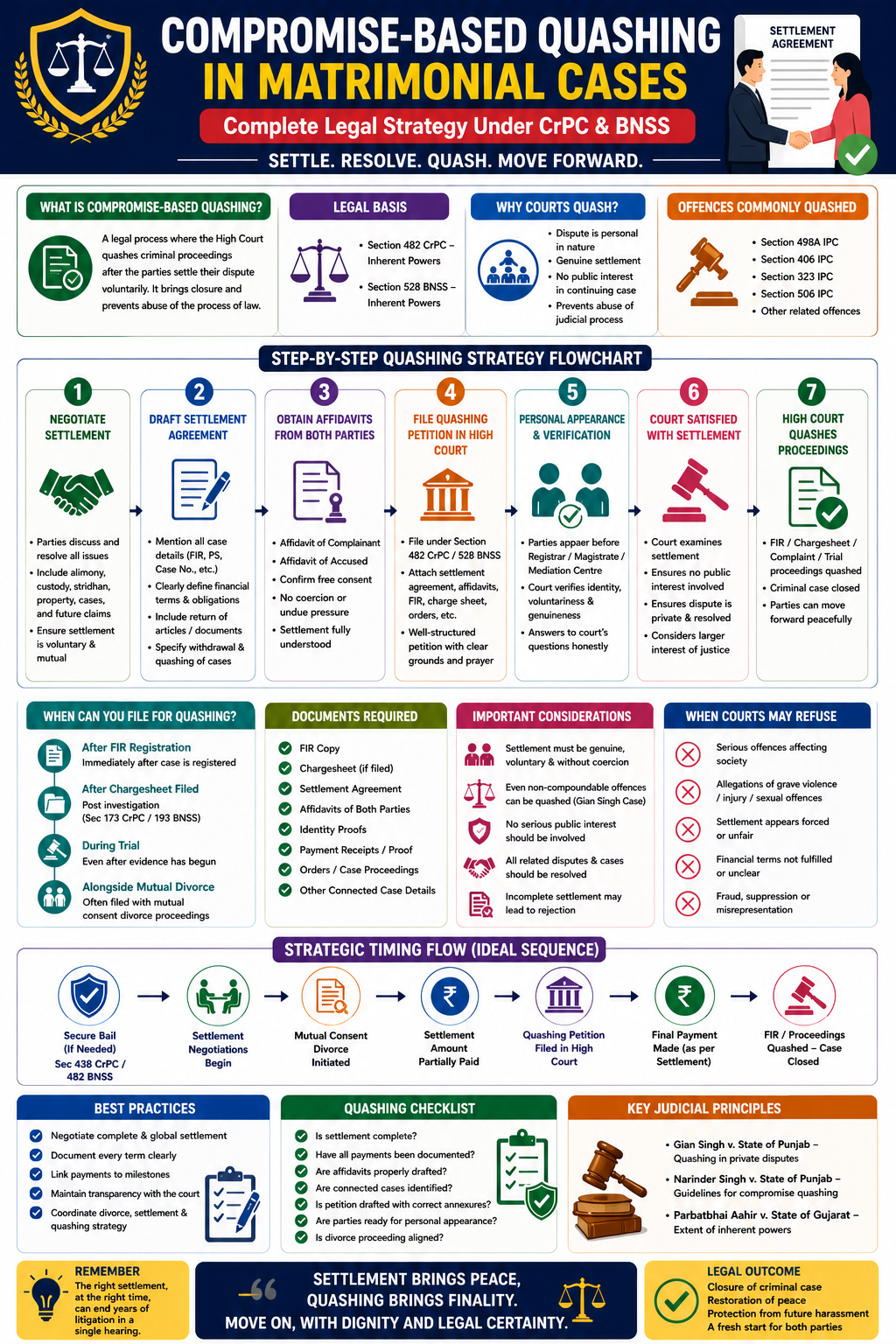
  • eCourts India on Compromise-Based Quashing in Matrimonial Cases – Complete Legal Strategy
  • The Divorce Law Firm on Life Cycle Stages of a Divorce case
  • The Divorce Law Firm on Life Cycle Stages of a Divorce case
  • ShadesOfKnife on Sandeep Pamarati Vs Ungrateful Knife (IPC 498A Case)
  • KONURU VINAYKUMAR on Sandeep Pamarati Vs Ungrateful Knife (IPC 498A Case)

Archives of SoK

  • July 2026 (13)
  • June 2026 (19)
  • May 2026 (24)
  • April 2026 (33)
  • March 2026 (42)
  • February 2026 (30)
  • January 2026 (21)
  • December 2025 (2)
  • November 2025 (3)
  • October 2025 (17)
  • September 2025 (12)
  • August 2025 (5)
  • July 2025 (10)
  • June 2025 (15)
  • May 2025 (3)
  • April 2025 (10)
  • March 2025 (7)
  • February 2025 (8)
  • January 2025 (1)
  • December 2024 (3)
  • November 2024 (4)
  • October 2024 (16)
  • September 2024 (15)
  • August 2024 (14)
  • July 2024 (11)
  • June 2024 (18)
  • May 2024 (13)
  • April 2024 (9)
  • March 2024 (23)
  • February 2024 (15)
  • January 2024 (11)
  • December 2023 (11)
  • November 2023 (9)
  • October 2023 (13)
  • September 2023 (12)
  • August 2023 (15)
  • July 2023 (17)
  • June 2023 (11)
  • May 2023 (6)
  • April 2023 (5)
  • March 2023 (10)
  • February 2023 (9)
  • January 2023 (12)
  • December 2022 (12)
  • November 2022 (8)
  • October 2022 (13)
  • September 2022 (17)
  • August 2022 (10)
  • July 2022 (21)
  • June 2022 (27)
  • May 2022 (23)
  • April 2022 (32)
  • March 2022 (17)
  • February 2022 (6)
  • January 2022 (2)
  • December 2021 (7)
  • November 2021 (7)
  • October 2021 (6)
  • September 2021 (10)
  • August 2021 (31)
  • July 2021 (45)
  • June 2021 (17)
  • May 2021 (17)
  • April 2021 (18)
  • March 2021 (58)
  • February 2021 (14)
  • January 2021 (50)
  • December 2020 (35)
  • November 2020 (68)
  • October 2020 (67)
  • September 2020 (28)
  • August 2020 (41)
  • July 2020 (20)
  • June 2020 (36)
  • May 2020 (40)
  • April 2020 (38)
  • March 2020 (26)
  • February 2020 (43)
  • January 2020 (35)
  • December 2019 (34)
  • November 2019 (4)
  • October 2019 (18)
  • September 2019 (57)
  • August 2019 (33)
  • July 2019 (12)
  • June 2019 (18)
  • May 2019 (5)
  • April 2019 (19)
  • March 2019 (58)
  • February 2019 (11)
  • January 2019 (90)
  • December 2018 (97)
  • November 2018 (43)
  • October 2018 (31)
  • September 2018 (73)
  • August 2018 (47)
  • July 2018 (143)
  • June 2018 (92)
  • May 2018 (97)
  • April 2018 (59)
  • March 2018 (8)

Blogroll

  • Daaman Promoting Harmony 0
  • Fight against Legal Terrorism Fight against Legal Terrorism along with MyNation Foundation 0
  • Good Morning Good Morning News 0
  • Insaaf India Insaaf Awareness Movement 0
  • MyNation Hope Foundation Wiki 0
  • MyNation.net Equality, Justice and Harmony 0
  • Sarvepalli Legal 0
  • Save Indian Family Save Indian Family Movement 0
  • SIF Chandigarh SIF Chandigarh 0
  • The Male Factor The Male Factor 0
  • Unitedmen Foundation a dedicated community forged with the mission to unite men facing legal challenges in marital disputes. 0
  • Vaastav Foundation The Social Reality 0
  • Vinayak my2centsworth – This blog is for honest law abiding men, married or planning to get married 0
  • Voice4india Indian Laws, Non-profits, Environment 0
  • Writing Law Writing Law by Ankur 0

RSS Cloudflare Status

  • AMS (Amsterdam) on 2026-07-24 July 24, 2026
    THIS IS A SCHEDULED EVENT Jul 24, 00:30 - 06:00 UTC Jul 14, 10:30 UTC Update - We will be performing scheduled maintenance in AMS (Amsterdam) datacenter on 2026-07-24 between 00:30 and 06:00 UTC.Traffic might be re-routed from this location, hence there is a possibility of a slight increase in latency during this maintenance window […]
    Cloudflare

RSS List of Spam Server IPs from Project Honeypot

  • 85.158.110.120 | S July 14, 2026
    Event: Bad Event | Total: 5 | First: 2026-07-14 | Last: 2026-07-14
Owned and Operated by Advocate Sandeep Pamarati and Advocate Suprajaa Rajan
Proudly powered by WordPress
Theme: Flint by Star Verte LLC

Bad Behavior has blocked 1079 access attempts in the last 7 days.

pixel