web analytics

Menu

Skip to content
Shades of Knife
  • Home
  • True Colors of a Vile Wife
  • Need Inspiration?
  • Blog Updates
  • SOK Gallery
  • Vile News Reporter
  • About Me
  • Contact Me

Shades of Knife

True Colors of a Vile Wife

Tag: Hindu Marriage Act

Dr. Garima Dubey and Ors Vs Dr. Saurabh Anand Dubey on 21 Apr 2026 – Judgement Summary

Posted on April 30 by Suprajaa Rajan

In Dr. Garima Dubey & Ors. v. Dr. Saurabh Anand Dubey, the Allahabad High Court addressed whether a highly qualified spouse can claim interim maintenance under Section 24 of the Hindu Marriage Act, 1955 (HMA) despite having the capacity to earn.

The case arose from a matrimonial dispute where the husband, a neurosurgeon, filed for divorce, and the wife, a qualified gynaecologist (M.D.), sought maintenance for herself and her children under Sections 24 and 26 HMA. While the trial court granted ₹60,000 per month for the children under Section 26, it denied maintenance to the wife under Section 24.

Challenging this partial rejection, the wife approached the High Court, claiming unemployment and entitlement to maintain the same standard of living. The Court, however, emphasised that earning capacity and qualifications cannot be ignored, particularly where evidence shows substantial prior income.

The Court ultimately upheld the trial court’s decision, reiterating that maintenance is not meant to support voluntary unemployment.

“5. Undisputedly, the appellant is a trained Gynecologist being a Post- Graduate possessing a degree in M.D. (Gynecology)…..”

“6. Where a qualified person is capable of earning more than enough through the use of her expertise and still refrains from doing so only to impose a burden upon her husband, in such a situation the Courts can deny maintenance under Section 24. Therefore, having gone through the order passed by the learned trial court where the application under Section 24 was rejected where the learned trial court has held that the appellant was earning handsomely based upon her ITRs which reflected that she was earning more than Rs.31 lakhs per annum.”

“7. Under the circumstances, this Court is of the opinion that the impugned order cannot be faulted.”

Decision

The Allahabad High Court dismissed the appeal and upheld the trial court’s order, holding that:

  • The wife, being a highly qualified medical professional, possesses sufficient earning capacity.
  • Voluntary unemployment cannot be a ground to claim maintenance under Section 24 HMA.
  • Documentary evidence (ITRs) demonstrated that the wife had substantial prior earnings, weakening her claim of financial dependency.
  • Maintenance granted to the children under Section 26 HMA was appropriate and continues at ₹60,000 per month.

The Court concluded that the trial court’s decision was legally sound and required no interference.


Garima Dubey and Ors Vs Saurabh Anand Dubey on 21 Apr 2026

Citation : 2026:AHC:88382-DB

Other Sources:


Index of Maintenance Judgments under Hindu Marriage Act is here.


Key Contributor :
Mrs. Suprajaa Rajan B.Com., LL.B., LL.M.
+91-9606345150


Posted in High Court of Allahabad Judgment or Order or Notification | Tagged 2-Judge (Division) Bench Decision Dr. Garima Dubey and Ors Vs Dr. Saurabh Anand Dubey Hindu Marriage Act HMA Sec 24 Matrimonial dispute Matrimonial law Summary Post | Leave a comment

Deep Dey Vs State of West Bengal and Anr on 6 Mar 2026

Posted on March 15 by Suprajaa Rajan

Calcutta High Court: Stamp Paper Marriage Has No Legal Validity; Bigamy Case Quashed

A single-judge Bench of the Calcutta High Court held that a marriage executed only through an agreement on stamp paper has no legal recognition under the Hindu Marriage Act, 1955.

The complainant claimed that she married the petitioner through a written agreement on stamp paper. Later, the petitioner entered into a registered marriage with another woman. The complainant then filed a criminal case alleging bigamy under Section 494 IPC and cruelty under Section 498A IPC.

However, the Court clarified that Hindu law requires solemnisation of marriage through recognised rites and ceremonies. A mere written agreement cannot create a valid marriage. Therefore, criminal liability for bigamy cannot arise from such an arrangement. As a result, the Court held that continuation of the criminal case would amount to an abuse of the process of law.

“A marriage by signature on an agreement paper is a mode of union unrecognised under this Act. It is a procedure unknown to Hindu Law; consequently, a ‘contractual marriage’ is a legal nullity.” (Para 13)

“Unless the marriage is ‘solemnized’ in the legal sense, it cannot be said to be a marriage for the purposes of the penal section.” (Para 14)

“There is a vital distinction between a marriage that is technically void… and a union that is legally non-existent from the start.” (Para 17)

“The shift from a ‘stamp paper marriage’ in the FIR to a ‘temple marriage’ in subsequent witness statements is a transparent attempt to cure a fatal legal infirmity.” (Para 18)

Decision of the Court

Therefore, the Calcutta High Court held that the alleged stamp-paper marriage had no legal validity under Hindu law. Consequently, the ingredients of Section 494 IPC and Section 498A IPC were not satisfied.

The Court thus exercised its inherent powers under Section 482 CrPC (Section 528 BNSS) and quashed the criminal proceedings against the petitioner. However, the Court clarified that the complainant may pursue other remedies available in law, if applicable.


Deep day Vs State of West Bengal and Anr on 6 Mar 2026

Citation :

Other Sources :


Index of Bigamy Judgments under Sections 494 and 495 of IPC is here.


Key Contributor :

Mrs. Suprajaa Rajan B.Com., LL.B., LL.M.

+91-9606345150


Posted in High Court of Calcutta Judgment or Order or Notification | Tagged 1-Judge Bench Decision CrPC 482 – Criminal Proceeding Quashed CrPC 482 – IPC 498A Quashed Deep Dey Vs State of West Bengal and Anr Hindu Marriage Act Matrimonial dispute Summary Post | Leave a comment

Dr.Praveen R Vs Dr.Arpitha on 31 Aug 2021

Posted on March 3 by ShadesOfKnife

The Karnataka High Court held that when a court records a specific finding that a party suppressed material facts on oath, it cannot dismiss a perjury application as premature merely because the main case remains pending. The Court ruled that allegations of false evidence affect the purity of judicial proceedings and require prompt consideration. It set aside the Family Court’s order and remitted the matter for fresh consideration.

The following paragraphs form the foundation of the Court’s decision.

Para 4(a):

“…If these IT Returns are taken into consideration, the respondent is having income and she is also earning income… She has not filed any counter to the objections filed by the petitioner and also with respect to these IT Returns. In fact, by filing a complaint she has admitted that she has filed Income Tax Returns… Under such circumstances, she has suppressed the fact that she was earning income…”

Para 4(b):

“…when the Court below has recorded a specific finding as to the income of the respondent from the medical profession that too on the basis of undisputed IT Returns for the relevant period; when it has also recorded a specific finding that the respondent has suppressed the fact that she was earning income; that being the position, the application of petitioner for initiating action for the offence of perjury, could not have been turned down as being premature merely because main matter is still pending…”

Para 4(c):

“…act of perjury is treated as a heinous offence in all civilized societies; consideration of complaints with regard to the same cannot be deferred or delayed; otherwise there is all possibility of the fountain of justice being polluted.”

Para 4(e):

“…applications of the kind need to be considered on merits at the earliest point of time so that a loud message goes to the unscrupulous section of the litigant public as to what would befall the perjuring parties.”

Decision

The High Court allowed the writ petition.

  • It set aside the Family Court’s order.
  • It remitted the matter for fresh consideration of the perjury application.
  • It directed that the main matrimonial case remain in abeyance until such consideration.

All contentions remained open.


Praveen R Vs Arpitha on 31 Aug 2021

Citation :2021:KHC:33333

Other Sources :


Index of Perjury Judgements is here. 


Key Contributor :

Mrs. Suprajaa Rajan B.Com., LL.B, LL.M.

+91-9606345150


Posted in High Court of Allahabad Judgment or Order or Notification | Tagged Cases where Perjury Proceedings were initated false affidavit Hindu Marriage Act HMA Sec 24 income suppression | Leave a comment

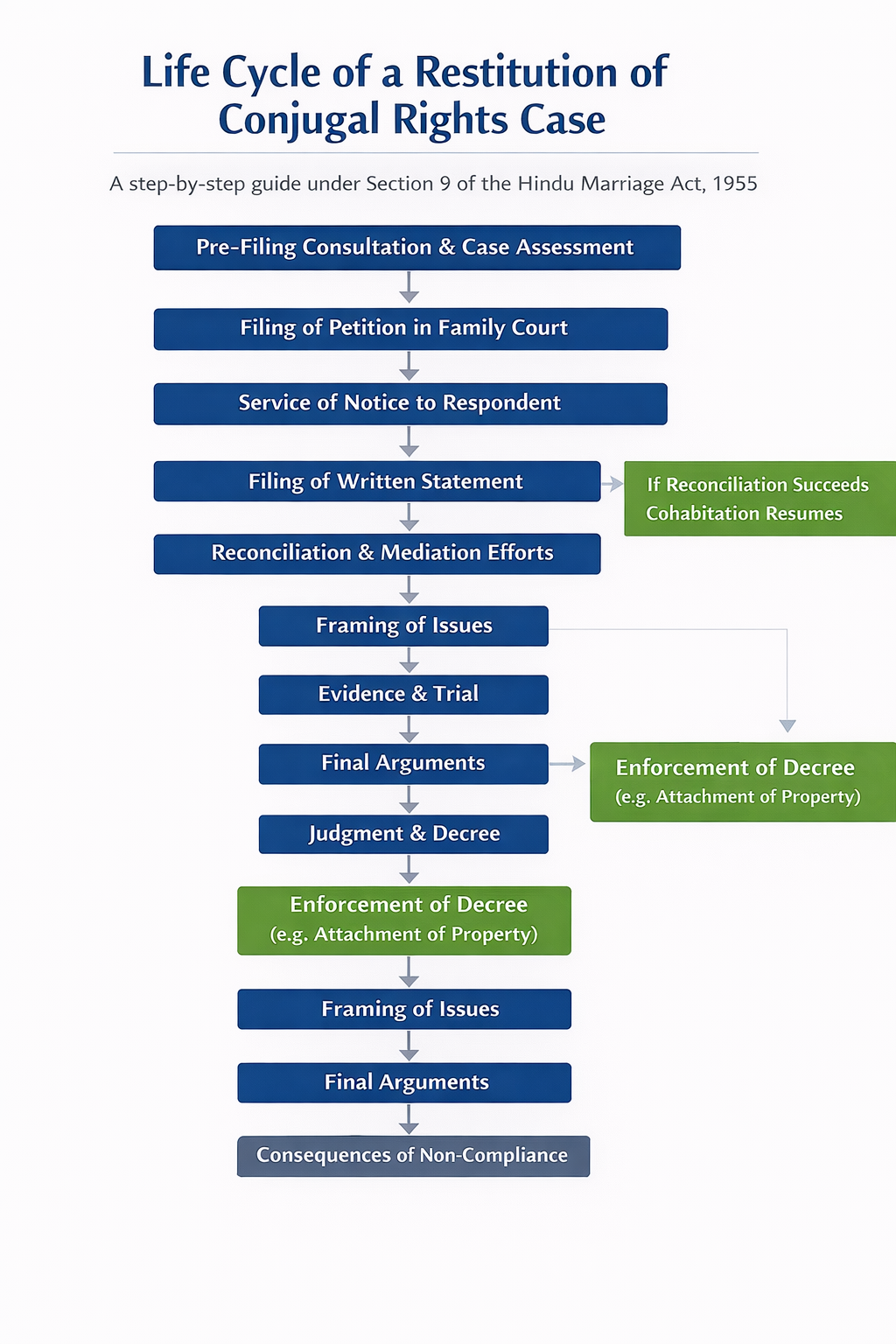
Life Cycle Stages of a Restitution of Conjugal Rights Case

Posted on February 27 by Suprajaa Rajan

A Step-by-Step Guide Under Section 9 of the Hindu Marriage Act, 1955 : Understanding the procedural journey of a Restitution of Conjugal Rights case under Section 9 of Hindu Marriage Act helps spouses navigate matrimonial litigation with clarity and preparedness.

Restitution of Conjugal Rights is a matrimonial remedy available under Section 9 of the Hindu Marriage Act, 1955. This provision allows an aggrieved spouse to seek a court order directing the other spouse to resume cohabitation.

The court grants relief only if it finds that one spouse has withdrawn from the society of the other without reasonable cause. This article explains the complete life cycle of a Restitution of Conjugal Rights case in a structured manner.

1. Legal Foundation of Restitution of Conjugal Rights

Section 9 of the Hindu Marriage Act, 1955 governs this remedy. The petitioner must prove withdrawal from marital society. The withdrawal must lack reasonable excuse.

The court examines whether the marriage remains legally valid. The court also verifies that no legal ground bars relief.

This remedy aims to preserve marriage rather than dissolve it.

2. Stage One: Pre-Filing Consultation and Case Assessment

The process begins with detailed consultation with a matrimonial lawyer. The lawyer evaluates whether the facts satisfy Section 9 requirements.

The petitioner must establish three essential elements:

  • A valid subsisting marriage.

  • Withdrawal by the respondent from marital society.

  • Absence of reasonable cause for such withdrawal.

The petitioner collects supporting documents before filing. These documents may include marriage certificate, communication records, and proof of separation.

Legal preparation strengthens the petition and reduces procedural objections.

3. Stage Two: Filing of Petition Before Family Court

The petitioner files a petition before the competent Family Court. Jurisdiction depends on residence of parties or place of marriage.

The petition contains material facts of the marriage. It specifies the date of marriage and details of separation. It clearly states how the respondent withdrew without reasonable cause. The petitioner prays for a decree directing restitution of conjugal rights.

After scrutiny, the court registers the petition and issues notice.

4. Stage Three: Service of Notice to the Respondent

The court ensures proper service of notice upon the respondent. Service of notice guarantees compliance with principles of natural justice.

The notice specifies the date of first hearing. The respondent must appear personally or through counsel. If the respondent fails to appear, the court may proceed ex parte.

Proper service validates subsequent proceedings.

5. Stage Four: Filing of Written Statement

The respondent files a written statement in response to the petition. The written statement addresses each allegation made by the petitioner. The respondent may deny withdrawal from marital society. The respondent may also assert reasonable cause for separation.

Common defences include cruelty, harassment, or apprehension of harm. The burden shifts to the respondent to prove reasonable excuse.

This stage defines the core dispute between the parties.

6. Stage Five: Reconciliation and Mediation Efforts

Family Courts prioritise reconciliation in matrimonial matters. The court may refer the parties to mediation or counseling. The judge may personally attempt settlement during hearings. The objective is restoration of marital harmony.

If reconciliation succeeds, the parties resume cohabitation. If reconciliation fails, the matter proceeds to trial.

This stage reflects the restorative intent of Section 9.

7. Stage Six: Framing of Issues

If disputes remain, the court frames issues for adjudication. Issues identify disputed questions of fact and law.

Typical issues may include:

  • Whether the respondent withdrew from marital society.

  • Whether such withdrawal lacked reasonable cause.

  • Whether the petitioner is entitled to decree under Section 9.

Framing of issues narrows the scope of trial. It guides the evidence stage systematically.

8. Stage Seven: Evidence and Trial

The petitioner presents evidence first. The petitioner may submit oral testimony and documentary proof. Witnesses may testify regarding separation and conduct of parties. The respondent has the right to cross-examine the petitioner.

After petitioner’s evidence, the respondent presents defence evidence. The respondent may produce documents and witnesses. The petitioner may cross-examine defence witnesses. The Court records all testimonies carefully.

The trial ensures fairness and evidentiary scrutiny.

9. Stage Eight: Final Arguments

After completion of evidence, the court schedules final arguments. Both parties present legal submissions through their advocates. The petitioner argues absence of reasonable cause. The respondent argues justification for withdrawal.

Counsel may rely on judicial precedents interpreting Section 9. The court evaluates facts and legal principles carefully.

Final arguments assist the court in reaching a reasoned decision.

10. Stage Nine: Judgment and Decree

The court delivers judgment after analysing pleadings and evidence. The judgment contains findings on each framed issue. If satisfied, the court grants a decree of restitution of conjugal rights.The decree directs the respondent to resume cohabitation. If the court finds reasonable cause for withdrawal, it dismisses the petition.

The decree is enforceable under civil procedure mechanisms.

11. Enforcement of Decree

The decree does not compel physical force for cohabitation. The law does not permit forced marital relations. The decree operates through attachment of property under execution proceedings. Non-compliance may result in attachment of respondent’s property.

However, courts prioritise voluntary compliance over coercive enforcement.

12. Consequences of Non-Compliance

Non-compliance has important legal consequences. If no cohabitation occurs for one year after decree, either party may seek divorce. Section 13(1A) of the Hindu Marriage Act provides this ground. Thus, restitution proceedings may indirectly lead to divorce.

This provision balances reconciliation with eventual finality.

13. Appeal and Post-Judgment Remedies

An aggrieved party may file an appeal before the appropriate appellate court. Appeals must comply with limitation periods under applicable law. The appellate court reviews legal and factual findings.The court may affirm, modify, or set aside the decree.

Parties may also seek review under limited circumstances.

Conclusion

A Restitution of Conjugal Rights case follows a structured judicial pathway. The remedy aims to preserve marriage rather than dissolve it.Each procedural stage ensures fairness, reconciliation, and legal scrutiny. Understanding the life cycle empowers individuals to approach the process responsibly.

Proper legal advice and timely action significantly influence the outcome of such proceedings.


Other Life Cycles: 498A IPC Case Lifecycle || Maintenance Case u/s 125 CrPC Lifecycle. Index of all life cycles is here.


Key Contributor:
Mrs Suprajaa Rajan B.Com, LL.B., LL.M.
+91-9606345150
Posted in Legal Procedure | Tagged Hindu Marriage Act HM Act 9 - Restitution of conjugal right Matrimonial dispute Matrimonial law Matrimonial Litigation India RCR coverted into Divorce | Leave a comment

Pradeep Bhardwaj Vs Priya on 15 July 2025

Posted on February 25 by Suprajaa Rajan

This judgment addresses the Supreme Court’s power to dissolve a marriage under Article 142 of the Constitution where the marriage has irretrievably broken down. The Court examined whether prolonged separation, failed mediation, and complete loss of marital bond justify dissolution, even when statutory grounds such as cruelty are not established.

The Court also considered the impact of acquittal in criminal proceedings under Sections 498A/406 IPC and the welfare of the minor child. The decision reflects the Court’s evolving approach toward dead marriages that survive only on paper.

“21. There are two main considerations which have weighed heavily with this Court while considering the rival contentions. Firstly, that the appellant-husband has been acquitted in the case of cruelty preferred by the respondent against him and his family members. Secondly, it is an admitted fact that the parties have been living separately since October 2009, i.e. almost for the past sixteen years.”

“22. It has been consistently held by this Court that the institution of marriage is rooted in dignity, mutual respect and shared companionship, and when these foundational aspects are irreparably lost, forcing a couple to remain legally bound serves no beneficial purpose.”

“23. In the present case, it is apparent that due to complete detachment and the prolonged estrangement, there has been an irretrievable breakdown of the marital bond, which cannot be mended by any means.”

“24. It is as clear as a day that in the case at hand, the continuance of marriage shall only fuel animosity and litigation between the parties, which runs contrary to the ethos of matrimonial harmony envisioned by the law.”

“25. This Court finds it a fit case to exercise its power under Article 142 of the Constitution and grant the relief of divorce to the parties on the ground of irretrievable breakdown of marriage.”

Decision

The Supreme Court allowed the appeal.

The Court:

  • Set aside the High Court’s judgment.

  • Granted divorce under Article 142 on the ground of irretrievable breakdown.

  • Enhanced monthly maintenance to Rs. 15,000/- for the wife and minor son.


Pradeep Bharadwaj Vs Priya on 15 Jul 2025

Citation : 2025 INSC 852

Other Sources :


Index of Divorce Judgments is here. 


Key Contributor :

Mrs. Suprajaa Rajan B.Com., LL.B., LL.M.

+91-9606345150

Posted in Supreme Court of India Judgment or Order or Notification | Tagged Acquitted in IPC 498A Article 142 - Enforcement of decrees and orders of Supreme Court and orders as to discovery etc CrPC 125 or BNSS 144 - Maintenance Granted divorce under hindu marriage act Hindu Marriage Act Irretrievable Breakdown of Marriage Long Separation divorce Maintenance Enhancement | Leave a comment

Hitesh Bhatnagar Vs Deepa Bhatnagar on 18 Apr 2011

Posted on February 24 by Suprajaa Rajan

The Supreme Court examined whether consent given at the time of filing a joint petition continues to bind the parties until decree, or whether it can be withdrawn at any stage before the court passes the final order.

The appellant argued that once the statutory period of 18 months had expired without formal withdrawal, the court had no option but to grant divorce. The respondent contended that mutual consent must subsist till the date of decree and that she had validly withdrawn her consent before the second motion.

The judgment clarified the nature of mutual consent as a jurisdictional requirement and reaffirmed earlier precedents on the subject. It also considered whether Article 142 of the Constitution could be invoked to dissolve the marriage on the ground of irretrievable breakdown.

“13. The appellant contends that the Additional District Judge, Gurgaon, was bound to grant divorce if the consent was not withdrawn within a period of 18 months in view of the language employed in Section 13B(2) of the Act. We find no merit in the submission made by the appellant in the light of the law laid down by this Court in Sureshta Devi’s case (supra).”

“14. The language employed in Section 13B(2) of the Act is clear. The Court is bound to pass a decree of divorce declaring the marriage of the parties before it to be dissolved with effect from the date of the decree, if the following conditions are met:
a. A second motion of both the parties is made not before 6 months from the date of filing of the petition as required under sub-section (1) and not later than 18 months;
b. After hearing the parties and making such inquiry as it thinks fit, the Court is satisfied that the averments in the petition are true; and
c. The petition is not withdrawn by either party at any time before passing the decree;”

“15. In other words, if the second motion is not made within the period of 18 months, then the Court is not bound to pass a decree of divorce by mutual consent. Besides, from the language of the Section, as well as the settled law, it is clear that one of the parties may withdraw their consent at any time before the passing of the decree. The most important requirement for a grant of a divorce by mutual consent is free consent of both the parties.”

“16. In the present fact scenario, the second motion was never made by both the parties as is a mandatory requirement of the law, and as has been already stated, no Court can pass a decree of divorce in the absence of that. The non-withdrawal of consent before the expiry of the said eighteen months has no bearing.”

“18. We are not inclined to entertain this submission of the appellant since the facts in that case are not akin to those that are before us.”

“25. It is settled law that this Court grants a decree of divorce only in those situations in which the Court is convinced beyond any doubt that there is absolutely no chance of the marriage surviving and it is broken beyond repair.”

Decision

The Supreme Court dismissed the appeal.

The Court held that:

  • Mutual consent must continue till the decree of divorce.

  • Either party may withdraw consent at any time before the decree.

  • The 18-month period does not bar withdrawal of consent.

  • Article 142 cannot be used to override statutory requirements in ordinary circumstances.


Hitesh bhatnagar Vs Deepa bhatnagar on 18 Apr 2011

Citation :(2011) 5 SCC 234

Other Sources :


Index of Divorce Judgements is here. 


Key Contributor :

Mrs. Suprajaa Rajan B.Com., LL.B., LL.M.

+91-9606345150

Posted in Supreme Court of India Judgment or Order or Notification | Tagged 2-Judge (Division) Bench Decision Family Courts Act family law Hindu Marriage Act Hitesh Bhatnagar Vs Deepa Bhatnagar Mutual Consent Divorce Section 13B HMA Withdrawal of consent | Leave a comment

Hindu Personal Code Laws

Posted on August 1, 2020 by ShadesOfKnife

Hindu Personal Laws are codified into the following four (4) laws.

  1. The Hindu Marriage Act, 1955
  2. The Hindu Succession Act, 1956
  3. The Hindu Minority and Guardianship Act, 1956
  4. The Hindu Adoptions and Maintenance Act, 1956
Posted in Bare Acts or State Amendments or Statutes or GOs or Notifications issued by Central or State Governments | Tagged Hindu Adoptions and Maintenance Act 1956 Hindu Marriage Act Hindu Minority and Guardianship Act Hindu Personal Code Laws Hindu Succession Act Summary Post | Leave a comment

The Hindu Marriage Act, 1955

Posted on April 5, 2018 by ShadesOfKnife

The following is the updated Hindu Marriage Act 1955, updated as on 14 May, 2019.

The Hindu Marriage Act, 1955 as on 14 May, 2019

Here is the inaugural bare act of The Hindu Marriage Act, 1955.

THE HINDU MARRIAGE ACT, 1955

The index for all four (4) Hindu Personal Laws is here.

Posted in Bare Acts or State Amendments or Statutes or GOs or Notifications issued by Central or State Governments | Tagged Hindu Marriage Act | Leave a comment

Search within entire Content of “Shades of Knife”

My Legal X Timeline

Advocate Sandeep Pamarati 🇮🇳💪👨🏻‍🎓 Follow

AP High Court Advocate with M Tech (CS) || 12 years in 'Software Industry' as Solution Architect || Blogs at https://t.co/29CB9BzK4w || #TDPTwitter

SandeepPamarati
Retweet on Twitter Advocate Sandeep Pamarati 🇮🇳💪👨🏻‍🎓 Retweeted
futurestacked Future Stacked @futurestacked ·
23 Jun

Your Gmail account is not an email account.

It is the master key to your bank, your crypto, your Apple ID, your PayPal, and every password you have ever saved.

One breach and all your passwords are gone.

Lock it down with these 7 easy steps 👇

Reply on Twitter 2069354786743374317 Retweet on Twitter 2069354786743374317 104 Like on Twitter 2069354786743374317 260 X 2069354786743374317
Retweet on Twitter Advocate Sandeep Pamarati 🇮🇳💪👨🏻‍🎓 Retweeted
thisguyknowsai Brady Long @thisguyknowsai ·
22 Jun

A German psychologist proved in 1885 that cramming erases what you learned within 48 hours. He published the fix in the same book. Almost no school on Earth has adopted it in 140 years.

His name was Hermann Ebbinghaus.

He had no lab. No funding. No colleagues.

He worked alone

Reply on Twitter 2068965021514891696 Retweet on Twitter 2068965021514891696 958 Like on Twitter 2068965021514891696 2820 X 2068965021514891696
Retweet on Twitter Advocate Sandeep Pamarati 🇮🇳💪👨🏻‍🎓 Retweeted
factcheckapgov FactCheck.AP.Gov.in @factcheckapgov ·
22 Jun

ఎంతో ప్రతిష్టాత్మకంగా నిర్వహించి ప్రజల ఆరోగ్యం పట్ల అవగాహన కల్పించిన అంతర్జాతీయ యోగా దినోత్సవం సందర్భంగా రాష్ట్రం లో పలుచోట్ల నిర్వహించిన యోగా కార్యక్రమం పై కొందరు తప్పుడు ప్రచారం చేస్తున్నారు. ఈ కార్యక్రమం కోసం రూ. 600 కోట్లు ఖర్చు అయినట్లు చెప్పడం పూర్తిగా అసత్యం. రాష్ట్రంలో

Reply on Twitter 2068972932827869255 Retweet on Twitter 2068972932827869255 38 Like on Twitter 2068972932827869255 85 X 2068972932827869255
Retweet on Twitter Advocate Sandeep Pamarati 🇮🇳💪👨🏻‍🎓 Retweeted
jaitdp Telugu Desam Party @jaitdp ·
22 Jun

చీఫ్ మినిస్టర్.. టీచర్ అయిన వేళ

అంగన్వాడీ కేంద్రాన్ని సందర్శించిన సీఎం చంద్రబాబు కాసేపు టీచర్‌గా మారి, పిల్లల అభ్యసనం ఎలా ఉందో తెలుసుకున్నారు. ఇంగ్లీష్ ఆల్ఫాబెట్స్ చెప్పమని సీఎం అడిగేసరికి పిల్లలు చక్కగా చెప్పారు.
#ChandrababuNaidu
#AndhraPradesh

Reply on Twitter 2068873963246399922 Retweet on Twitter 2068873963246399922 73 Like on Twitter 2068873963246399922 310 X 2068873963246399922
Load More

Recent Posts

  • Pavul Yesu Dhasan Vs Registrar SHRC of TN and Ors on 30 Apr 2025 June 18, 2026
  • Manoj Kumar Vs Nita Bharti on 17 Mar 2026 June 17, 2026
  • Cruelty as a Criminal Offence Explained June 12, 2026
  • Bail Compliance Undertaking Format – Draft, Legal Requirements & Sample Template June 12, 2026
  • Warning Signs of Escalating Matrimonial Litigation – Early Red Flags Every Spouse Should Recognize June 12, 2026

Most Read Posts

  • Reply to Section 41A CrPC Notice – Format with Legal Explanation (4,946 views)
  • Anu Aggarwal Vs Sushant Aggarwal on 20 Jan 2026 (3,487 views)
  • Umme Farva Vs State of U.P. and Anr on 14 Jan 2026 (3,373 views)
  • Charge Sheet and Final Report Explained (2,819 views)
  • Regular Bail Application Format (Section 437/439 CrPC) (2,195 views)
  • Neha Lal Vs Abhishek Kumar on 20 Jan 2026 (2,004 views)
  • Arrest Procedure in 498A cases after Arnesh Kumar (1,936 views)
  • Discharge Application Format in 498A Case – Draft, Procedure & Sample Template (1,777 views)
  • Can You Travel Abroad After an FIR Is Registered? – Legal Position Explained (1,698 views)
  • Atul Kumar Bajpai Vs State of UP and Anr on 17 Sep 2025 (1,540 views)

Tags

Reportable Judgement or Order (433)2-Judge (Division) Bench Decision (413)Legal Procedure Explained - Interpretation of Statutes (382)Landmark Case (381)1-Judge Bench Decision (362)Catena of Landmark Judgments Referred/Cited to (293)Work-In-Progress Article (215)3-Judge (Full) Bench Decision (101)Sandeep Pamarati (92)Article 21 - Protection of life and personal liberty (80)Issued or Recommended Guidelines or Directions or Protocols to be followed (71)Perjury Under 340 CrPC (66)Absurd Or After Thought Or Baseless Or False Or General Or Inherently Improbable Or Improved Or UnSpecific Or Omnibus Or Vague Allegations (61)Reprimands or Setbacks to YCP Govt of Andhra Pradesh (49)Summary Post (47)CrPC 482 - Quash (43)HM Act 13 - Divorce Granted to Husband (42)Legal Terrorism (41)Divorce granted on Cruelty ground (41)Not Authentic copy hence to be replaced (40)

Categories

Supreme Court of India Judgment or Order or Notification (753)Bare Acts or State Amendments or Statutes or GOs or Notifications issued by Central or State Governments (328)High Court of Andhra Pradesh Judgment or Order or Notification (186)High Court of Delhi Judgment or Order or Notification (164)High Court of Bombay Judgment or Order or Notification (112)High Court of Karnataka Judgment or Order or Notification (93)Legal Procedure (77)High Court of Madras Judgment or Order or Notification (70)High Court of Allahabad Judgment or Order or Notification (61)LLB Study Material (59)General Study Material (56)High Court of Punjab & Haryana Judgment or Order or Notification (52)Assorted Court Judgments or Orders or Notifications (50)High Court of Kerala Judgment or Order or Notification (46)Prakasam DV Cases (46)Judicial Activism (for Public Benefit) (45)District or Sessions or Magistrate Court Judgment or Order or Notification (44)High Court of Madhya Pradesh Judgment or Order or Notification (38)High Court of Gujarat Judgment or Order or Notification (28)High Court of Calcutta Judgment or Order or Notification (27)

Recent Comments

  • eCourts India on Compromise-Based Quashing in Matrimonial Cases – Complete Legal Strategy
  • The Divorce Law Firm on Life Cycle Stages of a Divorce case
  • The Divorce Law Firm on Life Cycle Stages of a Divorce case
  • ShadesOfKnife on Sandeep Pamarati Vs Ungrateful Knife (IPC 498A Case)
  • KONURU VINAYKUMAR on Sandeep Pamarati Vs Ungrateful Knife (IPC 498A Case)

Archives of SoK

  • June 2026 (9)
  • May 2026 (24)
  • April 2026 (33)
  • March 2026 (42)
  • February 2026 (30)
  • January 2026 (21)
  • December 2025 (2)
  • November 2025 (3)
  • October 2025 (17)
  • September 2025 (12)
  • August 2025 (5)
  • July 2025 (10)
  • June 2025 (15)
  • May 2025 (3)
  • April 2025 (10)
  • March 2025 (7)
  • February 2025 (8)
  • January 2025 (1)
  • December 2024 (3)
  • November 2024 (4)
  • October 2024 (16)
  • September 2024 (15)
  • August 2024 (14)
  • July 2024 (11)
  • June 2024 (18)
  • May 2024 (13)
  • April 2024 (9)
  • March 2024 (23)
  • February 2024 (15)
  • January 2024 (11)
  • December 2023 (11)
  • November 2023 (9)
  • October 2023 (13)
  • September 2023 (12)
  • August 2023 (15)
  • July 2023 (17)
  • June 2023 (11)
  • May 2023 (6)
  • April 2023 (5)
  • March 2023 (10)
  • February 2023 (9)
  • January 2023 (12)
  • December 2022 (12)
  • November 2022 (8)
  • October 2022 (13)
  • September 2022 (17)
  • August 2022 (10)
  • July 2022 (21)
  • June 2022 (27)
  • May 2022 (23)
  • April 2022 (32)
  • March 2022 (17)
  • February 2022 (6)
  • January 2022 (2)
  • December 2021 (7)
  • November 2021 (7)
  • October 2021 (6)
  • September 2021 (10)
  • August 2021 (31)
  • July 2021 (45)
  • June 2021 (17)
  • May 2021 (17)
  • April 2021 (18)
  • March 2021 (58)
  • February 2021 (14)
  • January 2021 (50)
  • December 2020 (35)
  • November 2020 (68)
  • October 2020 (67)
  • September 2020 (28)
  • August 2020 (41)
  • July 2020 (20)
  • June 2020 (36)
  • May 2020 (40)
  • April 2020 (38)
  • March 2020 (26)
  • February 2020 (43)
  • January 2020 (35)
  • December 2019 (34)
  • November 2019 (4)
  • October 2019 (18)
  • September 2019 (57)
  • August 2019 (33)
  • July 2019 (12)
  • June 2019 (18)
  • May 2019 (5)
  • April 2019 (19)
  • March 2019 (58)
  • February 2019 (11)
  • January 2019 (90)
  • December 2018 (97)
  • November 2018 (43)
  • October 2018 (31)
  • September 2018 (73)
  • August 2018 (47)
  • July 2018 (143)
  • June 2018 (92)
  • May 2018 (97)
  • April 2018 (59)
  • March 2018 (8)

Blogroll

  • Daaman Promoting Harmony 0
  • Fight against Legal Terrorism Fight against Legal Terrorism along with MyNation Foundation 0
  • Good Morning Good Morning News 0
  • Insaaf India Insaaf Awareness Movement 0
  • MyNation Hope Foundation Wiki 0
  • MyNation.net Equality, Justice and Harmony 0
  • Sarvepalli Legal 0
  • Save Indian Family Save Indian Family Movement 0
  • SIF Chandigarh SIF Chandigarh 0
  • The Male Factor The Male Factor 0
  • Unitedmen Foundation a dedicated community forged with the mission to unite men facing legal challenges in marital disputes. 0
  • Vaastav Foundation The Social Reality 0
  • Vinayak my2centsworth – This blog is for honest law abiding men, married or planning to get married 0
  • Voice4india Indian Laws, Non-profits, Environment 0
  • Writing Law Writing Law by Ankur 0

RSS Cloudflare Status

  • ARN (Stockholm) on 2026-06-25 June 25, 2026
    THIS IS A SCHEDULED EVENT Jun 25, 00:00 - 05:00 UTC Jun 19, 14:18 UTC Scheduled - We will be performing scheduled maintenance in ARN (Stockholm) datacenter on 2026-06-25 between 00:00 and 05:00 UTC.Traffic might be re-routed from this location, hence there is a possibility of a slight increase in latency during this maintenance window […]
  • ARN (Stockholm) on 2026-06-24 June 24, 2026
    Jun 24, 05:00 UTC Completed - The scheduled maintenance has been completed. Jun 24, 00:00 UTC In progress - Scheduled maintenance is currently in progress. We will provide updates as necessary. Jun 19, 13:08 UTC Scheduled - We will be performing scheduled maintenance in ARN (Stockholm) datacenter on 2026-06-24 between 00:00 and 05:00 UTC.Traffic might […]
  • Network Performance Issues - Increased HTTP 5XX Errors in Ashburn, US June 23, 2026
    Jun 23, 16:00 UTC Resolved - Between 17:07 and 17:45 UTC, Cloudflare experienced network performance issues in the Ashburn, US region, resulting in an elevated rate of 5xx errors for a subset of traffic. During this time, impacted users may have encountered intermittent connectivity issues or unexpected server responses. The underlying issue was successfully mitigated, […]

RSS List of Spam Server IPs from Project Honeypot

  • 34.106.192.29 | SD June 23, 2026
    Event: Bad Event | Total: 6 | First: 2026-06-23 | Last: 2026-06-23
  • 182.161.69.73 | S June 23, 2026
    Event: Bad Event | Total: 16 | First: 2011-01-28 | Last: 2026-06-23
  • 34.80.202.241 | SD June 23, 2026
    Event: Bad Event | Total: 6 | First: 2026-06-23 | Last: 2026-06-23
Owned and Operated by Advocate Sandeep Pamarati
Proudly powered by WordPress
Theme: Flint by Star Verte LLC

Bad Behavior has blocked 1450 access attempts in the last 7 days.

pixel
