web analytics

Menu

Skip to content
Shades of Knife
  • Home
  • True Colors of a Vile Wife
  • Need Inspiration?
  • Blog Updates
  • SOK Gallery
  • Vile News Reporter
  • About Me
  • Contact Me

Shades of Knife

True Colors of a Vile Wife

Tag: Family Courts Act Sec 14 – Application of Indian Evidence Act 1872

Praveen Kumar Singh Vs State of UP and Anr on 17 Feb 2026

Posted on February 28 by ShadesOfKnife

A single judge of Allahabad High Court held as follows,

From Para 4,

4. Learned counsel for the revisionist submits that the revisionist had filed written submissions before the trial court specifically alleging that opposite party no. 2 was living in adultery with one Rocky @ Tarun. However, the trial court did not consider the said allegation on the ground that no certificate under Section 65-B of the Indian Evidence Act had been filed in support of the electronic evidence.

From Para 7,

7. On considering the facts and circumstances of the case, the submissions advanced by learned counsel for revisionist and learned A.G.A., as well as perusal of the record and the order passed by the trial court, it appears that the WhatsApp chats annexed by the revisionist were not accepted solely on the ground that a certificate under Section 65-B of the Indian Evidence Act had not been submitted. However, Section 14 of the Family Courts Act provides that a Family Court may receive as evidence any report, statement, document, information, or matter that may, in its opinion, assist it in effectively dealing with a dispute, whether or not such evidence would otherwise be relevant or admissible under the Indian Evidence Act, 1872. Moreover, while adjudicating matrimonial disputes, the Family Court may lay down its own procedure.

Praveen Kumar Singh Vs State of UP and Anr on 17 Feb 2026

Citations: [2026:AHC:34917]

Other Sources:

https://lawtrend.in/family-court-must-consider-whatsapp-chat-indicating-adultery-even-without-section-65-b-certificate-allahabad-hc-sets-aside-maintenance/


Index

Posted in High Court of Allahabad Judgment or Order or Notification | Tagged 1-Judge Bench Decision BNSS Sec 393 - Language and contents of judgment BSA Sec 63 - Admissibility of electronic records Evidence Act 65B - Admissibility of electronic records Family Courts Act Sec 14 - Application of Indian Evidence Act 1872 Praveen Kumar Singh Vs State of UP and Anr | Leave a comment

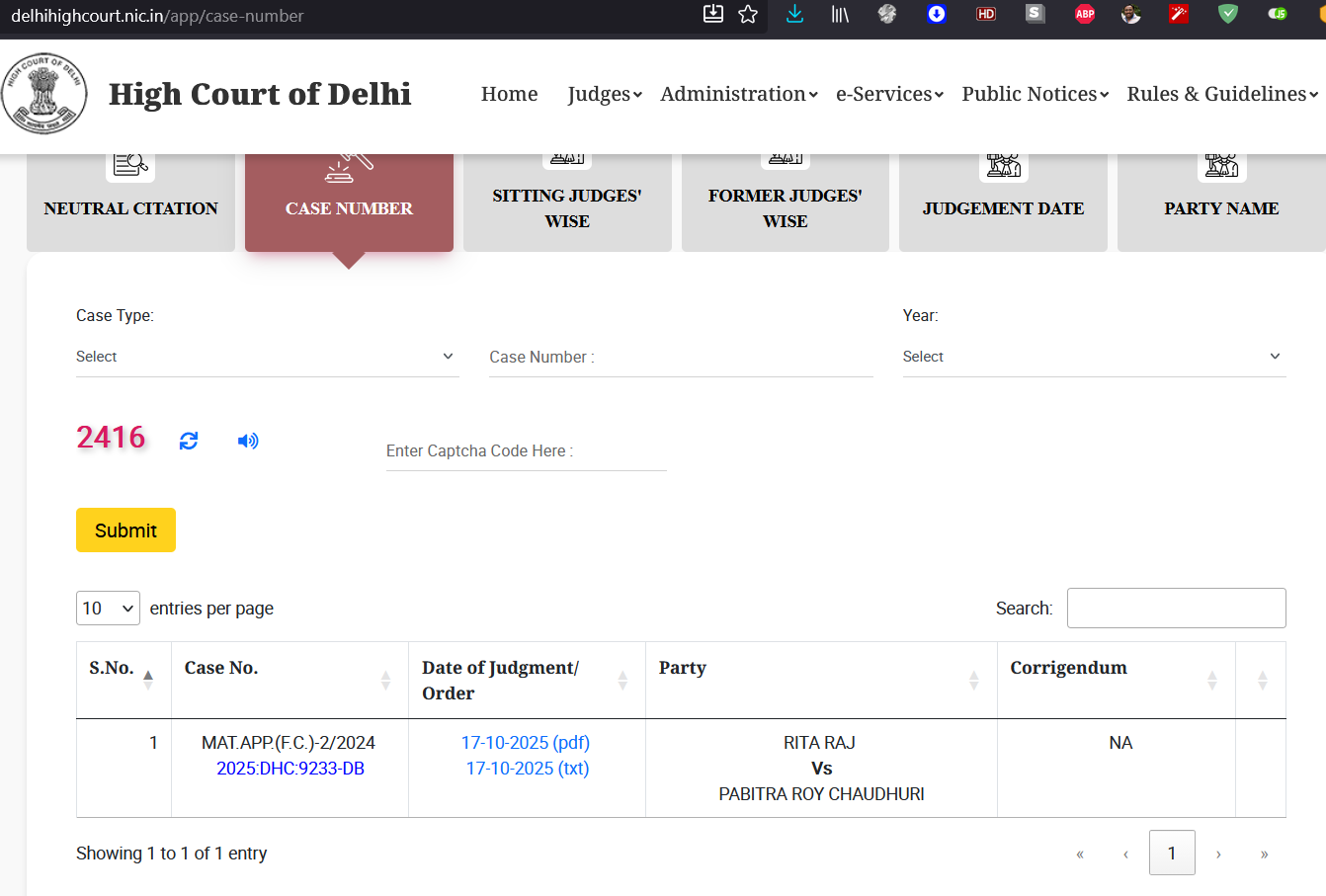
Rita Raj Vs Pabitra Roy Chaudhuri on 17 Oct 2025

Posted on October 19, 2025 by ShadesOfKnife

A division bench of Delhi High Court observed as follows, while upholding the Family Court’s decision not to grant alimony.

From Paras 53 to 57,

53. In the present Appeal, the Appellant‟s primary challenge is directed against the learned Family Court‟s finding on cruelty. The evidence on record unequivocally establishes a sustained pattern of mental cruelty inflicted by the Appellant upon the Respondent.
54. The most compelling evidence comprises the series of text messages sent from the Appellant‟s mobile number between March and June 2011. These messages, which contained vile, derogatory, and scandalous language, including questioning the Respondent‟s legitimacy and making reprehensible allegations against his mother, were proved beyond doubt.
55. Specific messages dated 09.05.2011, 15.05.2011, and 27.06.2011, which included terms such as “bastard”, “son of a bitch,” and suggestions that his mother should “earn through prostitution”, are by themselves sufficient to constitute mental cruelty of the gravest kind.
56. The Appellant‟s explanation that the Respondent must have sent these messages to himself from her phone is inherently improbable and was rightly rejected by the learned Family Court as an afterthought, particularly since this defense was never pleaded in the written statement and no corroborative evidence was adduced to support it.
57. Words and communications of the sort proved in this case are not innocuous. The law recognizes that mental cruelty may be visited by persistent and deliberate verbal abuse and conduct that degrades a spouse and injures reputation and self-respect. The text messages in question contained imputations of illegitimacy, filthy epithets directed at the Respondent‟s mother and other degrading expressions a pattern of conduct which, cumulatively, the learned Family Court was entitled to regard as causing grave mental agony to the Respondent.

From Para 82,

82. The provision under Section 25 is fundamentally equitable in nature and aims to secure financial justice between spouses, ensuring that a party lacking independent means of subsistence is not left destitute following the dissolution of marriage. However, the grant of such relief is not automatic; it is contingent upon proof of genuine financial necessity and equitable considerations.
83. In the present case, the Appellant is an officer of the IRTS, a highly esteemed branch of the Indian Civil Services, whereas the Respondent is a practicing lawyer.
84. It is an undisputed fact that the Appellant, being a Group ‘A’ officer, holds a senior and responsible position in the Government of India and receives a regular and substantial salary along with numerous allowances and service benefits commensurate with her post. The material on record does not disclose any evidence of financial hardship, dependency, or extraordinary circumstances that would render her incapable of maintaining herself with dignity. There is also no pleading or proof of any financial liability, medical condition, or familial obligation that could necessitate monetary support from the Respondent. Additionally, there is no evidence to suggest a substantial difference between the incomes of the parties.
85. Judicial discretion under Section 25 cannot be exercised to award alimony where the applicant is financially self-sufficient and independent, and such discretion must be exercised properly and judiciously, based on the record, the relative financial capacities of the parties, and the absence of any material demonstrating economic vulnerability on the part of the Appellant.
86. A careful examination of the record further reveals that the parties cohabited as husband and wife only for a brief and transitory period, and the marriage did not evolve into a stable or enduring union characterized by emotional, social, or financial interdependence. The absence of any child from the wedlock further eliminates a continuing financial responsibility that might otherwise justify an award of alimony or maintenance.
87. It is a settled principle that permanent alimony is intended as a measure of social justice and not as a tool for enrichment or equalizing the financial status of two capable individuals. The law requires that the applicant demonstrate a genuine need for financial assistance. In the present case, the Appellant‟s position as a senior government officer, her steady and substantial income, and the absence of dependents collectively establish that she is fully capable of maintaining herself. No evidence of financial incapacity, duress, or other compelling circumstances has been presented to justify judicial intervention.

Rita Raj Vs Pabitra Roy Chaudhuri on 17 Oct 2025

Citations: [2025:DHC:9233-DB]

Other Sources:

https://indiankanoon.org/doc/156230068/

https://www.casemine.com/judgement/in/68f2a09ee5e6a9673013a510


Index of Maintenance and Alimony judgment under Hindu Marriage Act is here.

Posted in High Court of Delhi Judgment or Order or Notification | Tagged 2-Judge (Division) Bench Decision Catena of Landmark Judgments Referred/Cited to Family Courts Act Sec 14 - Application of Indian Evidence Act 1872 HM Act 25 - No Maintenance or Alimony To Independent Wife HM Act 25 - Permanent alimony and maintenance HM Act 25 - Permanent Alimony Denied Rita Raj Vs Pabitra Roy Chaudhuri | Leave a comment

Anjali Sharma Vs Raman Upadhyay on 16 Jun 2025

Posted on June 25, 2025 by ShadesOfKnife

A single Judge of Madhya Pradesh High Court at Gwalior Bench held that one fundamental right under Constitution must yield to another and, the right to fair trial must yield to right to privacy.

From Paras 11 and 12,

11. In order to achieve its object to simplify the rules of evidence and procedure, Section 14 of the Family Courts Act provides for an exception to the general rule of evidence regarding admissibility of any report, statements, documents, information or matter, which it considers necessary to assist it and to deal with it effectively. Apparently, such a provision is made keeping in view the nature of cases which are dealt with by the Family Courts. Needless to mention here that Section 14 of Family Courts Act is a special legislation and by virtue of this provision, the strict principles of admissibility of evidence as provided under the Evidence Act have been relaxed.
12. A cumulative reading of Section 14 & 20 of the Family Courts Act, takes within its ambit the restricted applications of the provisions of the Evidence Act qua the documentary evidence which includes electronic evidence, whether or not the same is otherwise admissible. The only guiding factor is that the Family Court should be of the opinion that such evidence would assist the Court to deal with the matrimonial dispute effectively. It is the absolute power and authority of the Family Court either to accept or discard particular evidence in finally adjudicating the matrimonial dispute. However, to say that a party would be precluded from placing such documents on record and/or such documents can be refused to be exhibited unless they are proved as per Evidence Act, runs contrary to the object of Section 14 of the Family Courts Act.

From Paras 18 and 19, (No fundamental right under our Constitution is absolute)

18. By reading the dictum of Apex Court in the case of Sharda & Puttaswami (supra), it is evident that right to privacy is recognized as a fundamental right under Article 21 of Constitution, but the same is not an absolute right. In case of necessity, a law can be framed permitting invasion to life and personal liberty. Section 14 of Family Courts Act and Section 122 of Indian Evidence Act are some such statutory provisions which permits invasion to right to privacy. It is worth mentioning here that vires of either of the aforesaid provisions are not under challenge and, therefore, the same have to be deemed as valid, fair and reasonable.
19. Since no fundamental right under our Constitution is absolute, in the event of conflict between two fundamental rights, as in this case, a contest between the right to privacy and the right to fair trial, both of which arise under Article 21 of our Constitution, the right to privacy may have to yield to the right to fair trial. Reference in this regard can be made to the observations of a 5-Judge Constitution Bench decision of Apex Court in Sahara India Real Estate Corporation Limited Vs. Securities and Exchange Board of India reported in (2012)10 SCC 603

From Paras 20 and 21,

20. Reading the law laid down by Apex Court in the case of Sharda, Puttaswamy & Sahara India (supra), it comes out loud and clear that even though right to privacy has been recognized as a fundamental right, the same is not absolute and is subject to exceptions and limitations. While a litigating party certainly has a right to privacy, that right must yield to the right of an opposing party to bring evidence it considers relevant to court, to prove its case. It is a settled concept of fair trial that a litigating party gets a fair chance to bring relevant evidence before court. It is important to appreciate that while the right to privacy is essentially a personal right, the right to fair trial has wider ramifications and impacts public justice, which is a larger cause. The cause of public justice would suffer if the opportunity of fair trial is denied by shutting-out evidence that a litigating party may wish to lead, at the very threshold. Saying otherwise, would negate the specific statutory provision contained in Section 14 of Family Courts Act, which says that evidence would be admissible, whether or not the same is otherwise admissible under Evidence Act.
21. If it were to be held that evidence sought to be adduced before a Family Court should be excluded based on an objection of breach of privacy right then the provisions of Section 14 would be rendered nugatory and dead-letter. It is to be borne in mind that Family Courts have been established to deal with matters that are essentially sensitive, personal disputes relating to dissolution of marriage, restitution of conjugal rights, legitimacy of children, guardianship, custody, and access to minors; which matters, by the very nature of the relationship from which they arise, involve issues that are private, personal and involve intimacies. It is easily foreseeable therefore, that in most cases that come before the Family Court, the evidence sought to be marshaled would relate to the private affairs of the litigating parties. If Section 14 is held not to apply in its full expanse to evidence that impinges on a person’s right to privacy, then not only of Section 14 but the very object of constitution of Family Courts shall be frustrated. Therefore, the test of admissibility would only be the relevance. Accordingly, fundamental considerations of fair trial and public justice would warrant that evidence be received if it is relevant, regardless of how it is collected. The purpose of legislating Section 14 would be frustrated if it is to give way to right of privacy.

From Para 35,

35. In view of the discussion made above, this court is of the opinion that the Legislature, being fully aware of the principals of admissibility of evidence, has enacted Section 14 in order to expand that principle in so far as disputes relating to marriage and family affairs are concerned. The Family Court is thereby freed of restrictions of the strict law of evidence. The only test under Section 14 for a Family Court to receive the evidence, whether collected legitimately or otherwise, is based upon its subjective satisfaction that the evidence would assist it to deal effectually with the dispute.

From Para 38,

38. In view of the discussion made above, it is held that:
(a) the evidence is admissible so long as it is relevant, irrespective of the fact how it is collected. The possible misuse of this rule of evidence, particularly in the context of the right to privacy, can be addressed by prudent exercise of judicial discretion by the Family Court, not at the time of receiving evidence but at the time of using evidence at the stage of adjudication;
(b) merely admitting evidence on record is not proof of a fact-in-issue or a relevant fact. Admitting evidence is not even reliance by the court on such evidence. Admitting evidence is mere inclusion of evidence in record, to be assessed on a comprehensive set of factors, parameters and aspects, in the
discretion of the court;
(c) the test of ‘relevance’ ensures that the right of a party to bring evidence to court, and thereby to a fair trial, is not defeated. What weight is to be given to evidence so brought-in, and whether or not the court ultimately relies upon such evidence for proof of a fact-in-issue or a relevant fact, is always in the discretion of the court.
(d) merely because a court allows evidence to be admitted, does not mean that the person who has illegally collected such evidence is absolved of liability that may arise, whether in civil or criminal law or both;
(e) such evidence must be received and treated with caution and circumspection and to rule-out the possibility of any kind of tampering, the standard of proof applied by a court for the authenticity and accuracy of a such evidence should be more stringent as compared to other evidence;

Anjali Sharma Vs Raman Upadhyay on 16 Jun 2025

Index of Divorce Judgments is here.

Posted in High Court of Madhya Pradesh Judgment or Order or Notification | Tagged 1-Judge Bench Decision Anjali Sharma Vs Raman Upadhyay BSA Sec 128 - Communications during marriage Catena of Landmark Judgments Referred/Cited to Disagrees with Views of Other High Court Family Courts Act Sec 14 - Application of Indian Evidence Act 1872 Family Courts Act Sec 20 - Act to have overriding effect Illegally Obtained Evidence Admissible As Long As Relevant to Case | Leave a comment

Vibhor Garg Vs Neha on 14 Jul 2025

Posted on March 5, 2023 by ShadesOfKnife

The Punjab and Haryana High Court decision here is challenged at Apex Court (Diary No.- 31421 – 2021, SLP(C) No. 021195/2021 Registered on 24-12-2021). The Appeal was allowed by the Supreme Court in the following terms.

From Para 10.2 and 10.3,

10.2 Section 14 of the F.C. Act gives a wide discretion to the Family Courts in deciding matrimonial disputes since they can go beyond the strict rules of evidence in terms of relevance and admissibility while admitting any evidence which they think is relevant for the adjudication of the dispute at hand. However, we do not think that adverting to Section 14 of the F.C. Act is required in the present facts when the Evidence Act itself permits such a communication to be admitted in evidence by way of an exception. The powers under Section 14 of the F.C. Act would normally be resorted to in a scenario where the Evidence Act creates some prohibition with respect to relevance or admissibility of any evidence. But if the Family Court is of the opinion that it is expedient to go beyond the procedural technicalities of the Evidence Act for adjudicating the dispute, in such a case, the Family Court is allowed to take that evidence on record, notwithstanding what is stated in the Evidence Act. But the exercise of this extraordinary power under Section 14 of the F.C. Act is not warranted in this case.
10.3 Some arguments have been made by the learned amicus about the fact that permitting such an evidence would jeopardise domestic harmony and matrimonial relationship inasmuch as it would encourage snooping on the spouse, thereby fracturing the very objective of Section 122 of the Evidence Act. We do not think such an argument is tenable. If the marriage has reached a stage where spouses are actively snooping on each other, that is in itself a symptom of a broken relationship and denotes a lack of trust between them. The said snooping cannot be said to be a consequence of the Court admitting the evidence obtained by snooping. In fact, snooping between partners is an effect and not a cause of marital disharmony. The privacy of communication exists between spouses, as has been recognised by Section 122, but the said right of privacy cannot be absolute and has to be read also in light of the exception provided in Section 122 of the Evidence Act. When Section 122 itself recognises and protects spousal privacy in the first part of the Section then, the said right has to be construed in terms of Section 122 only and has to be subject to the exception contained therein. In other words, when the right to privacy of communication between spouses is the very basis of Section 122 then the exceptions to these should also flow only from Section 122 of the Evidence Act.

From Para 12,

12. In view of the aforesaid discussion, we firstly observe that Section 122 of the Evidence Act is not assailed in these proceedings. Secondly, under Section 122 of the said Act, privileged communication between the spouses is protected in the context of fostering intimate relationship. However, the exception under Section 122 of the Evidence Act has to be construed in light of right to a fair trial which is also an aspect of Article 21 of the Constitution of India. When we weigh the respective rights of the parties in a trial within the parameters of Section 122 of the Evidence Act, we do not think that there is any breach of right to privacy in the instant case. In fact, Section 122 of the aforesaid Act does not recognise such a right at all. On the other hand, the said Section carves out an exception to right to privacy between spouses and therefore cannot be applied horizontally at all. In this regard, we reiterate that as per procedure established by law, Section 122 of the Evidence Act does not touch upon the aspect of right to privacy as envisaged under Article 21 of the Constitution, let alone invade upon such right. The reason is because Section 122 of the Evidence Act recognises the right to a fair trial, right to produce relevant evidence and a right to prove one’s case against a spouse so as to avail the relief sought for by a party.


Vibhor Garg Vs Neha on 14 Jul 2025

Citations:

Other Sources:

https://indiankanoon.org/doc/5779829/

https://www.casemine.com/judgement/in/6875053de7e43c3ec3ce6a7c

https://www.livelaw.in/top-stories/secretly-recorded-telephonic-conversation-of-spouse-admissible-in-matrimonial-cases-supreme-court-297390

Supreme Court Landmark Judgment Allows Secret Spouse Recordings as Evidence in Divorce Cases

https://www.indianemployees.com/judgments/details/vibhor-garg-versus-neha

Supreme Court Major Ruling Explained: Can Secret Recordings In A Bedroom Be Used In Divorce Cases?

Secret recording of conversations of spouses can be used in matrimonial cases: Supreme Court

Privacy vs. Evidence: Supreme Court allows secretly recorded spousal conversations as admissible evidence in matrimonial disputes

https://www.theedulaw.in/content/judgements/261/Secret-call-recordings-now-valid-evidence-in-matrimonial-dispute-

Evidentiary Value of Secretly Recorded Phone Calls Between Spouses in Marital Disputes


Posted in Supreme Court of India Judgment or Order or Notification | Tagged 2-Judge (Division) Bench Decision Article 21 - Protection of life and personal liberty BSA Sec 128 - Communications during marriage Catena of Landmark Judgments Referred/Cited to Evidence Act 122 - Communications during marriage Family Courts Act Sec 14 - Application of Indian Evidence Act 1872 Landmark Case Legal Procedure Explained - Interpretation of Statutes Overruling Judgment Reportable Judgement or Order Right to Fair Trial Right to Privacy Vibhor Garg Vs Neha Violation of Right to Privacy | Leave a comment

Deepti Kapur Vs Kunal Julka on 30 June 2020

Posted on October 6, 2020 by ShadesOfKnife

In this case, Single Judge discussed the admissibility of evidence in cases filed in Family Courts u/s 14 and also dispelled the false notion that if a spouse obtains an evidence illegally (by installing a CCTV in this case), such act would not be violative of the other spouse’s right to privacy. And also nothing in Constitution of India prohibits such evidence.

From Para 37,

37. While consistency in law is of utmost importance and law must get its full play regardless of the fact situation, this court must record the unease it feels with regard to a certain aspect that has arisen in this matter. Marriage is a relationship to which sanctity is still attached in our society. Merely because rules of evidence favour a liberal approach for admitting evidence in court in aid of dispensation of justice, this should not be taken as approval for everyone to adopt any illegal means to collect evidence, especially in relationships of confidence such as marriage. If the right to adduce evidence collected by surreptitious means in a marital or family relationship is available without any qualification or consequences, it could potentially create havoc in people’s personal and family lives and thereby in the society at large. For instance, if a spouse has the carte blanche to install a recording device in a bedroom or other private space or to adopt any means whatsoever to collect evidence against the partner, even if in circumstances of matrimonial discord, it would be difficult to foresee the length to which a spouse may go in doing so ; and such possibility would itself spell the end of the marital relationship. It is not uncommon for spouses to continue living together, even in matrimonial strife, for years on-end. So, while law must trump sentiment, a salutary rule of evidence or a beneficent statutory provision, must not be taken as a license for illegal collection of evidence.

Deepti Kapur Vs Kunal Julka on 30 June 2020

Citations :

Other Sources :

https://indiankanoon.org/doc/170404652/

https://www.casemine.com/judgement/in/5efb8cc29fca196e33048e01

https://www.indianemployees.com/judgments/details/deepti-kapur-versus-kunal-julka

[S. 14 of Family Courts Act] Del HC | In a contest between right to privacy and right to fair trial, both of which arise under expansive Art. 21, right to privacy may have to yield to right to fair trial


Note: The nut case went to Supreme Court and the SC kicked out the SLP.

Deepti Kapur Vs Kunal Julka on 10 May 2022

Index of Divorce judgments is here.


Posted in High Court of Delhi Judgment or Order or Notification | Tagged 1-Judge Bench Decision Affirmed by Supreme Court of India or SLP dismissed Catena of Landmark Judgments Referred/Cited to Deepti Kapur Vs Kunal Julka Family Courts Act Sec 14 - Application of Indian Evidence Act 1872 HM Act 13 - Divorce Landmark Case Legal Procedure Explained - Interpretation of Statutes Right to Privacy | Leave a comment

Search within entire Content of “Shades of Knife”

My Legal X Timeline

Advocate Sandeep Pamarati 🇮🇳💪👨🏻‍🎓 Follow

AP High Court Advocate with M Tech (CS) || 12 years in 'Software Industry' as Solution Architect || Blogs at https://t.co/29CB9BzK4w || #TDPTwitter

SandeepPamarati
Retweet on Twitter Advocate Sandeep Pamarati 🇮🇳💪👨🏻‍🎓 Retweeted
vipintalwar vipin talwar @vipintalwar ·
12 Jun

Adani's Green Transformation Is Visible from the Ground Up

Tree plantation drives are common. Achieving an 88% survival rate is not.

At PEKB, the high survival rate means the restoration is not just happening on paper... it's creating real forests, real biodiversity, and real

Reply on Twitter 2065309482964697362 Retweet on Twitter 2065309482964697362 58 Like on Twitter 2065309482964697362 58 X 2065309482964697362
Retweet on Twitter Advocate Sandeep Pamarati 🇮🇳💪👨🏻‍🎓 Retweeted
ratansharda55 Ratan Sharda 🇮🇳 रतन शारदा @ratansharda55 ·
12 Jun

Bravo @navikakumar

Reply on Twitter 2065395655284338898 Retweet on Twitter 2065395655284338898 78 Like on Twitter 2065395655284338898 321 X 2065395655284338898
Retweet on Twitter Advocate Sandeep Pamarati 🇮🇳💪👨🏻‍🎓 Retweeted
hindujagrutiorg HinduJagrutiOrg @hindujagrutiorg ·
12 Jun

Amazon Insults Aryabhata

Aryabhata gave the world ZERO.
Amazon gave him ZERO respect.

Turning Bharat's greatest mathematician into a marketing prop for "zero fees" is not creativity, it's cultural insult.

@amazonIN Apologise. Withdraw the ad. Respect India's civilisational

Reply on Twitter 2065269861383835852 Retweet on Twitter 2065269861383835852 343 Like on Twitter 2065269861383835852 414 X 2065269861383835852
Retweet on Twitter Advocate Sandeep Pamarati 🇮🇳💪👨🏻‍🎓 Retweeted
its_the_dr Johnny Midnight ⚡️ @its_the_dr ·
12 Jun

That’s so true! George Carlin.

Reply on Twitter 2065238521929953768 Retweet on Twitter 2065238521929953768 162 Like on Twitter 2065238521929953768 503 X 2065238521929953768
Load More

Recent Posts

  • Cruelty as a Criminal Offence Explained June 12, 2026
  • Bail Compliance Undertaking Format – Draft, Legal Requirements & Sample Template June 12, 2026
  • Warning Signs of Escalating Matrimonial Litigation – Early Red Flags Every Spouse Should Recognize June 12, 2026
  • Objections a Defence Advocate Can Raise When the Prosecution Produces Documentary Evidence – Complete Trial Strategy Guide June 5, 2026
  • How to File a Complaint Against an Advocate in India – A First-Timer’s Complete Guide June 5, 2026

Most Read Posts

  • Reply to Section 41A CrPC Notice – Format with Legal Explanation (4,897 views)
  • Anu Aggarwal Vs Sushant Aggarwal on 20 Jan 2026 (3,425 views)
  • Umme Farva Vs State of U.P. and Anr on 14 Jan 2026 (3,277 views)
  • Charge Sheet and Final Report Explained (2,708 views)
  • Regular Bail Application Format (Section 437/439 CrPC) (2,101 views)
  • Neha Lal Vs Abhishek Kumar on 20 Jan 2026 (1,940 views)
  • Arrest Procedure in 498A cases after Arnesh Kumar (1,866 views)
  • Discharge Application Format in 498A Case – Draft, Procedure & Sample Template (1,697 views)
  • Can You Travel Abroad After an FIR Is Registered? – Legal Position Explained (1,606 views)
  • Atul Kumar Bajpai Vs State of UP and Anr on 17 Sep 2025 (1,494 views)

Tags

Reportable Judgement or Order (433)2-Judge (Division) Bench Decision (411)Legal Procedure Explained - Interpretation of Statutes (381)Landmark Case (381)1-Judge Bench Decision (362)Catena of Landmark Judgments Referred/Cited to (293)Work-In-Progress Article (215)3-Judge (Full) Bench Decision (101)Sandeep Pamarati (92)Article 21 - Protection of life and personal liberty (80)Issued or Recommended Guidelines or Directions or Protocols to be followed (71)Perjury Under 340 CrPC (66)Absurd Or After Thought Or Baseless Or False Or General Or Inherently Improbable Or Improved Or UnSpecific Or Omnibus Or Vague Allegations (61)Reprimands or Setbacks to YCP Govt of Andhra Pradesh (49)Summary Post (47)CrPC 482 - Quash (43)HM Act 13 - Divorce Granted to Husband (42)Legal Terrorism (41)Not Authentic copy hence to be replaced (40)Divorce granted on Cruelty ground (40)

Categories

Supreme Court of India Judgment or Order or Notification (752)Bare Acts or State Amendments or Statutes or GOs or Notifications issued by Central or State Governments (328)High Court of Andhra Pradesh Judgment or Order or Notification (186)High Court of Delhi Judgment or Order or Notification (164)High Court of Bombay Judgment or Order or Notification (112)High Court of Karnataka Judgment or Order or Notification (93)Legal Procedure (77)High Court of Madras Judgment or Order or Notification (70)High Court of Allahabad Judgment or Order or Notification (61)LLB Study Material (59)General Study Material (56)High Court of Punjab & Haryana Judgment or Order or Notification (52)Assorted Court Judgments or Orders or Notifications (50)High Court of Kerala Judgment or Order or Notification (46)Prakasam DV Cases (46)Judicial Activism (for Public Benefit) (45)District or Sessions or Magistrate Court Judgment or Order or Notification (44)High Court of Madhya Pradesh Judgment or Order or Notification (38)High Court of Gujarat Judgment or Order or Notification (28)High Court of Calcutta Judgment or Order or Notification (27)

Recent Comments

  • The Divorce Law Firm on Life Cycle Stages of a Divorce case
  • The Divorce Law Firm on Life Cycle Stages of a Divorce case
  • ShadesOfKnife on Sandeep Pamarati Vs Ungrateful Knife (IPC 498A Case)
  • KONURU VINAYKUMAR on Sandeep Pamarati Vs Ungrateful Knife (IPC 498A Case)
  • ShadesOfKnife on Lifecycle Stages of a Section 498A IPC Case

Archives of SoK

  • June 2026 (7)
  • May 2026 (24)
  • April 2026 (33)
  • March 2026 (42)
  • February 2026 (30)
  • January 2026 (21)
  • December 2025 (2)
  • November 2025 (3)
  • October 2025 (17)
  • September 2025 (12)
  • August 2025 (5)
  • July 2025 (10)
  • June 2025 (15)
  • May 2025 (3)
  • April 2025 (10)
  • March 2025 (7)
  • February 2025 (8)
  • January 2025 (1)
  • December 2024 (3)
  • November 2024 (4)
  • October 2024 (16)
  • September 2024 (15)
  • August 2024 (14)
  • July 2024 (11)
  • June 2024 (18)
  • May 2024 (13)
  • April 2024 (9)
  • March 2024 (23)
  • February 2024 (15)
  • January 2024 (11)
  • December 2023 (11)
  • November 2023 (9)
  • October 2023 (13)
  • September 2023 (12)
  • August 2023 (15)
  • July 2023 (17)
  • June 2023 (11)
  • May 2023 (6)
  • April 2023 (5)
  • March 2023 (10)
  • February 2023 (9)
  • January 2023 (12)
  • December 2022 (12)
  • November 2022 (8)
  • October 2022 (13)
  • September 2022 (17)
  • August 2022 (10)
  • July 2022 (21)
  • June 2022 (27)
  • May 2022 (23)
  • April 2022 (32)
  • March 2022 (17)
  • February 2022 (6)
  • January 2022 (2)
  • December 2021 (7)
  • November 2021 (7)
  • October 2021 (6)
  • September 2021 (10)
  • August 2021 (31)
  • July 2021 (45)
  • June 2021 (17)
  • May 2021 (17)
  • April 2021 (18)
  • March 2021 (58)
  • February 2021 (14)
  • January 2021 (50)
  • December 2020 (35)
  • November 2020 (68)
  • October 2020 (67)
  • September 2020 (28)
  • August 2020 (41)
  • July 2020 (20)
  • June 2020 (36)
  • May 2020 (40)
  • April 2020 (38)
  • March 2020 (26)
  • February 2020 (43)
  • January 2020 (35)
  • December 2019 (34)
  • November 2019 (4)
  • October 2019 (18)
  • September 2019 (57)
  • August 2019 (33)
  • July 2019 (12)
  • June 2019 (18)
  • May 2019 (5)
  • April 2019 (19)
  • March 2019 (58)
  • February 2019 (11)
  • January 2019 (90)
  • December 2018 (97)
  • November 2018 (43)
  • October 2018 (31)
  • September 2018 (73)
  • August 2018 (47)
  • July 2018 (143)
  • June 2018 (92)
  • May 2018 (97)
  • April 2018 (59)
  • March 2018 (8)

Blogroll

  • Daaman Promoting Harmony 0
  • Fight against Legal Terrorism Fight against Legal Terrorism along with MyNation Foundation 0
  • Good Morning Good Morning News 0
  • Insaaf India Insaaf Awareness Movement 0
  • MyNation Hope Foundation Wiki 0
  • MyNation.net Equality, Justice and Harmony 0
  • Sarvepalli Legal 0
  • Save Indian Family Save Indian Family Movement 0
  • SIF Chandigarh SIF Chandigarh 0
  • The Male Factor The Male Factor 0
  • Unitedmen Foundation a dedicated community forged with the mission to unite men facing legal challenges in marital disputes. 0
  • Vaastav Foundation The Social Reality 0
  • Vinayak my2centsworth – This blog is for honest law abiding men, married or planning to get married 0
  • Voice4india Indian Laws, Non-profits, Environment 0
  • Writing Law Writing Law by Ankur 0

RSS Cloudflare Status

  • Scheduled Workers Platform Configuration Maintenance June 22, 2026
    THIS IS A SCHEDULED EVENT Jun 22, 12:00 - 13:00 UTC Jun 10, 20:16 UTC Scheduled - On 2026-06-22 from 12:00-13:00 UTC, Cloudflare will be performing scheduled maintenance on the data store responsible for Workers platform configuration. During this maintenance window, customers will be unable to make configuration changes for up to 3 minutes. This […]
  • Zero Trust Underlying Storage Maintenance June 18, 2026
    THIS IS A SCHEDULED EVENT Jun 18, 12:00 - 13:00 UTC Jun 12, 00:38 UTC Scheduled - Cloudflare has scheduled maintenance for the backend storage system supporting Cloudflare One Client (WARP) / Zero Trust device management. Services will continue to operate normally. During a brief window of up to 3 minutes, device-related settings will be […]
  • ICN (Seoul) on 2026-06-17 June 17, 2026
    THIS IS A SCHEDULED EVENT Jun 17, 17:00 - 22:00 UTC Jun 4, 13:40 UTC Scheduled - We will be performing scheduled maintenance in ICN (Seoul) datacenter on 2026-06-17 between 17:00 and 22:00 UTC.Traffic might be re-routed from this location, hence there is a possibility of a slight increase in latency during this maintenance window […]

RSS List of Spam Server IPs from Project Honeypot

  • 34.182.239.50 | SD June 12, 2026
    Event: Bad Event | Total: 4 | First: 2026-06-12 | Last: 2026-06-12
  • 35.185.163.241 | SD June 12, 2026
    Event: Bad Event | Total: 6 | First: 2026-06-12 | Last: 2026-06-12
  • 77.68.12.172 | S June 12, 2026
    Event: Bad Event | Total: 4 | First: 2026-06-12 | Last: 2026-06-12
Owned and Operated by Advocate Sandeep Pamarati
Proudly powered by WordPress
Theme: Flint by Star Verte LLC

Bad Behavior has blocked 636 access attempts in the last 7 days.

pixel