In domestic violence litigation, facts alone rarely win cases—evidence does. Whether you represent the aggrieved person seeking protection or the respondent defending against exaggerated, incomplete, or false allegations, the strength of your case often depends on how effectively you collect, preserve, challenge, and present evidence.
Domestic violence proceedings frequently involve:
- Emotional allegations
- Private incidents without independent witnesses
- Digital communication disputes
- Financial allegations
- Claims of physical, verbal, emotional, or economic abuse
Therefore, a carefully planned evidence strategy in domestic violence cases can significantly influence interim relief, protection orders, residence rights, maintenance, and even parallel criminal proceedings.
This article explains the complete evidence strategy in domestic violence cases, with practical insights, procedural safeguards, and references to the Code of Criminal Procedure, 1973 (CrPC), the Bharatiya Nagarik Suraksha Sanhita, 2023 (BNSS), and the Protection of Women from Domestic Violence Act, 2005.
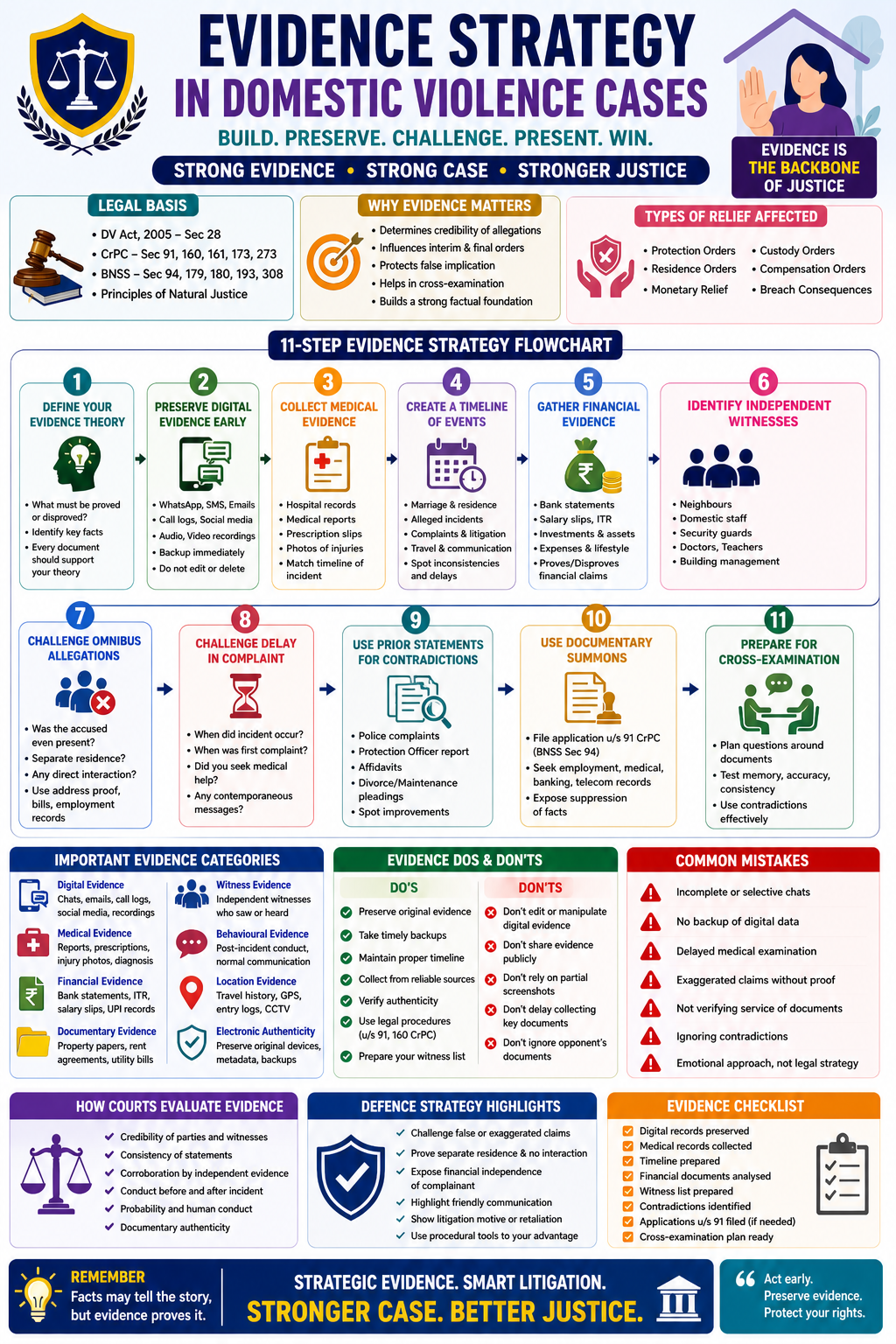
Understanding the Role of Evidence in Domestic Violence Cases
Proceedings under the Protection of Women from Domestic Violence Act, 2005 are often described as quasi-criminal in nature. Although the reliefs may appear civil, the consequences can include:
- Protection orders
- Residence orders
- Monetary relief
- Compensation orders
- Custody orders
- Breach-related criminal consequences
Therefore, evidence becomes central at every stage.
Courts evaluate:
- Credibility of allegations
- Consistency of conduct
- Supporting documents
- Independent corroboration
- Digital and financial records
Legal Framework
Domestic violence proceedings generally follow criminal procedural safeguards.
Relevant procedural provisions include:
- Section 28 of the Domestic Violence Act – Procedure governed by CrPC
- Section 91 CrPC (BNSS Section 94) – Summons to produce documents
- Section 160 CrPC (BNSS Section 179) – Attendance of witnesses
- Section 161 CrPC (BNSS Section 180) – Examination during investigation
- Section 173 CrPC (BNSS Section 193) – Investigation report, where applicable
- Section 273 CrPC (BNSS Section 308) – Evidence in presence of accused
Step 1: Build a Clear Evidence Theory Before Collecting Documents
Before collecting documents, define your case theory.
Ask:
What exactly must you prove or disprove?
Examples:
- No domestic relationship existed
- Parties lived separately
- No acts of violence occurred
- Allegations arose after matrimonial litigation
- Financial suppression exists
- Abuse allegations are exaggerated
Every document you collect must support your theory.
Step 2: Preserve Digital Evidence Immediately
In modern domestic violence cases, digital evidence often becomes decisive.
Preserve:
- WhatsApp chats
- SMS messages
- Emails
- Social media conversations
- Audio recordings
- Video recordings
- Call logs
- GPS or travel history
Digital evidence may reveal:
- Normal communication after alleged incidents
- Settlement discussions
- Contradictions in timelines
- Absence of fear or coercion
Practical Strategy
Immediately:
- Take backups
- Export chats
- Save cloud copies
- Preserve original devices
Do not edit or crop messages.
Authenticity matters.
Step 3: Collect Medical Evidence Carefully
If physical violence is alleged, medical evidence becomes highly relevant.
Preserve:
- Hospital records
- Emergency treatment documents
- Prescription slips
- Diagnostic reports
- Photographs of injuries
Important questions include:
- Was treatment sought immediately?
- Does the medical record match the allegations?
- Does the injury timeline match the complaint?
Delayed or inconsistent medical records may affect credibility.
Step 4: Build Timeline Evidence
Prepare a chronological timeline of events.
Include:
- Marriage date
- Residence history
- Alleged incidents
- Police complaints
- Travel records
- Financial transactions
- Court proceedings
A timeline often exposes:
- Delayed allegations
- Contradictory narratives
- Post-incident normal conduct
A visual chronology can become a powerful courtroom tool.
Step 5: Use Financial Evidence Strategically
Financial disputes often overlap with domestic violence claims.
Collect:
- Bank statements
- Salary slips
- Income tax returns
- Investment records
- Property documents
- UPI/payment records
Financial evidence helps establish:
- Actual standard of living
- Financial independence
- Suppression of income
- Economic abuse allegations
Step 6: Identify Independent Witnesses
Independent witnesses often strengthen credibility.
Possible witnesses include:
- Neighbours
- Security guards
- Domestic staff
- Family doctors
- School authorities
- Building management
Independent testimony can confirm:
- Living arrangements
- Frequency of disputes
- Physical presence
- Behavioural patterns
Step 7: Challenge Omnibus Allegations
Many domestic violence cases involve allegations against:
- Elderly parents
- Married sisters
- Distant relatives
Challenge:
- Physical presence
- Separate residence
- Lack of direct interaction
- Absence of communication
Evidence such as:
- Aadhaar address
- Utility bills
- Employment records
- Travel records
may help.
Step 8: Challenge Delay in Complaint
Delay can become a critical defence point.
Ask:
- When did the alleged incident occur?
- When was the first complaint made?
- Was any medical treatment sought?
- Were any contemporaneous messages sent?
Unexplained delay may weaken the case.
Step 9: Use Prior Statements for Contradictions
Compare:
- Police complaints
- Protection Officer reports
- Affidavits
- Maintenance applications
- Divorce pleadings
- FIR statements
Look for:
- New allegations
- Changed dates
- Added names
- Increased financial claims
Contradictions often become the strongest defence tool.
Step 10: Use Documentary Summons Strategically
If important documents remain unavailable, apply under:
- Section 91 CrPC (BNSS Section 94)
Seek:
- Employment records
- School records
- Hospital records
- Telecom records
- Banking records
This can expose suppression.
Step 11: Prepare Cross-Examination Around Evidence
Evidence collection alone is not enough.
Use documents during cross-examination to test:
- Memory
- Accuracy
- Consistency
- Credibility
Questions should focus on:
- Dates
- Locations
- Presence of witnesses
- Subsequent conduct
Common Evidence Mistakes
Avoid:
Selective Screenshot Production
Incomplete chats often backfire.
Editing Digital Material
Manipulation destroys credibility.
Delayed Preservation
Evidence may disappear permanently.
Emotional Documentation Without Strategy
Documents must support legal theory.
Ignoring Opponent’s Documentary Claims
Every document must be verified.
Defence Strategy in False or Exaggerated DV Cases
If defending a false or inflated claim:
Focus on:
Separate Residence
Did the accused even live with the complainant?
Financial Independence
Is the complainant employed?
Contradictory Litigation Positions
Do other cases tell a different story?
Friendly Post-Incident Communication
Do chats contradict fear allegations?
Travel and Social Media Evidence
Does conduct contradict abuse claims?
Judicial Approach
Courts increasingly scrutinise:
- General allegations
- Documentary contradictions
- Digital communication
- Financial suppression
- Delayed complaints
Courts prefer evidence-based litigation over emotional allegations.
Practical Evidence Checklist
Before hearing, ensure:
- Digital records preserved
- Medical documents collected
- Timeline prepared
- Financial documents analysed
- Witness list prepared
- Contradictions marked
- Documentary summons considered
- Cross-examination plan ready
Conclusion
In domestic violence litigation, evidence often matters more than allegations. A carefully designed evidence strategy can:
- Strengthen genuine claims
- Expose exaggeration
- Challenge false implication
- Influence interim orders
- Shape final outcomes
By:
- Acting early
- Preserving authentic records
- Building a coherent theory
- Using procedural tools strategically
you can dramatically improve your position in domestic violence proceedings.
In court, facts persuade—but evidence proves.
Index of Legal Strategies and Defence is here.
Key Contributor :
Mrs. Suprajaa Rajan B.Com., LL.B., LL.M.
+91-9606345150

