Introduction
Courts often grant exemption from personal appearance to accused persons to reduce hardship, especially in cases involving distance, health issues, or professional constraints. This relief is granted under Section 205 of the Code of Criminal Procedure, 1973 (CrPC) and its corresponding provision under Section 227 of the Bharatiya Nagarik Suraksha Sanhita, 2023 (BNSS).
However, this exemption is not absolute. Courts retain the power to cancel such exemption at any stage of proceedings if circumstances demand.
Therefore, it becomes essential to understand when and why courts cancel exemption from personal appearance, and how the accused should respond.
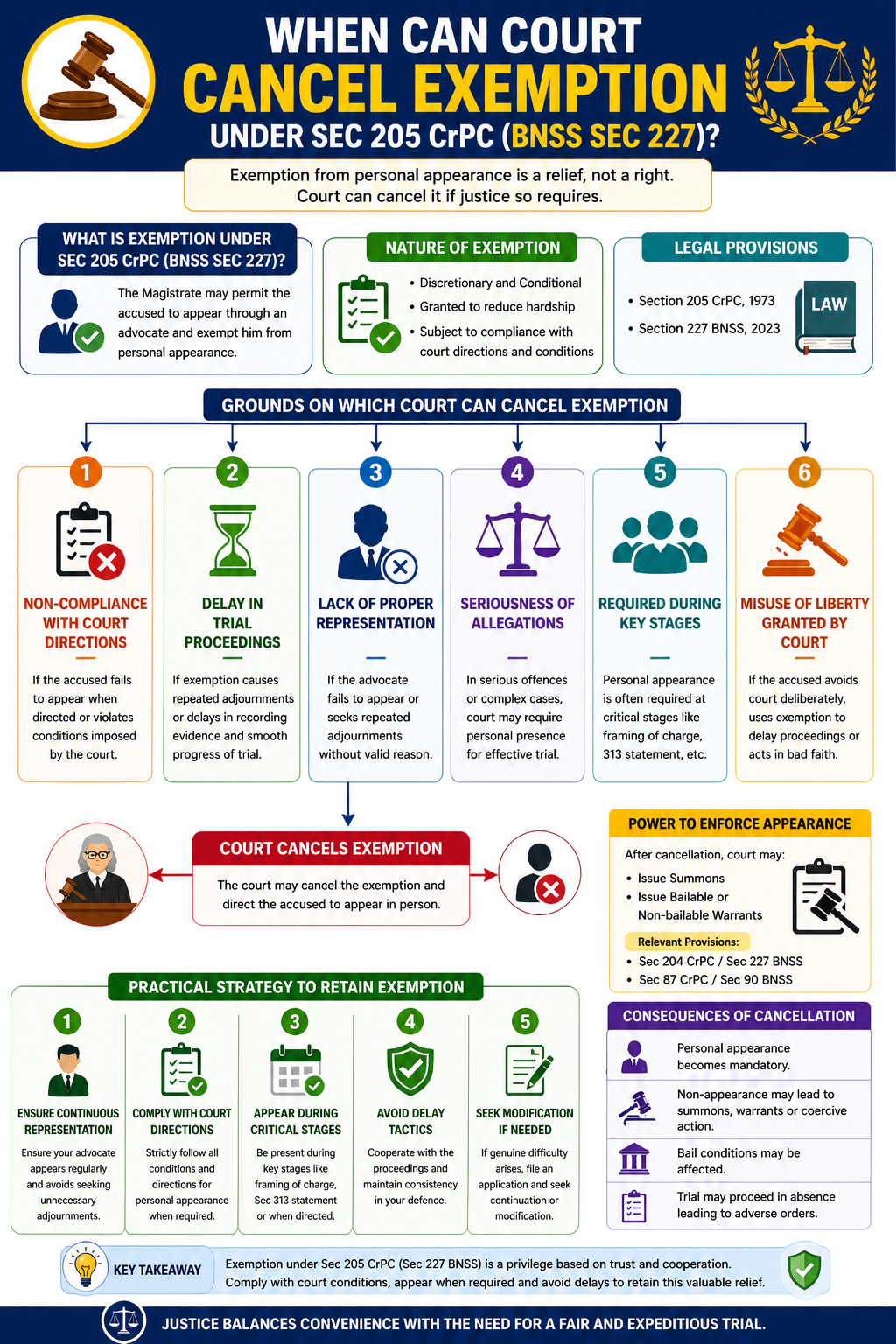
What Is Exemption Under Section 205 CrPC?
Under:
- Section 205 CrPC (Section 227 BNSS)
the Magistrate may permit the accused to:
- Appear through an advocate
- Avoid personal appearance in court
This provision aims to:
- Reduce unnecessary hardship
- Ensure convenience without affecting proceedings
- Balance personal liberty with judicial process
Nature of Exemption: Conditional, Not Absolute
The exemption granted under Section 205 is discretionary and conditional.
Courts usually impose conditions such as:
- Mandatory representation through counsel
- No delay in proceedings
- Appearance when specifically directed
Therefore, the accused must strictly comply with these conditions to retain the benefit.
Grounds on Which Courts Cancel Exemption
Courts cancel exemption when they find that the accused is misusing the relief or obstructing the judicial process.
1. Non-Compliance with Court Directions
If the accused:
- Fails to appear when directed
- Violates conditions imposed by the court
the court may cancel exemption and require personal appearance.
2. Delay in Trial Proceedings
Courts prioritise expeditious disposal of cases.
If exemption causes:
- Repeated adjournments
- Delays in recording evidence
the court may withdraw the benefit to ensure smooth progress.
3. Lack of Proper Representation
If the advocate:
- Fails to appear
- Seeks repeated adjournments
the court may hold that exemption is being misused and cancel it.
4. Seriousness of Allegations
In cases involving:
- Serious offences
- Complex factual disputes
courts may require the accused to be present for:
- Identification
- Clarification of facts
Thus, exemption may be revoked depending on the nature of the offence.
5. Requirement During Key Stages
Courts often insist on personal appearance during critical stages such as:
- Framing of charges → Section 240 CrPC (Section 263 BNSS)
- Examination under → Section 313 CrPC (Section 351 BNSS)
- Final arguments (in some cases)
If the accused fails to appear during such stages, exemption may be cancelled.
6. Misuse of Liberty Granted by Court
If the accused:
- Avoids court deliberately
- Uses exemption to delay proceedings
- Acts in bad faith
the court may cancel exemption to prevent abuse of process.
Power of Court to Enforce Appearance
Once exemption is cancelled, the court may:
- Issue summons
- Issue bailable or non-bailable warrants
Relevant provisions:
- Section 204 CrPC (Section 227 BNSS – process issuance contextually aligned)
- Section 87 CrPC (Section 90 BNSS) – Warrant in lieu of summons
Thus, non-compliance can lead to serious legal consequences.
Judicial Approach
Courts adopt a balanced approach:
- They grant exemption to reduce hardship
- They cancel exemption to prevent misuse
Courts consistently emphasise that:
- Exemption is a privilege, not a right
- Proceedings must not suffer due to absence of accused
Practical Defence Strategy
Step 1: Ensure Continuous Representation
Always ensure that your advocate:
- Appears regularly
- Avoids unnecessary adjournments
Step 2: Comply with Court Directions
Strictly follow:
- Conditions of exemption
- Directions for personal appearance
Step 3: Appear During Critical Stages
Even if exemption is granted, you should appear during:
- Framing of charge
- Statement under Section 313
- Any stage specifically directed
Step 4: Avoid Delay Tactics
Courts quickly detect delay strategies. Therefore:
- Cooperate with proceedings
- Maintain consistency in defence
Step 5: Seek Modification If Needed
If genuine difficulty arises (health, travel, etc.), you should:
- File an application explaining reasons
- Seek continuation or modification of exemption
Consequences of Cancellation
If the court cancels exemption:
- Personal appearance becomes mandatory
- Non-appearance may lead to warrants
- Bail conditions may be affected
Therefore, it is crucial to handle exemption carefully and responsibly.
Conclusion
Exemption from personal appearance under Section 205 CrPC (Section 227 BNSS) provides significant relief to accused persons. However, courts retain full authority to cancel such exemption if it is misused or hampers the trial.
By:
- Complying with court conditions
- Ensuring proper representation
- Appearing when required
the accused can continue to benefit from this provision without facing adverse consequences.
Ultimately, courts aim to strike a balance between convenience of the accused and effective administration of justice.
Related Legal Concepts
Index of Legal Strategies and Defence is here.
Key Contributor :
Mrs. Suprajaa Rajan B.Com., LL.B., LL.M.
+91-9606345150

