Introduction
A false arrest is not just a legal irregularity—it is a serious violation of personal liberty and fundamental rights. Indian law recognizes that unlawful detention can cause reputational damage, mental trauma, and financial loss.
Therefore, individuals who have been falsely arrested can seek compensation and legal remedies through constitutional and statutory mechanisms.
This article explains when an arrest is considered illegal, how to claim compensation, and the legal strategy involved, with reference to the Code of Criminal Procedure, 1973 (CrPC) and the Bharatiya Nagarik Suraksha Sanhita, 2023 (BNSS).
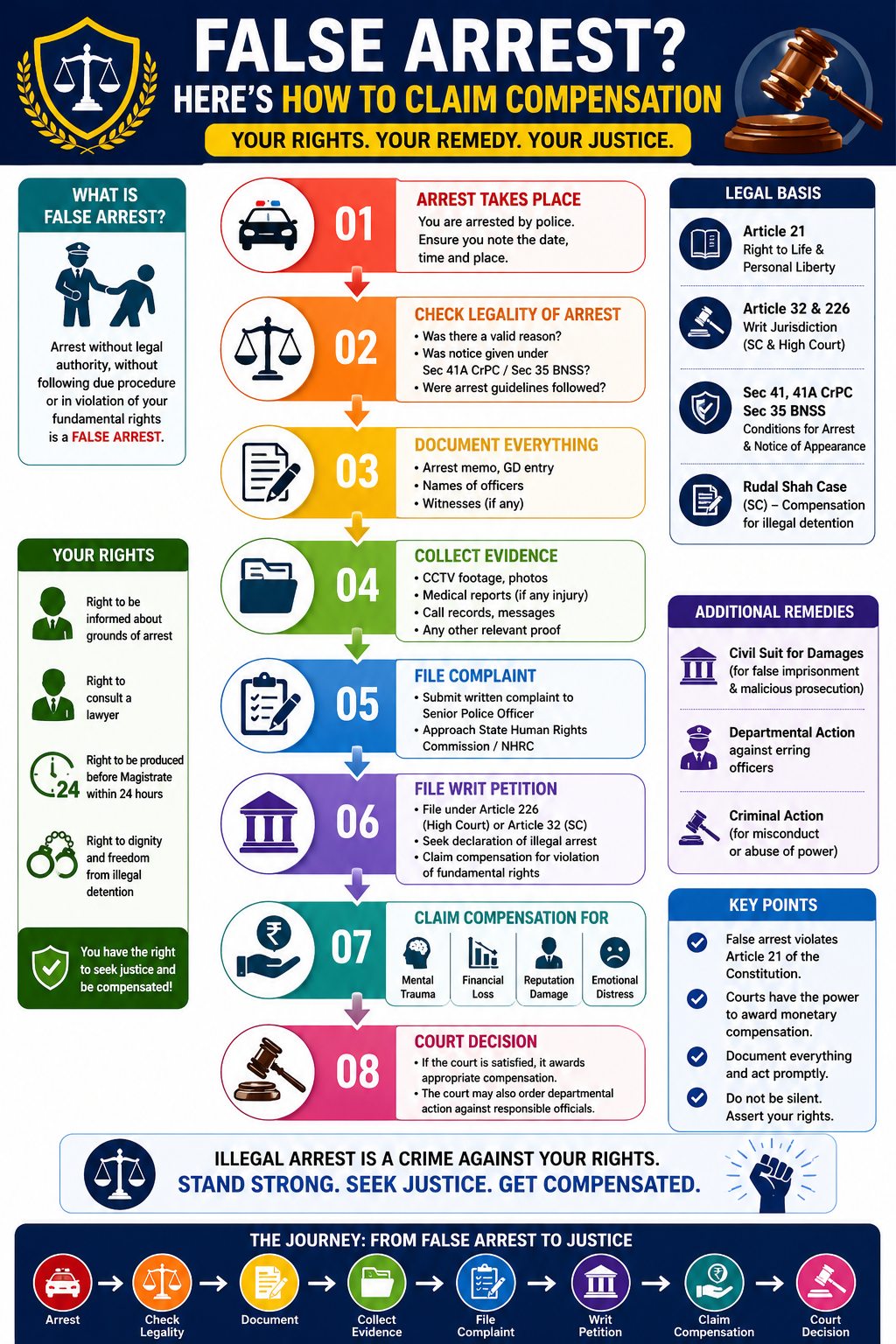
What Is a False Arrest?
A false arrest occurs when a person is detained:
- Without lawful justification
- Without following due procedure
- In violation of legal safeguards
An arrest becomes illegal when authorities fail to comply with:
- Section 41 CrPC (Section 35 BNSS) – Conditions for arrest
- Section 41A CrPC (Section 35 BNSS) – Notice of appearance
- Constitutional protections under Article 21 of the Constitution of India
Thus, any arrest that violates these safeguards may be challenged.
Legal Rights Against False Arrest
Every individual has the right to:
- Be informed of grounds of arrest
- Consult a lawyer
- Be produced before a Magistrate within 24 hours
- Be protected from arbitrary detention
Failure to comply with these rights strengthens a claim for compensation.
Constitutional Remedy for Compensation
The most effective remedy lies under:
- Article 32 (Supreme Court)
- Article 226 (High Courts)
Courts have the power to grant monetary compensation for violation of fundamental rights.
In
Rudal Shah v. State of Bihar,
the Supreme Court awarded compensation for unlawful detention, establishing that public law remedy is available for violation of fundamental rights.
When Can You Claim Compensation?
You can seek compensation if:
1. Arrest Without Legal Basis
If police arrest you without satisfying the conditions under:
- Section 41 CrPC (Section 35 BNSS)
2. Non-Compliance with Arrest Guidelines
Failure to follow guidelines laid down in
Arnesh Kumar v. State of Bihar
can make the arrest illegal.
3. Detention Beyond 24 Hours
If you are not produced before a Magistrate within 24 hours, it violates:
- Constitutional safeguards
- Procedural law
4. Malicious or Bad Faith Arrest
If arrest is made:
- To harass
- Without evidence
- With ulterior motives
it may attract compensation.
Legal Remedies Available
1. Writ Petition for Compensation
File a writ petition under:
- Article 226 (High Court)
Seek:
- Compensation
- Declaration of illegal arrest
- Action against responsible officers
2. Civil Suit for Damages
You can file a civil suit for:
- False imprisonment
- Malicious prosecution
This allows recovery of:
- Financial loss
- Mental agony
- Reputational harm
3. Departmental Action Against Police
You may file complaints seeking:
- Disciplinary action
- Inquiry against officers
4. Criminal Action (In Rare Cases)
If misconduct is severe, criminal proceedings may be initiated against officials.
Step-by-Step Strategy to Claim Compensation
Step 1: Document the Illegal Arrest
Immediately record:
- Date and time of arrest
- Grounds (if any)
- Witnesses
Step 2: Collect Evidence
Gather:
- Arrest memo
- CCTV footage
- Medical records (if any harm caused)
- Communication records
Step 3: File Representation
Submit a written complaint to:
- Senior police अधिकारियों
- Human rights authorities
Step 4: File Writ Petition
Approach High Court under:
- Article 226
Seek:
- Compensation
- Declaration of rights violation
Step 5: Consider Civil Damages Suit
For higher compensation, initiate a civil claim for damages.
Judicial Approach
Courts have consistently held that:
- Personal liberty is paramount
- State must compensate for illegal detention
- Abuse of power cannot go unchecked
Courts award compensation to:
- Deter misconduct
- Provide relief to victims
- Uphold rule of law
Key Factors Considered by Courts
Courts evaluate:
- Duration of illegal detention
- Nature of violation
- Conduct of authorities
- Impact on victim
Higher compensation is awarded in cases involving:
- Prolonged detention
- Public humiliation
- Malicious intent
Practical Considerations
Before filing a claim, consider:
- Strength of evidence
- Documentation of arrest
- Legal costs and time
A well-prepared case significantly improves chances of success.
Conclusion
False arrest, thus, strikes at the heart of personal liberty and constitutional rights. Indian law provides strong remedies to ensure that victims are compensated and authorities are held accountable.
By:
- Documenting violations
- Approaching constitutional courts
- Pursuing civil remedies
you can effectively seek justice and compensation.
Ultimately, such legal action reinforces the principle that no authority is above the law.
Related Legal Concepts
- Anticipatory Bail
- Arrest under CrPC
- Writ Petition
- Malicious Prosecution
- Fundamental Right to Liberty
Index of Legal Strategies and Defence is here.
Key Contributor :
Mrs. Suprajaa Rajan B.Com., LL.B., LL.M.
+91-9606345150

