web analytics

Menu

Skip to content
Shades of Knife
  • Home
  • True Colors of a Vile Wife
  • Need Inspiration?
  • Blog Updates
  • SOK Gallery
  • Vile News Reporter
  • About Me
  • Contact Me

Shades of Knife

True Colors of a Vile Wife

Tag: CrPC 41A – Notice of appearance before police officer

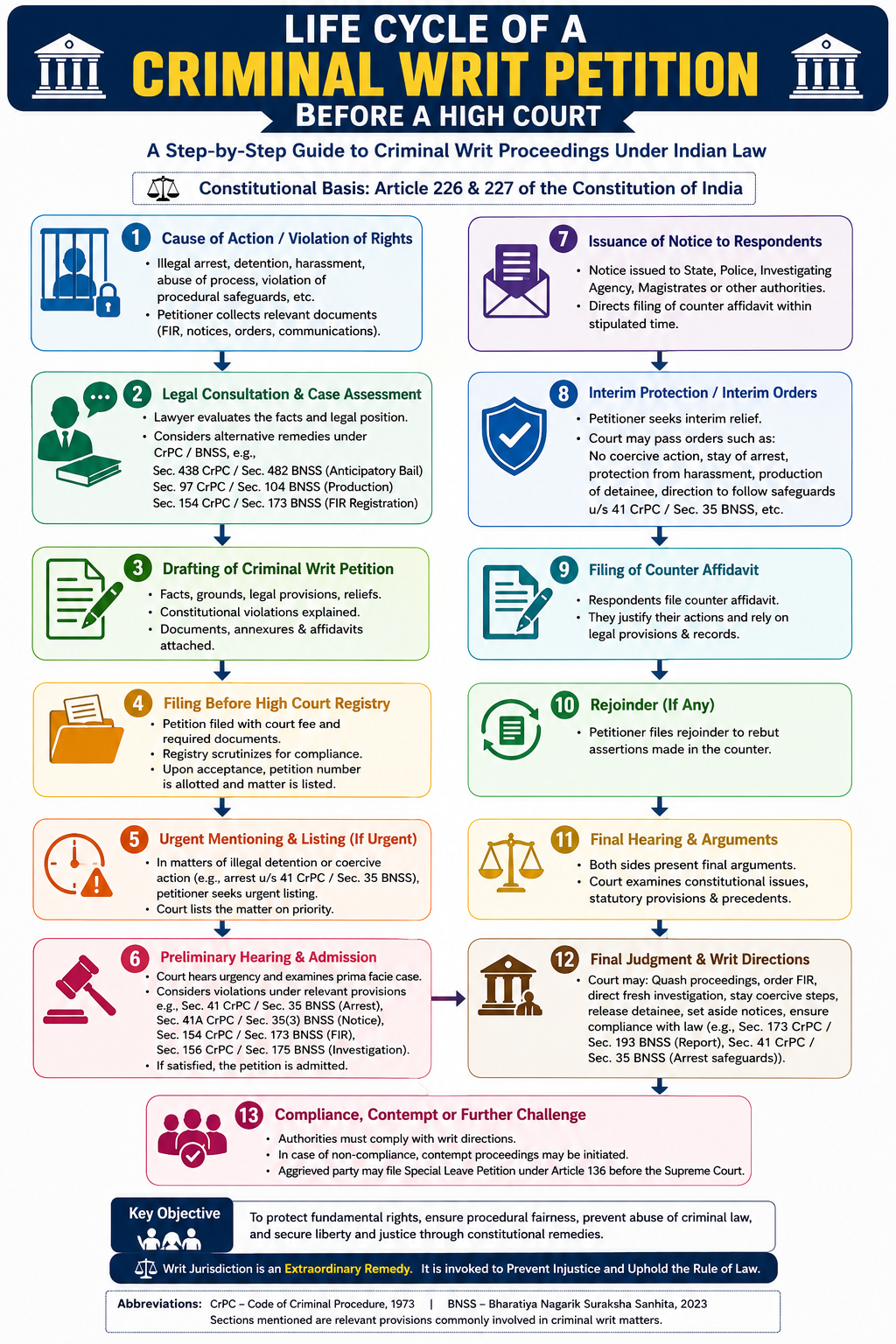
Life Cycle Stages of a Criminal Writ Petition Before a High Court

Posted on May 7 by Suprajaa Rajan

A Step-by-Step Guide to Criminal Writ Proceedings Under Indian Law

Understanding the procedural journey of a criminal writ petition helps individuals protect their fundamental rights, challenge illegal actions, and seek urgent judicial intervention from the High Court.

A criminal writ petition is an extraordinary constitutional remedy that a person may invoke when illegal detention, abuse of criminal process, violation of procedural safeguards, or infringement of fundamental rights occurs.

Unlike regular criminal trials, criminal writ petitions arise directly under the constitutional jurisdiction of the High Courts under Article 226 of the Constitution of India and, in appropriate cases, under Article 227 of the Constitution of India.

Although the power flows from the Constitution, the issues raised in such petitions often involve provisions of the Code of Criminal Procedure, 1973 (CrPC) and the Bharatiya Nagarik Suraksha Sanhita, 2023 (BNSS).

The following stages explain the complete life cycle of a criminal writ petition before a High Court.

1. Legal Foundation of Criminal Writ Jurisdiction

First, it is important to understand the legal foundation of criminal writ proceedings.

High Courts exercise writ jurisdiction under Article 226 of the Constitution of India to protect legal and fundamental rights. Additionally, High Courts exercise supervisory jurisdiction under Article 227 of the Constitution of India over subordinate courts and tribunals.

A person may file a criminal writ petition in situations involving:

  • Illegal arrest or detention
  • Violation of procedural safeguards
  • Abuse of criminal investigation
  • Failure of police authorities to act
  • Threat to personal liberty under Article 21
  • Illegal issuance of lookout notices or coercive action
  • Failure to follow mandatory criminal procedure

For instance, petitions may involve violations relating to arrest under Section 41 CrPC / Section 35 BNSS, notice of appearance under Section 41A CrPC / Section 35(3) BNSS, search and seizure, remand, or investigation.

Therefore, writ jurisdiction acts as an immediate constitutional safeguard.

2. Stage One: Cause of Action or Violation of Rights

Typically, a criminal writ petition begins when a person experiences an illegal action by police, investigating agencies, or other public authorities.

For example, the grievance may involve illegal detention, unlawful summons, harassment during investigation, refusal to register an FIR, or violation of procedural safeguards.

The aggrieved person first identifies the violation and gathers relevant documents, notices, FIR copies, summons, remand orders, or communication records.

Therefore, identifying the cause of action forms the foundation of the writ petition.

3. Stage Two: Legal Consultation and Case Assessment

Next, the aggrieved person consults a legal practitioner experienced in criminal and constitutional litigation.

At this stage, the lawyer evaluates whether the grievance requires a writ remedy or an alternative statutory remedy.

For example, the lawyer may examine whether relief could arise through:

  • FIR registration under Section 154 CrPC / Section 173 BNSS
  • Anticipatory bail under Section 438 CrPC / Section 482 BNSS
  • Regular bail under Section 439 CrPC / Section 483 BNSS
  • Production of a detained person under Section 97 CrPC / Section 104 BNSS

If immediate constitutional intervention becomes necessary, the lawyer prepares for writ proceedings.

4. Stage Three: Drafting of Criminal Writ Petition

After assessing the facts, the legal team drafts the criminal writ petition.

The petition generally includes:

  • Details of parties
  • Facts leading to the violation
  • Relevant constitutional rights violated
  • Relevant criminal law provisions
  • Grounds for invoking writ jurisdiction
  • Interim relief sought
  • Final relief sought

Additionally, the petitioner annexes supporting documents such as FIR copies, notices, complaint copies, remand orders, call records, or medical records.

A properly drafted petition significantly strengthens the case.

5. Stage Four: Filing Before the High Court Registry

Once the petition is ready, the petitioner files it before the Registry of the jurisdictional High Court.

The Registry scrutinises the petition for procedural compliance, court fees, formatting requirements, affidavits, and annexures.

If defects appear, the Registry returns the matter for correction.

Once compliance is complete, the Registry assigns a writ petition number and lists the matter before the appropriate bench.

Thus, the petition formally enters the judicial system.

6. Stage Five: Urgent Mentioning and Listing

In urgent matters involving personal liberty, illegal detention, or coercive police action, the petitioner may seek urgent listing.

For example, habeas corpus petitions involving unlawful detention may require immediate listing.

Similarly, petitions challenging illegal arrest under Section 41 CrPC / Section 35 BNSS may also require urgent hearing.

After hearing the urgency submissions, the High Court may list the matter on priority.

Therefore, urgent mentioning plays a crucial role in criminal writ proceedings.

7. Stage Six: Preliminary Hearing and Admission

Next, the High Court conducts a preliminary hearing.

At this stage, the petitioner’s counsel explains the urgency, constitutional violation, and statutory breaches.

The court examines whether the petition discloses a prima facie case.

For example, the court may examine violations involving:

  • Arrest procedure under Section 41 CrPC / Section 35 BNSS
  • Notice procedure under Section 41A CrPC / Section 35 BNSS
  • FIR registration under Section 154 CrPC / Section 173 BNSS
  • Investigation procedure under Section 156 CrPC / Section 175 BNSS

If the court finds merit, it admits the petition.

8. Stage Seven: Issuance of Notice to Respondents

After admission, the High Court issues notice to the respondents.

The respondents may include:

  • State Government
  • Police authorities
  • Investigating agencies
  • Magistrates or subordinate authorities, where legally permissible
  • Other affected parties

The notice directs the respondents to file their reply within a specified period.

This stage ensures compliance with principles of natural justice.

9. Stage Eight: Interim Protection or Interim Orders

Meanwhile, the petitioner may seek interim protection.

Depending on the facts, the High Court may pass interim directions such as:

  • No coercive steps
  • Stay of arrest
  • Protection from harassment
  • Production of detainee
  • Protection of evidence
  • Direction to follow procedural safeguards

For instance, the court may direct compliance with arrest safeguards under Section 41 CrPC / Section 35 BNSS.

In urgent cases, interim protection may determine the immediate outcome.

10. Stage Nine: Filing of Counter Affidavit and Rejoinder

Subsequently, the respondents file their counter affidavit.

The respondents justify their actions by relying on investigation records, statutory powers, or procedural compliance.

After that, the petitioner may file a rejoinder to rebut factual or legal assertions.

This stage helps the court understand the complete factual matrix.

11. Stage Ten: Final Hearing and Arguments

After pleadings conclude, the High Court hears final arguments.

The petitioner demonstrates constitutional violations, abuse of power, or procedural irregularities.

Conversely, the respondents defend the legality of their actions.

Both parties rely on constitutional principles, statutory provisions, and judicial precedents.

At this stage, the court examines whether state action violates due process or personal liberty.

12. Stage Eleven: Final Judgment and Writ Directions

Finally, the High Court delivers its judgment.

Depending on the facts, the court may:

  • Quash illegal proceedings
  • Direct registration of FIR
  • Order fresh investigation
  • Stay coercive action
  • Release an illegally detained person
  • Set aside unlawful notices
  • Direct compliance with procedural safeguards
  • Award costs in appropriate cases

For instance, the court may direct authorities to comply with investigation procedures under Section 173 CrPC / Section 193 BNSS or arrest safeguards under Section 41 CrPC / Section 35 BNSS.

Thus, the writ remedy ensures accountability.

13. Stage Twelve: Compliance, Contempt, or Further Challenge

After the judgment, authorities must comply with the writ directions.

If authorities fail to comply, the petitioner may initiate contempt proceedings before the High Court.

Additionally, an aggrieved party may challenge the judgment before the Supreme Court through:

  • Special Leave Petition under Article 136, or
  • Other constitutional remedies, where applicable.

Therefore, post-judgment remedies ensure continued judicial oversight.

Conclusion

Criminal writ petitions play a vital role in protecting personal liberty, procedural fairness, and constitutional rights.

Therefore, High Courts follow a structured process that balances urgent intervention with judicial scrutiny.

Understanding the life cycle of a criminal writ petition helps individuals seek timely constitutional remedies against illegal criminal action.

Ultimately, writ jurisdiction remains one of the strongest safeguards against misuse of criminal law.


Other Life Cycles: DV Case Lifecycle || Maintenance Case u/s 125 CrPC Lifecycle. Index is here.


Key Contributor :

Mrs. Suprajaa Rajan B.Com., LL.B., LL.M.

+91-9606345150


Posted in Legal Procedure | Tagged Article 226 Constitution Article 227 - Power of superintendence over all courts by the High Court CrPC 41A - Notice of appearance before police officer Life Cycle stages Life Cycle stages of a criminal writ petition | Leave a comment

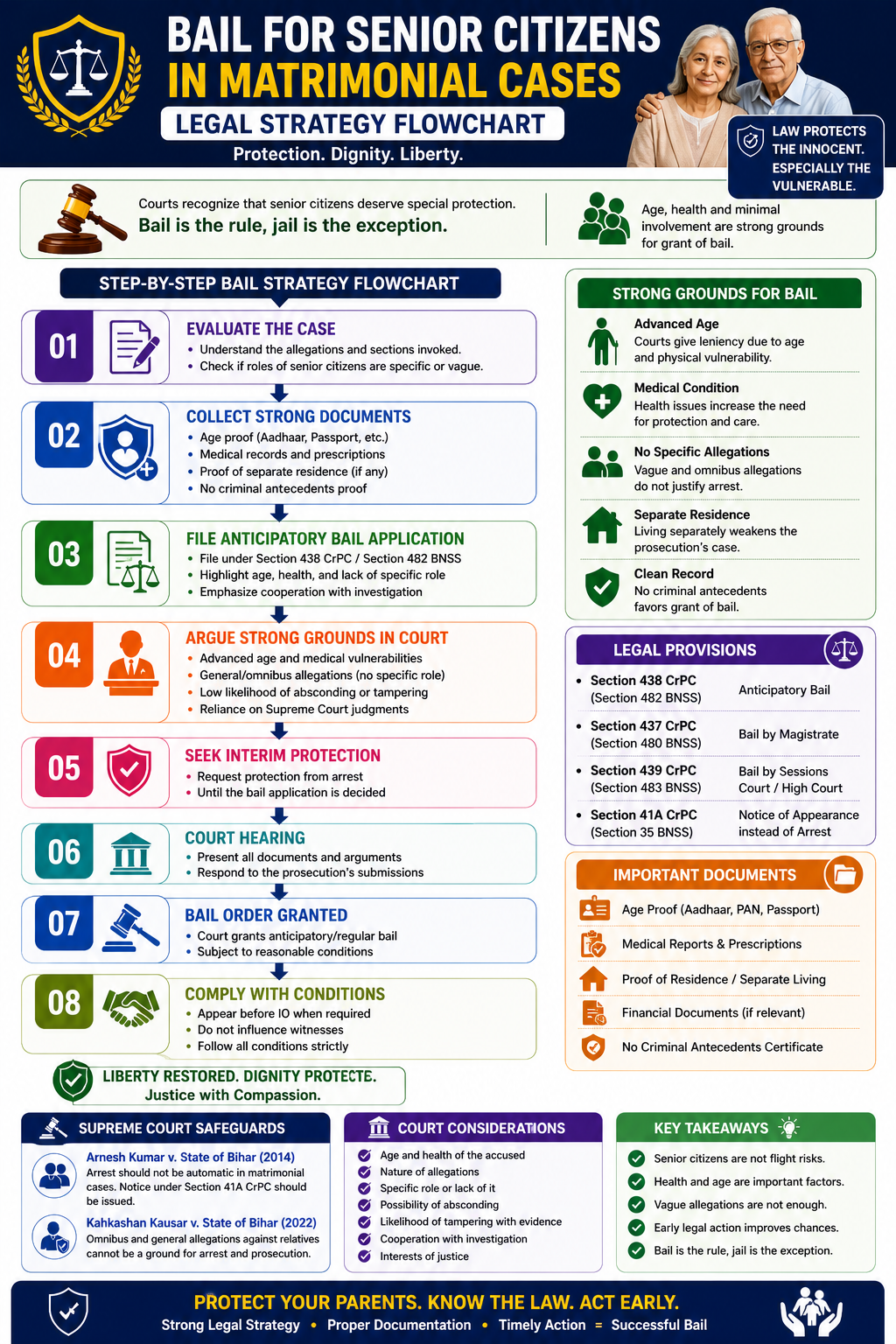
Bail for Senior Citizens in Matrimonial Cases – Legal Strategy & Safeguards

Posted on May 3 by Suprajaa Rajan

Matrimonial disputes often result in criminal complaints—particularly under provisions like cruelty or dowry harassment—where multiple family members, including elderly parents, are implicated. However, courts have increasingly recognised that senior citizens require special consideration due to their age, health, and limited involvement in marital conflicts.

As a result, bail jurisprudence in India has evolved to provide greater protection to elderly accused persons, especially in matrimonial cases.

This article explains the legal framework, judicial approach, and practical strategy for securing bail for senior citizens, with reference to the Code of Criminal Procedure, 1973 (CrPC) and the Bharatiya Nagarik Suraksha Sanhita, 2023 (BNSS).

Why Senior Citizens Deserve Special Consideration

Courts acknowledge that senior citizens:

  • Are less likely to abscond
  • Usually have minimal involvement in matrimonial disputes
  • May suffer serious health risks due to arrest or custody

Therefore, courts adopt a more liberal approach while granting bail to elderly persons.

Legal Provisions for Bail

Senior citizens can seek:

1. Anticipatory Bail

  • Section 438 CrPC (Section 482 BNSS)

This protects against arrest before it happens.

2. Regular Bail

  • Section 437 CrPC (Section 480 BNSS)
  • Section 439 CrPC (Section 483 BNSS)

Courts consider age and health as important factors.

Important Judicial Safeguards

In Arnesh Kumar v. State of Bihar, the Supreme Court laid down strict guidelines:

  • Arrest should not be automatic
  • Police must justify necessity of arrest
  • Notice under Section 41A CrPC (Section 35 BNSS) should be issued

These safeguards are particularly relevant for senior citizens, as they reduce unnecessary arrests.

Grounds for Grant of Bail to Senior Citizens

Courts consider the following factors:

1. Advanced Age

Elderly individuals are given leniency due to:

  • Physical vulnerability
  • Reduced mobility

2. Medical Condition

If the accused suffers from:

  • Chronic illness
  • Age-related health issues

courts are more inclined to grant bail.

3. Absence of Specific Allegations

In many matrimonial cases, allegations against elderly parents are:

  • General
  • Vague

or Courts often grant bail where no specific role is attributed.

4. Separate Residence

If the senior citizen:

  • Lives separately from the couple

this weakens the prosecution’s case.

5. No Criminal Antecedents

Clean past record strengthens the case for bail.

Role of Omnibus Allegations

In Kahkashan Kausar v. State of Bihar, the Supreme Court held:

  • Vague allegations against relatives cannot justify prosecution
  • Courts must scrutinise individual roles

This principle strongly supports grant of bail to elderly relatives.

Step-by-Step Strategy to Secure Bail

Step 1: Apply for Anticipatory Bail

File under:

  • Section 438 CrPC (Section 482 BNSS)

Highlight:

  • Age
  • Medical condition
  • Lack of involvement

Step 2: Emphasise Health and Age

Submit:

  • Medical records
  • Age proof

Step 3: Highlight Weak Allegations

Point out:

  • Lack of specific role
  • General accusations

Step 4: Show Cooperation

Assure the court that:

  • The accused will cooperate
  • No interference with investigation

Step 5: Seek Interim Protection

Request:

  • Protection from arrest during pendency of application

Conditions Typically Imposed by Courts

Courts may grant bail subject to:

  • Appearance before investigating officer
  • Non-interference with witnesses
  • Travel restrictions

These conditions balance liberty and investigation needs.

Judicial Approach

Courts today aim to:

  • Prevent misuse of criminal law
  • Protect vulnerable accused persons
  • Ensure fair investigation

They consistently emphasize that:

  • Arrest should be last resort
  • Bail should be the rule, especially for senior citizens

Practical Defence Insights

  • Courts are more sympathetic toward elderly parents in matrimonial disputes
  • Early legal action significantly improves chances of bail
  • Proper documentation (medical + residence proof) is critical

Common Mistakes to Avoid

  • Delaying bail application
  • Ignoring police notices
  • Failing to present medical evidence
  • Inconsistent statements

Conclusion

Senior citizens accused in matrimonial cases are entitled to enhanced legal protection. Courts recognize the risks of unnecessary arrest and therefore adopt a liberal approach in granting bail.

By:

  • Filing timely applications
  • Highlighting age and health factors
  • Demonstrating lack of involvement

elderly accused persons can effectively secure bail and avoid undue hardship.

Ultimately, the law seeks to ensure that criminal proceedings do not become a tool of harassment against vulnerable individuals.


Related Legal Concepts

  • Anticipatory Bail
  • Regular Bail
  • First Information Report (FIR)
  • Omnibus Allegations
  • Notice under Sec 41A


Index of Legal Strategies and Defence is here. 


Key Contributor : 

Mrs. Suprajaa Rajan B.Com., LL.B., LL.M.

+91-9606345150


Posted in Legal Procedure | Tagged Code of Criminal Procedure CrPC 41A - Notice of appearance before police officer Legal Procedure Explained - Interpretation of Statutes Legal Strategies and Defence Senior Citizen Bail | Leave a comment

Arrest and Custodial Procedure Explained

Posted on March 22 by Suprajaa Rajan

Arrest and custodial procedure form a critical part of criminal law, as they directly impact the personal liberty of an individual. The law, therefore, carefully regulates the power of the police to arrest and detain a person while ensuring that constitutional safeguards and procedural protections are strictly followed.

Under Indian law, the procedure relating to arrest and custody is governed by the Code of Criminal Procedure, 1973 and corresponding provisions under the Bharatiya Nagarik Suraksha Sanhita, 2023.

Additionally, these provisions strike a balance between the need for effective investigation and the protection of individual rights.

Meaning of Arrest

Arrest refers to the act of taking a person into custody under lawful authority, thereby restraining their liberty.

A police officer may arrest a person:

  • To prevent the commission of an offence

  • To ensure proper investigation

  • To prevent tampering with evidence

  • To secure the presence of the accused before the court

However, the power of arrest is not absolute and must be exercised in accordance with law and judicial guidelines.

Statutory Framework

The law governing arrest and custody is contained in:

  • Section 41 CrPC (Section 35 BNSS) – When police may arrest without warrant

  • Section 41A CrPC (Section 35(3) BNSS) – Notice of appearance

  • Section 46 CrPC (Section 43 BNSS) – How arrest is made

  • Section 50 CrPC (Section 47 BNSS) – Grounds of arrest to be informed

  • Section 57 CrPC (Section 58 BNSS) – Production before Magistrate within 24 hours

  • Section 167 CrPC (Section 187 BNSS) – Procedure for remand

These provisions collectively regulate the entire process of arrest and detention.

Arrest Without Warrant

The police may arrest a person without a warrant in certain circumstances under:

  • Section 41 CrPC (Section 35 BNSS)

However, the law requires that arrest must be based on reasonable suspicion and necessity.

The police must justify arrest on grounds such as:

  • Preventing further offence

  • Proper investigation

  • Preventing disappearance of evidence

Thus, arrest cannot be made mechanically and must satisfy legal necessity.

Notice of Appearance Instead of Arrest

In less serious cases, the police may issue a notice under:

  • Section 41A CrPC (Section 35(3) BNSS)

This provision requires the accused to appear before the police without being arrested.

This ensures that arrest is avoided where:

  • Custodial interrogation is not required

  • The accused cooperates with investigation

This provision acts as an important safeguard against unnecessary arrests.

Procedure of Arrest

The law prescribes a specific procedure for effecting arrest.

Under Section 46 CrPC (Section 43 BNSS):

  • The police must physically restrain the person or submit to custody

  • Excessive force cannot be used

  • Arrest must follow due process

Additionally, the police must:

  • Inform the person of the grounds of arrest

  • Allow communication with a lawyer or relative

These safeguards ensure transparency and accountability.

Rights of Arrested Person

The law provides several rights to a person who has been arrested.

These include:

  • Right to be informed of the grounds of arrest (Section 50 CrPC / Section 47 BNSS)

  • Right to inform a relative or friend

  • Right to legal representation

  • Right to be produced before a Magistrate within 24 hours (Section 57 CrPC / Section 58 BNSS)

These rights protect individuals from arbitrary detention and abuse of power.

Custodial Detention and Remand

After arrest, the police may seek custody of the accused for investigation purposes.

Under Section 167 CrPC (Section 187 BNSS):

  • The accused must be produced before a Magistrate

  • The Magistrate may grant police custody or judicial custody

  • Custody is subject to time limits prescribed by law

This stage ensures judicial oversight over detention.

Police Custody vs Judicial Custody

The law distinguishes between two types of custody:

Police Custody

  • The accused remains in the custody of the police

  • Used for interrogation and investigation

Judicial Custody

  • The accused is sent to jail

  • Police do not have direct control

This distinction ensures that custodial powers are regulated and supervised.

Safeguards Against Arbitrary Arrest

Courts have emphasised that arrest should not be made routinely.

In the landmark case of Arnesh Kumar v. State of Bihar, the Supreme Court laid down strict guidelines to prevent misuse of arrest powers, especially in matrimonial offences.

The Court held that:

  • Arrest must be justified

  • Police must record reasons for arrest

  • Compliance with Section 41 CrPC is mandatory

These guidelines reinforce the principle that liberty cannot be curtailed without valid reasons.

Importance of Custodial Procedure

Custodial procedure ensures that detention is:

  • Lawful

  • Necessary

  • Subject to judicial scrutiny

It ,thus, prevents abuse of power while enabling the police to conduct effective investigation.

Conclusion

Arrest and custodial procedure thus represent a sensitive area of criminal law where the powers of the state intersect with individual liberty. The law, therefore, imposes strict safeguards to ensure that arrest is exercised fairly, reasonably, and in accordance with due process.

By balancing investigative needs with constitutional protections, the legal framework undeniably ensures that justice is administered without compromising fundamental rights.

Related Legal Concepts

Explore related stages and concepts in criminal procedure:

  • Cognizable and Non-Cognizable Offences
  • First Information Report (FIR)
  • Police Investigation
  • Bail Law Explained
  • Criminal Trial Procedure


Index of Law Concepts explained here.


Key Contributor :
Mrs. Suprajaa Rajan B.Com., LL.B., LL.M.
+91-9606345150

Posted in LLB Study Material | Tagged 498A arrest procedure BNSS CrPC 41A - Notice of appearance before police officer CrPC 46 - Arrest how made Law Concepts explained | Leave a comment

Tavaragi Rajashekhar Shiva Prasad Vs State of Karnataka and Ors on 19 Jul 2024

Posted on September 4, 2024 by ShadesOfKnife

A single judge of Karnataka High Court (Bengaluru Bench) held that along with notice under 41A CrPC (Section 35 BNSS), a copy of the FIR must be sent along.

From Para 9,

This notice does have clarity as to why the petitioner is being summoned. The matter could be disposed of recording the fact that the second notice does contain the crime number, as the issue may seem to be very simple. In the considered view of the Court, it is not, as Section 41 of the Cr.P.C., deals with arrest of persons. Any notice so issued under Section 41-A if not complied with, the Station House Officer is entitled to arrest the noticee. Therefore, the noticee must be aware of why he is being summoned to the Police Station, as summoning to the Police Station is not summoning a person to a happy place. A citizen must know as to why he is being summoned. The information to the citizen cannot be half baked; it must be in full. The notice must contain the crime number and the purpose for which he is being summoned. While it can be transmitted electronically, no fault can be found with that, but it should mention crime number. The duty of the Station House Officer would not stop at mentioning crime number, but he should also attach to the communication, a copy of the FIR, so registered against the noticee, as power is available to summon the accused or any person in connection with a crime. Therefore, the noticee, without knowing the crime number and without getting a copy of the FIR, cannot be asked to appear before an officer of the police station on receipt of notice under Section 41-A.

From Para 10,

Sub-sections (2) to (6) of Section 35 of the BNSS assume significance. Section 35(4) permits issuance of a notice to any person and the noticee shall be bound to comply with the terms of the notice. Section 35(6) commands that if a person fails to comply with the terms of the notice or is unwilling to identify himself, the Police Officer may, subject to such orders as may have been passed by the competent Court in this behalf, arrest him for the offence mentioned in the notice. Therefore, the rigour is little stronger. Stronger the rigour, the noticee is required to know all that he has to reply, prior to his appearance before the Police. It, thus, becomes mandatory for a notice to be issued under Section 35 of the BNSS to mention the crime number, the offence alleged in the crime so registered and necessarily append to it a copy of the FIR so registered, as any person who receives the notice must be aware for what he is being summoned to the Police Station.

From Para 13,

13. It is made clear that till the guidelines/check list is so notified by the State, if any person is necessary to be summoned, the drill that shall be followed are:-
(a) The notice under Section 35 of the BNSS shall mention the crime number and the offence alleged in the crime number. This can be communicated to the noticee either through the conventional method or through electronic mode.
(b) The communication shall attach copy of the FIR so registered, as the FIR would contain the gist of the complaint.
(c) In the event notice does not contain the crime number, the offence alleged or appending of the FIR, subject to just exceptions, the noticee is not obliged to appear before the officer who has directed him to appear and no coercive action can be taken for non-appearance.
(d) It is also necessary for the Police Department to bring about robust system for the FIR being uploaded immediately on their registration and make it search friendly.

Tavaragi Rajashekhar Shiva Prasad AND State of Karnataka on 19 Jul 2024

Other remedies to police atrocities are here.

Posted in High Court of Karnataka Judgment or Order or Notification | Tagged 1-Judge Bench Decision CrPC 41A - Notice of appearance before police officer Issued or Recommended Guidelines or Directions or Protocols to be followed Landmark Case Misuse or Violation of CrPC 41A per Guidelines in Arnesh Kumar Judgment Tavaragi Rajashekhar Shiva Prasad Vs State of Karnataka and Ors | Leave a comment

Satender Kumar Antil Vs CBI and Anr on 11 Jul 2022

Posted on July 12, 2022 by ShadesOfKnife

A division bench of Apex Court passed the following guidelines with respect to Arrest and Bails

From Para 24,

24.Section 41A deals with the procedure for appearance before the police officer who is required to issue a notice to the person against whom a reasonable complaint has been made, or credible information has been received or a reasonable suspicion exists that he has committed a cognizable offence, and arrest is not required under Section 41(1). Section 41B deals with the procedure of arrest along with mandatory duty on the part of the officer.
25.On the scope and objective of Section 41 and 41A, it is obvious that they are facets of Article 21 of the Constitution. We need not elaborate any further, in light of the judgment of this Court in Arnesh Kumar v. State of Bihar, (2014) 8 SCC 273:
26.We only reiterate that the directions aforesaid ought to be complied with in letter and spirit by the investigating and prosecuting agencies, while the view expressed by us on the non-compliance of Section 41 and the consequences that flow from it has to be kept in mind by the Court, which is expected to be reflected in the orders.
27.Despite the dictum of this Court in Arnesh Kumar (supra), no concrete step has been taken to comply with the mandate of Section 41A of the Code. This Court has clearly interpreted Section 41(1)(b)(i) and (ii) inter alia holding that notwithstanding the existence of a reason to believe qua a police officer, the satisfaction for the need to arrest shall also be present. Thus, sub-clause (1)(b)(i) of Section 41 has to be read along with sub-clause (ii) and therefore both the elements of ‘reason to believe’ and ‘satisfaction qua an arrest’ are mandated and accordingly are to be recorded by the police officer.
28.It is also brought to our notice that there are no specific guidelines with respect to the mandatory compliance of Section 41A of the Code. An endeavour was made by the Delhi High Court while deciding Writ Petition (C) No. 7608 of 2017 vide order dated 07.02.2018, followed by order dated 28.10.2021 in Contempt Case (C) No. 480 of 2020 & CM Application No.25054 of 2020, wherein not only the need for guidelines but also the effect of non-compliance towards taking action against the officers concerned was discussed. We also take note of the fact that a standing order has been passed by the Delhi Police viz., Standing Order No. 109 of 2020, which provides for a set of guidelines in the form of procedure for issuance of notices or orders by the police officers. Considering the aforesaid action taken, in due compliance with the order passed by the Delhi High Court in Writ Petition (C) No.7608 of 2017 dated 07.02.2018, this Court has also passed an order in Writ Petition (Crl.) 420 of 2021 dated 10.05.2021 directing the State of Bihar to look into the said aspect of an appropriate modification to give effect to the mandate of Section 41A. A recent judgment has also been rendered on the same lines by the High Court of Jharkhand in Cr.M.P. No. 1291 of 2021 dated 16.06.2022.
29.Thus, we deem it appropriate to direct all the State Governments and the Union Territories to facilitate standing orders while taking note of the standing order issued by the Delhi Police i.e., Standing Order No. 109 of 2020, to comply with the mandate of Section 41A. We do feel that this would certainly take care of not only the unwarranted arrests, but also the clogging of bail applications before various Courts as they may not even be required for the offences up to seven years.

30.We also expect the courts to come down heavily on the officers effecting arrest without due compliance of Section 41 and Section 41A. We express our hope that the Investigating Agencies would keep in mind the law laid down in Arnesh Kumar (Supra), the discretion to be exercised on the touchstone of presumption of innocence, and the safeguards provided under Section 41, since an arrest is not mandatory. If discretion is exercised to effect such an arrest, there shall be procedural compliance. Our view is also reflected by the interpretation of the specific provision under Section 60A of the Code which warrants the officer concerned to make the arrest strictly in accordance with the Code.

Satender Kumar Antil Vs CBI and Anr on 11 Jul 2022

Citations :

Other Sources :


There is another Order passed earlier in this very same case with respect to NBW recall here.


Index of Bail Judgments is here.

Posted in Supreme Court of India Judgment or Order or Notification | Tagged 2-Judge (Division) Bench Decision Catena of Landmark Judgments Referred/Cited to CrPC 41A - Notice of appearance before police officer Issue of Non-Bailable Warrant Issued or Recommended Guidelines or Directions or Protocols to be followed Landmark Case Legal Procedure Explained - Interpretation of Statutes Misuse or Violation of CrPC 41A per Guidelines in Arnesh Kumar Judgment Reportable Judgement or Order Satender Kumar Antil Vs CBI and Anr | Leave a comment

Jagdish Shrivastava Vs State of Maharashtra on 11 Mar 2022

Posted on March 21, 2022 by ShadesOfKnife

Supreme Court deprecated such practice of the Police Officer in taking the petitioners into custody without compliance of Section 41(A) Cr.P.C.

Counsel for the petitioners submits that no notice under Section 41(A) Cr.P.C was ever served and after this fact came to the notice of the Investigating officer that SLPs have been preferred by the petitioners for seeking pre-arrest bail, he approached them and took the petitioners into custody on 8th March, 2022.
Since the petitioners have now been in custody, it may not be appropriate for this Court to pass further orders but at the same time, we grant them liberty to file regular bail application.

If such an application is filed, it is expected from the Trial Court to take note of non-compliance of Section 41(A) Cr.P.C and dispose of the application for post-arrest bail, if any, filed by the petitioners within a reasonable time as expeditiously as possible.
We deprecate such practice of the Police Officer in overstepping after the matter being instituted in this Court and taking the petitioners into custody without compliance of Section 41(A) Cr.P.C. and keeping in view the judgment of this Court in Arnesh Kumar vs. State of Bihar & Anr. (2014) 8 SCC 273.

Jagdish Shrivastava Vs State of Maharashtra on 11 Mar 2022
Posted in Supreme Court of India Judgment or Order or Notification | Tagged 2-Judge (Division) Bench Decision Arnesh Kumar Vs State Of Bihar and Anr CrPC 41A - Notice of appearance before police officer Jagdish Shrivastava Vs State of Maharashtra Misuse or Violation of CrPC 41A per Guidelines in Arnesh Kumar Judgment | Leave a comment

M.A Khaliq and Ors Vs Ashok Kumar and Anr on 15 Sep 2021

Posted on March 5, 2022 by ShadesOfKnife

A three-judge full bench of Apex Court held as follows.

The report of the Metropolitan Sessions Judge, after due inquiry into the matter sets out the factual details of the matter. The report indicates that the contempt petitioner was not only summoned to Akividu Police Station in the name of counseling but was also detained. In the circumstances, there was clear violation of the directions issued by this Court not only in Arnesh Kumar but also in the case in D.K. Basu v. State of West Bengal.
The mere fact that no crime was registered, could not be a defence, nor would it be an escape from the rigour of the decisions rendered by this Court. As a matter of fact, summoning the person without there being any crime registered against him and detaining him would itself be violative of basic principles.
In the circumstances, the Division Bench was not right and justified in setting aside the view taken by the Single Judge of the High Court. We, therefore, allow this appeal. While setting aside the decision of the Division Bench of the High Court, we restore the decision of the Single Judge.
However, considering the facts and circumstances on record, the substantive sentence of three months as recorded in paragraph 32 of the decision of the Single Judge is modified to 15 days leaving rest of the incidents of sentence completely intact.
The contemnor shall surrender himself before the Registrar of the High Court within two weeks from today.

M.A Khaliq and Ors Vs Ashok Kumar and Anr on 15 Sep 2021

Citations :

Other Sources :

https://indiankanoon.org/doc/136109957/

https://www.legitquest.com/case/ma-khaliq-ors-v-ashok-kumar-anr/1FCF45

https://legiteye.com/detaining-any-person-without-there-being-any-crime-registered-against-him-is-violation-of-basic-principles-supreme-court/


Division Bench decision is here.

Ashok Kumar Vs M.A.Khaliq on 18 Jul 2019

Single Judge decision is here.

M.A Khaliq and 2 Ors Vs Bhaskar Bhushan and Anr on 20 Nov 2018

Final Forum:

Review petition was filed but withdrawn by the contemnor himself.

Ashok Kumar Vs M.A.Khaliq on 30 Mar 2022
Posted in Supreme Court of India Judgment or Order or Notification | Tagged 3-Judge (Full) Bench Decision Arnesh Kumar Vs State Of Bihar and Anr CC Act Sec 12 - Contempt In Face Of Court CrPC 41A - Notice of appearance before police officer D.K. Basu Vs State of West Bengal Fine For Contempt Of Court Imprisonment For Contempt Of Court Landmark Case M.A Khaliq and Ors Vs Ashok Kumar and Anr Misuse or Violation of CrPC 41A per Guidelines in Arnesh Kumar Judgment | Leave a comment

Vimal Kumar Vs State of U.P. on 28 Jan 2021

Posted on February 2, 2021 by ShadesOfKnife

Based on Arnesh Kumar and Manav Adhikar, Allahabad High Court discussed the meaning and import of Sec 41A of CrPC and passed directions not to arrest accused automatically in 498A IPC cases.

Vimal Kumar Vs State of U.P. on 21 Jan 2021

Citations :

Other Sources :

https://www.barandbench.com/news/litigation/pained-unnecessary-arrest-allahabad-high-court-comply-with-section-41-crpc

https://lawsisto.com/legalnewsread/OTYwNQ==/Guidelines-directing-strict-compliance-with-Section-41-CrPC-issued-by-Allahabad-High-Court

https://www.latestlaws.com/latest-news/while-explaining-amended-meaning-of-section-41-cr-p-c-high-court-passes-several-direction-to-stop-the-routinely-and-arbitrary-arrests-read-order/


Posted in High Court of Allahabad Judgment or Order or Notification | Tagged 2-Judge (Division) Bench Decision Arnesh Kumar Vs State Of Bihar and Anr CrPC 41A - Notice of appearance before police officer Misuse or Violation of CrPC 41A per Guidelines in Arnesh Kumar Judgment No Automatic Arrest Reportable Judgement or Order Social Action Forum for Manav Adhikar and another Vs Union of India Vimal Kumar Vs State of U.P. | Leave a comment

Roshni Biswas Vs State of West Bengal and Anr on 28 Oct 2020

Posted on November 17, 2020 by ShadesOfKnife

Supreme Court sensed that, there is a need to ensure that the power under section 41A is not used to intimidate, threaten and harass. Thereafter, granted an ad-interim stay on High Court order compelling the petitioner to appear before Police u/s 41A CrPC.

05 Roshni Biswas Vs State of West Bengal and Anr on 28 Oct 2020
Posted in Supreme Court of India Judgment or Order or Notification | Tagged CrPC 41A - Notice of appearance before police officer Misuse or Violation of CrPC 41A per Guidelines in Arnesh Kumar Judgment Police Harassment Roshni Biswas Vs State of West Bengal and Anr | Leave a comment

Jangala Sambasiva Rao Vs State of AP and Anr on 28 Oct 2020

Posted on November 14, 2020 by ShadesOfKnife

Justise Lalitha Kanneganti held that there is violation of Guidelines issued in Arnesh Kumar in effecting an arrest without complying with 41A CrPC procedure and held demanded reports from both Police belonging to concerned PS and also the Magistrate who mechanically issue Judicial custody.

Jangala Sambasiva Rao Vs State of AP and Anr on 28 Oct 2020

A complete indexed and mess-wise segregated collection of reprimands received by this incumbent State Government of YSRC Party are here.

Posted in High Court of Andhra Pradesh Judgment or Order or Notification | Tagged 1-Judge Bench Decision Arnesh Kumar Vs State Of Bihar and Anr CrPC 41A - Notice of appearance before police officer Jangala Sambasiva Rao Vs State of AP and Anr | Leave a comment

Post navigation

  • Older posts

Search within entire Content of “Shades of Knife”

My Legal X Timeline

Advocate Sandeep Pamarati 🇮🇳💪👨🏻‍🎓 Follow

AP High Court Advocate with M Tech (CS) || 12 years in 'Software Industry' as Solution Architect || Blogs at https://t.co/29CB9BzK4w || #TDPTwitter

SandeepPamarati
Retweet on Twitter Advocate Sandeep Pamarati 🇮🇳💪👨🏻‍🎓 Retweeted
tathvamasi6 Tathvam-asi @tathvamasi6 ·
10 Jun

Hey @eyrahul Madhavilatha has something to say to you.

“Can you ask the same questions to previous govt, KTR and present Congress govt?” 🤣🤣🤣

Reply on Twitter 2064711748154757320 Retweet on Twitter 2064711748154757320 268 Like on Twitter 2064711748154757320 1046 X 2064711748154757320
Retweet on Twitter Advocate Sandeep Pamarati 🇮🇳💪👨🏻‍🎓 Retweeted
warma007 V @warma007 ·
10 Jun

100rs/🧑‍🦰

Reply on Twitter 2064644260327243848 Retweet on Twitter 2064644260327243848 81 Like on Twitter 2064644260327243848 320 X 2064644260327243848
Retweet on Twitter Advocate Sandeep Pamarati 🇮🇳💪👨🏻‍🎓 Retweeted
indian_analyzer The Analyzer (News Updates🗞️) @indian_analyzer ·
10 Jun

🚨Hint of Reintroducing Delimitation? PM Modi assures: "... this spree of Nation First decisions will pick up more PACE."🤯

🗣️ “For us, the NATION is above the party. When guided by patriotism and ‘Nation First’, no decision is difficult.

— Abrogation of Article 370 and full

Reply on Twitter 2064721819316445306 Retweet on Twitter 2064721819316445306 387 Like on Twitter 2064721819316445306 2027 X 2064721819316445306
Retweet on Twitter Advocate Sandeep Pamarati 🇮🇳💪👨🏻‍🎓 Retweeted
japan_nobunaga NOBUNAGA🇯🇵🏯_夏樹蒼依 @japan_nobunaga ·
10 Jun

As a Japanese, I can't wrap my head around what's happening in the UK.

Hundreds of thousands of young girls raped by grooming gangs.
Fathers who reported it got arrested.
Citizens told to stay quiet.

If this happened here in Japan, it would already be a civil war.
Why isn't

Reply on Twitter 2064635622896353536 Retweet on Twitter 2064635622896353536 9536 Like on Twitter 2064635622896353536 59712 X 2064635622896353536
Load More

Recent Posts

  • Cruelty as a Criminal Offence Explained June 12, 2026
  • Bail Compliance Undertaking Format – Draft, Legal Requirements & Sample Template June 12, 2026
  • Warning Signs of Escalating Matrimonial Litigation – Early Red Flags Every Spouse Should Recognize June 12, 2026
  • Objections a Defence Advocate Can Raise When the Prosecution Produces Documentary Evidence – Complete Trial Strategy Guide June 5, 2026
  • How to File a Complaint Against an Advocate in India – A First-Timer’s Complete Guide June 5, 2026

Most Read Posts

  • Reply to Section 41A CrPC Notice – Format with Legal Explanation (4,894 views)
  • Anu Aggarwal Vs Sushant Aggarwal on 20 Jan 2026 (3,417 views)
  • Umme Farva Vs State of U.P. and Anr on 14 Jan 2026 (3,275 views)
  • Charge Sheet and Final Report Explained (2,701 views)
  • Regular Bail Application Format (Section 437/439 CrPC) (2,095 views)
  • Neha Lal Vs Abhishek Kumar on 20 Jan 2026 (1,938 views)
  • Arrest Procedure in 498A cases after Arnesh Kumar (1,861 views)
  • Discharge Application Format in 498A Case – Draft, Procedure & Sample Template (1,694 views)
  • Can You Travel Abroad After an FIR Is Registered? – Legal Position Explained (1,602 views)
  • Atul Kumar Bajpai Vs State of UP and Anr on 17 Sep 2025 (1,492 views)

Tags

Reportable Judgement or Order (433)2-Judge (Division) Bench Decision (411)Legal Procedure Explained - Interpretation of Statutes (381)Landmark Case (381)1-Judge Bench Decision (362)Catena of Landmark Judgments Referred/Cited to (293)Work-In-Progress Article (215)3-Judge (Full) Bench Decision (101)Sandeep Pamarati (92)Article 21 - Protection of life and personal liberty (80)Issued or Recommended Guidelines or Directions or Protocols to be followed (71)Perjury Under 340 CrPC (66)Absurd Or After Thought Or Baseless Or False Or General Or Inherently Improbable Or Improved Or UnSpecific Or Omnibus Or Vague Allegations (61)Reprimands or Setbacks to YCP Govt of Andhra Pradesh (49)Summary Post (47)CrPC 482 - Quash (43)HM Act 13 - Divorce Granted to Husband (42)Legal Terrorism (41)Not Authentic copy hence to be replaced (40)Divorce granted on Cruelty ground (40)

Categories

Supreme Court of India Judgment or Order or Notification (752)Bare Acts or State Amendments or Statutes or GOs or Notifications issued by Central or State Governments (328)High Court of Andhra Pradesh Judgment or Order or Notification (186)High Court of Delhi Judgment or Order or Notification (164)High Court of Bombay Judgment or Order or Notification (112)High Court of Karnataka Judgment or Order or Notification (93)Legal Procedure (77)High Court of Madras Judgment or Order or Notification (70)High Court of Allahabad Judgment or Order or Notification (61)LLB Study Material (59)General Study Material (56)High Court of Punjab & Haryana Judgment or Order or Notification (52)Assorted Court Judgments or Orders or Notifications (50)High Court of Kerala Judgment or Order or Notification (46)Prakasam DV Cases (46)Judicial Activism (for Public Benefit) (45)District or Sessions or Magistrate Court Judgment or Order or Notification (44)High Court of Madhya Pradesh Judgment or Order or Notification (38)High Court of Gujarat Judgment or Order or Notification (28)High Court of Calcutta Judgment or Order or Notification (27)

Recent Comments

  • The Divorce Law Firm on Life Cycle Stages of a Divorce case
  • The Divorce Law Firm on Life Cycle Stages of a Divorce case
  • ShadesOfKnife on Sandeep Pamarati Vs Ungrateful Knife (IPC 498A Case)
  • KONURU VINAYKUMAR on Sandeep Pamarati Vs Ungrateful Knife (IPC 498A Case)
  • ShadesOfKnife on Lifecycle Stages of a Section 498A IPC Case

Archives of SoK

  • June 2026 (7)
  • May 2026 (24)
  • April 2026 (33)
  • March 2026 (42)
  • February 2026 (30)
  • January 2026 (21)
  • December 2025 (2)
  • November 2025 (3)
  • October 2025 (17)
  • September 2025 (12)
  • August 2025 (5)
  • July 2025 (10)
  • June 2025 (15)
  • May 2025 (3)
  • April 2025 (10)
  • March 2025 (7)
  • February 2025 (8)
  • January 2025 (1)
  • December 2024 (3)
  • November 2024 (4)
  • October 2024 (16)
  • September 2024 (15)
  • August 2024 (14)
  • July 2024 (11)
  • June 2024 (18)
  • May 2024 (13)
  • April 2024 (9)
  • March 2024 (23)
  • February 2024 (15)
  • January 2024 (11)
  • December 2023 (11)
  • November 2023 (9)
  • October 2023 (13)
  • September 2023 (12)
  • August 2023 (15)
  • July 2023 (17)
  • June 2023 (11)
  • May 2023 (6)
  • April 2023 (5)
  • March 2023 (10)
  • February 2023 (9)
  • January 2023 (12)
  • December 2022 (12)
  • November 2022 (8)
  • October 2022 (13)
  • September 2022 (17)
  • August 2022 (10)
  • July 2022 (21)
  • June 2022 (27)
  • May 2022 (23)
  • April 2022 (32)
  • March 2022 (17)
  • February 2022 (6)
  • January 2022 (2)
  • December 2021 (7)
  • November 2021 (7)
  • October 2021 (6)
  • September 2021 (10)
  • August 2021 (31)
  • July 2021 (45)
  • June 2021 (17)
  • May 2021 (17)
  • April 2021 (18)
  • March 2021 (58)
  • February 2021 (14)
  • January 2021 (50)
  • December 2020 (35)
  • November 2020 (68)
  • October 2020 (67)
  • September 2020 (28)
  • August 2020 (41)
  • July 2020 (20)
  • June 2020 (36)
  • May 2020 (40)
  • April 2020 (38)
  • March 2020 (26)
  • February 2020 (43)
  • January 2020 (35)
  • December 2019 (34)
  • November 2019 (4)
  • October 2019 (18)
  • September 2019 (57)
  • August 2019 (33)
  • July 2019 (12)
  • June 2019 (18)
  • May 2019 (5)
  • April 2019 (19)
  • March 2019 (58)
  • February 2019 (11)
  • January 2019 (90)
  • December 2018 (97)
  • November 2018 (43)
  • October 2018 (31)
  • September 2018 (73)
  • August 2018 (47)
  • July 2018 (143)
  • June 2018 (92)
  • May 2018 (97)
  • April 2018 (59)
  • March 2018 (8)

Blogroll

  • Daaman Promoting Harmony 0
  • Fight against Legal Terrorism Fight against Legal Terrorism along with MyNation Foundation 0
  • Good Morning Good Morning News 0
  • Insaaf India Insaaf Awareness Movement 0
  • MyNation Hope Foundation Wiki 0
  • MyNation.net Equality, Justice and Harmony 0
  • Sarvepalli Legal 0
  • Save Indian Family Save Indian Family Movement 0
  • SIF Chandigarh SIF Chandigarh 0
  • The Male Factor The Male Factor 0
  • Unitedmen Foundation a dedicated community forged with the mission to unite men facing legal challenges in marital disputes. 0
  • Vaastav Foundation The Social Reality 0
  • Vinayak my2centsworth – This blog is for honest law abiding men, married or planning to get married 0
  • Voice4india Indian Laws, Non-profits, Environment 0
  • Writing Law Writing Law by Ankur 0

RSS Cloudflare Status

  • Scheduled Workers Platform Configuration Maintenance June 22, 2026
    THIS IS A SCHEDULED EVENT Jun 22, 12:00 - 13:00 UTC Jun 10, 20:16 UTC Scheduled - On 2026-06-22 from 12:00-13:00 UTC, Cloudflare will be performing scheduled maintenance on the data store responsible for Workers platform configuration. During this maintenance window, customers will be unable to make configuration changes for up to 3 minutes. This […]
  • Zero Trust Underlying Storage Maintenance June 18, 2026
    THIS IS A SCHEDULED EVENT Jun 18, 12:00 - 13:00 UTC Jun 12, 00:38 UTC Scheduled - Cloudflare has scheduled maintenance for the backend storage system supporting Cloudflare One Client (WARP) / Zero Trust device management. Services will continue to operate normally. During a brief window of up to 3 minutes, device-related settings will be […]
  • ICN (Seoul) on 2026-06-17 June 17, 2026
    THIS IS A SCHEDULED EVENT Jun 17, 17:00 - 22:00 UTC Jun 4, 13:40 UTC Scheduled - We will be performing scheduled maintenance in ICN (Seoul) datacenter on 2026-06-17 between 17:00 and 22:00 UTC.Traffic might be re-routed from this location, hence there is a possibility of a slight increase in latency during this maintenance window […]

RSS List of Spam Server IPs from Project Honeypot

  • 190.247.242.104 | SD June 11, 2026
    Event: Bad Event | Total: 3,757 | First: 2024-09-06 | Last: 2026-06-11
  • 23.90.188.182 | SD June 11, 2026
    Event: Bad Event | Total: 99 | First: 2025-09-06 | Last: 2026-06-11
  • 34.125.143.167 | S June 11, 2026
    Event: Bad Event | Total: 3 | First: 2026-06-11 | Last: 2026-06-11
Owned and Operated by Advocate Sandeep Pamarati
Proudly powered by WordPress
Theme: Flint by Star Verte LLC

Bad Behavior has blocked 559 access attempts in the last 7 days.

pixel