Just read this judgment from P&H HC which held that, even thought when there is a subsisting marriage under HMA, living-together with another man or giving birth to twins with him, can be termed as marriage-like relationship.
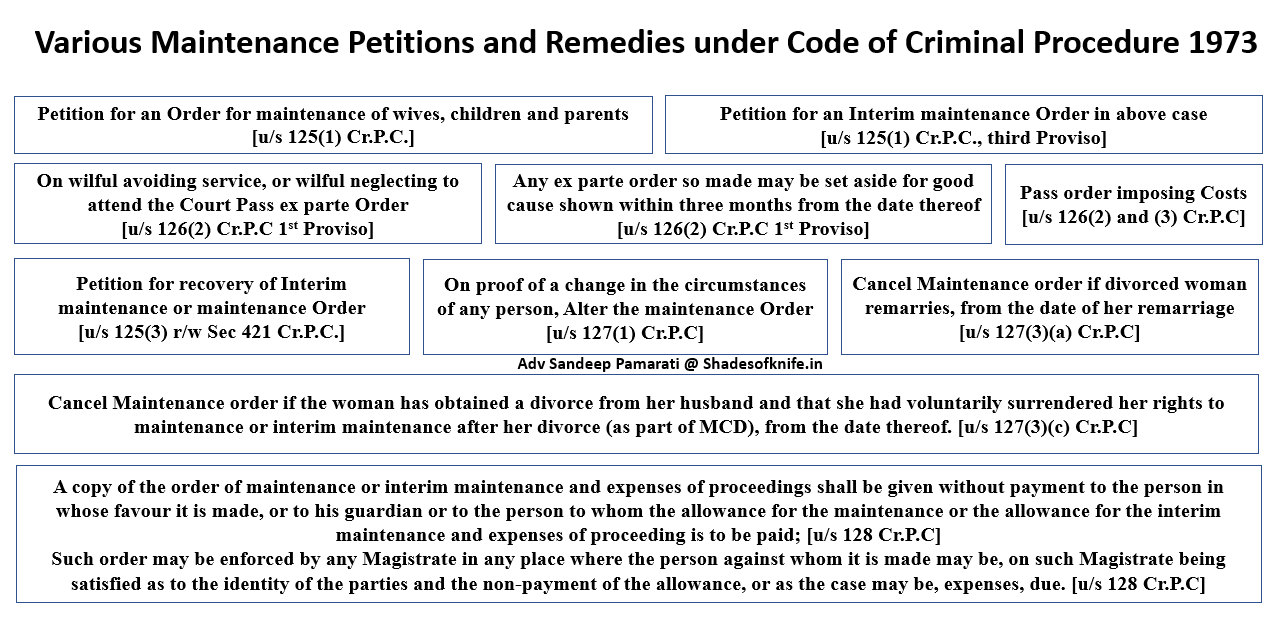
This is to chronicle the journey of the Section 125 CrPC through the years from its enactment.
Code of Criminal Procedure (CrPC) is the general procedural law of India and below are the amendments made to this law over the period.
| S. No. | Short title of amending legislation | Act No. | Act Year | Modification or Addition Brought In | Leader and Party in Central/State Government |
|---|---|---|---|---|---|
| 1 | The Repealing and Amending Act, 1974 | 56 | 1974 | Nothing useful in particular. | Indira Gandhi (Indian National Congress) |
| 2 | The Code of Criminal Procedure (Amendment) Act, 1978 | 45 | 1978 | Amendment to 468 CrPC: Period of limitation for related offences which may be tried together | Morarji Desai (Janata Party) |
| 3 | The Code of Criminal Procedure (Amendment) Act, 1980 | 63 | 1980 | All proceedings under sections 108, 109 and 110 of CrPC, pending before any Judicial Magistrate of the first class immediately before the commencement of this Act shall, notwithstanding anything contained in this Act, be dealt with as if this Act had not been enacted | Indira Gandhi (Indian National Congress) |
| 4 | The Criminal Law (Amendment) Act, 1983, wiki | 43 | 1983 | In the backdrop of Mathura Custodial rape case, sections to prevent/tackle such abuse are brought in. | Indira Gandhi (Indian National Congress) |
| 5 | The Criminal Law (Second Amendment) Act, 1983 | 46 | 1983 | Introduction of Sec 498A IPC, Sec 198A CrPC and Sec 113A of Evidence Act Amendment to Sections 174 and 176 of the Code of Criminal Procedure, 1973 | Indira Gandhi (Indian National Congress) |
| 6 | The Code of Criminal Procedure (Amendment) Act, 1988 | 32 | 1988 | Nothing useful in particular. | Rajiv Gandhi (Indian National Congress) |
| 7 | The Code of Criminal Procedure (Amendment) Act, 1990 | 10 | 1990 | Insertion of 166A: Letter of request to competent authority for investigation in a country or place outside India Insertion of 166B: Letter of request from a country or place outside India to a | Vishwanath Pratap Singh (Indian National Congress) |
| 8 | The Code of Criminal Procedure (Amendment) Act, 1991 | 43 | 1991 | Nothing useful in particular. | P.V. Narasimha Rao (Indian National Congress) |
| 9 | The Code of Criminal Procedure (Andhra Pradesh Second Amendment) Act, 1992 | 03 | 1992 | Sections 494, 495 IPC are made Cognizable and non-bailable within the State of Andhra Pradesh/Telangana. | N. Janardhana Reddy (Indian National Congress) |
| 9 | The Code of Criminal Procedure (Amendment) Act, 1993 | 40 | 1993 | New chapter VVIA introduced with provisions (150A-150L) relating to bringing back proceeds of crime from outside India. | P.V. Narasimha Rao (Indian National Congress) |
| 10 | The Criminal Law (Amendment) Act, 1993 | 42 | 1993 | Kidnapping for Ransom | P.V. Narasimha Rao (Indian National Congress) |
| 11 | The Code of Criminal Procedure (Amendment) Act, 2001 | 50 | 2001 |
| Atal Bihari Vajpayee (Bharatiya Janata Party) |
| 12 | Code of Criminal Procedure (Andhra Pradesh Amendment) Act, 2003 | 11 | 2003 |
| N. Chandrababu Naidu (Telugu Desam Party) |
| 13 | The Code of Criminal Procedure (Amendment) Act, 2005 | 25 | 2005 |
| Dr. Manmohan Singh (Indian National Congress) |
| 14 | The Criminal Law (Amendment) Act, 2005 | 2 | 2006 |
| Dr. Manmohan Singh (Indian National Congress) |
| 15 | The Code of Criminal Procedure (Amendment) Amending Act, 2006 | 25 | 2006 | Different dates for effectiveness for different provisions of CrPC (Amendment) Act 2005 | Dr. Manmohan Singh (Indian National Congress) |
| 16 | Code of Criminal Procedure (Amendment) Act, 2008 | 5 | 2009 |
| Dr. Manmohan Singh (Indian National Congress) |
| 17 | Code of Criminal Procedure (Amendment) Act, 2010 | 41 | 2010 | Powers of Police without warrant | Dr. Manmohan Singh (Indian National Congress) |
| 18 | Criminal Law (Amendment) Act, 2013, wiki | 13 | 2013 | In the aftermath of Nirbhaya gang rape case,
| Dr. Manmohan Singh (Indian National Congress) |
| 19 | Criminal Law (Amendment) Act, 2018, wiki | 22 | 2018 | In the aftermath of the Kathua gang rape and murder case, key Acts are amended. Highlights are (a) punishment for the offence of rape from the minimum imprisonment of seven years to ten years, which is extendable to imprisonment for life; | Narendra Damodardas Modi (Bharatiya Janata Party) |
Any new amendments will be updated as and when available.
The new BNSS is here.
This is the amendment to CrPC that removed the ceiling of Rs.500/- under the 125 CrPC. And this is the amendment that brought in ‘interim maintenance and expenses of proceeding’. A proviso is introduced which talk about disposal of interim maintenance application under 125 CrPC within 60 days. Of course, 127 CrPC is similarly screwed. And 128 CrPC is altered.
All the amendments made to the CrPC are available here.
In this judgment from Hon’ble Delhi High Court, it was held that “If a woman living separate from her husband had already filed a suit claiming maintenance and after adjudication maintenance has been determined by a competent court either in Civil Suit or by Court of MM in an application under Section 125 Cr.P.C. she does not have a right to claim additional maintenance under the Act. The Court of MM under the Act has power to grant maintenance and monetary reliefs on an interim basis in a fast track manner only in those cases where woman has not exercised her right of claiming maintenance either under Civil Court or under Section 125 Cr.P.C.”
Why PWDV Act?
Also held “It must be understood that the Protection of Women from Domestic Violence Act, 2005 does not create any additional right to claim maintenance on the part of the aggrieved person. It only puts the enforcement of existing right of maintenance available to an aggrieved person on fast track.”
Index to DV Judgments is here.
In this judgment from Apex Court, it was held that, despite the wife was a working lady and had income from properties, “Since both the wife and husband are residing at Agra. In our view, it is not possible for the wife to maintain herself in the town of Agra with the income of less than Rupees nine thousand per month. The husband, who is earning at least Rupees Twenty thousand per month, as stated by the appellant in this appeal and not controverted, is liable to pay some amount of maintenance to the wife so that she may be able to maintain herself. In the facts and circumstances of the case, we are of the view that it would be just and expedient to direct the husband to pay Rupees five thousand per month to the wife by way of maintenance from the date of filing of the petition under Section 125 Cr.P.C.”
This is the installment scheme devised by Apex Court, which goes into future installments too.
“Respondent No.1 is directed to pay maintenance at the rate of Rupees five thousand per month from 1st November, 1998 till 31st July, 2008 in the following manner:
By 31st August, 2008, Rupees fifty thousand;
By 30th September, 2008, Rupees fifty thousand;
By 31st October, 2008, Rupees fifty thousand;
By 31st November, 2008, Rupees One lakh fifty thousand;
By 31st December, 2008, Rupees One lakh fifty thousand;
By 31st January, 2009, the balance amount.”
Then, in just over 6 months, a settlement is arrived at by the parties and per the settlement terms, all cases between them are quashed in one fell swoop. Read Pages 2 and 3.
In this landmark judgment from Hon’ble Apex Court, it was held that a daughter (not just a son) is also liable to pay maintenance to her parents under 125 CrPC read with Sec 8 of IPC.
The lower court which is Bombay High Court has given this order here, was later on confirmed by the Apex Court.
This has a precedence from a Kerala high Court judgment available here and one subsequent judgment of High Court of AP here.
Citation: [1987 SCR (2) 331], [1987 SCC (2) 278], [JT 1987 (3) 46], [1987 SCALE (1) 379], [1987 BOMCR SC 1 629], [1987 AIR SC 1100], [1987 SCC CRI 354], [1987 CRIMES SC 1 713], [1987 CRIMES SC 3 348], [1987 CRLJ SC 977], [1987 ECC 11 416], [1987 ACR SC 11 334], [1987 APLJ SC 1 35], [1987 AWC SC 676], [1987 BOMLR 89 130], [1987 KLT SC 1 674], [1987 MHLJ 395], [1987 MPLJ 218], [1988 SHIMLC 1 133]
Other Sources :
https://indiankanoon.org/doc/780813/
https://www.casemine.com/judgement/in/5609ac39e4b014971140e515
This is the landmark ruling from Hon’ble Supreme Court wherein it was held that
“We are of the opinion that a broad and expansive interpretation should be given to the term “wife” to include even those cases where a man and woman have been living together as husband and wife for a reasonably long period of time, and strict proof of marriage should not be a precondition for maintenance under Section 125 CrPC, so as to fulfil the true spirit and essence of the beneficial provision of maintenance under Section 125. We also believe that such an interpretation would be a just application of the principles enshrined in the Preamble to our Constitution, namely, social justice and upholding the dignity of the individual.”
But in a para prior to this para, this case was referred to a larger bench (this was a 3-judge bench). But this case was but after two years dismissed as the advocate for appellant dies and the appellant did not pursue the case. Here is the Dismissal Order:
Here is the Para 45,
45.We, therefore, request the Hon’ble Chief Justice to refer the following, amongst other, questions to be decided by a larger Bench. According to us, the questions are:
1. Whether the living together of a man and woman as husband and wife for a considerable period of time would raise the presumption of a valid marriage between them and whether such a presumption would entitle the woman to maintenance under Section 125 Cr.P.C?
2. Whether strict proof of marriage is essential for a claim of maintenance under Section 125 Cr.P.C. having regard to the provisions of Domestic Violence Act, 2005?
3. Whether a marriage performed according to customary rites and ceremonies, without strictly fulfilling the requisites of Section 7(1) of the Hindu Marriage Act, 1955, or any other personal law would entitle the woman to maintenance under Section 125 Cr.P.C.?
So, this judgment is NOT a landmark judgment as the question of law was NOT decided either by this Court nor by a larger bench of this Court.
Citation: [2011 ANJ SC 1 26], [2010 AIOL 681], [2011 SCC 1 141], [2011 ALLMR CRI SC 346], [2010 SCALE 10 602], [2011 BOMCR SC 2 787], [2011 SCC CRI 2 666], [2011 CRLJ SC 96], [2010 RCR CIVIL SC 4 801], [2010 JT 11 132], [2010 AIR SC 6497], [2011 SCC CIV 1 53]
Other Source links: https://indiankanoon.org/doc/1949767/ or https://www.casemine.com/judgement/in/5609aedbe4b0149711414ea0
But this judgment declared it so here.
Reproduced in accordance with Section 52(q) of the Copyright Act 1957 (India) from main.sci.gov.in/judgments, judis.nic.in, lobis.nic.in, indiacode.nic.in and other Indian High Court and District Court Websites such as ecourts.gov.in
Hon’ble Supreme Court has held in this judgment that, as 125 CrPC proceedings are Summary in nature, no need of strict proof required for marriage between parties. It reiterated the law laid down in the judgment of Chanmuniya v. Virendra Kumar Singh Kushwaha here.
This is a judgment from Bombay High Court wherein it was held that, as 125 CrPC proceedings are Summary in nature, no need of strict proof required for marriage between parties.
Bad Behavior has blocked 1106 access attempts in the last 7 days.