web analytics

Menu

Skip to content
Shades of Knife
  • Home
  • True Colors of a Vile Wife
  • Need Inspiration?
  • Blog Updates
  • SOK Gallery
  • Vile News Reporter
  • About Me
  • Contact Me

Shades of Knife

True Colors of a Vile Wife

Tag: Criminal law

Bail Compliance Undertaking Format – Draft, Legal Requirements & Sample Template

Posted on June 12 by Suprajaa Rajan

A practical legal document through which an accused formally undertakes to comply with all bail conditions imposed by the court.

When a court grants bail, it often imposes specific conditions to ensure the accused’s presence during proceedings and to protect the integrity of the investigation and trial. To demonstrate compliance and good faith, the accused may file a Bail Compliance Undertaking before the court.

A properly drafted undertaking reassures the court that the accused understands the bail conditions and intends to comply with them fully. Moreover, such undertakings are frequently required in cases involving anticipatory bail, regular bail, interim bail, matrimonial disputes, economic offences, and other criminal proceedings.

This article explains the legal framework, purpose, drafting strategy, and provides a ready-to-use sample format with copy-to-clipboard functionality.

I. Legal Framework

The requirement to comply with bail conditions arises from the court’s power to impose conditions while granting bail.

Under the Code of Criminal Procedure, 1973

  • Section 436 CrPC – Bail in bailable offences
  • Section 437 CrPC – Bail in non-bailable offences
  • Section 438 CrPC – Anticipatory bail
  • Section 439 CrPC – Special powers regarding bail
  • Section 441 CrPC – Bond of accused and sureties

Corresponding Provisions under BNSS, 2023

  • Section 478 BNSS – Bail in bailable offences
  • Section 480 BNSS – Bail in non-bailable offences
  • Section 482 BNSS – Anticipatory bail
  • Section 483 BNSS – Special powers regarding bail
  • Section 491 BNSS – Bond and sureties

Therefore, once the court grants bail, the accused must strictly follow every condition imposed in the bail order.

II. What is a Bail Compliance Undertaking?

A Bail Compliance Undertaking is a written declaration filed by the accused stating that he or she will:

  • Appear before the court whenever required
  • Cooperate with the investigation
  • Not tamper with evidence
  • Not contact or influence witnesses
  • Not commit any similar offence during bail
  • Comply with all terms of the bail order

Thus, the undertaking serves as a formal assurance to the court regarding future conduct.

III. When is a Bail Compliance Undertaking Required?

Courts may require such an undertaking in situations involving:

  • Anticipatory bail proceedings
  • Regular bail applications
  • Interim bail orders
  • Bail in matrimonial disputes
  • Economic offences
  • Cases involving allegations of witness intimidation
  • Bail granted subject to specific conditions

Additionally, some courts insist on filing a compliance undertaking before accepting bail bonds.

IV. Why is This Undertaking Important?

Filing the undertaking helps to:

  • Demonstrate respect for the court’s order
  • Show willingness to cooperate with authorities
  • Strengthen credibility before the court
  • Reduce concerns regarding misuse of liberty
  • Facilitate smooth completion of bail formalities

Consequently, a well-drafted undertaking may assist in maintaining bail and avoiding future disputes.

V. Common Bail Conditions Covered by the Undertaking

Depending on the case, the undertaking may cover:

  • Attendance before court
  • Attendance before Investigating Officer
  • Surrender of passport
  • Restriction on foreign travel
  • Non-interference with witnesses
  • Non-tampering with evidence
  • Sharing contact details with authorities
  • Intimation before change of residence

Therefore, the undertaking should closely follow the wording of the bail order.

VI. Essential Elements of the Undertaking

Before drafting, you should include:

  • Name of accused
  • Case details
  • Date of bail order
  • Specific bail conditions
  • Undertaking to comply with all directions
  • Verification and signature

These details make the document clear, complete, and effective.

VII. Drafting Strategy

While drafting:

  • Refer specifically to the bail order
  • Use simple and unambiguous language
  • Address each important condition separately
  • Avoid making unnecessary statements
  • Ensure consistency with the court’s directions

A concise undertaking is usually more effective than a lengthy one.

VIII. Sample Draft Format – Bail Compliance Undertaking

Sample Draft – Bail Compliance Undertaking

BEFORE THE HONOURABLE COURT OF [COURT NAME] AT [CITY]

Case No.: [____]

UNDERTAKING ON BEHALF OF THE ACCUSED

I, [Name of Accused], aged about [___] years, residing at [Address], do hereby solemnly undertake as follows:

1. That I have been granted bail by this Hon’ble Court vide order dated [____].

2. That I shall strictly comply with all terms and conditions imposed by this Hon’ble Court in the said bail order.

3. That I shall appear before this Hon’ble Court on every date of hearing unless specifically exempted.

4. That I shall cooperate fully with the investigation and shall appear before the Investigating Officer whenever lawfully required.

5. That I shall not directly or indirectly contact, influence, threaten, induce, or coerce any witness connected with the case.

6. That I shall not tamper with any evidence or interfere with the investigation or trial.

7. That I shall immediately inform the court and investigating agency of any change in my residential address or contact details.

8. That I shall not commit any offence similar to the offence alleged during the period of bail.

9. That I understand that violation of any condition may result in appropriate legal consequences, including cancellation of bail.

10. I submit this undertaking voluntarily and in compliance with the directions of this Hon’ble Court.


Place: [City]
Date: [____]


Signature of Accused
[Name]

✔ Draft Copied Successfully!


IX. Common Mistakes to Avoid

Avoid:

  • Copying conditions that do not appear in the bail order
  • Ignoring specific court directions
  • Using vague language
  • Omitting case details
  • Filing an unsigned undertaking

Instead, ensure that the undertaking accurately reflects the conditions imposed by the court.

Conclusion

A Bail Compliance Undertaking is a simple yet important document that reinforces the accused’s commitment to obey the conditions of bail. By filing a clear undertaking, the accused demonstrates responsibility, cooperation, and respect for the judicial process.


Index of All Legal templates and Drafting is here. 


Disclaimer

These templates are provided for educational and informational purposes. Every case depends on specific facts and procedural posture. Professional legal advice should be obtained before filing any application.

Posted in Legal Procedure | Tagged Criminal law Criminal Law (Amendment) Act 1983 criminal law drafts Legal templates and drafting Matrimonial Litigation India | Leave a comment

Surety Affidavit Format – Draft, Legal Requirements & Sample Template

Posted on May 20 by Suprajaa Rajan

A practical legal document used by a surety to undertake responsibility before the court for the appearance and compliance of the accused.

In criminal proceedings, courts frequently direct the accused to furnish surety bonds and surety affidavits while granting bail. A surety affidavit acts as a formal declaration by the surety confirming their identity, financial capacity, address, and willingness to stand guarantee for the accused.

Therefore, a properly drafted Surety Affidavit becomes an essential compliance document in bail proceedings before Magistrate Courts, Sessions Courts, and High Courts.

This article explains the legal framework, purpose, drafting strategy, and provides a ready-to-use sample format with copy-to-clipboard functionality.

I. Legal Framework

Surety requirements primarily arise under the following provisions:

Under the Code of Criminal Procedure, 1973

  • Section 436 CrPC – Bail in bailable offences
  • Section 437 CrPC – Bail in non-bailable offences
  • Section 441 CrPC – Bond and sureties
  • Section 445 CrPC – Deposit instead of recognisance

Corresponding Provisions under BNSS, 2023

  • Section 478 BNSS – Bail in bailable offences
  • Section 480 BNSS – Bail in non-bailable offences
  • Section 491 BNSS – Bond and sureties
  • Section 495 BNSS – Deposit instead of bond

Thus, courts may require a financially and legally competent person to stand as surety for the accused.

II. What is a Surety Affidavit?

A surety affidavit is a sworn declaration filed before the court by the surety stating that:

  • The surety knows the accused personally
  • The surety undertakes responsibility for appearance of the accused
  • The surety possesses sufficient financial means
  • The surety is willing to comply with court directions

Importantly, this affidavit helps the court verify the credibility and solvency of the surety.

III. Who Can Become a Surety?

Generally, a surety may be:

  • Relative of the accused
  • Friend or acquaintance
  • Employer or colleague
  • Any person with sufficient financial capacity

However, the surety should:

  • Possess valid identity and address proof
  • Be financially solvent
  • Not be disqualified by law
  • Be capable of ensuring appearance of the accused

Therefore, courts usually verify both identity and solvency before acceptance.

IV. Documents Commonly Required with Surety Affidavit

Courts may require supporting documents such as:

  • Aadhaar Card
  • PAN Card
  • Property documents
  • Salary certificate
  • Electricity bill or address proof
  • Passport-size photographs
  • Bank statements

Thus, annexing proper documents avoids unnecessary objections during verification.

V. Why is the Surety Affidavit Important?

A surety affidavit helps to:

  • Establish authenticity of the surety
  • Assure the court regarding compliance
  • Prevent misuse of bail
  • Facilitate acceptance of bail bonds
  • Create accountability before the court

Accordingly, courts treat surety verification as a serious procedural safeguard.

VI. Essential Elements of the Affidavit

Before drafting, you should include:

  • Name and address of surety
  • Details of accused person
  • Case details
  • Relationship with accused
  • Statement regarding financial capacity
  • Undertaking regarding appearance of accused
  • Declaration regarding correctness of contents

These elements ensure the affidavit remains complete and legally valid.

VII. Drafting Strategy

While drafting:

  • Use clear and concise language
  • Mention property or financial details accurately
  • Avoid inconsistent statements
  • Attach supporting documents properly
  • Ensure affidavit matches bail order conditions

A properly drafted affidavit reduces the risk of court objections or verification delays.

VIII. Sample Draft Format – Surety Affidavit


Sample Draft – Surety Affidavit

AFFIDAVIT OF SURETY

I, [Name of Surety], aged about [___] years, residing at [full address], do hereby solemnly affirm and state as under:

1. That I am standing as surety for the accused namely [Name of Accused] in Case/FIR No. [____] pending before the Hon’ble Court of [Court Name].

2. That I personally know the accused and undertake to ensure his/her appearance before the Hon’ble Court as and when directed.

3. That I am a permanent resident of the above-mentioned address.

4. That I am financially solvent and capable of furnishing surety in the sum directed by this Hon’ble Court.

5. That my details and documents submitted before this Hon’ble Court are true and genuine.

6. That I undertake to inform the Hon’ble Court in case the accused violates any condition of bail or absconds from proceedings.

7. That this affidavit is being executed voluntarily and without any coercion.


DEPONENT


VERIFICATION

I, the above-named deponent, do hereby verify that the contents of this affidavit are true and correct to my knowledge and belief and nothing material has been concealed therefrom.


Verified at: [Place]
Date: [____]


DEPONENT

✔ Draft Copied Successfully!

IX. Common Mistakes to Avoid

Avoid:

  • Mentioning incorrect financial details
  • Filing incomplete identity documents
  • Using inconsistent addresses
  • Giving vague solvency details
  • Signing without proper verification

Instead, ensure accuracy, consistency, and proper documentation.

Conclusion

A Surety Affidavit plays a crucial role in the bail process by assuring the court that the accused will comply with legal obligations and appear before the court whenever required. Therefore, preparing the affidavit carefully and attaching proper supporting documents helps ensure smooth acceptance of surety bonds.


Index of All Legal templates and Drafting is here. 


Disclaimer

These templates are provided for educational and informational purposes. Every case depends on specific facts and procedural posture. Professional legal advice should be obtained before filing any application.


Key Contributor :

Mrs.Suprajaa Rajan B.Com., LL.B., LL.M.

+91-9606345150


Posted in Legal Procedure | Tagged Bail Granted Criminal law Criminal Law (Amendment) Act 1983 criminal law drafts Legal Drafting and Formats Section 437 CrPC – Bail in non-bailable offences by Magistrate Surety Affidavit | Leave a comment

Complaint Against Harassment During Investigation – Format, Procedure & Sample Draft

Posted on April 30 by Suprajaa Rajan

A practical remedy to report unlawful police conduct and ensure fair investigation.

During criminal investigations, individuals may sometimes face harassment, coercion, or misuse of authority by investigating agencies. However, the law strictly requires that investigations be conducted fairly, transparently, and in accordance with due process. Therefore, when such harassment occurs, a person can file a formal complaint against harassment during investigation before senior police authorities or other competent forums.

This article explains the legal framework, when to file such a complaint, drafting strategy, and provides a ready-to-use sample format with copy-to-clipboard functionality.

I. Legal Framework Governing Investigation

Police investigations must comply with statutory safeguards under:

Under the Code of Criminal Procedure, 1973

  • Section 41 CrPC – Conditions for arrest
  • Section 41A CrPC – Notice of appearance before police
  • Section 160 CrPC – Attendance of witnesses
  • Section 161 CrPC – Examination of witnesses

Corresponding Provisions under BNSS, 2023

  • Section 35 BNSS – Arrest without warrant
  • Section 35(7) BNSS – Notice of appearance
  • Section 179 BNSS – Examination of witnesses

Thus, the police must act within legal limits and procedural safeguards.

II. What Constitutes Harassment During Investigation?

Harassment may include:

  • Repeated and unnecessary summons
  • Threats or coercion
  • Illegal detention or intimidation
  • Forcing statements without due process
  • Summoning women or elderly persons at odd hours

Such actions violate constitutional protections and statutory safeguards.

III. Where Can You File the Complaint?

You can submit your complaint before:

  • Station House Officer (SHO) (if issue is with subordinate officers)
  • Superintendent of Police (SP)
  • Deputy Commissioner of Police (DCP)
  • Judicial Magistrate
  • Human Rights Commission (in serious cases)

Therefore, choosing the correct authority ensures effective redressal.

IV. Why is Filing a Complaint Important?

Filing a complaint helps to:

  • Create an official record of harassment
  • Prevent further misuse of authority
  • Strengthen your case in future proceedings
  • Demonstrate willingness to cooperate

Moreover, courts take such complaints seriously when assessing fairness of investigation.

V. Essential Elements of the Complaint

Before drafting, you should include:

  • Name and details of complainant
  • Details of police station and officer involved
  • FIR details (if applicable)
  • Specific instances of harassment
  • Dates and timeline of events
  • Request for appropriate action

These elements ensure that the complaint is clear, factual, and actionable.

VI. Drafting Strategy

While drafting:

  • Use clear and factual language
  • Avoid exaggeration or emotional tone
  • Mention specific incidents with dates
  • Emphasise willingness to cooperate
  • Request lawful investigation, not interference

This approach enhances the credibility and effectiveness of the complaint.

VII. Sample Draft Format – Complaint Against Harassment During Investigation


Sample Draft – Complaint Against Harassment During Investigation

To
The Superintendent of Police
[District/City]

Subject: Complaint Against Harassment During Investigation

Respected Sir/Madam,

I respectfully submit that I am being subjected to harassment during the course of investigation in connection with FIR No. [____] registered at [Police Station].

It is submitted that despite my full cooperation, the Investigating Officer has been repeatedly summoning me without reasonable cause and has subjected me to undue pressure.

On [date], I was called to the police station and was made to wait for long hours without any lawful justification.

Further, I am being threatened/coerced to make statements which are not voluntary.

I submit that I am a law-abiding citizen and am willing to cooperate with the investigation in accordance with law.

I request that appropriate directions be issued to ensure that the investigation is conducted fairly and without harassment.

I also request that my statement be recorded strictly in accordance with legal procedure.


Thanking you.


Yours faithfully,
[Name]
[Address]
[Contact Details]
[Signature]

Date: [____]
Place: [____]

✔ Draft Copied Successfully!

VIII. Common Mistakes to Avoid

Avoid:

  • Making vague or general allegations
  • Using aggressive or defamatory language
  • Failing to mention specific incidents
  • Not showing willingness to cooperate

Instead, focus on facts, clarity, and legal compliance.

Conclusion

A Complaint Against Harassment During Investigation is an important safeguard against misuse of police powers. Therefore, by documenting incidents and asserting your rights, you can ensure that the investigation remains fair, lawful, and unbiased.


Index of Legal Templates and Drafting is here.


Disclaimer

These templates are provided for educational and informational purposes. Every case depends on specific facts and procedural posture. Professional legal advice should be obtained before filing any application.


Key Contributor :

Mrs. Suprajaa Rajan B.Com., LL.B., LL.M.

+91-9606345150


Posted in Legal Procedure | Tagged Criminal law criminal law drafts Criminal law in India legal drafting Legal templates and drafting Police Harassment | Leave a comment

Representation to SHO Against Illegal Arrest – Format, Procedure & Sample Draft

Posted on April 27 by Suprajaa Rajan

A practical legal remedy to prevent unlawful arrest and ensure compliance with due process.

In criminal law, arrest is a serious step that directly impacts a person’s personal liberty under Article 21 of the Constitution. However, arrests are sometimes made without proper justification or in violation of procedural safeguards. In such situations, a person may submit a written representation to the Station House Officer (SHO) requesting that no illegal or arbitrary arrest be carried out.

Therefore, a Representation to SHO Against Illegal Arrest acts as a preventive legal measure. It places your objections on record and reminds the police to act strictly in accordance with law.

This article explains the legal framework, drafting strategy, and provides a ready-to-use sample format with copy-to-clipboard functionality.

I. Legal Framework Governing Arrest

Arrest must comply with the safeguards laid down under:

Under the Code of Criminal Procedure, 1973

  • Section 41 CrPC – Conditions for arrest without warrant
  • Section 41A CrPC – Notice of appearance before police
  • Section 50 CrPC – Right to be informed of grounds of arrest

Corresponding Provisions under BNSS, 2023

  • Section 35 BNSS – When police may arrest without warrant
  • Section 35(3) BNSS – Safeguards against unnecessary arrest
  • Section 35(7) BNSS – Notice of appearance (similar to Section 41A CrPC)

Thus, the police must justify arrest based on necessity, not mere allegations.

II. What is a Representation to SHO?

A representation to the SHO is a formal written communication submitted to:

  • Prevent illegal or arbitrary arrest
  • Assert willingness to cooperate with investigation
  • Request compliance with statutory safeguards

Although it is not a statutory application, it serves as important documentary protection.

III. When Should You File This Representation?

You should submit this representation when:

  • You apprehend imminent arrest
  • Police are acting without issuing notice under Section 41A CrPC
  • The allegations are false or exaggerated
  • There is risk of misuse of arrest powers

Therefore, timely submission can help prevent coercive action.

IV. Why is This Representation Important?

Filing this representation helps to:

  • Create a record of cooperation
  • Show that arrest is unnecessary
  • Strengthen your case for anticipatory bail
  • Protect against arbitrary police action

Moreover, courts often consider such conduct while granting relief.

V. Key Judicial Safeguards

The Supreme Court has repeatedly emphasised that:

  • Arrest should not be routine or mechanical
  • Police must record reasons for arrest
  • Notice under Section 41A CrPC should be preferred

These principles ensure that personal liberty is not curtailed unnecessarily.

VI. Essential Elements of the Representation

Before drafting, you should include:

  • Name and address of the applicant
  • FIR details (if known)
  • Clear statement of apprehension of arrest
  • Assertion of innocence
  • Willingness to cooperate
  • Request to follow due process

These elements make the representation clear, effective, and legally relevant.

VII. Drafting Strategy

While drafting this representation:

  • Use a calm and respectful tone
  • Avoid making allegations against police
  • Focus on legal rights and cooperation
  • Refer to relevant provisions (Section 41, 41A CrPC)

This approach increases the credibility of your request.

VIII. Sample Draft Format– Representation to SHO Against Illegal Arrest


Sample Draft – Representation to SHO Against Illegal Arrest

To
The Station House Officer
[Name of Police Station]
[City/District]

Subject: Representation Against Illegal Arrest

Respected Sir/Madam,

I respectfully submit that I apprehend arrest in connection with allegations made against me in relation to [brief details of complaint/FIR, if known].

I submit that I am innocent and have not committed any offence as alleged. The allegations are false and motivated.

I am a law-abiding citizen and am willing to fully cooperate with the investigation.

I respectfully request that no coercive steps be taken against me without following the due process of law, including compliance with Section 41 and 41A of the Code of Criminal Procedure, 1973.

I undertake to appear before the Investigating Officer as and when required.

I request that my representation be taken on record.


Thanking you.


Yours faithfully,
[Name]
[Address]
[Contact Details]
[Signature]

Date: [____]
Place: [____]

✔ Draft Copied Successfully!

IX. Common Mistakes to Avoid

Avoid:

  • Using aggressive or accusatory language
  • Making unverified allegations
  • Ignoring legal provisions
  • Failing to show willingness to cooperate

Instead, focus on legal compliance and good faith conduct.

Conclusion

A Representation to SHO Against Illegal Arrest is a simple yet effective step to safeguard personal liberty. Therefore, by asserting your rights and willingness to cooperate, you can reduce the risk of arbitrary arrest and strengthen your legal position.


Index of Legal Templates and Drafting is here.


Disclaimer

These templates are provided for educational and informational purposes. Every case depends on specific facts and procedural posture. Professional legal advice should be obtained before filing any application.


Key Contributor :

Mrs. Suprajaa Rajan B.Com., LL.B., LL.M.

+91-9606345150


Posted in Legal Procedure | Tagged Criminal law criminal law drafts Legal templates and drafting Matrimonial Criminal Law Matrimonial dispute | Leave a comment

Quashing of FIR

Posted on April 23 by Suprajaa Rajan

The power to quash an FIR is an extraordinary jurisdiction exercised by High Courts to prevent misuse of criminal law. Courts invoke this power when the continuation of criminal proceedings would result in abuse of process of law or miscarriage of justice.

Under Indian law, this power flows from the inherent jurisdiction of High Courts under the Code of Criminal Procedure, 1973 and corresponding provisions under the Bharatiya Nagarik Suraksha Sanhita, 2023.

Quashing ensures that individuals are not subjected to frivolous or malicious criminal proceedings.

Statutory Framework

The legal basis for quashing of FIR lies in:

  • Section 482 CrPC (Section 528 BNSS) – Inherent powers of High Court

This provision empowers the High Court to:

  • Prevent abuse of process of any court
  • Secure the ends of justice
  • Quash FIRs or criminal proceedings where necessary

This power is extraordinary and discretionary, and courts exercise it with caution.

Meaning of Quashing of FIR

Quashing of FIR refers to the judicial act of setting aside a First Information Report and all consequential proceedings.

When a court quashes an FIR:

  • The criminal case comes to an end
  • Investigation and trial proceedings stop
  • The accused is relieved from further legal action

Thus, quashing acts as a protective remedy against unjust prosecution.

Grounds for Quashing of FIR

Courts may quash an FIR under several circumstances.

Common grounds include:

  • Allegations do not disclose any offence
  • FIR is manifestly false or frivolous
  • Dispute is purely civil in nature
  • Proceedings initiated with mala fide intent
  • Lack of evidence to support allegations
  • Legal bar to institution of proceedings

These grounds ensure that criminal law is not used as a tool of harassment.

Landmark Principles

The Supreme Court laid down guiding principles for quashing in State of Haryana v. Bhajan Lal.

The Court identified illustrative categories where quashing may be justified, including:

  • Where allegations do not constitute an offence
  • Where allegations are absurd or improbable
  • Where proceedings are maliciously instituted

These principles continue to guide High Courts while exercising inherent powers.

Quashing in Matrimonial and Commercial Disputes

Courts frequently encounter quashing petitions in:

  • Matrimonial disputes (e.g., cruelty allegations)
  • Commercial or financial disputes

In such cases, courts examine whether:

  • The dispute has been settled amicably
  • Continuation of proceedings serves any purpose
  • The criminal case is being used to exert pressure

Thus, quashing promotes settlement and prevents unnecessary litigation.

Scope and Limitations

Although the power to quash is wide, it is subject to important limitations.

Courts:

  • Do not conduct a detailed trial
  • Do not evaluate evidence extensively
  • Do not decide disputed facts

Instead, courts examine whether the FIR, on its face, discloses a prima facie offence.

Therefore, quashing is not a substitute for trial but a safeguard against abuse of process.

Procedure for Quashing FIR

A party seeking quashing must file a petition before the High Court under:

  • Section 482 CrPC (Section 528 BNSS)

The process generally involves:

  • Filing of petition with supporting documents
  • Hearing arguments from both sides
  • Court examining the FIR and material on record
  • Passing appropriate orders

The court may:

  • Quash the FIR
  • Dismiss the petition
  • Grant interim protection

Difference Between Quashing and Discharge

Although both remedies protect the accused, they operate at different stages.

Quashing:

  • Invoked before or during investigation
  • Exercised by High Court
  • Ends proceedings at an early stage

Discharge:

  • Invoked after filing of charge sheet
  • Decided by trial court
  • Based on evaluation of material

Thus, quashing acts as an early-stage remedy, while discharge operates later.

Importance in Criminal Law

Quashing of FIR plays a crucial role in maintaining the integrity of the legal system.

It:

  • Prevents misuse of criminal law
  • Protects individuals from harassment
  • Saves judicial time
  • Ensures fairness in proceedings

Therefore, it acts as a powerful safeguard against unjust prosecution.

Conclusion

The power to quash an FIR, thus, reflects the judiciary’s commitment to ensuring that criminal law is not misused. By exercising inherent jurisdiction, High Courts prevent abuse of process and uphold the principles of justice.

However, courts exercise this power cautiously to ensure that genuine cases are not prematurely terminated, thereby maintaining a balance between individual rights and societal interests.


Related Legal Concepts

Explore related remedies and procedural safeguards in criminal law:

  • Abuse of Process of Law
  • First Information Report (FIR)
  • Discharge of Accused
  • Criminal Trial Procedure
  • Appeal, Revision & Review


Index of Law Concepts explained here.


Key Contributor :

Mrs. Suprajaa Rajan B.Com., LL.B., LL.M.

+91-9606345150

Posted in LLB Study Material | Tagged abuse of process Abuse of process of law Criminal law Criminal law in India Law Concepts explained Quashing of FIR | Leave a comment

Discharge of Accused Explained

Posted on March 18 by Suprajaa Rajan

Discharge of an accused is a crucial stage in criminal proceedings where the court examines the material on record and decides whether the case should proceed to trial. At this stage, the court evaluates whether sufficient grounds exist to continue proceedings against the accused.

Under Indian criminal law, provisions relating to discharge are contained in:

  • Section 227 CrPC (Section 250 BNSS) – Discharge in Sessions cases

  • Section 239 CrPC (Section 262 BNSS) – Discharge in warrant cases based on police report

  • Section 245 CrPC (Section 268 BNSS) – Discharge in warrant cases otherwise than on police report

These provisions ensure that courts do not subject individuals to unnecessary trials when the evidence does not disclose a prima facie case.

Meaning and Scope of Discharge

Discharge refers to the release of an accused person from criminal proceedings before the commencement of trial.

At this stage, the court does not conduct a detailed examination of evidence. Instead, it assesses whether:

  • The allegations, even if accepted as true, make out an offence, and

  • The material on record justifies proceeding further

If the court finds that the case lacks sufficient grounds, it discharges the accused.

Thus, discharge acts as a filtering mechanism to prevent misuse of criminal law.

Statutory Framework

The law provides different provisions for discharge depending on the nature of the case.

Sessions Cases

In serious offences triable by a Court of Session, the court exercises power under:

  • Section 227 CrPC (Section 250 BNSS)

Warrant Cases (Police Report)

Where the case arises from a police investigation:

  • Section 239 CrPC (Section 262 BNSS)

Warrant Cases (Complaint Cases)

Where the case is instituted otherwise than on a police report:

  • Section 245 CrPC (Section 268 BNSS)

Each provision ensures that the court applies judicial mind before allowing the case to proceed.

Stage at Which Discharge is Considered

The court considers discharge after the filing of the charge sheet and before framing of charges.

At this stage, the court examines:

  • Police report and documents

  • Statements of witnesses

  • Submissions made by the accused

Importantly, the court does not conduct a mini-trial. Instead, it only determines whether sufficient grounds exist to proceed.

Grounds for Discharge

Courts may discharge an accused under the following circumstances:

  • Absence of prima facie evidence

  • Allegations do not constitute any offence

  • Evidence appears inherently unreliable

  • Legal bar to prosecution exists

  • Proceedings are manifestly frivolous or vexatious

Therefore, discharge ensures that only legally sustainable cases proceed to trial.

Difference Between Discharge and Acquittal

Although both result in the release of the accused, they operate at different stages.

Discharge:

  • Occurs before trial

  • Based on preliminary evaluation

  • No detailed evidence examination

Acquittal:

  • Occurs after trial

  • Based on full appreciation of evidence

  • Results in final adjudication

Thus, discharge prevents unnecessary trials, while acquittal follows a complete judicial process.

Judicial Approach to Discharge

Courts have consistently held that while deciding discharge applications, judges must:

  • Apply judicial mind to the material on record

  • Avoid detailed analysis of evidence

  • Consider whether the case discloses a prima facie offence

If two views are possible, and one supports the prosecution, courts generally allow the case to proceed to trial.

However, if the material clearly fails to establish an offence, courts must discharge the accused to prevent abuse of process.

Importance of Discharge in Criminal Law

Discharge plays a vital role in ensuring fairness in criminal proceedings.

It protects individuals from:

  • Harassment through baseless prosecutions

  • Unnecessary criminal trials

  • Prolonged litigation without sufficient grounds

At the same time, it ensures that genuine cases proceed to trial based on credible material and legal justification.

Conclusion

Discharge of an accused serves as an important safeguard within the criminal justice system. It ensures that courts do not proceed with cases that lack sufficient legal basis.

By filtering out weak or unfounded cases at an early stage, discharge maintains the balance between individual liberty and the need to prosecute offences effectively.

Related Legal Concepts

To understand how discharge fits within criminal procedure, explore these related concepts:

  • First Information Report (FIR)
  • Police Investigation
  • Charge Sheet and Final Report
  • Framing of Charges
  • Criminal Trial Procedure


Index of Law Concepts explained here.


Key Contributor :

Mrs. Suprajaa Rajan B.Com., LL.B., LL.M.

+91-9606345150

Posted in LLB Study Material | Tagged Code of Criminal Procedure Criminal law CrPC 227 - Discharge CrPC 239 - Discharge CrPC 245 - When accused shall be discharged Law Concepts explained | Leave a comment

Rajesh Chaddha Vs State of Uttar Pradesh on 13 May 2025 – Judgement Summary

Posted on March 13 by Suprajaa Rajan

In Rajesh Chaddha v. State of Uttar Pradesh, the Supreme Court held that vague and omnibus allegations cannot sustain a conviction under Section 498A of the Indian Penal Code, 1860 (IPC) and Section 4 of the Dowry Prohibition Act, 1961.

The Court examined a case where the husband challenged his conviction for alleged cruelty and dowry demand. The prosecution mainly relied on the testimony of the complainant and her father. However, the Court found that the allegations lacked specific dates, incidents, and supporting evidence. Moreover, the complainant failed to produce medical records to support allegations of assault or miscarriage.

Therefore, the Court reiterated that criminal courts must rely on clear, specific, and credible evidence. Mere general accusations cannot justify a conviction under Section 498A IPC.

“In the present case, the allegations made by the Complainant are vague, omnibus and bereft of any material particulars to substantiate this threshold. Apart from claiming that Appellant husband harassed her for want of dowry, the Complainant has not given any specific details or described any particular instance of harassment.”

“It is alleged that the Complainant suffered a miscarriage… however, no medical document from any medical institution or hospital or nursery was produced to substantiate the allegations.” 

“Apart from the statements of PW-1 and PW-2, there is no evidence to substantiate the allegations of harassment and acts of cruelty within the scope of Section 498A of IPC, and Section 4 of the D.P. Act, 1961.” 

“This growing tendency to append every relative of the husband casts serious doubt on the veracity of the allegations made by the Complainant wife or her family members and vitiates the very objective of a protective legislation.” 

Decision of the Court

Ultimately, the Supreme Court found that the prosecution failed to prove cruelty or dowry demand with reliable evidence. The allegations remained vague and unsupported by independent proof.

Therefore, the Court allowed the appeal, set aside the conviction under Section 498A IPC and Section 4 of the Dowry Prohibition Act, 1961, and acquitted the appellant of all charges.


Rajesh Chaddha Vs State of UP on 13 May 2025

Citation :2025 INSC 671

Other Sources :


Index of Dowry Prohibition Act Judgments is here.


Key Contributor :

Mrs. Suprajaa Rajan B.Com., LL.B., LL.M.

+91-9606345150


Posted in Supreme Court of India Judgment or Order or Notification | Tagged Acquitted in IPC 498A Criminal law Dowry Prohibition Act 1961 Matrimonial Criminal Law Matrimonial Litigation India Misuse of Section 498A of IPC | Leave a comment

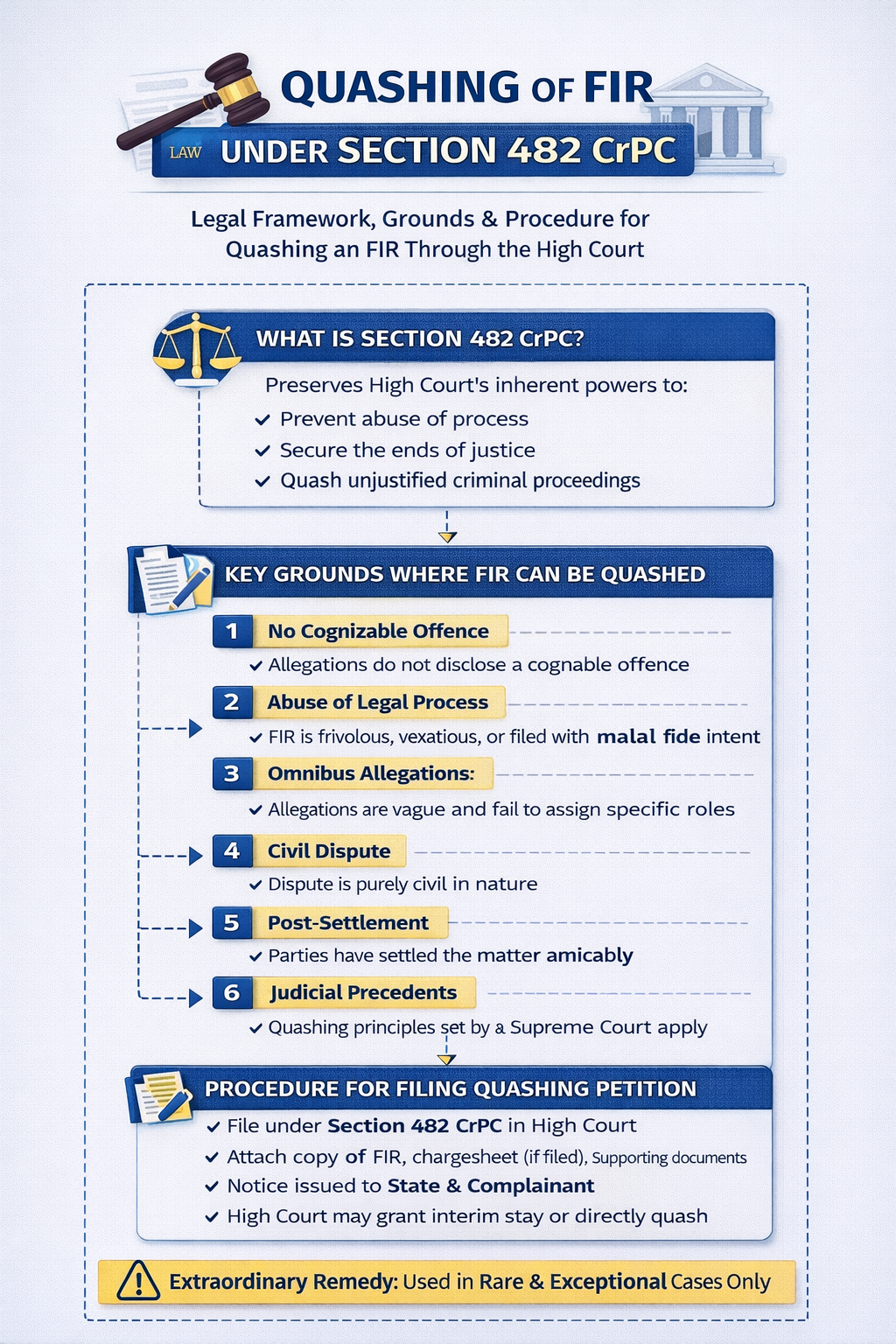
Quashing of FIR Under Section 482 CrPC

Posted on March 3 by Suprajaa Rajan

Understanding the scope, grounds, and judicial principles governing quashing of criminal proceedings.

Criminal prosecution can severely affect personal liberty, reputation, and professional life. However, not every FIR discloses a legally sustainable offence. In such situations, the law provides a constitutional safeguard.

The remedy lies under:

Code of Criminal Procedure, 1973

Specifically, Section 482 CrPC, which preserves the inherent powers of the High Court to:

  • Prevent abuse of process of law

  • Secure the ends of justice

  • Quash criminal proceedings where continuation is unjustified

This article explains the legal framework, judicial tests, landmark precedents, and strategic considerations for filing a quashing petition in brief.

Steps under Quashing FIR

I. What Is Section 482 CrPC?

Section 482 states that nothing in the Code shall limit the inherent powers of the High Court.

These powers are extraordinary in nature and must be exercised:

  • Sparingly

  • With caution

  • Only in rare and exceptional cases

Nevertheless, it is not an appellate power. In fact, it is a supervisory and preventive jurisdiction.

II. When Can FIR Be Quashed?

The Supreme Court laid down guiding principles in:

State of Haryana v. Bhajan Lal

This judgment identified illustrative categories where quashing may be justified.

Key Grounds for Quashing:

  • Allegations do not disclose a cognizable offence
  • FIR is manifestly attended with mala fide intent
  • Allegations are absurd or inherently improbable
  • There is no legal evidence supporting prosecution
  • Proceedings amount to abuse of process
  • Dispute is purely civil in nature
  • Parties have settled the dispute (in appropriate cases)

III. Quashing in Matrimonial Offences (498A Cases)

Quashing petitions frequently arise in complaints under:

  • Section 498A IPC

  • Section 406 IPC

  • Section 34 IPC

Courts have repeatedly cautioned against mechanical implication of relatives.

In Arnesh Kumar v. State of Bihar, the Supreme Court addressed misuse in matrimonial litigation and emphasised procedural safeguards.

High Courts often quash proceedings where:

  • Allegations are omnibus

  • No specific role is attributed

  • Distant relatives reside separately

  • Complaint lacks prima facie material

IV. Settlement-Based Quashing

Even though Section 498A IPC is non-compoundable, courts permit quashing where matrimonial disputes are amicably resolved.

In Gian Singh v. State of Punjab, the Supreme Court held that High Courts may quash non-compoundable offences if the dispute is personal and continuation would serve no purpose.

Similarly, in Narinder Singh v. State of Punjab, guidelines were laid down for compromise-based quashing.

The principle: criminal law should not be used as a weapon once parties have settled significantly.

V. Can FIR Be Quashed After Chargesheet?

Yes. Quashing is maintainable even after filing of chargesheet under Section 173 CrPC.

However, courts are more cautious once investigation is complete.

The test becomes:

  • Whether materials collected disclose a prima facie case

  • Whether continuation would amount to injustice

In case the evidence supports trial, courts may refuse interference.

VI. Procedure for Filing Quashing Petition

A petition under Section 482 CrPC is filed before the jurisdictional High Court.

Typical Components:

  • Copy of FIR
  • Chargesheet (if filed)
  • Relevant documents
  • Affidavit
  • Grounds invoking Bhajan Lal principles

Notice is issued to:

  • State

  • Complainant

High Court may:

  • Issue interim stay

  • Grant protection from coercive steps

  • Dismiss petition

  • Quash FIR entirely

  • Quash proceedings partially against specific accused

VII. Judicial Caution: What Courts Will Not Do

High Courts will not:

  • Conduct mini-trials

  • Examine disputed facts

  • Evaluate credibility of witnesses

  • Weigh evidence

If allegations disclose prima facie offence, trial must proceed. In any case, section 482 is not a substitute for trial.

VIII. Strategic Considerations Before Filing

Filing a premature petition may weaken credibility.

Consider:

  • Stage of investigation

  • Strength of allegations

  • Documentary contradictions

  • Settlement possibilities

  • Parallel civil proceedings

Thus strategic timing is undoubtedly crucial.

IX. Common Mistakes in Quashing Petitions

  • Raising factual disputes requiring evidence
  • Filing without examining FIR carefully
  • Over-reliance on defence documents
  • Ignoring Supreme Court precedents
  • Filing multiple repetitive petitions

Subsequently, courts may impose costs for frivolous petitions.

X. Recent Judicial Approach

Courts increasingly:

  • Protect distant relatives in 498A cases

  • Scrutinise omnibus allegations

  • Encourage settlement in matrimonial disputes

  • Emphasise that criminal law should not become harassment

However, courts remain strict where allegations show serious cruelty or violence.

Conclusion

Section 482 CrPC ,thus, acts as a constitutional safety valve against misuse of criminal process. Additionally, it ensures that criminal law does not become a tool of oppression.

However, it is an extraordinary remedy. Courts exercise it with restraint. A well-structured petition grounded in settled principles significantly improves prospects.

The guiding test remains:

Does continuation of prosecution serve justice — or defeat it?

Therefore, when proceedings lack legal foundation or arise from matrimonial vendetta, inherent powers of the High Court restore balance.


Index of Legal Strategies and Defence is here. 


Frequently Asked Questions

Not automatic. Court examines genuineness and societal impact.

Yes. Proceedings may be quashed selectively.

No. It terminates proceedings before trial.

Often exempted unless court directs otherwise.


Key Contributor:

Mrs. Suprajaa Rajan B.Com., LL.B., LL.M.

+91-9606345150


Posted in Legal Procedure | Tagged abuse of process Criminal law CrPC 482 – IPC 498A Quashed Matrimonial Litigation India Quashing of FIR Section 482 CrPC | Leave a comment

Bagadi Santhosh Kumar Vs Union of India and Ors on 12 Mar 2025

Posted on February 21 by ShadesOfKnife

The Andhra Pradesh High Court examined the legality of a Look-Out Circular (LOC) issued against the petitioner in a matrimonial-related criminal case.

The Court held that authorities cannot issue an LOC routinely. The Court emphasised that an LOC affects personal liberty and must satisfy the conditions laid down in the Ministry of Home Affairs guidelines. Since the petitioner had cooperated with the investigation and the case did not fall within exceptional categories, the Court directed withdrawal of the LOC.

Before reproducing the relevant extracts, the Court examined the constitutional protection of personal liberty and the statutory guidelines governing Look-Out Circulars.

Relevant Extracts from the Judgment:

“14. It is basic that merely because a person is involved in a criminal case, he is not denude of his Fundamental Rights, it is the fundamental of a person to move anywhere he likes including foreign countries. One’s such personal freedom and liberty cannot be abridged. [See; Article 21 Constitution of India].”

“14. But, in any case, it must be fair and reasonable. It should not be indiscriminate without any reason or basis.”

“17. Sub-para J of Office Memorandum dated 22.02.2021 mandates that a Look-Out Circular shall remain in force until and unless a deletion request is received by the Bureau of Immigration from the Originator and that no Look-Out Circular shall be deleted automatically.”

“18. Sub-para L of the circular dt. 22.02.2021 indicates that Look-Out Circulars could be issued in exceptional cases where the departure of the person concerned will be detrimental to the sovereignty, security and integrity of India…”

“20. Issuance of LOC, in the peculiar facts of this case, is unwarranted.”

“21. Given the facts and circumstances of the case, the 5th respondent shall withdraw the Look-Out Circular issued against the petitioner in connection with Crime No.319 of 2024… forthwith.”

Decision

The Andhra Pradesh High Court allowed the writ petition. The Court directed the authorities to withdraw the Look-Out Circular forthwith. The Court permitted the petitioner to approach the Magistrate for travel permission in the pending criminal case.


Bagadi Santosh Kumar Vs Union of India and Ors on 12 Mar 2025

Citation :

Other Sources :


Index of Look Out Circular notices is here. 


Key Contributor :

Mrs. Suprajaa Rajan B.Com., LL.B., LL.M.

+91-9606345150


Posted in High Court of Andhra Pradesh Judgment or Order or Notification | Tagged 1-Judge Bench Decision Article 21 - Protection of life and personal liberty Article 226 - Lookout Circular (LOC) Quashed Bagadi santhosh kumar Vs Union of India and Ors Criminal law Criminal Procedure LOC in Matrimonial Dispute Look Out Circular Look Out Circular Notices Quashing of LOC Right to Travel | Leave a comment

Search within entire Content of “Shades of Knife”

My Legal X Timeline

Advocate Sandeep Pamarati 🇮🇳💪👨🏻‍🎓 Follow

AP High Court Advocate with M Tech (CS) || 12 years in 'Software Industry' as Solution Architect || Blogs at https://t.co/29CB9BzK4w || #TDPTwitter

SandeepPamarati
Retweet on Twitter Advocate Sandeep Pamarati 🇮🇳💪👨🏻‍🎓 Retweeted
futurestacked Future Stacked @futurestacked ·
23 Jun

Your Gmail account is not an email account.

It is the master key to your bank, your crypto, your Apple ID, your PayPal, and every password you have ever saved.

One breach and all your passwords are gone.

Lock it down with these 7 easy steps 👇

Reply on Twitter 2069354786743374317 Retweet on Twitter 2069354786743374317 104 Like on Twitter 2069354786743374317 260 X 2069354786743374317
Retweet on Twitter Advocate Sandeep Pamarati 🇮🇳💪👨🏻‍🎓 Retweeted
thisguyknowsai Brady Long @thisguyknowsai ·
22 Jun

A German psychologist proved in 1885 that cramming erases what you learned within 48 hours. He published the fix in the same book. Almost no school on Earth has adopted it in 140 years.

His name was Hermann Ebbinghaus.

He had no lab. No funding. No colleagues.

He worked alone

Reply on Twitter 2068965021514891696 Retweet on Twitter 2068965021514891696 958 Like on Twitter 2068965021514891696 2820 X 2068965021514891696
Retweet on Twitter Advocate Sandeep Pamarati 🇮🇳💪👨🏻‍🎓 Retweeted
factcheckapgov FactCheck.AP.Gov.in @factcheckapgov ·
22 Jun

ఎంతో ప్రతిష్టాత్మకంగా నిర్వహించి ప్రజల ఆరోగ్యం పట్ల అవగాహన కల్పించిన అంతర్జాతీయ యోగా దినోత్సవం సందర్భంగా రాష్ట్రం లో పలుచోట్ల నిర్వహించిన యోగా కార్యక్రమం పై కొందరు తప్పుడు ప్రచారం చేస్తున్నారు. ఈ కార్యక్రమం కోసం రూ. 600 కోట్లు ఖర్చు అయినట్లు చెప్పడం పూర్తిగా అసత్యం. రాష్ట్రంలో

Reply on Twitter 2068972932827869255 Retweet on Twitter 2068972932827869255 38 Like on Twitter 2068972932827869255 85 X 2068972932827869255
Retweet on Twitter Advocate Sandeep Pamarati 🇮🇳💪👨🏻‍🎓 Retweeted
jaitdp Telugu Desam Party @jaitdp ·
22 Jun

చీఫ్ మినిస్టర్.. టీచర్ అయిన వేళ

అంగన్వాడీ కేంద్రాన్ని సందర్శించిన సీఎం చంద్రబాబు కాసేపు టీచర్‌గా మారి, పిల్లల అభ్యసనం ఎలా ఉందో తెలుసుకున్నారు. ఇంగ్లీష్ ఆల్ఫాబెట్స్ చెప్పమని సీఎం అడిగేసరికి పిల్లలు చక్కగా చెప్పారు.
#ChandrababuNaidu
#AndhraPradesh

Reply on Twitter 2068873963246399922 Retweet on Twitter 2068873963246399922 73 Like on Twitter 2068873963246399922 310 X 2068873963246399922
Load More

Recent Posts

  • Vijay R. Nair Vs Lijitha on 12 Jun 2026 June 24, 2026
  • Pavul Yesu Dhasan Vs Registrar SHRC of TN and Ors on 30 Apr 2025 June 18, 2026
  • Manoj Kumar Vs Nita Bharti on 17 Mar 2026 June 17, 2026
  • Cruelty as a Criminal Offence Explained June 12, 2026
  • Bail Compliance Undertaking Format – Draft, Legal Requirements & Sample Template June 12, 2026

Most Read Posts

  • Reply to Section 41A CrPC Notice – Format with Legal Explanation (4,946 views)
  • Anu Aggarwal Vs Sushant Aggarwal on 20 Jan 2026 (3,487 views)
  • Umme Farva Vs State of U.P. and Anr on 14 Jan 2026 (3,373 views)
  • Charge Sheet and Final Report Explained (2,821 views)
  • Regular Bail Application Format (Section 437/439 CrPC) (2,199 views)
  • Neha Lal Vs Abhishek Kumar on 20 Jan 2026 (2,004 views)
  • Arrest Procedure in 498A cases after Arnesh Kumar (1,937 views)
  • Discharge Application Format in 498A Case – Draft, Procedure & Sample Template (1,778 views)
  • Can You Travel Abroad After an FIR Is Registered? – Legal Position Explained (1,699 views)
  • Atul Kumar Bajpai Vs State of UP and Anr on 17 Sep 2025 (1,540 views)

Tags

Reportable Judgement or Order (433)2-Judge (Division) Bench Decision (414)Legal Procedure Explained - Interpretation of Statutes (382)Landmark Case (381)1-Judge Bench Decision (362)Catena of Landmark Judgments Referred/Cited to (293)Work-In-Progress Article (215)3-Judge (Full) Bench Decision (101)Sandeep Pamarati (92)Article 21 - Protection of life and personal liberty (80)Issued or Recommended Guidelines or Directions or Protocols to be followed (71)Perjury Under 340 CrPC (66)Absurd Or After Thought Or Baseless Or False Or General Or Inherently Improbable Or Improved Or UnSpecific Or Omnibus Or Vague Allegations (61)Reprimands or Setbacks to YCP Govt of Andhra Pradesh (49)Summary Post (47)CrPC 482 - Quash (43)HM Act 13 - Divorce Granted to Husband (42)Legal Terrorism (41)Divorce granted on Cruelty ground (41)Not Authentic copy hence to be replaced (40)

Categories

Supreme Court of India Judgment or Order or Notification (753)Bare Acts or State Amendments or Statutes or GOs or Notifications issued by Central or State Governments (328)High Court of Andhra Pradesh Judgment or Order or Notification (186)High Court of Delhi Judgment or Order or Notification (164)High Court of Bombay Judgment or Order or Notification (112)High Court of Karnataka Judgment or Order or Notification (93)Legal Procedure (77)High Court of Madras Judgment or Order or Notification (70)High Court of Allahabad Judgment or Order or Notification (61)LLB Study Material (59)General Study Material (56)High Court of Punjab & Haryana Judgment or Order or Notification (52)Assorted Court Judgments or Orders or Notifications (50)High Court of Kerala Judgment or Order or Notification (47)Prakasam DV Cases (46)Judicial Activism (for Public Benefit) (45)District or Sessions or Magistrate Court Judgment or Order or Notification (44)High Court of Madhya Pradesh Judgment or Order or Notification (38)High Court of Gujarat Judgment or Order or Notification (28)High Court of Calcutta Judgment or Order or Notification (27)

Recent Comments

  • eCourts India on Compromise-Based Quashing in Matrimonial Cases – Complete Legal Strategy
  • The Divorce Law Firm on Life Cycle Stages of a Divorce case
  • The Divorce Law Firm on Life Cycle Stages of a Divorce case
  • ShadesOfKnife on Sandeep Pamarati Vs Ungrateful Knife (IPC 498A Case)
  • KONURU VINAYKUMAR on Sandeep Pamarati Vs Ungrateful Knife (IPC 498A Case)

Archives of SoK

  • June 2026 (10)
  • May 2026 (24)
  • April 2026 (33)
  • March 2026 (42)
  • February 2026 (30)
  • January 2026 (21)
  • December 2025 (2)
  • November 2025 (3)
  • October 2025 (17)
  • September 2025 (12)
  • August 2025 (5)
  • July 2025 (10)
  • June 2025 (15)
  • May 2025 (3)
  • April 2025 (10)
  • March 2025 (7)
  • February 2025 (8)
  • January 2025 (1)
  • December 2024 (3)
  • November 2024 (4)
  • October 2024 (16)
  • September 2024 (15)
  • August 2024 (14)
  • July 2024 (11)
  • June 2024 (18)
  • May 2024 (13)
  • April 2024 (9)
  • March 2024 (23)
  • February 2024 (15)
  • January 2024 (11)
  • December 2023 (11)
  • November 2023 (9)
  • October 2023 (13)
  • September 2023 (12)
  • August 2023 (15)
  • July 2023 (17)
  • June 2023 (11)
  • May 2023 (6)
  • April 2023 (5)
  • March 2023 (10)
  • February 2023 (9)
  • January 2023 (12)
  • December 2022 (12)
  • November 2022 (8)
  • October 2022 (13)
  • September 2022 (17)
  • August 2022 (10)
  • July 2022 (21)
  • June 2022 (27)
  • May 2022 (23)
  • April 2022 (32)
  • March 2022 (17)
  • February 2022 (6)
  • January 2022 (2)
  • December 2021 (7)
  • November 2021 (7)
  • October 2021 (6)
  • September 2021 (10)
  • August 2021 (31)
  • July 2021 (45)
  • June 2021 (17)
  • May 2021 (17)
  • April 2021 (18)
  • March 2021 (58)
  • February 2021 (14)
  • January 2021 (50)
  • December 2020 (35)
  • November 2020 (68)
  • October 2020 (67)
  • September 2020 (28)
  • August 2020 (41)
  • July 2020 (20)
  • June 2020 (36)
  • May 2020 (40)
  • April 2020 (38)
  • March 2020 (26)
  • February 2020 (43)
  • January 2020 (35)
  • December 2019 (34)
  • November 2019 (4)
  • October 2019 (18)
  • September 2019 (57)
  • August 2019 (33)
  • July 2019 (12)
  • June 2019 (18)
  • May 2019 (5)
  • April 2019 (19)
  • March 2019 (58)
  • February 2019 (11)
  • January 2019 (90)
  • December 2018 (97)
  • November 2018 (43)
  • October 2018 (31)
  • September 2018 (73)
  • August 2018 (47)
  • July 2018 (143)
  • June 2018 (92)
  • May 2018 (97)
  • April 2018 (59)
  • March 2018 (8)

Blogroll

  • Daaman Promoting Harmony 0
  • Fight against Legal Terrorism Fight against Legal Terrorism along with MyNation Foundation 0
  • Good Morning Good Morning News 0
  • Insaaf India Insaaf Awareness Movement 0
  • MyNation Hope Foundation Wiki 0
  • MyNation.net Equality, Justice and Harmony 0
  • Sarvepalli Legal 0
  • Save Indian Family Save Indian Family Movement 0
  • SIF Chandigarh SIF Chandigarh 0
  • The Male Factor The Male Factor 0
  • Unitedmen Foundation a dedicated community forged with the mission to unite men facing legal challenges in marital disputes. 0
  • Vaastav Foundation The Social Reality 0
  • Vinayak my2centsworth – This blog is for honest law abiding men, married or planning to get married 0
  • Voice4india Indian Laws, Non-profits, Environment 0
  • Writing Law Writing Law by Ankur 0

RSS Cloudflare Status

  • ARN (Stockholm) on 2026-06-25 June 25, 2026
    THIS IS A SCHEDULED EVENT Jun 25, 00:00 - 05:00 UTC Jun 19, 14:18 UTC Scheduled - We will be performing scheduled maintenance in ARN (Stockholm) datacenter on 2026-06-25 between 00:00 and 05:00 UTC.Traffic might be re-routed from this location, hence there is a possibility of a slight increase in latency during this maintenance window […]
  • ARN (Stockholm) on 2026-06-24 June 24, 2026
    Jun 24, 05:00 UTC Completed - The scheduled maintenance has been completed. Jun 24, 00:00 UTC In progress - Scheduled maintenance is currently in progress. We will provide updates as necessary. Jun 19, 13:08 UTC Scheduled - We will be performing scheduled maintenance in ARN (Stockholm) datacenter on 2026-06-24 between 00:00 and 05:00 UTC.Traffic might […]
  • Network Performance Issues - Increased HTTP 5XX Errors in Ashburn, US June 23, 2026
    Jun 23, 16:00 UTC Resolved - Between 17:07 and 17:45 UTC, Cloudflare experienced network performance issues in the Ashburn, US region, resulting in an elevated rate of 5xx errors for a subset of traffic. During this time, impacted users may have encountered intermittent connectivity issues or unexpected server responses. The underlying issue was successfully mitigated, […]

RSS List of Spam Server IPs from Project Honeypot

  • 34.106.192.29 | SD June 23, 2026
    Event: Bad Event | Total: 6 | First: 2026-06-23 | Last: 2026-06-23
  • 182.161.69.73 | S June 23, 2026
    Event: Bad Event | Total: 16 | First: 2011-01-28 | Last: 2026-06-23
  • 34.80.202.241 | SD June 23, 2026
    Event: Bad Event | Total: 6 | First: 2026-06-23 | Last: 2026-06-23
Owned and Operated by Advocate Sandeep Pamarati
Proudly powered by WordPress
Theme: Flint by Star Verte LLC

Bad Behavior has blocked 1472 access attempts in the last 7 days.

pixel