Filing a complaint against an advocate – Advocates play a crucial role in the administration of justice. Clients trust lawyers with sensitive information, financial matters, litigation strategy, and court representation. Most advocates perform their duties professionally and ethically. However, there are situations where a client may genuinely feel aggrieved because of:
- Professional misconduct
- Misappropriation of money
- Non-appearance in court
- Misleading legal advice
- Fraudulent conduct
- Ethical violations
- Abuse of trust
- Conflict of interest
- Harassment or intimidation
In such situations, clients often ask:
“Can I file a complaint against an advocate?”
The answer is yes.
Indian law provides a mechanism to file complaints against advocates before the appropriate State Bar Council under the disciplinary framework governing legal professionals.
However, many people do not understand:
- Where to file the complaint
- What documents are required
- What qualifies as misconduct
- What relief can be expected
- Whether compensation is possible
- How disciplinary proceedings actually work
Therefore, this article acts as a first-timer’s practical guide explaining the complete process of filing a complaint against an advocate in India.
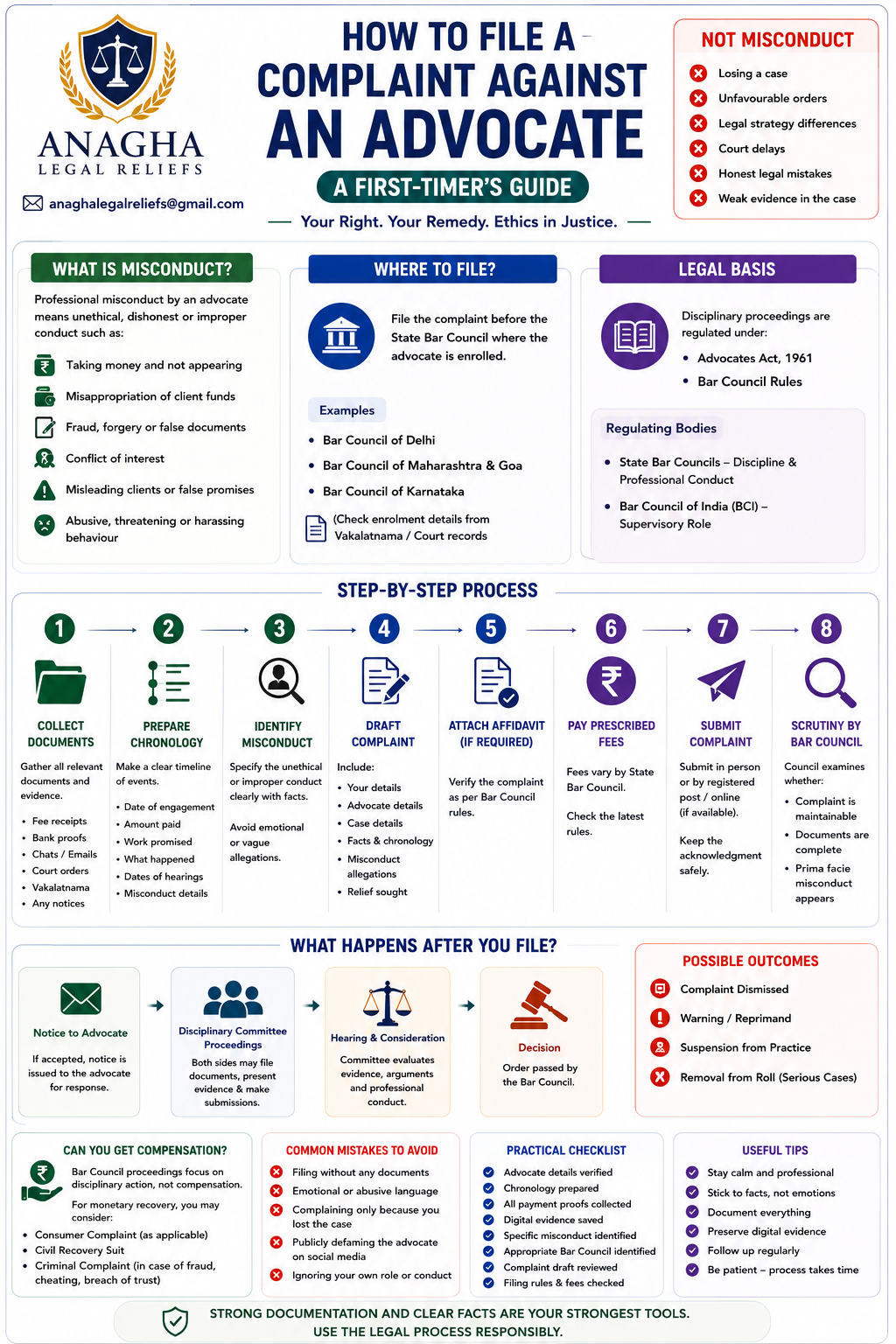
Who Regulates Advocates in India?
Advocates in India are regulated under:
Advocates Act, 1961
The legal profession is supervised through:
State Bar Councils
Each state has its own Bar Council.
Examples include:
- Bar Council of Delhi
- Bar Council of Maharashtra & Goa
- Bar Council of Karnataka
Bar Council of India
The Bar Council of India (BCI) supervises legal education and professional ethics nationally.
What Is “Professional Misconduct” by an Advocate?
Not every mistake or lost case amounts to misconduct.
A lawyer losing a case does not automatically justify disciplinary action.
However, certain acts may amount to professional misconduct.
Common Examples of Advocate Misconduct
1. Taking Money and Not Appearing in Court
Examples:
- Repeated absence
- Intentional non-appearance
- Abandoning the case without notice
2. Misappropriation of Client Funds
Examples:
- Keeping settlement money
- Misusing litigation funds
- Taking money under false promises
3. Fraud or Forgery
Examples:
- Fake orders
- Fabricated documents
- False representation
4. Conflict of Interest
Example:
Representing the opposite party improperly after previously advising you.
5. Professional Negligence Combined With Misconduct
Examples:
- Deliberate suppression
- Intentional misleading conduct
- Gross ethical violations
Simple negligence alone may not always become misconduct.
6. Threatening or Abusive Behaviour
Examples:
- Intimidation
- Harassment
- Abusive communication
7. Misleading Clients
Examples:
- False claims about case status
- Fake assurances of guaranteed results
- False statements regarding court orders
What Does NOT Usually Amount to Misconduct?
Many clients misunderstand this area.
The following usually do NOT automatically amount to misconduct:
- Losing a case
- Unfavourable court orders
- Legal strategy disagreements
- Delay caused by court system
- Honest legal mistakes
- Weak evidence in the case
Bar Councils generally distinguish between:
- Professional misconduct
vs - Professional error or strategic difference
Where Should You File the Complaint?
Usually before the:
State Bar Council where the advocate is enrolled
Example:
If the advocate is enrolled in Maharashtra, complaint usually goes before:
- Bar Council of Maharashtra & Goa
Even if the case was handled elsewhere, enrolment details matter.
How to Find an Advocate’s Enrolment Details
You may check:
- Vakalatnama
- Court filings
- Advocate ID details
- State Bar Council records
Proper identification is important before filing.
Legal Basis for Complaint Against Advocates
Relevant provisions arise under:
Advocates Act, 1961
Particularly disciplinary provisions relating to:
- Professional misconduct
- Disciplinary committees
- Suspension
- Removal from rolls
Step-by-Step Guide to Filing a Complaint Against an Advocate
Step 1: Collect All Relevant Documents
Before filing, gather all evidence carefully.
Important documents include:
- Fee receipts
- Bank transfer proof
- WhatsApp chats
- Emails
- Call recordings (where legally permissible)
- Court orders
- Vakalatnama copies
- Case status documents
- Notices exchanged
- Affidavits or undertakings
Strong documentation is critical.
Step 2: Prepare a Chronology of Events
Create a clear timeline.
Include:
- Date of engagement
- Amount paid
- Work promised
- What actually happened
- Dates of court hearings
- Misconduct details
A structured chronology improves credibility.
Step 3: Identify Specific Misconduct
Avoid emotional allegations like:
“The advocate ruined my life.”
Instead, specify conduct precisely.
Example:
“Advocate accepted fees but remained absent on three hearing dates.”
Specific allegations carry more weight.
Step 4: Draft the Complaint Properly
A proper complaint should include:
Basic Details
- Your name and address
- Advocate’s name and enrolment details
Case Information
- Court details
- Case number
Facts
Chronological narration.
Misconduct Allegation
Clearly explain ethical violation.
Supporting Documents
Attach copies.
Relief Sought
Mention requested action.
Step 5: Attach Supporting Affidavit (If Required)
Some State Bar Councils require:
- Verification affidavit
- Attestation formalities
Always check applicable procedural rules.
Step 6: Pay Prescribed Fees
Most Bar Councils require complaint filing fees.
Fees vary between states.
Check the official State Bar Council rules before filing.
Step 7: Submit Complaint Before Appropriate Authority
Submission may occur through:
- Physical filing
- Registered post
- Online mechanism (where available)
Preserve acknowledgment carefully.
What Happens After Filing the Complaint?
Stage 1: Scrutiny
The Bar Council examines whether:
- Complaint is maintainable
- Documents are complete
- Prima facie misconduct appears
Stage 2: Notice to Advocate
If accepted, notice may be issued to the advocate.
The advocate may file a response.
Stage 3: Disciplinary Committee Proceedings
The matter may proceed before a disciplinary committee.
Both sides may:
- File documents
- Present evidence
- Make submissions
Stage 4: Decision
Possible outcomes include:
Complaint Dismissed
If misconduct not proved.
Warning or Reprimand
Minor misconduct.
Suspension
Temporary prohibition from practice.
Removal From Roll
In serious misconduct cases.
Can You Get Compensation Through Bar Council Complaint?
Usually, Bar Council proceedings primarily address:
- Professional discipline
- Ethical accountability
Compensation may not always be the primary remedy.
For monetary recovery, separate proceedings may sometimes be required, such as:
- Consumer disputes (subject to legal position)
- Civil recovery proceedings
- Criminal complaint where fraud exists
Strategy depends on facts.
Can You File Criminal Case Against an Advocate?
In serious situations involving:
- Fraud
- Forgery
- Cheating
- Criminal breach of trust
criminal remedies may also exist.
However, criminal allegations require evidence—not mere dissatisfaction.
Always proceed carefully.
Important Difference: Misconduct vs Poor Outcome
Courts and Bar Councils repeatedly emphasise:
A lawyer is not automatically guilty merely because the case failed.
Therefore, before filing:
Ask:
- Was the conduct unethical?
- Or was the result simply unfavourable?
This distinction matters greatly.
Practical Tips for First-Time Complainants
Stay Professional
Avoid emotional language.
Focus on Documents
Documentary evidence is stronger than oral accusations.
Preserve Digital Evidence
Save:
- Chats
- Emails
- Payment proof
- Call records
Avoid Social Media Defamation
Do not post allegations publicly without legal basis.
This may create separate legal complications.
Understand Time and Process
Disciplinary proceedings may take time.
Maintain realistic expectations.
Common Mistakes People Make
Avoid:
Filing Without Documents
Weak complaints rarely succeed.
Emotional Allegations Without Facts
Precision matters.
Publicly Threatening the Advocate
Escalation may backfire.
Filing Complaint Only Because Case Was Lost
Loss alone is insufficient.
Suppressing Your Own Conduct
Transparency matters.
Can Complaints Be Settled?
Sometimes disputes resolve through:
- Fee refund
- Clarification
- Professional closure
However, serious ethical misconduct may still proceed independently.
Judicial Approach
Courts generally balance:
- Protection of clients
and - Independence of legal profession
Therefore:
- Genuine misconduct is treated seriously
- Frivolous complaints are discouraged
Credibility and documentation remain crucial.
Practical Checklist Before Filing Complaint
Before proceeding, ensure:
- Advocate details verified
- Chronology prepared
- Fee proof collected
- Court records obtained
- Digital evidence preserved
- Specific misconduct identified
- Emotional allegations avoided
- Appropriate Bar Council identified
- Filing rules checked
Conclusion
Filing a complaint against an advocate is a serious legal step and should be taken carefully, responsibly, and with proper documentation.
While clients absolutely have the right to challenge:
- Fraud
- Misconduct
- Ethical violations
- Abuse of trust
they must also understand that:
- Losing a case alone is not misconduct
- Strategic disagreements are not always disciplinary violations
By:
- Collecting proper evidence
- Following the correct procedure
- Presenting facts clearly
- Remaining professional throughout
a complainant can effectively pursue legitimate grievances before the appropriate Bar Council.
In legal ethics matters, strong documentation and disciplined presentation are far more powerful than emotional allegations.
Index of Legal Strategies and Defence is here.
Key Contributor :
Mrs. Suprajaa Rajan B.Com., LL.B., LL.M.
+91-9606345150

