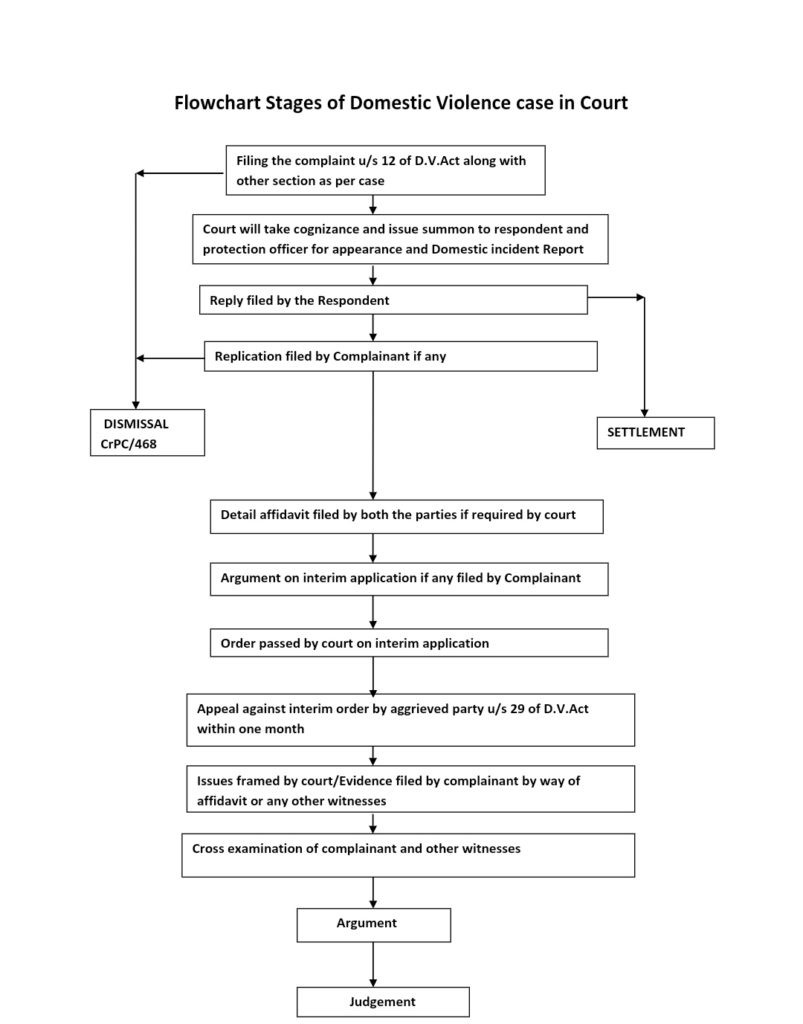
Listed below are a reasonably laid-out sequence of events in a Domestic Violence Case filed under PWDV Act, 2005. The rules related to the Act are here.
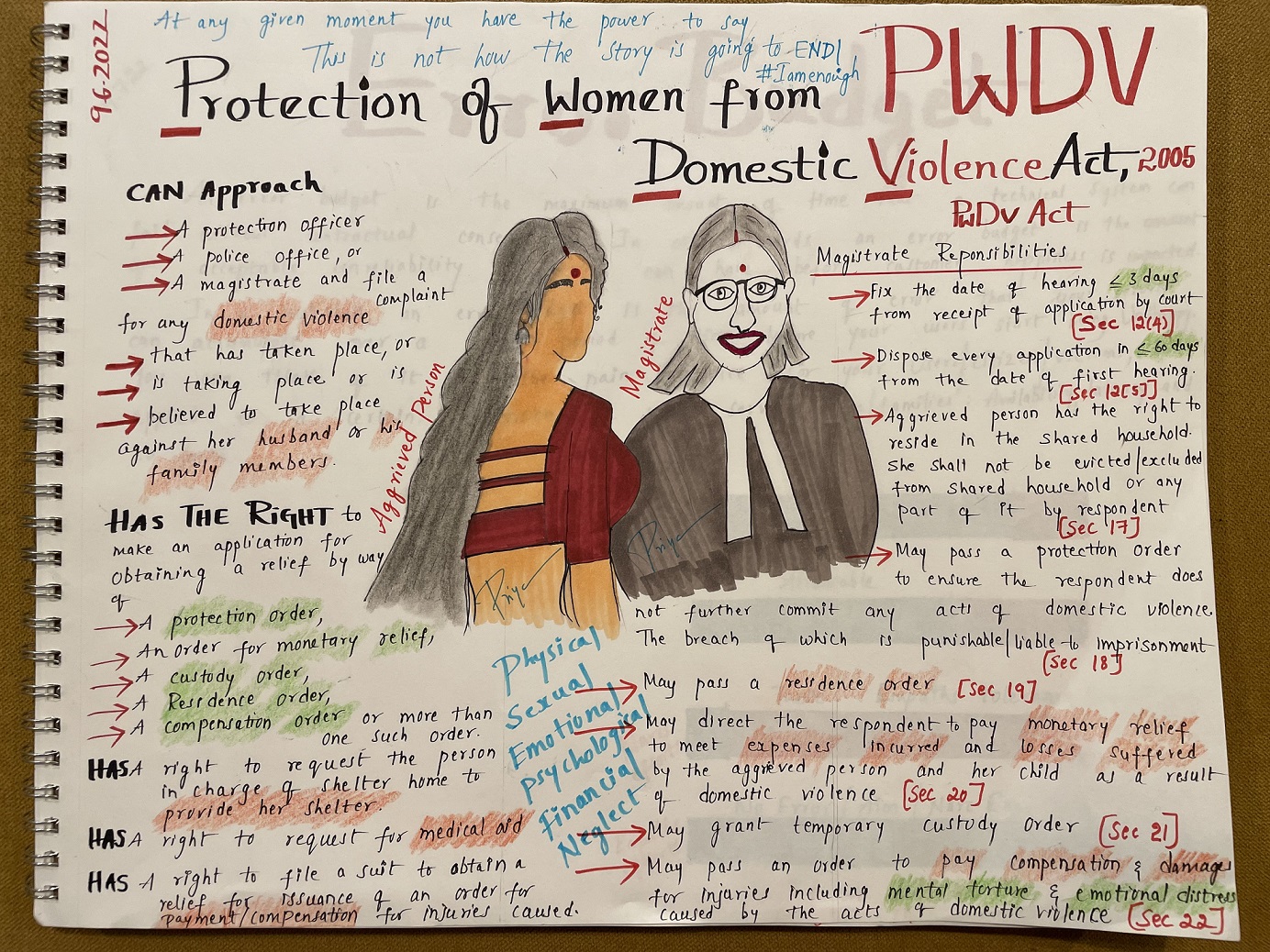
Note: Take a thorough look at the below infographic to understand the various remedies available for an aggrieved person under this law.
Copyright (c) Holders:
Content: Suprajaa Rajan
Infographic: Padma Priya Jupally #IAmEnough
Other Life Cycles: 498A IPC Case Lifecycle || Maintenance Case u/s 125 CrPC Lifecycle. Index of all life cycles is here. Looking for Domestic Violence case-laws? go here!
Before Entering Into Court
- First step is that the aggrieved person/AP [read sec 2(a)] or a Protection Officer or any other person on behalf of the aggrieved person [AP] will file an application under sec 12(1) to the Magistrate seeking one or more reliefs under this Act.
Key Highlights
- This Act is a CIVIL Act, meaning there are civil reliefs that can be claimed by AP and there is no penal punishment given under this Act. Only one exception to this is, when a person disobeys or violates a protection or interim protection order issued by the Magistrate. [read sec 31]
- Magistrate will take up the application and order the Protection Officer [read sec 2(n)] to conduct mediation at court-appointed mediation center to see the possibility of a compromise and also to fill 3 ready-made forms called as Domestic Incident Reports (DIR forms).
- Protection Officer, who is the District Welfare Officer, will issue a notice to all the people named and identified in the application.
- Purpose: Mentioned as above.
- What happens there: Lot of emotional drama, oral diarrhoea, convincing words followed by intermittent threats of 498A IPC case by the so-called Protection Officer/other service providers.
- What to do: Keep your calmest best self and don’t overreact, nor let parents over-react. If you are capable and confident, ensure a audio/video recording of the session is made discreetly. If you have doubts, DO NOT DO IT. More valuable tips here.
- Apart from husband, other family members who are implicated in this case, may become liable to the reliefs mentioned in the Act, based on the Complainant proving their acts of domestic violence. Maintenance component, under Monetary Reliefs alone, is the whole and sole responsibility of husband.
- There are various reliefs [AP] may seek under the various sections. Do no worry about property getting taken over or similar issues. No ‘ownership transfer’ of any such property takes place. Only temporary residence may be ordered which one can oppose and offer similar alternative accommodation. Many idiots hope and try to extort money/property via Domestic Violence complaint. They remain idiotic fools.
Focus Areas
- At this point in time, focus should be
- to attend the proceedings with Protection Officer
- to enjoy (record, if possible) the melodrama at mediation center and let it fail (just say, no compromise with liars, when my family was falsely implicated in the case)
- to not worry about what is captured in the DIR Forms 1-5; they are not equivalent to FIR in case of a criminal matter.
- to let the case move back to Court (there ends the matter with Protection Officer)
- PO will send the mediation report along with earlier duly-prepared DIR forms.
- PO to ensure the AP files the mandatory affidavit prescribed in the Apex Court judgment of Rajnesh Vs Neha, which mandates that the deponent of the affidavit disclosed their income, assets and liabilities.
After Entering Into Court (APPEARANCE AND FOR COUNTER stages)
- Now Court issues a notices to all the respondents ([read sec 2(a)]: proper term for accused people in a Domestic Violence Case) to attend court proceedings on a specific date. The stage is called APPEARANCE.
Key Highlights
- All respondents to attend court on the first appearance date and give attendance and collect the ‘accused copies’ of Domestic Violence Complaint, Affidavit under 297 CrPC, DIR forms and mediation report from the Court Bench Clerk. One set will be given per respondent.
- Till this point, no need of engaging an advocate. Court gives next date, the business of which will be FOR COUNTER. The written statement of our objects otherwise a counter, is to be prepared and submitted to the court on next date of appearance or earlier, with Bench Clerk.
- One may engage a lawyer to plead the case for you here on wards. If you know Law + Case Facts + Court Procedure, one may let court know, you would like to argue the case, on your own, as Party-in-person.
- It is perfectly OKAY, if there are no DIR reports on the record of the case. It is the mandatory duty of the Protection Officer u/s 9(1)(b) and the duty of the Service Provider u/s 10(2)(a), as applicable, to record/make the DIRs. If they have not done their duty, dispute this fact in your Written Statement. The consequence is that the Presiding Officer (Magistrate) will pass an order to PO/Service Provider to make such DIRs, since it is the Magistrate duty under the proviso to Sec 12(1). But the Case will NOT become invalid and the case will be perfectly maintainable. There is no provision of filing Discharge petition u/s 239 CrPC in a DVC, so don’t waste time and money in this.
Focus Areas
- At this point in time, focus should be
- to prepare a Counter/written statement document based on whether the [AP] can prove the allegation laid out in the Domestic Violence Complaint.
- to deny clearly all those allegations that are absurd, untruths, improbable and baseless, and mention ‘the petitioner is put to strict proof of same’. As settled principle of law, whoever alleges something have the burden of proving the same.
- to state/submit those facts that can not be denied by Complainant. Rest all facts/evidences are to be secured and need not be shared with lawyer as well.
- to submit/file the written statement/Counter on the next date prescribed by court. Unless it benefits us in a tangible way, do not skip/seek dates.
- to ensure respondent (first the AP and then the respondent, in that sequence) file the mandatory affidavit prescribed in the Apex Court judgment of Rajnesh Vs Neha, which mandates that the deponent of the affidavit disclosed their income, assets and liabilities, within 4 weeks of the Income affidavit filed by the AP.
- to seek mediation facility, if the respondent so desires to settle the matter with the AP.
EXAMINATION Stage
After Written Statement is filed generally, the next stage is the EXAMINATION. Naturally, it would begin examination of the complainant. The Court frames the issues at this Stage of the case. (read O14 R1 of CPC)
Additionally, if the AP filed an application u/s 23 of the PWDV Act seeking interim/ex-parte reliefs, then that application will be picked up by the Court. Scroll down to the relevant section (INTERIM Orders Stage) on this page.
Key Highlights
- The respondents can file a petition u/s 205 CrPC (with grounds such as age factor, distance to travel, medical/health issues, unavailable in India etc), through your advocate, and seek exemption from personal appearance in the Court.
- This Stage has two parts involving the AP as well as the respondent.
- AP has to file an affidavit stating the facts and such affidavit is brought on record of the case/Court after administering Oath to the AP. This is called as Affidavit-in-Chief or Chief-Examination-Affidavit. By doing so, the AP submits herself to the Court as Prosecution Witness-1 (PW-1). Prosecution has to give a list of Prosecution witnesses to the Court and a copy to be given to the Respondent (advocate).
- After AP file Chief Examination Affidavit (which is more or less replica of the same facts mentioned in the Sec 12 Application) and Respondent gets an opportunity to Cross-Examine the AP (who is now arrayed as PW-1). Read various other techniques respondents can use here.
- If need arises, the respondent can re-examine the witness, as provided by Evidence Act 1872.
- Once cross-examination of the PW-1 finishes, Chief examination of next prosecution witness begins, if any available from Prosecution side.
- Once chief and cross of all prosecution witnesses finishes, the Court gives permission for Respondent side, to submit themselves for Examination.
- Similar to what happened to Prosecution witnesses, if Respondents want to submit themselves for Prosecution’s examination, they have to give a list of Respondent witnesses to the Court and a copy to be given to the Prosecution (advocate).
- Then the Chief Examination of DW-1 (Defence Witness/Respondent Witness-1) is finished (or affidavit is filed), followed by the Cross-examination of DW-1. This continues for all DWs.
- During this Stage, the parties can adduce evidence in support of their stand and get them marked as Exhibits on the record of the Court.
ARGUMENTS Stage
After completion of examination of Prosecution and Respondent Witnesses and bring on record all the Evidence from both the parties, the Court opens for Arguments Stage.
Key Highlights
- The Prosecution team submits their oral arguments in support of their Sec 12 application, relying on the averments in the Chief-Examination Affidavit and prays to the Court to allow their application.
- The Respondent team submits their oral arguments against the Sec 12 application, relying on the Cross Examination of the Prosecution witnesses and prays to the Court to dismiss the application.
- Both parties have opportunity to submit Written Arguments after concluding Oral arguments. This is a best practice but rarely followed in Courts.
- Once both parties conclude their Oral (and/or Written) Arguments, the Court reserves it’s judgment. The case is now ‘Reserved for Judgment‘.
- Once the judgment is reserved, no more activity is possible from either parties.
JUDGMENT Stage
The Court takes time to draft the judgment with reasons for the decision taken and pronounces the same in the Open Court, in the presence of both the parties. The court passes appropriate order/judgement. The court may decide the matter in three manners.
- Grant all relief sought by complainant
- Grant some of the reliefs and deny rest of the reliefs
- Dismiss the complaint entirely without any relief.
Next steps
- The Prosecution and the Respondent teams have a remedy of Appeal u/s 29 of the Act at Sessions Court, challenging the decision of the Trial Court, within 30 days.
INTERIM Orders Stage
The AP may file an application u/s 23, seeking Interim orders on the available reliefs under this Act. Such interim applications are to be disposed of in summary manner meaning, no evidence is to be taken on record and only the application/written statement/counter and relevant affidavits are the only things that need to be considered. Both parties will be given an opportunity to submit their arguments/hearing, after which the Court will pass an Order.
If such interim orders were obtained by AP by committing the offence of perjury upon the Court, do not hesitate to file an application u/s 340 CrPC in the same Court, right after such judicial order is passed.
Ready Reference:
Key Contributor: