web analytics

Menu

Skip to content
Shades of Knife
  • Home
  • True Colors of a Vile Wife
  • Need Inspiration?
  • Blog Updates
  • SOK Gallery
  • Vile News Reporter
  • About Me
  • Contact Me

Shades of Knife

True Colors of a Vile Wife

Tag: BNSS Sec 528 – Saving of inherent powers of High Court

Checklist Before Filing Quashing Petition – Complete Practical Guide

Posted on June 25 by Suprajaa Rajan

A criminal case does not always have to proceed until trial. In appropriate situations, an accused person may approach the High Court seeking quashing of criminal proceedings to prevent abuse of the legal process and to secure the ends of justice.

However, filing a quashing petition is not a routine appeal against an FIR or chargesheet. High Courts exercise their inherent powers carefully and interfere only when the case falls within recognized legal principles.

Many petitions fail because they are filed:

  • Without proper documents
  • Without identifying legal grounds
  • Without examining maintainability
  • Without considering the stage of proceedings
  • Without understanding the limits of High Court jurisdiction

Therefore, before filing a quashing petition, a detailed legal and factual checklist is essential.

This article explains the complete checklist before filing a quashing petition, including documents, legal grounds, procedural requirements, strategy, and common mistakes.
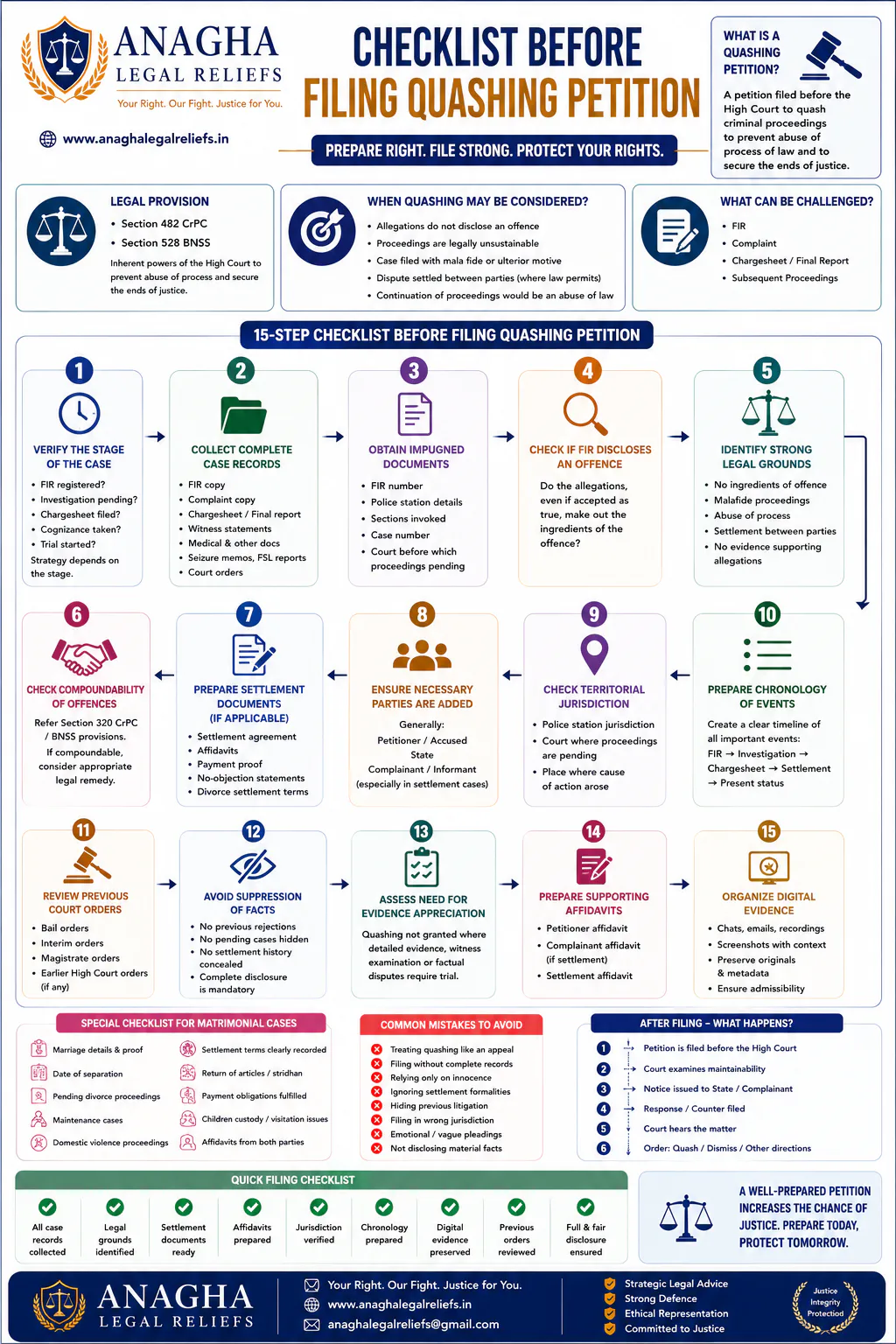
What Is a Quashing Petition?

A quashing petition is an application filed before the High Court requesting it to terminate criminal proceedings.

The High Court may exercise its inherent powers when:

  • The allegations do not disclose an offence
  • Proceedings are legally unsustainable
  • Continuation of the case would amount to abuse of process
  • Parties have settled a dispute where law permits
  • Criminal proceedings are being misused for personal disputes

Legal Provision for Quashing

Under CrPC

Section 482 CrPC

This provision recognises the inherent powers of the High Court.

Under BNSS

Section 528 BNSS

The BNSS continues the High Court’s inherent power to:

  • Prevent abuse of process
  • Secure the ends of justice

When Is Quashing Generally Considered?

Quashing may be considered in situations such as:

1. False or Baseless Allegations

Where the FIR or complaint does not disclose any criminal offence.

2. Civil Dispute Given Criminal Colour

Example:

A purely contractual or family dispute is converted into a criminal complaint.

3. Matrimonial Disputes

Common examples:

  • 498A IPC matters
  • Family disputes
  • Settlement after complaint

4. Settlement Between Parties

Where continuation of prosecution serves no purpose.

5. Legal Bar Against Proceedings

Where law prevents continuation of prosecution.

Checklist Before Filing Quashing Petition

1. Verify the Correct Stage of the Case

First determine:

  • Is only FIR registered?
  • Is investigation pending?
  • Is chargesheet filed?
  • Has cognizance been taken?
  • Has trial started?

The strategy changes depending on the stage.

For example:

An FIR challenge may focus on allegations.

A chargesheet challenge may require examination of investigation material.

2. Collect Complete Case Records

Before approaching the High Court, obtain:

  • FIR copy
  • Complaint copy
  • Chargesheet/final report (if filed)
  • Statements recorded during investigation
  • Medical documents (if applicable)
  • Seizure memos
  • Forensic reports
  • Court orders

Incomplete records often weaken petitions.

3. Obtain the Impugned Documents

The petition should clearly identify what is being challenged.

Collect:

  • FIR number
  • Police station details
  • Sections invoked
  • Case number
  • Magistrate court details

Accuracy is critical.

4. Check Whether the FIR Discloses an Offence

One of the strongest grounds.

Ask:

Even if the allegations are accepted as true, do they constitute an offence?

If the answer is no, quashing may be considered.

5. Identify the Legal Grounds Clearly

A strong petition must state specific grounds.

Common grounds include:

Ground 1: No Ingredients of Offence

The complaint lacks essential elements of the alleged offence.

Example:

Section invoked but necessary facts missing.

Ground 2: Malafide Proceedings

The complaint appears motivated by:

  • Personal revenge
  • Pressure tactics
  • Harassment

Ground 3: Abuse of Criminal Process

Criminal law cannot be used as a tool for:

  • Civil recovery
  • Personal disputes
  • Settlement pressure

Ground 4: Settlement Between Parties

Where parties have resolved disputes.

Common in:

  • Matrimonial cases
  • Business disputes
  • Personal disputes

Ground 5: No Evidence Supporting Allegations

Investigation does not support the complaint.

6. Check Whether the Offences Are Compoundable

Before filing quashing:

Examine whether settlement can legally end proceedings.

Relevant provision:

CrPC

Section 320 CrPC

BNSS

Corresponding compounding provisions.

If an offence is compoundable, another remedy may exist.

7. Prepare Settlement Documents (If Applicable)

If parties have settled, collect:

  • Settlement agreement
  • Affidavits
  • Divorce settlement terms (if applicable)
  • Payment proof
  • No-objection statements

A vague settlement is usually insufficient.

8. Verify Presence of All Necessary Parties

Generally, proceedings involve:

  • Petitioner/accused
  • State
  • Complainant/informant

The complainant’s presence becomes important especially where settlement is relied upon.

9. Check Territorial Jurisdiction

File before the appropriate High Court.

Consider:

  • Police station jurisdiction
  • Court where proceedings are pending
  • Cause of action

Wrong jurisdiction can delay proceedings.

10. Prepare a Complete Chronology

Create a timeline:

Example:

Date | Event

  • FIR registered
  • Arrest/bail
  • Investigation
  • Settlement
  • Chargesheet filing

Courts appreciate clear factual presentation.

11. Review Previous Court Orders

Collect:

  • Bail orders
  • Interim protection orders
  • Magistrate orders
  • Earlier High Court orders

Previous proceedings must be disclosed.

12. Check for Suppression of Facts

Never hide:

  • Earlier rejection orders
  • Pending proceedings
  • Settlement history
  • Related cases

Suppression can damage credibility.

13. Examine Whether Evidence Needs Trial

High Courts generally avoid detailed evidence appreciation.

Quashing may not be appropriate where:

  • Witness examination is required
  • Facts are disputed
  • Evidence needs evaluation

14. Prepare Supporting Affidavits

Depending on circumstances:

  • Petitioner affidavit
  • Complainant affidavit
  • Settlement affidavit

may be required.

15. Organise Digital Evidence

Modern criminal cases often involve:

  • WhatsApp chats
  • Emails
  • Audio recordings
  • CCTV
  • Digital documents

Preserve originals and metadata wherever possible.

Special Checklist for Matrimonial Quashing Cases

Matrimonial matters require additional preparation.

Check:

  • Marriage details
  • Separation date
  • Pending divorce proceedings
  • Maintenance cases
  • Domestic violence proceedings
  • Settlement terms
  • Return of articles/stridhan
  • Payment obligations

Common Mistakes While Filing Quashing Petition

Mistake 1: Treating Quashing Like an Appeal

High Court does not conduct a full trial.

Mistake 2: Filing Without Complete Records

Incomplete facts weaken the petition.

Mistake 3: Relying Only on Innocence

“I am innocent” alone is not a quashing ground.

Mistake 4: Ignoring Settlement Formalities

Settlement must be properly documented.

Mistake 5: Hiding Previous Litigation

Transparency matters.

What Happens After Filing?

Generally:

Step 1

Petition is filed.

Step 2

Court examines maintainability.

Step 3

Notice may be issued.

Step 4

State and complainant respond.

Step 5

Court decides whether interference is justified.

Important Judicial Principle

The High Court uses inherent powers sparingly.

The objective is not to decide guilt or innocence but to prevent:

  • Abuse of process
  • Unnecessary harassment
  • Legally unsustainable prosecution

Practical Filing Checklist

Before filing, confirm:

  • FIR copy obtained
  • Chargesheet status checked
  • Correct sections identified
  • Grounds of quashing prepared
  • Case chronology drafted
  • Supporting documents attached
  • Settlement documents ready (if applicable)
  • Previous orders disclosed
  • Jurisdiction verified
  • Affidavits prepared
  • Digital evidence preserved

Conclusion

A quashing petition is a powerful legal remedy, but success depends heavily on preparation.

The strongest petitions are built on:

  • Clear legal grounds
  • Complete documentation
  • Accurate facts
  • Proper procedural compliance
  • Strategic presentation

Before approaching the High Court, a litigant must carefully evaluate whether the case genuinely falls within the scope of inherent powers.

A well-prepared quashing petition can prevent unnecessary criminal proceedings and protect individuals from misuse of the criminal justice system.


Index of Legal Strategies and Defence is here. 


Posted in Legal Procedure | Tagged Absurd Or After Thought Or Baseless Or False Or General Or Inherently Improbable Or Improved Or UnSpecific Or Omnibus Or Vague Allegations BNSS Sec 528 – Saving of inherent powers of High Court CrPC 482 - Quash Legal Strategies and Defence Quashing of FIR | Leave a comment

Inherent Powers of High Court

Posted on May 4 by Suprajaa Rajan

The inherent powers of the High Court constitute one of the most important safeguards within the criminal justice system. These powers enable the High Court to ensure that judicial proceedings remain fair, just, and free from misuse.

Under Indian criminal law, these powers are expressly recognised under the Code of Criminal Procedure, 1973 and the corresponding provisions under the Bharatiya Nagarik Suraksha Sanhita, 2023.

The High Court exercises these powers to prevent abuse of process of law and to secure the ends of justice.

Statutory Framework

The legal basis for inherent powers is contained in:

  • Section 482 CrPC (Section 528 BNSS) – Saving of inherent powers of High Court

This provision does not confer new powers. Instead, it recognises and preserves the inherent jurisdiction already vested in the High Court.

The High Court may exercise these powers to:

  • Prevent abuse of process of any court
  • Secure the ends of justice
  • Pass appropriate orders where no specific provision exists

Meaning and Scope of Inherent Powers

“Inherent powers” refer to those powers that are essential for the administration of justice, even if they are not expressly provided in statutory provisions.

These powers are:

  • Residual in nature
  • Extraordinary in character
  • To be exercised sparingly

The High Court invokes these powers only when ordinary remedies are inadequate or unavailable.

Objectives of Exercising Inherent Powers

The High Court primarily exercises inherent powers for the following purposes:

Prevent Abuse of Process

The court intervenes when legal proceedings are used for malicious or improper purposes.

Secure Ends of Justice

The court ensures that justice prevails, even in situations where procedural law is silent.

Fill Procedural Gaps

The court may pass orders where the law does not provide a specific remedy.

Thus, inherent powers function as a safety valve within the legal system.

Common Situations Where Powers Are Invoked

The High Court frequently exercises inherent powers in the following situations:

  • Quashing of FIR or criminal proceedings
  • Preventing multiplicity of proceedings
  • Correcting gross procedural irregularities
  • Intervening in cases of manifest injustice
  • Protecting fundamental rights

These situations demonstrate how inherent powers act as a corrective and preventive mechanism.

Judicial Principles Governing Exercise of Powers

Courts have laid down guiding principles for exercising inherent powers.

In
State of Haryana v. Bhajan Lal, the Supreme Court clarified that these powers must be exercised:

  • With great caution
  • Only in exceptional cases
  • Without interfering in legitimate prosecution

The Court emphasised that inherent powers should not be used to stifle genuine proceedings.

Limitations on Inherent Powers

Although wide, these powers are not unlimited.

The High Court cannot:

  • Override express statutory provisions
  • Conduct a detailed trial or evaluate evidence
  • Interfere in routine matters
  • Substitute appellate or revisional jurisdiction

Therefore, the exercise of inherent powers remains carefully controlled and limited.

Difference Between Inherent Powers and Other Remedies

It is important to distinguish inherent powers from other remedies.

Inherent Powers:

  • Extraordinary and discretionary
  • Invoked under Section 482 CrPC (Section 528 BNSS)
  • Used to prevent injustice

Appeal/Revision:

  • Statutory remedies
  • Governed by specific provisions
  • Follow structured procedure

Thus, inherent powers act as a last resort remedy.

Importance in Criminal Justice System

The inherent powers of the High Court play a crucial role in maintaining the integrity of the legal system.

They:

  • Prevent misuse of judicial process
  • Ensure fairness and justice
  • Protect individuals from harassment
  • Strengthen judicial oversight

Without these powers, courts would be unable to address exceptional situations effectively.

Conclusion

The inherent powers of the High Court serve as a cornerstone of criminal justice. They empower courts to act beyond procedural limitations to ensure that justice prevails.

However, courts exercise these powers with restraint to maintain a balance between preventing misuse of law and allowing legitimate prosecution to proceed.


Related Legal Concepts

Explore related remedies and powers in criminal law:

  • Quashing of FIR
  • Abuse of Process of Law
  • Appeal, Revision & Review
  • Criminal Trial Procedure
  • Cognizable and Non-Cognizable Offences


Index of Law Concepts explained here.


Key Contributor :

Mrs. Suprajaa Rajan B.Com., LL.B., LL.M.

+91-9606345150


Posted in LLB Study Material | Tagged abuse of process Abuse of process of law BNSS Sec 528 – Saving of inherent powers of High Court CrPC 482 - Saving of inherent powers of High Court Law Concepts explained Quashing of FIR | Leave a comment

Abuse of process of Law

Posted on April 21 by Suprajaa Rajan

The doctrine of abuse of process of law plays a vital role in preventing misuse of judicial procedures. Courts invoke this principle when legal processes are used maliciously, vexatiously, or for ulterior purposes, rather than for genuine legal redress.

Under Indian criminal law, courts exercise inherent and supervisory powers to prevent such misuse under the Code of Criminal Procedure, 1973 and corresponding provisions under the Bharatiya Nagarik Suraksha Sanhita, 2023.

This doctrine ensures that the legal system functions to advance justice and not to harass individuals.

Meaning of Abuse of Process

Abuse of process occurs when a party uses legal proceedings:

  • For an improper or ulterior motive
  • To harass, intimidate, or pressurise another party
  • To achieve objectives unrelated to justice

In such situations, courts intervene to prevent the continuation of proceedings that undermine the integrity of the judicial system.

Statutory Framework

The power to prevent abuse of process primarily flows from:

  • Section 482 CrPC (Section 528 BNSS) – Inherent powers of High Court

This provision empowers the High Court to:

  • Prevent abuse of process of any court
  • Secure the ends of justice
  • Quash criminal proceedings where necessary

These powers are extraordinary in nature and must be exercised cautiously.

Scope of Inherent Powers

Under Section 482 CrPC (Section 528 BNSS), the High Court may intervene in exceptional cases.

The court may:

  • Quash FIR or criminal proceedings
  • Prevent misuse of legal machinery
  • Ensure fairness in judicial process

However, the court does not conduct a full trial at this stage. Instead, it examines whether the proceedings are legally sustainable.

Common Instances of Abuse of Process

Courts often identify abuse of process in the following situations:

  • Filing of false or frivolous complaints
  • Initiating criminal proceedings for civil disputes
  • Multiple proceedings on the same cause of action
  • Proceedings initiated with mala fide intent
  • Use of criminal law to exert pressure in personal or commercial disputes

In such cases, continuation of proceedings would result in miscarriage of justice.

Judicial Principles Governing Quashing

Courts have developed guiding principles to determine whether proceedings amount to abuse of process.

In
State of Haryana v. Bhajan Lal, the Supreme Court laid down illustrative categories where courts may quash proceedings.

These include:

  • Where allegations do not disclose any offence
  • Where allegations are absurd or inherently improbable
  • Where proceedings are maliciously instituted

These principles continue to guide courts in exercising inherent powers.

Difference Between Abuse of Process and Legitimate Prosecution

It is important to distinguish between genuine legal action and abuse of process.

Legitimate Prosecution:

  • Based on valid legal grounds
  • Supported by evidence
  • Aims to seek justice

Abuse of Process:

  • Based on ulterior motives
  • Lacks legal foundation
  • Intended to harass or misuse law

Therefore, courts must carefully evaluate facts to ensure that genuine cases are not prematurely terminated.

Role of High Courts

High Courts play a crucial role in preventing abuse of process.

They exercise inherent powers to:

  • Protect individuals from harassment
  • Maintain judicial discipline
  • Prevent misuse of criminal law

However, courts exercise this power sparingly and with caution, as premature interference may affect legitimate prosecution.

Importance in Criminal Justice System

The doctrine of abuse of process ensures that:

  • Courts do not become tools of oppression
  • Legal procedures are not misused
  • Justice remains the primary objective of law

It, therefore, acts as a safeguard against arbitrary and malicious litigation.

Conclusion

Abuse of process of law, hence, undermines the very purpose of the legal system. Therefore, courts exercise inherent powers to prevent misuse and ensure that judicial proceedings serve the cause of justice.

By striking a balance between preventing misuse and allowing genuine cases to proceed, the law upholds the principles of fairness, integrity, and justice.


Related Legal Concepts

Explore related remedies and procedural safeguards in criminal law:

  • Quashing of FIR
  • Discharge of Accused
  • Criminal Trial Procedure
  • Appeal, Revision & Review
  • Cognizable and Non-Cognizable Offences


Index of Law Concepts explained here.


Key Contributor :

Mrs. Suprajaa Rajan B.Com., LL.B., LL.M.

+91-9606345150


Posted in General Study Material LLB Study Material | Tagged Abuse of process of law BNSS Sec 528 – Saving of inherent powers of High Court Criminal law in India CrPC 482 - Saving of inherent powers of High Court Legal Remedies after chargesheet Quashing of FIR Remedies against Malicious Prosecution in India | Leave a comment

BNSS Sec 528 – Saving of inherent powers of High Court

Posted on June 27, 2024 by ShadesOfKnife

528. Nothing in this Sanhita shall be deemed to limit or affect the inherent powers of the High Court to make such orders as may be necessary to give effect to any order under this Sanhita, or to prevent abuse of the process of any Court or otherwise to secure the ends of justice.


Entire Sanhita available here.

Posted in Bare Acts or State Amendments or Statutes or GOs or Notifications issued by Central or State Governments | Tagged BNSS Sec 528 – Saving of inherent powers of High Court CrPC 482 - Saving of inherent powers of High Court | Leave a comment

Search within entire Content of “Shades of Knife”

My Legal X Timeline

Advocate Sandeep Pamarati 🇮🇳💪👨🏻‍🎓 Follow

AP High Court Advocate with M Tech (CS) || 12 years in 'Software Industry' as Solution Architect || Blogs at https://t.co/29CB9BzK4w || #TDPTwitter

SandeepPamarati
Retweet on Twitter Advocate Sandeep Pamarati 🇮🇳💪👨🏻‍🎓 Retweeted
rose_k01 Rosy @rose_k01 ·
10 Jul

Women in the Yao village of China are famous for having the Longest hair in the World averaging 6 feet long. Women in their 80s still don't have a Single grey hair!! Their secret is Fermented Rice water. Watch How they make & use it 🍚🌾💧

Reply on Twitter 2075635918879523325 Retweet on Twitter 2075635918879523325 898 Like on Twitter 2075635918879523325 3901 X 2075635918879523325
Retweet on Twitter Advocate Sandeep Pamarati 🇮🇳💪👨🏻‍🎓 Retweeted
ani ANI @ani ·
12 Jul

Promo | ANI Podcast with R.V.S. Mani, Former Under Secretary, Ministry of Home Affairs, Premieres Today at 5 PM IST

"Narendra Modi and Amit Shah Were the Targets in the Ishrat Jahan Case."

"None of the Files Had the Term 'Hindu Terror' Until 2010."

"Digvijaya Singh Asked Me to

Reply on Twitter 2076177037165994029 Retweet on Twitter 2076177037165994029 614 Like on Twitter 2076177037165994029 1586 X 2076177037165994029
Retweet on Twitter Advocate Sandeep Pamarati 🇮🇳💪👨🏻‍🎓 Retweeted
kolla_ch1 చైతన్య కొల్లా @kolla_ch1 ·
11 Jul

రాష్ట్రం మీద పడి.. అడ్డ గాడిదల్లా... అడ్డ దిడ్డంగా పడి దోచుకున్న అడ్డమైన ఎదవలకు ఊడిగం చేస్తూ

డెలివరీ బాయ్ లను అవమానపర్చే

ఆ నెల తక్కువ సన్నాసి మొహాన కొట్టండయ్యా దీన్ని 🤷‍♂️

Reply on Twitter 2076018293836808437 Retweet on Twitter 2076018293836808437 111 Like on Twitter 2076018293836808437 642 X 2076018293836808437
Retweet on Twitter Advocate Sandeep Pamarati 🇮🇳💪👨🏻‍🎓 Retweeted
shunyta_007 𝐒ɦυ𐓣𝗒𝗍α @shunyta_007 ·
12 Jul

Observation Skills 🔥

Reply on Twitter 2076189650885226496 Retweet on Twitter 2076189650885226496 537 Like on Twitter 2076189650885226496 3146 X 2076189650885226496
Load More

Recent Posts

  • Prahlad Singh Bhati Vs N.C.T. Delhi and Anr on 23 Mar 2001 July 12, 2026
  • Application for Day-to-Day Trial – Format, Procedure & Sample Draft July 8, 2026
  • Pooja Ramesh Singh Vs JnK Bank and Anr on 02 Jul 2026 July 8, 2026
  • A.S.S.K.Durga Prasad Vs NCDRC and Ors on 24 Jun 2026 July 7, 2026
  • Application for Permanent Exemption from Appearance – Format, Procedure & Sample Draft July 7, 2026

Most Read Posts

  • Reply to Section 41A CrPC Notice – Format with Legal Explanation (5,046 views)
  • Anu Aggarwal Vs Sushant Aggarwal on 20 Jan 2026 (3,599 views)
  • Umme Farva Vs State of U.P. and Anr on 14 Jan 2026 (3,529 views)
  • Charge Sheet and Final Report Explained (2,998 views)
  • Regular Bail Application Format (Section 437/439 CrPC) (2,368 views)
  • Neha Lal Vs Abhishek Kumar on 20 Jan 2026 (2,151 views)
  • Arrest Procedure in 498A cases after Arnesh Kumar (2,055 views)
  • Discharge Application Format in 498A Case – Draft, Procedure & Sample Template (1,918 views)
  • Can You Travel Abroad After an FIR Is Registered? – Legal Position Explained (1,864 views)
  • Life Cycle of a Perjury Case (1,782 views)

Tags

Reportable Judgement or Order (436)2-Judge (Division) Bench Decision (422)Legal Procedure Explained - Interpretation of Statutes (386)Landmark Case (383)1-Judge Bench Decision (366)Catena of Landmark Judgments Referred/Cited to (297)Work-In-Progress Article (215)3-Judge (Full) Bench Decision (101)Sandeep Pamarati (91)Article 21 - Protection of life and personal liberty (80)Issued or Recommended Guidelines or Directions or Protocols to be followed (71)Perjury Under 340 CrPC (66)Absurd Or After Thought Or Baseless Or False Or General Or Inherently Improbable Or Improved Or UnSpecific Or Omnibus Or Vague Allegations (62)Reprimands or Setbacks to YCP Govt of Andhra Pradesh (49)Summary Post (47)CrPC 482 - Quash (44)HM Act Sec 13 - Divorce Granted to Husband (42)Divorce Granted on Cruelty ground (42)Legal Terrorism (41)Abuse Or Misuse of Process of Court (40)

Categories

Supreme Court of India Judgment or Order or Notification (758)Bare Acts or State Amendments or Statutes or GOs or Notifications issued by Central or State Governments (329)High Court of Andhra Pradesh Judgment or Order or Notification (187)High Court of Delhi Judgment or Order or Notification (164)High Court of Bombay Judgment or Order or Notification (112)High Court of Karnataka Judgment or Order or Notification (95)Legal Procedure (83)High Court of Madras Judgment or Order or Notification (71)High Court of Allahabad Judgment or Order or Notification (62)LLB Study Material (59)General Study Material (56)High Court of Punjab & Haryana Judgment or Order or Notification (53)Assorted Court Judgments or Orders or Notifications (51)High Court of Kerala Judgment or Order or Notification (47)Judicial Activism (for Public Benefit) (47)Prakasam DV Cases (46)District or Sessions or Magistrate Court Judgment or Order or Notification (44)High Court of Madhya Pradesh Judgment or Order or Notification (38)High Court of Gujarat Judgment or Order or Notification (28)High Court of Telangana Judgment or Order or Notification (28)

Recent Comments

  • eCourts India on Compromise-Based Quashing in Matrimonial Cases – Complete Legal Strategy
  • The Divorce Law Firm on Life Cycle Stages of a Divorce case
  • The Divorce Law Firm on Life Cycle Stages of a Divorce case
  • ShadesOfKnife on Sandeep Pamarati Vs Ungrateful Knife (IPC 498A Case)
  • KONURU VINAYKUMAR on Sandeep Pamarati Vs Ungrateful Knife (IPC 498A Case)

Archives of SoK

  • July 2026 (13)
  • June 2026 (19)
  • May 2026 (24)
  • April 2026 (33)
  • March 2026 (42)
  • February 2026 (30)
  • January 2026 (21)
  • December 2025 (2)
  • November 2025 (3)
  • October 2025 (17)
  • September 2025 (12)
  • August 2025 (5)
  • July 2025 (10)
  • June 2025 (15)
  • May 2025 (3)
  • April 2025 (10)
  • March 2025 (7)
  • February 2025 (8)
  • January 2025 (1)
  • December 2024 (3)
  • November 2024 (4)
  • October 2024 (16)
  • September 2024 (15)
  • August 2024 (14)
  • July 2024 (11)
  • June 2024 (18)
  • May 2024 (13)
  • April 2024 (9)
  • March 2024 (23)
  • February 2024 (15)
  • January 2024 (11)
  • December 2023 (11)
  • November 2023 (9)
  • October 2023 (13)
  • September 2023 (12)
  • August 2023 (15)
  • July 2023 (17)
  • June 2023 (11)
  • May 2023 (6)
  • April 2023 (5)
  • March 2023 (10)
  • February 2023 (9)
  • January 2023 (12)
  • December 2022 (12)
  • November 2022 (8)
  • October 2022 (13)
  • September 2022 (17)
  • August 2022 (10)
  • July 2022 (21)
  • June 2022 (27)
  • May 2022 (23)
  • April 2022 (32)
  • March 2022 (17)
  • February 2022 (6)
  • January 2022 (2)
  • December 2021 (7)
  • November 2021 (7)
  • October 2021 (6)
  • September 2021 (10)
  • August 2021 (31)
  • July 2021 (45)
  • June 2021 (17)
  • May 2021 (17)
  • April 2021 (18)
  • March 2021 (58)
  • February 2021 (14)
  • January 2021 (50)
  • December 2020 (35)
  • November 2020 (68)
  • October 2020 (67)
  • September 2020 (28)
  • August 2020 (41)
  • July 2020 (20)
  • June 2020 (36)
  • May 2020 (40)
  • April 2020 (38)
  • March 2020 (26)
  • February 2020 (43)
  • January 2020 (35)
  • December 2019 (34)
  • November 2019 (4)
  • October 2019 (18)
  • September 2019 (57)
  • August 2019 (33)
  • July 2019 (12)
  • June 2019 (18)
  • May 2019 (5)
  • April 2019 (19)
  • March 2019 (58)
  • February 2019 (11)
  • January 2019 (90)
  • December 2018 (97)
  • November 2018 (43)
  • October 2018 (31)
  • September 2018 (73)
  • August 2018 (47)
  • July 2018 (143)
  • June 2018 (92)
  • May 2018 (97)
  • April 2018 (59)
  • March 2018 (8)

Blogroll

  • Daaman Promoting Harmony 0
  • Fight against Legal Terrorism Fight against Legal Terrorism along with MyNation Foundation 0
  • Good Morning Good Morning News 0
  • Insaaf India Insaaf Awareness Movement 0
  • MyNation Hope Foundation Wiki 0
  • MyNation.net Equality, Justice and Harmony 0
  • Sarvepalli Legal 0
  • Save Indian Family Save Indian Family Movement 0
  • SIF Chandigarh SIF Chandigarh 0
  • The Male Factor The Male Factor 0
  • Unitedmen Foundation a dedicated community forged with the mission to unite men facing legal challenges in marital disputes. 0
  • Vaastav Foundation The Social Reality 0
  • Vinayak my2centsworth – This blog is for honest law abiding men, married or planning to get married 0
  • Voice4india Indian Laws, Non-profits, Environment 0
  • Writing Law Writing Law by Ankur 0

RSS Cloudflare Status

  • Cloudflare Storage Maintenance July 16, 2026
    THIS IS A SCHEDULED EVENT Jul 16, 12:00 - 13:00 UTC Jul 6, 22:38 UTC Scheduled - Cloudflare has scheduled maintenance for our backend storage systems. Services will continue to operate normally, but customers will be unable to create/delete/modify Client-Side Security settings via the Dashboard or the public API for a period of up to […]
    Cloudflare

RSS List of Spam Server IPs from Project Honeypot

  • 188.95.67.196 | S July 13, 2026
    Event: Bad Event | Total: 106 | First: 2025-03-27 | Last: 2026-07-13
Owned and Operated by Advocate Sandeep Pamarati and Advocate Suprajaa Rajan
Proudly powered by WordPress
Theme: Flint by Star Verte LLC

Bad Behavior has blocked 1085 access attempts in the last 7 days.

pixel