web analytics

Menu

Skip to content
Shades of Knife
  • Home
  • True Colors of a Vile Wife
  • Need Inspiration?
  • Blog Updates
  • SOK Gallery
  • Vile News Reporter
  • About Me
  • Contact Me

Shades of Knife

True Colors of a Vile Wife

Tag: Article 226 Constitution

Life Cycle Stages of a Criminal Writ Petition Before a High Court

Posted on May 7 by Suprajaa Rajan

A Step-by-Step Guide to Criminal Writ Proceedings Under Indian Law

Understanding the procedural journey of a criminal writ petition helps individuals protect their fundamental rights, challenge illegal actions, and seek urgent judicial intervention from the High Court.

A criminal writ petition is an extraordinary constitutional remedy that a person may invoke when illegal detention, abuse of criminal process, violation of procedural safeguards, or infringement of fundamental rights occurs.

Unlike regular criminal trials, criminal writ petitions arise directly under the constitutional jurisdiction of the High Courts under Article 226 of the Constitution of India and, in appropriate cases, under Article 227 of the Constitution of India.

Although the power flows from the Constitution, the issues raised in such petitions often involve provisions of the Code of Criminal Procedure, 1973 (CrPC) and the Bharatiya Nagarik Suraksha Sanhita, 2023 (BNSS).

The following stages explain the complete life cycle of a criminal writ petition before a High Court.
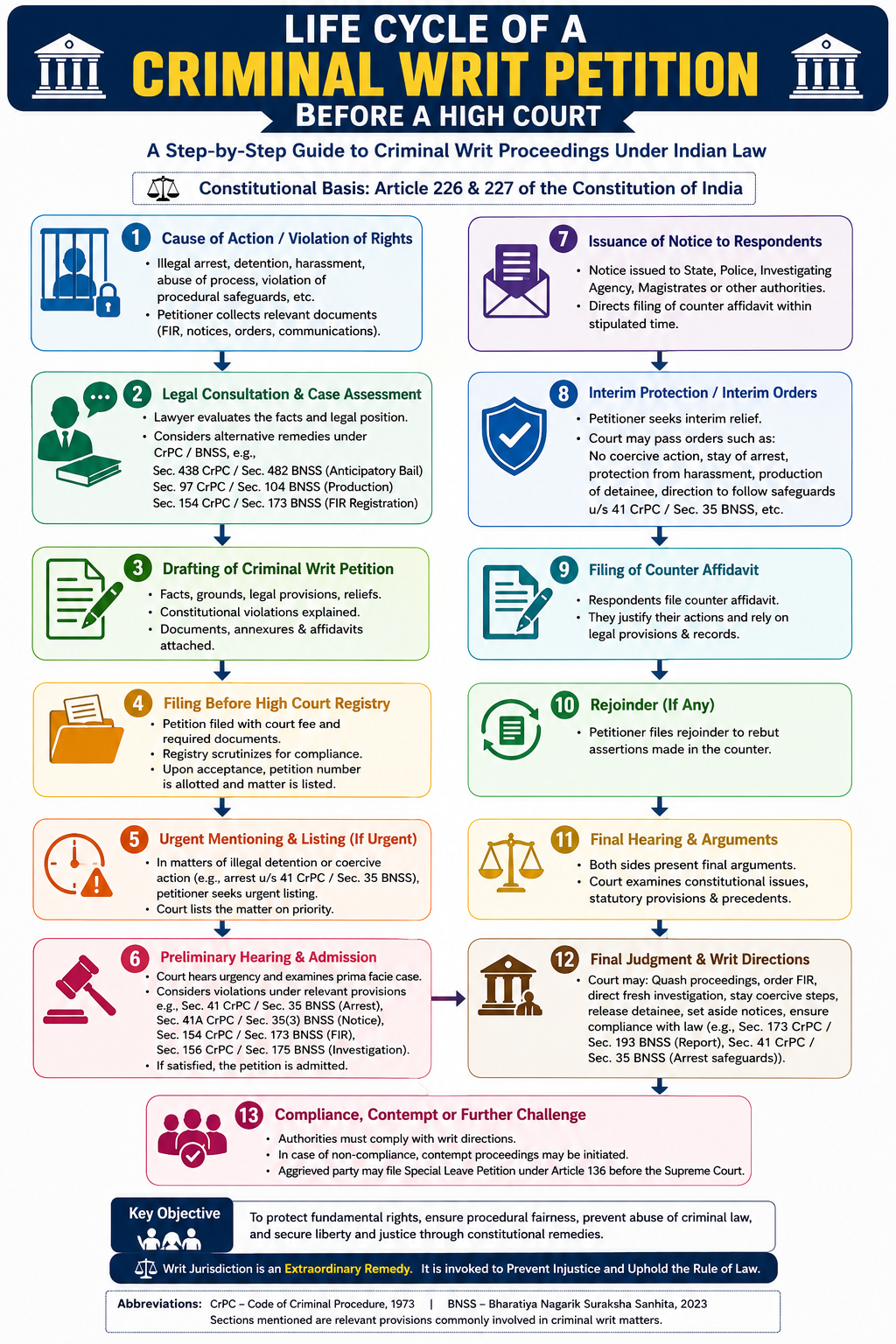
1. Legal Foundation of Criminal Writ Jurisdiction

First, it is important to understand the legal foundation of criminal writ proceedings.

High Courts exercise writ jurisdiction under Article 226 of the Constitution of India to protect legal and fundamental rights. Additionally, High Courts exercise supervisory jurisdiction under Article 227 of the Constitution of India over subordinate courts and tribunals.

A person may file a criminal writ petition in situations involving:

  • Illegal arrest or detention
  • Violation of procedural safeguards
  • Abuse of criminal investigation
  • Failure of police authorities to act
  • Threat to personal liberty under Article 21
  • Illegal issuance of lookout notices or coercive action
  • Failure to follow mandatory criminal procedure

For instance, petitions may involve violations relating to arrest under Section 41 CrPC / Section 35 BNSS, notice of appearance under Section 41A CrPC / Section 35(3) BNSS, search and seizure, remand, or investigation.

Therefore, writ jurisdiction acts as an immediate constitutional safeguard.

2. Stage One: Cause of Action or Violation of Rights

Typically, a criminal writ petition begins when a person experiences an illegal action by police, investigating agencies, or other public authorities.

For example, the grievance may involve illegal detention, unlawful summons, harassment during investigation, refusal to register an FIR, or violation of procedural safeguards.

The aggrieved person first identifies the violation and gathers relevant documents, notices, FIR copies, summons, remand orders, or communication records.

Therefore, identifying the cause of action forms the foundation of the writ petition.

3. Stage Two: Legal Consultation and Case Assessment

Next, the aggrieved person consults a legal practitioner experienced in criminal and constitutional litigation.

At this stage, the lawyer evaluates whether the grievance requires a writ remedy or an alternative statutory remedy.

For example, the lawyer may examine whether relief could arise through:

  • FIR registration under Section 154 CrPC / Section 173 BNSS
  • Anticipatory bail under Section 438 CrPC / Section 482 BNSS
  • Regular bail under Section 439 CrPC / Section 483 BNSS
  • Production of a detained person under Section 97 CrPC / Section 104 BNSS

If immediate constitutional intervention becomes necessary, the lawyer prepares for writ proceedings.

4. Stage Three: Drafting of Criminal Writ Petition

After assessing the facts, the legal team drafts the criminal writ petition.

The petition generally includes:

  • Details of parties
  • Facts leading to the violation
  • Relevant constitutional rights violated
  • Relevant criminal law provisions
  • Grounds for invoking writ jurisdiction
  • Interim relief sought
  • Final relief sought

Additionally, the petitioner annexes supporting documents such as FIR copies, notices, complaint copies, remand orders, call records, or medical records.

A properly drafted petition significantly strengthens the case.

5. Stage Four: Filing Before the High Court Registry

Once the petition is ready, the petitioner files it before the Registry of the jurisdictional High Court.

The Registry scrutinises the petition for procedural compliance, court fees, formatting requirements, affidavits, and annexures.

If defects appear, the Registry returns the matter for correction.

Once compliance is complete, the Registry assigns a writ petition number and lists the matter before the appropriate bench.

Thus, the petition formally enters the judicial system.

6. Stage Five: Urgent Mentioning and Listing

In urgent matters involving personal liberty, illegal detention, or coercive police action, the petitioner may seek urgent listing.

For example, habeas corpus petitions involving unlawful detention may require immediate listing.

Similarly, petitions challenging illegal arrest under Section 41 CrPC / Section 35 BNSS may also require urgent hearing.

After hearing the urgency submissions, the High Court may list the matter on priority.

Therefore, urgent mentioning plays a crucial role in criminal writ proceedings.

7. Stage Six: Preliminary Hearing and Admission

Next, the High Court conducts a preliminary hearing.

At this stage, the petitioner’s counsel explains the urgency, constitutional violation, and statutory breaches.

The court examines whether the petition discloses a prima facie case.

For example, the court may examine violations involving:

  • Arrest procedure under Section 41 CrPC / Section 35 BNSS
  • Notice procedure under Section 41A CrPC / Section 35 BNSS
  • FIR registration under Section 154 CrPC / Section 173 BNSS
  • Investigation procedure under Section 156 CrPC / Section 175 BNSS

If the court finds merit, it admits the petition.

8. Stage Seven: Issuance of Notice to Respondents

After admission, the High Court issues notice to the respondents.

The respondents may include:

  • State Government
  • Police authorities
  • Investigating agencies
  • Magistrates or subordinate authorities, where legally permissible
  • Other affected parties

The notice directs the respondents to file their reply within a specified period.

This stage ensures compliance with principles of natural justice.

9. Stage Eight: Interim Protection or Interim Orders

Meanwhile, the petitioner may seek interim protection.

Depending on the facts, the High Court may pass interim directions such as:

  • No coercive steps
  • Stay of arrest
  • Protection from harassment
  • Production of detainee
  • Protection of evidence
  • Direction to follow procedural safeguards

For instance, the court may direct compliance with arrest safeguards under Section 41 CrPC / Section 35 BNSS.

In urgent cases, interim protection may determine the immediate outcome.

10. Stage Nine: Filing of Counter Affidavit and Rejoinder

Subsequently, the respondents file their counter affidavit.

The respondents justify their actions by relying on investigation records, statutory powers, or procedural compliance.

After that, the petitioner may file a rejoinder to rebut factual or legal assertions.

This stage helps the court understand the complete factual matrix.

11. Stage Ten: Final Hearing and Arguments

After pleadings conclude, the High Court hears final arguments.

The petitioner demonstrates constitutional violations, abuse of power, or procedural irregularities.

Conversely, the respondents defend the legality of their actions.

Both parties rely on constitutional principles, statutory provisions, and judicial precedents.

At this stage, the court examines whether state action violates due process or personal liberty.

12. Stage Eleven: Final Judgment and Writ Directions

Finally, the High Court delivers its judgment.

Depending on the facts, the court may:

  • Quash illegal proceedings
  • Direct registration of FIR
  • Order fresh investigation
  • Stay coercive action
  • Release an illegally detained person
  • Set aside unlawful notices
  • Direct compliance with procedural safeguards
  • Award costs in appropriate cases

For instance, the court may direct authorities to comply with investigation procedures under Section 173 CrPC / Section 193 BNSS or arrest safeguards under Section 41 CrPC / Section 35 BNSS.

Thus, the writ remedy ensures accountability.

13. Stage Twelve: Compliance, Contempt, or Further Challenge

After the judgment, authorities must comply with the writ directions.

If authorities fail to comply, the petitioner may initiate contempt proceedings before the High Court.

Additionally, an aggrieved party may challenge the judgment before the Supreme Court through:

  • Special Leave Petition under Article 136, or
  • Other constitutional remedies, where applicable.

Therefore, post-judgment remedies ensure continued judicial oversight.

Conclusion

Criminal writ petitions play a vital role in protecting personal liberty, procedural fairness, and constitutional rights.

Therefore, High Courts follow a structured process that balances urgent intervention with judicial scrutiny.

Understanding the life cycle of a criminal writ petition helps individuals seek timely constitutional remedies against illegal criminal action.

Ultimately, writ jurisdiction remains one of the strongest safeguards against misuse of criminal law.


Other Life Cycles: DV Case Lifecycle || Maintenance Case u/s 125 CrPC Lifecycle. Index is here.


Key Contributor :

Mrs. Suprajaa Rajan B.Com., LL.B., LL.M.

+91-9606345150


Posted in Legal Procedure | Tagged Article 226 Constitution Article 227 - Power of superintendence over all courts by the High Court CrPC 41A - Notice of appearance before police officer Life Cycle stages Life Cycle stages of a criminal writ petition | Leave a comment

Rashmi Raikhy and Anr Vs The State of NCT Delhi and Ors on 1 Feb 2018

Posted on February 19 by ShadesOfKnife

The High Court of Delhi, quashed the Look Out Circular (LOC) issued against the petitioners registered under Sections 406/498-A/34 IPC.

The Court held that issuance and continuation of an LOC in a matrimonial dispute involving Section 406 IPC was neither reasonable nor justified, especially when the petitioners had regularly appeared before the trial court, complied with bail conditions under Section 438 CrPC, and had not misused permission to travel abroad.

The Court emphasised that an LOC is a serious coercive measure and cannot be mechanically issued in matrimonial disputes where the accused are neither absconding nor involved in heinous offences.

The LOC was accordingly directed to be withdrawn.


The following paragraphs were instrumental in the Court’s decision to quash the Look Out Circular:

Para 4 “Record reveals that on several occasions permissions were sought by the petitioners to travel abroad and the said permissions were granted; there are no allegations of their misuse. Record further reveals that the petitioners are regularly appearing before the court concerned in the said proceedings.”

Para 5 “During this period since 2009/2010, the petitioners have suffered a lot due to issuance of LOC against them. Even after discharge order on 11.12.2017, LOC against the petitioner No.2 has not been rescinded.”

Para 7 “For the offence under Section 406 IPC, in matrimonial dispute, issuance of LOC against the petitioners till disposal of the case cannot be justified; the offence is not heinous in nature.”

Para 8 “In the case of E.V.Perumal Samy Reddy, E.V.R.Santosh Reddy and Rajeshwari vs. State represented by the Deputy Commissioner of Police and State represented by the Inspector of Police MANU/TN/2308/2013, Madras High Court noted various types of persons who could be included in the LOC:-

(i) Persons with Terrorists or Militant Links,
(ii) Belligerent Foreigners,
(iii) Foreigners previously noticed for violations of visa conditions.
(iv) Persons required by courts in criminal/civil cases who are absconding
(v) Absconding Offenders wanted by Police/CBI/Customs /Central excise/ Directorate of Rev. Intelligence/other agencies”

Para 9 “Apparently, the petitioners do not fall in any of the above categories. There are no allegations that petitioner No.1 ever absconded and did not participate in the criminal proceedings.”

Para 10 “Issuance of LOC is a serious matter as it contains full particulars of the individual which are sent throughout the world. Peculiar facts and circumstances of the case and due to subsequent development whereby the petitioner No.1 was charged only under Section 406 IPC, continuation of LOC against her can’t be considered reasonable and justified.”

Para 11 “In view of the above discussion, the concerned authorities are directed to withdraw the LOC order issued against the petitioners.”


Decision of the Court

Exercising jurisdiction under Articles 226/227 of the Constitution of India read with Section 482 CrPC, the Delhi High Court allowed the writ petition and directed the withdrawal of the Look Out Circular issued against the petitioners.


Rashmi Raikhy Vs State of NCT of Delhi

Citation: [2018:DHC:785]

Other Sources :


Index of Look Out Circular decisions is here.


Key Contributor:
Mrs Suprajaa Rajan B.Com, LL.B., LL.M.
+91-9606345150

Posted in High Court of Delhi Judgment or Order or Notification | Tagged 1-Judge Bench Decision Article 226 Constitution Criminal Procedure Code Dowry Case Law LOC in Matrimonial Dispute Look Out Circular Matrimonial Litigation India Quashing of LOC Rashmi Raikhy & Anr Vs The State of NCR Delhi Reportable Judgement or Order Section 406 IPC Section 498A IPC Writ Petition | Leave a comment

Search within entire Content of “Shades of Knife”

My Legal X Timeline

Advocate Sandeep Pamarati 🇮🇳💪👨🏻‍🎓 Follow

AP High Court Advocate with M Tech (CS) || 12 years in 'Software Industry' as Solution Architect || Blogs at https://t.co/29CB9BzK4w || #TDPTwitter

SandeepPamarati
Retweet on Twitter Advocate Sandeep Pamarati 🇮🇳💪👨🏻‍🎓 Retweeted
its_me_jasraj 𝗗𝗿.𝗝𝗮𝘀𝗿𝗮𝗷 𝗣𝗿𝗮𝗷𝗮𝗽𝗮𝘁𝗶 @its_me_jasraj ·
21 Jun

5 Protein Facts They Never Told You ✅

Reply on Twitter 2068689430140080559 Retweet on Twitter 2068689430140080559 120 Like on Twitter 2068689430140080559 402 X 2068689430140080559
Retweet on Twitter Advocate Sandeep Pamarati 🇮🇳💪👨🏻‍🎓 Retweeted
mohiniwealth Mohini Maheshwari @mohiniwealth ·
22 Jun

The Dark Truth 🥷

Reply on Twitter 2068918051966513614 Retweet on Twitter 2068918051966513614 58 Like on Twitter 2068918051966513614 233 X 2068918051966513614
Retweet on Twitter Advocate Sandeep Pamarati 🇮🇳💪👨🏻‍🎓 Retweeted
shree_2_2 श्री @shree_2_2 ·
21 Jun

He spoke on behalf of all nationalists loved this side of Anand sir😅😅😅

Reply on Twitter 2068683121504170027 Retweet on Twitter 2068683121504170027 317 Like on Twitter 2068683121504170027 817 X 2068683121504170027
Retweet on Twitter Advocate Sandeep Pamarati 🇮🇳💪👨🏻‍🎓 Retweeted
shoneekapoor ShoneeKapoor @shoneekapoor ·
20 Jun

Judge Calls Wife’s Beating “Blessing”? Gender Reverse Karke Dekho

A husband tells the court that his wife beats him. In a viral clip from Gwalior Bench proceedings, the judge is heard saying:

“Husband who gets beaten up by his wife is a lucky man. That beating is a blessing.

Reply on Twitter 2068312690423185883 Retweet on Twitter 2068312690423185883 257 Like on Twitter 2068312690423185883 490 X 2068312690423185883
Load More

Recent Posts

  • Pavul Yesu Dhasan Vs Registrar SHRC of TN and Ors on 30 Apr 2025 June 18, 2026
  • Manoj Kumar Vs Nita Bharti on 17 Mar 2026 June 17, 2026
  • Cruelty as a Criminal Offence Explained June 12, 2026
  • Bail Compliance Undertaking Format – Draft, Legal Requirements & Sample Template June 12, 2026
  • Warning Signs of Escalating Matrimonial Litigation – Early Red Flags Every Spouse Should Recognize June 12, 2026

Most Read Posts

  • Reply to Section 41A CrPC Notice – Format with Legal Explanation (4,940 views)
  • Anu Aggarwal Vs Sushant Aggarwal on 20 Jan 2026 (3,473 views)
  • Umme Farva Vs State of U.P. and Anr on 14 Jan 2026 (3,361 views)
  • Charge Sheet and Final Report Explained (2,809 views)
  • Regular Bail Application Format (Section 437/439 CrPC) (2,189 views)
  • Neha Lal Vs Abhishek Kumar on 20 Jan 2026 (1,998 views)
  • Arrest Procedure in 498A cases after Arnesh Kumar (1,929 views)
  • Discharge Application Format in 498A Case – Draft, Procedure & Sample Template (1,772 views)
  • Can You Travel Abroad After an FIR Is Registered? – Legal Position Explained (1,686 views)
  • Atul Kumar Bajpai Vs State of UP and Anr on 17 Sep 2025 (1,536 views)

Tags

Reportable Judgement or Order (433)2-Judge (Division) Bench Decision (413)Legal Procedure Explained - Interpretation of Statutes (382)Landmark Case (381)1-Judge Bench Decision (362)Catena of Landmark Judgments Referred/Cited to (293)Work-In-Progress Article (215)3-Judge (Full) Bench Decision (101)Sandeep Pamarati (92)Article 21 - Protection of life and personal liberty (80)Issued or Recommended Guidelines or Directions or Protocols to be followed (71)Perjury Under 340 CrPC (66)Absurd Or After Thought Or Baseless Or False Or General Or Inherently Improbable Or Improved Or UnSpecific Or Omnibus Or Vague Allegations (61)Reprimands or Setbacks to YCP Govt of Andhra Pradesh (49)Summary Post (47)CrPC 482 - Quash (43)HM Act 13 - Divorce Granted to Husband (42)Legal Terrorism (41)Divorce granted on Cruelty ground (41)Not Authentic copy hence to be replaced (40)

Categories

Supreme Court of India Judgment or Order or Notification (753)Bare Acts or State Amendments or Statutes or GOs or Notifications issued by Central or State Governments (328)High Court of Andhra Pradesh Judgment or Order or Notification (186)High Court of Delhi Judgment or Order or Notification (164)High Court of Bombay Judgment or Order or Notification (112)High Court of Karnataka Judgment or Order or Notification (93)Legal Procedure (77)High Court of Madras Judgment or Order or Notification (70)High Court of Allahabad Judgment or Order or Notification (61)LLB Study Material (59)General Study Material (56)High Court of Punjab & Haryana Judgment or Order or Notification (52)Assorted Court Judgments or Orders or Notifications (50)High Court of Kerala Judgment or Order or Notification (46)Prakasam DV Cases (46)Judicial Activism (for Public Benefit) (45)District or Sessions or Magistrate Court Judgment or Order or Notification (44)High Court of Madhya Pradesh Judgment or Order or Notification (38)High Court of Gujarat Judgment or Order or Notification (28)High Court of Calcutta Judgment or Order or Notification (27)

Recent Comments

  • eCourts India on Compromise-Based Quashing in Matrimonial Cases – Complete Legal Strategy
  • The Divorce Law Firm on Life Cycle Stages of a Divorce case
  • The Divorce Law Firm on Life Cycle Stages of a Divorce case
  • ShadesOfKnife on Sandeep Pamarati Vs Ungrateful Knife (IPC 498A Case)
  • KONURU VINAYKUMAR on Sandeep Pamarati Vs Ungrateful Knife (IPC 498A Case)

Archives of SoK

  • June 2026 (9)
  • May 2026 (24)
  • April 2026 (33)
  • March 2026 (42)
  • February 2026 (30)
  • January 2026 (21)
  • December 2025 (2)
  • November 2025 (3)
  • October 2025 (17)
  • September 2025 (12)
  • August 2025 (5)
  • July 2025 (10)
  • June 2025 (15)
  • May 2025 (3)
  • April 2025 (10)
  • March 2025 (7)
  • February 2025 (8)
  • January 2025 (1)
  • December 2024 (3)
  • November 2024 (4)
  • October 2024 (16)
  • September 2024 (15)
  • August 2024 (14)
  • July 2024 (11)
  • June 2024 (18)
  • May 2024 (13)
  • April 2024 (9)
  • March 2024 (23)
  • February 2024 (15)
  • January 2024 (11)
  • December 2023 (11)
  • November 2023 (9)
  • October 2023 (13)
  • September 2023 (12)
  • August 2023 (15)
  • July 2023 (17)
  • June 2023 (11)
  • May 2023 (6)
  • April 2023 (5)
  • March 2023 (10)
  • February 2023 (9)
  • January 2023 (12)
  • December 2022 (12)
  • November 2022 (8)
  • October 2022 (13)
  • September 2022 (17)
  • August 2022 (10)
  • July 2022 (21)
  • June 2022 (27)
  • May 2022 (23)
  • April 2022 (32)
  • March 2022 (17)
  • February 2022 (6)
  • January 2022 (2)
  • December 2021 (7)
  • November 2021 (7)
  • October 2021 (6)
  • September 2021 (10)
  • August 2021 (31)
  • July 2021 (45)
  • June 2021 (17)
  • May 2021 (17)
  • April 2021 (18)
  • March 2021 (58)
  • February 2021 (14)
  • January 2021 (50)
  • December 2020 (35)
  • November 2020 (68)
  • October 2020 (67)
  • September 2020 (28)
  • August 2020 (41)
  • July 2020 (20)
  • June 2020 (36)
  • May 2020 (40)
  • April 2020 (38)
  • March 2020 (26)
  • February 2020 (43)
  • January 2020 (35)
  • December 2019 (34)
  • November 2019 (4)
  • October 2019 (18)
  • September 2019 (57)
  • August 2019 (33)
  • July 2019 (12)
  • June 2019 (18)
  • May 2019 (5)
  • April 2019 (19)
  • March 2019 (58)
  • February 2019 (11)
  • January 2019 (90)
  • December 2018 (97)
  • November 2018 (43)
  • October 2018 (31)
  • September 2018 (73)
  • August 2018 (47)
  • July 2018 (143)
  • June 2018 (92)
  • May 2018 (97)
  • April 2018 (59)
  • March 2018 (8)

Blogroll

  • Daaman Promoting Harmony 0
  • Fight against Legal Terrorism Fight against Legal Terrorism along with MyNation Foundation 0
  • Good Morning Good Morning News 0
  • Insaaf India Insaaf Awareness Movement 0
  • MyNation Hope Foundation Wiki 0
  • MyNation.net Equality, Justice and Harmony 0
  • Sarvepalli Legal 0
  • Save Indian Family Save Indian Family Movement 0
  • SIF Chandigarh SIF Chandigarh 0
  • The Male Factor The Male Factor 0
  • Unitedmen Foundation a dedicated community forged with the mission to unite men facing legal challenges in marital disputes. 0
  • Vaastav Foundation The Social Reality 0
  • Vinayak my2centsworth – This blog is for honest law abiding men, married or planning to get married 0
  • Voice4india Indian Laws, Non-profits, Environment 0
  • Writing Law Writing Law by Ankur 0

RSS Cloudflare Status

  • ARN (Stockholm) on 2026-06-25 June 25, 2026
    THIS IS A SCHEDULED EVENT Jun 25, 00:00 - 05:00 UTC Jun 19, 14:18 UTC Scheduled - We will be performing scheduled maintenance in ARN (Stockholm) datacenter on 2026-06-25 between 00:00 and 05:00 UTC.Traffic might be re-routed from this location, hence there is a possibility of a slight increase in latency during this maintenance window […]
  • ARN (Stockholm) on 2026-06-24 June 24, 2026
    THIS IS A SCHEDULED EVENT Jun 24, 00:00 - 05:00 UTC Jun 19, 13:08 UTC Scheduled - We will be performing scheduled maintenance in ARN (Stockholm) datacenter on 2026-06-24 between 00:00 and 05:00 UTC.Traffic might be re-routed from this location, hence there is a possibility of a slight increase in latency during this maintenance window […]
  • MSP (Minneapolis) on 2026-06-23 June 23, 2026
    THIS IS A SCHEDULED EVENT Jun 23, 03:00 - 08:00 UTC Jun 18, 18:30 UTC Scheduled - We will be performing scheduled maintenance in MSP (Minneapolis) datacenter on 2026-06-23 between 03:00 and 08:00 UTC.Traffic might be re-routed from this location, hence there is a possibility of a slight increase in latency during this maintenance window […]

RSS List of Spam Server IPs from Project Honeypot

  • 34.14.86.214 | SD June 22, 2026
    Event: Bad Event | Total: 12 | First: 2026-01-12 | Last: 2026-06-22
  • 34.52.210.100 | S June 22, 2026
    Event: Bad Event | Total: 2 | First: 2026-06-22 | Last: 2026-06-22
  • 45.174.88.88 | S June 22, 2026
    Event: Bad Event | Total: 10 | First: 2025-08-07 | Last: 2026-06-22
Owned and Operated by Advocate Sandeep Pamarati
Proudly powered by WordPress
Theme: Flint by Star Verte LLC

Bad Behavior has blocked 1274 access attempts in the last 7 days.

pixel