Witness testimony often forms the backbone of a criminal trial. However, during investigation and trial, witnesses do not always remain consistent. A witness may:
- Change statements
- Contradict earlier testimony
- Refuse to support the prosecution
- Become evasive
- Suppress material facts
- Support the accused unexpectedly
When this happens, courts may treat the person as a hostile witness.
Hostile witnesses frequently arise in:
- Matrimonial disputes
- Family conflicts
- Financial offences
- Assault cases
- Property disputes
- Political cases
- Cases involving compromise or settlement
For both prosecution and defence, handling hostile witnesses strategically becomes crucial because one witness can significantly alter the direction of the trial.
Therefore, understanding how hostile witnesses are treated, examined, challenged, and strategically handled is essential for litigants and lawyers alike.
This article explains the legal framework, procedural strategy, cross-examination methods, evidentiary impact, judicial approach, and defence considerations, with references to the Code of Criminal Procedure, 1973 (CrPC), the Bharatiya Nagarik Suraksha Sanhita, 2023 (BNSS), the Indian Evidence Act, 1872, and the Bharatiya Sakshya Adhiniyam, 2023 (BSA).
What Is a Hostile Witness?
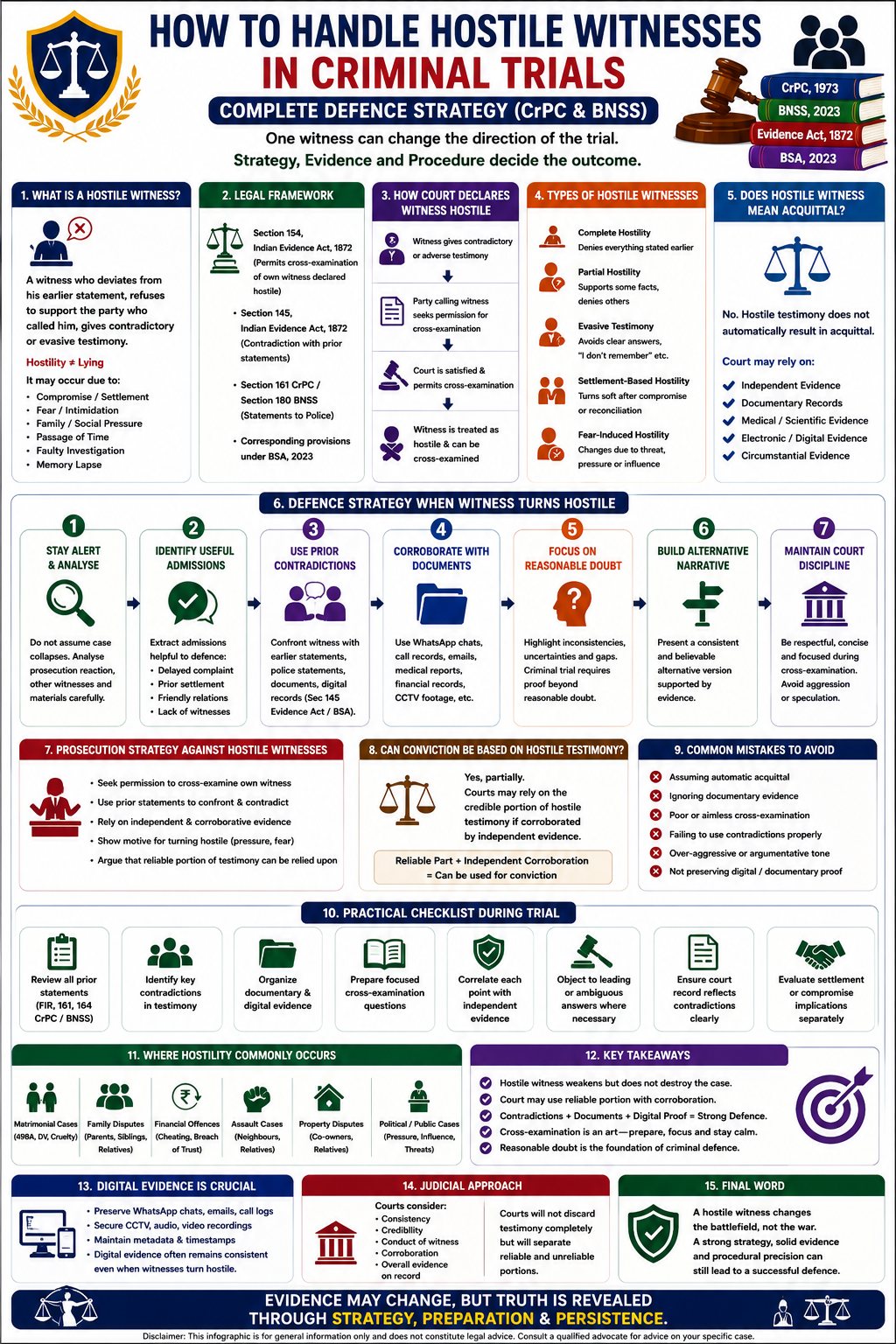
A hostile witness is generally a witness who:
- Deviates from earlier statements
- Refuses to support the party who called them
- Gives contradictory testimony
- Becomes adverse to the prosecution or defence
Hostility does not automatically mean the witness is lying.
Sometimes witnesses become hostile because of:
- Compromise or settlement
- Fear or intimidation
- Family pressure
- Passage of time
- Faulty investigation
- Emotional considerations
- Memory inconsistencies
Legal Position of Hostile Witnesses
Under evidence law, the party calling a witness may seek permission to cross-examine its own witness if the witness turns hostile.
Under Indian Evidence Act
- Section 154 Indian Evidence Act
Under Bharatiya Sakshya Adhiniyam, 2023
- Corresponding provisions relating to hostile witness cross-examination under BSA
The court has discretion to permit such cross-examination.
Does Hostile Witness Mean Automatic Acquittal?
No.
This is one of the biggest misconceptions.
Even if a witness turns hostile:
- The entire prosecution case does not automatically fail
- Courts may still rely on other evidence
- Portions of hostile testimony may still be accepted
Courts examine:
- Independent evidence
- Documentary records
- Medical evidence
- Electronic evidence
- Circumstantial material
Therefore, hostility weakens a case—but may not completely destroy it.
Common Types of Hostile Witness Situations
1. Complete Hostility
The witness completely denies earlier allegations.
Example:
“I never gave such statement.”
2. Partial Hostility
The witness supports some facts but denies critical allegations.
Example:
- Admits quarrel
- Denies assault
3. Evasive Testimony
The witness avoids giving clear answers.
Example:
- “I do not remember.”
- “I am not sure.”
4. Settlement-Based Hostility
Common in:
- Matrimonial disputes
- Cheque bounce matters
- Family conflicts
The witness softens after compromise.
5. Fear-Induced Hostility
The witness changes testimony due to:
- Pressure
- Threats
- Social influence
Courts carefully scrutinise such situations.
Relevant Investigation Provisions
Statements recorded during investigation may become important when witnesses turn hostile.
Police Statements
- Section 161 CrPC (Section 180 BNSS)
Contradictions During Trial
- Section 145 Indian Evidence Act
- Corresponding BSA provisions
Prior inconsistent statements may be used to confront the witness.
How Courts Declare a Witness Hostile
The court does not automatically declare hostility merely because testimony becomes inconvenient.
Usually:
Step 1
Witness gives contradictory testimony.
Step 2
The party calling the witness seeks permission.
Step 3
Court permits cross-examination if justified.
Step 4
Witness may be confronted with earlier statements.
Can Defence Benefit From Hostile Witnesses?
Yes—strategically.
A hostile witness may help defence by:
- Weakening prosecution narrative
- Creating reasonable doubt
- Contradicting FIR allegations
- Supporting false implication defence
- Exposing exaggeration
However, defence must still proceed carefully.
Defence Strategy When Witness Turns Hostile
Step 1: Stay Procedurally Alert
Do not assume the case automatically collapses.
Monitor:
- Prosecution reaction
- Documentary evidence
- Other witness testimony
- Medical evidence
Trials are evaluated cumulatively.
Step 2: Identify Useful Admissions
Even hostile witnesses may inadvertently support defence.
Look for admissions relating to:
- Delayed complaint
- Prior settlement discussions
- Friendly relations after incident
- Separate residence
- Financial disputes
- Lack of independent witnesses
Strategic extraction matters.
Step 3: Use Prior Contradictions Carefully
If contradictions exist:
Confront the witness using:
- Earlier police statements
- Prior complaints
- Digital records
- Written communications
Relevant provision:
- Section 145 Evidence Act / corresponding BSA provision
Contradictions can significantly weaken credibility.
Step 4: Correlate With Documentary Evidence
Use:
- WhatsApp chats
- Call records
- Financial records
- Medical reports
- CCTV footage
Digital evidence often becomes decisive after hostile testimony.
Step 5: Focus on Reasonable Doubt
Criminal trials require proof beyond reasonable doubt.
Hostile testimony may create:
- Inconsistency
- Uncertainty
- Evidentiary gaps
Defence should emphasise cumulative doubt.
Prosecution Strategy Against Hostile Witnesses
When witnesses turn hostile, prosecution generally attempts to:
Cross-Examine Own Witness
With court permission.
Use Earlier Statements for Contradiction
Especially investigation statements.
Rely on Independent Evidence
Such as:
- Medical reports
- Scientific evidence
- Electronic evidence
Demonstrate Pressure or Influence
If witness appears compromised.
Importance of Cross-Examination
Cross-examination becomes critical once hostility emerges.
Effective cross-examination may reveal:
- Motive for changing testimony
- Prior inconsistency
- Settlement pressure
- Relationship dynamics
- Memory gaps
A poorly handled hostile witness can damage either side.
Hostile Witnesses in Matrimonial Cases
Hostility frequently occurs in:
- Section 498A IPC prosecutions
- Domestic violence-related criminal complaints
- Family disputes involving relatives
Common reasons include:
- Settlement
- Mutual divorce
- Family pressure
- Reconciliation attempts
Defence should examine:
Whether Settlement Exists
May support quashing later.
Whether Allegations Became Generalised
Vague allegations weaken prosecution.
Whether Witnesses Contradict FIR
Contradictions can become significant.
Hostile Witnesses in Financial and Property Cases
In financial disputes, hostility may arise because of:
- Business settlement
- Debt repayment
- Family compromise
Defence should examine:
- Transaction records
- Written agreements
- Payment proof
- Email communication
Can Conviction Be Based on Hostile Witness Testimony?
Yes—partially.
Courts may rely on the credible portion of hostile testimony if corroborated by independent evidence.
Therefore:
- Hostility does not erase testimony entirely
- Courts separate reliable and unreliable portions
This principle is extremely important.
Judicial Approach
Indian courts generally hold:
- Hostile testimony is not automatically discarded
- Courts may accept trustworthy portions
- Contradictions affect weight, not automatic admissibility
- Independent corroboration remains important
Thus, credibility analysis becomes central.
Common Defence Mistakes
Avoid:
Assuming Automatic Acquittal
Hostility alone may not end prosecution.
Ignoring Documentary Evidence
Courts increasingly rely on electronic records.
Over-Aggressive Cross-Examination
May alienate the court.
Failing to Use Contradictions Properly
Technical procedure matters.
Ignoring Settlement Dynamics
Settlement may influence broader strategy.
Practical Checklist for Handling Hostile Witnesses
During trial, ensure:
- Prior statements reviewed
- Contradictions identified
- Digital evidence preserved
- Cross-examination strategy prepared
- Documentary corroboration organized
- Settlement implications assessed
- Court record monitored carefully
Strategic Importance of Digital Evidence
Modern courts increasingly rely on:
- WhatsApp chats
- Audio recordings
- Call detail records
- Financial records
- CCTV footage
because human testimony may fluctuate.
Therefore, documentary and electronic evidence often stabilize defence strategy.
Hostile Witness vs False Evidence
A hostile witness is not automatically guilty of perjury.
Courts distinguish between:
- Natural inconsistency
- Memory failure
- Deliberate falsehood
Perjury proceedings require separate legal analysis.
Conclusion
Hostile witnesses can dramatically reshape criminal trials—but their impact depends entirely on how the evidence is handled.
For defence strategy, hostile testimony may:
- Create reasonable doubt
- Expose contradictions
- Support false implication arguments
- Weaken prosecution consistency
However, success still depends on:
- Cross-examination quality
- Documentary support
- Digital evidence
- Procedural precision
- Overall credibility analysis
By:
- Staying strategically disciplined
- Using contradictions carefully
- Correlating digital evidence
- Understanding evidentiary rules
litigants can effectively navigate hostile witness situations.
In criminal trials, a hostile witness changes the battlefield—but strategy still determines the outcome.
Index of Legal Strategies and Defence is here.
Key Contributor :
Mrs. Suprajaa Rajan B.Com., LL.B., LL.M.
+91-9606345150