web analytics

Menu

Skip to content
Shades of Knife
  • Home
  • True Colors of a Vile Wife
  • Need Inspiration?
  • Blog Updates
  • SOK Gallery
  • Vile News Reporter
  • About Me
  • Contact Me

Shades of Knife

True Colors of a Vile Wife

Tag: 498A defence strategy

How to Handle Hostile Witnesses in Criminal Trials – Complete Defence Strategy

Posted on May 22 by Suprajaa Rajan

Witness testimony often forms the backbone of a criminal trial. However, during investigation and trial, witnesses do not always remain consistent. A witness may:

  • Change statements
  • Contradict earlier testimony
  • Refuse to support the prosecution
  • Become evasive
  • Suppress material facts
  • Support the accused unexpectedly

When this happens, courts may treat the person as a hostile witness.

Hostile witnesses frequently arise in:

  • Matrimonial disputes
  • Family conflicts
  • Financial offences
  • Assault cases
  • Property disputes
  • Political cases
  • Cases involving compromise or settlement

For both prosecution and defence, handling hostile witnesses strategically becomes crucial because one witness can significantly alter the direction of the trial.

Therefore, understanding how hostile witnesses are treated, examined, challenged, and strategically handled is essential for litigants and lawyers alike.

This article explains the legal framework, procedural strategy, cross-examination methods, evidentiary impact, judicial approach, and defence considerations, with references to the Code of Criminal Procedure, 1973 (CrPC), the Bharatiya Nagarik Suraksha Sanhita, 2023 (BNSS), the Indian Evidence Act, 1872, and the Bharatiya Sakshya Adhiniyam, 2023 (BSA).
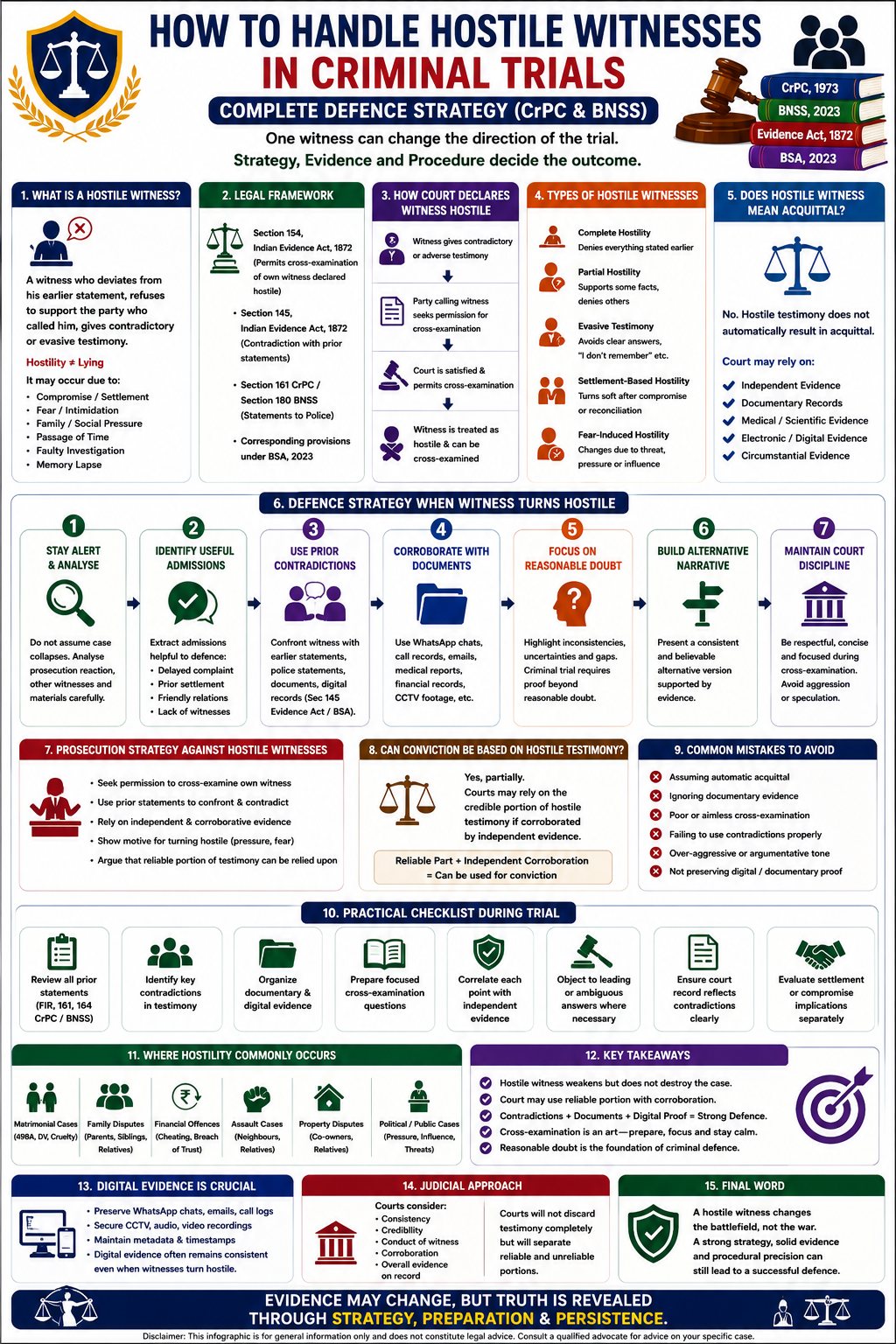
What Is a Hostile Witness?

A hostile witness is generally a witness who:

  • Deviates from earlier statements
  • Refuses to support the party who called them
  • Gives contradictory testimony
  • Becomes adverse to the prosecution or defence

Hostility does not automatically mean the witness is lying.

Sometimes witnesses become hostile because of:

  • Compromise or settlement
  • Fear or intimidation
  • Family pressure
  • Passage of time
  • Faulty investigation
  • Emotional considerations
  • Memory inconsistencies

Legal Position of Hostile Witnesses

Under evidence law, the party calling a witness may seek permission to cross-examine its own witness if the witness turns hostile.

Under Indian Evidence Act

  • Section 154 Indian Evidence Act

Under Bharatiya Sakshya Adhiniyam, 2023

  • Corresponding provisions relating to hostile witness cross-examination under BSA

The court has discretion to permit such cross-examination.

Does Hostile Witness Mean Automatic Acquittal?

No.

This is one of the biggest misconceptions.

Even if a witness turns hostile:

  • The entire prosecution case does not automatically fail
  • Courts may still rely on other evidence
  • Portions of hostile testimony may still be accepted

Courts examine:

  • Independent evidence
  • Documentary records
  • Medical evidence
  • Electronic evidence
  • Circumstantial material

Therefore, hostility weakens a case—but may not completely destroy it.

Common Types of Hostile Witness Situations

1. Complete Hostility

The witness completely denies earlier allegations.

Example:

“I never gave such statement.”

2. Partial Hostility

The witness supports some facts but denies critical allegations.

Example:

  • Admits quarrel
  • Denies assault

3. Evasive Testimony

The witness avoids giving clear answers.

Example:

  • “I do not remember.”
  • “I am not sure.”

4. Settlement-Based Hostility

Common in:

  • Matrimonial disputes
  • Cheque bounce matters
  • Family conflicts

The witness softens after compromise.

5. Fear-Induced Hostility

The witness changes testimony due to:

  • Pressure
  • Threats
  • Social influence

Courts carefully scrutinise such situations.

Relevant Investigation Provisions

Statements recorded during investigation may become important when witnesses turn hostile.

Police Statements

  • Section 161 CrPC (Section 180 BNSS)

Contradictions During Trial

  • Section 145 Indian Evidence Act
  • Corresponding BSA provisions

Prior inconsistent statements may be used to confront the witness.

How Courts Declare a Witness Hostile

The court does not automatically declare hostility merely because testimony becomes inconvenient.

Usually:

Step 1

Witness gives contradictory testimony.

Step 2

The party calling the witness seeks permission.

Step 3

Court permits cross-examination if justified.

Step 4

Witness may be confronted with earlier statements.

Can Defence Benefit From Hostile Witnesses?

Yes—strategically.

A hostile witness may help defence by:

  • Weakening prosecution narrative
  • Creating reasonable doubt
  • Contradicting FIR allegations
  • Supporting false implication defence
  • Exposing exaggeration

However, defence must still proceed carefully.

Defence Strategy When Witness Turns Hostile

Step 1: Stay Procedurally Alert

Do not assume the case automatically collapses.

Monitor:

  • Prosecution reaction
  • Documentary evidence
  • Other witness testimony
  • Medical evidence

Trials are evaluated cumulatively.

Step 2: Identify Useful Admissions

Even hostile witnesses may inadvertently support defence.

Look for admissions relating to:

  • Delayed complaint
  • Prior settlement discussions
  • Friendly relations after incident
  • Separate residence
  • Financial disputes
  • Lack of independent witnesses

Strategic extraction matters.

Step 3: Use Prior Contradictions Carefully

If contradictions exist:

Confront the witness using:

  • Earlier police statements
  • Prior complaints
  • Digital records
  • Written communications

Relevant provision:

  • Section 145 Evidence Act / corresponding BSA provision

Contradictions can significantly weaken credibility.

Step 4: Correlate With Documentary Evidence

Use:

  • WhatsApp chats
  • Call records
  • Financial records
  • Medical reports
  • CCTV footage

Digital evidence often becomes decisive after hostile testimony.

Step 5: Focus on Reasonable Doubt

Criminal trials require proof beyond reasonable doubt.

Hostile testimony may create:

  • Inconsistency
  • Uncertainty
  • Evidentiary gaps

Defence should emphasise cumulative doubt.

Prosecution Strategy Against Hostile Witnesses

When witnesses turn hostile, prosecution generally attempts to:

Cross-Examine Own Witness

With court permission.

Use Earlier Statements for Contradiction

Especially investigation statements.

Rely on Independent Evidence

Such as:

  • Medical reports
  • Scientific evidence
  • Electronic evidence

Demonstrate Pressure or Influence

If witness appears compromised.

Importance of Cross-Examination

Cross-examination becomes critical once hostility emerges.

Effective cross-examination may reveal:

  • Motive for changing testimony
  • Prior inconsistency
  • Settlement pressure
  • Relationship dynamics
  • Memory gaps

A poorly handled hostile witness can damage either side.

Hostile Witnesses in Matrimonial Cases

Hostility frequently occurs in:

  • Section 498A IPC prosecutions
  • Domestic violence-related criminal complaints
  • Family disputes involving relatives

Common reasons include:

  • Settlement
  • Mutual divorce
  • Family pressure
  • Reconciliation attempts

Defence should examine:

Whether Settlement Exists

May support quashing later.

Whether Allegations Became Generalised

Vague allegations weaken prosecution.

Whether Witnesses Contradict FIR

Contradictions can become significant.

Hostile Witnesses in Financial and Property Cases

In financial disputes, hostility may arise because of:

  • Business settlement
  • Debt repayment
  • Family compromise

Defence should examine:

  • Transaction records
  • Written agreements
  • Payment proof
  • Email communication

Can Conviction Be Based on Hostile Witness Testimony?

Yes—partially.

Courts may rely on the credible portion of hostile testimony if corroborated by independent evidence.

Therefore:

  • Hostility does not erase testimony entirely
  • Courts separate reliable and unreliable portions

This principle is extremely important.

Judicial Approach

Indian courts generally hold:

  • Hostile testimony is not automatically discarded
  • Courts may accept trustworthy portions
  • Contradictions affect weight, not automatic admissibility
  • Independent corroboration remains important

Thus, credibility analysis becomes central.

Common Defence Mistakes

Avoid:

Assuming Automatic Acquittal

Hostility alone may not end prosecution.

Ignoring Documentary Evidence

Courts increasingly rely on electronic records.

Over-Aggressive Cross-Examination

May alienate the court.

Failing to Use Contradictions Properly

Technical procedure matters.

Ignoring Settlement Dynamics

Settlement may influence broader strategy.

Practical Checklist for Handling Hostile Witnesses

During trial, ensure:

  • Prior statements reviewed
  • Contradictions identified
  • Digital evidence preserved
  • Cross-examination strategy prepared
  • Documentary corroboration organized
  • Settlement implications assessed
  • Court record monitored carefully

Strategic Importance of Digital Evidence

Modern courts increasingly rely on:

  • WhatsApp chats
  • Audio recordings
  • Call detail records
  • Financial records
  • CCTV footage

because human testimony may fluctuate.

Therefore, documentary and electronic evidence often stabilize defence strategy.

Hostile Witness vs False Evidence

A hostile witness is not automatically guilty of perjury.

Courts distinguish between:

  • Natural inconsistency
  • Memory failure
  • Deliberate falsehood

Perjury proceedings require separate legal analysis.

Conclusion

Hostile witnesses can dramatically reshape criminal trials—but their impact depends entirely on how the evidence is handled.

For defence strategy, hostile testimony may:

  • Create reasonable doubt
  • Expose contradictions
  • Support false implication arguments
  • Weaken prosecution consistency

However, success still depends on:

  • Cross-examination quality
  • Documentary support
  • Digital evidence
  • Procedural precision
  • Overall credibility analysis

By:

  • Staying strategically disciplined
  • Using contradictions carefully
  • Correlating digital evidence
  • Understanding evidentiary rules

litigants can effectively navigate hostile witness situations.

In criminal trials, a hostile witness changes the battlefield—but strategy still determines the outcome.


Index of Legal Strategies and Defence is here. 


Key Contributor : 

Mrs. Suprajaa Rajan B.Com., LL.B., LL.M.

+91-9606345150

Posted in Legal Procedure | Tagged 498A Defence 498A defence strategy BNSS Code of Criminal Procedure Hostile Witness Case Legal Strategies and Defence Matrimonial Litigation India | Leave a comment

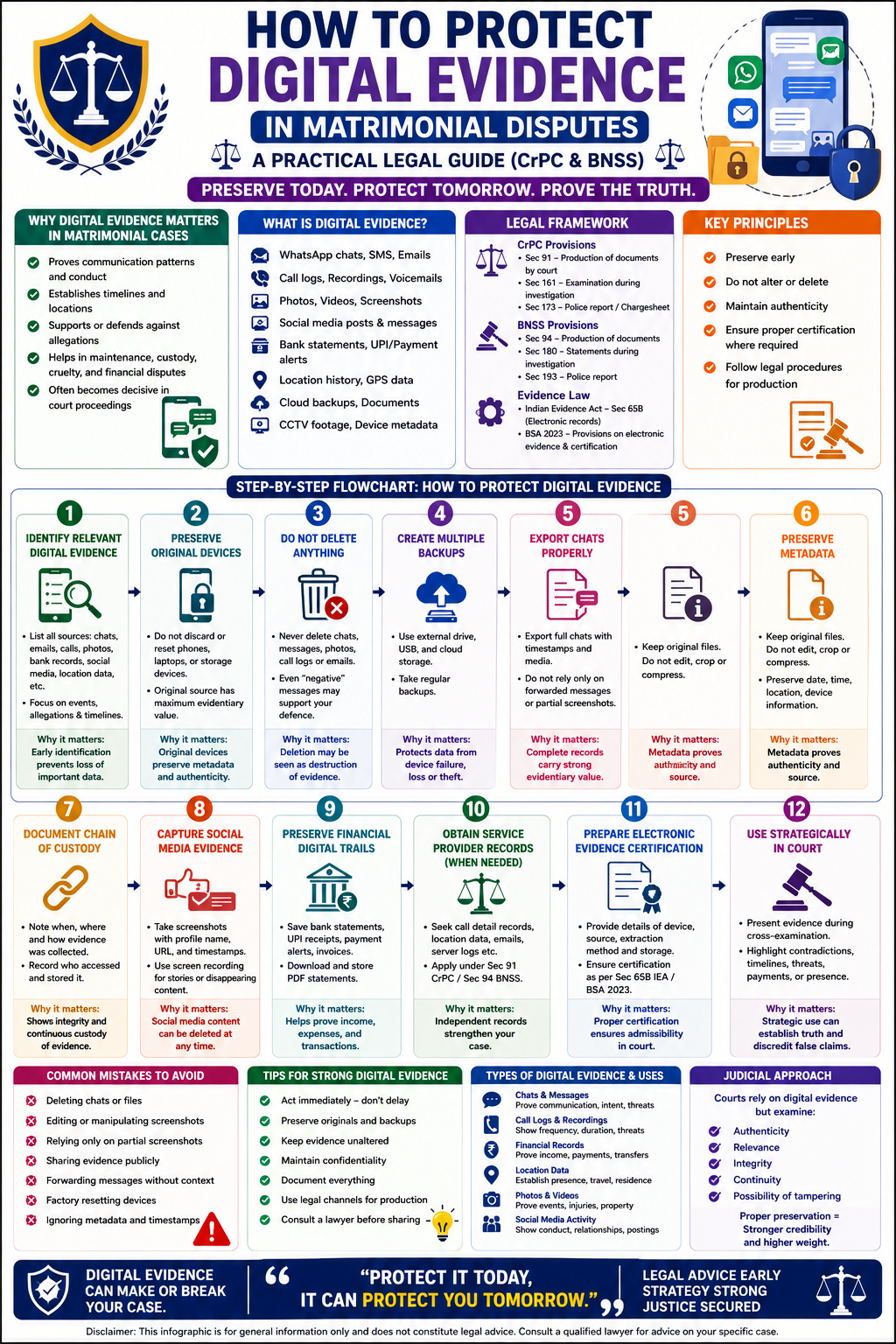
How to Protect Digital Evidence in Matrimonial Disputes – A Practical Legal Guide

Posted on May 6 by Suprajaa Rajan

In modern matrimonial litigation, digital evidence often speaks louder than oral allegations. WhatsApp chats, emails, call logs, bank alerts, social media posts, photographs, location records, video calls, and cloud backups frequently become decisive in disputes involving:

  • Cruelty allegations
  • Dowry harassment complaints
  • Domestic violence proceedings
  • Maintenance disputes
  • Child custody battles
  • Adultery-related allegations
  • Financial concealment claims
  • False implication defences

In many cases, the party who preserves digital evidence properly gains a significant strategic advantage.

However, digital evidence is fragile. Messages can disappear, devices can fail, accounts can be deleted, metadata can change, and improper handling can destroy evidentiary value.

Therefore, understanding how to protect digital evidence in matrimonial disputes becomes essential for litigants, family members, and legal practitioners.

This article explains the complete strategy for identifying, preserving, authenticating, producing, and defending digital evidence, with references to the Code of Criminal Procedure, 1973 (CrPC), the Bharatiya Nagarik Suraksha Sanhita, 2023 (BNSS), the Indian Evidence Act, 1872, and the Bharatiya Sakshya Adhiniyam, 2023 (BSA).

What Is Digital Evidence?

Digital evidence includes any information stored, transmitted, or generated electronically.

Common examples include:

  • WhatsApp chats
  • SMS messages
  • Emails
  • Call recordings
  • Video recordings
  • CCTV footage
  • GPS location history
  • UPI/payment alerts
  • Banking app notifications
  • Social media posts
  • Cloud backups
  • Google timeline records
  • Screenshots
  • Photographs with metadata
  • Audio notes
  • Video call records

In matrimonial disputes, these records often reveal:

  • Communication patterns
  • Financial conduct
  • Residence history
  • Threats or harassment
  • Reconciliation attempts
  • Settlement discussions
  • Contradictions in allegations

Why Digital Evidence Matters in Matrimonial Cases

Digital evidence frequently helps establish:

Cruelty or Harassment

Messages may show:

  • Threats
  • Abusive language
  • Emotional manipulation
  • Coercive demands

False Allegations

Chats may reveal:

  • Friendly communication after alleged incidents
  • Settlement pressure
  • Contradictory statements

Financial Disputes

Bank records may show:

  • Transfers
  • Shared expenses
  • Hidden income
  • Asset diversion

Custody Disputes

Location records and communication logs may establish:

  • Parenting involvement
  • Travel history
  • Daily caregiving

Thus, digital evidence often shapes the narrative before trial even begins.

Legal Framework

Investigation and Document Production

Production of Documents

  • Section 91 CrPC (BNSS Section 94)

Courts may summon:

  • Phone records
  • Bank records
  • Emails
  • Server logs
  • Cloud data

Investigation Statements

  • Section 161 CrPC (BNSS Section 180)

Digital records may be examined during investigation.

Police Report

  • Section 173 CrPC (BNSS Section 193)

Electronic material may form part of the chargesheet.

Electronic Evidence Under Evidence Law

Under Indian Evidence Act

  • Section 65B

Under Bharatiya Sakshya Adhiniyam, 2023

  • Electronic records provisions under BSA

Electronic evidence generally requires proper certification where applicable.

Therefore, preservation must begin early.

Step 1: Identify Relevant Digital Evidence Immediately

The first mistake many litigants make is waiting too long.

The moment matrimonial conflict escalates, identify relevant digital records.

Create a checklist:

Communication

  • WhatsApp chats
  • SMS
  • Emails
  • Telegram/Signal chats

Financial

  • UPI records
  • Bank alerts
  • Wallet transactions

Media

  • Photos
  • Videos
  • Audio notes

Location

  • Google timeline
  • Ride-sharing records
  • Travel bookings

Social Media

  • Posts
  • Stories
  • Direct messages

Early identification prevents accidental loss.

Step 2: Preserve Original Devices

One of the most important rules:

Never discard the original device.

Preserve:

  • Mobile phones
  • Laptops
  • Tablets
  • External drives
  • Memory cards

Why?

Because courts often prefer original sources.

Metadata may include:

  • Date
  • Time
  • Device information
  • Location
  • File creation history

Changing devices without backups can destroy critical evidence.

Step 3: Do Not Delete Anything

Many people delete chats out of anger or fear.

This can be disastrous.

Never delete:

  • Messages
  • Photos
  • Audio notes
  • Call logs
  • Contact histories

Even “embarrassing” messages may later support your defence.

Preservation always comes before interpretation.

Step 4: Create Multiple Backups

Create secure backups immediately.

Use:

Local Backup

  • External hard drive
  • Encrypted USB drive

Cloud Backup

Examples include:

Google Drive,
iCloud, or
Microsoft OneDrive

Offline Export

Export:

  • Chat histories
  • Emails
  • Call logs

Multiple backups reduce accidental loss.

Step 5: Export Chats Properly

For messaging platforms:

Export complete chats.

Do not:

  • Crop screenshots
  • Forward selected messages only
  • Edit content

Instead:

  • Export with timestamps
  • Include media where relevant
  • Preserve contact details

Incomplete screenshots often invite challenge.

Step 6: Preserve Metadata

Metadata often becomes more valuable than the content itself.

Metadata may prove:

  • Exact creation time
  • Device source
  • GPS location
  • Editing history

Do not:

  • Compress files repeatedly
  • Rename files unnecessarily
  • Edit screenshots

Original metadata strengthens authenticity.

Step 7: Record Chain of Custody

Document:

  • When evidence was collected
  • Who accessed it
  • Where it was stored
  • When backups were created

This becomes crucial if authenticity is challenged later.

Step 8: Capture Social Media Evidence Correctly

If social media content may disappear:

Preserve:

  • Profile URLs
  • Screenshots
  • Screen recordings
  • Time and date stamps

Include:

  • Username
  • Profile picture
  • Post date
  • Comments

Anonymous screenshots are weaker.

Step 9: Preserve Financial Digital Trails

Save:

  • Net banking screenshots
  • Transaction IDs
  • UPI receipts
  • Wallet statements
  • Credit card statements

Financial evidence often defeats exaggerated maintenance claims.

Step 10: Obtain Service Provider Records Where Necessary

If records become disputed, seek production through court.

Apply under:

  • Section 91 CrPC (Section 94 BNSS)

Possible records include:

  • Call detail records
  • Tower location
  • Email server logs
  • Banking records
  • Telecom records

Independent records often carry high credibility.

Step 11: Prepare Electronic Evidence Certification

Where certification becomes necessary:

Prepare:

  • Device details
  • Source details
  • Extraction method
  • Storage details

Certification should align with applicable evidence law.

Improper certification may delay admissibility.

Step 12: Use Digital Evidence Strategically During Cross-Examination

Digital evidence is most powerful when used at the right stage.

Use it to challenge:

  • Timelines
  • Presence claims
  • Threat allegations
  • Financial assertions
  • Residence disputes

Examples:

Friendly Chats After Alleged Cruelty

May weaken prosecution.

Location Records

May disprove physical presence.

Payment Records

May contradict maintenance claims.

Common Mistakes to Avoid

Avoid:

Selective Screenshots

Incomplete records weaken credibility.

Editing Messages

Manipulation can destroy admissibility.

Sharing Evidence Publicly

Social media disclosure may backfire.

Forwarding Sensitive Evidence

Loss of metadata may occur.

Relying Only on Screenshots

Original files matter.

Factory Resetting Devices

Critical evidence may disappear permanently.

Defence Strategy in False Matrimonial Cases

If defending against false allegations, digital evidence may establish:

Separate Residence

Location history.

Friendly Relations

Post-incident chats.

Settlement Pressure

Recorded negotiations.

Financial Independence

Income transfers and business activity.

False Timelines

Travel records and digital timestamps.

Judicial Approach

Courts increasingly rely on:

  • Electronic communication
  • Digital payment records
  • Location evidence
  • Social media activity
  • Audio and video recordings

However, courts also carefully examine:

  • Authenticity
  • Continuity
  • Source reliability
  • Possibility of manipulation

Therefore, preservation matters as much as content.

Practical Digital Evidence Checklist

Before litigation escalates, ensure:

  • Original device preserved
  • Chats exported
  • Cloud backup created
  • Financial records saved
  • Metadata preserved
  • Social media content archived
  • Chain of custody recorded
  • Service provider records identified
  • Legal certification planned

Conclusion

In matrimonial litigation, digital evidence often becomes the most powerful witness.

A properly preserved digital record can:

  • Support genuine allegations
  • Expose false claims
  • Protect innocent family members
  • Strengthen settlement negotiations
  • Influence bail, trial, maintenance, and quashing proceedings

By:

  • Acting early
  • Preserving originals
  • Creating secure backups
  • Maintaining metadata
  • Using procedural tools strategically

you can significantly strengthen your legal position.

In modern litigation, devices may forget—but properly preserved digital evidence does not.


Index of Legal Strategies and Defence is here. 


Key Contributor : 

Mrs. Suprajaa Rajan B.Com., LL.B., LL.M.

+91-9606345150

Posted in Legal Procedure | Tagged 498A Defence 498A defence strategy BNSS Code of Criminal Procedure Digital Evidence Legal Strategies and Defence Matrimonial dispute Matrimonial Litigation India | Leave a comment

Cross-Examination Strategy in 498A Trials – Defence Tactics That Can Change the Outcome

Posted on May 4 by Suprajaa Rajan

In criminal trials arising out of matrimonial disputes, cross-examination often determines the final outcome more than the FIR itself. While allegations under Section 498A of the IPC may appear serious at the initial stage, many prosecutions weaken when witnesses face a structured and legally sound cross-examination.

A well-planned cross-examination can:

  • Expose exaggerations and contradictions
  • Reveal omissions in prior statements
  • Test credibility of prosecution witnesses
  • Challenge documentary evidence
  • Build a foundation for acquittal

Therefore, understanding the cross-examination strategy in 498A trials becomes critical for every accused person, defence lawyer, and family member involved in matrimonial criminal litigation.

This article explains the legal framework, strategic approach, practical techniques, and common mistakes to avoid, with references to both the Code of Criminal Procedure, 1973 (CrPC) and the Bharatiya Nagarik Suraksha Sanhita, 2023 (BNSS).

Understanding Cross-Examination in Criminal Trials

Cross-examination is the process where the defence questions prosecution witnesses after examination-in-chief.

In criminal trials, evidence is recorded before the trial court under:

  • Section 273 CrPC (BNSS Section 308) – Evidence to be taken in presence of accused
  • Section 231 CrPC (BNSS Section 254) – Evidence for prosecution in Sessions trial
  • Section 242 CrPC (BNSS Section 265) – Evidence in warrant cases instituted otherwise than on police report
  • Section 246 CrPC (BNSS Section 269) – Evidence in warrant cases on police report

Cross-examination forms a core part of the constitutional guarantee of a fair trial.

Why Cross-Examination Is Crucial in 498A Cases

In many matrimonial prosecutions, allegations involve:

  • Mental cruelty
  • Physical harassment
  • Dowry demands
  • Emotional abuse
  • Family-wide allegations against relatives

However, many complaints also contain:

  • General allegations
  • Omnibus accusations
  • Emotional exaggerations
  • Lack of dates, places, and specific incidents

A strategic cross-examination can expose these weaknesses.

Step 1: Study the Entire Prosecution Record

Before asking even one question, the defence must thoroughly analyse:

FIR

Compare:

  • Dates of incidents
  • Sequence of allegations
  • Names of accused persons
  • Specific acts attributed to each accused

Relevant provision:

  • Section 154 CrPC (BNSS Section 173) – Registration of FIR

Statements During Investigation

Compare witness statements recorded under:

  • Section 161 CrPC (BNSS Section 180) – Police statements

Look for:

  • Improvements
  • Omissions
  • Contradictions

Documents Filed with Chargesheet

Review:

  • Medical records
  • Chat records
  • Emails
  • Financial documents
  • Photographs
  • Call records

Chargesheet filed under:

  • Section 173 CrPC (BNSS Section 193)

Step 2: Identify the Defence Theory First

Cross-examination should never be random.

First establish:

What is your defence?

Examples:

  • False implication after matrimonial dispute
  • Property dispute disguised as criminal complaint
  • Pressure for settlement
  • Retaliation after divorce proceedings
  • Inclusion of distant relatives without role

Every question must support this theory.

Step 3: Challenge Specificity of Allegations

One of the strongest strategies in 498A trials is to expose vague allegations.

Ask questions such as:

  • On what exact date did this happen?
  • At what location?
  • Who was present?
  • What exact words were spoken?
  • Was any complaint made immediately?

If the witness cannot answer clearly, credibility weakens.

Step 4: Expose Omnibus Allegations Against Family Members

In many 498A cases, multiple relatives are implicated.

Cross-examination should establish:

  • Whether the accused lived separately
  • Whether the accused was even present
  • Whether there was direct interaction

Ask:

  • Did the accused live in the matrimonial home?
  • Can you produce any communication with this accused?
  • How many times did you personally meet them?

This becomes especially important for:

  • Elderly parents
  • Married sisters
  • Relatives living in other cities

Step 5: Use Prior Contradictions Effectively

Contradictions are powerful tools.

If the witness changes the story from earlier statements recorded under:

  • Section 161 CrPC (BNSS Section 180)

the defence may confront them with prior omissions.

Examples:

FIR says:

“Dowry demanded.”

Court testimony says:

“₹10 lakhs demanded in front of relatives.”

If amount, date, or persons were missing earlier, the defence should highlight the improvement.

Step 6: Test Delay in Complaint

Delay often matters in matrimonial litigation.

Ask:

  • When did the alleged incident occur?
  • When did you first tell your parents?
  • Did you visit police immediately?
  • Did you seek medical treatment?
  • Did you send any written complaint?

Unexplained delay may weaken prosecution.

Step 7: Challenge Documentary Evidence

If chats, emails, audio clips, or financial documents are produced:

Question:

  • Who created this document?
  • Is it original?
  • Was it altered?
  • Who had access?
  • When was it first disclosed?

This becomes crucial in digital evidence disputes.

Step 8: Test Conduct After Alleged Cruelty

Human conduct often reveals inconsistencies.

Ask:

  • Did you continue living with the accused?
  • Did you travel together afterward?
  • Did you celebrate festivals together?
  • Did you exchange affectionate messages later?

Post-incident conduct may contradict allegations.

Step 9: Cross-Examine Independent Witnesses

Independent witnesses often strengthen or weaken the case.

Question:

  • Were you personally present?
  • Did you hear the alleged demand directly?
  • Are you related to the complainant?
  • Did you make any written complaint?

This helps distinguish hearsay from direct evidence.

Step 10: Maintain Courtroom Discipline

A strong cross-examination is:

  • Calm
  • Structured
  • Precise
  • Non-argumentative

Never:

  • Intimidate the witness
  • Ask emotional or irrelevant questions
  • Repeat questions unnecessarily

Judges observe both content and conduct.

Common Defence Mistakes

Avoid these mistakes:

Asking Questions Without Purpose

Every question must support your defence.

Asking Open-Ended Questions

Open questions may allow witnesses to repair weak testimony.

Revealing Defence Too Early

Do not disclose your entire strategy at the beginning.

Ignoring Documentary Contradictions

Documents often defeat oral exaggerations.

Emotional Cross-Examination

Aggressive questioning may backfire.

Judicial Approach in 498A Trials

Courts increasingly scrutinise:

  • Vague allegations
  • Mechanical implication of relatives
  • Improvements in testimony
  • Delayed complaints

Courts expect prosecution witnesses to withstand cross-examination with consistency.

Practical Defence Checklist

Before cross-examination, ensure:

  • FIR analysed
  • Section 161 statements compared
  • Chargesheet reviewed
  • Timeline prepared
  • Contradictions marked
  • Documentary evidence examined
  • Defence theory finalised

Conclusion

In 498A trials, cross-examination is not merely a procedural stage—it is often the turning point of the case.

A carefully planned cross-examination can:

  • Break the prosecution narrative
  • Expose exaggeration
  • Separate genuine allegations from omnibus accusations
  • Create reasonable doubt

By combining legal preparation, factual precision, and courtroom discipline, the defence can significantly improve the chances of acquittal.

In criminal trials, facts matter—but how those facts are tested in cross-examination often matters even more.


Index of Legal Strategies and Defence is here. 


Key Contributor : 

Mrs. Suprajaa Rajan B.Com., LL.B., LL.M.

+91-9606345150

Posted in Legal Procedure | Tagged 498A cases 498A Defence 498A defence strategy Cross-examination strategy Legal Strategies and Defence Matrimonial Litigation India | Leave a comment

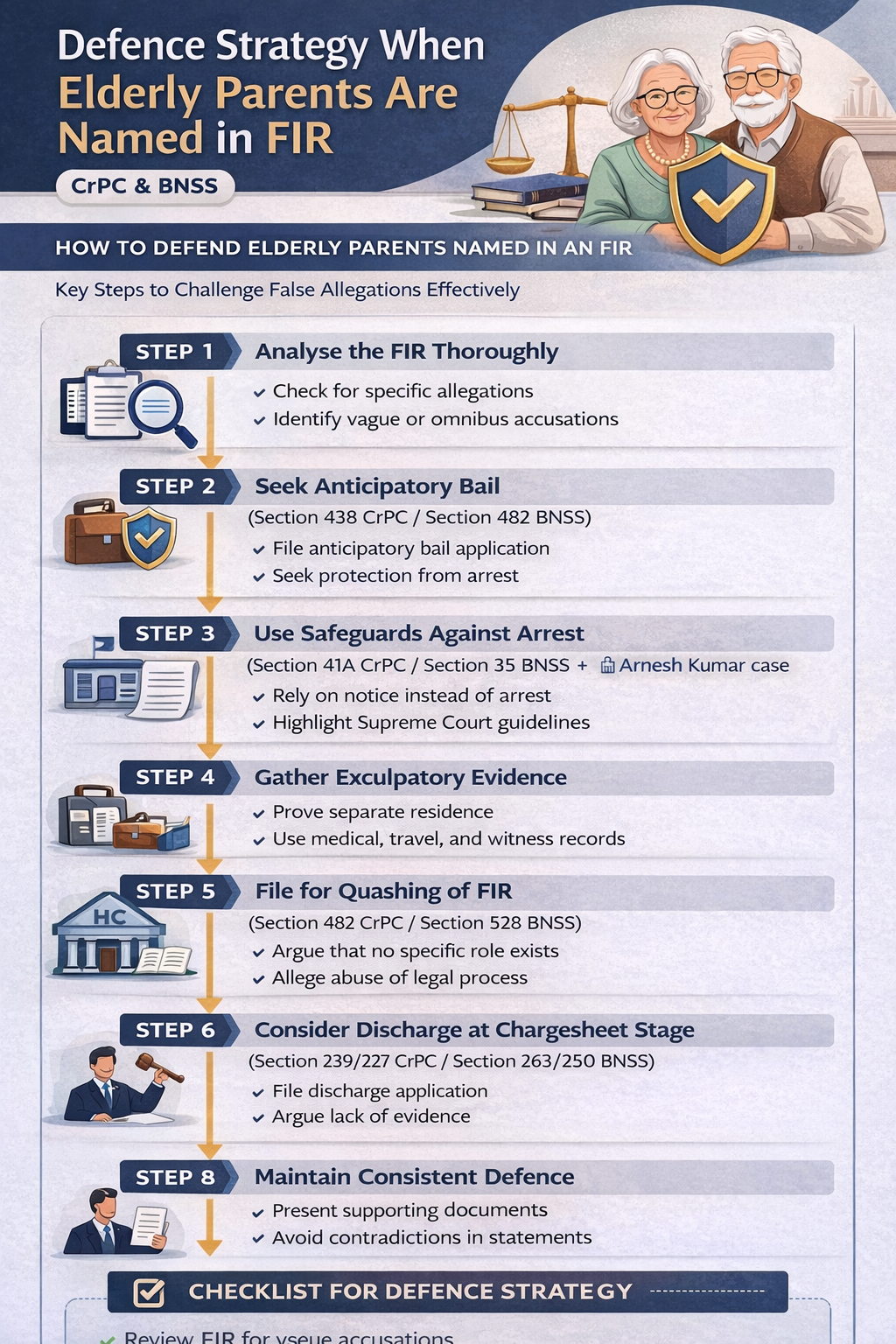
Defence Strategy When Elderly Parents Are Named in FIR

Posted on April 3 by Suprajaa Rajan

In matrimonial and family disputes, complainants often name multiple family members, including elderly parents, in a First Information Report (FIR). However, courts have consistently cautioned against the mechanical implication of relatives without specific allegations.

Therefore, when an FIR includes elderly parents, you must adopt a focused legal defence strategy. You should highlight the absence of direct involvement, lack of evidence, and misuse of criminal law provisions.

This article explains the legal remedies and defence strategies available when elderly parents are falsely implicated, along with relevant provisions under the Code of Criminal Procedure, 1973 (CrPC) and the Bharatiya Nagarik Suraksha Sanhita, 2023 (BNSS).

Understanding the Legal Position

The police register an FIR under Section 154 CrPC (Section 173 BNSS) when they receive information about a cognizable offence. After registration, the investigation begins, and all named persons may face legal scrutiny.

However, courts do not rely solely on allegations. Instead, they examine:

  • Specific acts attributed to each accused
  • Supporting evidence
  • The individual role of each person

In many cases, complaints contain general and vague allegations against elderly parents, which you can challenge at an early stage.

Step 1: Analyse the FIR Carefully

First, you must carefully examine the FIR. A strong defence always begins with identifying weaknesses in the complaint.

You should check:

  • Whether the FIR contains specific allegations
  • Whether it mentions dates, events, or overt acts
  • Whether allegations appear vague or omnibus

If the complaint lacks specificity, you can argue that it fails to disclose a prima facie case against elderly parents.

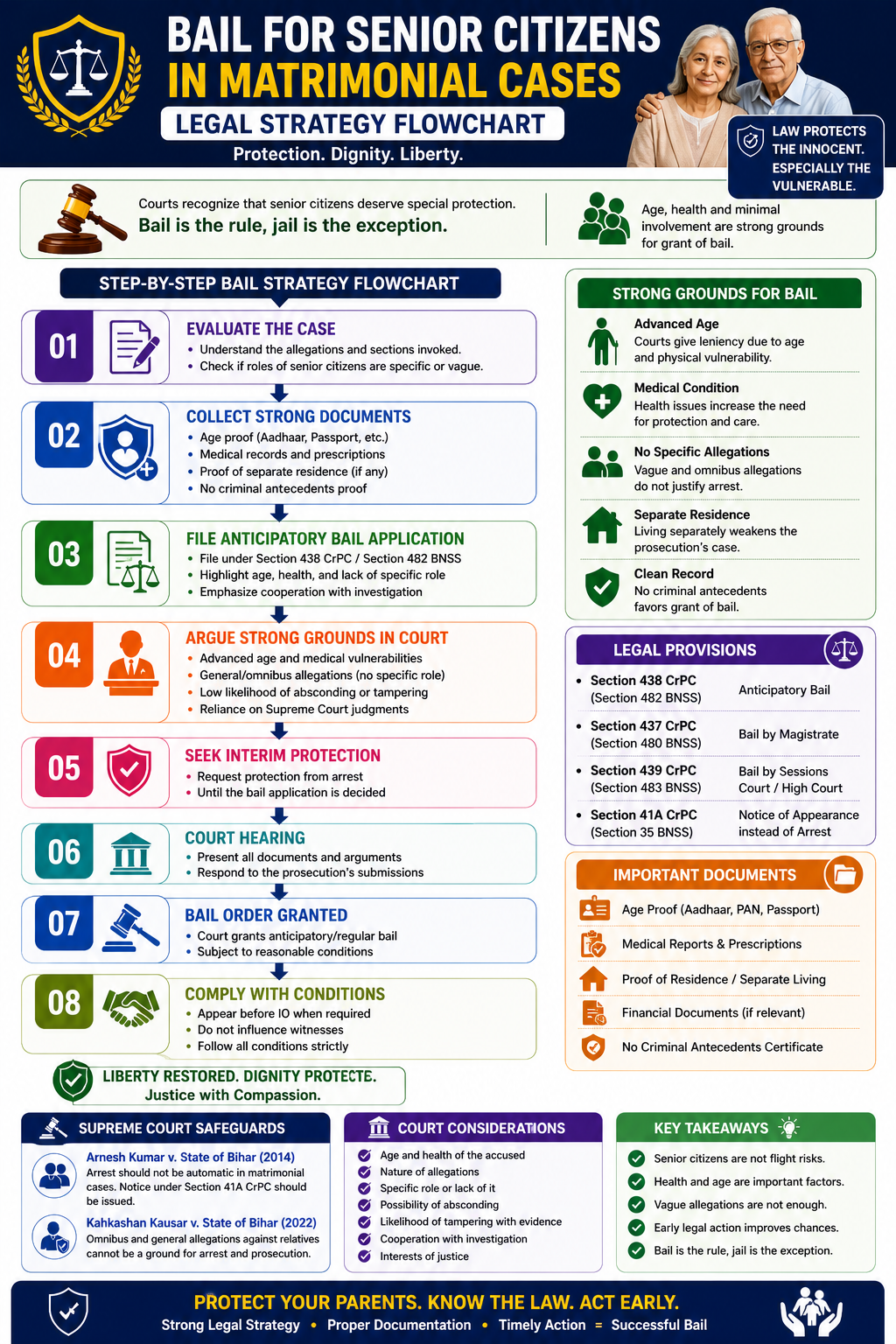
Step 2: Seek Protection from Arrest

Next, you should promptly seek protection from arrest by filing an anticipatory bail application.

You can file this application under:

  • Section 438 CrPC (Section 482 BNSS)

Courts generally adopt a lenient approach toward elderly parents, especially when:

  • They reside separately
  • They have no direct involvement
  • The allegations appear exaggerated

Additionally, courts consider age, health, and dependency factors while granting relief.

Step 3: Rely on Safeguards Against Arbitrary Arrest

You should also rely on statutory safeguards that prevent unnecessary arrests.

The police must issue a notice of appearance under:

  • Section 41A CrPC (Section 35 BNSS)

instead of making immediate arrests when the accused cooperates with the investigation.

Further, the Supreme Court in
Arnesh Kumar v. State of Bihar
directed authorities to avoid automatic arrests in matrimonial offences.

Therefore, elderly parents can use these safeguards to prevent unjustified detention and harassment.

Step 4: Gather Evidence Showing Lack of Involvement

After securing protection, you should collect evidence that demonstrates the absence of involvement.

You should gather:

  • Proof of separate residence
  • Medical records indicating age-related limitations
  • Travel records
  • Independent witness statements

This evidence helps establish that the allegations are false, exaggerated, or legally unsustainable.

Step 5: File for Quashing of FIR

If the FIR clearly lacks specific allegations, you should approach the High Court to quash the proceedings.

You can invoke:

  • Section 482 CrPC (Section 528 BNSS)

The High Court may quash proceedings when:

  • Allegations are vague or omnibus
  • No specific role is attributed
  • Continuation of proceedings amounts to abuse of process

Courts frequently grant relief to elderly parents in such circumstances.

Step 6: Seek Discharge at Chargesheet Stage

If the police file a chargesheet, you should consider filing a discharge application.

Relevant provisions include:

  • Section 239 CrPC (Section 263 BNSS) – Warrant cases
  • Section 227 CrPC (Section 250 BNSS) – Sessions cases

You can argue that:

  • No evidence exists against elderly parents
  • The chargesheet fails to establish involvement
  • The case relies on assumptions rather than proof

If the court agrees, it may discharge the accused at this stage.

Step 7: Challenge Mechanical Implication of Relatives

Courts consistently discourage the practice of implicating all family members without distinction.

Therefore, you should emphasize:

  • Absence of specific allegations
  • Lack of direct interaction with the complainant
  • No supporting evidence

This approach aligns with judicial principles that prevent misuse of criminal law in matrimonial disputes.

Step 8: Maintain a Consistent Defence Strategy

Finally, you must maintain a consistent and structured defence throughout the proceedings.

You should:

  • Avoid contradictory statements
  • Cooperate with the investigation
  • Present documentary evidence at each stage

A consistent defence strengthens credibility and improves the chances of relief.

Judicial Approach

Courts recognise that false implication of elderly parents can lead to serious injustice and misuse of the legal process.

Therefore, courts often:

  • Grant anticipatory bail
  • Quash proceedings where appropriate
  • Discharge accused in absence of evidence

This balanced approach ensures that only genuine cases proceed to trial.

Conclusion

When elderly parents are named in an FIR, the law provides multiple safeguards to protect them from unjust prosecution.

You should:

  • Analyse the FIR thoroughly
  • Seek anticipatory bail under Section 438 CrPC (Section 482 BNSS)
  • Invoke High Court powers under Section 482 CrPC (Section 528 BNSS)
  • File for discharge under Section 239/227 CrPC (Section 263/250 BNSS)

By adopting a structured legal strategy, you can effectively challenge false allegations and protect innocent family members.


Index of Legal Strategies and Defence is here.


Related Legal Concepts

Explore related stages and concepts in criminal procedure:

  • First Information Report 
  • Anticipatory Bail
  • Quashing of FIR
  • Discharge of an accused
  • Inherent powers of High Court


Key Contributor :
Mrs. Suprajaa Rajan B.Com., LL.B., LL.M.
+91-9606345150


Posted in Legal Procedure | Tagged 498A defence strategy BNSS Code of Criminal Procedure CrPC 239 - Discharge CrPC 438 - Anticipatory Bail Legal Strategies and Defence | Leave a comment

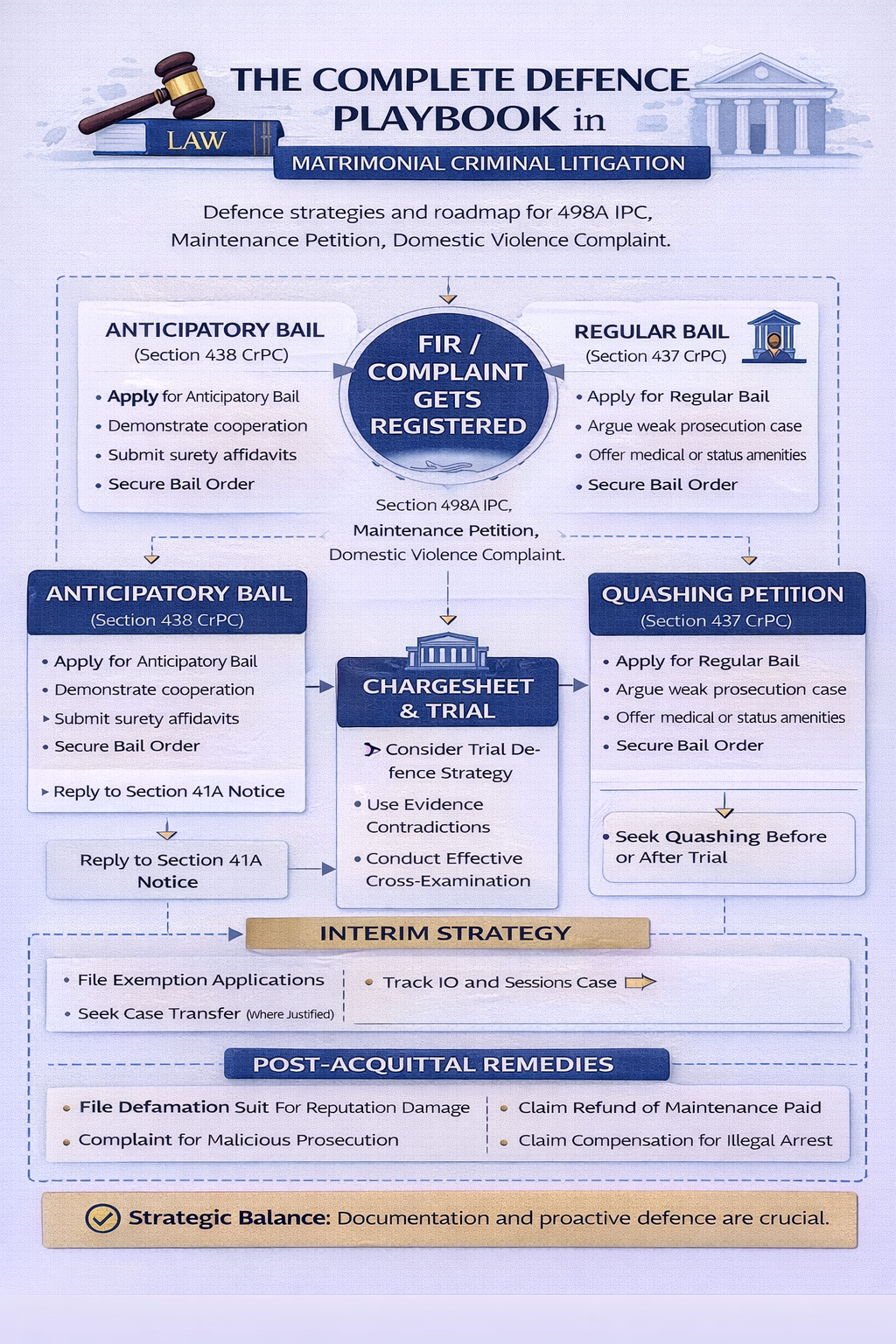
Matrimonial Criminal Litigation – The Complete Defence Guide

Posted on March 5 by Suprajaa Rajan

A structured legal roadmap to protect liberty, reputation, and financial security at every stage of criminal matrimonial proceedings.

Matrimonial criminal litigation in India often begins abruptly — with an FIR under Section 498A IPC, a complaint under the Domestic Violence Act, or a maintenance claim under Section 125 CrPC.

What follows is confusion, pressure, and procedural complexity.

This playbook provides a stage-wise strategic framework for navigating criminal matrimonial disputes lawfully and effectively.

I. Stage One: Immediately After FIR Registration

Most accused individuals panic at this stage. Strategy must, undoubtedly, begin immediately.

Key Legal Provisions:

  • Section 498A IPC

  • Section 406 IPC

  • Section 34 IPC

  • Section 41 & 41A CrPC

Immediate Strategic Steps:

  • Verify FIR contents
  • Assess arrest risk
  • Prepare anticipatory bail strategy
  • Collect documentary evidence
  • Preserve digital communications

The Supreme Court in Arnesh Kumar v. State of Bihar, held that arrest cannot be automatic in offences punishable up to seven years.

Read also : Arrest Procedure in 498A Cases After Arnesh Kumar

II. Stage Two: Bail & Liberty Protection

Personal liberty under Article 21 of the Constitution remains paramount.

Strategic Remedies:

1. Anticipatory Bail – Section 438 CrPC

Filed when arrest apprehension exists.

2. Regular Bail – Section 437/439 CrPC

Filed after arrest.

3. Transit Anticipatory Bail

When FIR is lodged in another State.

Courts evaluate:

  • Specificity of allegations

  • Role of each accused

  • Possibility of tampering

  • Cooperation with investigation

Read also : Anticipatory Bail in Matrimonial Offences – Complete Guide

III. Stage Three: Investigation & Chargesheet

After investigation, police may file chargesheet under:

  • Section 173 CrPC

This stage determines the trial trajectory.

Defence Strategy Includes:

  • Filing discharge application
  • Challenging omnibus allegations
  • Examining absence of specific overt acts
  • Seeking exemption from personal appearance

High Courts frequently quash proceedings against distant relatives where allegations are vague.

Read also : Discharge Application in 498A Cases – Legal Framework

IV. Stage Four: High Court Remedies

Where proceedings amount to abuse of process, remedy lies under:

  • Section 482 CrPC

High Courts exercise inherent powers to prevent miscarriage of justice.

Grounds commonly invoked:

  • Absence of prima facie case

  • Generalised allegations

  • Settlement between parties

  • Malicious prosecution

Read also : Quashing of FIR Under Section 482 CrPC – Explained

V. Parallel Civil & Financial Litigation

Matrimonial disputes rarely remain confined to criminal law.

Parallel proceedings may include:

  • Domestic Violence Act, 2005

  • Section 125 CrPC Maintenance

  • Divorce proceedings under personal laws

Financial Defence Strategy:

  • Accurate income disclosure
  • Challenging inflated claims
  • Contesting interim maintenance
  • Seeking modification upon change of circumstances

VI. Trial Strategy

If matter proceeds to trial, defence must shift from procedural to evidentiary strength.

Key Focus Areas:

  • Cross-examination strategy

  • Contradictions in complaint & deposition

  • Electronic evidence admissibility

  • Medical and documentary inconsistencies

  • Hostile witness handling

Trial requires patience, consistency, and procedural discipline.

VII. Settlement & Strategic Exit

Despite non-compoundable nature of 498A, courts allow quashing upon settlement.

Compromise-based quashing has evolved as a judicially recognised solution where matrimonial disputes are resolved.

Strategic mediation may:

  • Reduce litigation time

  • Protect reputation

  • Avoid prolonged trial

VIII. Common Strategic Mistakes to Avoid

  • Ignoring Section 41A notice
  • Filing multiple inconsistent petitions
  • Aggressive communication with complainant
  • Social media commentary
  • Suppressing financial disclosures
  • Non-cooperation with investigation

IX. Long-Term Reputation & Legal Risk Management

Criminal matrimonial litigation impacts:

  • Passport applications

  • Employment background verification

  • Professional licences

  • Immigration status

Strategic handling at early stages significantly influences long-term outcomes.

X. Guiding Principles of Defence

  1. Arrest is not automatic.

  2. Allegations must be specific.

  3. Liberty is constitutionally protected.

  4. Procedure is a safeguard, not a technicality.

  5. Early strategy prevents prolonged litigation.

Conclusion

Matrimonial criminal litigation, thus, requires structured legal response, not emotional reaction. Each procedural stage offers remedies. Each remedy must be invoked strategically.

The defence playbook lies in:

  • Understanding statutory safeguards

  • Timely filing of appropriate applications

  • Preserving documentary evidence

  • Maintaining procedural discipline

So liberty, reputation, and financial security depend on informed legal action.


Index of Legal Strategies and Defence is here. 


Key Contributor : 

Mrs. Suprajaa Rajan B.Com., LL.B., LL.M.

+91-9606345150

Posted in Legal Procedure | Tagged 498A defence strategy Criminal Trial CrPC 482 - FIR Can Be Quashed Maintenance Defence Matrimonial Criminal Law Matrimonial Litigation India Quashing of FIR | Leave a comment

Search within entire Content of “Shades of Knife”

My Legal X Timeline

Advocate Sandeep Pamarati 🇮🇳💪👨🏻‍🎓 Follow

AP High Court Advocate with M Tech (CS) || 12 years in 'Software Industry' as Solution Architect || Blogs at https://t.co/29CB9BzK4w || #TDPTwitter

SandeepPamarati
Retweet on Twitter Advocate Sandeep Pamarati 🇮🇳💪👨🏻‍🎓 Retweeted
its_me_jasraj 𝗗𝗿.𝗝𝗮𝘀𝗿𝗮𝗷 𝗣𝗿𝗮𝗷𝗮𝗽𝗮𝘁𝗶 @its_me_jasraj ·
21 Jun

5 Protein Facts They Never Told You ✅

Reply on Twitter 2068689430140080559 Retweet on Twitter 2068689430140080559 120 Like on Twitter 2068689430140080559 402 X 2068689430140080559
Retweet on Twitter Advocate Sandeep Pamarati 🇮🇳💪👨🏻‍🎓 Retweeted
mohiniwealth Mohini Maheshwari @mohiniwealth ·
22 Jun

The Dark Truth 🥷

Reply on Twitter 2068918051966513614 Retweet on Twitter 2068918051966513614 58 Like on Twitter 2068918051966513614 233 X 2068918051966513614
Retweet on Twitter Advocate Sandeep Pamarati 🇮🇳💪👨🏻‍🎓 Retweeted
shree_2_2 श्री @shree_2_2 ·
21 Jun

He spoke on behalf of all nationalists loved this side of Anand sir😅😅😅

Reply on Twitter 2068683121504170027 Retweet on Twitter 2068683121504170027 317 Like on Twitter 2068683121504170027 817 X 2068683121504170027
Retweet on Twitter Advocate Sandeep Pamarati 🇮🇳💪👨🏻‍🎓 Retweeted
shoneekapoor ShoneeKapoor @shoneekapoor ·
20 Jun

Judge Calls Wife’s Beating “Blessing”? Gender Reverse Karke Dekho

A husband tells the court that his wife beats him. In a viral clip from Gwalior Bench proceedings, the judge is heard saying:

“Husband who gets beaten up by his wife is a lucky man. That beating is a blessing.

Reply on Twitter 2068312690423185883 Retweet on Twitter 2068312690423185883 257 Like on Twitter 2068312690423185883 490 X 2068312690423185883
Load More

Recent Posts

  • Pavul Yesu Dhasan Vs Registrar SHRC of TN and Ors on 30 Apr 2025 June 18, 2026
  • Manoj Kumar Vs Nita Bharti on 17 Mar 2026 June 17, 2026
  • Cruelty as a Criminal Offence Explained June 12, 2026
  • Bail Compliance Undertaking Format – Draft, Legal Requirements & Sample Template June 12, 2026
  • Warning Signs of Escalating Matrimonial Litigation – Early Red Flags Every Spouse Should Recognize June 12, 2026

Most Read Posts

  • Reply to Section 41A CrPC Notice – Format with Legal Explanation (4,940 views)
  • Anu Aggarwal Vs Sushant Aggarwal on 20 Jan 2026 (3,473 views)
  • Umme Farva Vs State of U.P. and Anr on 14 Jan 2026 (3,361 views)
  • Charge Sheet and Final Report Explained (2,809 views)
  • Regular Bail Application Format (Section 437/439 CrPC) (2,189 views)
  • Neha Lal Vs Abhishek Kumar on 20 Jan 2026 (1,998 views)
  • Arrest Procedure in 498A cases after Arnesh Kumar (1,929 views)
  • Discharge Application Format in 498A Case – Draft, Procedure & Sample Template (1,772 views)
  • Can You Travel Abroad After an FIR Is Registered? – Legal Position Explained (1,686 views)
  • Atul Kumar Bajpai Vs State of UP and Anr on 17 Sep 2025 (1,536 views)

Tags

Reportable Judgement or Order (433)2-Judge (Division) Bench Decision (413)Legal Procedure Explained - Interpretation of Statutes (382)Landmark Case (381)1-Judge Bench Decision (362)Catena of Landmark Judgments Referred/Cited to (293)Work-In-Progress Article (215)3-Judge (Full) Bench Decision (101)Sandeep Pamarati (92)Article 21 - Protection of life and personal liberty (80)Issued or Recommended Guidelines or Directions or Protocols to be followed (71)Perjury Under 340 CrPC (66)Absurd Or After Thought Or Baseless Or False Or General Or Inherently Improbable Or Improved Or UnSpecific Or Omnibus Or Vague Allegations (61)Reprimands or Setbacks to YCP Govt of Andhra Pradesh (49)Summary Post (47)CrPC 482 - Quash (43)HM Act 13 - Divorce Granted to Husband (42)Legal Terrorism (41)Divorce granted on Cruelty ground (41)Not Authentic copy hence to be replaced (40)

Categories

Supreme Court of India Judgment or Order or Notification (753)Bare Acts or State Amendments or Statutes or GOs or Notifications issued by Central or State Governments (328)High Court of Andhra Pradesh Judgment or Order or Notification (186)High Court of Delhi Judgment or Order or Notification (164)High Court of Bombay Judgment or Order or Notification (112)High Court of Karnataka Judgment or Order or Notification (93)Legal Procedure (77)High Court of Madras Judgment or Order or Notification (70)High Court of Allahabad Judgment or Order or Notification (61)LLB Study Material (59)General Study Material (56)High Court of Punjab & Haryana Judgment or Order or Notification (52)Assorted Court Judgments or Orders or Notifications (50)High Court of Kerala Judgment or Order or Notification (46)Prakasam DV Cases (46)Judicial Activism (for Public Benefit) (45)District or Sessions or Magistrate Court Judgment or Order or Notification (44)High Court of Madhya Pradesh Judgment or Order or Notification (38)High Court of Gujarat Judgment or Order or Notification (28)High Court of Calcutta Judgment or Order or Notification (27)

Recent Comments

  • eCourts India on Compromise-Based Quashing in Matrimonial Cases – Complete Legal Strategy
  • The Divorce Law Firm on Life Cycle Stages of a Divorce case
  • The Divorce Law Firm on Life Cycle Stages of a Divorce case
  • ShadesOfKnife on Sandeep Pamarati Vs Ungrateful Knife (IPC 498A Case)
  • KONURU VINAYKUMAR on Sandeep Pamarati Vs Ungrateful Knife (IPC 498A Case)

Archives of SoK

  • June 2026 (9)
  • May 2026 (24)
  • April 2026 (33)
  • March 2026 (42)
  • February 2026 (30)
  • January 2026 (21)
  • December 2025 (2)
  • November 2025 (3)
  • October 2025 (17)
  • September 2025 (12)
  • August 2025 (5)
  • July 2025 (10)
  • June 2025 (15)
  • May 2025 (3)
  • April 2025 (10)
  • March 2025 (7)
  • February 2025 (8)
  • January 2025 (1)
  • December 2024 (3)
  • November 2024 (4)
  • October 2024 (16)
  • September 2024 (15)
  • August 2024 (14)
  • July 2024 (11)
  • June 2024 (18)
  • May 2024 (13)
  • April 2024 (9)
  • March 2024 (23)
  • February 2024 (15)
  • January 2024 (11)
  • December 2023 (11)
  • November 2023 (9)
  • October 2023 (13)
  • September 2023 (12)
  • August 2023 (15)
  • July 2023 (17)
  • June 2023 (11)
  • May 2023 (6)
  • April 2023 (5)
  • March 2023 (10)
  • February 2023 (9)
  • January 2023 (12)
  • December 2022 (12)
  • November 2022 (8)
  • October 2022 (13)
  • September 2022 (17)
  • August 2022 (10)
  • July 2022 (21)
  • June 2022 (27)
  • May 2022 (23)
  • April 2022 (32)
  • March 2022 (17)
  • February 2022 (6)
  • January 2022 (2)
  • December 2021 (7)
  • November 2021 (7)
  • October 2021 (6)
  • September 2021 (10)
  • August 2021 (31)
  • July 2021 (45)
  • June 2021 (17)
  • May 2021 (17)
  • April 2021 (18)
  • March 2021 (58)
  • February 2021 (14)
  • January 2021 (50)
  • December 2020 (35)
  • November 2020 (68)
  • October 2020 (67)
  • September 2020 (28)
  • August 2020 (41)
  • July 2020 (20)
  • June 2020 (36)
  • May 2020 (40)
  • April 2020 (38)
  • March 2020 (26)
  • February 2020 (43)
  • January 2020 (35)
  • December 2019 (34)
  • November 2019 (4)
  • October 2019 (18)
  • September 2019 (57)
  • August 2019 (33)
  • July 2019 (12)
  • June 2019 (18)
  • May 2019 (5)
  • April 2019 (19)
  • March 2019 (58)
  • February 2019 (11)
  • January 2019 (90)
  • December 2018 (97)
  • November 2018 (43)
  • October 2018 (31)
  • September 2018 (73)
  • August 2018 (47)
  • July 2018 (143)
  • June 2018 (92)
  • May 2018 (97)
  • April 2018 (59)
  • March 2018 (8)

Blogroll

  • Daaman Promoting Harmony 0
  • Fight against Legal Terrorism Fight against Legal Terrorism along with MyNation Foundation 0
  • Good Morning Good Morning News 0
  • Insaaf India Insaaf Awareness Movement 0
  • MyNation Hope Foundation Wiki 0
  • MyNation.net Equality, Justice and Harmony 0
  • Sarvepalli Legal 0
  • Save Indian Family Save Indian Family Movement 0
  • SIF Chandigarh SIF Chandigarh 0
  • The Male Factor The Male Factor 0
  • Unitedmen Foundation a dedicated community forged with the mission to unite men facing legal challenges in marital disputes. 0
  • Vaastav Foundation The Social Reality 0
  • Vinayak my2centsworth – This blog is for honest law abiding men, married or planning to get married 0
  • Voice4india Indian Laws, Non-profits, Environment 0
  • Writing Law Writing Law by Ankur 0

RSS Cloudflare Status

  • ARN (Stockholm) on 2026-06-25 June 25, 2026
    THIS IS A SCHEDULED EVENT Jun 25, 00:00 - 05:00 UTC Jun 19, 14:18 UTC Scheduled - We will be performing scheduled maintenance in ARN (Stockholm) datacenter on 2026-06-25 between 00:00 and 05:00 UTC.Traffic might be re-routed from this location, hence there is a possibility of a slight increase in latency during this maintenance window […]
  • ARN (Stockholm) on 2026-06-24 June 24, 2026
    THIS IS A SCHEDULED EVENT Jun 24, 00:00 - 05:00 UTC Jun 19, 13:08 UTC Scheduled - We will be performing scheduled maintenance in ARN (Stockholm) datacenter on 2026-06-24 between 00:00 and 05:00 UTC.Traffic might be re-routed from this location, hence there is a possibility of a slight increase in latency during this maintenance window […]
  • MSP (Minneapolis) on 2026-06-23 June 23, 2026
    THIS IS A SCHEDULED EVENT Jun 23, 03:00 - 08:00 UTC Jun 18, 18:30 UTC Scheduled - We will be performing scheduled maintenance in MSP (Minneapolis) datacenter on 2026-06-23 between 03:00 and 08:00 UTC.Traffic might be re-routed from this location, hence there is a possibility of a slight increase in latency during this maintenance window […]

RSS List of Spam Server IPs from Project Honeypot

  • 34.14.86.214 | SD June 22, 2026
    Event: Bad Event | Total: 12 | First: 2026-01-12 | Last: 2026-06-22
  • 34.52.210.100 | S June 22, 2026
    Event: Bad Event | Total: 2 | First: 2026-06-22 | Last: 2026-06-22
  • 45.174.88.88 | S June 22, 2026
    Event: Bad Event | Total: 10 | First: 2025-08-07 | Last: 2026-06-22
Owned and Operated by Advocate Sandeep Pamarati
Proudly powered by WordPress
Theme: Flint by Star Verte LLC

Bad Behavior has blocked 1272 access attempts in the last 7 days.

pixel
