web analytics

Menu

Skip to content
Shades of Knife
  • Home
  • True Colors of a Vile Wife
  • Need Inspiration?
  • Blog Updates
  • SOK Gallery
  • Vile News Reporter
  • About Me
  • Contact Me

Shades of Knife

True Colors of a Vile Wife

Tag: 498A cases

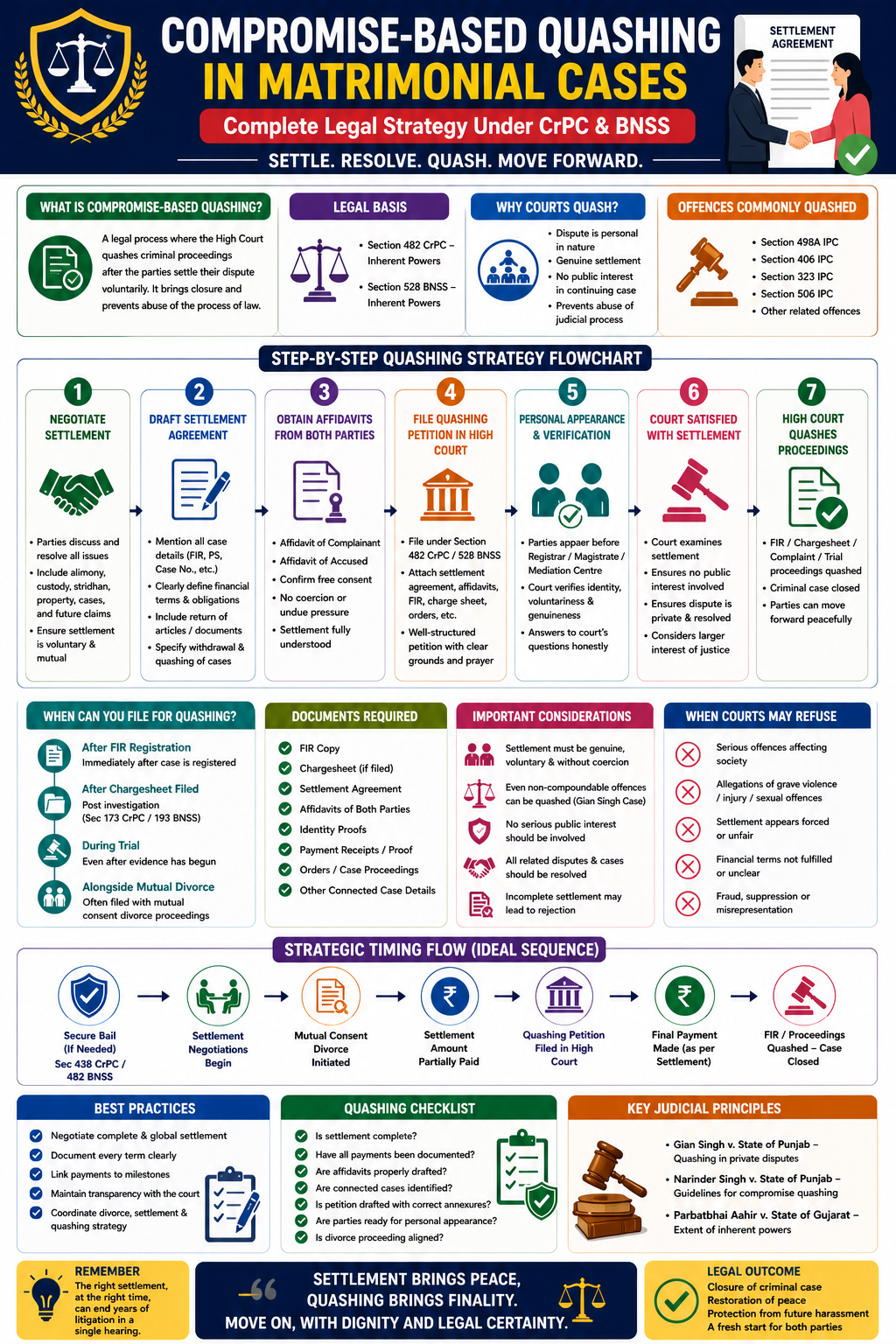
Compromise-Based Quashing in Matrimonial Cases – Complete Legal Strategy

Posted on May 6 by Suprajaa Rajan

Matrimonial disputes often begin as emotional conflicts but eventually transform into multiple legal proceedings—criminal complaints, domestic violence cases, maintenance petitions, custody disputes, and divorce litigation. In many cases, however, parties later decide to resolve their differences through negotiation, mediation, mutual settlement, or divorce by consent.

Once a genuine settlement takes place, the next critical legal question arises:

Can the criminal case also be closed?

The answer is yes—through compromise-based quashing.

Indian High Courts regularly exercise their inherent powers to quash criminal proceedings arising from matrimonial disputes when the parties settle their disputes voluntarily and continuation of prosecution serves no useful purpose.

Therefore, understanding the strategy for compromise-based quashing in matrimonial cases becomes essential for accused persons, complainants, family members, and legal practitioners.

This article explains the legal framework, procedural roadmap, documentation, judicial principles, strategic timing, and practical safeguards, with references to both the Code of Criminal Procedure, 1973 (CrPC) and the Bharatiya Nagarik Suraksha Sanhita, 2023 (BNSS).

What Is Compromise-Based Quashing?

Compromise-based quashing is a legal process where the High Court terminates criminal proceedings after the parties settle their dispute.

The court may quash:

  • FIR
  • Chargesheet
  • Criminal complaint
  • Summoning order
  • Trial proceedings
  • Related criminal proceedings

The purpose is simple:

If the dispute is private, personal, and has been genuinely resolved, continuing prosecution may amount to an abuse of judicial process.

Legal Basis for Quashing

Under CrPC

  • Section 482 CrPC

The High Court exercises inherent powers:

  • To prevent abuse of process
  • To secure the ends of justice

Under BNSS

  • Section 528 BNSS

This provision preserves the High Court’s inherent jurisdiction in similar terms.

Thus, compromise-based quashing continues under the new procedural framework.

Why Matrimonial Cases Are Commonly Quashed

Matrimonial litigation often involves:

  • Emotional allegations
  • Family-wide implication
  • Settlement negotiations
  • Mutual divorce proceedings
  • Financial settlement

Because such disputes are predominantly personal in nature, courts frequently consider compromise-based quashing appropriate.

Typical offences include:

  • Section 498A IPC
  • Section 406 IPC
  • Section 323 IPC
  • Section 506 IPC
  • Section 34 IPC

and their corresponding provisions under the new criminal law framework, where applicable.

Can Non-Compoundable Offences Also Be Quashed?

Yes.

This is the most important legal principle.

Even if an offence is technically non-compoundable, the High Court may still quash proceedings if:

  • The dispute is personal
  • Settlement is genuine
  • No overriding public interest is involved
  • Continuation of prosecution would serve no useful purpose

This principle transformed matrimonial criminal litigation in India.

Leading Judicial Principles

In
Gian Singh v. State of Punjab,
the Supreme Court held that High Courts may quash criminal proceedings involving private disputes if settlement genuinely resolves the controversy.

Later, in
Narinder Singh v. State of Punjab,
the Supreme Court laid down detailed principles governing compromise-based quashing.

Further, in
Parbatbhai Aahir v. State of Gujarat,
the Court clarified how inherent powers should be exercised.

These decisions now guide High Courts across India.

When Should You File for Quashing?

Timing can significantly affect the outcome.

Compromise-based quashing may be filed:

After FIR Registration

If parties settle immediately after criminal proceedings begin.

After Chargesheet

Once investigation is complete.

Relevant provision:

  • Section 173 CrPC (BNSS Section 193) – Police report

During Trial

Even after evidence begins.

Alongside Mutual Divorce

Often strategically synchronised.

Therefore, settlement timing should align with the broader matrimonial strategy.

Step 1: Finalise a Genuine Settlement

Before approaching the High Court, both parties should complete settlement discussions.

Settlement may include:

  • Mutual divorce
  • Permanent alimony
  • Return of stridhan
  • Child custody terms
  • Withdrawal of connected proceedings
  • Property settlement

The settlement should be:

  • Clear
  • Written
  • Voluntary
  • Specific

Ambiguous settlements create future disputes.

Step 2: Draft a Detailed Settlement Agreement

A proper settlement agreement should include:

Case Details

Mention:

  • FIR number
  • Police station
  • Case numbers
  • Pending proceedings

Financial Terms

Specify:

  • Alimony
  • Settlement amount
  • Payment schedule

Property Terms

Clarify:

  • Return of articles
  • Jewellery
  • Documents
  • Shared assets

Litigation Closure

Specify:

  • Cases to be withdrawn
  • Quashing to be pursued

Precision prevents future disputes.

Step 3: Obtain Affidavits from Both Parties

Courts generally expect:

  • Affidavit of accused
  • Affidavit of complainant

Affidavits should confirm:

  • Free consent
  • No coercion
  • Settlement fully understood
  • No further claims

This helps establish genuineness.

Step 4: File Quashing Petition

File before the jurisdictional High Court under:

  • Section 482 CrPC (Section 528 BNSS)

The petition should include:

  • Synopsis
  • List of dates
  • Grounds
  • Settlement deed
  • Affidavits
  • FIR copy
  • Chargesheet (if filed)
  • Relevant orders

A well-organised petition improves credibility.

Step 5: Ensure Personal Appearance

High Courts often direct:

  • Personal presence of parties
  • Verification before Registrar, Magistrate, or Mediation Centre

The court verifies:

  • Identity
  • Voluntariness
  • Settlement authenticity

Therefore, prepare both parties in advance.

Step 6: Verification of Settlement

Courts may ask:

  • Was the settlement voluntary?
  • Has consideration been paid?
  • Are all disputes resolved?
  • Is divorce underway or completed?
  • Are there any pending claims?

Consistency matters.

Contradictory statements can derail the petition.

Step 7: Address Connected Proceedings

Before final hearing, review:

  • Maintenance cases
  • Domestic violence proceedings
  • Custody disputes
  • Execution proceedings
  • Civil claims

Incomplete settlement often creates future litigation.

Therefore, aim for a global settlement strategy.

When Courts May Refuse Quashing

Despite settlement, courts may refuse quashing if:

Serious Public Interest Is Involved

Examples:

  • Grave violence
  • Serious bodily injury
  • Sexual offences
  • Offences affecting society

Settlement Appears Coerced

If the complainant appears reluctant.

Settlement Terms Are Incomplete

If financial obligations remain disputed.

Fraud or Suppression Exists

If material facts are concealed.

Thus, genuineness remains critical.

Strategic Timing in Matrimonial Cases

A strong legal strategy often follows this sequence:

Step 1

Settlement negotiations begin.

Step 2

Interim protection or bail secured.

  • Section 438 CrPC (BNSS Section 482) – Anticipatory bail

Step 3

Mutual consent divorce initiated.

Step 4

Settlement amount partially paid.

Step 5

Joint quashing petition filed.

Step 6

Final payment made at hearing.

Step 7

FIR quashed.

This sequence minimises risk.

Common Defence Mistakes

Avoid:

Filing Before Settlement Is Complete

Incomplete settlements often collapse.

Paying Entire Amount Too Early

Link payments to milestones.

Ignoring Connected Cases

Unresolved proceedings may revive disputes.

Using Generic Settlement Clauses

Every case needs customised drafting.

Contradictory Statements in Court

Consistency is essential.

Practical Quashing Checklist

Before filing, ensure:

  • FIR copy obtained
  • Chargesheet reviewed
  • Settlement deed executed
  • Financial terms documented
  • Payment milestones fixed
  • Affidavits prepared
  • Connected cases identified
  • Personal appearance coordinated
  • Divorce strategy aligned

Judicial Approach in Matrimonial Quashing

High Courts generally favour:

  • Genuine settlements
  • Family dispute resolution
  • Reduction of unnecessary litigation
  • Restoration of peace

Courts recognise that criminal law should not continue merely as leverage once disputes are genuinely resolved.

However, courts carefully ensure:

  • Voluntariness
  • Fairness
  • Completeness of settlement

Practical Defence Strategy

For accused persons, compromise-based quashing works best when you:

Secure Bail First

Avoid coercive pressure.

Negotiate Global Settlement

Resolve all disputes together.

Document Every Payment

Maintain receipts and acknowledgments.

Avoid Informal Verbal Promises

Everything must be written.

Coordinate Timing Carefully

Quashing, divorce, and payment should move together.

Conclusion

Compromise-based quashing has become one of the most effective remedies in matrimonial criminal litigation. It allows parties to:

  • End criminal prosecution
  • Avoid prolonged trial
  • Reduce emotional and financial strain
  • Move forward with certainty

By:

  • Negotiating carefully
  • Drafting precise settlements
  • Filing a structured quashing petition
  • Presenting a genuine compromise

parties can successfully bring criminal matrimonial disputes to a legally secure closure.

In matrimonial litigation, the right settlement—executed at the right time—can end years of litigation in a single hearing.


Index of Legal Strategies and Defence is here. 


Key Contributor : 

Mrs. Suprajaa Rajan B.Com., LL.B., LL.M.

+91-9606345150


Posted in Legal Procedure | Tagged 498A cases criminal defence strategy Legal Procedure Explained - Interpretation of Statutes Legal Strategies and Defence Matrimonial Criminal Law Matrimonial Litigation India matrimonial offences Quashing of FIR | 1 Comment

Cross-Examination Strategy in 498A Trials – Defence Tactics That Can Change the Outcome

Posted on May 4 by Suprajaa Rajan

In criminal trials arising out of matrimonial disputes, cross-examination often determines the final outcome more than the FIR itself. While allegations under Section 498A of the IPC may appear serious at the initial stage, many prosecutions weaken when witnesses face a structured and legally sound cross-examination.

A well-planned cross-examination can:

  • Expose exaggerations and contradictions
  • Reveal omissions in prior statements
  • Test credibility of prosecution witnesses
  • Challenge documentary evidence
  • Build a foundation for acquittal

Therefore, understanding the cross-examination strategy in 498A trials becomes critical for every accused person, defence lawyer, and family member involved in matrimonial criminal litigation.

This article explains the legal framework, strategic approach, practical techniques, and common mistakes to avoid, with references to both the Code of Criminal Procedure, 1973 (CrPC) and the Bharatiya Nagarik Suraksha Sanhita, 2023 (BNSS).

Understanding Cross-Examination in Criminal Trials

Cross-examination is the process where the defence questions prosecution witnesses after examination-in-chief.

In criminal trials, evidence is recorded before the trial court under:

  • Section 273 CrPC (BNSS Section 308) – Evidence to be taken in presence of accused
  • Section 231 CrPC (BNSS Section 254) – Evidence for prosecution in Sessions trial
  • Section 242 CrPC (BNSS Section 265) – Evidence in warrant cases instituted otherwise than on police report
  • Section 246 CrPC (BNSS Section 269) – Evidence in warrant cases on police report

Cross-examination forms a core part of the constitutional guarantee of a fair trial.

Why Cross-Examination Is Crucial in 498A Cases

In many matrimonial prosecutions, allegations involve:

  • Mental cruelty
  • Physical harassment
  • Dowry demands
  • Emotional abuse
  • Family-wide allegations against relatives

However, many complaints also contain:

  • General allegations
  • Omnibus accusations
  • Emotional exaggerations
  • Lack of dates, places, and specific incidents

A strategic cross-examination can expose these weaknesses.

Step 1: Study the Entire Prosecution Record

Before asking even one question, the defence must thoroughly analyse:

FIR

Compare:

  • Dates of incidents
  • Sequence of allegations
  • Names of accused persons
  • Specific acts attributed to each accused

Relevant provision:

  • Section 154 CrPC (BNSS Section 173) – Registration of FIR

Statements During Investigation

Compare witness statements recorded under:

  • Section 161 CrPC (BNSS Section 180) – Police statements

Look for:

  • Improvements
  • Omissions
  • Contradictions

Documents Filed with Chargesheet

Review:

  • Medical records
  • Chat records
  • Emails
  • Financial documents
  • Photographs
  • Call records

Chargesheet filed under:

  • Section 173 CrPC (BNSS Section 193)

Step 2: Identify the Defence Theory First

Cross-examination should never be random.

First establish:

What is your defence?

Examples:

  • False implication after matrimonial dispute
  • Property dispute disguised as criminal complaint
  • Pressure for settlement
  • Retaliation after divorce proceedings
  • Inclusion of distant relatives without role

Every question must support this theory.

Step 3: Challenge Specificity of Allegations

One of the strongest strategies in 498A trials is to expose vague allegations.

Ask questions such as:

  • On what exact date did this happen?
  • At what location?
  • Who was present?
  • What exact words were spoken?
  • Was any complaint made immediately?

If the witness cannot answer clearly, credibility weakens.

Step 4: Expose Omnibus Allegations Against Family Members

In many 498A cases, multiple relatives are implicated.

Cross-examination should establish:

  • Whether the accused lived separately
  • Whether the accused was even present
  • Whether there was direct interaction

Ask:

  • Did the accused live in the matrimonial home?
  • Can you produce any communication with this accused?
  • How many times did you personally meet them?

This becomes especially important for:

  • Elderly parents
  • Married sisters
  • Relatives living in other cities

Step 5: Use Prior Contradictions Effectively

Contradictions are powerful tools.

If the witness changes the story from earlier statements recorded under:

  • Section 161 CrPC (BNSS Section 180)

the defence may confront them with prior omissions.

Examples:

FIR says:

“Dowry demanded.”

Court testimony says:

“₹10 lakhs demanded in front of relatives.”

If amount, date, or persons were missing earlier, the defence should highlight the improvement.

Step 6: Test Delay in Complaint

Delay often matters in matrimonial litigation.

Ask:

  • When did the alleged incident occur?
  • When did you first tell your parents?
  • Did you visit police immediately?
  • Did you seek medical treatment?
  • Did you send any written complaint?

Unexplained delay may weaken prosecution.

Step 7: Challenge Documentary Evidence

If chats, emails, audio clips, or financial documents are produced:

Question:

  • Who created this document?
  • Is it original?
  • Was it altered?
  • Who had access?
  • When was it first disclosed?

This becomes crucial in digital evidence disputes.

Step 8: Test Conduct After Alleged Cruelty

Human conduct often reveals inconsistencies.

Ask:

  • Did you continue living with the accused?
  • Did you travel together afterward?
  • Did you celebrate festivals together?
  • Did you exchange affectionate messages later?

Post-incident conduct may contradict allegations.

Step 9: Cross-Examine Independent Witnesses

Independent witnesses often strengthen or weaken the case.

Question:

  • Were you personally present?
  • Did you hear the alleged demand directly?
  • Are you related to the complainant?
  • Did you make any written complaint?

This helps distinguish hearsay from direct evidence.

Step 10: Maintain Courtroom Discipline

A strong cross-examination is:

  • Calm
  • Structured
  • Precise
  • Non-argumentative

Never:

  • Intimidate the witness
  • Ask emotional or irrelevant questions
  • Repeat questions unnecessarily

Judges observe both content and conduct.

Common Defence Mistakes

Avoid these mistakes:

Asking Questions Without Purpose

Every question must support your defence.

Asking Open-Ended Questions

Open questions may allow witnesses to repair weak testimony.

Revealing Defence Too Early

Do not disclose your entire strategy at the beginning.

Ignoring Documentary Contradictions

Documents often defeat oral exaggerations.

Emotional Cross-Examination

Aggressive questioning may backfire.

Judicial Approach in 498A Trials

Courts increasingly scrutinise:

  • Vague allegations
  • Mechanical implication of relatives
  • Improvements in testimony
  • Delayed complaints

Courts expect prosecution witnesses to withstand cross-examination with consistency.

Practical Defence Checklist

Before cross-examination, ensure:

  • FIR analysed
  • Section 161 statements compared
  • Chargesheet reviewed
  • Timeline prepared
  • Contradictions marked
  • Documentary evidence examined
  • Defence theory finalised

Conclusion

In 498A trials, cross-examination is not merely a procedural stage—it is often the turning point of the case.

A carefully planned cross-examination can:

  • Break the prosecution narrative
  • Expose exaggeration
  • Separate genuine allegations from omnibus accusations
  • Create reasonable doubt

By combining legal preparation, factual precision, and courtroom discipline, the defence can significantly improve the chances of acquittal.

In criminal trials, facts matter—but how those facts are tested in cross-examination often matters even more.


Index of Legal Strategies and Defence is here. 


Key Contributor : 

Mrs. Suprajaa Rajan B.Com., LL.B., LL.M.

+91-9606345150


Posted in Legal Procedure | Tagged 498A cases 498A Defence 498A defence strategy Cross-examination strategy Legal Strategies and Defence Matrimonial Litigation India | Leave a comment

Strategic Divorce Filing After Criminal Complaint – A Legal Perspective

Posted on April 27 by Suprajaa Rajan

Introduction

In matrimonial disputes, it is increasingly common for one spouse to initiate criminal proceedings (such as cruelty, dowry harassment, or domestic violence) before or alongside divorce proceedings. This raises a critical question—should and when should the other spouse file for divorce after a criminal complaint?

Filing for divorce after a criminal complaint is not merely a reactive step. Instead, it can be a strategic legal decision that influences both civil and criminal proceedings.

This article explains the timing, legal grounds, and strategic advantages of filing for divorce after a criminal complaint, along with procedural aspects under the Code of Civil Procedure, 1908, the Hindu Marriage Act, 1955, and relevant criminal provisions under CrPC and BNSS.

Understanding the Legal Landscape

When a criminal complaint is filed (commonly under Section 498A IPC or domestic violence laws), two parallel legal tracks may emerge:

  1. Criminal Proceedings
  2. Civil Matrimonial Proceedings (Divorce)

These proceedings are independent, but they often influence each other in practice.

Why Consider Divorce After a Criminal Complaint?

Filing for divorce after a criminal complaint can serve multiple legal and strategic purposes.

1. Allegations May Constitute Mental Cruelty

False or exaggerated criminal allegations can amount to mental cruelty, which is a valid ground for divorce under:

  • Section 13 Hindu Marriage Act

Courts have repeatedly held that false criminal cases against a spouse or their family can justify dissolution of marriage.

2. Break Down of Matrimonial Relationship

A criminal complaint often reflects:

  • Complete breakdown of trust
  • Irretrievable breakdown of marriage (though not a statutory ground, courts consider it)

Therefore, filing for divorce acknowledges the practical reality of a failed marriage.

3. Strategic Pressure for Settlement

Divorce proceedings can:

  • Encourage settlement discussions
  • Lead to mediation or mutual consent divorce
  • Balance negotiating positions between parties

Thus, it becomes a strategic legal counterstep.

When Should You File for Divorce?

Timing plays a crucial role in maximising legal advantage.

1. After Filing of FIR

Once an FIR is registered under:

  • Section 154 CrPC (Section 173 BNSS)

you may consider initiating divorce proceedings.

At this stage:

  • Allegations are formally on record
  • You can rely on the contents of the complaint

2. After Interim Protection or Bail

It is often advisable to file for divorce after securing:

  • Anticipatory bail → Section 438 CrPC (Section 482 BNSS)

This ensures:

  • Protection from arrest
  • Stability to pursue civil proceedings

3. After Chargesheet or Weak Evidence

If the investigation results in:

  • Weak chargesheet → Section 173 CrPC (Section 193 BNSS)
  • Lack of evidence

you gain a stronger footing to claim false implication and cruelty.

4. After Acquittal (Strongest Ground)

If the court acquits the accused:

  • It significantly strengthens the divorce case
  • It establishes falsity of allegations

This becomes the most powerful ground for divorce based on cruelty.

Legal Grounds for Divorce in Such Cases

1. Mental Cruelty

False criminal allegations, harassment through legal proceedings, and damage to reputation constitute mental cruelty.

2. Desertion (if applicable)

If the complainant has:

  • Left the matrimonial home
  • Refused cohabitation

you may also invoke desertion as an additional ground.

3. Irretrievable Breakdown (Judicial Consideration)

Although not codified, courts often consider irretrievable breakdown of marriage in such disputes.

Step-by-Step Strategic Approach

Step 1: Secure Criminal Law Protection

First, ensure:

  • Anticipatory bail
  • Protection from coercive action

Step 2: Analyse Allegations

Carefully evaluate:

  • Nature of allegations
  • Evidence on record
  • Role attributed to each accused

Step 3: Decide Timing of Divorce Petition

Choose timing based on:

  • Stage of criminal case
  • Strength of evidence
  • Settlement possibilities

Step 4: Draft Divorce Petition Strategically

Your petition should clearly highlight:

  • False allegations
  • Harassment through legal proceedings
  • Impact on mental health and reputation

Step 5: Explore Settlement Options

Simultaneously consider:

  • Mediation
  • Mutual consent divorce
  • Comprehensive settlement agreements

Impact on Criminal Proceedings

While divorce and criminal cases are separate:

  • Statements in divorce petitions can be used in criminal trial
  • Settlement in matrimonial disputes may lead to quashing of FIR

Relevant provision:

  • Section 482 CrPC (Section 528 BNSS)

Thus, both proceedings often become strategically interconnected.

Judicial Approach

Courts adopt a balanced view:

  • They protect genuine victims
  • They discourage misuse of criminal law

Courts have repeatedly held that:

  • Filing false criminal complaints amounts to cruelty
  • Matrimonial litigation should not become a tool of harassment

Risks and Considerations

Before filing for divorce, you must consider:

  • Ongoing criminal liability
  • Possibility of counter-allegations
  • Impact on settlement negotiations

A poorly timed divorce petition may weaken your position.

Conclusion

Filing for divorce after a criminal complaint is not merely a reaction—it is a strategic legal decision.

By:

  • Choosing the right timing
  • Securing criminal law protection
  • Highlighting false allegations as cruelty

you can effectively strengthen your case in matrimonial proceedings.

A well-planned approach ensures that both criminal defence and matrimonial strategy work in alignment, leading to better legal outcomes.


Related Legal Concepts

  • First Information Report (FIR)
  • Anticipatory Bail
  • Quashing of FIR
  • Mental Cruelty in Divorce
  • Chargesheet

Index of Legal Strategies and Defence is here. 


Key Contributor : 

Mrs. Suprajaa Rajan B.Com., LL.B., LL.M.

+91-9606345150


Posted in Legal Procedure | Tagged 498A cases CrPC 438 - Anticipatory Bail Divorce Strategy Legal Strategies and Defence Matrimonial dispute Matrimonial law | Leave a comment

Search within entire Content of “Shades of Knife”

My Legal X Timeline

Advocate Sandeep Pamarati 🇮🇳💪👨🏻‍🎓 Follow

AP High Court Advocate with M Tech (CS) || 12 years in 'Software Industry' as Solution Architect || Blogs at https://t.co/29CB9BzK4w || #TDPTwitter

SandeepPamarati
Retweet on Twitter Advocate Sandeep Pamarati 🇮🇳💪👨🏻‍🎓 Retweeted
its_me_jasraj 𝗗𝗿.𝗝𝗮𝘀𝗿𝗮𝗷 𝗣𝗿𝗮𝗷𝗮𝗽𝗮𝘁𝗶 @its_me_jasraj ·
21 Jun

5 Protein Facts They Never Told You ✅

Reply on Twitter 2068689430140080559 Retweet on Twitter 2068689430140080559 120 Like on Twitter 2068689430140080559 402 X 2068689430140080559
Retweet on Twitter Advocate Sandeep Pamarati 🇮🇳💪👨🏻‍🎓 Retweeted
mohiniwealth Mohini Maheshwari @mohiniwealth ·
22 Jun

The Dark Truth 🥷

Reply on Twitter 2068918051966513614 Retweet on Twitter 2068918051966513614 58 Like on Twitter 2068918051966513614 233 X 2068918051966513614
Retweet on Twitter Advocate Sandeep Pamarati 🇮🇳💪👨🏻‍🎓 Retweeted
shree_2_2 श्री @shree_2_2 ·
21 Jun

He spoke on behalf of all nationalists loved this side of Anand sir😅😅😅

Reply on Twitter 2068683121504170027 Retweet on Twitter 2068683121504170027 317 Like on Twitter 2068683121504170027 817 X 2068683121504170027
Retweet on Twitter Advocate Sandeep Pamarati 🇮🇳💪👨🏻‍🎓 Retweeted
shoneekapoor ShoneeKapoor @shoneekapoor ·
20 Jun

Judge Calls Wife’s Beating “Blessing”? Gender Reverse Karke Dekho

A husband tells the court that his wife beats him. In a viral clip from Gwalior Bench proceedings, the judge is heard saying:

“Husband who gets beaten up by his wife is a lucky man. That beating is a blessing.

Reply on Twitter 2068312690423185883 Retweet on Twitter 2068312690423185883 257 Like on Twitter 2068312690423185883 490 X 2068312690423185883
Load More

Recent Posts

  • Pavul Yesu Dhasan Vs Registrar SHRC of TN and Ors on 30 Apr 2025 June 18, 2026
  • Manoj Kumar Vs Nita Bharti on 17 Mar 2026 June 17, 2026
  • Cruelty as a Criminal Offence Explained June 12, 2026
  • Bail Compliance Undertaking Format – Draft, Legal Requirements & Sample Template June 12, 2026
  • Warning Signs of Escalating Matrimonial Litigation – Early Red Flags Every Spouse Should Recognize June 12, 2026

Most Read Posts

  • Reply to Section 41A CrPC Notice – Format with Legal Explanation (4,940 views)
  • Anu Aggarwal Vs Sushant Aggarwal on 20 Jan 2026 (3,473 views)
  • Umme Farva Vs State of U.P. and Anr on 14 Jan 2026 (3,361 views)
  • Charge Sheet and Final Report Explained (2,809 views)
  • Regular Bail Application Format (Section 437/439 CrPC) (2,189 views)
  • Neha Lal Vs Abhishek Kumar on 20 Jan 2026 (1,998 views)
  • Arrest Procedure in 498A cases after Arnesh Kumar (1,929 views)
  • Discharge Application Format in 498A Case – Draft, Procedure & Sample Template (1,772 views)
  • Can You Travel Abroad After an FIR Is Registered? – Legal Position Explained (1,686 views)
  • Atul Kumar Bajpai Vs State of UP and Anr on 17 Sep 2025 (1,536 views)

Tags

Reportable Judgement or Order (433)2-Judge (Division) Bench Decision (413)Legal Procedure Explained - Interpretation of Statutes (382)Landmark Case (381)1-Judge Bench Decision (362)Catena of Landmark Judgments Referred/Cited to (293)Work-In-Progress Article (215)3-Judge (Full) Bench Decision (101)Sandeep Pamarati (92)Article 21 - Protection of life and personal liberty (80)Issued or Recommended Guidelines or Directions or Protocols to be followed (71)Perjury Under 340 CrPC (66)Absurd Or After Thought Or Baseless Or False Or General Or Inherently Improbable Or Improved Or UnSpecific Or Omnibus Or Vague Allegations (61)Reprimands or Setbacks to YCP Govt of Andhra Pradesh (49)Summary Post (47)CrPC 482 - Quash (43)HM Act 13 - Divorce Granted to Husband (42)Legal Terrorism (41)Divorce granted on Cruelty ground (41)Not Authentic copy hence to be replaced (40)

Categories

Supreme Court of India Judgment or Order or Notification (753)Bare Acts or State Amendments or Statutes or GOs or Notifications issued by Central or State Governments (328)High Court of Andhra Pradesh Judgment or Order or Notification (186)High Court of Delhi Judgment or Order or Notification (164)High Court of Bombay Judgment or Order or Notification (112)High Court of Karnataka Judgment or Order or Notification (93)Legal Procedure (77)High Court of Madras Judgment or Order or Notification (70)High Court of Allahabad Judgment or Order or Notification (61)LLB Study Material (59)General Study Material (56)High Court of Punjab & Haryana Judgment or Order or Notification (52)Assorted Court Judgments or Orders or Notifications (50)High Court of Kerala Judgment or Order or Notification (46)Prakasam DV Cases (46)Judicial Activism (for Public Benefit) (45)District or Sessions or Magistrate Court Judgment or Order or Notification (44)High Court of Madhya Pradesh Judgment or Order or Notification (38)High Court of Gujarat Judgment or Order or Notification (28)High Court of Calcutta Judgment or Order or Notification (27)

Recent Comments

  • eCourts India on Compromise-Based Quashing in Matrimonial Cases – Complete Legal Strategy
  • The Divorce Law Firm on Life Cycle Stages of a Divorce case
  • The Divorce Law Firm on Life Cycle Stages of a Divorce case
  • ShadesOfKnife on Sandeep Pamarati Vs Ungrateful Knife (IPC 498A Case)
  • KONURU VINAYKUMAR on Sandeep Pamarati Vs Ungrateful Knife (IPC 498A Case)

Archives of SoK

  • June 2026 (9)
  • May 2026 (24)
  • April 2026 (33)
  • March 2026 (42)
  • February 2026 (30)
  • January 2026 (21)
  • December 2025 (2)
  • November 2025 (3)
  • October 2025 (17)
  • September 2025 (12)
  • August 2025 (5)
  • July 2025 (10)
  • June 2025 (15)
  • May 2025 (3)
  • April 2025 (10)
  • March 2025 (7)
  • February 2025 (8)
  • January 2025 (1)
  • December 2024 (3)
  • November 2024 (4)
  • October 2024 (16)
  • September 2024 (15)
  • August 2024 (14)
  • July 2024 (11)
  • June 2024 (18)
  • May 2024 (13)
  • April 2024 (9)
  • March 2024 (23)
  • February 2024 (15)
  • January 2024 (11)
  • December 2023 (11)
  • November 2023 (9)
  • October 2023 (13)
  • September 2023 (12)
  • August 2023 (15)
  • July 2023 (17)
  • June 2023 (11)
  • May 2023 (6)
  • April 2023 (5)
  • March 2023 (10)
  • February 2023 (9)
  • January 2023 (12)
  • December 2022 (12)
  • November 2022 (8)
  • October 2022 (13)
  • September 2022 (17)
  • August 2022 (10)
  • July 2022 (21)
  • June 2022 (27)
  • May 2022 (23)
  • April 2022 (32)
  • March 2022 (17)
  • February 2022 (6)
  • January 2022 (2)
  • December 2021 (7)
  • November 2021 (7)
  • October 2021 (6)
  • September 2021 (10)
  • August 2021 (31)
  • July 2021 (45)
  • June 2021 (17)
  • May 2021 (17)
  • April 2021 (18)
  • March 2021 (58)
  • February 2021 (14)
  • January 2021 (50)
  • December 2020 (35)
  • November 2020 (68)
  • October 2020 (67)
  • September 2020 (28)
  • August 2020 (41)
  • July 2020 (20)
  • June 2020 (36)
  • May 2020 (40)
  • April 2020 (38)
  • March 2020 (26)
  • February 2020 (43)
  • January 2020 (35)
  • December 2019 (34)
  • November 2019 (4)
  • October 2019 (18)
  • September 2019 (57)
  • August 2019 (33)
  • July 2019 (12)
  • June 2019 (18)
  • May 2019 (5)
  • April 2019 (19)
  • March 2019 (58)
  • February 2019 (11)
  • January 2019 (90)
  • December 2018 (97)
  • November 2018 (43)
  • October 2018 (31)
  • September 2018 (73)
  • August 2018 (47)
  • July 2018 (143)
  • June 2018 (92)
  • May 2018 (97)
  • April 2018 (59)
  • March 2018 (8)

Blogroll

  • Daaman Promoting Harmony 0
  • Fight against Legal Terrorism Fight against Legal Terrorism along with MyNation Foundation 0
  • Good Morning Good Morning News 0
  • Insaaf India Insaaf Awareness Movement 0
  • MyNation Hope Foundation Wiki 0
  • MyNation.net Equality, Justice and Harmony 0
  • Sarvepalli Legal 0
  • Save Indian Family Save Indian Family Movement 0
  • SIF Chandigarh SIF Chandigarh 0
  • The Male Factor The Male Factor 0
  • Unitedmen Foundation a dedicated community forged with the mission to unite men facing legal challenges in marital disputes. 0
  • Vaastav Foundation The Social Reality 0
  • Vinayak my2centsworth – This blog is for honest law abiding men, married or planning to get married 0
  • Voice4india Indian Laws, Non-profits, Environment 0
  • Writing Law Writing Law by Ankur 0

RSS Cloudflare Status

  • ARN (Stockholm) on 2026-06-25 June 25, 2026
    THIS IS A SCHEDULED EVENT Jun 25, 00:00 - 05:00 UTC Jun 19, 14:18 UTC Scheduled - We will be performing scheduled maintenance in ARN (Stockholm) datacenter on 2026-06-25 between 00:00 and 05:00 UTC.Traffic might be re-routed from this location, hence there is a possibility of a slight increase in latency during this maintenance window […]
  • ARN (Stockholm) on 2026-06-24 June 24, 2026
    THIS IS A SCHEDULED EVENT Jun 24, 00:00 - 05:00 UTC Jun 19, 13:08 UTC Scheduled - We will be performing scheduled maintenance in ARN (Stockholm) datacenter on 2026-06-24 between 00:00 and 05:00 UTC.Traffic might be re-routed from this location, hence there is a possibility of a slight increase in latency during this maintenance window […]
  • MSP (Minneapolis) on 2026-06-23 June 23, 2026
    THIS IS A SCHEDULED EVENT Jun 23, 03:00 - 08:00 UTC Jun 18, 18:30 UTC Scheduled - We will be performing scheduled maintenance in MSP (Minneapolis) datacenter on 2026-06-23 between 03:00 and 08:00 UTC.Traffic might be re-routed from this location, hence there is a possibility of a slight increase in latency during this maintenance window […]

RSS List of Spam Server IPs from Project Honeypot

  • 34.14.86.214 | SD June 22, 2026
    Event: Bad Event | Total: 12 | First: 2026-01-12 | Last: 2026-06-22
  • 34.52.210.100 | S June 22, 2026
    Event: Bad Event | Total: 2 | First: 2026-06-22 | Last: 2026-06-22
  • 45.174.88.88 | S June 22, 2026
    Event: Bad Event | Total: 10 | First: 2025-08-07 | Last: 2026-06-22
Owned and Operated by Advocate Sandeep Pamarati
Proudly powered by WordPress
Theme: Flint by Star Verte LLC

Bad Behavior has blocked 1274 access attempts in the last 7 days.

pixel