web analytics

Menu

Skip to content
Shades of Knife
  • Home
  • True Colors of a Vile Wife
  • Need Inspiration?
  • Blog Updates
  • SOK Gallery
  • Vile News Reporter
  • About Me
  • Contact Me

Shades of Knife

True Colors of a Vile Wife

Tag: 498A arrest procedure

Arrest and Custodial Procedure Explained

Posted on March 22 by Suprajaa Rajan

Arrest and custodial procedure form a critical part of criminal law, as they directly impact the personal liberty of an individual. The law, therefore, carefully regulates the power of the police to arrest and detain a person while ensuring that constitutional safeguards and procedural protections are strictly followed.

Under Indian law, the procedure relating to arrest and custody is governed by the Code of Criminal Procedure, 1973 and corresponding provisions under the Bharatiya Nagarik Suraksha Sanhita, 2023.

Additionally, these provisions strike a balance between the need for effective investigation and the protection of individual rights.

Meaning of Arrest

Arrest refers to the act of taking a person into custody under lawful authority, thereby restraining their liberty.

A police officer may arrest a person:

  • To prevent the commission of an offence

  • To ensure proper investigation

  • To prevent tampering with evidence

  • To secure the presence of the accused before the court

However, the power of arrest is not absolute and must be exercised in accordance with law and judicial guidelines.

Statutory Framework

The law governing arrest and custody is contained in:

  • Section 41 CrPC (Section 35 BNSS) – When police may arrest without warrant

  • Section 41A CrPC (Section 35(3) BNSS) – Notice of appearance

  • Section 46 CrPC (Section 43 BNSS) – How arrest is made

  • Section 50 CrPC (Section 47 BNSS) – Grounds of arrest to be informed

  • Section 57 CrPC (Section 58 BNSS) – Production before Magistrate within 24 hours

  • Section 167 CrPC (Section 187 BNSS) – Procedure for remand

These provisions collectively regulate the entire process of arrest and detention.

Arrest Without Warrant

The police may arrest a person without a warrant in certain circumstances under:

  • Section 41 CrPC (Section 35 BNSS)

However, the law requires that arrest must be based on reasonable suspicion and necessity.

The police must justify arrest on grounds such as:

  • Preventing further offence

  • Proper investigation

  • Preventing disappearance of evidence

Thus, arrest cannot be made mechanically and must satisfy legal necessity.

Notice of Appearance Instead of Arrest

In less serious cases, the police may issue a notice under:

  • Section 41A CrPC (Section 35(3) BNSS)

This provision requires the accused to appear before the police without being arrested.

This ensures that arrest is avoided where:

  • Custodial interrogation is not required

  • The accused cooperates with investigation

This provision acts as an important safeguard against unnecessary arrests.

Procedure of Arrest

The law prescribes a specific procedure for effecting arrest.

Under Section 46 CrPC (Section 43 BNSS):

  • The police must physically restrain the person or submit to custody

  • Excessive force cannot be used

  • Arrest must follow due process

Additionally, the police must:

  • Inform the person of the grounds of arrest

  • Allow communication with a lawyer or relative

These safeguards ensure transparency and accountability.

Rights of Arrested Person

The law provides several rights to a person who has been arrested.

These include:

  • Right to be informed of the grounds of arrest (Section 50 CrPC / Section 47 BNSS)

  • Right to inform a relative or friend

  • Right to legal representation

  • Right to be produced before a Magistrate within 24 hours (Section 57 CrPC / Section 58 BNSS)

These rights protect individuals from arbitrary detention and abuse of power.

Custodial Detention and Remand

After arrest, the police may seek custody of the accused for investigation purposes.

Under Section 167 CrPC (Section 187 BNSS):

  • The accused must be produced before a Magistrate

  • The Magistrate may grant police custody or judicial custody

  • Custody is subject to time limits prescribed by law

This stage ensures judicial oversight over detention.

Police Custody vs Judicial Custody

The law distinguishes between two types of custody:

Police Custody

  • The accused remains in the custody of the police

  • Used for interrogation and investigation

Judicial Custody

  • The accused is sent to jail

  • Police do not have direct control

This distinction ensures that custodial powers are regulated and supervised.

Safeguards Against Arbitrary Arrest

Courts have emphasised that arrest should not be made routinely.

In the landmark case of Arnesh Kumar v. State of Bihar, the Supreme Court laid down strict guidelines to prevent misuse of arrest powers, especially in matrimonial offences.

The Court held that:

  • Arrest must be justified

  • Police must record reasons for arrest

  • Compliance with Section 41 CrPC is mandatory

These guidelines reinforce the principle that liberty cannot be curtailed without valid reasons.

Importance of Custodial Procedure

Custodial procedure ensures that detention is:

  • Lawful

  • Necessary

  • Subject to judicial scrutiny

It ,thus, prevents abuse of power while enabling the police to conduct effective investigation.

Conclusion

Arrest and custodial procedure thus represent a sensitive area of criminal law where the powers of the state intersect with individual liberty. The law, therefore, imposes strict safeguards to ensure that arrest is exercised fairly, reasonably, and in accordance with due process.

By balancing investigative needs with constitutional protections, the legal framework undeniably ensures that justice is administered without compromising fundamental rights.

Related Legal Concepts

Explore related stages and concepts in criminal procedure:

  • Cognizable and Non-Cognizable Offences
  • First Information Report (FIR)
  • Police Investigation
  • Bail Law Explained
  • Criminal Trial Procedure


Index of Law Concepts explained here.


Key Contributor :
Mrs. Suprajaa Rajan B.Com., LL.B., LL.M.
+91-9606345150
Posted in LLB Study Material | Tagged 498A arrest procedure BNSS CrPC 41A - Notice of appearance before police officer CrPC 46 - Arrest how made Law Concepts explained | Leave a comment

Reply to Section 41A CrPC Notice – Format with Legal Explanation

Posted on March 4 by Suprajaa Rajan

A structured response template to protect your liberty during investigation.

Receiving a notice under Section 41A of the Code of Criminal Procedure, 1973 means the police require your appearance during investigation. It does not automatically mean arrest.

The provision was strengthened by the Supreme Court in Arnesh Kumar v. State of Bihar. The Court held that arrest is not mandatory in offences punishable up to seven years and that compliance with Section 41A safeguards personal liberty.

This guide explains:

  • When 41A notice is issued

  • Why replying properly is important

  • A structured reply format

  • Common mistakes to avoid

I. What Is Section 41A CrPC?

Code of Criminal Procedure, 1973

Section 41A empowers police to issue a Notice of Appearance instead of arrest.

It applies where:

  • Arrest is not immediately necessary

  • Offence is punishable up to 7 years

  • Investigation requires cooperation

If the accused complies, arrest should ordinarily not follow unless justified.

II. Why You Should Reply in Writing

Although appearance is mandatory, a written reply helps to:

  • Record willingness to cooperate
  • Avoid allegations of non-compliance
  • Demonstrate clean conduct
  • Strengthen anticipatory bail defence
  • Prevent coercive action

A structured reply builds documentary protection.

III. Important Points Before Drafting

  1. Do not admit allegations.

  2. Do not argue the case in detail.

  3. Confirm willingness to cooperate.

  4. Mention availability dates.

  5. Keep language professional and neutral.

The purpose is compliance — not defence evidence.

IV. Sample Format – Reply to Section 41A Notice


Sample Format – Reply to Section 41A CrPC Notice

BEFORE THE STATION HOUSE OFFICER

[Name of Police Station]
[District/City]


Subject: Reply to Notice under Section 41A CrPC

Respected Sir/Madam,

I acknowledge receipt of notice dated [insert date] issued under Section 41A of the Code of Criminal Procedure, 1973, in connection with FIR No. [____].

I respectfully submit that I am a law-abiding citizen and have deep respect for the legal process.

I assure my full cooperation in the investigation and undertake to appear before the Investigating Officer on [date] at [time] or on any other date convenient to the investigating authority.

I further undertake not to tamper with evidence or influence any witness.

I request that no coercive steps be taken against me as I am fully cooperating with the investigation.

Kindly acknowledge receipt of this reply.


Yours faithfully,

[Name]
[Address]
[Contact Details]
[Signature]

V. Strategic Additions (Optional)

Depending on facts, you may include:

  • Medical condition details

  • Senior citizen status

  • Residence in another State

  • Request for video appearance (if justified)

Avoid unnecessary factual rebuttal at this stage.

VI. What Happens After You Reply?

If you:

  • Appear as required
  • Cooperate during questioning
  • Provide documents when requested

Arrest should not ordinarily follow unless new circumstances arise.

Failure to comply may justify arrest under Section 41 CrPC.

VII. Common Mistakes to Avoid

  • Ignoring the notice
  • Sending emotional or aggressive replies
  • Admitting facts inadvertently
  • Sending incomplete contact details
  • Skipping appearance after written reply

Non-compliance weakens defence in bail proceedings.

Conclusion

A Section 41A notice is a procedural safeguard, not a presumption of guilt. Responding properly protects liberty and demonstrates bona fide conduct.

Strategic compliance strengthens future remedies including anticipatory bail and quashing.


Index of All Legal templates and Drafting is here. 


Disclaimer

These templates are provided for educational and informational purposes. Every case depends on specific facts and procedural posture. Professional legal advice should be obtained before filing any application.


Key Contributor :

Mrs.Suprajaa Rajan B.Com., LL.B., LL.M.

+91-9606345150

Posted in Legal Procedure | Tagged 498A arrest procedure Arnesh Kumar Vs State Of Bihar and Anr pre-arrest strategy Section 41A Notice | Leave a comment

Arrest Procedure in 498A cases after Arnesh Kumar

Posted on February 26 by Suprajaa Rajan

Understanding the legal safeguards that protect personal liberty in matrimonial criminal proceedings.

Arrest in matrimonial disputes under Section 498A of the Indian Penal Code was once routine and immediate. Complaints often led to mechanical arrests of husbands and relatives.

The legal landscape changed significantly after the Supreme Court’s landmark ruling in:

Arnesh Kumar v. State of Bihar

In this case, the judgment reshaped arrest jurisprudence in matrimonial offences and reinforced constitutional protection under Article 21.

This article explains the law thereafter, the procedural safeguards under the Code of Criminal Procedure, 1973, and what accused persons must know.

I. The Legal Position Before Arnesh Kumar

Indian Penal Code

Section 498A IPC is cognizable, non-bailable and non-compoundable. Since the offence is cognizable, police had wide discretion to arrest without warrant. Accordingly, in practice, arrest often followed immediately after FIR registration.

Courts observed misuse through mechanical implication of elderly parents, married sisters living separately and distant relatives. This raised serious concerns regarding the abuse of process.

II. The Turning Point: Arnesh Kumar Judgment

In Arnesh Kumar, the Supreme Court held that:

  • Arrest is not mandatory in every 498A case.

  • Police must justify necessity of arrest under Section 41 CrPC.

  • Failure to comply may invite departmental action.

The Court emphasised that personal liberty cannot be curtailed casually. Additionally, this ruling applies not only to 498A but to all offences punishable up to seven years.

III. Section 41 CrPC – When Can Police Arrest?

Code of Criminal Procedure, 1973

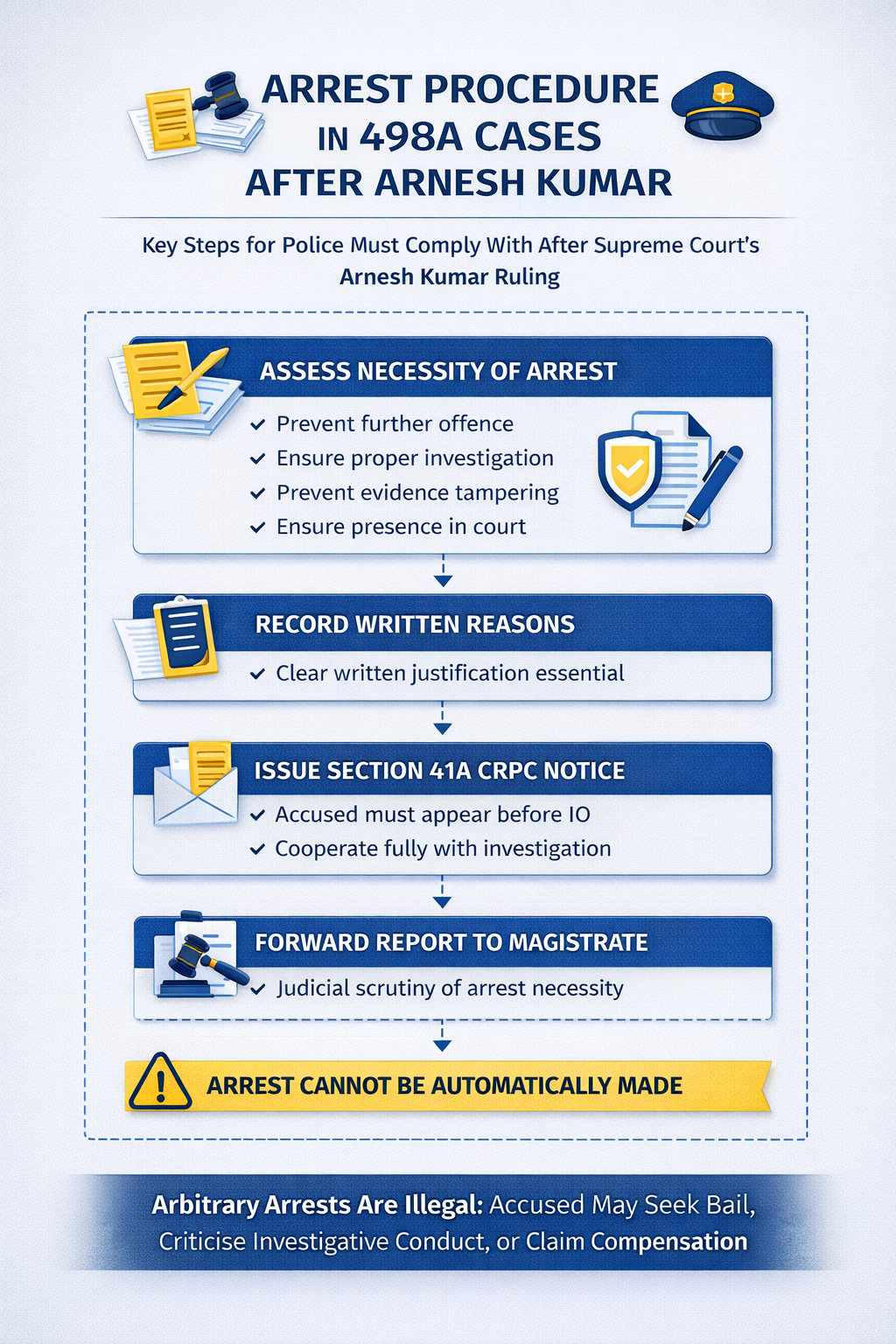
Under Section 41(1)(b) CrPC, police may arrest only if they believe it is necessary to:

  • Prevent further offence

  • Ensure proper investigation

  • Prevent tampering of evidence

  • Prevent inducement or threat to witnesses

  • Ensure presence in court

Police must record reasons in writing and the arrest cannot be automatic.

IV. Section 41A CrPC – Notice of Appearance

Instead of immediate arrest, police must ordinarily issue:

Notice under Section 41A CrPC

The accused must:

  • Appear before the Investigating Officer and,

  • Cooperate with investigation

If the accused complies, arrest should not follow unless justified by fresh reasons.

V. Checklist Police Must Follow

After Arnesh Kumar, police must:

  • Assess necessity of arrest
  • Record written reasons
  • Issue 41A notice
  • Avoid mechanical detention
  • Forward reasons to Magistrate

The Magistrate must independently examine whether arrest is justified.

VI. What Happens If Police Violate These Safeguards?

If arrest occurs without compliance:

  • Accused may seek immediate bail

  • Courts may criticise investigative conduct

  • Departmental action may follow

  • Compensation may be claimed in extreme cases

Violation of procedure can strengthen defence during trial.

VII. Protection for Relatives and Senior Citizens

Courts frequently reiterate that distant relatives cannot be arrested without specific allegations. General and omnibus accusations are insufficient grounds for custodial arrest. High Courts often intervene under Section 482 CrPC to prevent abuse.

VIII. Practical Steps If You Receive 41A Notice

If you receive a Section 41A notice:

  1. Do not ignore it.

  2. Consult legal counsel immediately.

  3. Appear as required.

  4. Cooperate with investigation.

  5. Preserve documentary evidence.

Non-compliance may weaken your position.

IX. Anticipatory Bail Still Remains Important

Even after Arnesh Kumar, anticipatory bail remains a vital safeguard.

Where there is:

  • Risk of arbitrary arrest

  • Threat of custodial harassment

  • Multiple accused family members

Filing under Section 438 CrPC ensures additional protection.

Read also : Anticipatory Bail in Matrimonial Offences – Complete Guide

X. Judicial Approach After Arnesh Kumar

Post-2014, courts increasingly:

  • Scrutinise arrest memos

  • Examine compliance with Section 41

  • Criticise routine detention

  • Emphasise proportionality

The guiding principle remains: Arrest is an exception, not the rule.

Conclusion

The decision in Arnesh Kumar v. State of Bihar, hence, marked a watershed moment in matrimonial criminal jurisprudence. Altogether, it restored balance between protection of complainants and preservation of personal liberty.

Section 498A remains a serious offence. However, arrest cannot be mechanical or punitive. Police must undeniably demonstrate necessity. Magistrates must exercise independent scrutiny.

Understanding arrest procedure subsequently empowers accused persons to assert their constitutional rights lawfully and strategically.


Frequently Asked Questions

No. They must comply with Section 41 CrPC and consider issuing notice under Section 41A.

No. Arrest is permissible where statutory conditions are satisfied.

It applies to offences punishable up to seven years.

Courts may treat such arrest as illegal and grant relief.


Index of Legal Strategies and Defence is here.


Key Contributor :

Mrs. Suprajaa Rajan B.Com., LL.B., LL.M.

+91-9606345150


Posted in Legal Procedure | Tagged 498A arrest procedure Arnesh Kumar Vs State Of Bihar and Anr Criminal Procedure CrPC 438 - Anticipatory Bail Matrimonial Criminal Law Matrimonial law Section 41 CrPC Section 41A Notice | Leave a comment

Anticipatory Bail in Matrimonial Offences – Complete Guide

Posted on February 24 by Suprajaa Rajan

Strategic legal protection to safeguard your liberty before arrest in matrimonial criminal proceedings.

Matrimonial disputes frequently escalate into criminal complaints under provisions such as Section 498A IPC, the Dowry Prohibition Act, or allied offences. In many cases, accused individuals face the threat of immediate arrest.

Anticipatory bail serves as a critical safeguard. It protects personal liberty while the investigation proceeds.

This guide explains the legal framework, judicial principles, procedure, and strategic considerations involved in seeking anticipatory bail in matrimonial cases.

I. What Is Anticipatory Bail?

Anticipatory bail is pre-arrest protection granted by a Court under:

Code of Criminal Procedure, 1973. Specifically under Section 438 CrPC. It allows a person to seek bail in anticipation of arrest, even before police take them into custody. Unlike regular bail, anticipatory bail prevents detention itself.

II. Why Is Anticipatory Bail Crucial in Matrimonial Cases?

Offences commonly invoked include:

  • Section 498A IPC (Cruelty)

  • Section 406 IPC (Criminal breach of trust)

  • Sections 3 & 4 of the Dowry Prohibition Act

These offences are:

  • Cognizable

  • Non-bailable

Arrest can severely impact:

  • Employment

  • Passport status

  • Reputation

  • Elderly parents and relatives

Therefore, immediate pre-arrest strategy becomes essential.

III. Supreme Court Safeguards Against Arbitrary Arrest

The landmark judgment in Arnesh Kumar v. State of Bihar transformed arrest jurisprudence in 498A cases.

The Supreme Court held:

  • Police cannot automatically arrest the accused.

  • They must satisfy conditions under Section 41 CrPC.

  • Notice under Section 41A CrPC should ordinarily precede arrest.

This decision strengthened the constitutional protection of personal liberty under Article 21.

Read also : “Arrest Procedure in 498A Cases After Arnesh Kumar”

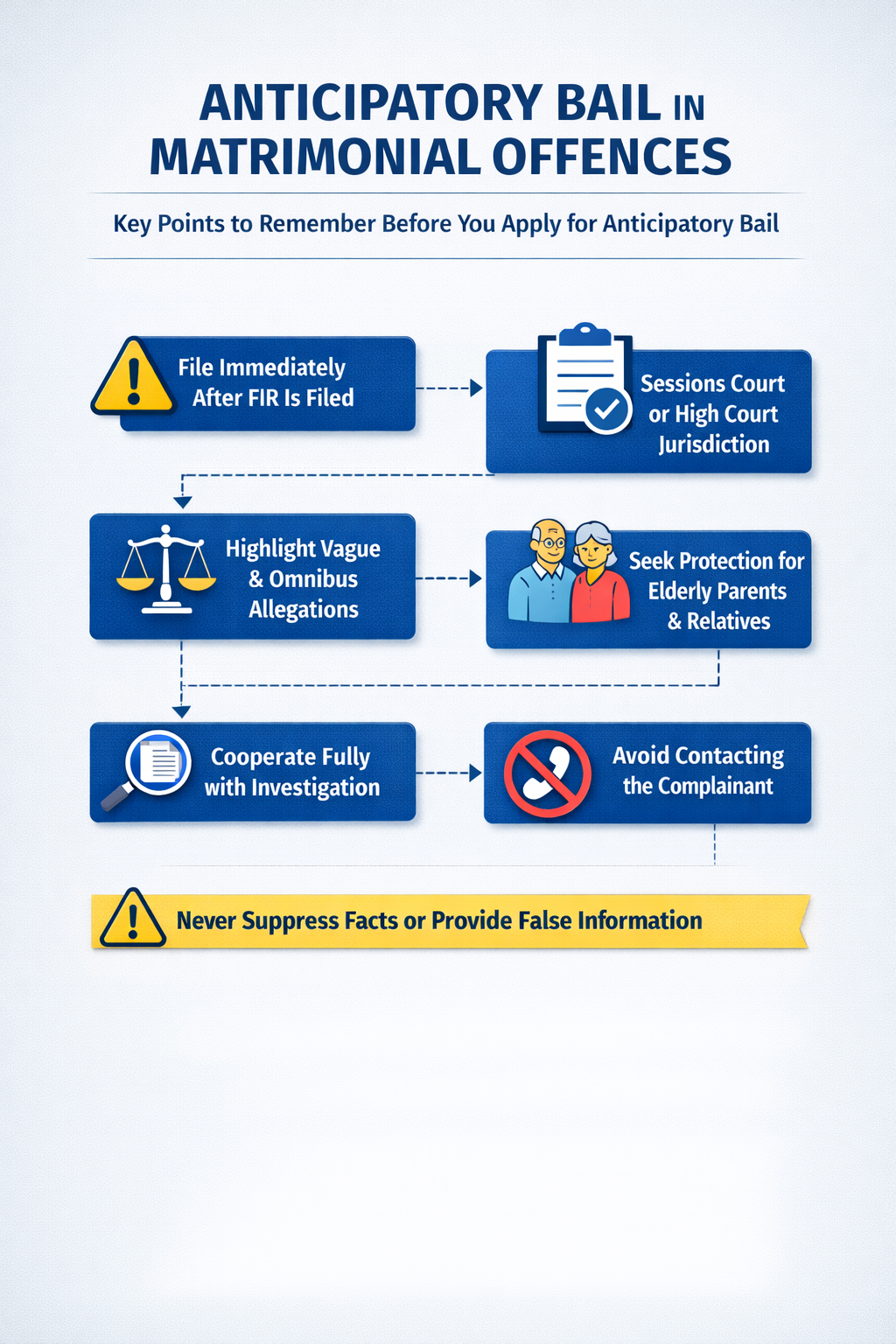
IV. When Should You Apply for Anticipatory Bail?

You should apply immediately if:

  • FIR has been registered.

  • Police have issued a notice.

  • There is apprehension of arrest.

  • Multiple family members are named without specific allegations.

Delay may weaken your legal position. Early filing signals cooperation and preparedness.

V. Which Court Has Jurisdiction?

Application may be filed before:

  • Sessions Court

  • High Court

Generally, the Sessions Court is approached first unless exceptional circumstances justify direct High Court intervention.

VI. What Factors Do Courts Consider?

Courts evaluate:

  • Nature and gravity of allegations
  • Specificity of accusations
  • Role attributed to each accused
  • Possibility of absconding
  • Likelihood of tampering with evidence
  • Criminal antecedents

Vague and omnibus allegations often strengthen the case for anticipatory bail. Courts increasingly recognise that matrimonial disputes sometimes involve exaggerated complaints.

VII. Conditions Imposed by Courts

Anticipatory bail orders may include:

  • Cooperation with investigation

  • No contact with complainant

  • No tampering with evidence

  • Travel restrictions

Violation of conditions can lead to cancellation of bail.

VIII. Protection for Parents and Relatives

Courts frequently observe misuse through mechanical implication of:

  • Elderly parents

  • Married sisters living separately 

  • Distant relatives

Where allegations lack specific overt acts, courts are inclined to grant protection.

IX. Common Mistakes to Avoid

  • Ignoring police notice
  • Filing incomplete application
  • Suppressing facts
  • Adopting aggressive or retaliatory approach

Strategic transparency strengthens credibility before the Court.

X. Can Anticipatory Bail Be Cancelled?

Yes. Anticipatory bail can be cancelled if :

  • Conditions are violated

  • False information was provided

  • Accused obstructs investigation

Courts retain the power to cancel protection.

XI. Strategic Considerations in Matrimonial Cases

Anticipatory bail must align with broader litigation strategy, especially where parallel proceedings exist:

  • Domestic Violence cases

  • Maintenance proceedings

  • Divorce petitions

Coordinated legal planning prevents contradictions across cases.

Conclusion

Anticipatory bail in matrimonial offences is not merely a procedural remedy. It is a constitutional shield against unnecessary arrest.

Courts recognise the need to balance protection of genuine victims with safeguards against abuse of process. Early, structured legal action significantly improves the likelihood of securing protection.

Liberty once lost is difficult to restore. Strategic defence must begin before arrest.


Index of Legal Strategies and Defence is here. 

Frequently Asked Questions

No. It depends on facts and judicial discretion.

Yes, if allegations are general and lack specificity.

Usually yes, unless exempted by the Court.

Yes. Courts may consider bona fide settlement while granting protection.

Posted in Legal Procedure | Tagged 498A arrest procedure CrPC 438 - Anticipatory Bail Dowry Case bail legal strategy and defence | Leave a comment

Search within entire Content of “Shades of Knife”

My Legal X Timeline

Advocate Sandeep Pamarati 🇮🇳💪👨🏻‍🎓 Follow

AP High Court Advocate with M Tech (CS) || 12 years in 'Software Industry' as Solution Architect || Blogs at https://t.co/29CB9BzK4w || #TDPTwitter

SandeepPamarati
Retweet on Twitter Advocate Sandeep Pamarati 🇮🇳💪👨🏻‍🎓 Retweeted
meghupdates Megh Updates 🚨™ @meghupdates ·
24 Jun

Sambhal, Uttar Pradesh | In a key breakthrough in the case involving the alleged sexual assault of a 6-year-old girl, police sniffer dog Mary helped investigators trace the accused monster, Sandeep, within minutes.

A gamcha recovered from the scene was used for scent tracking,

Reply on Twitter 2069765085422374920 Retweet on Twitter 2069765085422374920 380 Like on Twitter 2069765085422374920 2439 X 2069765085422374920
Retweet on Twitter Advocate Sandeep Pamarati 🇮🇳💪👨🏻‍🎓 Retweeted
telugu360 Telugu360 @telugu360 ·
24 Jun

వాట్సాప్‌లో నన్ను తిట్టేది, పొగిడేది మీరే. పది నిర్ణయాలు తీసుకుంటే మూడు తప్పులు అవ్వచ్చు.. ఆ తప్పులను సరిదిద్దుకుని ముందడుగు వేద్దాం. నన్ను తిట్టిన వారిని నేనెప్పుడూ బ్లాక్ చేయను, వారి ఆవేదనను స్వీకరిస్తా.

నారా లోకేష్

#NaraLokesh

Reply on Twitter 2069778787244576818 Retweet on Twitter 2069778787244576818 86 Like on Twitter 2069778787244576818 574 X 2069778787244576818
Retweet on Twitter Advocate Sandeep Pamarati 🇮🇳💪👨🏻‍🎓 Retweeted
politicalkida Political Kida @politicalkida ·
25 Jun

In 2018, CPI(M) supporter Debu Das and his wife were burnt alive by TMC goons.

The administration tried to pass it off as a short circuit, while the victims' son was made to wait for hours at police station instead of receiving justice.

Yesterday, the BJP govt arrested 10 TMC

Reply on Twitter 2070048322292007208 Retweet on Twitter 2070048322292007208 623 Like on Twitter 2070048322292007208 1901 X 2070048322292007208
Retweet on Twitter Advocate Sandeep Pamarati 🇮🇳💪👨🏻‍🎓 Retweeted
rshivshankar Rahul Shivshankar @rshivshankar ·
25 Jun

"THIS ISN'T AN ASIAN PROBLEM IT IS A PAK PROBLEM. IT'S A MISNOMER TO LABEL THEM "ASIAN GROOMING GANGS".
Rupert Lowe, British MP, Founder of UK's fastest growing party "RESTORE BRITAIN" and the man behind the report that exposed the UK's "Pak Rape Gangs" makes a clear and

Reply on Twitter 2069965275093746169 Retweet on Twitter 2069965275093746169 627 Like on Twitter 2069965275093746169 1611 X 2069965275093746169
Load More

Recent Posts

  • Is Bigamy (under sections 494, 495 IPC and now Section 82 BNS) a Cognizable and non-bailable offence, as much as it applies to State of Andhra Pradesh? June 27, 2026
  • Advocates Act 1961 Section 18 – Transfer of name from one State roll to another June 27, 2026
  • Are BCI and State Bar Councils Statutorily empowered to Levy Fees for Transfer of Enrollment? June 27, 2026
  • Petition Prayers Are Not Final Outcomes – Understanding Legal Strategy Before Making Decisions June 27, 2026
  • RS Tamilvendan Vs The Secretary and Ors on 21 May 2026 June 25, 2026

Most Read Posts

  • Reply to Section 41A CrPC Notice – Format with Legal Explanation (4,959 views)
  • Anu Aggarwal Vs Sushant Aggarwal on 20 Jan 2026 (3,501 views)
  • Umme Farva Vs State of U.P. and Anr on 14 Jan 2026 (3,389 views)
  • Charge Sheet and Final Report Explained (2,849 views)
  • Regular Bail Application Format (Section 437/439 CrPC) (2,223 views)
  • Neha Lal Vs Abhishek Kumar on 20 Jan 2026 (2,018 views)
  • Arrest Procedure in 498A cases after Arnesh Kumar (1,957 views)
  • Discharge Application Format in 498A Case – Draft, Procedure & Sample Template (1,796 views)
  • Can You Travel Abroad After an FIR Is Registered? – Legal Position Explained (1,725 views)
  • Atul Kumar Bajpai Vs State of UP and Anr on 17 Sep 2025 (1,560 views)

Tags

Reportable Judgement or Order (433)2-Judge (Division) Bench Decision (415)Legal Procedure Explained - Interpretation of Statutes (382)Landmark Case (381)1-Judge Bench Decision (362)Catena of Landmark Judgments Referred/Cited to (293)Work-In-Progress Article (215)3-Judge (Full) Bench Decision (101)Sandeep Pamarati (92)Article 21 - Protection of life and personal liberty (80)Issued or Recommended Guidelines or Directions or Protocols to be followed (71)Perjury Under 340 CrPC (66)Absurd Or After Thought Or Baseless Or False Or General Or Inherently Improbable Or Improved Or UnSpecific Or Omnibus Or Vague Allegations (62)Reprimands or Setbacks to YCP Govt of Andhra Pradesh (49)Summary Post (47)CrPC 482 - Quash (44)HM Act Sec 13 - Divorce Granted to Husband (42)Divorce Granted on Cruelty ground (42)Legal Terrorism (41)Not Authentic copy hence to be replaced (40)

Categories

Supreme Court of India Judgment or Order or Notification (753)Bare Acts or State Amendments or Statutes or GOs or Notifications issued by Central or State Governments (329)High Court of Andhra Pradesh Judgment or Order or Notification (186)High Court of Delhi Judgment or Order or Notification (164)High Court of Bombay Judgment or Order or Notification (112)High Court of Karnataka Judgment or Order or Notification (93)Legal Procedure (80)High Court of Madras Judgment or Order or Notification (71)High Court of Allahabad Judgment or Order or Notification (61)LLB Study Material (59)General Study Material (56)High Court of Punjab & Haryana Judgment or Order or Notification (52)Assorted Court Judgments or Orders or Notifications (50)High Court of Kerala Judgment or Order or Notification (47)Judicial Activism (for Public Benefit) (47)Prakasam DV Cases (46)District or Sessions or Magistrate Court Judgment or Order or Notification (44)High Court of Madhya Pradesh Judgment or Order or Notification (38)High Court of Gujarat Judgment or Order or Notification (28)High Court of Calcutta Judgment or Order or Notification (27)

Recent Comments

  • eCourts India on Compromise-Based Quashing in Matrimonial Cases – Complete Legal Strategy
  • The Divorce Law Firm on Life Cycle Stages of a Divorce case
  • The Divorce Law Firm on Life Cycle Stages of a Divorce case
  • ShadesOfKnife on Sandeep Pamarati Vs Ungrateful Knife (IPC 498A Case)
  • KONURU VINAYKUMAR on Sandeep Pamarati Vs Ungrateful Knife (IPC 498A Case)

Archives of SoK

  • June 2026 (17)
  • May 2026 (24)
  • April 2026 (33)
  • March 2026 (42)
  • February 2026 (30)
  • January 2026 (21)
  • December 2025 (2)
  • November 2025 (3)
  • October 2025 (17)
  • September 2025 (12)
  • August 2025 (5)
  • July 2025 (10)
  • June 2025 (15)
  • May 2025 (3)
  • April 2025 (10)
  • March 2025 (7)
  • February 2025 (8)
  • January 2025 (1)
  • December 2024 (3)
  • November 2024 (4)
  • October 2024 (16)
  • September 2024 (15)
  • August 2024 (14)
  • July 2024 (11)
  • June 2024 (18)
  • May 2024 (13)
  • April 2024 (9)
  • March 2024 (23)
  • February 2024 (15)
  • January 2024 (11)
  • December 2023 (11)
  • November 2023 (9)
  • October 2023 (13)
  • September 2023 (12)
  • August 2023 (15)
  • July 2023 (17)
  • June 2023 (11)
  • May 2023 (6)
  • April 2023 (5)
  • March 2023 (10)
  • February 2023 (9)
  • January 2023 (12)
  • December 2022 (12)
  • November 2022 (8)
  • October 2022 (13)
  • September 2022 (17)
  • August 2022 (10)
  • July 2022 (21)
  • June 2022 (27)
  • May 2022 (23)
  • April 2022 (32)
  • March 2022 (17)
  • February 2022 (6)
  • January 2022 (2)
  • December 2021 (7)
  • November 2021 (7)
  • October 2021 (6)
  • September 2021 (10)
  • August 2021 (31)
  • July 2021 (45)
  • June 2021 (17)
  • May 2021 (17)
  • April 2021 (18)
  • March 2021 (58)
  • February 2021 (14)
  • January 2021 (50)
  • December 2020 (35)
  • November 2020 (68)
  • October 2020 (67)
  • September 2020 (28)
  • August 2020 (41)
  • July 2020 (20)
  • June 2020 (36)
  • May 2020 (40)
  • April 2020 (38)
  • March 2020 (26)
  • February 2020 (43)
  • January 2020 (35)
  • December 2019 (34)
  • November 2019 (4)
  • October 2019 (18)
  • September 2019 (57)
  • August 2019 (33)
  • July 2019 (12)
  • June 2019 (18)
  • May 2019 (5)
  • April 2019 (19)
  • March 2019 (58)
  • February 2019 (11)
  • January 2019 (90)
  • December 2018 (97)
  • November 2018 (43)
  • October 2018 (31)
  • September 2018 (73)
  • August 2018 (47)
  • July 2018 (143)
  • June 2018 (92)
  • May 2018 (97)
  • April 2018 (59)
  • March 2018 (8)

Blogroll

  • Daaman Promoting Harmony 0
  • Fight against Legal Terrorism Fight against Legal Terrorism along with MyNation Foundation 0
  • Good Morning Good Morning News 0
  • Insaaf India Insaaf Awareness Movement 0
  • MyNation Hope Foundation Wiki 0
  • MyNation.net Equality, Justice and Harmony 0
  • Sarvepalli Legal 0
  • Save Indian Family Save Indian Family Movement 0
  • SIF Chandigarh SIF Chandigarh 0
  • The Male Factor The Male Factor 0
  • Unitedmen Foundation a dedicated community forged with the mission to unite men facing legal challenges in marital disputes. 0
  • Vaastav Foundation The Social Reality 0
  • Vinayak my2centsworth – This blog is for honest law abiding men, married or planning to get married 0
  • Voice4india Indian Laws, Non-profits, Environment 0
  • Writing Law Writing Law by Ankur 0

RSS Cloudflare Status

  • Errors when uploading Custom Certificates June 26, 2026
    Jun 26, 15:00 UTC Resolved - This incident has been resolved. Jun 26, 12:33 UTC Investigating - Cloudflare is investigating 500/2000 errors when customers attempt to upload a new custom certificate. Custom certificates already in production remain unaffected and are operating normally.
    Cloudflare

RSS List of Spam Server IPs from Project Honeypot

  • 171.25.158.95 | SD June 26, 2026
    Event: Bad Event | Total: 226 | First: 2026-05-03 | Last: 2026-06-26
Owned and Operated by Advocate Sandeep Pamarati and Advocate Suprajaa Rajan
Proudly powered by WordPress
Theme: Flint by Star Verte LLC

Bad Behavior has blocked 2408 access attempts in the last 7 days.

pixel