In criminal trials, documentary evidence often plays a decisive role. Prosecution agencies routinely rely on:
- FIRs
- Medical reports
- Call Detail Records (CDRs)
- Bank statements
- WhatsApp chats
- CCTV footage
- Forensic reports
- Recovery memos
- Seizure panchanamas
- Electronic records
- Government documents
- Expert opinions
However, merely producing a document in court does not automatically make it admissible, reliable, or legally proved.
A skilled defence advocate must carefully scrutinize every document produced by the prosecution and raise timely objections wherever legally justified.
Many cases are won not because the defence produces strong evidence, but because the prosecution fails to properly prove its own documents.
Therefore, understanding the various objections available against prosecution documentary evidence is an essential part of criminal defence strategy.
This article explains the most important documentary evidence objections under the:
- Bharatiya Sakshya Adhiniyam, 2023 (BSA)
- Bharatiya Nagarik Suraksha Sanhita, 2023 (BNSS)
- Corresponding provisions of the Indian Evidence Act, 1872
- Corresponding provisions of the Code of Criminal Procedure, 1973 (CrPC)
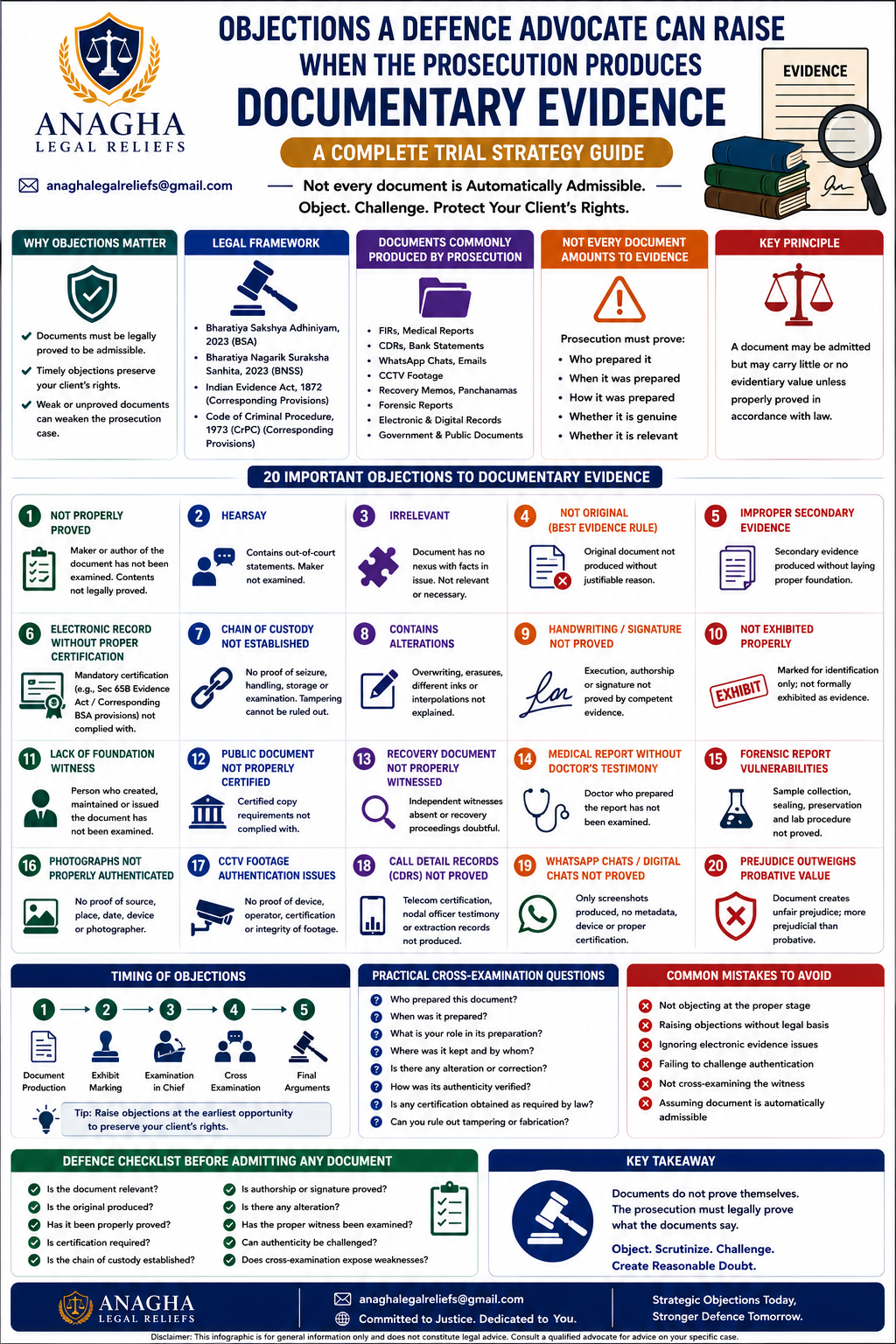
Why Documentary Evidence Must Be Objected To Promptly
A common mistake among young advocates is:
“I will argue admissibility during final arguments.”
This can be dangerous.
Many objections should be raised:
- At the time of marking the document
- During examination-in-chief
- During exhibit marking
- During witness examination
Failure to object at the proper stage may weaken later challenges.
Categories of Documentary Evidence Objections
Broadly, objections fall into:
- Admissibility objections
- Proof objections
- Relevancy objections
- Authenticity objections
- Electronic evidence objections
- Procedural objections
- Secondary evidence objections
Objection 1: Document Not Properly Proved
This is the most common defence objection.
Merely producing a document does not prove its contents.
The prosecution must prove:
- Who prepared it
- When it was prepared
- How it was prepared
- Whether it is genuine
Example
A police officer produces a private document.
Defence may object:
“The maker of the document has not been examined.”
Without proper proof, the document may have limited evidentiary value.
Objection 2: Document Is Hearsay
Documents containing statements made by third parties may amount to hearsay.
Example
Witness states:
“Someone told me this document proves the accused’s involvement.”
Defence objection:
“The contents constitute hearsay and the maker has not been examined.”
Courts generally require direct evidence unless covered by statutory exceptions.
Objection 3: Relevancy Objection
Not every document connected to the case is legally relevant.
Defence may object if the document has no connection to:
- Facts in issue
- Relevant facts
- Circumstantial chain
Example
Old personal records having no nexus to the alleged offence.
Objection:
“Document is irrelevant and lacks probative value.”
Objection 4: Document Not Original (Best Evidence Rule)
The prosecution should ordinarily produce original documents.
Example
Photocopy of agreement produced without original.
Defence objection:
“Original document has not been produced.”
This often becomes a powerful objection.
Objection 5: Improper Secondary Evidence
Secondary evidence cannot automatically replace original documents.
The prosecution must first establish why original evidence is unavailable.
Example
Photocopy of receipt produced without explanation.
Defence may argue:
- Foundation not laid
- Conditions for secondary evidence not satisfied
Objection 6: Electronic Record Without Proper Certification
One of the strongest objections in modern trials.
Electronic evidence includes:
- WhatsApp chats
- Emails
- CCTV footage
- Hard drives
- Mobile extractions
- Audio recordings
Under the earlier law:
- Section 65B Evidence Act
Under BSA:
- Corresponding provisions governing electronic records
Defence Objection
“Mandatory certification requirements have not been complied with.”
Improper certification can significantly affect admissibility.
Objection 7: Chain of Custody Not Established
Particularly important in:
- Mobile phone evidence
- CCTV footage
- Hard drives
- Pen drives
- Forensic evidence
The prosecution must show:
- Who seized it
- Who handled it
- Where it was stored
- Whether tampering was possible
Defence Objection
“Chain of custody remains unproved.”
Objection 8: Document Contains Alterations
Always examine:
- Overwriting
- Different ink
- Erasures
- Corrections
- Interpolations
Defence Objection
“Material alterations remain unexplained.”
This can seriously affect credibility.
Objection 9: Unproved Handwriting or Signature
Where authorship is disputed:
The prosecution must prove:
- Signature
- Handwriting
- Execution
Example
Alleged confession note.
Defence objection:
“Execution of document has not been proved.”
Objection 10: Document Not Exhibited Properly
Many documents are merely marked for identification.
They may not become exhibited evidence automatically.
Defence Objection
“Document is marked but not formally proved.”
This distinction is often overlooked.
Objection 11: Lack of Foundation Witness
A document often requires testimony from the person who:
- Created it
- Maintained it
- Issued it
Example
Bank statement produced through investigating officer.
Defence objection:
“Competent custodian has not been examined.”
Objection 12: Public Document Not Properly Certified
Where prosecution relies on:
- Government records
- Revenue documents
- Official registers
Proper certification may be required.
Defence Objection
“Certified copy requirements not satisfied.”
Objection 13: Recovery Document Not Properly Witnessed
Recovery memos and seizure panchanamas are frequently challenged.
Questions include:
- Were independent witnesses present?
- Did witnesses actually witness recovery?
- Were signatures obtained later?
Defence Objection
“Recovery proceedings appear doubtful.”
Objection 14: Medical Report Without Doctor’s Testimony
Medical reports may require supporting testimony.
Example
Injury certificate produced.
Defence objection:
“Doctor has not been examined.”
This becomes important where injuries are disputed.
Objection 15: Forensic Report Vulnerabilities
Forensic reports are influential but not immune from challenge.
Questions include:
- Sample collection
- Sample sealing
- Preservation
- Laboratory procedures
Defence Objection
“Link evidence is incomplete.”
Objection 16: Photographs Not Properly Authenticated
Photographs must be linked to:
- Place
- Date
- Device
- Photographer
Defence Objection
“Source and authenticity not established.”
Objection 17: CCTV Footage Authentication Issues
Common challenges include:
- Missing DVR
- Edited footage
- Incomplete footage
- No certification
- Unknown operator
Defence Objection
“Authenticity and integrity remain unproved.”
Objection 18: Call Detail Records (CDRs) Not Properly Proved
CDRs often require:
- Telecom certification
- Nodal officer testimony
- Proper extraction records
Defence Objection
“CDRs have not been proved in accordance with law.”
Objection 19: WhatsApp Chat Authenticity Challenge
Common issues include:
- Screenshots only
- Missing metadata
- No device production
- Selective extraction
Defence Objection
“Source and integrity of chats remain doubtful.”
Objection 20: Prejudice Outweighs Probative Value
Sometimes a document creates unfair prejudice.
Example
Unrelated allegations from the past.
Defence may argue:
“The document is more prejudicial than probative.”
Strategic Timing of Objections
Defence advocates should consider objections at:
Stage 1
Document production
Stage 2
Exhibit marking
Stage 3
Examination-in-chief
Stage 4
Stage 5
Final arguments
Early objection is usually stronger.
Practical Cross-Examination Questions
When challenging documentary evidence, ask:
About Creation
- Who prepared it?
- When?
About Custody
- Where was it kept?
- Who handled it?
About Authenticity
- Any alterations?
- Any verification?
About Procedure
- Was certification obtained?
- Were rules followed?
These questions frequently expose weaknesses.
Common Defence Mistakes
Avoid:
Objecting Without Legal Basis
Weak objections reduce credibility.
Missing Electronic Evidence Objections
Electronic records require careful scrutiny.
Ignoring Exhibit Marking Stage
Many opportunities are lost here.
Failing to Cross-Examine
Unchallenged documents gain weight.
Raising Objections Too Late
Timing matters.
Judicial Approach
Courts generally distinguish between:
Admissibility
Can the document be received?
and
Evidentiary Weight
How much importance should be given?
A document may be admitted yet ultimately carry little weight if not properly proved.
Defence Checklist for Documentary Evidence
Before admitting any prosecution document, ask:
- Is it relevant?
- Is it original?
- Has it been properly proved?
- Is certification required?
- Is chain of custody established?
- Is authorship proved?
- Is there any alteration?
- Has the proper witness been examined?
- Can authenticity be challenged?
- Does cross-examination expose weaknesses?
Conclusion
Documentary evidence is often perceived as powerful. However, in criminal trials, documents do not prove themselves.
A vigilant defence advocate must examine:
- Admissibility
- Authenticity
- Relevancy
- Proof
- Certification
- Procedural compliance
Timely and well-founded objections can significantly weaken the prosecution case, expose investigative lapses, and create reasonable doubt.
In many criminal trials, the battle is not about what documents say—it is about whether the prosecution has legally proved what the documents say.
Index of Legal Strategies and Defence is here.
Key Contributor :
Mrs. Suprajaa Rajan B.Com., LL.B., LL.M.
+91-9606345150

