Introduction
Section 498A of the Indian Penal Code deals with cruelty by husband or his relatives. Over time, this provision has become one of the most litigated sections in matrimonial disputes. However, there are several misconceptions surrounding arrest and bail in 498A cases.
Many individuals believe that arrest is automatic and bail is difficult to obtain, which is not entirely correct. Courts have introduced safeguards to prevent misuse while ensuring protection for genuine victims.
This article clarifies the common myths and legal realities regarding bail in 498A cases, along with the applicable provisions under the Code of Criminal Procedure, 1973 (CrPC) and the Bharatiya Nagarik Suraksha Sanhita, 2023 (BNSS).
Understanding Section 498A IPC
Section 498A of the Indian Penal Code
criminalizes cruelty inflicted upon a married woman by her husband or his relatives.
The offence is:
- Cognizable
- Non-bailable
- Non-compoundable (subject to judicial exceptions)
Because of its serious nature, the law initially allowed immediate police action. However, judicial intervention has significantly changed how the provision operates in practice.
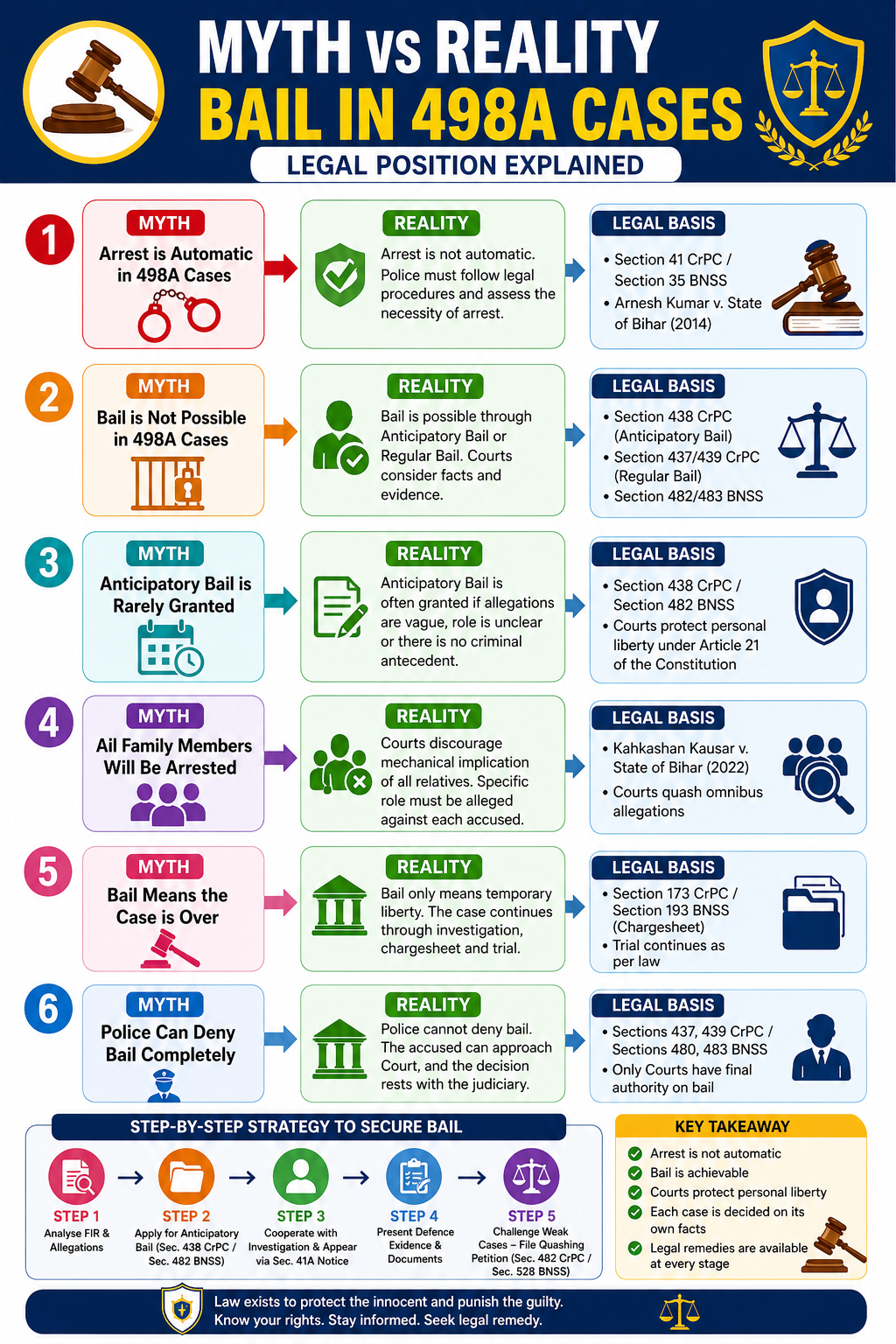
Myth 1: Arrest Is Automatic in 498A Cases
Reality
Arrest is not automatic in 498A cases.
The Supreme Court in
Arnesh Kumar v. State of Bihar
held that police must not make arrests in a routine manner.
Instead, police must:
- Assess necessity of arrest
- Record reasons for arrest
- Issue notice of appearance
Relevant provisions:
- Section 41A CrPC (Section 35 BNSS) – Notice of appearance
- Section 41 CrPC (Section 35 BNSS – principles of arrest)
Therefore, if the accused cooperates, arrest can often be avoided.
Myth 2: Bail Is Not Possible in 498A Cases
Reality
Although 498A is a non-bailable offence, bail is very much possible.
The accused can seek:
- Anticipatory Bail → Section 438 CrPC (Section 482 BNSS)
- Regular Bail → Section 437/439 CrPC (Section 480/483 BNSS)
Courts consider:
- Nature of allegations
- Evidence on record
- Role of the accused
- Possibility of misuse
In many cases, courts grant bail, especially where allegations are exaggerated or general in nature.
Myth 3: Anticipatory Bail Is Rarely Granted
Reality
Courts regularly grant anticipatory bail in 498A cases when:
- Allegations are vague
- No specific role is attributed
- The accused is cooperating
Courts also consider:
- Age (especially elderly parents)
- Medical condition
- Absence of criminal history
Thus, anticipatory bail acts as a strong safeguard against unnecessary arrest.
Myth 4: All Family Members Will Be Arrested
Reality
Courts discourage the mechanical implication of all relatives.
In Kahkashan Kausar v. State of Bihar, the Supreme Court held that:
- Vague allegations against relatives are not sufficient
- Courts must scrutinize individual roles
Therefore, distant relatives and elderly parents often receive protection from arrest and early relief.
Myth 5: Bail Means the Case Is Over
Reality
Grant of bail does not end the case.
Bail only ensures that:
- The accused remains free during trial
- The accused cooperates with the investigation
The case continues through:
- Chargesheet → Section 173 CrPC (Section 193 BNSS)
- Trial process
- Final judgment
Therefore, bail is a procedural safeguard, not an acquittal.
Myth 6: Police Can Deny Bail Completely
Reality
Police do not have the final authority to deny bail in non-bailable offences.
The accused can approach:
- Magistrate Court
- Sessions Court
- High Court
Courts ultimately decide whether bail should be granted based on legal principles and facts of the case.
Step-by-Step Strategy to Secure Bail in 498A Cases
Step 1: Assess FIR and Allegations
Carefully examine:
- Specific allegations
- Role of each accused
- Supporting evidence
Step 2: Apply for Anticipatory Bail
File application under:
- Section 438 CrPC (Section 482 BNSS)
Seek interim protection where necessary.
Step 3: Cooperate with Investigation
Appear before police when required under:
- Section 41A CrPC (Section 35 BNSS)
Cooperation strengthens the case for bail.
Step 4: Present Defence Material
Submit:
- Proof of separate residence
- Medical documents
- Evidence contradicting allegations
Step 5: Challenge Weak Cases
If allegations are false or vague, consider:
- Quashing petition → Section 482 CrPC (Section 528 BNSS)
Judicial Approach
Courts today follow a balanced approach:
- Protect genuine victims
- Prevent misuse of law
They emphasise:
- Individual role of accused
- Need to avoid unnecessary arrests
- Importance of personal liberty
Conclusion
The law relating to bail in 498A cases has , thus, evolved significantly. While the offence remains serious, courts have introduced safeguards to ensure that criminal law is not misused as a tool of harassment.
In reality:
- Arrest is not automatic
- Bail is achievable
- Courts carefully evaluate each case
Therefore, individuals facing 498A allegations should adopt a structured legal strategy and seek timely legal remedies.
Related Legal Concepts
- Anticipatory Bail
- Regular Bail
- First Information Report(FIR)
- Quashing of FIR
- Non-Bailable Offence
Index of Legal Strategies and Defence is here.
Key Contributor :
Mrs. Suprajaa Rajan B.Com., LL.B., LL.M.
+91-9606345150

