A structured legal roadmap to protect liberty, reputation, and financial security at every stage of criminal matrimonial proceedings.
Matrimonial criminal litigation in India often begins abruptly — with an FIR under Section 498A IPC, a complaint under the Domestic Violence Act, or a maintenance claim under Section 125 CrPC.
What follows is confusion, pressure, and procedural complexity.
This playbook provides a stage-wise strategic framework for navigating criminal matrimonial disputes lawfully and effectively.
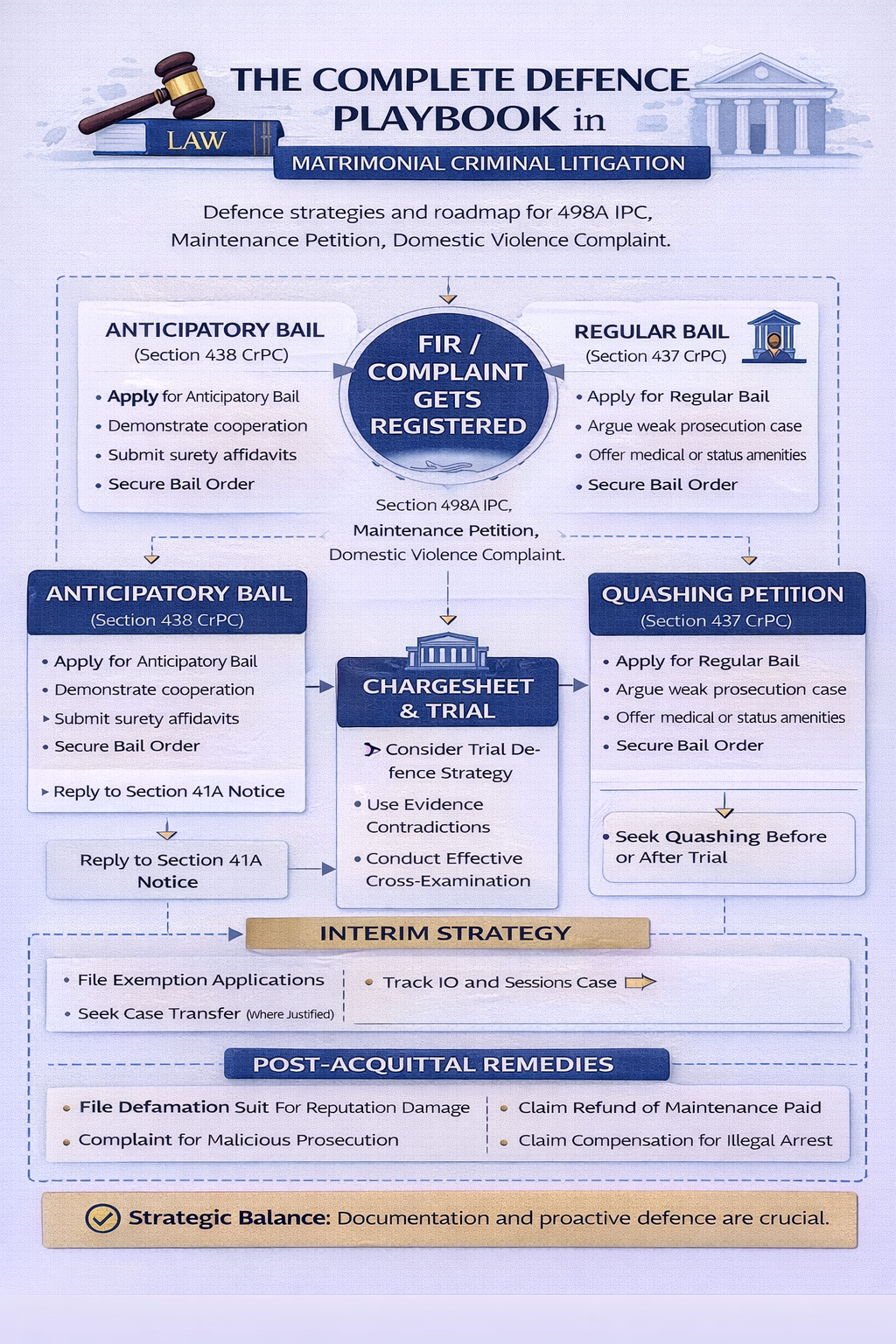
I. Stage One: Immediately After FIR Registration
Most accused individuals panic at this stage. Strategy must, undoubtedly, begin immediately.
Key Legal Provisions:
Section 498A IPC
Section 406 IPC
Section 34 IPC
Section 41 & 41A CrPC
Immediate Strategic Steps:
- Verify FIR contents
- Assess arrest risk
- Prepare anticipatory bail strategy
- Collect documentary evidence
- Preserve digital communications
The Supreme Court in Arnesh Kumar v. State of Bihar, held that arrest cannot be automatic in offences punishable up to seven years.
Read also : Arrest Procedure in 498A Cases After Arnesh Kumar
II. Stage Two: Bail & Liberty Protection
Personal liberty under Article 21 of the Constitution remains paramount.
Strategic Remedies:
1. Anticipatory Bail – Section 438 CrPC
Filed when arrest apprehension exists.
2. Regular Bail – Section 437/439 CrPC
Filed after arrest.
3. Transit Anticipatory Bail
When FIR is lodged in another State.
Courts evaluate:
Specificity of allegations
Role of each accused
Possibility of tampering
Cooperation with investigation
Read also : Anticipatory Bail in Matrimonial Offences – Complete Guide
III. Stage Three: Investigation & Chargesheet
After investigation, police may file chargesheet under:
Section 173 CrPC
This stage determines the trial trajectory.
Defence Strategy Includes:
- Filing discharge application
- Challenging omnibus allegations
- Examining absence of specific overt acts
- Seeking exemption from personal appearance
High Courts frequently quash proceedings against distant relatives where allegations are vague.
Read also : Discharge Application in 498A Cases – Legal Framework
IV. Stage Four: High Court Remedies
Where proceedings amount to abuse of process, remedy lies under:
Section 482 CrPC
High Courts exercise inherent powers to prevent miscarriage of justice.
Grounds commonly invoked:
Absence of prima facie case
Generalised allegations
Settlement between parties
Malicious prosecution
Read also : Quashing of FIR Under Section 482 CrPC – Explained
V. Parallel Civil & Financial Litigation
Matrimonial disputes rarely remain confined to criminal law.
Parallel proceedings may include:
Domestic Violence Act, 2005
Section 125 CrPC Maintenance
Divorce proceedings under personal laws
Financial Defence Strategy:
- Accurate income disclosure
- Challenging inflated claims
- Contesting interim maintenance
- Seeking modification upon change of circumstances
VI. Trial Strategy
If matter proceeds to trial, defence must shift from procedural to evidentiary strength.
Key Focus Areas:
Cross-examination strategy
Contradictions in complaint & deposition
Electronic evidence admissibility
Medical and documentary inconsistencies
Hostile witness handling
Trial requires patience, consistency, and procedural discipline.
VII. Settlement & Strategic Exit
Despite non-compoundable nature of 498A, courts allow quashing upon settlement.
Compromise-based quashing has evolved as a judicially recognised solution where matrimonial disputes are resolved.
Strategic mediation may:
Reduce litigation time
Protect reputation
Avoid prolonged trial
VIII. Common Strategic Mistakes to Avoid
- Ignoring Section 41A notice
- Filing multiple inconsistent petitions
- Aggressive communication with complainant
- Social media commentary
- Suppressing financial disclosures
- Non-cooperation with investigation
IX. Long-Term Reputation & Legal Risk Management
Criminal matrimonial litigation impacts:
Passport applications
Employment background verification
Professional licences
Immigration status
Strategic handling at early stages significantly influences long-term outcomes.
X. Guiding Principles of Defence
Arrest is not automatic.
Allegations must be specific.
Liberty is constitutionally protected.
Procedure is a safeguard, not a technicality.
Early strategy prevents prolonged litigation.
Conclusion
Matrimonial criminal litigation, thus, requires structured legal response, not emotional reaction. Each procedural stage offers remedies. Each remedy must be invoked strategically.
The defence playbook lies in:
Understanding statutory safeguards
Timely filing of appropriate applications
Preserving documentary evidence
Maintaining procedural discipline
So liberty, reputation, and financial security depend on informed legal action.
Index of Legal Strategies and Defence is here.
Key Contributor :
Mrs. Suprajaa Rajan B.Com., LL.B., LL.M.
+91-9606345150

