In modern matrimonial litigation, digital evidence often speaks louder than oral allegations. WhatsApp chats, emails, call logs, bank alerts, social media posts, photographs, location records, video calls, and cloud backups frequently become decisive in disputes involving:
- Cruelty allegations
- Dowry harassment complaints
- Domestic violence proceedings
- Maintenance disputes
- Child custody battles
- Adultery-related allegations
- Financial concealment claims
- False implication defences
In many cases, the party who preserves digital evidence properly gains a significant strategic advantage.
However, digital evidence is fragile. Messages can disappear, devices can fail, accounts can be deleted, metadata can change, and improper handling can destroy evidentiary value.
Therefore, understanding how to protect digital evidence in matrimonial disputes becomes essential for litigants, family members, and legal practitioners.
This article explains the complete strategy for identifying, preserving, authenticating, producing, and defending digital evidence, with references to the Code of Criminal Procedure, 1973 (CrPC), the Bharatiya Nagarik Suraksha Sanhita, 2023 (BNSS), the Indian Evidence Act, 1872, and the Bharatiya Sakshya Adhiniyam, 2023 (BSA).
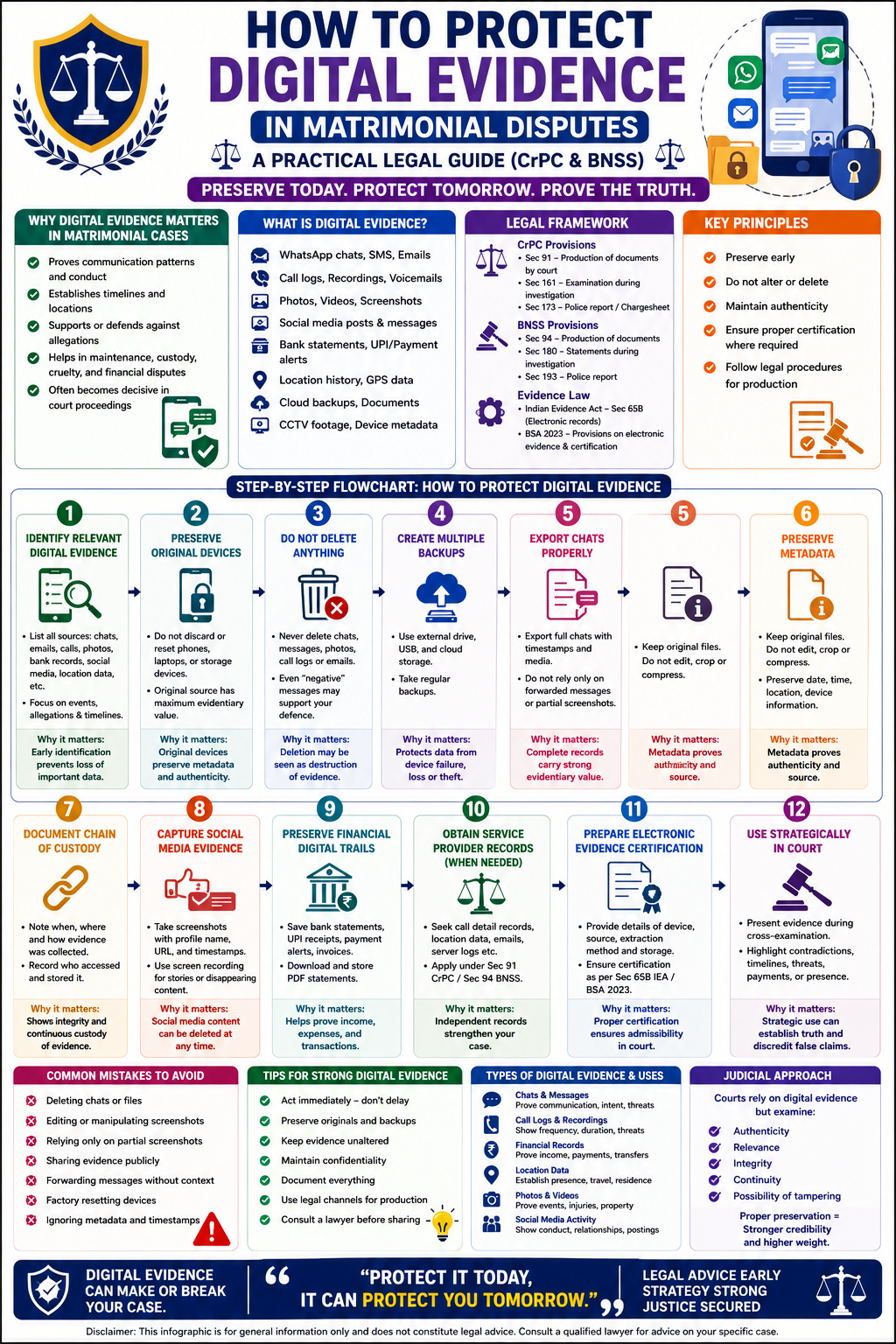
What Is Digital Evidence?
Digital evidence includes any information stored, transmitted, or generated electronically.
Common examples include:
- WhatsApp chats
- SMS messages
- Emails
- Call recordings
- Video recordings
- CCTV footage
- GPS location history
- UPI/payment alerts
- Banking app notifications
- Social media posts
- Cloud backups
- Google timeline records
- Screenshots
- Photographs with metadata
- Audio notes
- Video call records
In matrimonial disputes, these records often reveal:
- Communication patterns
- Financial conduct
- Residence history
- Threats or harassment
- Reconciliation attempts
- Settlement discussions
- Contradictions in allegations
Why Digital Evidence Matters in Matrimonial Cases
Digital evidence frequently helps establish:
Cruelty or Harassment
Messages may show:
- Threats
- Abusive language
- Emotional manipulation
- Coercive demands
False Allegations
Chats may reveal:
- Friendly communication after alleged incidents
- Settlement pressure
- Contradictory statements
Financial Disputes
Bank records may show:
- Transfers
- Shared expenses
- Hidden income
- Asset diversion
Custody Disputes
Location records and communication logs may establish:
- Parenting involvement
- Travel history
- Daily caregiving
Thus, digital evidence often shapes the narrative before trial even begins.
Legal Framework
Investigation and Document Production
Production of Documents
- Section 91 CrPC (BNSS Section 94)
Courts may summon:
- Phone records
- Bank records
- Emails
- Server logs
- Cloud data
Investigation Statements
- Section 161 CrPC (BNSS Section 180)
Digital records may be examined during investigation.
Police Report
- Section 173 CrPC (BNSS Section 193)
Electronic material may form part of the chargesheet.
Electronic Evidence Under Evidence Law
Under Indian Evidence Act
- Section 65B
Under Bharatiya Sakshya Adhiniyam, 2023
- Electronic records provisions under BSA
Electronic evidence generally requires proper certification where applicable.
Therefore, preservation must begin early.
Step 1: Identify Relevant Digital Evidence Immediately
The first mistake many litigants make is waiting too long.
The moment matrimonial conflict escalates, identify relevant digital records.
Create a checklist:
Communication
- WhatsApp chats
- SMS
- Emails
- Telegram/Signal chats
Financial
- UPI records
- Bank alerts
- Wallet transactions
Media
- Photos
- Videos
- Audio notes
Location
- Google timeline
- Ride-sharing records
- Travel bookings
Social Media
- Posts
- Stories
- Direct messages
Early identification prevents accidental loss.
Step 2: Preserve Original Devices
One of the most important rules:
Never discard the original device.
Preserve:
- Mobile phones
- Laptops
- Tablets
- External drives
- Memory cards
Why?
Because courts often prefer original sources.
Metadata may include:
- Date
- Time
- Device information
- Location
- File creation history
Changing devices without backups can destroy critical evidence.
Step 3: Do Not Delete Anything
Many people delete chats out of anger or fear.
This can be disastrous.
Never delete:
- Messages
- Photos
- Audio notes
- Call logs
- Contact histories
Even “embarrassing” messages may later support your defence.
Preservation always comes before interpretation.
Step 4: Create Multiple Backups
Create secure backups immediately.
Use:
Local Backup
- External hard drive
- Encrypted USB drive
Cloud Backup
Examples include:
Google Drive,
iCloud, or
Microsoft OneDrive
Offline Export
Export:
- Chat histories
- Emails
- Call logs
Multiple backups reduce accidental loss.
Step 5: Export Chats Properly
For messaging platforms:
Export complete chats.
Do not:
- Crop screenshots
- Forward selected messages only
- Edit content
Instead:
- Export with timestamps
- Include media where relevant
- Preserve contact details
Incomplete screenshots often invite challenge.
Step 6: Preserve Metadata
Metadata often becomes more valuable than the content itself.
Metadata may prove:
- Exact creation time
- Device source
- GPS location
- Editing history
Do not:
- Compress files repeatedly
- Rename files unnecessarily
- Edit screenshots
Original metadata strengthens authenticity.
Step 7: Record Chain of Custody
Document:
- When evidence was collected
- Who accessed it
- Where it was stored
- When backups were created
This becomes crucial if authenticity is challenged later.
Step 8: Capture Social Media Evidence Correctly
If social media content may disappear:
Preserve:
- Profile URLs
- Screenshots
- Screen recordings
- Time and date stamps
Include:
- Username
- Profile picture
- Post date
- Comments
Anonymous screenshots are weaker.
Step 9: Preserve Financial Digital Trails
Save:
- Net banking screenshots
- Transaction IDs
- UPI receipts
- Wallet statements
- Credit card statements
Financial evidence often defeats exaggerated maintenance claims.
Step 10: Obtain Service Provider Records Where Necessary
If records become disputed, seek production through court.
Apply under:
- Section 91 CrPC (Section 94 BNSS)
Possible records include:
- Call detail records
- Tower location
- Email server logs
- Banking records
- Telecom records
Independent records often carry high credibility.
Step 11: Prepare Electronic Evidence Certification
Where certification becomes necessary:
Prepare:
- Device details
- Source details
- Extraction method
- Storage details
Certification should align with applicable evidence law.
Improper certification may delay admissibility.
Step 12: Use Digital Evidence Strategically During Cross-Examination
Digital evidence is most powerful when used at the right stage.
Use it to challenge:
- Timelines
- Presence claims
- Threat allegations
- Financial assertions
- Residence disputes
Examples:
Friendly Chats After Alleged Cruelty
May weaken prosecution.
Location Records
May disprove physical presence.
Payment Records
May contradict maintenance claims.
Common Mistakes to Avoid
Avoid:
Selective Screenshots
Incomplete records weaken credibility.
Editing Messages
Manipulation can destroy admissibility.
Sharing Evidence Publicly
Social media disclosure may backfire.
Forwarding Sensitive Evidence
Loss of metadata may occur.
Relying Only on Screenshots
Original files matter.
Factory Resetting Devices
Critical evidence may disappear permanently.
Defence Strategy in False Matrimonial Cases
If defending against false allegations, digital evidence may establish:
Separate Residence
Location history.
Friendly Relations
Post-incident chats.
Settlement Pressure
Recorded negotiations.
Financial Independence
Income transfers and business activity.
False Timelines
Travel records and digital timestamps.
Judicial Approach
Courts increasingly rely on:
- Electronic communication
- Digital payment records
- Location evidence
- Social media activity
- Audio and video recordings
However, courts also carefully examine:
- Authenticity
- Continuity
- Source reliability
- Possibility of manipulation
Therefore, preservation matters as much as content.
Practical Digital Evidence Checklist
Before litigation escalates, ensure:
- Original device preserved
- Chats exported
- Cloud backup created
- Financial records saved
- Metadata preserved
- Social media content archived
- Chain of custody recorded
- Service provider records identified
- Legal certification planned
Conclusion
In matrimonial litigation, digital evidence often becomes the most powerful witness.
A properly preserved digital record can:
- Support genuine allegations
- Expose false claims
- Protect innocent family members
- Strengthen settlement negotiations
- Influence bail, trial, maintenance, and quashing proceedings
By:
- Acting early
- Preserving originals
- Creating secure backups
- Maintaining metadata
- Using procedural tools strategically
you can significantly strengthen your legal position.
In modern litigation, devices may forget—but properly preserved digital evidence does not.
Index of Legal Strategies and Defence is here.
Key Contributor :
Mrs. Suprajaa Rajan B.Com., LL.B., LL.M.
+91-9606345150

