In matrimonial and family disputes, complainants often name multiple family members, including elderly parents, in a First Information Report (FIR). However, courts have consistently cautioned against the mechanical implication of relatives without specific allegations.
Therefore, when an FIR includes elderly parents, you must adopt a focused legal defence strategy. You should highlight the absence of direct involvement, lack of evidence, and misuse of criminal law provisions.
This article explains the legal remedies and defence strategies available when elderly parents are falsely implicated, along with relevant provisions under the Code of Criminal Procedure, 1973 (CrPC) and the Bharatiya Nagarik Suraksha Sanhita, 2023 (BNSS).
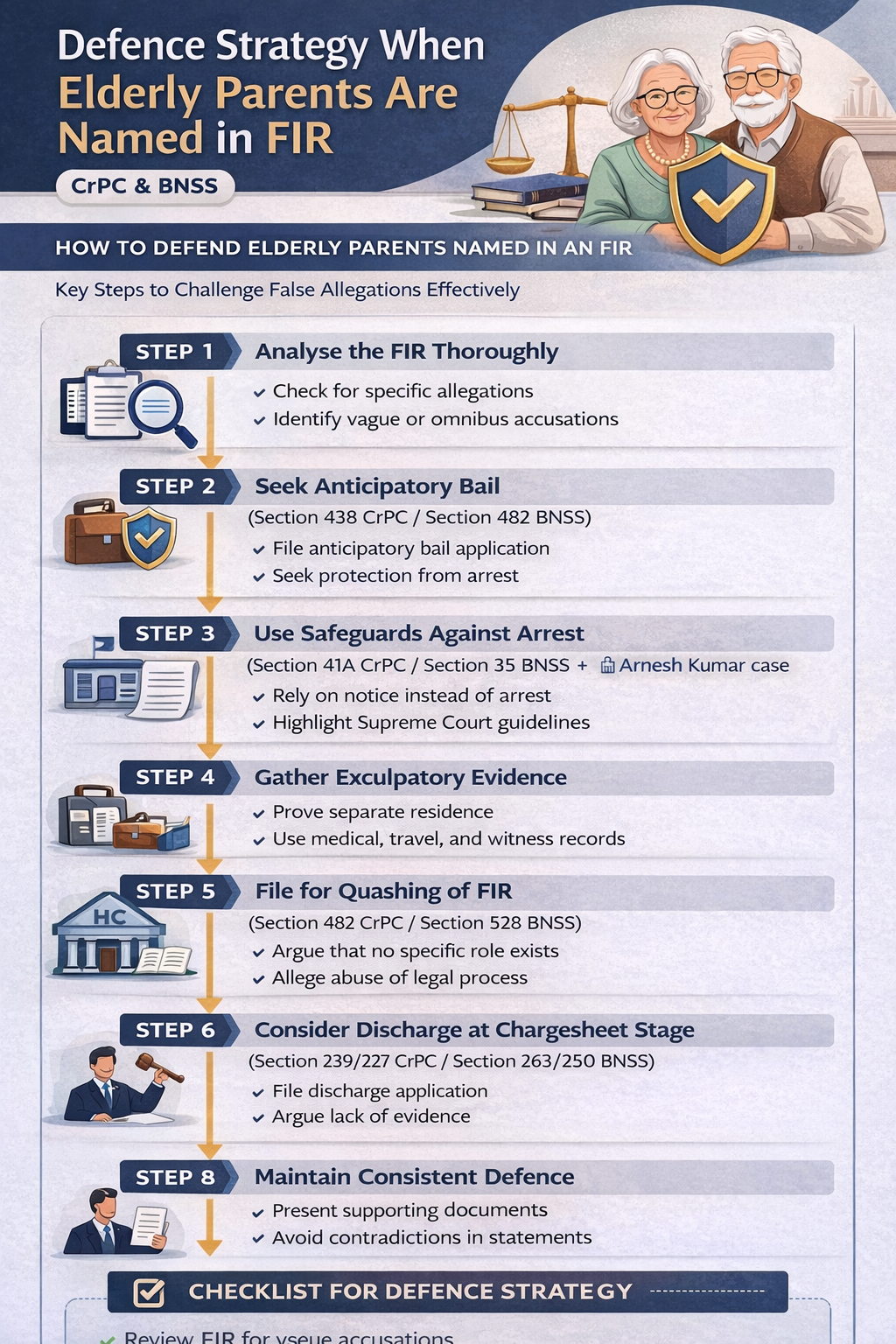
Understanding the Legal Position
The police register an FIR under Section 154 CrPC (Section 173 BNSS) when they receive information about a cognizable offence. After registration, the investigation begins, and all named persons may face legal scrutiny.
However, courts do not rely solely on allegations. Instead, they examine:
- Specific acts attributed to each accused
- Supporting evidence
- The individual role of each person
In many cases, complaints contain general and vague allegations against elderly parents, which you can challenge at an early stage.
Step 1: Analyse the FIR Carefully
First, you must carefully examine the FIR. A strong defence always begins with identifying weaknesses in the complaint.
You should check:
- Whether the FIR contains specific allegations
- Whether it mentions dates, events, or overt acts
- Whether allegations appear vague or omnibus
If the complaint lacks specificity, you can argue that it fails to disclose a prima facie case against elderly parents.
Step 2: Seek Protection from Arrest
Next, you should promptly seek protection from arrest by filing an anticipatory bail application.
You can file this application under:
- Section 438 CrPC (Section 482 BNSS)
Courts generally adopt a lenient approach toward elderly parents, especially when:
- They reside separately
- They have no direct involvement
- The allegations appear exaggerated
Additionally, courts consider age, health, and dependency factors while granting relief.
Step 3: Rely on Safeguards Against Arbitrary Arrest
You should also rely on statutory safeguards that prevent unnecessary arrests.
The police must issue a notice of appearance under:
- Section 41A CrPC (Section 35 BNSS)
instead of making immediate arrests when the accused cooperates with the investigation.
Further, the Supreme Court in
Arnesh Kumar v. State of Bihar
directed authorities to avoid automatic arrests in matrimonial offences.
Therefore, elderly parents can use these safeguards to prevent unjustified detention and harassment.
Step 4: Gather Evidence Showing Lack of Involvement
After securing protection, you should collect evidence that demonstrates the absence of involvement.
You should gather:
- Proof of separate residence
- Medical records indicating age-related limitations
- Travel records
- Independent witness statements
This evidence helps establish that the allegations are false, exaggerated, or legally unsustainable.
Step 5: File for Quashing of FIR
If the FIR clearly lacks specific allegations, you should approach the High Court to quash the proceedings.
You can invoke:
- Section 482 CrPC (Section 528 BNSS)
The High Court may quash proceedings when:
- Allegations are vague or omnibus
- No specific role is attributed
- Continuation of proceedings amounts to abuse of process
Courts frequently grant relief to elderly parents in such circumstances.
Step 6: Seek Discharge at Chargesheet Stage
If the police file a chargesheet, you should consider filing a discharge application.
Relevant provisions include:
- Section 239 CrPC (Section 263 BNSS) – Warrant cases
- Section 227 CrPC (Section 250 BNSS) – Sessions cases
You can argue that:
- No evidence exists against elderly parents
- The chargesheet fails to establish involvement
- The case relies on assumptions rather than proof
If the court agrees, it may discharge the accused at this stage.
Step 7: Challenge Mechanical Implication of Relatives
Courts consistently discourage the practice of implicating all family members without distinction.
Therefore, you should emphasize:
- Absence of specific allegations
- Lack of direct interaction with the complainant
- No supporting evidence
This approach aligns with judicial principles that prevent misuse of criminal law in matrimonial disputes.
Step 8: Maintain a Consistent Defence Strategy
Finally, you must maintain a consistent and structured defence throughout the proceedings.
You should:
- Avoid contradictory statements
- Cooperate with the investigation
- Present documentary evidence at each stage
A consistent defence strengthens credibility and improves the chances of relief.
Judicial Approach
Courts recognise that false implication of elderly parents can lead to serious injustice and misuse of the legal process.
Therefore, courts often:
- Grant anticipatory bail
- Quash proceedings where appropriate
- Discharge accused in absence of evidence
This balanced approach ensures that only genuine cases proceed to trial.
Conclusion
When elderly parents are named in an FIR, the law provides multiple safeguards to protect them from unjust prosecution.
You should:
- Analyse the FIR thoroughly
- Seek anticipatory bail under Section 438 CrPC (Section 482 BNSS)
- Invoke High Court powers under Section 482 CrPC (Section 528 BNSS)
- File for discharge under Section 239/227 CrPC (Section 263/250 BNSS)
By adopting a structured legal strategy, you can effectively challenge false allegations and protect innocent family members.
Index of Legal Strategies and Defence is here.
Related Legal Concepts
Explore related stages and concepts in criminal procedure:
- First Information Report
- Anticipatory Bail
- Quashing of FIR
- Discharge of an accused
- Inherent powers of High Court
Key Contributor :
Mrs. Suprajaa Rajan B.Com., LL.B., LL.M.
+91-9606345150

