web analytics

Menu

Skip to content
Shades of Knife
  • Home
  • True Colors of a Vile Wife
  • Need Inspiration?
  • Blog Updates
  • SOK Gallery
  • Vile News Reporter
  • About Me
  • Contact Me

Shades of Knife

True Colors of a Vile Wife

Category: LLB Study Material

Various Doctrines in Law

Posted on October 12, 2020 by ShadesOfKnife


Public Trust Doctrine:

Public Trust Doctrine primarily rests on the principle that certain resources like air sea, waters and the forests have such a great importance to the people as a whole that it would be wholly unjust to make them a subject of private ownership. The said resources being a gift of nature, they should be made freely available to everyone irrespective of the status in life. The doctrine enjoins upon the Government to protect the resources for the enjoyment of the general public rather than to permit their use for private ownership or commercial purposes.

Posted in LLB Study Material | Tagged Doctrines in Law | Leave a comment

Amicable working with Advocate

Posted on August 27, 2020 by ShadesOfKnife

The following are my learnings while working with advocates. Some taught me Dos and some Don’ts. Take it as you like.


  • Start using eCourts app and learn to find more information from High Court websites, if not found on eCourts platform (app and website)
  • Discuss your priorities and expectations from the case, in clear terms. Better safe than sorry.
  • Ask/find and record/save alternate means of communicating with your Advocate. Office Address, Alternate contact numbers, Colleague in his Chambers, Email etc.,
  • Learn the Law and the court procedure involved in the instant case thoroughly. It helps pacify unwarranted fears to some extent.
  • Most petitions are available in/near Court premises and sold at retail price. No need to shell out 1000’s for these forms.
  • Ensure ALL your payments to Advocate are made digitally. This is solid evidence against unpleasant disputes
  • In Criminal Trials, Electronic Evidences in their Original devices need not be shared with advocates at the beginning itself. A set of copies will do for perusal and any drafting. There is stage later on when Evidence needs to be brought on record of Court supported by a certificate u/s 65B of Indian Evidence Act.
  • Ask them to read (a) All Protection from Police here and (b) All Reliefs from Judiciary here. hehe
  • Above tip not working? Want to discontinue the services of current advocate? Communicate on email, phone clearly your intent and ask for NOC (No Objection Certificate). This is NOT a rule but a unwritten practice, so avoid complications between advocates due to clients. NOC is nothing but Vakalath/Vakalathnama on the sleeve/side of which Advocate writes, ‘No objection to engage another advocate’, along with Name, Signature, Enrollment number and date. Simple!


Posted in LLB Study Material | Leave a comment

Websites of Police Department of Various States and Union Territories

Posted on August 16, 2020 by ShadesOfKnife

Here are the websites of Police Departments belonging to various States and Union Territories in India. You will find option on these sites to view/download FIRs. In some sites, you have facility to lodge online complaint/FIR too.

  1. Andhra Pradesh Police
  2. Arunachal Pradesh Police
  3. Assam Police
  4. Bihar Police
  5. Chhattisgarh Police
    • Twitter
  6. Goa Police
  7. Gujarat Police
  8. Haryana Police
  9. Himachal Pradesh Police
    • Twitter
  10. Jharkhand Police
    • Twitter
  11. Karnataka Police
  12. Kerala Police
    • Twitter
  13. Madhya Pradesh Police
  14. Maharashtra Police
    • DGP
  15. Manipur Police
  16. Meghalaya Police
    • Twitter
  17. Mizoram Police
  18. Nagaland Police
  19. Odisha Police
  20. Punjab Police
  21. Rajasthan Police
    • Twitter
  22. Sikkim Police
  23. Tamil Nadu Police
  24. Telangana Police
  25. Tripura Police
    • Twitter
  26. Uttar Pradesh Police
    • Twitter
  27. Uttarakhand Police
  28. West Bengal Police
    • Twitter
  29.  Andaman and Nicobar Islands
  30. Chandigarh Police
  31. Dadra and Nagar Haveli and Daman and Diu
  32. Delhi Police
    • Twitter
  33. Jammu and Kashmir Police
    • Twitter
  34. Ladakh
  35. Lakshadweep Police
  36. Puducherry Police


Posted in LLB Study Material | Leave a comment

All Reliefs from Judiciary

Posted on August 16, 2020 by ShadesOfKnife

Awareness of law involved in the case laid against you is crucial to handle and take charge of your case yourself. The following are some of the general reliefs one can invoke in Andhra Pradesh for sure. They may apply to other states also. List of High Courts is here.


BNSS is available here.


Note: If you need some reliefs from Police High-handedness, go here.


Always remember Article 21 of Constitution of India

Article 21 is what powers Fair treatment of accused during criminal trials. It provides for fair investigation, Fair trial and Fair Judgment. Any violation of Article 21 gives you liberty to invoke Article 226 at High Court and Article 32 at Supreme Court to seek Writ Reliefs. Case laws are available in chronological order here.

It reads as follows:

21. Protection of life and personal liberty.—No person shall be deprived of his life or personal liberty except according to procedure established by law.


Engagement of Advocates

As per Section 32 of Advocates Act 1961, you can appear in your own case.

If a victim wants to engage a private advocate to prosecute their case, yes you can, but only to assist the PP. The sections to back this aspect are to read

  1. Sec 225 CrPC
  2. Proviso to Sec 24(8) CrPC
  3. Sec 301 CrPC
  4. and finally Sec 302 CrPC. In that Order.

Hope this helps clarify the legal position to those of us who filed/intend to file Criminal cases against OP. This is explained in this case law here. The case law is available on my site here.


Engagement of a third-party other than Advocates

As per again Section 32 of Advocates Act 1961, you can appear in some one else’s case, subject to certain conditions.

  1. You must be a non-advocate
  2. You must have some relationship due to which the accused/defendant trusts you
  3. You may be permitted by a Court, an authority or any person
  4. You may be permitted to appear in any particular case; as a corollary, may not be permitted in all cases or for all clients
  5. Prior Court permission is necessary (via a Petition; sample here)

This is laid out by the Legendary Jurist Sri V.R. Krishna Iyer in this celebrated case law here.


Terminating the services of Advocates (through issuing a termination letter discharging existing Advocate from case who earlier filed vakalatnama and communicating the same to advocate)

You have complete freedom to terminate the services of your Advocate and engage another one. Just be cautiously about the local procedures which can differ from High Court to High Court. It means, in some High Courts, there is no need of any No-Objection-Certification (NOC) from your current Advocate before you engage another. Like in Karnataka. But not so in Andhra Pradesh, wherein it is unwritten rule to obtain NOC so as to avoid unpleasant situations/conversations/interactions between you and your advocates (or between the earlier and current Advocates). Nevertheless Supreme Court has laid down a landmark case law here. Use it judiciously. Also take a look at other similar case laws here.


First Appearance in Court

Once the case documents are sent to Court via a Charge sheet or Closure report as mandated u/s 173 CrPC, Court Filing Section staff gives is a case number and list it in the causelist (daily timetable of work) before a competent Magistrate/ Judge.

On your first appearance day in the Court, Court staff will ask questions to identify you and your purpose of attending the Court. Next question is if you have engaged an advocate or need time for this purpose. Finally, case will be adjourned to a future date and each accused person will be given a set of copy of the above case documents which were submitted into Court by Police as mandated u/s 207 CrPC.

And once an Anticipatory Bail is granted, it protected the grantee/accused until the end of trial and there is no need to obtain Regular Bail, after Charge sheet is filed by Police into the Court. Case law here.


Exemption from Personal Appearance in Court

If you do not want to appear even on first appearance for certain obvious and unavoidable reasons, take help from this case law here and here and You can seek exemption for self or other accused from appearing in the Court in a case u/s 205 CrPC of CrPC 205. Vital Case laws are available here. For single-day relief, see Absent Petition below.


Provision u/s 173 CrPC to demand documents from IO to be submitted to Court and to obtain a copy of prosecution documents

Section 173(7) reads as follows:

(7) Where the police officer investigating the case finds it convenient so to do, he may furnish to the accused copies of all or any of the documents referred to in sub-section (5).

How to use it:

If you are good terms with IO, then he/she may find it convenient to furnish to the accused copies of all or any of the documents. Be courteous to IO to make use of this.

Note: Otherwise, as mentioned above, Court will anyways, provide a copy of the entire bunch of prosecution documents to each accused on first appearance.

Section 173(6) reads as follows:

(6) If the police officer is of opinion that any part of any such statement is not relevant to the subject-matter of the proceedings or that its disclosure to the accused is not essential in the interests of justice and is inexpedient in the public interest, he shall indicate that part of the statement and append a note requesting the Magistrate to exclude that part from the copies to be granted to the accused and stating his reasons for making such request.

How to use it:

If you have submitted any documents/made a statement that IO records during inquiry (supposedly u/s 41A CrPC), and such documents are missing in the bunch of documents procured via above section or u/s 207 CrPC, then submit to the Court that such left-out/excluded documents be brought on record of Court. The case law is here.

Even if such seeking of documents is objected to for any legal reason, one can seek for inspection of such documents as held in here.


Protest Petition

After Police file a final report ( be it a Charge sheet or a Closure report), Court notifies the informant/complainant about the same and invites any objections to the same. The informant/complainant can file a protest petition into the Court and object to section/accused removal from Charge sheet or Closure report itself can be objected to. Couple of Landmark judgments are here.


Limited Authority of Registry or Filing Section/Office attached to a Court

A Registry attached to a High Court or a Filing Section attached to a District/Magistrate Court has a limited set of functions on the administration of Justice and authority and they certainly can not exercise judicial function as held by Supreme Court here. Use this judgment, as appropriate, to ensure Court staff perform only their duties and nothing beyond that.


Time-bound disposal provisions in Various Enactments

Check this page here for various provision available in the gender-biased laws which specify time limits for disposal of cases.


Use of Interrogatories in Civil and Criminal cases

Carefully designed Interrogatories are a tool to extract helpful information from OP. Read more info here.

Code of Civil Procedure (CPC) Order XI – Discovery and Inspection (read with Sec 30) has the necessary Rules to be following to file an application for delivery of interrogatories in a Civil case like DVC, HMA24 etc.

Code of Criminal Procedure (CrPC) Section 287 provides a similar provision in Criminal cases in which a commission is issued.

Case laws here.


Usage of Rule 37 of Criminal Rules of Practice and Circular Orders, 1990 (High Court of A.P.)

If you are going to fight your case on your own as Party-in-person, make good use of Rule 37 of the Criminal Rules of Practice and Circular Orders, 1990 (High Court of A.P.), which allows you to represent your co-accused, most probably, your parents or family members.

Same Rules apply to folks in Telangana State too. Some case laws here.


Absent Petition

You can seek exemption for self or other accused from appearing in the Court on a particular singular date in a case u/s 317 CrPC.

You can send your duly-filled, stamped and signed absent petitions to the Office of Superintendent of the Court where your case is going on, well in advance, with a cover letter to place your Absent petition on the Bench.


Non-bailable Warrants (NBWs) for arrest

It is highly possible that trial courts may issue NBWs at the drop of the hat. Despite having bail for the said accused already. So to overcome this issue, once has to file a Recall petition seeking recall of the NBW. Use these judgments here, to tide over this menace.

The general procedure is issue summons first, then bailable warrants and finally non-bailable warrants for arrest of accused. As per BNSS, such serving of these instruments is permissible through electronic means too as per this decision.

In case NBWs are issued and petition for recall of the same (u/s 70(2) CrPC) are refused/dismissed, you can file Revision at the Appellate Court (u/s 397 CrPC). Use these judgments here


Speedy Trial

Our right to Fair and Speedy Trial arises from Article 21 (read with Article 227) . The case laws are here. A landmark judgment is here which also refers to section 483 CrPC. Article 227 also is a remedy.


Arrest unnecessary adjournments

Tareeq pe tareeq epidemic can easily be addressed taking help u/s 309(2) CrPC which is amended by Act 5 of 2009, s. 21 (w.e.f. 1-11-2010). Read the Landmark judgment which insisted on the importance, utility and urgent need of Trial/Session Courts to use the 4th Proviso to this sub-section here (2013). A 2017 reportable decision here. Also Read the other judgments here (included AP HC case law).

Also if prosecution fails to bring the witnesses to Court for examination, Courts can deny granting adjournments as held here.

Also if prosecution or defence try to delay Cross-examination of a witness, Courts can at max defer to 3 days as held here and can also levy heavy fines as held in this tagline here.

It is held by the Apex Court here that, Chief Examination & Cross-Examination Of Witness Must Be Recorded On The Same Day Or Following Day. Another similar case law here.


Recording of Prosecution Evidence

This is a part of the broader Examination Stage, wherein Prosecution brings forward all their Witnesses and Evidences necessary to convict the accused persons. This is mandated u/s 273 CrPC. While the rule says, all evidence taken in the course of the trial or other proceeding shall be taken in the presence of the accused, there is one exception to it, that is, when the attendance of accused is dispensed with (under any of sections 205 or 317), then the prosecution evidence can be recorded by the Court, in the absence of the accused, but in the presence of the pleader of the accused. And such evidence of prosecution may be recorded, when the accused joins the proceedings, virtually through video conferencing. Supporting case law here.


Time-barred Litigation

Time-barred litigation should be attacked using the provision u/s 468 of CrPC.


Register a complaint against Public Servant (No sanction from Government required!!!)

If any Public servant (read as Judge, Magistrate or Police) does something to violate their duty as prescribed u/s 197 CrPC, they are liable for criminal prosecution u/s 166A IPC. Read full details here. Karnataka High Court clearly explains this here.


Discharge Petition

If the prosecution documents do not have any basis to connect you to the allegation listed in Charge sheet by Police, this is one opportunity to find the grounds and file a Discharge Petition and come out the case. Check out the landmark case laws here. Especially, B S Neelakanta judgment.


Case Calendar

The common frustration defence has with Prosecution in a false case is, absconding of the prosecution witnesses from Cross-examination. For obvious reasons, false case filers generally, do not appear for Cross examination. To tackle such scenarios, you can use the Supreme Court judgment to force the Trial judge to come up with case calendar for the entire case, which is available here.


Only 6 months Stay on Proceedings

It is common knowledge that one party goes to higher courts seeking to stay proceedings in lower court. Supreme Court has restricting this behavior of endless stay on proceedings which is impacting the disposal of cases in timely manner in this judgment here.


During Cross examination of Lying witnesses

Make good use of this set of legal weapons from Indian Evidence Act 1872.


59. Proof of facts by oral evidence. –– All facts, except the contents of documents or electronic records, may be proved by oral evidence.

60. Oral evidence must be direct. –– Oral evidence must, in all cases whatever, be direct; that is to say ––
if it refers to a fact which could be seen, it must be the evidence of a witness who says he saw it;
if it refers to a fact which could be heard, it must be the evidence of a witness who says he heard it;
if it refers to a fact which could be perceived by any other sense or in any other manner, it must be the evidence of a witness who says he perceived it by that sense or in that manner;
if it refers to an opinion or to the grounds on which that opinion is held, it must be the evidence of the person who holds that opinion on those grounds:
Provided that the opinions of experts expressed in any treatise commonly offered for sale, and the grounds on which such opinions are held, may be proved by the production of such treatises if the author is dead or cannot be found, or has become incapable of giving evidence, or cannot be called as a witness without an amount of delay or expense which the Court regards as unreasonable.
Provided also that, if oral evidence refers to the existence or condition of any material thing other than a document, the Court may, if it thinks fit, require the production of such material thing for its inspection.

61. Proof of contents of documents. –– The contents of documents may be proved either by primary or by secondary evidence.

101. Burden of proof. –– Whoever desires any Court to give judgment as to any legal right or liability dependent on the existence of facts which he asserts, must prove that those facts exist. When a person is bound to prove the existence of any fact, it is said that the burden of proof lies on that person.

106. Burden of proving fact especially within knowledge. –– When any fact is especially within the knowledge of any person, the burden of proving that fact is upon him.


132. Witness not excused from answering on ground that answer will criminate. –– A witness shall not be excused from answering any question as to any matter relevant to the matter in issue in any suit or in any civil or criminal proceeding, upon the ground that the answer to such question will criminate, or may tend directly or indirectly to criminate, such witness, or that it will expose, or tend directly or indirectly to expose, such witness to a penalty or forfeiture of any kind:
Proviso. –– Provided that no such answer, which a witness shall be compelled to give, shall subject him to any arrest or prosecution, or be proved against him in any criminal proceeding, except a prosecution for giving false evidence by such answer.

138. Order of examinations. –– Witnesses shall be first examined-in-chief, then (if the adverse party so desires) cross-examined, then (if the party calling him so desires) re-examined.
The examination and cross-examination must relate to relevant facts, but the cross-examination need not be confined to the facts to which the witness testified on his examination-in-chief. A landmark judgment is available here.

146. Questions lawful in cross-examination. –– When a witness is cross-examined, he may, in addition to the questions hereinbefore referred to, be asked any questions which tend––
(1) to test his veracity,
(2) to discover who he is and what is his position in life, or
(3) to shake his credit, by injuring his character, although the answer to such questions might tend directly or indirectly to criminate him, or might expose or tend directly or indirectly to expose him to a penalty or forfeiture:
Provided that in a prosecution for an offence under section 376, 3[section 376A, section 376AB section 376B, section 376C, section 376D, section 376DA, section 376DB] or section 376E of the Indian Penal Code (45 of 1860) or for attempt to commit any such offence, where the question of consent is an issue, it shall not be permissible to adduce evidence or to put questions in the cross-examination of the victim as to the general immoral character, or previous sexual experience, of such victim with any person for proving such consent or the quality of consent.

155. Impeaching credit of witness. –– The credit of a witness may be impeached in the following ways by the adverse party, or, with the consent of the Court, by the party who calls him: ––
(1) By the evidence of persons who testify that they, from their knowledge of the witness, believe him to be unworthy of credit;
(2) By proof that the witness has been bribed, or has accepted the offer of a bribe, or has received any other corrupt inducement to give his evidence;
(3) By proof of former statements inconsistent with any part of his evidence which is liable to be contradicted;
Explanation. –– A witness declaring another witness to be unworthy of credit may not, upon his examination-in-chief, give reasons for his belief, but he may be asked his reasons in cross-examination, and the answers which he gives cannot be contradicted, though, if they are false, he may afterwards be charged with giving false evidence.

159. Refreshing memory. –– A witness may, while under examination, refresh his memory by referring to any writing made by himself at the time of the transaction concerning which he is questioned, or so soon afterwards that the Court considers it likely that the transaction was at that time fresh in his memory.
The witness may also refer to any such writing made by any other person, and read by the witness within the time aforesaid, if when he read it he knew it to be correct.
When witness may use copy of document to refresh memory. –– Whenever a witness may refresh his memory by reference to any document, he may, with the permission of the Court, refer to a copy of such document:
Provided the Court be satisfied that there is sufficient reason for the non-production of the original. An expert may refresh his memory by reference to professional treatises.

160. Testimony to facts stated in document mentioned in section 159. ––A witness may also testify to facts mentioned in any such document as is mentioned in section 159, although he has no specific recollection of the facts themselves, if he is sure that the facts were correctly recorded in the document.


Objections raised by Prosecution or Court during the Examination/Evidence Stage:

It is possible that either the Prosecution or the Court may raise objections to the questions put to the Prosecution witnesses during Cross Examination stage. Use this judgment here to get the questions and deposition recorded properly.


Prosecution witnesses absent for the Examination/Evidence Stage:

Cr.P.C. (u/s 284 and 285 onwards) provides for issuing commissions which will go to the place where the prosecution witness resides and record the deposition. Use this sample here to tighten the screws of the lying (and absenting) complainant.


Arguments

Then comes the crucial stage of Arguments. You can submit oral arguments before the Court and also file written arguments which must be made part of the case record/bundle. This is covered under section 314 of Cr.P.C. and the Trial Courts must not refuse them to be brought on record of case. Check these cases here.


Perjury is nearby

Let the OP lie in Court. Just ensure you have the truth (hint: evidences) with you. Perjury will be awaiting just in case an illegal order gets to be passed. Here are the Case laws.


Contempt Jurisdiction to the rescue

If no order gets passed due to Perjury, let the Contempt jurisdiction take care of falsifications, material concealments, forgeries etc. Again do let the OP lie and cheat, which comes to them naturally. You can get punishment and fine levied upon the OP under the following provisions. Few case here.

  1. Article 129 of the Constitution of India (At Supreme Court)
  2. Article 142 of the Constitution of India (At Supreme Court)
  3. Article 215 of the Constitution of India (At High Courts)
  4. Contempt of Courts Act 1971 (here is the Act)

Compensation


Delay in Pronouncing Judgments

Sometimes, Courts take enormous amount of time in pronouncing the Judgments after reserving the same. Supreme Court gave directions that can be used by us. One such landmark judgment is here. This tag here has some more judgments.


Obtaining copy of the Judgment/Order for free

Order passed under

  • Section 204(3) CrPC: Summon (in a summons-case) or Warrant (in a warrants-case) issued u/s 204(1) shall be accompanied by a copy of such complaint. (Also obtain the list of prosecution witnesses !!)
  • Section 248(1) CrPC: Acquittal Order after Trail
  • Section 249 CrPC: Discharge from a non-cognizable or a compoundable case, if the complainant is absent
  • Section 252 CrPC: Conviction Order in case of guilty plea.
  • Section 256 CrPC: Acquittal Order in case of non-appearance or death of complainant
  • Section 257 CrPC: Acquittal Order in case of withdrawal of complaint
  • Section 258 CrPC: Acquittal or Discharge of an accused due to stoppage of proceedings by Magistrate
  • Section 24 of PWDV Act 2005: Court to give copies of order free of cost.

Certified copies of Docket Order

If you want to obtain certified copies of the docket order in any case, no Court can deny because the docket order is very much part of Court record. If the Copy or/and Filing sections rerutn your copy application (CA) by giving an objection like, a permission petition has to be filed, take help from this case laws here.


Reasoned Orders/Judgments

The hallmark of a judicial pronouncement is the quality of reasons given against each issue/charge framed at the beginning of the decision. This decision here is just one which emphasizes the same.


Remedies against Malicious Prosecution in India

Check out this page here.


MASTER SITEMAP here.
Posted in LLB Study Material | Tagged All Reliefs from Judiciary Article 21 - Protection of life and personal liberty Article 227 - Power of superintendence over all courts by the High Court BNSS Sec 530 - Trial and proceedings to be held in electronic mode BNSS Sec 70 - Proof of service in such cases and when serving officer not present Costs For Contempt Of Court CPC Order 11 - Discovery and Inspection Criminal Rules of Practice Rule 37 - One Accused May Be Permitted To Represent Other CrPC 164 - Recording of Confessions and Statements CrPC 173 - Report of Police Officer on Completion of Investigation CrPC 173(5) - Prosecution Can Produce Additional Documents CrPC 197 - Prosecution of Judges and public servants CrPC 205 – Magistrate may dispense with personal attendance of accused CrPC 207 - Supply to the accused of copy of police report and other documents CrPC 239 - When accused shall be discharged CrPC 273 - Evidence to be taken in presence of accused CrPC 284 - When attendance of witness may be dispensed with and commission issued CrPC 285 - Commission to whom to be issued CrPC 287 - Parties may examine witnesses CrPC 309 - Power to Postpone or Adjourn Proceedings CrPC 314 - Oral arguments and memorandum of arguments CrPC 317 - Provision for inquiries and trial being held in the absence of accused in certain cases CrPC 397/399 - Revision CrPC 468 - Bar to taking cognizance after lapse of the period of limitation CrPC 483 - Duty of High Court to exercise continuous superintendence over Courts of Judicial Magistrates CrPC 73 - Warrant may be directed to any person Fine For Contempt Of Court Imprisonment For Contempt Of Court Interrogatories IPC 166A - Public servant disobeying direction under law Perjury Under 340 CrPC Remedies against Malicious Prosecution in India Work-In-Progress Article | 4 Comments

All Protection from Police High-handedness

Posted on August 15, 2020 by ShadesOfKnife

Biggest threat from supposedly-protective Police is the misuse of the official power that they are delegated with, as per law. The following are some of the aspects that may be helpful for you to deal with this misuse of powers menace. List of Police websites is here.


BNSS is available here.


Note: If you need some reliefs from Judiciary, go here.

Threats of all kinds

  1. Generally, some Police calls you up and demands your appearance in the Police Station. He/She gives threats if you disobey such demands. Be clever and ensure you create electronic evidence of such threats and in this digital age, it is easy to get such corrupt/abusive police out of department. That is, only if you want to do that. If you have fear of later consequences, do not do this and suffer later.

Routine Violation of Guidelines issued by Supreme Court of India in it’s Judgments/Orders

  1. No automatic arrest should be effected for any offence in India which carries a punishment of 7 years or less. In such cases, strict adherence of procedure laid down in 41A CrPC is to be followed. This is as per Arnesh Kumar judgment. All the baseless false and motivated cases fall within this bracket. So, if any police violates this guideline, there are consequences listed in the same judgment. So, invoke this judgment, if the offences listed in FIR carry punishment of 7 years or less. This protection is reinforced by this judgment here. Read this page too. The procedure to be followed by police while arresting is elucidated in the landmark judgements here and here.
  2. To overcome this hurdle placed by the Hon’ble Supreme Court, Police add at least one section which carries punishment more than 7 years or less. If that case, immediately obtain Anticipatory Bail u/s 438 for all the accused persons mentioned in the FIR and this is not a stage where you can argue that allegations on accused other than A1 (most probably your parents and siblings) do not make out the said offence/section. Read about Anticipatory Bail in the below section. Make good use of the efiling facility, during COVID-19 times, as Bails are categorized as Urgent matters, with the help of any advocate in your favorable/local area.
  3. Even if civil matters are pending in courts between parties like DVC, Maintenance, Divorce, Custody, Succession, Police cannot deny to register FIR. 3-Judge bench of SC says so here.
  4. Use this latest judgment here if Police tinker with 41A CrPC/35 BNSS Notices. Police have to attach FIR copy along with 41A CrPC/35 BNSS Notice.

Get FIR from Police websites

Obtain a copy of FIR from the websites of the respective police departments. The list is here. Show them this landmark judgment here, if they act smart.


Use RTI to Obtain Complaint Copy and FIR

One can file a RTI application to the Public Information Officer (PIO) designated to every Police station and seek a copy of Complaint and FIR laid against you. It will take 30 days or less for this, as stipulated in the RTI Act. You can invoke Sec 7 – Risk to live or personal liberty to obtain the above documents in 48 hours.


Compoundability of Offences u/s 320 Cr.P.C.

Not all people can dare to go through the rigors of an Criminal trial for obvious reasons. Cr.P.C provides section 320 which has a list of offences that can be compounded by settling the matter amicable in a Lok Adalat.

In Andhra Pradesh, 494 IPC and 498A IPC are made compoundable via a State amendment here on the recommendation of the Chairperson, AP Women’s Commission.


Bail

Go here.

Additionally, stop all further communication with the gang of Opposite party family, as it is easy for them, on that fact alone (can claim a ground that you threatened them with what-not) to get your bail cancelled. Do NOT be a emotional dumbo and screw your (and your family/parent’s) bail. Please.

And once an Anticipatory Bail is granted, it protected the grantee/accused until the end of trial and there is no need to obtain Regular Bail, after Charge sheet is filed by Police into the Court. Case law here.


Register a complaint against Public Servant (No sanction from Government required!!!)

If any Public servant (read as Judge, Magistrate or Police) does something to violate their duty as prescribed u/s 197 CrPC, they are liable for criminal prosecution u/s 166A IPC. Read full details here.

Additionally, you can invoke section 29 of Police Act 1861 here or/and Section 4 of Police-Forces (Restriction of Rights) Act, 1966 here.


Beauty of Zero FIR

In Lalita Kumari judgement here, Supreme Court held that if a cognizable offence is reported or brought to the notice of a police station, the IO of that station has to register an FIR. If the said police station does not have territorial jurisdiction, it has to register a FIR with zero ‘0’ number and then transfer it to the police station which has territorial jurisdiction. Other judgments on same principle here or listed in chronological order here.


Possibility of Quashing the FIR and the subsequent proceedings

Once you (and/or your family members) are safe from Police clutches, evaluate the possibilities of Quashing the entire proceedings initiated by Police (or Court) u/s 482 CrPC. Begin reading from here to understand what is meant by a Quash Petition and how best to use it (if applicable) in your cases.


Investigation and Charge sheet

  1. Police are given certain time to complete investigation, as per Law. No point in poking them with RTI applications seeking progress/evidence collected, copy of Charge sheet etc. as such documents will be anyways given to accused persons (one complete set for each accused person) on your first appearance day in Court, after you receive summons from Court. Check your case details/progress regularly on eCourts app.
  2. Police may offer to remove sections and/or accused person from charge sheet for some gratification. On payment of bribe, they may follow through on do so as well. What they do not tell you is about a petition/right called as Protect petition that the de-facto complainant has. By filing this petition or by appearing in Court and orally giving statement that Police colluded with accused and removed sections and/or accused person from charge sheet for some gratification, Magistrate/Judge is within their power to restore back the sections and/or accused person on to the charge sheet. Don’t fall for this trap and lose money, as what you get in return is illusory.
  3. If the I.O. decides to file a charge sheet against you upon completion of investigation, you can request (no demand here) that you be given a copy of charge sheet and other documents (including witness statements recorded u/s 161 CrPC) that are being submitted to Court u/s 173 CrPC.
    • This relief lies in 173(7) CrPC which reads as: “(7) Where the police officer investigating the case finds it convenient so to do, he may furnish to the accused copies of all or any of the documents referred to in sub-section (5).”

File a complaint at Police Station

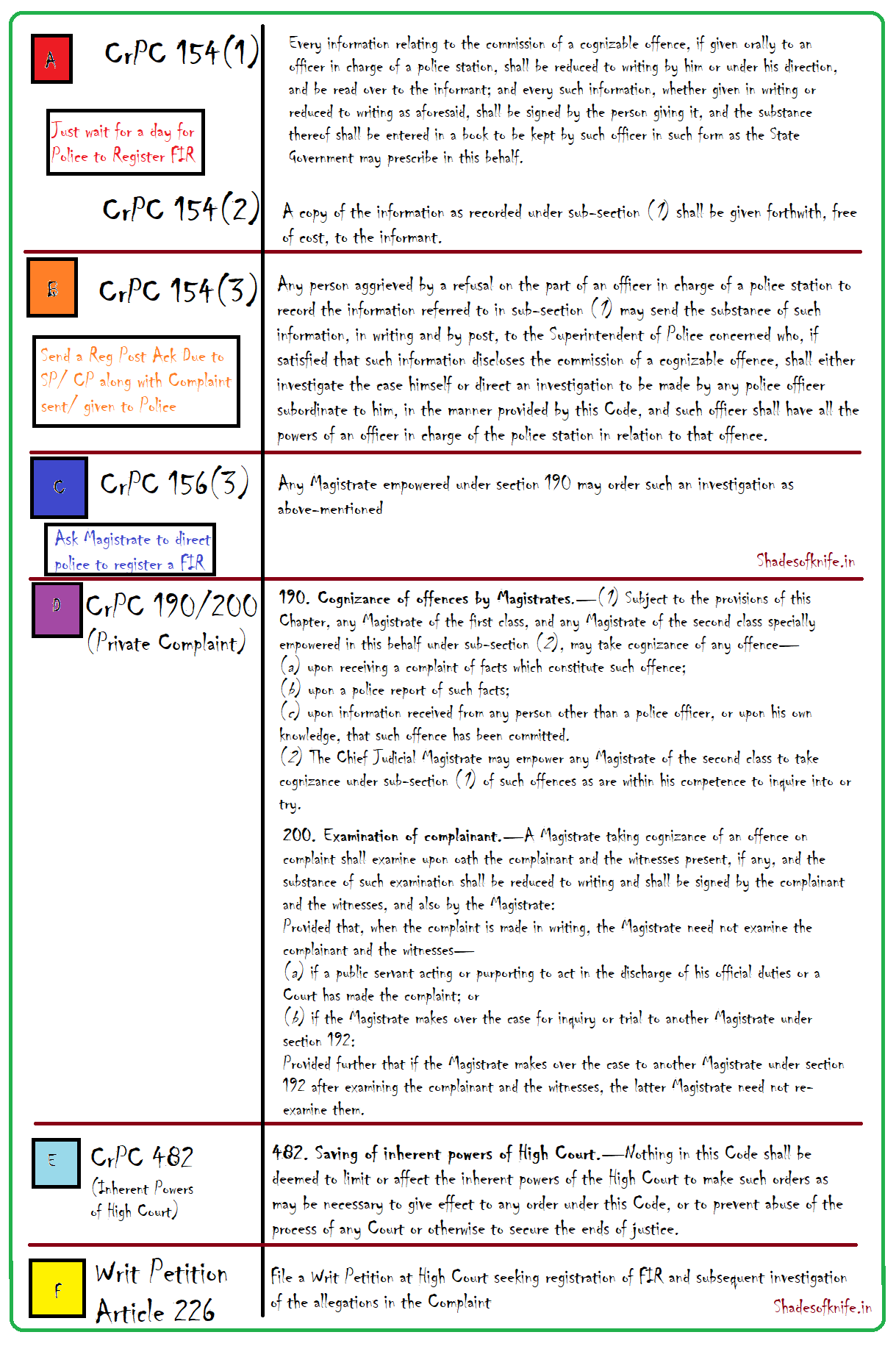
Whenever you have to report a cognizable complaint to Police, just follow the three steps in that very same order quickly. Do not crib or cry, if one step does not work per your liking.

PRE-COGNIZANCE STAGE:

  1. Register a written/oral Complaint with the nearest police station where the crime has occurred. This is mandatory as per section 154(1) CrPC.
  2. In the event Police do not register FIR based on your complaint, come back from there and file a Escalation letter (do not send same complaint as-it-is; if you want, you annex a copy of your complaint given at police station to this Escalation letter) to Senior Superintendent of Police of the District or the Commissioner of Police of the Metropolitan City via Registered Post with Acknowledgement Due card. This is mandatory requirement as per section 154(3) CrPC.
  3. Once your complaint to PS in (1) and escalation to SP/CP/SSP in (2) are exhausted and do not give result (registration of FIR and providing a copy to you, free), then register a complaint with the Magistrate Court which exercises Jurisdiction upto the above PS/SP Officer. The prayer will be to ‘direct the SP to direct the PS to register FIR. This is the procedure as per section 156(3) CrPC. If a FIR is registered in any of the these three scenarios, such case is called a Warrant case.
  4. The judgments list is here.

POST-COGNIZANCE STAGE:

  1. If Magistrate does not pass any direction as per above procedures, file a complaint directly u/s 190 CrPC r/w Sec 200 CrPC and Sec 202 CrPC. This is called as Private complaint.
  2. There is scope for going to High Court u/s 482 CrPC.
  3. If all of the above steps fail, go to the High Court under Writ Jurisdiction and file a Writ Petition u/Article 226 of the Constitution of India, seeking registration of FIR.

Note: Check the Schedule 1-Table in CrPC book to know if a particular IPC crime is Cognizable of not.


Remedies against Malicious Prosecution in India

Check out this page here.

Your Fundamental Rights Against Police Abuse

Even during investigation or arrest, every citizen in India enjoys constitutional protections. Police powers are not unlimited, and misuse of authority can be challenged in courts.

The following constitutional rights protect individuals from police high-handedness.

Article 14 – Equality Before Law

Every person is equal before the law. Police authorities cannot discriminate based on religion, caste, gender, political opinion, or personal bias.

Article 21 – Right to Life and Personal Liberty

No person can be deprived of life or liberty except according to procedure established by law. Illegal detention, torture, custodial violence, and harassment violate this fundamental right.

Article 22 – Protection Against Arbitrary Arrest

A person arrested by police has the right:

  • To be informed of the grounds of arrest
  • To consult and be defended by a lawyer
  • To be produced before a magistrate within 24 hours

Detention beyond 24 hours without judicial authorization is illegal.

Article 39A – Right to Free Legal Aid

If a person cannot afford legal representation, the State must provide legal aid through Legal Services Authorities.

Rights of Citizens During Police Arrest

The Supreme Court of India has issued several guidelines to prevent abuse of police powers. These safeguards must be followed during arrest and detention.

The Arrest Memo

When a person is arrested, police must prepare an arrest memo containing:

  • Date and time of arrest
  • Name of arresting officer
  • Name of witness
  • Signature of the arrested person

Informing Family or Friend

Police must inform a relative, friend, or nominated person about the arrest and place of detention.

Right to Legal Counsel

An arrested person has the right to consult a lawyer during interrogation.

Medical Examination

The arrested person must undergo medical examination periodically while in custody to prevent torture or abuse.

Production Before Magistrate

The accused must be produced before a magistrate within 24 hours of arrest.

Failure to follow these procedures can make the arrest illegal.

Important Supreme Court Judgments Protecting Citizens

Over the years, the Supreme Court has issued several landmark rulings to prevent police misuse of power.

D.K. Basu vs State of West Bengal

This landmark judgment laid down detailed guidelines for arrest and detention to prevent custodial violence.

Joginder Kumar vs State of Uttar Pradesh

The Court held that police cannot arrest someone merely because they have the power to do so. Arrest must be justified.

Arnesh Kumar vs State of Bihar

The Court ruled that police should not make automatic arrests in offences punishable with imprisonment up to seven years. Instead, a notice under Section 41A CrPC should be issued.

Lalita Kumari vs Government of Uttar Pradesh

The Court made it mandatory for police to register an FIR when information discloses a cognizable offence.

What Police Cannot Legally Do

Police powers are limited by law. The following actions may amount to abuse of authority.

Illegal Detention

Police cannot detain a person in the police station without formal arrest.

Arrest Without Proper Grounds

Arrest cannot be used as a tool of intimidation or harassment.

Forced Confessions

Police cannot force a person to sign statements or confessions.

Threats or Coercion

Threatening family members or using intimidation tactics is illegal.

Seizing Property Without Documentation

If property is seized, police must prepare a seizure memo and provide a copy.

If any of these actions occur, the affected person may approach courts for relief.

Special Protections for Women

Indian law provides additional safeguards to protect women from abuse during police investigation.

Arrest of Women at Night

Women should not be arrested after sunset and before sunrise except in exceptional circumstances and with permission of a magistrate.

Female Officers

Search of women must be conducted only by female police officers.

Recording of Statements

Statements of women may be recorded at their residence rather than at a police station in appropriate cases.

Protection of Dignity

The dignity and privacy of women must be respected during investigation.

Violation of these safeguards can lead to disciplinary and legal action against police officers.

How to File a Complaint Against Police Misconduct

If a police officer behaves unlawfully, several remedies are available.

Complaint to Superintendent of Police (SP)

A written complaint can be filed with the district Superintendent of Police describing the misconduct.

Complaint to Police Complaints Authority

Most states have a Police Complaints Authority (PCA) that investigates serious allegations such as:

  • Custodial torture
  • Illegal detention
  • Abuse of power

Approach the Magistrate

A complaint can be filed before a Judicial Magistrate seeking investigation or legal action against the officer.

Human Rights Commission

Complaints can be made to the National Human Rights Commission (NHRC) or State Human Rights Commission in cases involving custodial violence or illegal detention.

Immediate Legal Remedies in Case of Police Harassment

If a person faces harassment or illegal action by police, the following remedies may be used.

Anticipatory Bail

If there is apprehension of arrest in a false case, the person can apply for anticipatory bail under Section 438 CrPC.

Writ Petition in High Court

Under Article 226 of the Constitution, a person may approach the High Court seeking protection from police harassment.

Habeas Corpus

If someone is illegally detained, a Habeas Corpus petition may be filed demanding that the detained person be produced before the court.

Compensation for Custodial Abuse

Courts may award compensation if police violate fundamental rights.

Practical Steps to Protect Yourself from Police Harassment

If police start calling or visiting frequently, it is important to remain calm and act strategically.

Maintain Documentation

Keep records of:

  • Call logs
  • Messages
  • Notices issued by police
  • Copies of complaints filed

Record Interactions

If legally permissible, record conversations or interactions to preserve evidence.

Avoid Signing Blank Papers

Never sign blank documents or statements without reading them carefully.

Seek Legal Advice

Consult a lawyer before responding to serious allegations or notices.

Inform Family Members

Always inform family or trusted persons if you are called to a police station.

Evidence That Can Help Prove Police Misconduct

In cases of police abuse, evidence plays a crucial role.

Important forms of evidence include:

  • CCTV footage
  • Audio or video recordings
  • Medical examination reports
  • Witness statements
  • Phone call records
  • Copies of police notices

Preserving such evidence can significantly strengthen a legal case.

When to Approach the High Court

In serious cases of police harassment, approaching the High Court may be necessary.

Situations where High Court intervention may be appropriate include:

  • Continuous harassment by police without lawful basis
  • Threats of illegal arrest
  • Refusal to register FIR
  • Illegal detention
  • Fabrication of false cases

High Courts have wide powers to issue directions to police authorities and protect citizens’ rights.

Conclusion

Police authorities play a vital role in maintaining law and order, but their powers must always be exercised within the framework of the law. Citizens are not helpless against abuse of authority. The Constitution, criminal procedure laws, and judicial precedents provide strong safeguards against arbitrary police action.

Understanding one’s rights, maintaining proper documentation, and using available legal remedies can effectively protect individuals from police high-handedness.

Anyone facing serious harassment should seek legal advice and take appropriate steps through the legal system to safeguard their rights.


MASTER SITEMAP here.

Posted in LLB Study Material | Tagged Misuse of Police Powers Police Act 1861 Police Confiscated Passport Police Reforms Remedies against Malicious Prosecution in India Work-In-Progress Article | Leave a comment

Future Chief Justice of Supreme Court of India

Posted on August 14, 2020 by ShadesOfKnife

The following is my analysis of who will be the next Chief Justice of India based on settled traditions prevailing in India. The source data is available here. Appointments of Judges are picked up from here.

Current Chief Justice of India

  • Hon’ble Mr. Justice Surya Kant on 24-11-2025 until 09-02-2027 (for 1 year, 2 months and 16 days)

Next in Line

  • Hon’ble Mr. Justice Vikram Nath on 10-02-2027 until 24-09-2027 (for 7 months and 14 days)
  • Hon’ble Ms. Justice BV Nagarathna on 25-09-2027 until 30-10-2027 (for 1 month and 6 days)
  • Hon’ble Mr. Justice PS Narasimha on 31-10-2027 until 03-05-2028 (for 6 months and 4 days)
  • Hon’ble Mr. Justice JB Pardiwala on 04-05-2028 until 11-08-2030 (for 2 year, 3 months and 1 days)
  • Hon’ble Mr. Justice xyz on 12-08-2030 until xy-yz-zzzz


Posted in LLB Study Material | Tagged Chief Justice of Supreme Court of India | Leave a comment

High Courts of India

Posted on June 11, 2020 by ShadesOfKnife

Here are the websites of High Courts in India. Wiki page with more details here. The link from eCourts project is here. The link on the newly launched (Dt: 29-08-2020) eCommittee website is here.

State High Courts

All are accessible from here.

  1. Andhra Pradesh (Formation)
    • Case Status
  2. Arunachal Pradesh (Gauhati High Court – Itanagar Bench) – Foundation Stone laid for Own High Court Building here.
    • Case Status (on eCourts)
  3. Assam
    • Case Status (on eCourts)
  4. Bihar
    • Case Status
  5. Chhattisgarh
    • Case Status
  6. Goa
    • Case Status
  7. Gujarat
    • Case Status
  8. Haryana
    • Case Status
  9. Himachal Pradesh
    • Case Status
    • Case Status (on eCourts)
  10. Jharkhand
    • Case Status (on eCourts)
  11. Karnataka
    • Case Status
  12. Kerala
    • Case Status (on eCourts)
  13. Madhya Pradesh
    • Case Status
    • Case Status (on eCourts)
  14. Maharashtra
    • Case Status
  15. Manipur
    • Case Status (on eCourts)
  16. Meghalaya
    • Case Status (on eCourts)
  17. Mizoram
    • Case Status (on eCourts)
  18. Nagaland
    • Case Status (on eCourts)
  19. Odisha
    • Case Status (on eCourts)
  20. Punjab
    • Case Status
  21. Rajasthan
    • Case Status
      • Case Status (on eCourts – Jabalpur Bench -Principal seat)
    • Case Status
      • Case Status (on eCourts – Jaipur Bench)
  22. Sikkim
    • Case Status
  23. Tamil Nadu
    • Case Status (on eCourts – Madras Bench – Principal seat)
    • Case Status (Both Madras and Madurai Benches)
  24. Telangana
    • Case Status
  25. Tripura
    • Case Status
  26. Uttar Pradesh
    • Case Status
    • Case Status (on eCourts)
  27. Uttarakhand
    • Case Status (on eCourts)
  28. West Bengal
    • Case Status
    • Case Status (on eCourts – Original side)
    • Case Status (on eCourts – Circuit Bench – Jalpaiguri)

Union Territories

  1.  Andaman and Nicobar Islands
    • Case Status
  2. Chandigarh
    • Case Status
  3. Dadra and Nagar Haveli and Daman and Diu
    • Case Status
  4. Delhi
    • Case Status
  5. Jammu and Kashmir
    • Case Status (on eCourts – Jammu Wing)
    • Case Status (on eCourts – Kashmir Wing)
  6. Ladakh
    • Case Status
  7. Lakshadweep
    • Case Status
  8. Puducherry
    • Case Status


Finally, the Supreme Court website is here.

  • Case Status


And eCourts Project came up with a Case Law Repository and designed a search feature here.

Posted in LLB Study Material | Leave a comment

Extension of Reservations to Scheduled Castes (SCs) and Scheduled Tribes (STs) – Constitutional Amendments

Posted on May 9, 2020 by ShadesOfKnife

Here is the small listing of Amendments made to Constitution of India to provide and continue the Reservations to Scheduled Castes (SCs) and Scheduled Tribes (STs) in India.

Amendment No
Bill No
Bill Year
Bill Introduced on
Act Name
Bill Assented to on
Effective From
Summary
8791959Monday, November 16, 1959The Constitution (Eighth Amendment) Act, 1959Tuesday, January 5, 1960Tuesday, January 5, 1960“ten years” became “twenty years”
23781969Thursday, August 21, 1969The Constitution (Twenty-third Amendment) Act, 1969Friday, January 23, 1970“twenty years” became “thirty years”
4511980Wednesday, January 16, 1980THE CONSTITUTION (Forty-fifth Amendment) Act, 1980Monday, April 14, 1980Friday, January 25, 1980“thirty years” became “forty years”
621291988Tuesday, December 13, 1988The Constitution (Sixty-second Amendment) Act, 1989Thursday, December 15, 1988Tuesday, March 28, 1989“forty years” became “fifty years”
79Thursday, October 21, 1999The Constitution (Seventy-ninth Amendment) Act, 2000Friday, January 21, 2000Tuesday, January 25, 2000“fifty years” became “sixty years”
95The Constitution (Ninety-fifth Amendment) Act, 2009Monday, January 18, 2010Monday, January 25, 2010“sixty years” became “seventy years”
1043712019Monday, December 9, 2019The Constitution (One Hundred and Fourth Amendment) Act, 2019Tuesday, January 21, 2020Saturday, January 25, 2020“seventy years” became “eighty years
Posted in LLB Study Material | Leave a comment

Activities for Law Students

Posted on November 2, 2019 by ShadesOfKnife

Hope this assortment helps you guys pick and plan something to keep the folks engaged


English Training

2-3 weeks of daily classes on listening, writing and reading, in an effort to improve vocabulary and legal drafting skils


Subject Discussion

Weekly sessions to discuss/debate/brainstorm topics from Class Subjects


Public Interest Litigation

Motivate to get involved into PIL space of various areas of Law.

Field Trips to
– Special Children School
–


Potluck Event

A bonding and team building exercise


Movie Shows

Another bonding and team building exercise

A list is here.


Enactment of Plays/Books/Movie scenes

– Merchant of Venice.
– Trials of Gandhi


Mock Trials

https://www.livelaw.in/know-the-law/murder-by-poisoning-is-conviction-possible-even-without-detecting-poison-in-the-body-of-the-deceased-149291


Awards for Performance

Best Teacher Award based on student voting.

In-memory (of parents or elders) Awards

Posted in LLB Study Material

37th Edition of The Bar Council of India Trust All India Inter-University Moot Court Competition-2019

Posted on October 4, 2019 by ShadesOfKnife

After the wonderful Moot experience at GITAM here, I embark on a more tougher Moot competition at Kalinga Institute of Industrial Technology at Bhubaneswar.

The Starters

Like previous Moot competition, even this one was a surprise for me. Was actually preparing for this moot at KL University.


The Team

My team this time consisted of folks who are all-new to a external Moot Competition. Just like I was, in the previous competition!

    1. Suprajaa Rajan
    2. Sandhya


Each of these individuals have contributed in their own capacities and time lines.


Both of them showed keen interest in Mooting and were eager to join in with us in our WhatsApp group to learn how we work towards a Moot competition

The Preparation


Here are the Memorials prepared for Moot Problem #1

Moot Problem #1

36th-BCIT-MOOT-PROBLEM-1

Petitioner Memorial

Will be uploaded once Competition ends.

Respondent Memorial

Will be uploaded once Competition ends.


The Journey


The Moot Experience


The Learnings


Posted in LLB Study Material | Tagged Moot Competition

Post navigation

  • Older posts
  • Newer posts

Search within entire Content of “Shades of Knife”

My Legal X Timeline

Advocate Sandeep Pamarati 🇮🇳💪👨🏻‍🎓 Follow

AP High Court Advocate with M Tech (CS) || 12 years in 'Software Industry' as Solution Architect || Blogs at https://t.co/29CB9BzK4w || #TDPTwitter

SandeepPamarati
Retweet on Twitter Advocate Sandeep Pamarati 🇮🇳💪👨🏻‍🎓 Retweeted
realsiff SIFF - Save Indian Family Foundation @realsiff ·
7 Jun

@elonmusk Elon, India is false case capital of the world. Men are scared of getting married and having children.

Reply on Twitter 2063469657177419931 Retweet on Twitter 2063469657177419931 55 Like on Twitter 2063469657177419931 262 X 2063469657177419931
Retweet on Twitter Advocate Sandeep Pamarati 🇮🇳💪👨🏻‍🎓 Retweeted
deepbluecrypto 🌋🌋 Deep₿lueCrypto 🌋🌋 @deepbluecrypto ·
7 May 2024

@CommunityNotes @JMilei "Low birth rate was a problem in Rome in 50 BC. The same was true in Ancient Greece."

Low Birth Rate = Decline of Civilization

The more prosperous a civilization, the lower its birth rate. One would expect the opposite to be true but it’s not.

HAVE MORE BABIES PEOPLE

Reply on Twitter 1787809530321027079 Retweet on Twitter 1787809530321027079 67 Like on Twitter 1787809530321027079 201 X 1787809530321027079
Retweet on Twitter Advocate Sandeep Pamarati 🇮🇳💪👨🏻‍🎓 Retweeted
elonmusk Elon Musk @elonmusk ·
6 Jun

India’s birth rate has fallen below replacement.

Among those most educated, India’s birth rate fell below replacement many years ago.

Reply on Twitter 2063296176246427655 Retweet on Twitter 2063296176246427655 17398 Like on Twitter 2063296176246427655 131610 X 2063296176246427655
Retweet on Twitter Advocate Sandeep Pamarati 🇮🇳💪👨🏻‍🎓 Retweeted
indiannavy SpokespersonNavy @indiannavy ·
6 Jun

Join Indian Navy

Indian Navy invites applications for Agniveer (Apprentice) - 01/2027 & 02/2027 Batch.
@IN_Chilka

Application window open from 05 Jun 2026 to 29 Jun 2026

Reply on Twitter 2063087201358061642 Retweet on Twitter 2063087201358061642 122 Like on Twitter 2063087201358061642 865 X 2063087201358061642
Load More

Recent Posts

  • Objections a Defence Advocate Can Raise When the Prosecution Produces Documentary Evidence – Complete Trial Strategy Guide June 5, 2026
  • How to File a Complaint Against an Advocate in India – A First-Timer’s Complete Guide June 5, 2026
  • Are Offices of Dowry Prohibition Officers in AP designated as Police Stations? June 3, 2026
  • Pune Bar Association Vs Union of India on 22 May 2026 June 2, 2026
  • Chidurala Shyamsubder Vs State of Telangana on 27 Aug 2018 May 28, 2026

Most Read Posts

  • Reply to Section 41A CrPC Notice – Format with Legal Explanation (4,872 views)
  • Anu Aggarwal Vs Sushant Aggarwal on 20 Jan 2026 (3,387 views)
  • Umme Farva Vs State of U.P. and Anr on 14 Jan 2026 (3,233 views)
  • Charge Sheet and Final Report Explained (2,652 views)
  • Jinesh CR Vs Aswathy PR on 19 Nov 2025 (2,133 views)
  • Regular Bail Application Format (Section 437/439 CrPC) (2,063 views)
  • Neha Lal Vs Abhishek Kumar on 20 Jan 2026 (1,914 views)
  • Arrest Procedure in 498A cases after Arnesh Kumar (1,828 views)
  • Discharge Application Format in 498A Case – Draft, Procedure & Sample Template (1,659 views)
  • Can You Travel Abroad After an FIR Is Registered? – Legal Position Explained (1,562 views)

Tags

Reportable Judgement or Order (433)2-Judge (Division) Bench Decision (411)Legal Procedure Explained - Interpretation of Statutes (381)Landmark Case (381)1-Judge Bench Decision (362)Catena of Landmark Judgments Referred/Cited to (293)Work-In-Progress Article (215)3-Judge (Full) Bench Decision (101)Sandeep Pamarati (92)Article 21 - Protection of life and personal liberty (80)Issued or Recommended Guidelines or Directions or Protocols to be followed (71)Perjury Under 340 CrPC (66)Absurd Or After Thought Or Baseless Or False Or General Or Inherently Improbable Or Improved Or UnSpecific Or Omnibus Or Vague Allegations (61)Reprimands or Setbacks to YCP Govt of Andhra Pradesh (49)Summary Post (47)CrPC 482 - Quash (43)HM Act 13 - Divorce Granted to Husband (42)Legal Terrorism (41)Not Authentic copy hence to be replaced (40)Divorce granted on Cruelty ground (40)

Categories

Supreme Court of India Judgment or Order or Notification (752)Bare Acts or State Amendments or Statutes or GOs or Notifications issued by Central or State Governments (328)High Court of Andhra Pradesh Judgment or Order or Notification (186)High Court of Delhi Judgment or Order or Notification (164)High Court of Bombay Judgment or Order or Notification (112)High Court of Karnataka Judgment or Order or Notification (93)Legal Procedure (75)High Court of Madras Judgment or Order or Notification (70)High Court of Allahabad Judgment or Order or Notification (61)LLB Study Material (58)General Study Material (56)High Court of Punjab & Haryana Judgment or Order or Notification (52)Assorted Court Judgments or Orders or Notifications (50)High Court of Kerala Judgment or Order or Notification (46)Prakasam DV Cases (46)Judicial Activism (for Public Benefit) (45)District or Sessions or Magistrate Court Judgment or Order or Notification (44)High Court of Madhya Pradesh Judgment or Order or Notification (38)High Court of Gujarat Judgment or Order or Notification (28)High Court of Calcutta Judgment or Order or Notification (27)

Recent Comments

  • The Divorce Law Firm on Life Cycle Stages of a Divorce case
  • The Divorce Law Firm on Life Cycle Stages of a Divorce case
  • ShadesOfKnife on Sandeep Pamarati Vs Ungrateful Knife (IPC 498A Case)
  • KONURU VINAYKUMAR on Sandeep Pamarati Vs Ungrateful Knife (IPC 498A Case)
  • ShadesOfKnife on Lifecycle Stages of a Section 498A IPC Case

Archives of SoK

  • June 2026 (4)
  • May 2026 (24)
  • April 2026 (33)
  • March 2026 (42)
  • February 2026 (30)
  • January 2026 (21)
  • December 2025 (2)
  • November 2025 (3)
  • October 2025 (17)
  • September 2025 (12)
  • August 2025 (5)
  • July 2025 (10)
  • June 2025 (15)
  • May 2025 (3)
  • April 2025 (10)
  • March 2025 (7)
  • February 2025 (8)
  • January 2025 (1)
  • December 2024 (3)
  • November 2024 (4)
  • October 2024 (16)
  • September 2024 (15)
  • August 2024 (14)
  • July 2024 (11)
  • June 2024 (18)
  • May 2024 (13)
  • April 2024 (9)
  • March 2024 (23)
  • February 2024 (15)
  • January 2024 (11)
  • December 2023 (11)
  • November 2023 (9)
  • October 2023 (13)
  • September 2023 (12)
  • August 2023 (15)
  • July 2023 (17)
  • June 2023 (11)
  • May 2023 (6)
  • April 2023 (5)
  • March 2023 (10)
  • February 2023 (9)
  • January 2023 (12)
  • December 2022 (12)
  • November 2022 (8)
  • October 2022 (13)
  • September 2022 (17)
  • August 2022 (10)
  • July 2022 (21)
  • June 2022 (27)
  • May 2022 (23)
  • April 2022 (32)
  • March 2022 (17)
  • February 2022 (6)
  • January 2022 (2)
  • December 2021 (7)
  • November 2021 (7)
  • October 2021 (6)
  • September 2021 (10)
  • August 2021 (31)
  • July 2021 (45)
  • June 2021 (17)
  • May 2021 (17)
  • April 2021 (18)
  • March 2021 (58)
  • February 2021 (14)
  • January 2021 (50)
  • December 2020 (35)
  • November 2020 (68)
  • October 2020 (67)
  • September 2020 (28)
  • August 2020 (41)
  • July 2020 (20)
  • June 2020 (36)
  • May 2020 (40)
  • April 2020 (38)
  • March 2020 (26)
  • February 2020 (43)
  • January 2020 (35)
  • December 2019 (34)
  • November 2019 (4)
  • October 2019 (18)
  • September 2019 (57)
  • August 2019 (33)
  • July 2019 (12)
  • June 2019 (18)
  • May 2019 (5)
  • April 2019 (19)
  • March 2019 (58)
  • February 2019 (11)
  • January 2019 (90)
  • December 2018 (97)
  • November 2018 (43)
  • October 2018 (31)
  • September 2018 (73)
  • August 2018 (47)
  • July 2018 (143)
  • June 2018 (92)
  • May 2018 (97)
  • April 2018 (59)
  • March 2018 (8)

Blogroll

  • Daaman Promoting Harmony 0
  • Fight against Legal Terrorism Fight against Legal Terrorism along with MyNation Foundation 0
  • Good Morning Good Morning News 0
  • Insaaf India Insaaf Awareness Movement 0
  • MyNation Hope Foundation Wiki 0
  • MyNation.net Equality, Justice and Harmony 0
  • Sarvepalli Legal 0
  • Save Indian Family Save Indian Family Movement 0
  • SIF Chandigarh SIF Chandigarh 0
  • The Male Factor The Male Factor 0
  • Unitedmen Foundation a dedicated community forged with the mission to unite men facing legal challenges in marital disputes. 0
  • Vaastav Foundation The Social Reality 0
  • Vinayak my2centsworth – This blog is for honest law abiding men, married or planning to get married 0
  • Voice4india Indian Laws, Non-profits, Environment 0
  • Writing Law Writing Law by Ankur 0

RSS Cloudflare Status

  • ICN (Seoul) on 2026-06-17 June 17, 2026
    THIS IS A SCHEDULED EVENT Jun 17, 17:00 - 22:00 UTC Jun 4, 13:40 UTC Scheduled - We will be performing scheduled maintenance in ICN (Seoul) datacenter on 2026-06-17 between 17:00 and 22:00 UTC.Traffic might be re-routed from this location, hence there is a possibility of a slight increase in latency during this maintenance window […]
  • Cloudflare Storage Maintenance June 15, 2026
    THIS IS A SCHEDULED EVENT Jun 15, 12:00 - 13:00 UTC May 28, 22:16 UTC Scheduled - Cloudflare has scheduled maintenance for our backend storage systems. Services will continue to operate normally, but customers will be unable to create/delete/modify tunnels, routes, hostname routes, virtual networks, devices and tunnel configurations via the Dashboard or the public […]
  • EWR (Newark) on 2026-06-11 June 11, 2026
    THIS IS A SCHEDULED EVENT Jun 11, 06:00 - 14:00 UTC Jun 4, 13:40 UTC Scheduled - We will be performing scheduled maintenance in EWR (Newark) datacenter on 2026-06-11 between 06:00 and 14:00 UTC.Traffic might be re-routed from this location, hence there is a possibility of a slight increase in latency during this maintenance window […]

RSS List of Spam Server IPs from Project Honeypot

  • 103.24.244.128 | SD June 7, 2026
    Event: Bad Event | Total: 1,144 | First: 2026-05-19 | Last: 2026-06-07
  • 101.47.21.193 | S June 7, 2026
    Event: Bad Event | Total: 48 | First: 2024-11-19 | Last: 2026-06-07
  • 45.207.225.251 | S June 7, 2026
    Event: Bad Event | Total: 7 | First: 2026-06-07 | Last: 2026-06-07
Owned and Operated by Advocate Sandeep Pamarati
Proudly powered by WordPress
Theme: Flint by Star Verte LLC

Bad Behavior has blocked 611 access attempts in the last 7 days.

pixel