web analytics

Menu

Skip to content
Shades of Knife
  • Home
  • True Colors of a Vile Wife
  • Need Inspiration?
  • Blog Updates
  • SOK Gallery
  • Vile News Reporter
  • About Me
  • Contact Me

Shades of Knife

True Colors of a Vile Wife

Category: Legal Procedure

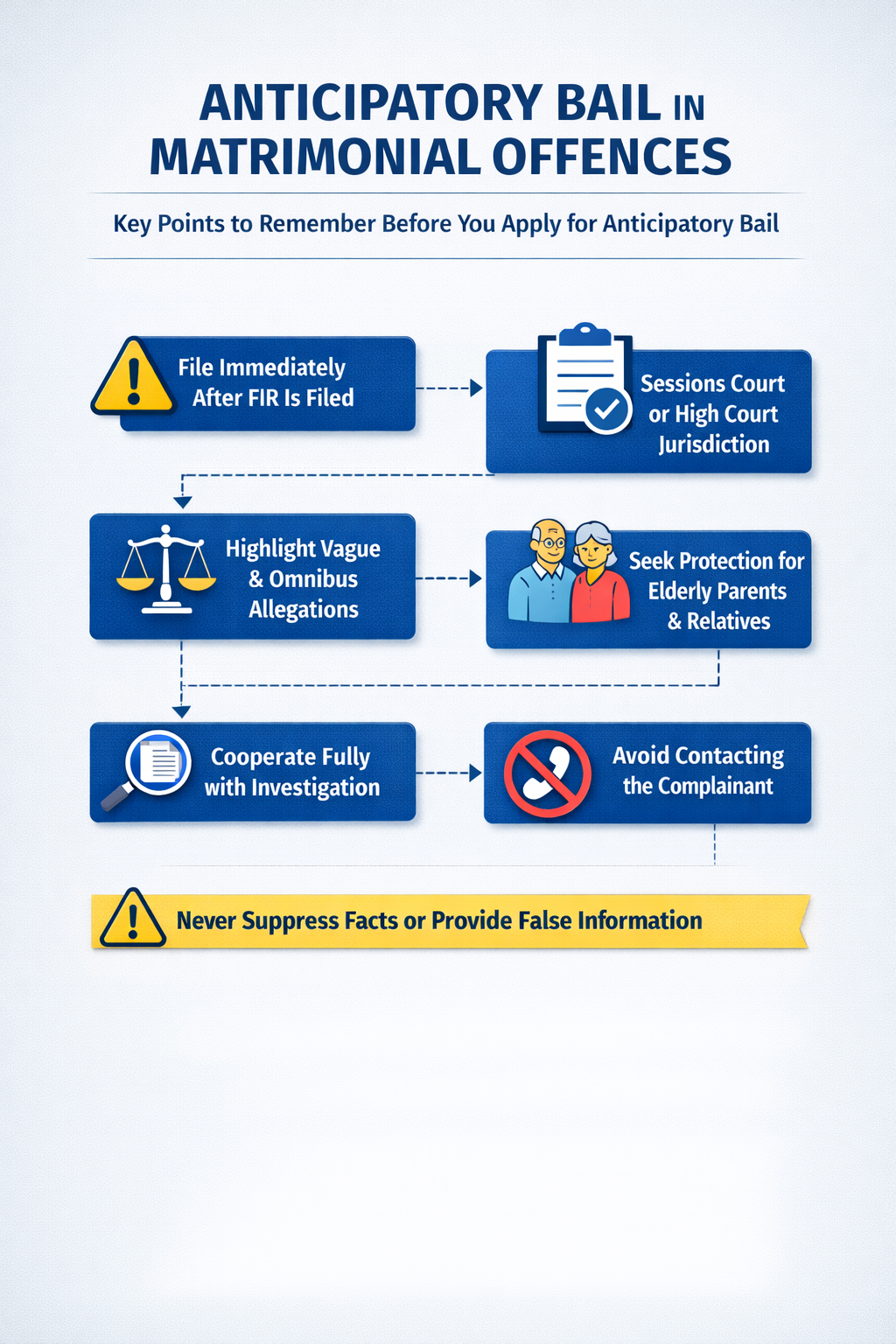
Anticipatory Bail in Matrimonial Offences – Complete Guide

Posted on February 24 by Suprajaa Rajan

Strategic legal protection to safeguard your liberty before arrest in matrimonial criminal proceedings.

Matrimonial disputes frequently escalate into criminal complaints under provisions such as Section 498A IPC, the Dowry Prohibition Act, or allied offences. In many cases, accused individuals face the threat of immediate arrest.

Anticipatory bail serves as a critical safeguard. It protects personal liberty while the investigation proceeds.

This guide explains the legal framework, judicial principles, procedure, and strategic considerations involved in seeking anticipatory bail in matrimonial cases.

I. What Is Anticipatory Bail?

Anticipatory bail is pre-arrest protection granted by a Court under:

Code of Criminal Procedure, 1973. Specifically under Section 438 CrPC. It allows a person to seek bail in anticipation of arrest, even before police take them into custody. Unlike regular bail, anticipatory bail prevents detention itself.

II. Why Is Anticipatory Bail Crucial in Matrimonial Cases?

Offences commonly invoked include:

  • Section 498A IPC (Cruelty)

  • Section 406 IPC (Criminal breach of trust)

  • Sections 3 & 4 of the Dowry Prohibition Act

These offences are:

  • Cognizable

  • Non-bailable

Arrest can severely impact:

  • Employment

  • Passport status

  • Reputation

  • Elderly parents and relatives

Therefore, immediate pre-arrest strategy becomes essential.

III. Supreme Court Safeguards Against Arbitrary Arrest

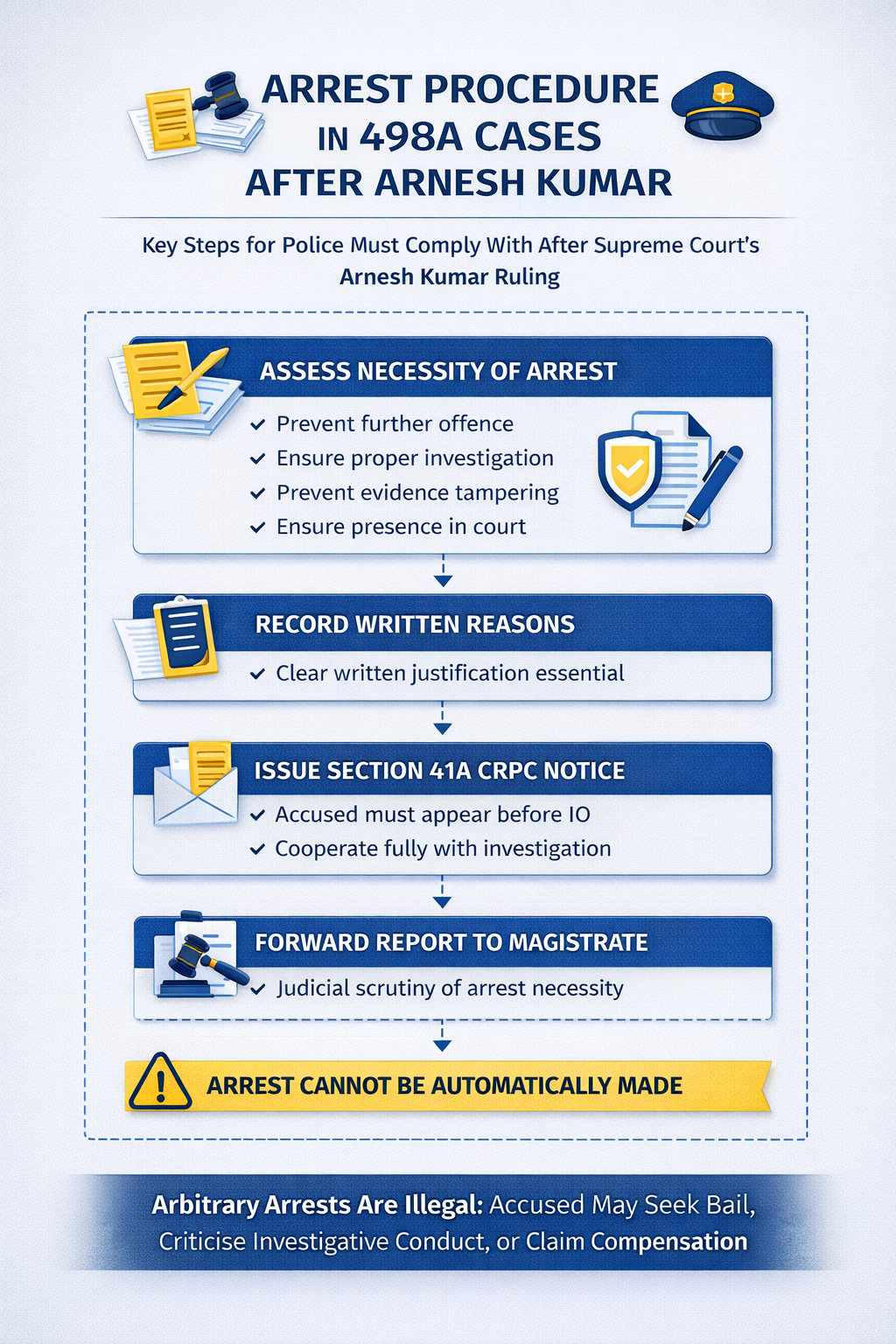
The landmark judgment in Arnesh Kumar v. State of Bihar transformed arrest jurisprudence in 498A cases.

The Supreme Court held:

  • Police cannot automatically arrest the accused.

  • They must satisfy conditions under Section 41 CrPC.

  • Notice under Section 41A CrPC should ordinarily precede arrest.

This decision strengthened the constitutional protection of personal liberty under Article 21.

Read also : “Arrest Procedure in 498A Cases After Arnesh Kumar”

IV. When Should You Apply for Anticipatory Bail?

You should apply immediately if:

  • FIR has been registered.

  • Police have issued a notice.

  • There is apprehension of arrest.

  • Multiple family members are named without specific allegations.

Delay may weaken your legal position. Early filing signals cooperation and preparedness.

V. Which Court Has Jurisdiction?

Application may be filed before:

  • Sessions Court

  • High Court

Generally, the Sessions Court is approached first unless exceptional circumstances justify direct High Court intervention.

VI. What Factors Do Courts Consider?

Courts evaluate:

  • Nature and gravity of allegations
  • Specificity of accusations
  • Role attributed to each accused
  • Possibility of absconding
  • Likelihood of tampering with evidence
  • Criminal antecedents

Vague and omnibus allegations often strengthen the case for anticipatory bail. Courts increasingly recognise that matrimonial disputes sometimes involve exaggerated complaints.

VII. Conditions Imposed by Courts

Anticipatory bail orders may include:

  • Cooperation with investigation

  • No contact with complainant

  • No tampering with evidence

  • Travel restrictions

Violation of conditions can lead to cancellation of bail.

VIII. Protection for Parents and Relatives

Courts frequently observe misuse through mechanical implication of:

  • Elderly parents

  • Married sisters living separately 

  • Distant relatives

Where allegations lack specific overt acts, courts are inclined to grant protection.

IX. Common Mistakes to Avoid

  • Ignoring police notice
  • Filing incomplete application
  • Suppressing facts
  • Adopting aggressive or retaliatory approach

Strategic transparency strengthens credibility before the Court.

X. Can Anticipatory Bail Be Cancelled?

Yes. Anticipatory bail can be cancelled if :

  • Conditions are violated

  • False information was provided

  • Accused obstructs investigation

Courts retain the power to cancel protection.

XI. Strategic Considerations in Matrimonial Cases

Anticipatory bail must align with broader litigation strategy, especially where parallel proceedings exist:

  • Domestic Violence cases

  • Maintenance proceedings

  • Divorce petitions

Coordinated legal planning prevents contradictions across cases.

Conclusion

Anticipatory bail in matrimonial offences is not merely a procedural remedy. It is a constitutional shield against unnecessary arrest.

Courts recognise the need to balance protection of genuine victims with safeguards against abuse of process. Early, structured legal action significantly improves the likelihood of securing protection.

Liberty once lost is difficult to restore. Strategic defence must begin before arrest.


Index of Legal Strategies and Defence is here. 

Frequently Asked Questions

No. It depends on facts and judicial discretion.

Yes, if allegations are general and lack specificity.

Usually yes, unless exempted by the Court.

Yes. Courts may consider bona fide settlement while granting protection.

Posted in Legal Procedure | Tagged 498A arrest procedure CrPC 438 - Anticipatory Bail Dowry Case bail legal strategy and defence | Leave a comment

Legal Strategies and Defence – A practical legal guide

Posted on February 23 by Suprajaa Rajan

This provides structured legal strategy and practical guidance for individuals facing criminal and matrimonial proceedings. Each guide below explains the legal position, procedural safeguards, and immediate steps required to protect your rights at every stage of litigation.


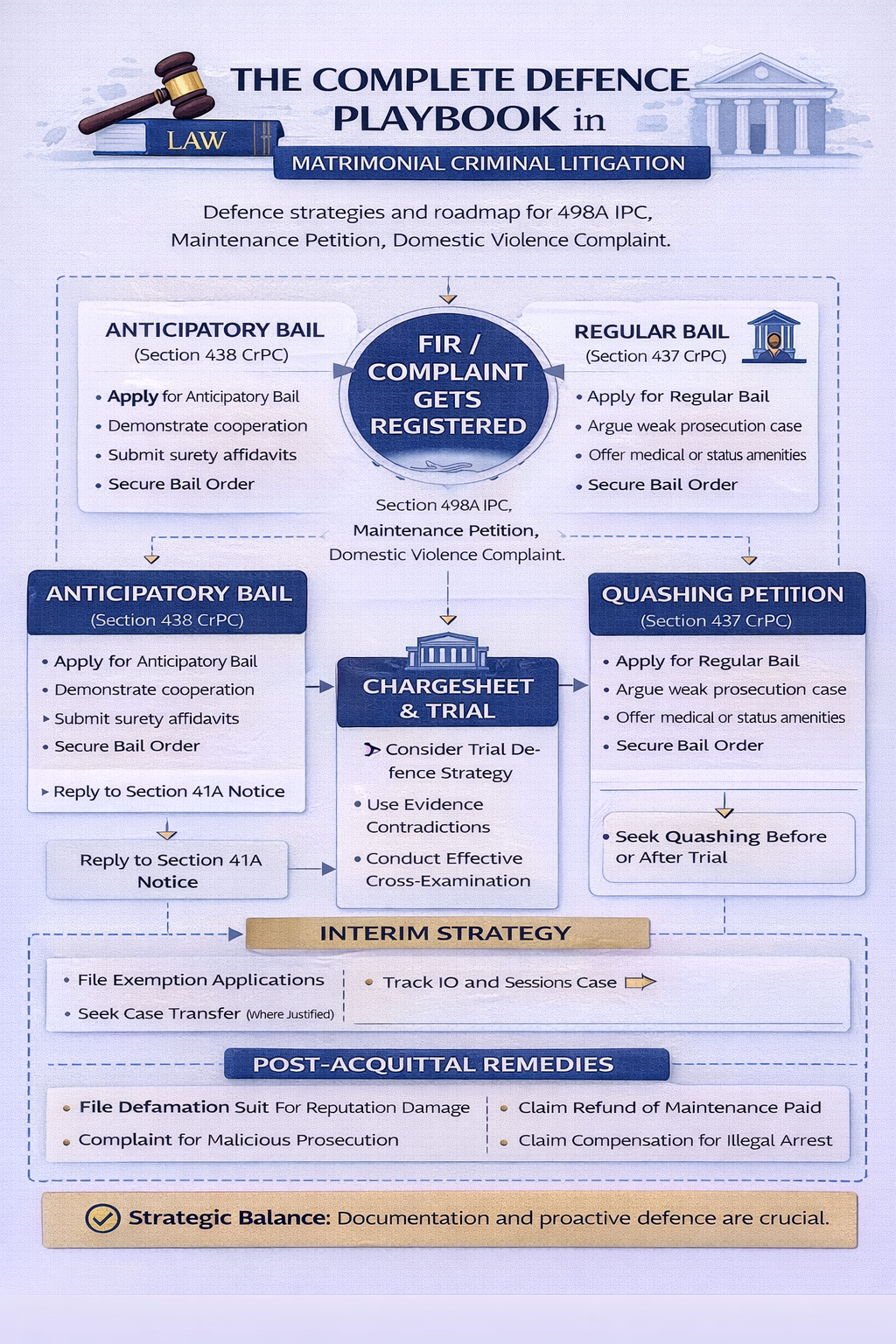
  1. Matrimonial Criminal Litigation – The Complete Defence Guide here.
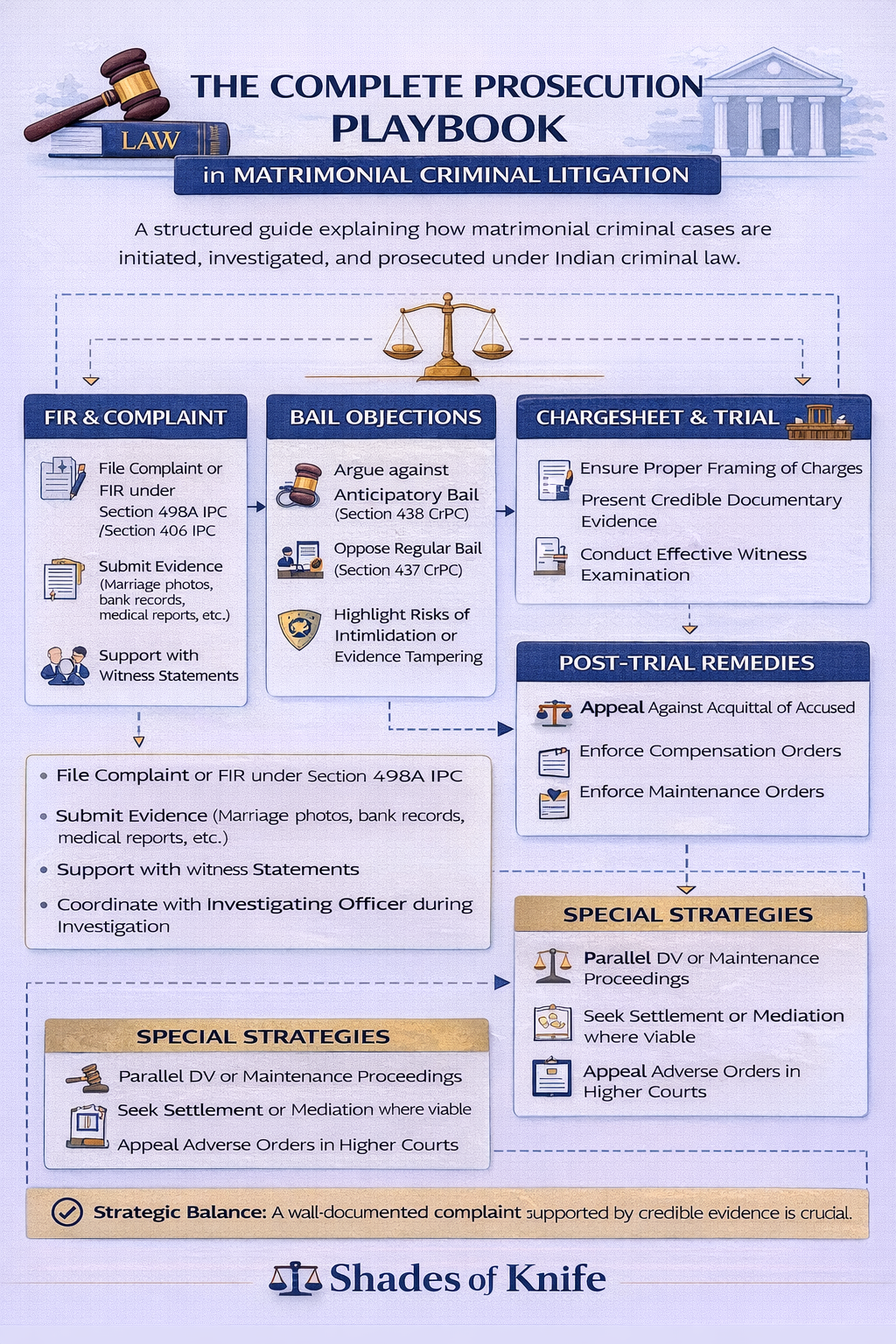
  2. Matrimonial Criminal Litigation – The Complete Prosecution Strategy Guide here. 
  3. Falsely accused under Section 498A IPC here.
  4. Anticipatory Bail in Matrimonial Offences here.
  5. Arrest procedure in 498A cases after Arnesh Kumar here.
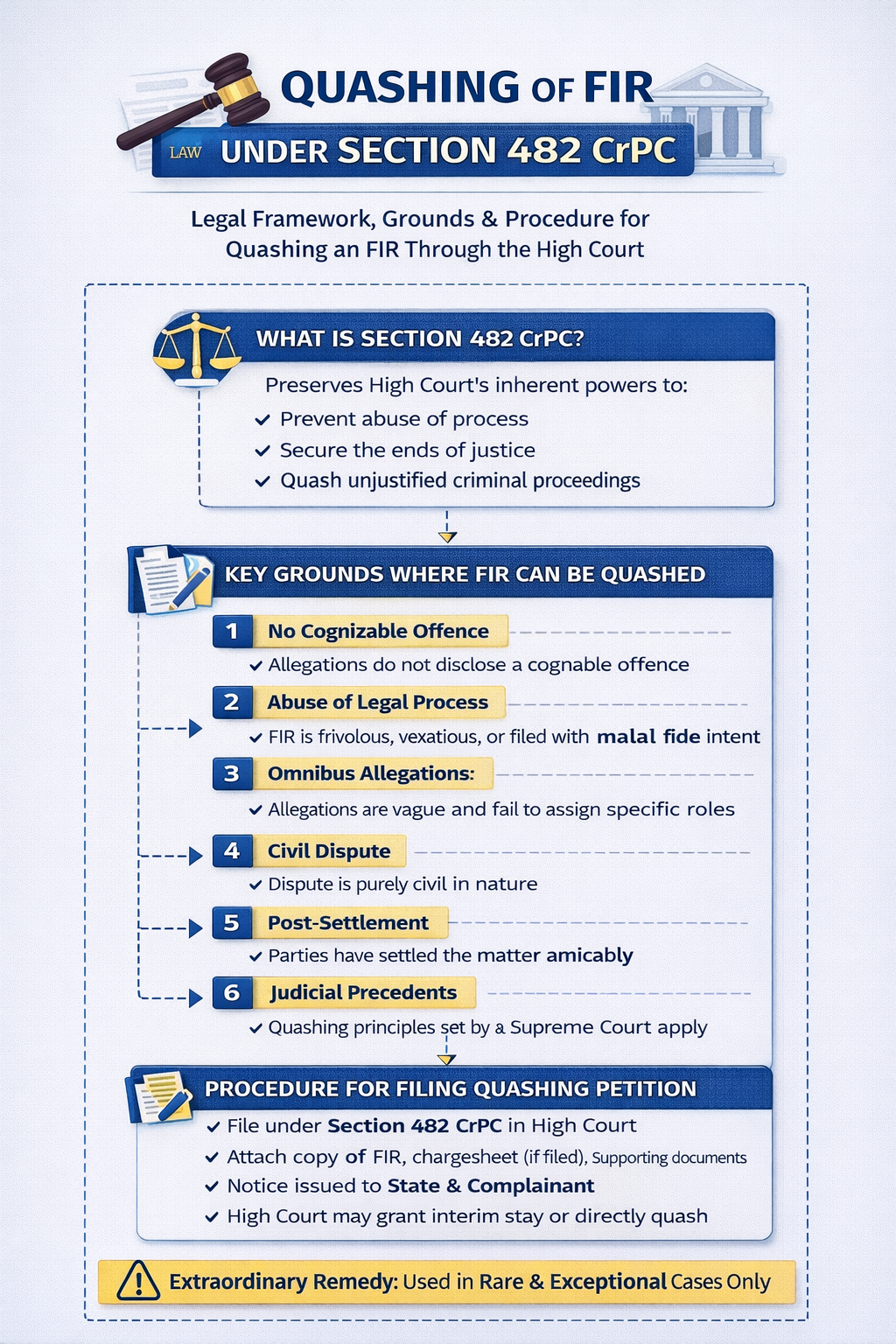
  6. Quashing of FIR under Section 482 CrPC here.
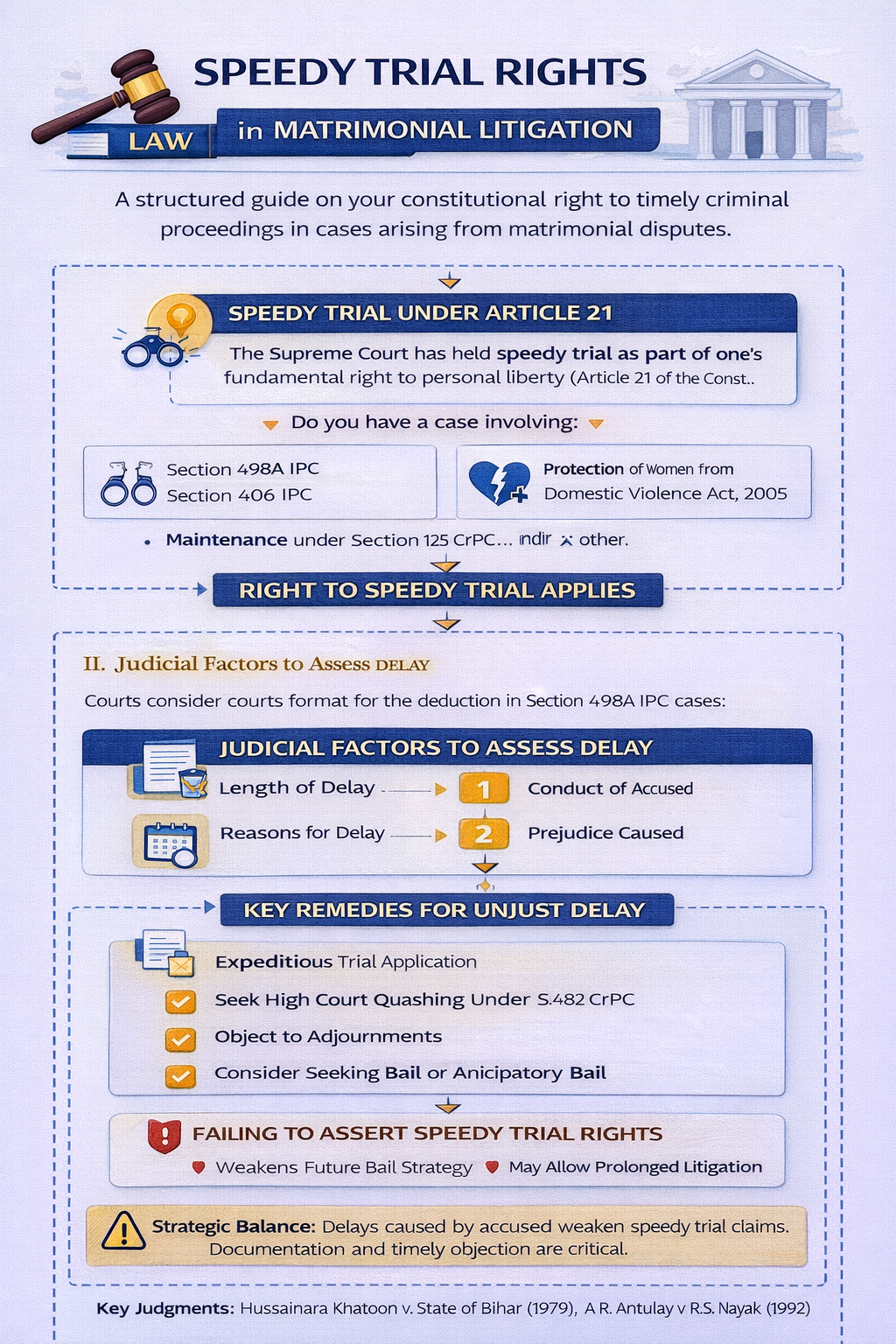
  7. Speedy Trial Rights in Matrimonial Litigation here.
  8. How to Defend Excessive Maintenance Claims in Matrimonial Cases here.
  9. False Domestic Violence Allegations – Legal Defence Strategy in India here.
  10. Can You Travel Abroad After an FIR Is Registered? – Legal Position Explained here.
  11. How to Prepare for Police Interrogation? – Legal Rights and Practical Guidance here.
  12. What to Do After Chargesheet Is Filed – Defence Strategy here.
  13. Defence Strategy When Elderly Parents Are Named in FIR here.
  14. When to File Defamation for False Allegations – Legal Strategy here.
  15. How Courts Quash Omnibus Allegations in Matrimonial FIRs – Case Study here.
  16. Myth vs Reality: Bail in 498A Cases – Legal Position Explained here.
  17. When Can Court Cancel Exemption Under Section 205 CrPC – Explained here.
  18. Strategic Divorce Filing After Criminal Complaint – A Legal Perspective here.
  19. How to Seek Compensation for False Arrest in India? here.
  20. What to Say (and Not Say) During Investigation – A Practical Legal Guide here.
  21. Reducing Maintenance – Legal Grounds and Strategy here.
  22. Cross-Examination Strategy in 498A Trials – Defence Tactics That Can Change the Outcome here.
  23. How to Challenge Ex Parte Orders in Criminal and Matrimonial Proceedings – Legal Remedies here.
  24. Compromise-Based Quashing in Matrimonial Cases – Complete Legal Strategy here.
  25. Top 10 Mistakes Accused Make in Matrimonial Cases – And How to Avoid Them here.
  26. How to Protect Digital Evidence in Matrimonial Disputes – A Practical Legal Guide here.
  27. Bail Conditions – How to Avoid Cancellation of Bail here.
  28. Second Anticipatory Bail Application – Is It Legally Possible? Complete Strategy here.
  29. How to Protect Reputation During Criminal Litigation? A Complete Legal & Practical Strategy here.
  30. How to Handle Hostile Witnesses in Criminal Trials – Complete Defence Strategy here.
  31. How to File a Complaint Against an Advocate in India – A First-Timer’s Complete Guide here.
  32. Objections a Defence Advocate Can Raise When the Prosecution Produces Documentary Evidence – Complete Trial Strategy Guide here.
  33. Warning Signs of Escalating Matrimonial Litigation – Early Red Flags Every Spouse Should Recognize here. 


Posted in Legal Procedure | Leave a comment

What To Do If You Are Falsely Accused Under Section 498A IPC

Posted on February 23 by Suprajaa Rajan

Introduction

Being named in an FIR under Section 498A of the Indian Penal Code can be legally and emotionally overwhelming. The provision deals with cruelty by a husband or his relatives toward a married woman. It is cognizable and non-bailable, which means arrest is legally permissible without a warrant.

However, courts have repeatedly recognised that vague and omnibus allegations should not automatically result in arrest or prosecution.

If you believe the complaint is false or exaggerated, you must act strategically and immediately. This guide explains the precise legal steps you should take.

I. Understand the Nature of Section 498A IPC

Indian Penal Code :

Section 498A defines cruelty as:

  • Wilful conduct likely to drive a woman to suicide, or

  • Harassment in connection with unlawful dowry demands.

Mere marital discord, incompatibility, or trivial disputes do not automatically amount to statutory cruelty.

II. Do Not Panic or Engage in Direct Confrontation

Avoid contacting the complainant to “settle” the issue emotionally. Any communication may later be produced as evidence.

Do not:

  • Threaten

  • Argue

  • Attempt private coercive settlement

Instead, consult a criminal law practitioner immediately.

III. Secure Anticipatory Bail Without Delay

If arrest appears imminent, file for anticipatory bail under:

Code of Criminal Procedure, 1973

Specifically under Section 438 CrPC.

The Supreme Court in Arnesh Kumar v. State of Bihar held that automatic arrests in 498A cases violate personal liberty. Police must comply with Section 41 and 41A CrPC safeguards before arrest.

Anticipatory bail protects you from custodial detention during investigation.

Read also : “Anticipatory Bail in Matrimonial Offences – Complete Guide”

IV. Collect and Preserve Documentary Evidence

Your defence begins with documentation.

Secure:

  • WhatsApp chats and emails

  • Call records

  • Bank transactions

  • Proof of financial transfers

  • Travel history

  • Medical records

  • Photographs and CCTV footage

  • Witness details

Preserve electronic evidence in original format. Do not tamper with devices.

V. Evaluate Grounds for Quashing the FIR

If the complaint contains:

  • Vague allegations

  • No specific date or incident

  • General accusations against distant relatives

  • No specific dowry demand

You may approach the High Court under Section 482 CrPC seeking quashing.

The Supreme Court in State of Haryana v. Bhajan Lal laid down categories where criminal proceedings may be quashed, especially when allegations do not disclose a prima facie offence or appear mala fide.

Read also : “File a Discharge or Quash petition”

VI. Challenge Illegal Arrest or Procedural Violations

If police arrest without complying with Section 41 CrPC safeguards, you may:

  • Seek immediate bail

  • Move for departmental action

  • File writ petition for violation of Article 21 rights

Personal liberty remains constitutionally protected.

VII. Avoid Counter-Litigation in Anger

Filing multiple retaliatory complaints may weaken your credibility.

Instead, take structured legal action such as:

  • Defamation proceedings (in appropriate cases)

  • Petition for restitution or divorce

  • Application for discharge at charge stage

Each step must align with long-term strategy.

VIII. Understand the Investigation Process

After FIR registration:

  1. Police record statements under Section 161 CrPC

  2. Evidence is collected

  3. Charge sheet may be filed before Magistrate

If evidence is weak, you may seek discharge before trial begins.

Read also : “Lifecycle stages of a Section 498A IPC case”

IX. Protect Elderly Parents and Relatives

Courts frequently criticise the practice of implicating all family members without specific allegations.

If distant relatives are named without overt acts, this strengthens grounds for quashing.

Courts consistently hold that criminal law cannot be used as a tool for matrimonial pressure.

X. Maintain Dignity and Composure

498A litigation often accompanies:

  • Domestic Violence proceedings

  • Maintenance claims

  • Divorce petitions

Coordinate defence strategy across all proceedings. Fragmented legal responses create contradictions.

Conclusion

A false accusation under Section 498A IPC demands calm, structured, and legally sound action. Panic or retaliation worsens the situation.

Indian courts recognise misuse concerns. They insist on procedural safeguards and evidentiary scrutiny. Early anticipatory bail, evidence preservation, and strategic litigation under Section 482 CrPC can prevent prolonged harassment.

Criminal law must protect genuine victims. It must not become an instrument of coercion in matrimonial disputes.


Frequently Asked Questions

No. After Arnesh Kumar, police must justify arrest under Section 41 CrPC.

Yes. High Courts exercise inherent powers under Section 482 CrPC where allegations fail to disclose an offence.

It is generally non-compoundable, but courts may quash proceedings in case of genuine settlement.

Courts discourage prosecution based on vague or omnibus statements.

Posted in Legal Procedure | Tagged bhajan lal principles CrPC 438 - Anticipatory Bail Dowry Case Law False 498A case Quashing of FIR Section 498A IPC | Leave a comment

Life Cycle Stages of a Divorce case

Posted on February 19 by Suprajaa Rajan

A divorce case follows a structured legal pathway, and understanding each stage enables individuals to approach the process with preparedness and clarity.

Here is a Detailed Step-by-Step Guide to Divorce by Mutual Consent and Contested Divorce in India.

Divorce is a formal legal process through which a valid marriage is dissolved by a court of law. The procedure follows a structured framework under personal laws and procedural statutes. In India, divorce proceedings are primarily governed by personal laws such as the Hindu Marriage Act, 1955, the Special Marriage Act, 1954, and procedural provisions under the Code of Civil Procedure, 1908.

This article explains the complete life cycle of a divorce case. It focuses on two major types of divorce proceedings: divorce by mutual consent and contested divorce.

Types of Divorce Cases

1. Divorce by Mutual Consent

Divorce by mutual consent arises when both spouses agree to dissolve the marriage. They mutually decide that they can no longer live together harmoniously. Section 13B of the Hindu Marriage Act, 1955 provides for divorce by mutual consent.

Both parties must agree on key issues before filing the petition. These issues include child custody, maintenance, alimony, and division of property.
The agreement must reflect free will and absence of coercion. Courts encourage this method because it reduces emotional and financial strain.
This process is generally faster than contested divorce proceedings.

2. Contested Divorce

A contested divorce occurs when one spouse files for divorce without the consent of the other spouse. The petitioner must prove legally recognised grounds for divorce. Section 13 of the Hindu Marriage Act, 1955 lists grounds such as cruelty, adultery, desertion, conversion, mental disorder, and others.

The respondent may oppose the petition and deny the allegations. The matter then proceeds through evidence, trial, and judicial determination.
Contested divorces often require detailed examination of facts and legal arguments.

1. Stage One: Pre-Filing Consultation and Legal Preparation

The divorce process usually begins with legal consultation. A spouse consults an advocate to understand rights, obligations, and potential outcomes.
The lawyer evaluates the facts to determine whether grounds for divorce exist.

At this stage, parties gather essential documents. These documents include the marriage certificate, proof of residence, identity documents, and evidence supporting allegations. Financial documents such as income statements and property records are also collected.

In mutual consent cases, spouses negotiate settlement terms before filing.In contested cases, the petitioner prepares factual pleadings and supporting material.

Legal preparation ensures clarity and reduces procedural delays.

2. Stage Two: Filing of the Divorce Petition

The formal process begins when the petitioner files a divorce petition before the competent Family Court. Jurisdiction depends on place of marriage, last residence together, or current residence of the respondent.

The petition contains material facts of the marriage. It states the date of marriage, details of children, and grounds for divorce. It also specifies relief sought, including dissolution of marriage, custody, maintenance, and litigation expenses.

In mutual consent divorce, both parties jointly file a petition under Section 13B. In contested divorce, only one spouse files the petition citing statutory grounds.

After scrutiny, the court registers the case and assigns a case number. The court then issues notice to the respondent.

3. Stage Three: Service of Notice and Appearance

The court ensures proper service of notice upon the respondent. Service of notice guarantees adherence to principles of natural justice. The respondent must receive an opportunity to present a defence.

The notice specifies the next hearing date. The respondent must appear personally or through legal counsel.Failure to appear may result in ex-parte proceedings.

Proper service validates further proceedings in the case.

4. Stage Four: Filing of Written Statement and Counter-Claims

In contested divorce cases, the respondent files a written statement. The written statement responds to each allegation in the petition. The respondent may admit, deny, or explain specific claims.The respondent may also raise counter-claims seeking independent relief. Counter-claims may include restitution of conjugal rights or custody rights.

In mutual consent cases, both parties submit affidavits confirming voluntary agreement. The court verifies that consent is genuine and informed.

This stage defines the scope of dispute between parties.

5. Stage Five: Interim Applications and Temporary Relief

During pendency of the case, parties may seek interim relief. Section 24 of the Hindu Marriage Act allows maintenance pendente lite and litigation expenses. Either spouse may apply for interim financial support.

Courts may also pass temporary custody orders in the best interest of the child. Interim protection orders ensure stability during litigation.

The court evaluates financial capacity and needs before granting interim relief. These orders remain effective until final judgment.

6. Stage Six: Mediation and Reconciliation Efforts

Family Courts often refer parties to mediation or conciliation. Section 9 of the Family Courts Act encourages settlement efforts. Mediation promotes amicable resolution without prolonged litigation. A neutral mediator facilitates constructive dialogue. Parties may resolve disputes regarding custody and property during mediation.

If mediation succeeds, parties record settlement terms before the court.
If mediation fails, the case proceeds to trial.

7. Stage Seven: Framing of Issues

In contested divorce, the court frames issues for determination. Issues identify disputed questions of fact and law. Each issue requires evidence and adjudication. For example, the court may frame an issue on whether cruelty occurred. The court may also frame issues regarding entitlement to maintenance.

Framing of issues narrows the scope of trial.
It provides procedural clarity to both parties.

8. Stage Eight: Evidence and Trial

The trial stage begins with the petitioner presenting evidence. Evidence may include documents, photographs, medical reports, or electronic records.
Witnesses may testify in support of allegations.

The respondent cross-examines the petitioner’s witnesses. Cross-examination tests credibility and factual accuracy.After the petitioner closes evidence, the respondent presents defence evidence. The petitioner may cross-examine defence witnesses.

The court records all testimonies systematically. The trial ensures procedural fairness and evidentiary scrutiny.

9. Stage Nine: Final Arguments

After completion of evidence, the court schedules final arguments. Advocates summarise factual findings and legal provisions. They cite relevant precedents to strengthen submissions.

The judge evaluates oral and written arguments carefully. The court may raise clarificatory questions during arguments. Final arguments provide an opportunity to persuade the court.

10. Stage Ten: Judgment and Decree

After considering pleadings, evidence, and arguments, the court delivers judgment. The judgment explains reasoning and legal conclusions. If grounds are proved, the court grants a decree of divorce. The decree formally dissolves the marriage. The court also decides maintenance, custody, and property disputes.

In mutual consent cases, the court grants decree after second motion confirmation. The decree becomes effective upon pronouncement.

11. Post-Judgment Remedies and Appeal

An aggrieved party may file an appeal before a higher court. Appeals must comply with statutory limitation periods. The appellate court reviews legal and procedural correctness. Parties may also seek modification of custody or maintenance orders. Courts entertain modification applications upon change in circumstances.

Conclusion

A divorce case follows a structured and legally regulated life cycle.
Divorce by mutual consent offers a cooperative and time-efficient resolution.
Contested divorce involves detailed judicial examination and trial.

Each stage safeguards fairness, transparency, and due process.
Understanding the procedure empowers individuals to approach the process confidently.
Proper legal guidance and informed decision-making significantly improve outcomes.


Other Life Cycles: 498A IPC Case Lifecycle || Maintenance Case u/s 125 CrPC Lifecycle. Index of all life cycles is here.


Key Contributor:
Mrs Suprajaa Rajan B.Com, LL.B., LL.M.
+91-9606345150

Posted in Legal Procedure | Tagged contested divorce Divorce by mutual consent divorce under hindu marriage act HM Act Sec 13B - Divorce by Mutual Consent Life cycle of divorce case stages in a divorce case | 2 Comments

Publicly available Legal Research tools

Posted on November 3, 2024 by ShadesOfKnife

This page contains some Publicly available Legal Research tools that can help to extract valuable information that can be presented in Courts as evidence and also during filling/filing of Income, Assets and Liabilities Affidavit as per Rajnesh Vs Neha judgement of the Apex Court.

  • Tax Evasion Petition (TEP)
    • What is a TEP? Learn basics here and find a format here.
    • Income Tax Department issues New Benami Transactions Informants Reward Scheme, 2018. Link here. You never know what your in-laws deal in.
    • Income Tax Department issues Revised Income Tax Informants Reward Scheme, 2018. Link here.
    • CBDT launches e-portal for filing complaints regarding tax evasion/Benami Properties/Foreign Undisclosed Assets. Link here.
    • Link to file a TEP here.
  • Provident Fund Information
    • Establishment Search portal here.
    • Home page of EPFO Website here.
  • Ask for a report of Form 26AS/Annual Tax Statement from TRACES
    • Portal link here.
  • Refunds generated, if any, on/after processing of Income Tax Returns by CPC-Bangalore
    • Portal link here.


MASTER Index is here.

Posted in Legal Procedure | Tagged Publicly available Legal Research tools | Leave a comment

Sample Format of 284 CrPC petition for Issuance of Commission

Posted on February 14, 2023 by ShadesOfKnife

One can rely on Cr.P.C. 284 and Cr.P.C. 285 onwards, to ensure the absenting prosecution witnesses are properly re-oriented, either to come to Court for Examination and Evidence or be ready to invite the Chief Judicial Magistrate to their home for the exact same purpose. The below sample is only for your guidance. Customize it to your needs and file.

Format-of-284-CrPC-petition-Sample for Issuance of Commission
Posted in Legal Procedure | Tagged CrPC 284 - When attendance of witness may be dispensed with and commission issued Sample Format of 284 CrPC petition for Issuance of Commission | Leave a comment

Life Cycle stages of a Public Interest Litigation (WP-PIL) in a High Court

Posted on December 15, 2022 by ShadesOfKnife

Let’s look at the high level stages in filing a WP-PIL into AP High Court until its’ disposal. Take a look at my file disposed PIL here, for reference and original case documents.

Journey of Idea to Petition

This is a interesting journey from the birth of an idea to eradicate a social evil to turning this idea into a Court-Acceptable Petition. Of Course, one can write a letter and email/post to the Contact address of a High Court (Info here) or Supreme Court (Info here).


Ideation

Look around you. Tell me in which aspect of life, there is no problem. So once you find a problem, you need to know where is the ideal solution lie. Meaning, which part of the Government has the responsibility to fix the problem. This will give answers to what exactly goes into your Prayers and Respondents sections of the WP-PIL.


Who can be a Petitioner in a WP-PIL?

Any public spirited person can espouse any cause impacting any sphere of the life of general public. But the Constitutional Courts (Supreme Court and High Courts) expect the petitioner capable enough to do details research, within his capacity, on the issue being raised and propose one (or more) solutions which would address the issue raised. Since a PIL ‘is NOT a adversary litigation but it is a challenge and an opportunity to the government and its officers to make basic human rights meaningful to the deprived and vulnerable sections of the community and to assure them social and economic justice which is the signature tune of our Constitution.‘

As with anything open to public, even PIL are misused and often criticized by Judiciary as Publicity Interest Litigation. Thereafter, Supreme Court [in State Of Uttaranchal vs Balwant Singh Chaufal Ors on 18 January, 2010] directed High Courts to frame rules to be followed by those coming forward to file PILs, to make them responsible for adverse consequences in case their PILs are held to be frivolous or motivated.


Format of a WP-PIL

Each High Court prescribes certain guidelines and a format to be followed while drafting the WP Petition and Affidavit. Additionally, it may require the petitioner to file along, more affidavits declaring various aspects corresponding to various rules. Here is the AP/TS PIL Rules 2015

2015-09-02 High Court of AP, Public Interest Litigation Rules, 2015

Drafting of a WP-PIL

There is no hard and fast rule for drafting. Emphasis must be on explaining the issue briefly under various heads of the PIL format and support the issue with as much evidence as possible from our research. Propose how your solutions are supported under various provisions of laws and principles of natural justice. Objective is to make it lucid enough for the Court (most probably Court-1/Chief Justice Court) to grasp the crux of the issue in one hearing itself.


Filing of a WP-PIL

Once the WP-PIL is drafted, reviewed (as many times as necessary), have it printed and filed into the Court. In most High Courts, the PILs are handled by the Division Bench headed by the Chief Justice of that High Court. Many two copies for the Bench. Make as many extra copies as there are Respondents, except where if same government advocate is going to represent more than one respondent. Make copies of ALL the material papers (technical word for bundle of Annexures) to go with above copies of petitions. You can make good use of the filing clerks in/around the High Court premises. This may become redundant, once paperless Courts become a reality!

There will be a section/wing within Filing Section of the High Court, which accepts and scrutinizes the draft. The section staff will assign a SR number to the bundle as a temporary identifier. If there are any objections/questions from the Scrutiny officer, the bundle will be returned to you (via Returns Section) for you to rectify and re-file the bundle. Once this exercise completes, your PIL will get a final case number.

The Scrutiny officer may want some approval from the Registrar (Judicial) to allow you to appear and argue your own PIL, as petitioner. It may be not required, if you are an advocate. The point here is the person arguing the matter/case, must be competent to assist the Court.


Listing of a WP-PIL

Most probably, the PIL will be listed before the Court-1 (or whichever Court looks into PILs in that High Court) and the business of the day will be to hear the petitioner and make an assessment if notices need to be issued to the respondents or can the PIL be disposed off at this admission stage itself. If the notices are not issued, it is most certain that the PIL was dismissed, for reasons best known to the bench and mentioned in the dismissal order. Like I came to know in above mentioned WP-PIL.

Otherwise, the respondents will have a total of 120 days to respond to the PIL, by filing their Counters. This is as per the AP High Court WP Proceedings 1977 available here. Other High Court have different Rules. Check that High Court’s website or the Filing Section in person. It is another matter that in AP High Court, Court-1 does not see any urgency, when advocates bring to the notice of the Court that the respondents already are in violation of this Rule 12. The Chief Justice himself commented to me in open Court, that there are cases pending even before my case. I am not sure, if this is a matter of pride or shame! I can not stand the lack of empathy towards the WPs filed as PILs here.


Disposal of a WP-PIL

Depending on the issue raised in the PIL petition, the case moves to the next stages involving weighing the contents and objections of the Counters filed by the respondents and the Bench may pass intermittent Orders to unearth the real issues and ways to effectively eradicate them.


Index of various other Life Cycles here.

Posted in Legal Procedure | Tagged Article 226 - Power of High Courts to issue certain writs Life Cycle stages of a Public Interest Litigation (WP-PIL) in a High Court Work-In-Progress Article | Leave a comment

Life Cycles of Various case types

Posted on December 20, 2021 by ShadesOfKnife

Here are a collection of life cycles of various cases

  • Life Cycle of a Section 498A IPC Dowry Harassment case here.
  • Life Cycle of a Domestic Violence case under PWDV Act 2005 here.
  • Life Cycle of a Maintenance Case under section 125 CrPC here.
  • Life Cycle of a Divorce case here.
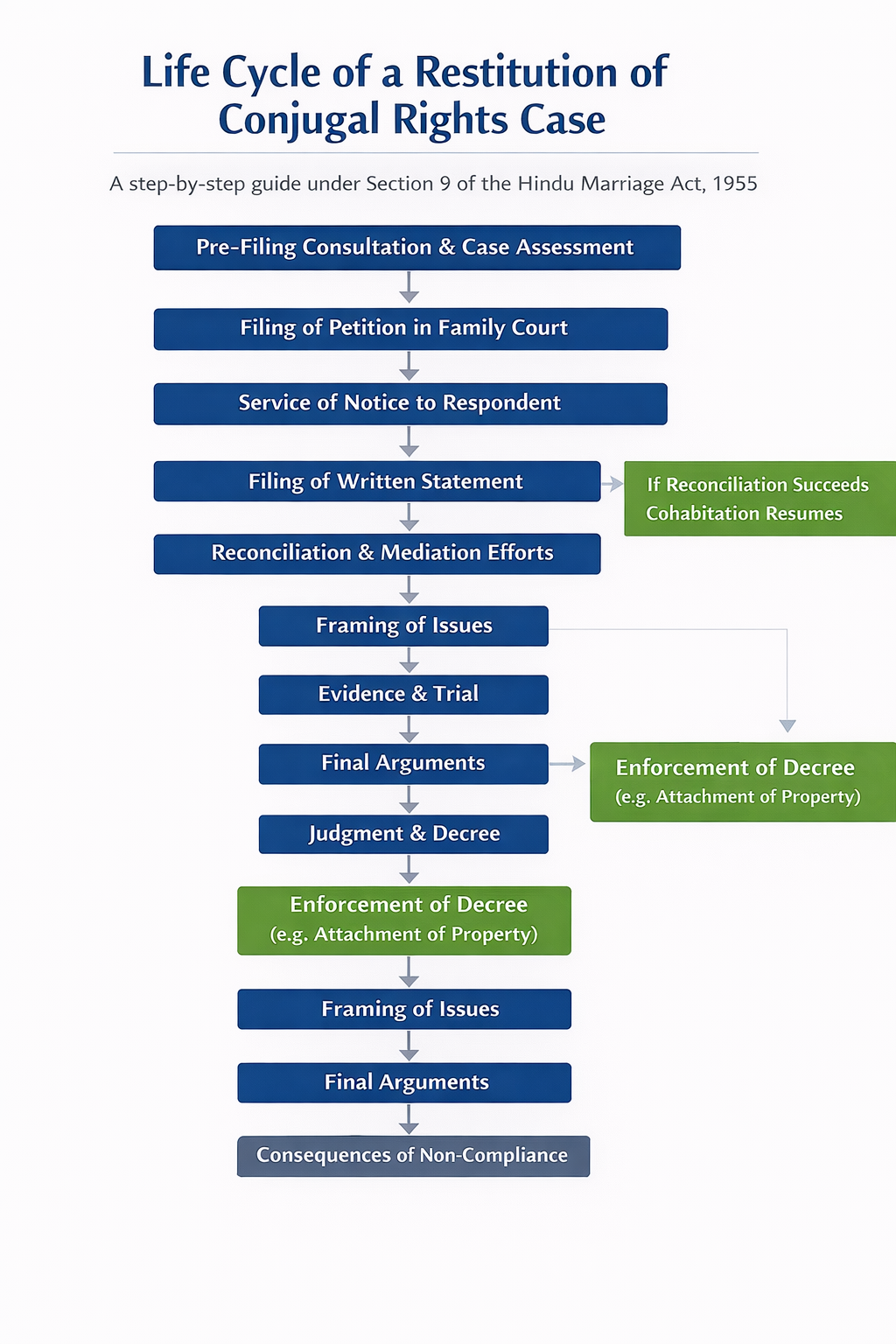
  • Life Cycle of a RCR (Restitution of Conjugal Rights; Sec 9 of Hindu Marriage Act 1955) case here.
  • Life Cycle of a Child Custody/Visitation case here.
  • Life Cycle of a Defamation case here.
  • Life Cycle of a Perjury case here.
  • Life Cycle of a Quash/Discharge case here.
  • Life Cycle of a Criminal Writ Petition case at a High Court here.
  • Life Cycle of a Transfer Petition case here.
  • Life Cycle of a Contempt of Court case here.
  • Life Cycle of a Public Interest Litigation (Just a Writ Petition only, but with PIL Rules of a High Court) case at a High Court here.


A lot of helpful tips while dealing with above case types, either from Police here and from judiciary here.


MASTER SITEMAP is available here.

Posted in Legal Procedure | Tagged Life Cycles of Various case types | Leave a comment

Lifecycle Stages of a Maintenance Case under Section 125 CrPC

Posted on December 10, 2021 by ShadesOfKnife

Listed below are a reasonably laid out sequence of events in a Maintenance Case filed under Section 125 of CrPC. Also, various other Maintenance cases under CrPC and remedies are presented at the end of this article.


Other Life Cycles: 498A IPC Case Lifecycle || DV Case Lifecycle. Index of all life cycles is here. Looking for Maintenance case-laws? go here!


Initial signs of facing a Maintenance case u/s 125 CrPC

This is the 3rd false case after the 498A IPC and Domestic Violence cases, that you may face. This case completes what is colloquially called as Full package. First a criminal case is filed so that Police power can be misused and when that does not break you, Civil reliefs are prayed for through Domestic Violence case. When even that plot fails and you don’t budge, the final attack comes in the form of this maintenance case, in which they think there is a sure shot success in extracting money from you. How comical bozos these are… hahahaha

The COMPLAINT

The petition/application u/s 125 CrPC containing the facts of the case, stating the circumstances under which the wife (as per the law, parents or children can also seek maintenance in cases of neglect) seeks to claim maintenance, all personal relevant details is filed before the Family Court (or jurisdictional Junior Civil Judge Court if Family Court is not available).

Issue of Notice to the Respondent

The Family Court scrutinizes the petition and issues notice to the husband against whom the petition has been filed by the wife. Petitioner copy may be sent along with notice.

Reference to Reconciliation/Mediation

The parties may be directed to appear before the court for reconciliation or may be directed to mediation and efforts are made to reconcile them first in an effort to avoid litigation.

Reconciliation Proceedings

If the reconciliation proceedings after being conducted by the family court are successful, then the matter stands settled. If they lead to failure, then the Court proceeds with the petition to decide it on merits.

Written Statement (of objections)

After giving a copy of the petition to the Respondent, the Family Court directs the opposite part to file a reply/WS/Counter to the maintenance petition stating the facts which he/she accepts or denies. Both the parties are also asked to file their detailed Income Affidavit (as per Rajnesh Vs Neha Case) so that it can infer the capabilities and liabilities. Petitioner must be given a copy of reply.

Rejoinder/Rebuttal

The petitioner is directed to file a rejoinder/rebuttal to reply filed by the opposite party. The application for interim maintenance, if any filed by the petitioner, is decided by the court at this stage of the case, based on pleadings and affidavits alone. No evidence will be entertained to decide Interim applications. Respondent must be given a copy.

Framing of Issues

The court then proceeds further and frames issues for adjudication and the matter is posted for evidence of the parties.

Petitioner’s Evidence

The petitioner is directed to lead its evidence by way of filing the relevant documents, papers, etc. and by summoning all its witnesses. List of witnesses must be given to other side before examining the first prosecution witness. Once prosecution witness examination completes by way of Chief Examination Affidavit, the witness will face Cross Examination from the Counsel of opposite party and the deposition of each witness is recorded, up on oath.

Respondent’s Evidence

The respondent is directed to lead its evidence by way of filing the relevant documents, papers, etc. and by summoning all its witnesses. This is optional and the Respondent may forego examination/ evidence, if they think that the prosecution failed to support their case.

FINAL ARGUMENTS –

The final arguments in the matter are held and the matter is decided by the court. Written Arguments may also be submitted to the Family Court, as a best practice.

Order/Judgment

The Court finally passes the final order/judgement where it may either dismiss the petition or allow the petition and direct the other party to pay an amount as directed by the court monthly.

Infographic


Key Contributor:

Ms. Suprajaa Rajan (B.Com., LL.B.)
Cell:
Posted in Legal Procedure | Tagged CrPC 125 or BNSS 144 - Order for Maintenance of Wives Children and Parents Lifecycle Stages of a Maintenance Case under 125 CrPC or BNSS 144 Work-In-Progress Article | 1 Comment

Lifecycle Stages of a Domestic Violence Case under PWDV Act

Posted on December 28, 2018 by ShadesOfKnife

Listed below are a reasonably laid-out sequence of events in a Domestic Violence Case filed under PWDV Act, 2005. The rules related to the Act are here.

Note: Take a thorough look at the below infographic to understand the various remedies available for an aggrieved person under this law.

Copyright (c) Holders:
Content: Suprajaa Rajan
Infographic: Padma Priya Jupally #IAmEnough


Other Life Cycles: 498A IPC Case Lifecycle || Maintenance Case u/s 125 CrPC Lifecycle. Index of all life cycles is here. Looking for Domestic Violence case-laws? go here!


Before Entering Into Court

  1. First step is that the aggrieved person/AP [read sec 2(a)] or a Protection Officer or any other person on behalf of the aggrieved person [AP] will file an application under sec 12(1) to the Magistrate seeking one or more reliefs under this Act.

Key Highlights

  • This Act is a CIVIL Act, meaning there are civil reliefs that can be claimed by AP and there is no penal punishment given under this Act. Only one exception to this is, when a person disobeys or violates a protection or interim protection order issued by the Magistrate. [read sec 31]
  • Magistrate will take up the application and order the Protection Officer [read sec 2(n)] to conduct mediation at court-appointed mediation center to see the possibility of a compromise and also to fill 3 ready-made forms called as Domestic Incident Reports (DIR forms).
  • Protection Officer, who is the District Welfare Officer, will issue a notice to all the people named and identified in the application.
    • Purpose: Mentioned as above.
    • What happens there: Lot of emotional drama, oral diarrhoea, convincing words followed by intermittent threats of 498A IPC case by the so-called Protection Officer/other service providers.
    • What to do: Keep your calmest best self and don’t overreact, nor let parents over-react. If you are capable and confident, ensure a audio/video recording of the session is made discreetly. If you have doubts, DO NOT DO IT. More valuable tips here.
  • Apart from husband, other family members who are implicated in this case, may become liable to the reliefs mentioned in the Act, based on the Complainant proving their acts of domestic violence. Maintenance component, under Monetary Reliefs alone, is the whole and sole responsibility of husband.
  • There are various reliefs [AP] may seek under the various sections. Do no worry about property getting taken over or similar issues. No ‘ownership transfer’ of any such property takes place. Only temporary residence may be ordered which one can oppose and offer similar alternative accommodation. Many idiots hope and try to extort money/property via Domestic Violence complaint. They remain idiotic fools.

Focus Areas

  • At this point in time, focus should be
    • to attend the proceedings with Protection Officer
    • to enjoy (record, if possible) the melodrama at mediation center and let it fail (just say, no compromise with liars, when my family was falsely implicated in the case)
    • to not worry about what is captured in the DIR Forms 1-5; they are not equivalent to FIR in case of a criminal matter.
    • to let the case move back to Court (there ends the matter with Protection Officer)
  • PO will send the mediation report along with earlier duly-prepared DIR forms.
  • PO to ensure the AP files the mandatory affidavit prescribed in the Apex Court judgment of Rajnesh Vs Neha, which mandates that the deponent of the affidavit disclosed their income, assets and liabilities.

After Entering Into Court (APPEARANCE AND FOR COUNTER stages)

  1.  Now Court issues a notices to all the respondents ([read sec 2(a)]: proper term for accused people in a Domestic Violence Case) to attend court proceedings on a specific date. The stage is called APPEARANCE.

Key Highlights

  • All respondents to attend court on the first appearance date and give attendance and collect the ‘accused copies’ of Domestic Violence Complaint, Affidavit under 297 CrPC, DIR forms and mediation report from the Court Bench Clerk. One set will be given per respondent.
  • Till this point, no need of engaging an advocate. Court gives next date, the business of which will be FOR COUNTER. The written statement of our objects otherwise a counter, is to be prepared and submitted to the court on next date of appearance or earlier, with Bench Clerk.
  • One may engage a lawyer to plead the case for you here on wards. If you know Law + Case Facts + Court Procedure, one may let court know, you would like to argue the case, on your own, as Party-in-person.
  • It is perfectly OKAY, if there are no DIR reports on the record of the case. It is the mandatory duty of the Protection Officer u/s 9(1)(b) and the duty of the Service Provider u/s 10(2)(a), as applicable, to record/make the DIRs. If they have not done their duty, dispute this fact in your Written Statement. The consequence is that the Presiding Officer (Magistrate) will pass an order to PO/Service Provider to make such DIRs, since it is the Magistrate duty under the proviso to Sec 12(1). But the Case will NOT become invalid and the case will be perfectly maintainable. There is no provision of filing Discharge petition u/s 239 CrPC in a DVC, so don’t waste time and money in this.

Focus Areas

  • At this point in time, focus should be
    • to prepare a Counter/written statement document based on whether the [AP] can prove the allegation laid out in the Domestic Violence Complaint.
    • to deny clearly all those allegations that are absurd, untruths, improbable and baseless, and mention ‘the petitioner is put to strict proof of same’. As settled principle of law, whoever alleges something have the burden of proving the same.
    • to state/submit those facts that can not be denied by Complainant. Rest all facts/evidences are to be secured and need not be shared with lawyer as well.
    • to submit/file the written statement/Counter on the next date prescribed by court. Unless it benefits us in a tangible way, do not skip/seek dates.
    • to ensure respondent (first the AP and then the respondent, in that sequence) file the mandatory affidavit prescribed in the Apex Court judgment of Rajnesh Vs Neha, which mandates that the deponent of the affidavit disclosed their income, assets and liabilities, within 4 weeks of the Income affidavit filed by the AP.
    • to seek mediation facility, if the respondent so desires to settle the matter with the AP.

EXAMINATION Stage

After Written Statement is filed generally, the next stage is the EXAMINATION. Naturally, it would begin examination of the complainant. The Court frames the issues at this Stage of the case. (read O14 R1 of CPC)

Additionally, if the AP filed an application u/s 23 of the PWDV Act seeking interim/ex-parte reliefs, then that application will be picked up by the Court. Scroll down to the relevant section (INTERIM Orders Stage) on this page.

Key Highlights

  • The respondents can file a petition u/s 205 CrPC (with grounds such as age factor, distance to travel, medical/health issues, unavailable in India etc), through your advocate, and seek exemption from personal appearance in the Court.
  • This Stage has two parts involving the AP as well as the respondent.
    • AP has to file an affidavit stating the facts and such affidavit is brought on record of the case/Court after administering Oath to the AP. This is called as Affidavit-in-Chief or Chief-Examination-Affidavit. By doing so, the AP submits herself to the Court as Prosecution Witness-1 (PW-1). Prosecution has to give a list of Prosecution witnesses to the Court and a copy to be given to the Respondent (advocate).
    • After AP file Chief Examination Affidavit (which is more or less replica of the same facts mentioned in the Sec 12 Application) and Respondent gets an opportunity to Cross-Examine the AP (who is now arrayed as PW-1). Read various other techniques respondents can use here.
    • If need arises, the respondent can re-examine the witness, as provided by Evidence Act 1872.
    • Once cross-examination of the PW-1 finishes, Chief examination of next prosecution witness begins, if any available from Prosecution side.
    • Once chief and cross of all prosecution witnesses finishes, the Court gives permission for Respondent side, to submit themselves for Examination.
    • Similar to what happened to Prosecution witnesses, if Respondents want to submit themselves for Prosecution’s examination, they have to give a list of Respondent witnesses to the Court and a copy to be given to the Prosecution (advocate).
    • Then the Chief Examination of DW-1 (Defence Witness/Respondent Witness-1) is finished (or affidavit is filed), followed by the Cross-examination of DW-1. This continues for all DWs.
  • During this Stage, the parties can adduce evidence in support of their stand and get them marked as Exhibits on the record of the Court.


ARGUMENTS Stage

After completion of examination of Prosecution and Respondent Witnesses and bring on record all the Evidence from both the parties, the Court opens for Arguments Stage.

Key Highlights

  • The Prosecution team submits their oral arguments in support of their Sec 12 application, relying on the averments in the Chief-Examination Affidavit and prays to the Court to allow their application.
  • The Respondent team submits their oral arguments against the Sec 12 application, relying on the Cross Examination of the Prosecution witnesses and prays to the Court to dismiss the application.
  • Both parties have opportunity to submit Written Arguments after concluding Oral arguments. This is a best practice but rarely followed in Courts.
  • Once both parties conclude their Oral (and/or Written) Arguments, the Court reserves it’s judgment. The case is now ‘Reserved for Judgment‘.
  • Once the judgment is reserved, no more activity is possible from either parties.


JUDGMENT Stage

The Court takes time to draft the judgment with reasons for the decision taken and pronounces the same in the Open Court, in the presence of both the parties. The court passes appropriate order/judgement. The court may decide the matter in three manners.

  • Grant all relief sought by complainant
  • Grant some of the reliefs and deny rest of the reliefs
  • Dismiss the complaint entirely without any relief.

Next steps

  • The Prosecution and the Respondent teams have a remedy of Appeal u/s 29 of the Act at Sessions Court, challenging the decision of the Trial Court, within 30 days.

INTERIM Orders Stage

The AP may file an application u/s 23, seeking Interim orders on the available reliefs under this Act. Such interim applications are to be disposed of in summary manner meaning, no evidence is to be taken on record and only the application/written statement/counter and relevant affidavits are the only things that need to be considered. Both parties will be given an opportunity to submit their arguments/hearing, after which the Court will pass an Order.

If such interim orders were obtained by AP by committing the offence of perjury upon the Court, do not hesitate to file an application u/s 340 CrPC in the same Court, right after such judicial order is passed.


Ready Reference:


Key Contributor:

Ms. Suprajaa Rajan (B.Com., LL.B.)
Cell:
Posted in Legal Procedure | Tagged Catena of Landmark Judgments Referred/Cited to Protection of Women from Domestic Violence Act 2005 Work-In-Progress Article | Leave a comment

Post navigation

  • Older posts
  • Newer posts

Search within entire Content of “Shades of Knife”

My Legal X Timeline

Advocate Sandeep Pamarati 🇮🇳💪👨🏻‍🎓 Follow

AP High Court Advocate with M Tech (CS) || 12 years in 'Software Industry' as Solution Architect || Blogs at https://t.co/29CB9BzK4w || #TDPTwitter

SandeepPamarati
Retweet on Twitter Advocate Sandeep Pamarati 🇮🇳💪👨🏻‍🎓 Retweeted
vipintalwar vipin talwar @vipintalwar ·
21h

Adani's Green Transformation Is Visible from the Ground Up

Tree plantation drives are common. Achieving an 88% survival rate is not.

At PEKB, the high survival rate means the restoration is not just happening on paper... it's creating real forests, real biodiversity, and real

Reply on Twitter 2065309482964697362 Retweet on Twitter 2065309482964697362 58 Like on Twitter 2065309482964697362 58 X 2065309482964697362
Retweet on Twitter Advocate Sandeep Pamarati 🇮🇳💪👨🏻‍🎓 Retweeted
ratansharda55 Ratan Sharda 🇮🇳 रतन शारदा @ratansharda55 ·
15h

Bravo @navikakumar

Reply on Twitter 2065395655284338898 Retweet on Twitter 2065395655284338898 78 Like on Twitter 2065395655284338898 321 X 2065395655284338898
Retweet on Twitter Advocate Sandeep Pamarati 🇮🇳💪👨🏻‍🎓 Retweeted
hindujagrutiorg HinduJagrutiOrg @hindujagrutiorg ·
23h

Amazon Insults Aryabhata

Aryabhata gave the world ZERO.
Amazon gave him ZERO respect.

Turning Bharat's greatest mathematician into a marketing prop for "zero fees" is not creativity, it's cultural insult.

@amazonIN Apologise. Withdraw the ad. Respect India's civilisational

Reply on Twitter 2065269861383835852 Retweet on Twitter 2065269861383835852 343 Like on Twitter 2065269861383835852 414 X 2065269861383835852
Retweet on Twitter Advocate Sandeep Pamarati 🇮🇳💪👨🏻‍🎓 Retweeted
its_the_dr Johnny Midnight ⚡️ @its_the_dr ·
12 Jun

That’s so true! George Carlin.

Reply on Twitter 2065238521929953768 Retweet on Twitter 2065238521929953768 162 Like on Twitter 2065238521929953768 503 X 2065238521929953768
Load More

Recent Posts

  • Cruelty as a Criminal Offence Explained June 12, 2026
  • Bail Compliance Undertaking Format – Draft, Legal Requirements & Sample Template June 12, 2026
  • Warning Signs of Escalating Matrimonial Litigation – Early Red Flags Every Spouse Should Recognize June 12, 2026
  • Objections a Defence Advocate Can Raise When the Prosecution Produces Documentary Evidence – Complete Trial Strategy Guide June 5, 2026
  • How to File a Complaint Against an Advocate in India – A First-Timer’s Complete Guide June 5, 2026

Most Read Posts

  • Reply to Section 41A CrPC Notice – Format with Legal Explanation (4,895 views)
  • Anu Aggarwal Vs Sushant Aggarwal on 20 Jan 2026 (3,421 views)
  • Umme Farva Vs State of U.P. and Anr on 14 Jan 2026 (3,275 views)
  • Charge Sheet and Final Report Explained (2,703 views)
  • Regular Bail Application Format (Section 437/439 CrPC) (2,099 views)
  • Neha Lal Vs Abhishek Kumar on 20 Jan 2026 (1,938 views)
  • Arrest Procedure in 498A cases after Arnesh Kumar (1,864 views)
  • Discharge Application Format in 498A Case – Draft, Procedure & Sample Template (1,694 views)
  • Can You Travel Abroad After an FIR Is Registered? – Legal Position Explained (1,603 views)
  • Atul Kumar Bajpai Vs State of UP and Anr on 17 Sep 2025 (1,494 views)

Tags

Reportable Judgement or Order (433)2-Judge (Division) Bench Decision (411)Legal Procedure Explained - Interpretation of Statutes (381)Landmark Case (381)1-Judge Bench Decision (362)Catena of Landmark Judgments Referred/Cited to (293)Work-In-Progress Article (215)3-Judge (Full) Bench Decision (101)Sandeep Pamarati (92)Article 21 - Protection of life and personal liberty (80)Issued or Recommended Guidelines or Directions or Protocols to be followed (71)Perjury Under 340 CrPC (66)Absurd Or After Thought Or Baseless Or False Or General Or Inherently Improbable Or Improved Or UnSpecific Or Omnibus Or Vague Allegations (61)Reprimands or Setbacks to YCP Govt of Andhra Pradesh (49)Summary Post (47)CrPC 482 - Quash (43)HM Act 13 - Divorce Granted to Husband (42)Legal Terrorism (41)Not Authentic copy hence to be replaced (40)Divorce granted on Cruelty ground (40)

Categories

Supreme Court of India Judgment or Order or Notification (752)Bare Acts or State Amendments or Statutes or GOs or Notifications issued by Central or State Governments (328)High Court of Andhra Pradesh Judgment or Order or Notification (186)High Court of Delhi Judgment or Order or Notification (164)High Court of Bombay Judgment or Order or Notification (112)High Court of Karnataka Judgment or Order or Notification (93)Legal Procedure (77)High Court of Madras Judgment or Order or Notification (70)High Court of Allahabad Judgment or Order or Notification (61)LLB Study Material (59)General Study Material (56)High Court of Punjab & Haryana Judgment or Order or Notification (52)Assorted Court Judgments or Orders or Notifications (50)High Court of Kerala Judgment or Order or Notification (46)Prakasam DV Cases (46)Judicial Activism (for Public Benefit) (45)District or Sessions or Magistrate Court Judgment or Order or Notification (44)High Court of Madhya Pradesh Judgment or Order or Notification (38)High Court of Gujarat Judgment or Order or Notification (28)High Court of Calcutta Judgment or Order or Notification (27)

Recent Comments

  • The Divorce Law Firm on Life Cycle Stages of a Divorce case
  • The Divorce Law Firm on Life Cycle Stages of a Divorce case
  • ShadesOfKnife on Sandeep Pamarati Vs Ungrateful Knife (IPC 498A Case)
  • KONURU VINAYKUMAR on Sandeep Pamarati Vs Ungrateful Knife (IPC 498A Case)
  • ShadesOfKnife on Lifecycle Stages of a Section 498A IPC Case

Archives of SoK

  • June 2026 (7)
  • May 2026 (24)
  • April 2026 (33)
  • March 2026 (42)
  • February 2026 (30)
  • January 2026 (21)
  • December 2025 (2)
  • November 2025 (3)
  • October 2025 (17)
  • September 2025 (12)
  • August 2025 (5)
  • July 2025 (10)
  • June 2025 (15)
  • May 2025 (3)
  • April 2025 (10)
  • March 2025 (7)
  • February 2025 (8)
  • January 2025 (1)
  • December 2024 (3)
  • November 2024 (4)
  • October 2024 (16)
  • September 2024 (15)
  • August 2024 (14)
  • July 2024 (11)
  • June 2024 (18)
  • May 2024 (13)
  • April 2024 (9)
  • March 2024 (23)
  • February 2024 (15)
  • January 2024 (11)
  • December 2023 (11)
  • November 2023 (9)
  • October 2023 (13)
  • September 2023 (12)
  • August 2023 (15)
  • July 2023 (17)
  • June 2023 (11)
  • May 2023 (6)
  • April 2023 (5)
  • March 2023 (10)
  • February 2023 (9)
  • January 2023 (12)
  • December 2022 (12)
  • November 2022 (8)
  • October 2022 (13)
  • September 2022 (17)
  • August 2022 (10)
  • July 2022 (21)
  • June 2022 (27)
  • May 2022 (23)
  • April 2022 (32)
  • March 2022 (17)
  • February 2022 (6)
  • January 2022 (2)
  • December 2021 (7)
  • November 2021 (7)
  • October 2021 (6)
  • September 2021 (10)
  • August 2021 (31)
  • July 2021 (45)
  • June 2021 (17)
  • May 2021 (17)
  • April 2021 (18)
  • March 2021 (58)
  • February 2021 (14)
  • January 2021 (50)
  • December 2020 (35)
  • November 2020 (68)
  • October 2020 (67)
  • September 2020 (28)
  • August 2020 (41)
  • July 2020 (20)
  • June 2020 (36)
  • May 2020 (40)
  • April 2020 (38)
  • March 2020 (26)
  • February 2020 (43)
  • January 2020 (35)
  • December 2019 (34)
  • November 2019 (4)
  • October 2019 (18)
  • September 2019 (57)
  • August 2019 (33)
  • July 2019 (12)
  • June 2019 (18)
  • May 2019 (5)
  • April 2019 (19)
  • March 2019 (58)
  • February 2019 (11)
  • January 2019 (90)
  • December 2018 (97)
  • November 2018 (43)
  • October 2018 (31)
  • September 2018 (73)
  • August 2018 (47)
  • July 2018 (143)
  • June 2018 (92)
  • May 2018 (97)
  • April 2018 (59)
  • March 2018 (8)

Blogroll

  • Daaman Promoting Harmony 0
  • Fight against Legal Terrorism Fight against Legal Terrorism along with MyNation Foundation 0
  • Good Morning Good Morning News 0
  • Insaaf India Insaaf Awareness Movement 0
  • MyNation Hope Foundation Wiki 0
  • MyNation.net Equality, Justice and Harmony 0
  • Sarvepalli Legal 0
  • Save Indian Family Save Indian Family Movement 0
  • SIF Chandigarh SIF Chandigarh 0
  • The Male Factor The Male Factor 0
  • Unitedmen Foundation a dedicated community forged with the mission to unite men facing legal challenges in marital disputes. 0
  • Vaastav Foundation The Social Reality 0
  • Vinayak my2centsworth – This blog is for honest law abiding men, married or planning to get married 0
  • Voice4india Indian Laws, Non-profits, Environment 0
  • Writing Law Writing Law by Ankur 0

RSS Cloudflare Status

  • Scheduled Workers Platform Configuration Maintenance June 22, 2026
    THIS IS A SCHEDULED EVENT Jun 22, 12:00 - 13:00 UTC Jun 10, 20:16 UTC Scheduled - On 2026-06-22 from 12:00-13:00 UTC, Cloudflare will be performing scheduled maintenance on the data store responsible for Workers platform configuration. During this maintenance window, customers will be unable to make configuration changes for up to 3 minutes. This […]
  • Zero Trust Underlying Storage Maintenance June 18, 2026
    THIS IS A SCHEDULED EVENT Jun 18, 12:00 - 13:00 UTC Jun 12, 00:38 UTC Scheduled - Cloudflare has scheduled maintenance for the backend storage system supporting Cloudflare One Client (WARP) / Zero Trust device management. Services will continue to operate normally. During a brief window of up to 3 minutes, device-related settings will be […]
  • ICN (Seoul) on 2026-06-17 June 17, 2026
    THIS IS A SCHEDULED EVENT Jun 17, 17:00 - 22:00 UTC Jun 4, 13:40 UTC Scheduled - We will be performing scheduled maintenance in ICN (Seoul) datacenter on 2026-06-17 between 17:00 and 22:00 UTC.Traffic might be re-routed from this location, hence there is a possibility of a slight increase in latency during this maintenance window […]

RSS List of Spam Server IPs from Project Honeypot

  • 34.182.239.50 | SD June 12, 2026
    Event: Bad Event | Total: 4 | First: 2026-06-12 | Last: 2026-06-12
  • 35.185.163.241 | SD June 12, 2026
    Event: Bad Event | Total: 6 | First: 2026-06-12 | Last: 2026-06-12
  • 77.68.12.172 | S June 12, 2026
    Event: Bad Event | Total: 4 | First: 2026-06-12 | Last: 2026-06-12
Owned and Operated by Advocate Sandeep Pamarati
Proudly powered by WordPress
Theme: Flint by Star Verte LLC

Bad Behavior has blocked 597 access attempts in the last 7 days.

pixel