A strategic legal remedy when courts proceed with interim maintenance without financial disclosure.
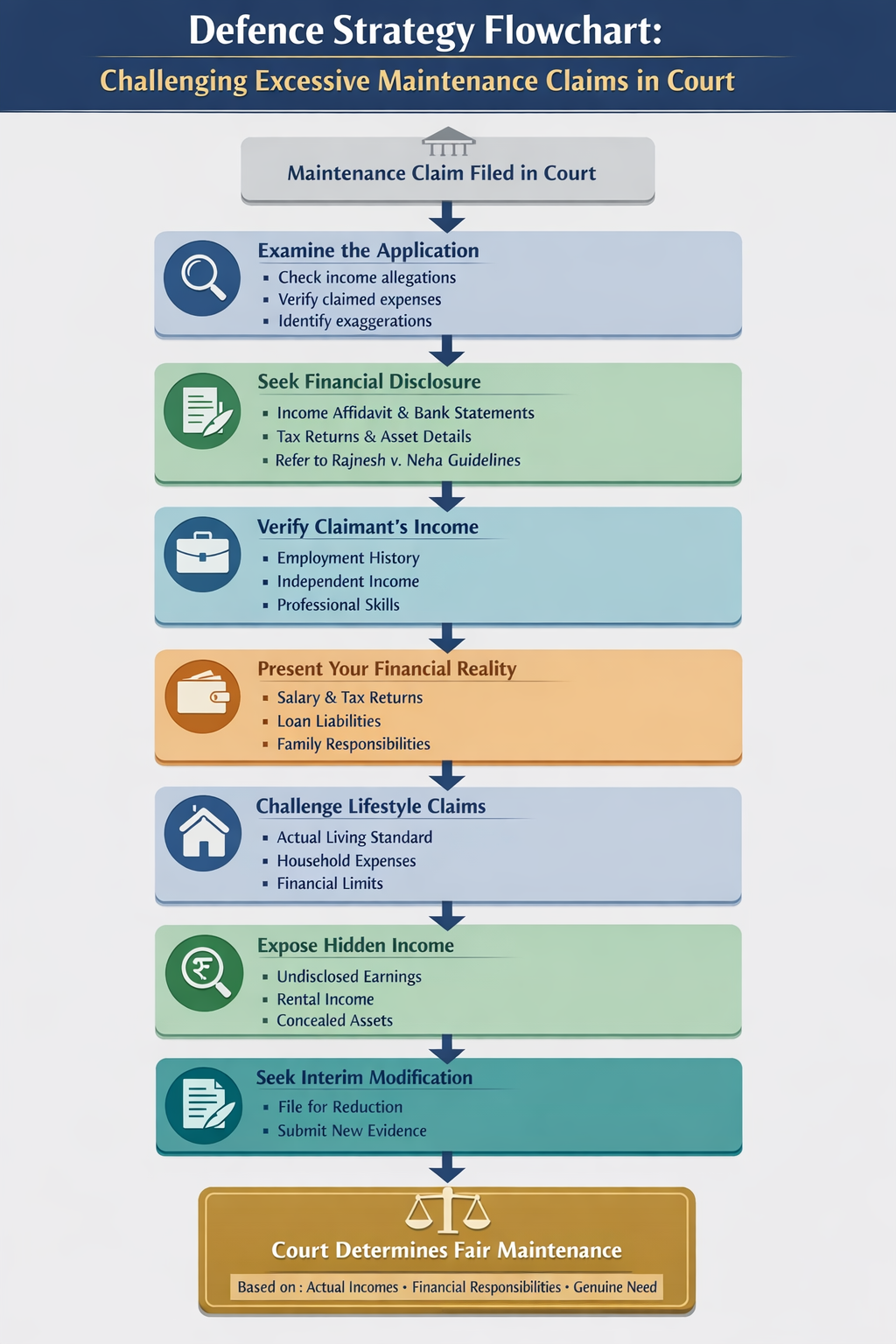
In matrimonial litigation, courts sometimes proceed to pass interim maintenance orders without insisting on the mandatory Affidavit of Assets & Liabilities. However, such an approach directly contradicts the binding guidelines laid down by the Supreme Court in Rajnesh v. Neha.
Therefore, when a court attempts to grant interim relief without financial disclosure, the aggrieved party must act immediately by filing a Memo seeking compliance with Supreme Court guidelines.
This article provides a practical legal response, procedural clarity, and a ready-to-use draft format.
I. Legal Position – Mandatory Financial Disclosure
The Supreme Court in Rajnesh v. Neha clearly held that:
Both parties must file Affidavit of Assets & Liabilities
Courts must not decide maintenance arbitrarily
Financial disclosure ensures fair and realistic assessment
Therefore, passing interim orders without such affidavits may result in:
Violation of principles of natural justice
Arbitrary determination of maintenance
Grounds for challenge before appellate court
II. What Should You Do in This Situation?
If the court indicates that it may proceed without affidavit:
Step 1: File a Memo Immediately
You must bring this issue formally on record.
Step 2: Refer to Supreme Court Guidelines
Specifically highlight Rajnesh v. Neha compliance.
Step 3: Request Court to Defer Interim Order
Seek direction to both parties to file affidavits first.
Step 4: Preserve Your Right to Challenge
This memo creates a record for appeal/revision if needed.
III. Who Should File This Memo?
The Respondent (usually husband in maintenance cases)
Through advocate on record
Or in person, if no advocate is engaged
IV. Drafting Strategy
While drafting this memo:
Keep it respectful, not confrontational
Avoid accusing the court directly
Use language like “in light of binding precedent”
Focus on procedural compliance, not merits
V. Sample Draft Format – Memo Seeking Compliance with Affidavit Requirement
Sample Draft – Memo Seeking Filing of Affidavit of Assets & Liabilities (Rajnesh v. Neha Compliance)
BEFORE THE HONOURABLE COURT OF [COURT NAME] AT [CITY]
Case No.: [____]
In the matter of:
[Name of Applicant/Wife]
…Applicant
Versus
[Name of Respondent/Husband]
…Respondent
MEMO ON BEHALF OF RESPONDENT SEEKING COMPLIANCE OF AFFIDAVIT OF ASSETS & LIABILITIES
Most Respectfully Submitted:
1. That the present matter is pending before this Hon’ble Court and is listed for hearing on interim relief.
2. That this Hon’ble Court is considering grant of interim maintenance in the present proceedings.
3. It is respectfully submitted that the Hon’ble Supreme Court in Rajnesh v. Neha (2021) 2 SCC 324 has laid down mandatory guidelines requiring both parties to file detailed Affidavit of Assets and Liabilities before determination of maintenance.
4. That in the present case, the Applicant has not filed the Affidavit of Assets and Liabilities as mandated by the Hon’ble Supreme Court.
5. That in absence of such financial disclosure, any determination of interim maintenance may not reflect the true financial position of the parties.
6. Therefore, it is most respectfully submitted that both parties may be directed to file their Affidavit of Assets and Liabilities before passing any interim order.
PRAYER
In view of the above, it is most respectfully prayed that this Hon’ble Court may be pleased to:
a) Direct the parties to file Affidavit of Assets and Liabilities in compliance with Supreme Court guidelines; and
b) Defer consideration of interim maintenance till such affidavits are placed on record.
Place: [City]
Date: [Date]
Counsel for the Respondent
[Signature]
VI. What If the Court Still Passes an Interim Order?
If the court proceeds despite this memo:
You can file Revision / Appeal before higher court
Challenge order as contrary to Supreme Court guidelines
Highlight absence of financial disclosure
This memo becomes critical evidence to show you objected at the right stage.
Conclusion
When courts proceed without insisting on Affidavit of Assets & Liabilities, it is essential to respond strategically rather than passively. Therefore, filing a well-drafted memo invoking Supreme Court guidelines ensures procedural fairness and protects your legal rights.
Ultimately, this approach strengthens your case both at the trial stage and in appellate proceedings.
Index of Legal Templates and Drafting is here.
Disclaimer
These templates are provided for educational and informational purposes. Every case depends on specific facts and procedural posture. Professional legal advice should be obtained before filing any application.
Key Contributor :
Mrs. Suprajaa Rajan B.Com., LL.B., LL.M.
+91-9606345150