web analytics

Menu

Skip to content
Shades of Knife
  • Home
  • True Colors of a Vile Wife
  • Need Inspiration?
  • Blog Updates
  • SOK Gallery
  • Vile News Reporter
  • About Me
  • Contact Me

Shades of Knife

True Colors of a Vile Wife

Category: Legal Procedure

Strategic Divorce Filing After Criminal Complaint – A Legal Perspective

Posted on April 27 by Suprajaa Rajan

Introduction

In matrimonial disputes, it is increasingly common for one spouse to initiate criminal proceedings (such as cruelty, dowry harassment, or domestic violence) before or alongside divorce proceedings. This raises a critical question—should and when should the other spouse file for divorce after a criminal complaint?

Filing for divorce after a criminal complaint is not merely a reactive step. Instead, it can be a strategic legal decision that influences both civil and criminal proceedings.

This article explains the timing, legal grounds, and strategic advantages of filing for divorce after a criminal complaint, along with procedural aspects under the Code of Civil Procedure, 1908, the Hindu Marriage Act, 1955, and relevant criminal provisions under CrPC and BNSS.

Understanding the Legal Landscape

When a criminal complaint is filed (commonly under Section 498A IPC or domestic violence laws), two parallel legal tracks may emerge:

  1. Criminal Proceedings
  2. Civil Matrimonial Proceedings (Divorce)

These proceedings are independent, but they often influence each other in practice.

Why Consider Divorce After a Criminal Complaint?

Filing for divorce after a criminal complaint can serve multiple legal and strategic purposes.

1. Allegations May Constitute Mental Cruelty

False or exaggerated criminal allegations can amount to mental cruelty, which is a valid ground for divorce under:

  • Section 13 Hindu Marriage Act

Courts have repeatedly held that false criminal cases against a spouse or their family can justify dissolution of marriage.

2. Break Down of Matrimonial Relationship

A criminal complaint often reflects:

  • Complete breakdown of trust
  • Irretrievable breakdown of marriage (though not a statutory ground, courts consider it)

Therefore, filing for divorce acknowledges the practical reality of a failed marriage.

3. Strategic Pressure for Settlement

Divorce proceedings can:

  • Encourage settlement discussions
  • Lead to mediation or mutual consent divorce
  • Balance negotiating positions between parties

Thus, it becomes a strategic legal counterstep.

When Should You File for Divorce?

Timing plays a crucial role in maximising legal advantage.

1. After Filing of FIR

Once an FIR is registered under:

  • Section 154 CrPC (Section 173 BNSS)

you may consider initiating divorce proceedings.

At this stage:

  • Allegations are formally on record
  • You can rely on the contents of the complaint

2. After Interim Protection or Bail

It is often advisable to file for divorce after securing:

  • Anticipatory bail → Section 438 CrPC (Section 482 BNSS)

This ensures:

  • Protection from arrest
  • Stability to pursue civil proceedings

3. After Chargesheet or Weak Evidence

If the investigation results in:

  • Weak chargesheet → Section 173 CrPC (Section 193 BNSS)
  • Lack of evidence

you gain a stronger footing to claim false implication and cruelty.

4. After Acquittal (Strongest Ground)

If the court acquits the accused:

  • It significantly strengthens the divorce case
  • It establishes falsity of allegations

This becomes the most powerful ground for divorce based on cruelty.

Legal Grounds for Divorce in Such Cases

1. Mental Cruelty

False criminal allegations, harassment through legal proceedings, and damage to reputation constitute mental cruelty.

2. Desertion (if applicable)

If the complainant has:

  • Left the matrimonial home
  • Refused cohabitation

you may also invoke desertion as an additional ground.

3. Irretrievable Breakdown (Judicial Consideration)

Although not codified, courts often consider irretrievable breakdown of marriage in such disputes.

Step-by-Step Strategic Approach

Step 1: Secure Criminal Law Protection

First, ensure:

  • Anticipatory bail
  • Protection from coercive action

Step 2: Analyse Allegations

Carefully evaluate:

  • Nature of allegations
  • Evidence on record
  • Role attributed to each accused

Step 3: Decide Timing of Divorce Petition

Choose timing based on:

  • Stage of criminal case
  • Strength of evidence
  • Settlement possibilities

Step 4: Draft Divorce Petition Strategically

Your petition should clearly highlight:

  • False allegations
  • Harassment through legal proceedings
  • Impact on mental health and reputation

Step 5: Explore Settlement Options

Simultaneously consider:

  • Mediation
  • Mutual consent divorce
  • Comprehensive settlement agreements

Impact on Criminal Proceedings

While divorce and criminal cases are separate:

  • Statements in divorce petitions can be used in criminal trial
  • Settlement in matrimonial disputes may lead to quashing of FIR

Relevant provision:

  • Section 482 CrPC (Section 528 BNSS)

Thus, both proceedings often become strategically interconnected.

Judicial Approach

Courts adopt a balanced view:

  • They protect genuine victims
  • They discourage misuse of criminal law

Courts have repeatedly held that:

  • Filing false criminal complaints amounts to cruelty
  • Matrimonial litigation should not become a tool of harassment

Risks and Considerations

Before filing for divorce, you must consider:

  • Ongoing criminal liability
  • Possibility of counter-allegations
  • Impact on settlement negotiations

A poorly timed divorce petition may weaken your position.

Conclusion

Filing for divorce after a criminal complaint is not merely a reaction—it is a strategic legal decision.

By:

  • Choosing the right timing
  • Securing criminal law protection
  • Highlighting false allegations as cruelty

you can effectively strengthen your case in matrimonial proceedings.

A well-planned approach ensures that both criminal defence and matrimonial strategy work in alignment, leading to better legal outcomes.


Related Legal Concepts

  • First Information Report (FIR)
  • Anticipatory Bail
  • Quashing of FIR
  • Mental Cruelty in Divorce
  • Chargesheet

Index of Legal Strategies and Defence is here. 


Key Contributor : 

Mrs. Suprajaa Rajan B.Com., LL.B., LL.M.

+91-9606345150


Posted in Legal Procedure | Tagged 498A cases CrPC 438 - Anticipatory Bail Divorce Strategy Legal Strategies and Defence Matrimonial dispute Matrimonial law | Leave a comment

When Can Court Cancel Exemption Under Section 205 CrPC?

Posted on April 27 by Suprajaa Rajan

Introduction

Courts often grant exemption from personal appearance to accused persons to reduce hardship, especially in cases involving distance, health issues, or professional constraints. This relief is granted under Section 205 of the Code of Criminal Procedure, 1973 (CrPC) and its corresponding provision under Section 227 of the Bharatiya Nagarik Suraksha Sanhita, 2023 (BNSS).

However, this exemption is not absolute. Courts retain the power to cancel such exemption at any stage of proceedings if circumstances demand.

Therefore, it becomes essential to understand when and why courts cancel exemption from personal appearance, and how the accused should respond.

What Is Exemption Under Section 205 CrPC?

Under:

  • Section 205 CrPC (Section 227 BNSS)

the Magistrate may permit the accused to:

  • Appear through an advocate
  • Avoid personal appearance in court

This provision aims to:

  • Reduce unnecessary hardship
  • Ensure convenience without affecting proceedings
  • Balance personal liberty with judicial process

Nature of Exemption: Conditional, Not Absolute

The exemption granted under Section 205 is discretionary and conditional.

Courts usually impose conditions such as:

  • Mandatory representation through counsel
  • No delay in proceedings
  • Appearance when specifically directed

Therefore, the accused must strictly comply with these conditions to retain the benefit.

Grounds on Which Courts Cancel Exemption

Courts cancel exemption when they find that the accused is misusing the relief or obstructing the judicial process.

1. Non-Compliance with Court Directions

If the accused:

  • Fails to appear when directed
  • Violates conditions imposed by the court

the court may cancel exemption and require personal appearance.

2. Delay in Trial Proceedings

Courts prioritise expeditious disposal of cases.

If exemption causes:

  • Repeated adjournments
  • Delays in recording evidence

the court may withdraw the benefit to ensure smooth progress.

3. Lack of Proper Representation

If the advocate:

  • Fails to appear
  • Seeks repeated adjournments

the court may hold that exemption is being misused and cancel it.

4. Seriousness of Allegations

In cases involving:

  • Serious offences
  • Complex factual disputes

courts may require the accused to be present for:

  • Identification
  • Clarification of facts

Thus, exemption may be revoked depending on the nature of the offence.

5. Requirement During Key Stages

Courts often insist on personal appearance during critical stages such as:

  • Framing of charges → Section 240 CrPC (Section 263 BNSS)
  • Examination under → Section 313 CrPC (Section 351 BNSS)
  • Final arguments (in some cases)

If the accused fails to appear during such stages, exemption may be cancelled.

6. Misuse of Liberty Granted by Court

If the accused:

  • Avoids court deliberately
  • Uses exemption to delay proceedings
  • Acts in bad faith

the court may cancel exemption to prevent abuse of process.

Power of Court to Enforce Appearance

Once exemption is cancelled, the court may:

  • Issue summons
  • Issue bailable or non-bailable warrants

Relevant provisions:

  • Section 204 CrPC (Section 227 BNSS – process issuance contextually aligned)
  • Section 87 CrPC (Section 90 BNSS) – Warrant in lieu of summons

Thus, non-compliance can lead to serious legal consequences.

Judicial Approach

Courts adopt a balanced approach:

  • They grant exemption to reduce hardship
  • They cancel exemption to prevent misuse

Courts consistently emphasise that:

  • Exemption is a privilege, not a right
  • Proceedings must not suffer due to absence of accused

Practical Defence Strategy

Step 1: Ensure Continuous Representation

Always ensure that your advocate:

  • Appears regularly
  • Avoids unnecessary adjournments

Step 2: Comply with Court Directions

Strictly follow:

  • Conditions of exemption
  • Directions for personal appearance

Step 3: Appear During Critical Stages

Even if exemption is granted, you should appear during:

  • Framing of charge
  • Statement under Section 313
  • Any stage specifically directed

Step 4: Avoid Delay Tactics

Courts quickly detect delay strategies. Therefore:

  • Cooperate with proceedings
  • Maintain consistency in defence

Step 5: Seek Modification If Needed

If genuine difficulty arises (health, travel, etc.), you should:

  • File an application explaining reasons
  • Seek continuation or modification of exemption

Consequences of Cancellation

If the court cancels exemption:

  • Personal appearance becomes mandatory
  • Non-appearance may lead to warrants
  • Bail conditions may be affected

Therefore, it is crucial to handle exemption carefully and responsibly.

Conclusion

Exemption from personal appearance under Section 205 CrPC (Section 227 BNSS) provides significant relief to accused persons. However, courts retain full authority to cancel such exemption if it is misused or hampers the trial.

By:

  • Complying with court conditions
  • Ensuring proper representation
  • Appearing when required

the accused can continue to benefit from this provision without facing adverse consequences.

Ultimately, courts aim to strike a balance between convenience of the accused and effective administration of justice.

Related Legal Concepts

  • Exemption Application under Sec 205 CrPC
  • Abuse of Process of law
  • First Information Report (FIR)


Index of Legal Strategies and Defence is here. 


Key Contributor : 

Mrs. Suprajaa Rajan B.Com., LL.B., LL.M.

+91-9606345150


Posted in Legal Procedure | Tagged BNSS Sec 227 CrPC Sec 205 Exemption Exemption from Appearance Legal Strategies and Defence | Leave a comment

Exemption Application Under Section 205 CrPC – Format, Procedure & Sample Draft

Posted on April 26 by Suprajaa Rajan

A practical guide to seeking exemption from personal appearance before a Magistrate in criminal proceedings.

In criminal cases, it is not always necessary for an accused to be physically present before the court on every date of hearing. Therefore, the law provides a mechanism to seek exemption from personal appearance through an application under Section 205 of the Code of Criminal Procedure, 1973 (CrPC).

This provision becomes particularly useful in cases involving:

  • Matrimonial disputes (e.g., Section 498A IPC cases)
  • Complaint cases under Section 138 NI Act
  • Situations where the accused resides in a different city
  • Cases involving professionals or elderly persons

Accordingly, a properly drafted application under Section 205 CrPC can save time, cost, and unnecessary hardship.

I. Legal Provision

Under CrPC

  • Section 205 CrPC – Magistrate may dispense with personal attendance of the accused and permit appearance through pleader

Corresponding Provision under BNSS, 2023

  • Section 227 BNSS – Dispensing with personal attendance of accused

Thus, courts have the discretion to allow the accused to be represented through counsel instead of appearing in person.

II. What is an Application Under Section 205 CrPC?

An application under Section 205 CrPC is filed to request the court to:

  • Exempt the accused from personal appearance
  • Allow representation through an advocate
  • Avoid repeated travel and inconvenience

However, this exemption is not absolute. The court may still direct personal presence when necessary.

III. When Can This Application Be Filed?

You may file this application:

  • At the first appearance after summons
  • At any stage of the proceedings
  • When the accused is unable to attend due to:
    • Distance
    • Medical reasons
    • Professional commitments
    • Personal hardship

Therefore, the application should clearly explain why exemption is justified.

IV. Factors Considered by Courts

While deciding such applications, courts consider:

  • Nature of offence
  • Conduct of the accused
  • Whether presence is necessary for proceedings
  • Risk of delay or misuse
  • Bona fide reasons for exemption

Consequently, a well-drafted application must show that:

  • Presence is not required on every date
  • The accused will cooperate fully with the court

V. Essential Elements of the Application

Before drafting, you should include:

  • Case details and court name
  • Details of the accused
  • Grounds for seeking exemption
  • Undertaking to appear when directed
  • Statement of representation through counsel

These elements ensure the application is legally sound and persuasive.

VI. Drafting Strategy

While drafting:

  • Keep the tone respectful and concise
  • Clearly mention practical difficulty in attending court
  • Avoid unnecessary arguments on merits
  • Give a clear undertaking to comply with court directions

This builds trust and credibility before the court.

VII. Sample Draft Format – Section 205 CrPC Application


Sample Draft – Application Under Section 205 CrPC (Exemption from Personal Appearance)

BEFORE THE HONOURABLE COURT OF [MAGISTRATE] AT [CITY]

Case No.: [____]

In the matter of:

State of [State]
…Complainant

Versus

[Name of Accused]
…Accused/Applicant


APPLICATION UNDER SECTION 205 CrPC
(READ WITH SECTION 227 BNSS)

Most Respectfully Submitted:

1. That the Applicant is an accused in the above-mentioned case and has been summoned to appear before this Hon’ble Court.

2. That the Applicant resides at [location] which is at a considerable distance from this Hon’ble Court.

3. That due to personal/professional reasons, it is difficult for the Applicant to appear before this Hon’ble Court on each and every date of hearing.

4. That the Applicant has engaged counsel who will represent him/her before this Hon’ble Court.

5. That the Applicant undertakes to appear before this Hon’ble Court as and when directed.

6. That no prejudice will be caused to the prosecution if exemption is granted.

PRAYER

In view of the above, it is most respectfully prayed that this Hon’ble Court may be pleased to dispense with the personal appearance of the Applicant and permit representation through counsel.


Place: [City]
Date: [Date]


Counsel for the Applicant
[Signature]

✔ Draft Copied Successfully!

VIII. Common Mistakes to Avoid

Avoid:

  • Filing without valid reason
  • Not giving undertaking to appear
  • Using vague or casual language
  • Treating exemption as absolute right

Instead, focus on genuine difficulty and willingness to cooperate.

IX. Conclusion

An application under Section 205 CrPC (Section 227 BNSS) is an effective procedural tool to reduce unnecessary hardship while ensuring smooth conduct of trial. Therefore, a well-drafted application can help balance convenience of the accused with requirements of justice.


Index of Legal Templates and Drafting is here.

Read also : | Difference Between Section 205 and Section 317 CrPC || When Can Court Cancel Exemption? || Personal Appearance in Criminal Trial||


Disclaimer

These templates are provided for educational and informational purposes. Every case depends on specific facts and procedural posture. Professional legal advice should be obtained before filing any application.


Key Contributor :

Mrs. Suprajaa Rajan B.Com., LL.B., LL.M.

+91-9606345150

Posted in Legal Procedure | Tagged BNSS Sec 227 CrPC Sec 205 Exemption Exemption Application format Legal templates Legal templates and drafting | Leave a comment

Myth vs Reality: Bail in 498A Cases – Legal Position Explained

Posted on April 25 by Suprajaa Rajan

Introduction

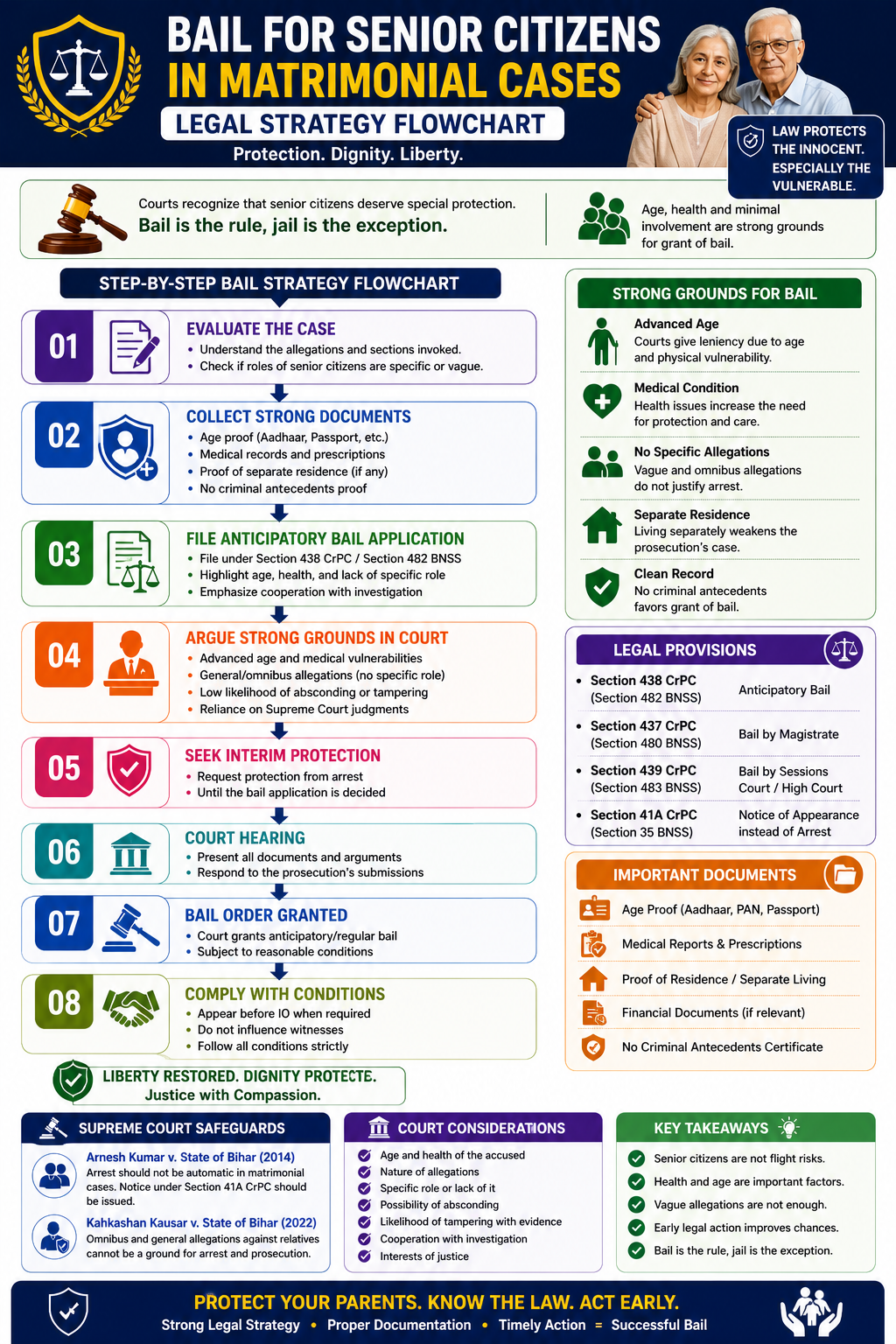
Section 498A of the Indian Penal Code deals with cruelty by husband or his relatives. Over time, this provision has become one of the most litigated sections in matrimonial disputes. However, there are several misconceptions surrounding arrest and bail in 498A cases.

Many individuals believe that arrest is automatic and bail is difficult to obtain, which is not entirely correct. Courts have introduced safeguards to prevent misuse while ensuring protection for genuine victims.

This article clarifies the common myths and legal realities regarding bail in 498A cases, along with the applicable provisions under the Code of Criminal Procedure, 1973 (CrPC) and the Bharatiya Nagarik Suraksha Sanhita, 2023 (BNSS).
Understanding Section 498A IPC

Section 498A of the Indian Penal Code
criminalizes cruelty inflicted upon a married woman by her husband or his relatives.

The offence is:

  • Cognizable
  • Non-bailable
  • Non-compoundable (subject to judicial exceptions)

Because of its serious nature, the law initially allowed immediate police action. However, judicial intervention has significantly changed how the provision operates in practice.

Myth 1: Arrest Is Automatic in 498A Cases

Reality

Arrest is not automatic in 498A cases.

The Supreme Court in
Arnesh Kumar v. State of Bihar
held that police must not make arrests in a routine manner.

Instead, police must:

  • Assess necessity of arrest
  • Record reasons for arrest
  • Issue notice of appearance

Relevant provisions:

  • Section 41A CrPC (Section 35 BNSS) – Notice of appearance
  • Section 41 CrPC (Section 35 BNSS – principles of arrest)

Therefore, if the accused cooperates, arrest can often be avoided.

Myth 2: Bail Is Not Possible in 498A Cases

Reality

Although 498A is a non-bailable offence, bail is very much possible.

The accused can seek:

  • Anticipatory Bail → Section 438 CrPC (Section 482 BNSS)
  • Regular Bail → Section 437/439 CrPC (Section 480/483 BNSS)

Courts consider:

  • Nature of allegations
  • Evidence on record
  • Role of the accused
  • Possibility of misuse

In many cases, courts grant bail, especially where allegations are exaggerated or general in nature.

Myth 3: Anticipatory Bail Is Rarely Granted

Reality

Courts regularly grant anticipatory bail in 498A cases when:

  • Allegations are vague
  • No specific role is attributed
  • The accused is cooperating

Courts also consider:

  • Age (especially elderly parents)
  • Medical condition
  • Absence of criminal history

Thus, anticipatory bail acts as a strong safeguard against unnecessary arrest.

Myth 4: All Family Members Will Be Arrested

Reality

Courts discourage the mechanical implication of all relatives.

In Kahkashan Kausar v. State of Bihar, the Supreme Court held that:

  • Vague allegations against relatives are not sufficient
  • Courts must scrutinize individual roles

Therefore, distant relatives and elderly parents often receive protection from arrest and early relief.

Myth 5: Bail Means the Case Is Over

Reality

Grant of bail does not end the case.

Bail only ensures that:

  • The accused remains free during trial
  • The accused cooperates with the investigation

The case continues through:

  • Chargesheet → Section 173 CrPC (Section 193 BNSS)
  • Trial process
  • Final judgment

Therefore, bail is a procedural safeguard, not an acquittal.

Myth 6: Police Can Deny Bail Completely

Reality

Police do not have the final authority to deny bail in non-bailable offences.

The accused can approach:

  • Magistrate Court
  • Sessions Court
  • High Court

Courts ultimately decide whether bail should be granted based on legal principles and facts of the case.

Step-by-Step Strategy to Secure Bail in 498A Cases

Step 1: Assess FIR and Allegations

Carefully examine:

  • Specific allegations
  • Role of each accused
  • Supporting evidence

Step 2: Apply for Anticipatory Bail

File application under:

  • Section 438 CrPC (Section 482 BNSS)

Seek interim protection where necessary.

Step 3: Cooperate with Investigation

Appear before police when required under:

  • Section 41A CrPC (Section 35 BNSS)

Cooperation strengthens the case for bail.

Step 4: Present Defence Material

Submit:

  • Proof of separate residence
  • Medical documents
  • Evidence contradicting allegations

Step 5: Challenge Weak Cases

If allegations are false or vague, consider:

  • Quashing petition → Section 482 CrPC (Section 528 BNSS)

Judicial Approach

Courts today follow a balanced approach:

  • Protect genuine victims
  • Prevent misuse of law

They emphasise:

  • Individual role of accused
  • Need to avoid unnecessary arrests
  • Importance of personal liberty

Conclusion

The law relating to bail in 498A cases has , thus, evolved significantly. While the offence remains serious, courts have introduced safeguards to ensure that criminal law is not misused as a tool of harassment.

In reality:

  • Arrest is not automatic
  • Bail is achievable
  • Courts carefully evaluate each case

Therefore, individuals facing 498A allegations should adopt a structured legal strategy and seek timely legal remedies.


Related Legal Concepts

  • Anticipatory Bail
  • Regular Bail
  • First Information Report(FIR)
  • Quashing of FIR
  • Non-Bailable Offence


Index of Legal Strategies and Defence is here. 


Key Contributor : 

Mrs. Suprajaa Rajan B.Com., LL.B., LL.M.

+91-9606345150

Posted in Judicial Review Legal Procedure | Tagged 498A Defence Arnesh Kumar Vs State Of Bihar and Anr False 498A case Legal Strategies and Defence Matrimonial law matrimonial offences | Leave a comment

How Courts Quash Omnibus Allegations in Matrimonial FIRs – Case Study

Posted on April 18 by Suprajaa Rajan

Introduction

In matrimonial disputes, complainants often make general and sweeping allegations against multiple family members without specifying their individual roles. These are commonly referred to as “omnibus allegations.”

However, courts have consistently held that criminal law cannot be used to implicate entire families without specific evidence. Therefore, High Courts frequently exercise their powers to quash such proceedings at an early stage.

This article explains how courts deal with omnibus allegations, supported by judicial principles and practical defence strategy under the Code of Criminal Procedure, 1973 (CrPC) and the Bharatiya Nagarik Suraksha Sanhita, 2023 (BNSS).

What Are Omnibus Allegations?

Omnibus allegations refer to:

  • Vague and generalised accusations
  • Lack of specific dates, acts, or roles
  • Naming multiple family members without distinction

For example, statements such as:

“All in-laws harassed me for dowry”

without detailing who did what, when, and how, are treated as omnibus allegations. Courts view such allegations with caution because they often indicate misuse of criminal law in matrimonial disputes.

Legal Basis for Quashing

The High Court has inherent powers to quash criminal proceedings under:

  • Section 482 CrPC (Section 528 BNSS)

The court exercises this power when:

  • The FIR does not disclose a prima facie offence
  • Allegations are vague or inherently improbable
  • Proceedings amount to abuse of process

Thus, omnibus allegations form a strong ground for seeking quashing.

Judicial Approach Toward Omnibus Allegations

Courts consistently emphasise that criminal liability must be individual and specific.

In Kahkashan Kausar v. State of Bihar, the Supreme Court held that:

  • Courts must be cautious in proceeding against relatives
  • Vague allegations without specific roles are insufficient
  • Mechanical implication of family members must be discouraged

Similarly, courts often observe that continuation of proceedings based on omnibus allegations leads to injustice.

Case Study: Quashing of FIR Against Family Members

Facts of the Case

In a typical matrimonial dispute:

  • The complainant filed an FIR alleging cruelty and harassment
  • Multiple family members, including elderly parents and distant relatives, were named
  • The complaint contained general allegations without specific acts

Legal Issue

Whether the FIR disclosed sufficient material to proceed against all accused persons.

Court’s Analysis

The High Court examined:

  • The absence of specific allegations against individual accused
  • Lack of dates, incidents, or overt acts
  • No supporting evidence indicating involvement

The court noted that the complaint relied entirely on general and sweeping statements.

Court’s Decision

The High Court exercised its inherent powers under:

  • Section 482 CrPC (Section 528 BNSS)

and held that:

  • The allegations were omnibus in nature
  • No prima facie case existed against the relatives
  • Continuation of proceedings would amount to abuse of process

Accordingly, the court quashed the FIR against the family members.

Step-by-Step Defence Strategy

Step 1: Identify Omnibus Allegations

First, carefully analyse the FIR and identify:

  • Lack of specific roles
  • General statements against multiple accused
  • Absence of supporting details

Step 2: Gather Supporting Evidence

Next, collect evidence showing:

  • Separate residence
  • Lack of interaction with the complainant
  • Absence during alleged incidents

This helps demonstrate that the allegations are false or exaggerated.

Step 3: File Petition for Quashing

You should file a petition before the High Court under:

  • Section 482 CrPC (Section 528 BNSS)

The petition should clearly highlight:

  • Vague nature of allegations
  • Absence of evidence
  • Misuse of criminal law

Step 4: Rely on Judicial Precedents

You should rely on judgments like:

  • Kahkashan Kausar v. State of Bihar
  • Arnesh Kumar v. State of Bihar

These cases strengthen the argument against mechanical implication of relatives.

Step 5: Seek Interim Protection

While the quashing petition is pending, you should seek:

  • Protection from coercive action
  • Stay on further proceedings

This ensures that the accused do not face unnecessary harassment.

Importance of Specific Allegations in Criminal Law

Criminal law requires that:

  • Each accused must have a clearly defined role
  • Allegations must be supported by evidence
  • Courts must apply judicial mind before proceeding

Therefore, omnibus allegations fail to meet the basic threshold required for criminal prosecution.

Practical Insight

Courts increasingly recognise that matrimonial disputes sometimes involve over-implication of family members.

As a result:

  • High Courts actively scrutinise FIRs
  • Relief is granted at an early stage
  • Innocent relatives are protected from prolonged litigation

Conclusion

Omnibus allegations, thus, weaken the foundation of a criminal case because they lack specificity, evidence, and credibility.

By invoking the inherent powers of the High Court under Section 482 CrPC (Section 528 BNSS), accused persons can seek early relief from false and generalised accusations.

A well-drafted quashing petition, supported by evidence and judicial precedents, ensures that criminal law is not misused as a tool of harassment.

Related Legal Concepts

  • First Information Report (FIR)
  • Quashing of FIR
  • Inherent powers of High Court
  • Anticipatory Bail
  • Prima Facie case

Index of Legal Strategies and Defence is here. 


Key Contributor : 

Mrs. Suprajaa Rajan B.Com., LL.B., LL.M.

+91-9606345150

Posted in Legal Procedure | Tagged 498A Defence Absurd Or After Thought Or Baseless Or False Or General Or Inherently Improbable Or Improved Or UnSpecific Or Omnibus Or Vague Allegations Legal Strategies and Defence Quashing of FIR | Leave a comment

When to File Defamation for False Allegations – Legal Strategy

Posted on April 11 by Suprajaa Rajan

Introduction

False allegations in matrimonial and criminal disputes can seriously damage a person’s reputation, dignity, and social standing. While individuals often focus on defending the primary case, they may overlook an important remedy—defamation proceedings.

Therefore, when allegations are false, malicious, and harm reputation, the law allows the aggrieved person to initiate defamation action. However, timing and strategy play a crucial role in ensuring success.

This article explains when to file defamation for false allegations, along with relevant provisions under the Code of Criminal Procedure, 1973 (CrPC) and the Bharatiya Nagarik Suraksha Sanhita, 2023 (BNSS).

What Constitutes Defamation?

Defamation involves making a false statement that harms the reputation of a person.

Under Indian law:

  • Section 499 IPC (to be read with Bharatiya Nyaya Sanhita, 2023) defines defamation
  • Section 500 IPC prescribes punishment

A statement amounts to defamation when:

  • It is false
  • It is made with intent or knowledge to harm reputation
  • It is communicated to a third person

Thus, not every allegation amounts to defamation—only those that are false and damaging.

Types of Defamation Remedies

You can initiate defamation proceedings in two ways:

1. Criminal Defamation

You can file a complaint before a Magistrate.

Relevant procedure:

  • Section 200 CrPC (Section 223 BNSS) – Filing of complaint before Magistrate

2. Civil Defamation

You can file a civil suit seeking damages (compensation) for reputational harm.

Both remedies can run simultaneously, depending on the strategy.

When Should You File Defamation?

Timing plays a critical role. You should not rush to file defamation immediately in every case.

1. When Allegations Are Clearly False

You should initiate defamation only when:

  • Allegations are demonstrably false
  • No supporting evidence exists
  • Statements are malicious in nature

If the matter is still under investigation, courts may advise caution.

2. After Filing of Chargesheet or Closure Report

It is often strategically advisable to wait until:

  • The police file a closure report, or
  • The chargesheet does not support the allegations

Relevant provision:

  • Section 173 CrPC (Section 193 BNSS)

At this stage, you can show that the allegations lack evidentiary support.

3. After Acquittal by Court

The strongest ground for defamation arises after acquittal.

Once the court acquits the accused, it establishes that:

  • The allegations were not proved
  • The prosecution failed to establish guilt

You can then rely on the judgment to initiate defamation proceedings effectively.

4. When False Allegations Are Made Publicly

If the complainant:

  • Publishes allegations on social media
  • Circulates defamatory statements
  • Makes public accusations

you can initiate defamation immediately, as publication is a key element.

Step-by-Step Legal Strategy

Step 1: Collect Evidence of Defamation

First, you must gather proof of:

  • False statements
  • Mode of publication
  • Harm caused to reputation

Evidence may include:

  • Social media posts
  • Emails or messages
  • Public complaints or notices

Step 2: Analyse Whether Exceptions Apply

The law provides exceptions to defamation, such as:

  • Statements made in good faith
  • Statements made for public good
  • Complaints made to lawful authorities

Therefore, you must ensure that the case does not fall within these exceptions.

Step 3: File Criminal Complaint

You can file a criminal complaint before the Magistrate under:

  • Section 200 CrPC (Section 223 BNSS)

The Magistrate may:

  • Record your statement
  • Examine witnesses
  • Issue process against the accused

Step 4: Consider Civil Suit for Damages

In addition to criminal proceedings, you may file a civil suit claiming:

  • Compensation for reputational harm
  • Damages for mental agony

This step strengthens your overall legal strategy.

Step 5: Prepare for Preliminary Evidence Stage

The Magistrate will examine whether sufficient grounds exist to proceed.

Relevant provisions:

  • Section 202 CrPC (Section 225 BNSS) – Inquiry by Magistrate

At this stage, you must present:

  • Supporting documents
  • Witness statements
  • Proof of publication

Strategic Considerations Before Filing

Before initiating defamation, you should consider:

  • Strength of evidence
  • Stage of the main criminal case
  • Possibility of settlement
  • Risk of counter-litigation

Filing defamation prematurely may weaken your case.

Judicial Approach

Courts recognise that false allegations can seriously harm reputation. At the same time, courts also protect:

  • Genuine complainants
  • Statements made in good faith

Therefore, courts strike a balance between:

  • Protecting reputation
  • Preventing misuse of defamation law

Conclusion

Defamation serves as an important legal remedy against false and malicious allegations. However, success depends on timing, evidence, and legal strategy.

You should ideally:

  • Wait for investigation outcome or acquittal
  • Collect strong documentary evidence
  • File complaint under Section 200 CrPC (Section 223 BNSS)
  • Consider both criminal and civil remedies

By adopting a strategic and evidence-based approach, you can effectively protect your reputation and seek legal redress.


Index of Legal Strategies and Defence is here. 


Key Contributor : 

Mrs. Suprajaa Rajan B.Com., LL.B., LL.M.

+91-9606345150
Posted in Legal Procedure | Tagged Criminal complaint CrPC Sec 200 or BNSS Sec 223 - Filing of complaint before Magistrate False Allegations IPC 499 - Defamation Legal Strategies and Defence Matrimonial Litigation India | Leave a comment

Judgment in Criminal Cases Explained

Posted on April 5 by Suprajaa Rajan

A judgment in a criminal case represents the final decision of the court after evaluating the evidence, hearing arguments, and applying the law. It determines whether the accused is convicted or acquitted, thereby bringing the trial to a conclusion.

The law governing criminal judgments is contained in the Code of Criminal Procedure, 1973 and corresponding provisions under the Bharatiya Nagarik Suraksha Sanhita, 2023.

The delivery of judgment ensures that the judicial process culminates in a reasoned and legally sound outcome.

Statutory Framework

The provisions relating to judgment are primarily contained in:

  • Section 353 CrPC (Section 392 BNSS) – Pronouncement of judgment
  • Section 354 CrPC (Section 393 BNSS) – Language and contents of judgment
  • Section 355 CrPC (Section 394 BNSS) – Judgment in summons cases
  • Section 357 CrPC (Section 395 BNSS) – Compensation to victims

These provisions ensure that judgments are structured, reasoned, and transparent.

Meaning and Nature of Judgment

A judgment is a formal expression of the court’s decision after trial. It reflects the court’s analysis of:

  • Facts presented during trial
  • Evidence on record
  • Legal provisions applicable to the case

The court must deliver a reasoned judgment, which explains how it arrived at its conclusion.

Essential Elements of a Criminal Judgment

Under Section 354 CrPC (Section 393 BNSS), every judgment must contain certain essential elements.

These include:

  • Points for determination
  • Decision on each point
  • Reasons for the decision
  • Relevant legal provisions
  • Final order (conviction or acquittal)

A well-reasoned judgment ensures clarity, accountability, and fairness.

Pronouncement of Judgment

The court delivers the judgment under Section 353 CrPC (Section 392 BNSS).

The court may:

  • Pronounce judgment in open court
  • Read out the operative portion
  • Provide a copy to the parties

Pronouncement in open court ensures transparency in judicial proceedings.

Types of Judgments in Criminal Cases

A criminal court may deliver different types of judgments based on the outcome of the trial.

Conviction

The court convicts the accused when the prosecution proves guilt beyond reasonable doubt.

Acquittal

The court acquits the accused when the prosecution fails to prove its case or when reasonable doubt exists.

Benefit of Doubt

If the evidence creates uncertainty, the court gives the benefit of doubt to the accused and acquits them.

Standard Applied by Courts

While delivering judgment, courts apply the principle of proof beyond reasonable doubt.

This means:

  • The prosecution must establish guilt with certainty
  • Any reasonable doubt must favour the accused

This high standard protects individuals from wrongful conviction.

Compensation to Victims

The court may award compensation to victims under:

  • Section 357 CrPC (Section 395 BNSS)

This provision enables courts to:

  • Direct payment of compensation
  • Address the harm suffered by victims

Thus, the judgment not only determines guilt but also addresses victim rights.

Importance of Reasoned Judgments

Courts must provide clear and detailed reasons in their judgments.

Reasoned judgments:

  • Enable appellate courts to review decisions
  • Ensure transparency
  • Build public confidence in the judiciary
  • Prevent arbitrary decision-making

Therefore, reasoning forms the core of judicial decision-making.

Post-Judgment Remedies

After the judgment, parties may avail legal remedies such as:

  • Appeal
  • Revision
  • Review (in limited cases)

These remedies ensure that errors can be corrected and justice is effectively administered.

Conclusion

A judgment in a criminal case, thus, represents the culmination of the entire trial process. It determines the rights and liabilities of the accused based on evidence and law.

By requiring courts to deliver reasoned and transparent decisions, the law, therefore, ensures that justice is not only done but is also seen to be done.


Related Legal Concepts

Understand the stages leading up to judgment in a criminal case:

  • First Information Report (FIR)
  • Police Investigation
  • Charge Sheet and Final Report
  • Framing of Charges
  • Criminal Trial Procedure


Index of Law Concepts explained here.


Key Contributor :

Mrs. Suprajaa Rajan B.Com., LL.B., LL.M.

+91-9606345150



Posted in Legal Procedure | Tagged Code of Criminal Procedure Criminal law in India CrPC Sec 353 - Pronouncement of Judgement CrPC Sec 354 - Language and contents of judgment Law Concepts explained | Leave a comment

Life Cycle Stages of a Child Custody / Visitation Case

Posted on April 4 by Suprajaa Rajan

A Step-by-Step Guide to Custody Proceedings Under Indian Law

Understanding the procedural journey of a child custody or visitation case helps parents protect the best interests of the child while navigating court proceedings effectively.

Child custody disputes arise when parents disagree on the care, control, and upbringing of a minor child. Indian courts decide such matters based on the welfare and best interests of the child, which remains the paramount consideration.

Custody and visitation matters are governed primarily by the Hindu Minority and Guardianship Act, 1956, the Guardians and Wards Act, 1890, and relevant provisions of procedural law under the Code of Civil Procedure, 1908, along with certain applicable provisions of the Code of Criminal Procedure, 1973 (CrPC) and the Bharatiya Nagarik Suraksha Sanhita, 2023 (BNSS).

The following stages explain the complete life cycle of a child custody or visitation case.

1. Legal Foundation of Child Custody Law

First, it is important to understand the legal framework governing custody disputes.

Courts decide custody matters under the Guardians and Wards Act, 1890, and personal laws applicable to the parties. However, the court always prioritises the welfare of the child over the rights of the parents.

Additionally, in urgent situations, a parent may seek interim protection or custody through procedural provisions. For instance, a party may invoke interim relief mechanisms similar to those under Section 97 CrPC / Section 104 BNSS, where applicable.

Therefore, courts adopt a child-centric approach while deciding custody and visitation matters.

2. Stage One: Dispute Between Parents Regarding Custody

Typically, a custody dispute arises when parents separate or initiate matrimonial proceedings.

For example, disputes often arise during divorce, judicial separation, or domestic conflicts. One parent may retain custody of the child, while the other parent may seek custody or visitation rights.

At this stage, the parties may attempt informal resolution or family mediation. However, if the dispute continues, the aggrieved parent may approach the court.

3. Stage Two: Filing of Custody Petition Before Court

If the dispute remains unresolved, the aggrieved parent files a custody or guardianship petition before the competent Family Court or District Court.

The petition includes details of the child, relationship between parties, and the relief sought. The petitioner may seek permanent custody, joint custody, or visitation rights.

Additionally, the petitioner may file an application for interim custody or visitation.

After filing, the court registers the case and issues notice to the respondent parent.

4. Stage Three: Service of Notice and Appearance of Respondent

Next, the court ensures that the respondent receives proper notice of the proceedings.

The notice specifies the date of hearing and directs the respondent to appear before the court.

The respondent may appear personally or through legal counsel. If the respondent fails to appear, the court may proceed ex parte.

Proper service of notice ensures compliance with principles of natural justice.

5. Stage Four: Filing of Reply and Counter-Claims

After receiving notice, the respondent files a written statement or reply to the petition.

The respondent may oppose the claim for custody or propose alternative arrangements such as shared custody or limited visitation.

In some cases, the respondent may also file counter-claims seeking custody or enhanced visitation rights.

This stage helps the court identify the issues in dispute.

6. Stage Five: Interim Custody and Visitation Orders

Since custody matters involve immediate welfare concerns, courts often pass interim orders at an early stage.

For instance, the court may grant temporary custody to one parent and visitation rights to the other parent.

In urgent situations, a parent may also seek immediate production of the child through remedies similar to Section 97 CrPC / Section 104 BNSS, where unlawful detention is alleged.

The court considers factors such as age of the child, emotional needs, and stability before granting interim relief.

These interim orders remain effective during the pendency of the case.

7. Stage Six: Mediation and Counseling

Subsequently, the court may refer the parties to mediation or counseling.

Family Courts actively encourage amicable settlement in custody disputes. Mediation helps parents arrive at mutually acceptable arrangements for custody and visitation.

Additionally, courts may interact with the child to understand the child’s preferences.

If mediation succeeds, the parties record a settlement before the court. If mediation fails, the case proceeds to trial.

8. Stage Seven: Framing of Issues

If disputes persist, the court frames issues for determination.

These issues may include questions such as which parent can better ensure the welfare of the child and whether visitation rights should be granted.

Framing of issues helps structure the trial and focus on relevant questions.

9. Stage Eight: Evidence and Examination

At this stage, both parties present evidence to support their claims.

For example, parties may produce documents relating to income, living conditions, and educational background. Witnesses may testify regarding the child’s upbringing and parental conduct.

The court may also consider expert reports from child psychologists or welfare officers.

Additionally, the court may interact with the child, depending on the child’s age and maturity.

The opposing party has the right to cross-examine witnesses.

10. Stage Nine: Final Arguments

After completion of evidence, both parties present final arguments before the court.

Each party attempts to demonstrate that their custody arrangement serves the best interests of the child.

The court carefully evaluates all evidence, statutory provisions, and judicial precedents.

The welfare of the child remains the overriding consideration at this stage.

11. Stage Ten: Judgment and Final Custody Order

Finally, the court delivers its judgment after considering all aspects of the case.

The court may grant sole custody, joint custody, or structured visitation rights.

The order may also include directions regarding education, healthcare, and overall welfare of the child.

The court ensures that the final order promotes the child’s physical, emotional, and psychological well-being.

12. Enforcement of Custody and Visitation Orders

After passing the order, both parties must comply with the court’s directions.

If one parent violates the custody or visitation order, the aggrieved parent may approach the court for enforcement.

In appropriate cases, courts may invoke coercive measures. For instance, the court may direct production of the child through mechanisms similar to Section 97 CrPC / Section 104 BNSS, where applicable.

Courts may also modify orders to ensure compliance and protect the child’s welfare.

13. Modification and Appeal

Child custody orders are not final in the strict sense because circumstances may change over time.

Therefore, either parent may seek modification of custody or visitation arrangements if circumstances materially change.

Additionally, an aggrieved party may file an appeal before a higher court challenging the custody order.

The appellate court reviews whether the lower court correctly applied the principle of welfare of the child.

Conclusion

Child custody and visitation cases require careful judicial balancing of parental rights and the welfare of the child. Therefore, courts follow a structured process that includes interim relief, mediation, evidence, and final adjudication.

Understanding the life cycle of a custody case helps parents approach the process with clarity and responsibility. Ultimately, the law ensures that every decision prioritises the best interests and well-being of the child.


Other Life Cycles: DV Case Lifecycle || Maintenance Case u/s 125 CrPC Lifecycle. Index is here.


Key Contributor :
Mrs. Suprajaa Rajan B.Com., LL.B., LL.M.
+91-9606345150


Posted in Legal Procedure | Tagged child custody law Life Cycle stages of a child custody case Matrimonial Criminal Law Matrimonial dispute Matrimonial Litigation India | Leave a comment

Defence Strategy When Elderly Parents Are Named in FIR

Posted on April 3 by Suprajaa Rajan

In matrimonial and family disputes, complainants often name multiple family members, including elderly parents, in a First Information Report (FIR). However, courts have consistently cautioned against the mechanical implication of relatives without specific allegations.

Therefore, when an FIR includes elderly parents, you must adopt a focused legal defence strategy. You should highlight the absence of direct involvement, lack of evidence, and misuse of criminal law provisions.

This article explains the legal remedies and defence strategies available when elderly parents are falsely implicated, along with relevant provisions under the Code of Criminal Procedure, 1973 (CrPC) and the Bharatiya Nagarik Suraksha Sanhita, 2023 (BNSS).

Understanding the Legal Position

The police register an FIR under Section 154 CrPC (Section 173 BNSS) when they receive information about a cognizable offence. After registration, the investigation begins, and all named persons may face legal scrutiny.

However, courts do not rely solely on allegations. Instead, they examine:

  • Specific acts attributed to each accused
  • Supporting evidence
  • The individual role of each person

In many cases, complaints contain general and vague allegations against elderly parents, which you can challenge at an early stage.

Step 1: Analyse the FIR Carefully

First, you must carefully examine the FIR. A strong defence always begins with identifying weaknesses in the complaint.

You should check:

  • Whether the FIR contains specific allegations
  • Whether it mentions dates, events, or overt acts
  • Whether allegations appear vague or omnibus

If the complaint lacks specificity, you can argue that it fails to disclose a prima facie case against elderly parents.

Step 2: Seek Protection from Arrest

Next, you should promptly seek protection from arrest by filing an anticipatory bail application.

You can file this application under:

  • Section 438 CrPC (Section 482 BNSS)

Courts generally adopt a lenient approach toward elderly parents, especially when:

  • They reside separately
  • They have no direct involvement
  • The allegations appear exaggerated

Additionally, courts consider age, health, and dependency factors while granting relief.

Step 3: Rely on Safeguards Against Arbitrary Arrest

You should also rely on statutory safeguards that prevent unnecessary arrests.

The police must issue a notice of appearance under:

  • Section 41A CrPC (Section 35 BNSS)

instead of making immediate arrests when the accused cooperates with the investigation.

Further, the Supreme Court in
Arnesh Kumar v. State of Bihar
directed authorities to avoid automatic arrests in matrimonial offences.

Therefore, elderly parents can use these safeguards to prevent unjustified detention and harassment.

Step 4: Gather Evidence Showing Lack of Involvement

After securing protection, you should collect evidence that demonstrates the absence of involvement.

You should gather:

  • Proof of separate residence
  • Medical records indicating age-related limitations
  • Travel records
  • Independent witness statements

This evidence helps establish that the allegations are false, exaggerated, or legally unsustainable.

Step 5: File for Quashing of FIR

If the FIR clearly lacks specific allegations, you should approach the High Court to quash the proceedings.

You can invoke:

  • Section 482 CrPC (Section 528 BNSS)

The High Court may quash proceedings when:

  • Allegations are vague or omnibus
  • No specific role is attributed
  • Continuation of proceedings amounts to abuse of process

Courts frequently grant relief to elderly parents in such circumstances.

Step 6: Seek Discharge at Chargesheet Stage

If the police file a chargesheet, you should consider filing a discharge application.

Relevant provisions include:

  • Section 239 CrPC (Section 263 BNSS) – Warrant cases
  • Section 227 CrPC (Section 250 BNSS) – Sessions cases

You can argue that:

  • No evidence exists against elderly parents
  • The chargesheet fails to establish involvement
  • The case relies on assumptions rather than proof

If the court agrees, it may discharge the accused at this stage.

Step 7: Challenge Mechanical Implication of Relatives

Courts consistently discourage the practice of implicating all family members without distinction.

Therefore, you should emphasize:

  • Absence of specific allegations
  • Lack of direct interaction with the complainant
  • No supporting evidence

This approach aligns with judicial principles that prevent misuse of criminal law in matrimonial disputes.

Step 8: Maintain a Consistent Defence Strategy

Finally, you must maintain a consistent and structured defence throughout the proceedings.

You should:

  • Avoid contradictory statements
  • Cooperate with the investigation
  • Present documentary evidence at each stage

A consistent defence strengthens credibility and improves the chances of relief.

Judicial Approach

Courts recognise that false implication of elderly parents can lead to serious injustice and misuse of the legal process.

Therefore, courts often:

  • Grant anticipatory bail
  • Quash proceedings where appropriate
  • Discharge accused in absence of evidence

This balanced approach ensures that only genuine cases proceed to trial.

Conclusion

When elderly parents are named in an FIR, the law provides multiple safeguards to protect them from unjust prosecution.

You should:

  • Analyse the FIR thoroughly
  • Seek anticipatory bail under Section 438 CrPC (Section 482 BNSS)
  • Invoke High Court powers under Section 482 CrPC (Section 528 BNSS)
  • File for discharge under Section 239/227 CrPC (Section 263/250 BNSS)

By adopting a structured legal strategy, you can effectively challenge false allegations and protect innocent family members.


Index of Legal Strategies and Defence is here.


Related Legal Concepts

Explore related stages and concepts in criminal procedure:

  • First Information Report 
  • Anticipatory Bail
  • Quashing of FIR
  • Discharge of an accused
  • Inherent powers of High Court


Key Contributor :
Mrs. Suprajaa Rajan B.Com., LL.B., LL.M.
+91-9606345150


Posted in Legal Procedure | Tagged 498A defence strategy BNSS Code of Criminal Procedure CrPC 239 - Discharge CrPC 438 - Anticipatory Bail Legal Strategies and Defence | Leave a comment

Interim Bail Application Format – Draft, Procedure & Sample Template

Posted on March 31 by Suprajaa Rajan

Interim Bail Application Format – Draft, Procedure & Sample Template

In criminal proceedings, there are situations where an accused requires immediate but temporary relief from custody. In such cases, an interim bail application becomes an important legal remedy. Unlike regular bail, interim bail is granted for a short, specific period, often pending final hearing of bail or due to urgent circumstances.

Therefore, understanding how to draft an effective interim bail application is crucial for both litigants and legal practitioners.

This article explains the legal framework, key considerations, and provides a ready-to-use draft format with copy-to-clipboard functionality.

I. What is Interim Bail?

Interim bail refers to temporary release from custody granted for a limited duration, usually:

  • Pending disposal of anticipatory bail application (Section 438 CrPC)

  • Pending hearing of regular bail application (Sections 437/439 CrPC)

  • On humanitarian grounds (medical emergency, family crisis, etc.)

Although the Code of Criminal Procedure, 1973 does not expressly define interim bail, courts exercise their inherent and discretionary powers to grant such relief.

II. Corresponding Provisions under BNSS, 2023

Under the Bharatiya Nagarik Suraksha Sanhita, 2023 (BNSS):

  • Section 482 BNSS – corresponds to Section 438 CrPC (anticipatory bail)

  • Section 480 BNSS – corresponds to Section 437 CrPC (bail by Magistrate)

  • Section 483 BNSS – corresponds to Section 439 CrPC (bail by Sessions/High Court)

Thus, interim bail is granted within the framework of these provisions, depending on the stage of the case.

III. When Can Interim Bail Be Filed?

An interim bail application may be filed in situations such as:

  • When anticipatory bail is pending for hearing

  • When the accused needs temporary relief before regular bail is decided

  • In cases involving medical emergencies

  • For family obligations (marriage, funeral, etc.)

  • When immediate custody is not necessary

Therefore, interim bail acts as a short-term protection of liberty.

IV. Key Factors Considered by Courts

While granting interim bail, courts consider:

  • Urgency of the situation

  • Nature of allegations

  • Conduct of the accused

  • Need for custodial interrogation

  • Possibility of misuse of liberty

Consequently, the application must clearly demonstrate urgency and bona fide intent.

V. Essential Elements of an Interim Bail Application

Before drafting, you should include:

  • Details of FIR and sections invoked

  • Current stage of proceedings

  • Specific reason for seeking interim relief

  • Duration for which bail is sought

  • Undertaking to cooperate with investigation

  • Assurance not to tamper with evidence

These elements help establish credibility and necessity of interim relief.

VI. Drafting Strategy

While drafting an interim bail application:

  • Focus on urgency and necessity

  • Keep the application short and precise

  • Avoid detailed merits of the case

  • Clearly mention time period requested

  • Maintain a respectful tone

Unlike regular bail, interim bail depends heavily on immediate circumstances.

VII. Sample Draft Format – Interim Bail Application


Sample Draft – Interim Bail Application

BEFORE THE HONOURABLE COURT OF [COURT NAME] AT [CITY]

Criminal Application No.: [____]

In the matter of:

[Name of Applicant]
…Applicant

Versus

State of [State]
…Respondent


APPLICATION FOR GRANT OF INTERIM BAIL

Most Respectfully Submitted:

1. That the Applicant has been implicated in FIR No. [____] registered at [Police Station] for offences alleged under Sections [____].

2. That the Applicant is seeking interim bail pending disposal of the main bail application.

3. That the present application is being filed due to urgent circumstances, namely [mention reason – medical emergency/family function/other].

4. That the Applicant is a law-abiding citizen and has no intention to abscond or evade the process of law.

5. That the Applicant undertakes to cooperate with the investigation and appear before the authorities as and when required.

6. That the Applicant undertakes not to tamper with evidence or influence any witnesses.

7. That the Applicant seeks interim bail for a limited period of [number of days].

PRAYER

In view of the above, it is most respectfully prayed that this Hon’ble Court may be pleased to grant interim bail to the Applicant for a limited period in the interest of justice.


Place: [City]
Date: [Date]


Counsel for the Applicant
[Signature]

✔ Draft Copied Successfully!

VIII. Common Mistakes to Avoid

Avoid the following while filing interim bail:

  • Not specifying urgent reason

  • Seeking vague or indefinite time period

  • Arguing full merits of the case

  • Failing to provide undertakings

Instead, focus on clarity, urgency, and limited relief.

Conclusion

Interim bail serves as an important temporary safeguard of personal liberty in urgent situations. Therefore, a well-drafted application can ensure timely relief while maintaining compliance with legal procedure.

By clearly presenting urgency, duration, and willingness to cooperate, applicants can effectively seek interim protection from custody.


Index of Legal Templates and Drafting is here.


Disclaimer

These templates are provided for educational and informational purposes. Every case depends on specific facts and procedural posture. Professional legal advice should be obtained before filing any application.


Related Legal Concepts

Explore related stages and concepts in criminal procedure:

  • Cancellation of bail
  • Bail conditions
  • Difference between bail, interim bail and anticipatory bail
  • Discretionary Powers of Courts
  • Doctrine of Personal Liberty

Key Contributor :

Mrs. Suprajaa Rajan B.Com., LL.B., LL.M.

+91-9606345150


Posted in Legal Procedure | Tagged CrPC bail format Interim Bail interim bail application Legal templates and drafting | Leave a comment

Post navigation

  • Older posts
  • Newer posts

Search within entire Content of “Shades of Knife”

My Legal X Timeline

Advocate Sandeep Pamarati 🇮🇳💪👨🏻‍🎓 Follow

AP High Court Advocate with M Tech (CS) || 12 years in 'Software Industry' as Solution Architect || Blogs at https://t.co/29CB9BzK4w || #TDPTwitter

SandeepPamarati
Retweet on Twitter Advocate Sandeep Pamarati 🇮🇳💪👨🏻‍🎓 Retweeted
vipintalwar vipin talwar @vipintalwar ·
17h

Adani's Green Transformation Is Visible from the Ground Up

Tree plantation drives are common. Achieving an 88% survival rate is not.

At PEKB, the high survival rate means the restoration is not just happening on paper... it's creating real forests, real biodiversity, and real

Reply on Twitter 2065309482964697362 Retweet on Twitter 2065309482964697362 58 Like on Twitter 2065309482964697362 58 X 2065309482964697362
Retweet on Twitter Advocate Sandeep Pamarati 🇮🇳💪👨🏻‍🎓 Retweeted
ratansharda55 Ratan Sharda 🇮🇳 रतन शारदा @ratansharda55 ·
11h

Bravo @navikakumar

Reply on Twitter 2065395655284338898 Retweet on Twitter 2065395655284338898 78 Like on Twitter 2065395655284338898 321 X 2065395655284338898
Retweet on Twitter Advocate Sandeep Pamarati 🇮🇳💪👨🏻‍🎓 Retweeted
hindujagrutiorg HinduJagrutiOrg @hindujagrutiorg ·
19h

Amazon Insults Aryabhata

Aryabhata gave the world ZERO.
Amazon gave him ZERO respect.

Turning Bharat's greatest mathematician into a marketing prop for "zero fees" is not creativity, it's cultural insult.

@amazonIN Apologise. Withdraw the ad. Respect India's civilisational

Reply on Twitter 2065269861383835852 Retweet on Twitter 2065269861383835852 343 Like on Twitter 2065269861383835852 414 X 2065269861383835852
Retweet on Twitter Advocate Sandeep Pamarati 🇮🇳💪👨🏻‍🎓 Retweeted
its_the_dr Johnny Midnight ⚡️ @its_the_dr ·
21h

That’s so true! George Carlin.

Reply on Twitter 2065238521929953768 Retweet on Twitter 2065238521929953768 162 Like on Twitter 2065238521929953768 503 X 2065238521929953768
Load More

Recent Posts

  • Cruelty as a Criminal Offence Explained June 12, 2026
  • Bail Compliance Undertaking Format – Draft, Legal Requirements & Sample Template June 12, 2026
  • Warning Signs of Escalating Matrimonial Litigation – Early Red Flags Every Spouse Should Recognize June 12, 2026
  • Objections a Defence Advocate Can Raise When the Prosecution Produces Documentary Evidence – Complete Trial Strategy Guide June 5, 2026
  • How to File a Complaint Against an Advocate in India – A First-Timer’s Complete Guide June 5, 2026

Most Read Posts

  • Reply to Section 41A CrPC Notice – Format with Legal Explanation (4,894 views)
  • Anu Aggarwal Vs Sushant Aggarwal on 20 Jan 2026 (3,419 views)
  • Umme Farva Vs State of U.P. and Anr on 14 Jan 2026 (3,275 views)
  • Charge Sheet and Final Report Explained (2,702 views)
  • Regular Bail Application Format (Section 437/439 CrPC) (2,097 views)
  • Neha Lal Vs Abhishek Kumar on 20 Jan 2026 (1,938 views)
  • Arrest Procedure in 498A cases after Arnesh Kumar (1,862 views)
  • Discharge Application Format in 498A Case – Draft, Procedure & Sample Template (1,694 views)
  • Can You Travel Abroad After an FIR Is Registered? – Legal Position Explained (1,602 views)
  • Atul Kumar Bajpai Vs State of UP and Anr on 17 Sep 2025 (1,492 views)

Tags

Reportable Judgement or Order (433)2-Judge (Division) Bench Decision (411)Legal Procedure Explained - Interpretation of Statutes (381)Landmark Case (381)1-Judge Bench Decision (362)Catena of Landmark Judgments Referred/Cited to (293)Work-In-Progress Article (215)3-Judge (Full) Bench Decision (101)Sandeep Pamarati (92)Article 21 - Protection of life and personal liberty (80)Issued or Recommended Guidelines or Directions or Protocols to be followed (71)Perjury Under 340 CrPC (66)Absurd Or After Thought Or Baseless Or False Or General Or Inherently Improbable Or Improved Or UnSpecific Or Omnibus Or Vague Allegations (61)Reprimands or Setbacks to YCP Govt of Andhra Pradesh (49)Summary Post (47)CrPC 482 - Quash (43)HM Act 13 - Divorce Granted to Husband (42)Legal Terrorism (41)Not Authentic copy hence to be replaced (40)Divorce granted on Cruelty ground (40)

Categories

Supreme Court of India Judgment or Order or Notification (752)Bare Acts or State Amendments or Statutes or GOs or Notifications issued by Central or State Governments (328)High Court of Andhra Pradesh Judgment or Order or Notification (186)High Court of Delhi Judgment or Order or Notification (164)High Court of Bombay Judgment or Order or Notification (112)High Court of Karnataka Judgment or Order or Notification (93)Legal Procedure (77)High Court of Madras Judgment or Order or Notification (70)High Court of Allahabad Judgment or Order or Notification (61)LLB Study Material (59)General Study Material (56)High Court of Punjab & Haryana Judgment or Order or Notification (52)Assorted Court Judgments or Orders or Notifications (50)High Court of Kerala Judgment or Order or Notification (46)Prakasam DV Cases (46)Judicial Activism (for Public Benefit) (45)District or Sessions or Magistrate Court Judgment or Order or Notification (44)High Court of Madhya Pradesh Judgment or Order or Notification (38)High Court of Gujarat Judgment or Order or Notification (28)High Court of Calcutta Judgment or Order or Notification (27)

Recent Comments

  • The Divorce Law Firm on Life Cycle Stages of a Divorce case
  • The Divorce Law Firm on Life Cycle Stages of a Divorce case
  • ShadesOfKnife on Sandeep Pamarati Vs Ungrateful Knife (IPC 498A Case)
  • KONURU VINAYKUMAR on Sandeep Pamarati Vs Ungrateful Knife (IPC 498A Case)
  • ShadesOfKnife on Lifecycle Stages of a Section 498A IPC Case

Archives of SoK

  • June 2026 (7)
  • May 2026 (24)
  • April 2026 (33)
  • March 2026 (42)
  • February 2026 (30)
  • January 2026 (21)
  • December 2025 (2)
  • November 2025 (3)
  • October 2025 (17)
  • September 2025 (12)
  • August 2025 (5)
  • July 2025 (10)
  • June 2025 (15)
  • May 2025 (3)
  • April 2025 (10)
  • March 2025 (7)
  • February 2025 (8)
  • January 2025 (1)
  • December 2024 (3)
  • November 2024 (4)
  • October 2024 (16)
  • September 2024 (15)
  • August 2024 (14)
  • July 2024 (11)
  • June 2024 (18)
  • May 2024 (13)
  • April 2024 (9)
  • March 2024 (23)
  • February 2024 (15)
  • January 2024 (11)
  • December 2023 (11)
  • November 2023 (9)
  • October 2023 (13)
  • September 2023 (12)
  • August 2023 (15)
  • July 2023 (17)
  • June 2023 (11)
  • May 2023 (6)
  • April 2023 (5)
  • March 2023 (10)
  • February 2023 (9)
  • January 2023 (12)
  • December 2022 (12)
  • November 2022 (8)
  • October 2022 (13)
  • September 2022 (17)
  • August 2022 (10)
  • July 2022 (21)
  • June 2022 (27)
  • May 2022 (23)
  • April 2022 (32)
  • March 2022 (17)
  • February 2022 (6)
  • January 2022 (2)
  • December 2021 (7)
  • November 2021 (7)
  • October 2021 (6)
  • September 2021 (10)
  • August 2021 (31)
  • July 2021 (45)
  • June 2021 (17)
  • May 2021 (17)
  • April 2021 (18)
  • March 2021 (58)
  • February 2021 (14)
  • January 2021 (50)
  • December 2020 (35)
  • November 2020 (68)
  • October 2020 (67)
  • September 2020 (28)
  • August 2020 (41)
  • July 2020 (20)
  • June 2020 (36)
  • May 2020 (40)
  • April 2020 (38)
  • March 2020 (26)
  • February 2020 (43)
  • January 2020 (35)
  • December 2019 (34)
  • November 2019 (4)
  • October 2019 (18)
  • September 2019 (57)
  • August 2019 (33)
  • July 2019 (12)
  • June 2019 (18)
  • May 2019 (5)
  • April 2019 (19)
  • March 2019 (58)
  • February 2019 (11)
  • January 2019 (90)
  • December 2018 (97)
  • November 2018 (43)
  • October 2018 (31)
  • September 2018 (73)
  • August 2018 (47)
  • July 2018 (143)
  • June 2018 (92)
  • May 2018 (97)
  • April 2018 (59)
  • March 2018 (8)

Blogroll

  • Daaman Promoting Harmony 0
  • Fight against Legal Terrorism Fight against Legal Terrorism along with MyNation Foundation 0
  • Good Morning Good Morning News 0
  • Insaaf India Insaaf Awareness Movement 0
  • MyNation Hope Foundation Wiki 0
  • MyNation.net Equality, Justice and Harmony 0
  • Sarvepalli Legal 0
  • Save Indian Family Save Indian Family Movement 0
  • SIF Chandigarh SIF Chandigarh 0
  • The Male Factor The Male Factor 0
  • Unitedmen Foundation a dedicated community forged with the mission to unite men facing legal challenges in marital disputes. 0
  • Vaastav Foundation The Social Reality 0
  • Vinayak my2centsworth – This blog is for honest law abiding men, married or planning to get married 0
  • Voice4india Indian Laws, Non-profits, Environment 0
  • Writing Law Writing Law by Ankur 0

RSS Cloudflare Status

  • Scheduled Workers Platform Configuration Maintenance June 22, 2026
    THIS IS A SCHEDULED EVENT Jun 22, 12:00 - 13:00 UTC Jun 10, 20:16 UTC Scheduled - On 2026-06-22 from 12:00-13:00 UTC, Cloudflare will be performing scheduled maintenance on the data store responsible for Workers platform configuration. During this maintenance window, customers will be unable to make configuration changes for up to 3 minutes. This […]
  • Zero Trust Underlying Storage Maintenance June 18, 2026
    THIS IS A SCHEDULED EVENT Jun 18, 12:00 - 13:00 UTC Jun 12, 00:38 UTC Scheduled - Cloudflare has scheduled maintenance for the backend storage system supporting Cloudflare One Client (WARP) / Zero Trust device management. Services will continue to operate normally. During a brief window of up to 3 minutes, device-related settings will be […]
  • ICN (Seoul) on 2026-06-17 June 17, 2026
    THIS IS A SCHEDULED EVENT Jun 17, 17:00 - 22:00 UTC Jun 4, 13:40 UTC Scheduled - We will be performing scheduled maintenance in ICN (Seoul) datacenter on 2026-06-17 between 17:00 and 22:00 UTC.Traffic might be re-routed from this location, hence there is a possibility of a slight increase in latency during this maintenance window […]

RSS List of Spam Server IPs from Project Honeypot

  • 34.182.239.50 | SD June 12, 2026
    Event: Bad Event | Total: 4 | First: 2026-06-12 | Last: 2026-06-12
  • 35.185.163.241 | SD June 12, 2026
    Event: Bad Event | Total: 6 | First: 2026-06-12 | Last: 2026-06-12
  • 77.68.12.172 | S June 12, 2026
    Event: Bad Event | Total: 4 | First: 2026-06-12 | Last: 2026-06-12
Owned and Operated by Advocate Sandeep Pamarati
Proudly powered by WordPress
Theme: Flint by Star Verte LLC

Bad Behavior has blocked 588 access attempts in the last 7 days.

pixel